By BRUCE SCHREINERUpdated 2:32 PM CDT, September 18, 2024Share
FRANKFORT, Ky. (AP) — Democratic Gov. Andy Beshear banned the use of “conversion therapy” on minors in Kentucky on Wednesday, calling his executive order a necessary step to protect children from a widely discredited practice that tries to change a person’s sexual orientation or gender identity through counseling.
The governor used his executive powers after Republicans who control the state legislature repeatedly blocked efforts to enact a state law banning the practice. Beshear said he would no longer wait for others to “do what’s right.”
“My faith teaches me that all children are children of God,” Beshear said during the signing ceremony at the Kentucky Capitol. “And where practices are endangering and even harming those children, we must act. The practice of so-called ‘conversion therapy’ hurts our children.”
The former president’s debunked comments that Haitian immigrants are eating household pets in Springfield, Ohio, is just the latest in a long history of smears against them, experts say.
Call it a mother’s intuition. After former President Donald Trump repeated a vicious smear about Haitians in Springfield, Ohio, during his September 10 debate with Vice President Kamala Harris, many parents in that community instinctively kept their children home from school. They were right to be concerned. In the days following Trump remarking on national television that these immigrants are eating household pets — a debunked rumor that first spread on social media — the threats rolled in.
The bomb and mass shooting threats that started shortly after the debate and continued through the weekend forced evacuations and closures of government buildings, hospitals, a university and schools in Springfield. Although Trump’s words have imperiled Haitian immigrants, he has not withdrawn his claim; he has doubled down on it. On Thursday, while campaigning, he suggested Haitians had ruined “beautiful Springfield” and were not in the city legally, although Ohio Gov. Mike DeWine said they are living and working there lawfully. Trump also insinuated the immigrants are involved in sexual violence against “young American girls,” continuing his pattern of linking immigration to the predation of White women and girls.
The targeting of Haitians in the smalltown Midwest has led to an outcry of support from the public, policymakers and immigration advocates. The National Parents Union, a woman-led organization made up of parent advocacy groups fighting for equity in education, criticized “the reckless and irresponsible comments” from Republican leaders and announced that it “stand[s] with the families of Springfield” in a statement on Friday.
But no one empathizes with Springfield’s Haitian community like Haitian Americans themselves, they say. The 19th spoke with scholars and immigrant advocates, mostly women of Haitian heritage, about the repercussions of Trump’s words. They contend that his claim — and the hate before and after it — are nothing new: Due to the unique ways race, religion and resistance have intersected in Haiti’s history, immigrants from the Caribbean nation have experienced a specific brand of xenophobia in the United States, even as Black immigrants in this country lack visibility.
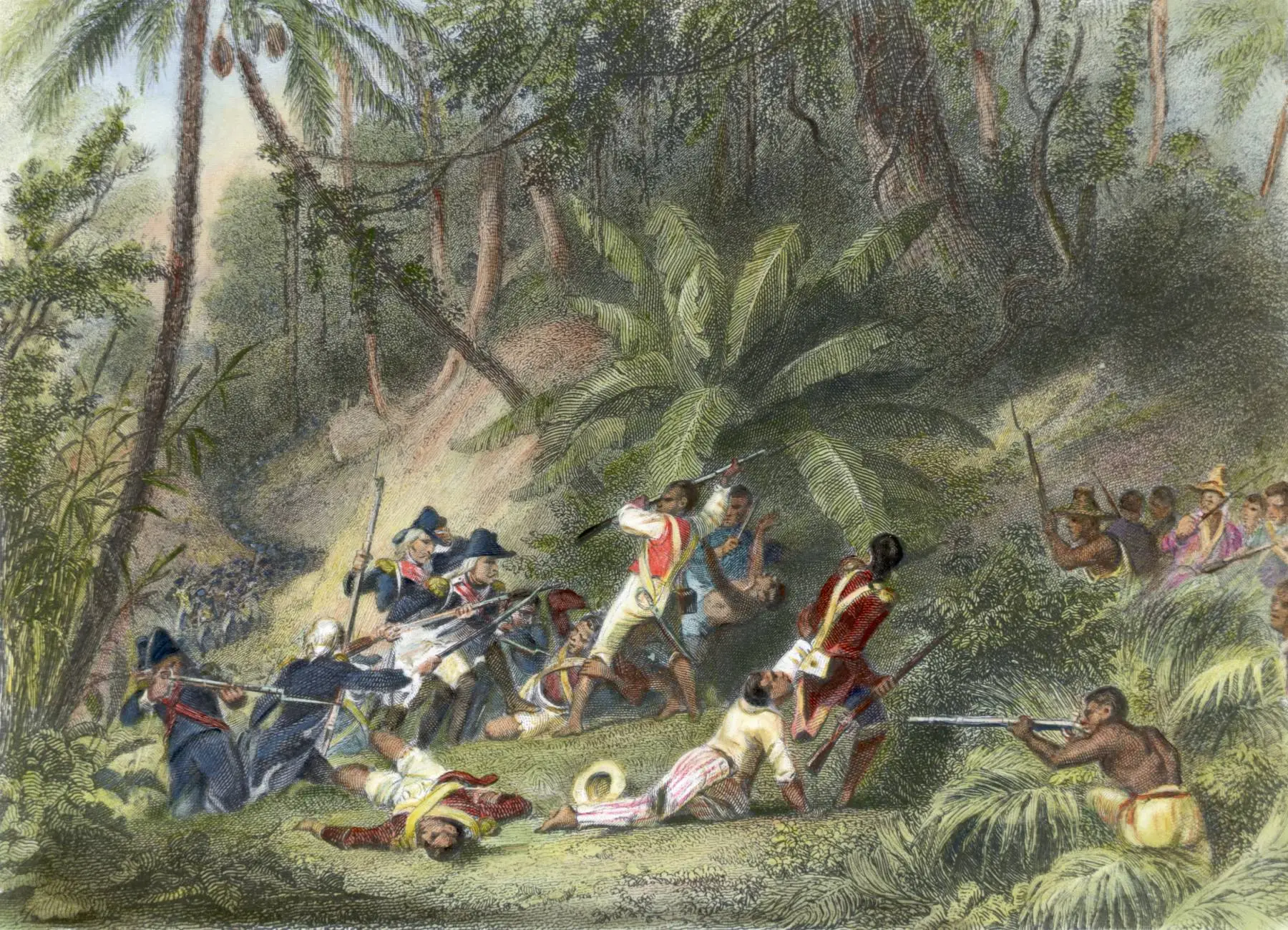
“This kind of narrative has been going on since at least the middle of the 19th century,” said Danielle N. Boaz, professor of Africana Studies at the University of North Carolina at Charlotte. “We can connect all of this back to the thing that Haitians did that was unforgivable to people of European heritage, which is they had this . . . rebellion that started in the 1790s and culminated in what historians have sometimes called the only successful slave rebellion in history, where they were able to defeat not only the French but other foreign powers.”
Illustration depicting Francois Dominique Toussaint L’Ouverture participating in the successful revolt against French power in St. Dominique (Haiti). Hand-colored engraving. Bettman/Getty
The 1804 creation of Saint-Domingue, later Haiti, left slaveholding societies terrified that the human beings they held in bondage would also rebel. For securing their freedom, Haitians were demonized, with the Vodou religion often used to make wild claims against them, Boaz said.
“So, over the years, the narrative just kind of increases about how Haiti is this barbaric place,” she said. “It’s run only by Black people.”
Trump reinforced the barbarism messaging by implying Thursday that Haitians are “savage criminal aliens.”
Despite Springfield Police denying any “credible reports or specific claims” of Haitians abusing animals or committing other crimes, Trump’s allegations have reverberated nationally. Christopher Rufo, who has led the national push against critical race theory in schools and is a trustee for the New College of Florida, where hundreds of books on gender and diversity were discarded last month, offered a $5,000 “bounty” to anyone with evidence of Haitian immigrants in Springfield eating cats. In Florida and New York — the states with the largest Haitian-American communities — Haitian-American leaders condemned Trump’s remarks and similar statements by his running mate, Sen. JD Vance of Ohio.
The bomb and shooting threats targeting Haitians disproportionately place pressure on mothers, said Taisha Saintil, senior policy analyst for the UndocuBlack Network, which advocates for Black immigrants. Often children’s primary caregivers, women rearrange work schedules, stay home or make childcare plans when schools close, losing household income in the process.
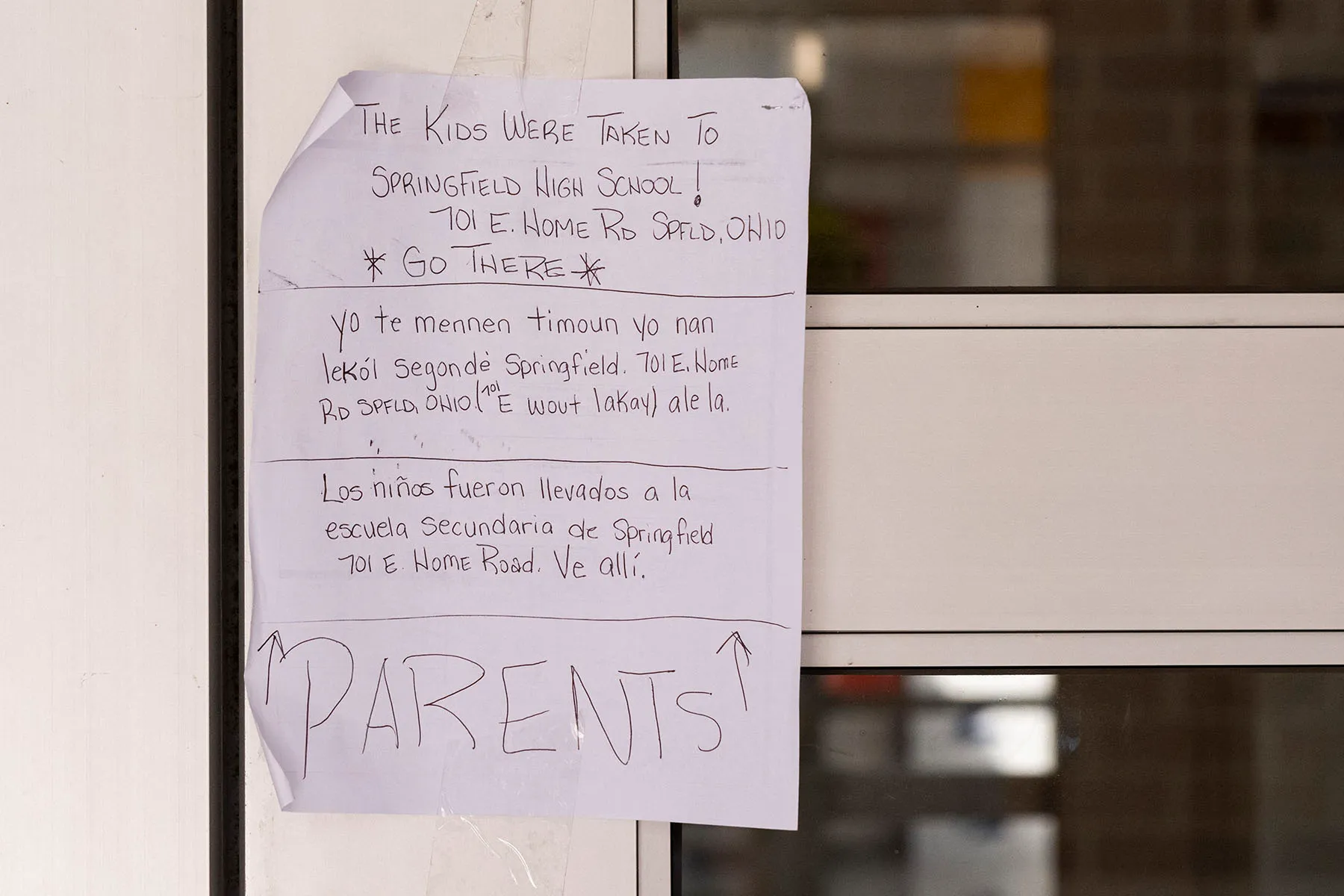
A note on the front door of Fulton Elementary School directs parents to a nearby school for pick-up after the building was evacuated due to bomb threats earlier in the day in Springfield, Ohio, on September 12, 2024. (Roberto Schmidt/AFP/Getty Images)
“Women are often the ones managing the day-to-day fears, picking up and dropping off children, and trying to shield them from the psychological trauma of these threats,” Saintil said. “This gender dynamic adds another layer to the stress, as women feel pressure to keep things normal for their families while silently shouldering the weight of their own fear and frustration.”
Having immigrated to Florida from Haiti in 2006 at age 9, Saintil said that she feels for Springfield’s Haitian community. Before moving to diverse Fort Lauderdale, Florida, she briefly lived in a White community where she said her classmates taunted, spat on her and called her a cat-eater.
“I remember . . . the fear, waking up every single day knowing that I’m going to get bullied, nobody wanting to talk to me, sitting at the lunch table by myself,” Saintil said. “When I compare it to what is happening now to the newly arrived kids, I think about just how . . . the bullying will mark them for the rest of their lives.”
Lured by manufacturing jobs, an estimated 15,000 Haitian immigrants have settled in Springfield — a mostly White town of just under 60,000 people — starting in about 2017. Before then, Springfield experienced an economic downturn caused, in part, by population decline. Then, the immigrants arrived, giving the city an economic boost.
Valerie Lacarte, a senior policy analyst with the Migration Policy Institute’s U.S. Immigration Policy Program, said that immigrants typically settle in areas because they know they can find reliable employment or their ethnic community already lives there. Springfield wasn’t previously home to a Haitian community, but state officials reportedly advertised the city’s livability and jobs, news that attracted migrants.
“You have employers who are hiring these people, so from the job market perspective, that’s a good thing. You have a match,” Lacarte said.
But this mutually beneficial development did not prevent tensions, which, last year, worsened after a Haitian immigrant crashed into a school bus, killing one child, Aiden Clark, and hurting nearly 30 others. Still, Nathan Clark, Aiden’s father, spoke out at a city commission meeting last week to denounce immigration foes for exploiting his son’s death. Anti-immigrant residents, meanwhile, have complained that Springfield lacks the infrastructure for population growth.
“It’s tempting to think the growth of immigrants, that’s what’s causing the problems,” said Karthick Ramakrishnan, coauthor of “Framing Immigrants: News Coverage, Public Opinion, and Policy” and a University of California, Berkeley, researcher. “It’s the politicization of immigrants, and especially in places that have significant Republican voting populations, the scapegoating of immigrants tends to be higher. This is an issue we’ve seen time and again in the American heartland, places that are depopulating, places that are short of workers, that actually benefit from immigrant workers, but you have people . . . tapping into these national dynamics, when it comes to race and xenophobia, to win elected office.”
Officials must “be intentional about social cohesion” to avoid conflict between the longtime residents and the Haitian transplants, said Lacarte, the daughter of Haitian immigrants. It’s important to make sure that both the U.S.-born and foreign-born community members get the attention and resources needed to grow together as a diverse community.
Longtime residents may misunderstand why people who look and sound different from them are moving in, Lacarte said. They witness the demographic shift, but they don’t realize these changes can be helpful. Then, bad actors deepen anxieties by spreading disinformation about immigrants.
“Immigrants have been not only filling these jobs and helping grow the economy. They have their own demand for goods and services,” Lacarte said. “They send their kids to school. They even, in some cases, create businesses . . . and that grows the economy.”
During the presidential debate, Trump did not portray foreign-born workers as a positive but as a threat to Americans, accusing immigrants of taking jobs from Black workers. This framing overlooks that immigrants fill jobs the native-born population doesn’t pursue, Lacarte said, and that more workers are needed as birth rates decline and the White population ages. It also belies the fact that Black immigrants exist.
About one in five Black people are immigrants or the children of Black immigrants, the Pew Research Center reported in 2022. Africans have driven Black immigrant growth; their population increased by 246 percent between 2000 and 2019. In 2005, The New York Times reported that more Africans were entering the United States than since the slave trade. Today, Africans make up 42 percent of the Black foreign-born population, while Caribbean immigrants make up 46 percent. Of the latter, most come from two countries: Jamaica and Haiti.
A United States Border Patrol agent on horseback tries to stop a Haitian migrant from entering an encampment on the banks of the Rio Grande near the Acuna Del Rio International Bridge in Del Rio, Texas on September 19, 2021. The United States said Saturday it would ramp up deportation flights for thousands of migrants who flooded into the Texas border city of Del Rio, as authorities scramble to alleviate a burgeoning crisis for President Joe Biden’s administration. PAUL RATJE/AFP
After footage of Border Patrol agents on horseback confronting Haitian migrants in Del Rio, Texas, went viral in 2021, Saintil said she received multiple messages disclosing, “I did not know there were Black immigrants. Where did they come from?” She assumed, due to her profession, that people knew the United States had Black immigrants.
“Most of my work now has been to raise visibility of Haitian and Black immigrants,” Saintil said. “We’re the most detained, the most placed in solitary confinement. Our bail bonds are higher. So, the same things that are happening to African Americans in the criminal justice system are happening to Black immigrants in the detention center. Our asylum claims are the most denied because immigration judges don’t trust our pain.”
Long before the debate, Trump disparaged Black immigrants. In 2017, he reportedly said that Nigerians lived in “huts” and Haitians “all have AIDS.” The following year, he labeled Haiti, African nations and El Salvador “shithole countries.” In Springfield, local Republicans have echoed Trump’s remarks. In addition to the pet-eating allegations, they’ve accused immigrants of being in gangs, spreading disease and practicing “voodoo” rituals, claims police have denied.
As Haiti became the yardstick for measuring whether Black people could participate in society equally, attacks on its character escalated. By the 1880s, stories spread about Haitians engaging in cannibalism and human sacrifice, especially of White children, Boaz said. Told repeatedly, these stories inform the rumors about Haitians in Springfield today, and they may jeopardize women.
“Historically, women in marginalized communities, whether immigrants, ethnic minorities, or refugees, have been specifically targeted for intimidation,” Saintil said. “This may be because some view them as ‘easier’ to attack or harass than men. . . . In this context, when Haitian women are being targeted for threats, harassment or even racial slurs in public spaces, the consequences are far-reaching. This not only creates an atmosphere of terror for women but can also ripple through the entire family.”
Haitian-American anthropologist Gina Athena Ulysse, a professor of humanities at the University of California, Santa Cruz, said that she’s tired of defending her personhood and identity. Following the 2010 Haiti earthquake, Ulysse wrote a book called “Why Haiti Needs New Narratives: A Post-Quake Chronicle” because she found the dehumanizing remarks about Haitians then disturbing.
“We’re always having to refute as opposed to having an identity that is an affirmed one,” Ulysse said. “There is a profound disappointment that in 2024 that I am listening to someone who is running to be the president of the highest nation in the land say something this surreal, this absurd. But I’m also someone as a Black woman, as a social scientist, as someone who understands race and racial construction, what that is meant to do, and that is to paint Haitians as the ultimate ‘others,’ cannibalists and otherwise, so that it can keep fueling this narrative that’s necessary to strip people of their humanity.”
Ulysse said that the broader immigrant community faces xenophobia, too. One study concluded that the level of anti-immigrant rhetoric in the Republican Party today rivals anti-Chinese sentiment during the late 1800s, a period that restricted Chinese immigration. Chinese immigrants have also been accused of consuming dogs and cats, insults revived during the onset of COVID-19, which Trump called the “China virus.”
“He’s gone from talking about Mexican immigrants as predominantly being criminals and rapists to then talking about immigrants as vectors of disease and and now using similar kinds of dehumanizing language to talk about . . . not just what they eat, but the kind of the social threat they supposedly pose to American society,” Ramakrishnan said. “I think the kinds of emotions it’s supposed to evoke are emotions of disgust, of othering and reduced empathy, and also support for drastic measures like rounding up and deporting people who are not deemed to be American.”
If Harris becomes president, she would not only be the first woman in the Oval Office but also the first person of South Asian and Caribbean heritage. Might that change perceptions and policies related to Caribbean immigrants?
“No matter how well meaning one person may be, they’re part of a social structure and a system that makes decisions,” Ulysse said. “She’s not going to make decisions by herself, so what difference does it make that she’s from the Caribbean? She’s got advisors. She’s got to think about Congress. She’s got to think about the Senate. She’s got to think about geopolitics and history.”
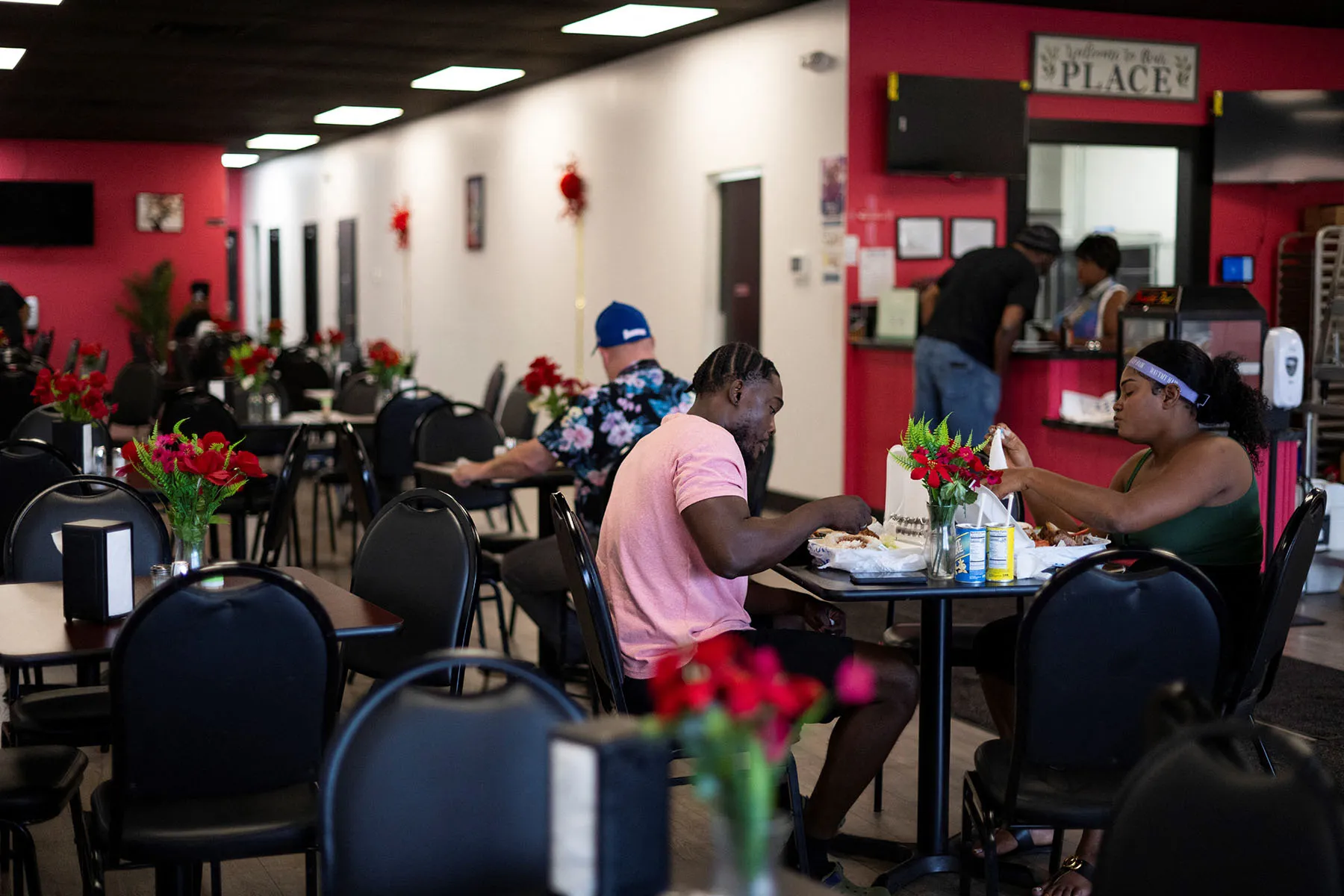
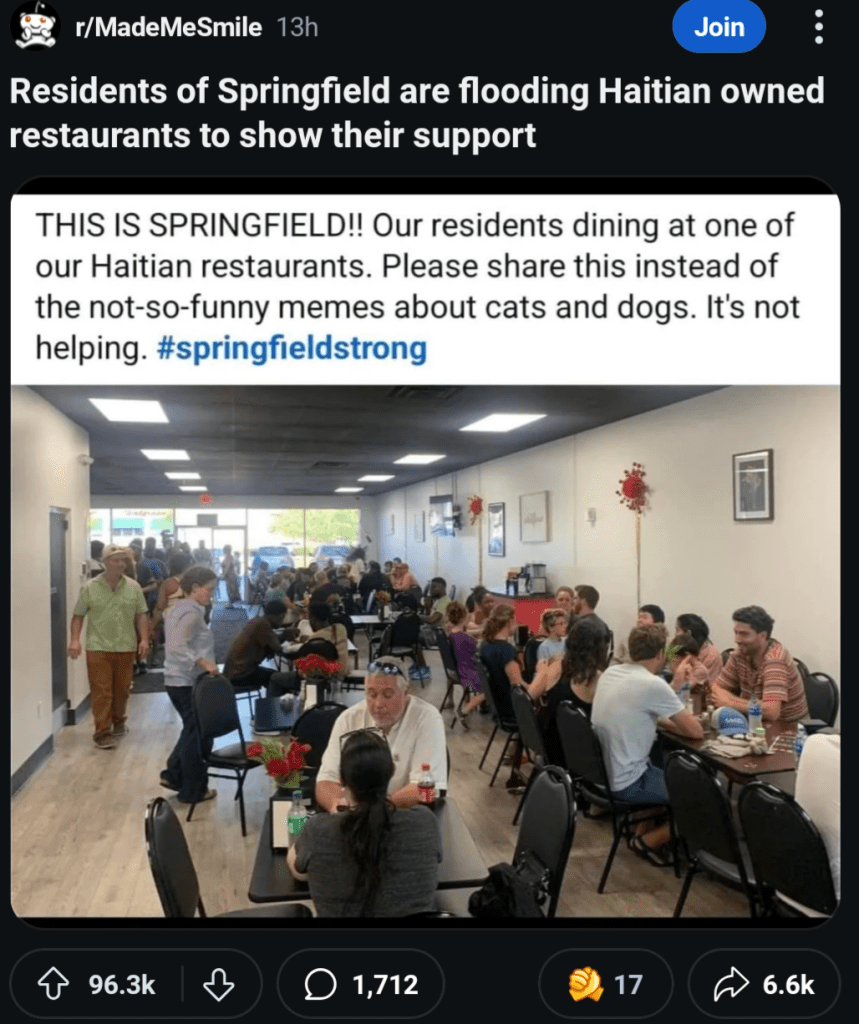
Community members eat at a Haitian restaurant in Springfield, Ohio, on September 12, 2024. (Roberto Schmidt/AFP/Getty Images)
When Trump took aim at Haitian immigrants during the debate, Harris laughed in apparent disbelief but did not rebuke him. Ulysse finds it disturbing that many people laughed at Trump’s claims because, as absurd as they are, they’re endangering Haitians.
On Friday, President Joe Biden called the attacks on Haitians “simply wrong,” noting that White House Press Secretary Karine Jean-Pierre is “a proud Haitian American.”
Along with being terrified and traumatized, Saintil said the Haitian children and parents impacted by the threats and smears likely feel betrayed.
“You’re getting it from a country that you thought you could be safe in,” she said. “You’re getting it in a country that you’ve been hoping to be in because you thought your life would be better, but now you’re being treated worse than dirt. You’re being called a savage . . . How do you go on from there?”
Springfield, Ohio's city hall was evacuated this morning due to a bomb threat.
This comes two days after former President Donald Trump boosted the baseless rumor that Haitian immigrants there were “eating the pets of the people that live there.” pic.twitter.com/VnCwYE5Zpy
Springfield Police confirmed to me that "multiple facilities" including at least city hall and Fulton Elementary have been evacuated due to a bomb threat received around 8:20 this morning https://t.co/MyOVu2bgze
Wittenberg University is currently taking precautions following a possible threat to campus tomorrow, Sunday, Sept. 15, 2024. All events and activities tomorrow are canceled. See alert website at https://t.co/q8SBqL88p1 for more information, safety tips, and resources. pic.twitter.com/w7GcwjIlWC
Ohio Gov. Mike DeWine defends Haitian immigrants, telling @MarthaRaddatz that while there are “legitimate” problems at the border, “What’s going on in Springfield is just fundamentally different.”
A day after a Springfield school and other public buildings were evacuated and closed due to bomb threats, and the same day that two other Springfield elementary schools were evacuated and one middle school closed due to a new, separate bomb threat, Husted posted a photo of two geese on X Friday morning with the comment, “Most Americans agree that these migrants should be deported.”Husted’s spox has refused to comment. He first appeared here in 2012 when as Ohio secretary of state he eliminated extended hours for early voting.
NEW: Fraudulent petition signatures cited by the DeSantis administration to justify its probe of Amendment 4 had already been rejected by a local supervisor of elections.
They were never counted toward the total that got the initiative on the ballot. https://t.co/f0sXetVwUW
Ron DeSantis has mobilized the Florida state government to spend taxpayer resources on the political process. He's now waging a multi-front war against Amendment 4, which would restore abortion rights pic.twitter.com/QreyQAi7Kn
This kind of propaganda issued by the state, using taxpayer money and operating outside of the political process sets a dangerous precedent.https://t.co/dJbVj8A6kK
After sending police to knock on doors of voters who signed petitions to get the FL abortion rights amendment on the ballot, now Ron Desantis is using taxpayer funds to illegally have a state agency & website campaign against the amendment. Story.https://t.co/2ywnO6kALR
BREAKING: In a 2022 tirade against reproductive health care, Mark Robinson repeatedly waves his hand by his groin, says young women just need to “get this under control." #NCGovpic.twitter.com/QXuUtZuBAL
“When people ask me…What’s gonna happen if the Flip – Flopping, Laughing Hyena Wins?? I say…write down all the addresses of the people who had her signs in their yards! Sooo…when the Illegal human ‘Locust’ (which she supports!) Need places to live…We’ll already have the addresses of the their New families…who supported their arrival!” Zuchowski wrote.
Read the full article. Replies to his post are turned off. Zuchowski made news several years ago for a rant about the name change for the Cleveland Indians, which he claimed was “erasing our heritage.”
Ryan Routh voted for Trump in 16’, then supported Gabbard, and then moved on to Hailey. He’s no liberal. He’s a Republican who is disillusioned with Trump’s foreign policy and Putin-phelia. pic.twitter.com/PaEkWoPcqX
Suspect Ryan Wesley Routh is a Democrat. He was allegedly hiding in the bushes with an AK-47 with a scope, two backpacks, and a GoPro and was spotted by the Secret Service before he could take action on President Trump #shootingpic.twitter.com/3xkbB7EU19
Elon/X has allowed someone to create a fake account under the alleged shooter’s name (Ryan Wesley Routh), and it’s now being used to spread vile anti-Semitic content including quotes from a Hitler account that X is also allowing on the platform. pic.twitter.com/reqGUcmynS
“I’ve seen the guns myself and all, and, yeah, they had a lot of guns and stuff over there, and, yeah, a lot of people were afraid of him back in the day,” she said.
The State Attorney for Palm Beach County is an elected Democrat, so Desantis is doing what Desantis does.
Maybe Desantis should investigate himself for making it so easy to acquire and walk around with an assault rifle in FL even with an extensive criminal history. pic.twitter.com/DwAWAE928L
“These are people that want to destroy our country. It is called the enemy from within. They are the real threat. They do it with a combination of rhetoric and lawsuits they wrap me up in.
The Mississippi Black Women’s Roundtable has traveled around the state for “boot camps” aimed at better mobilizing Black women to get out the vote. They face roadblocks in a state with a deep history of voter suppression.
This article is part of U.S. Democracy Day, a nationwide collaborative on September 15, the International Day of Democracy, in which news organizations cover how democracy works and the threats it faces. To learn more, visit usdemocracyday.org.
SOUTHAVEN, MISSISSIPPI — The training in northwest Mississippi that Cassandra Welchlin led was focused on get-out-the-vote efforts, but the longtime community organizer wanted to make space to sing.
Ain’t gonna let nobody turn me around, turn me around …
“Come on, y’all!” Welchlin told the crowd of nearly 100, who joined in on the next verse. Turn me around …
Ain’t gonna let nobody turn me around. I’m gonna keep on walking, keep on talking, marching up to freedom lane …
“I am so happy to have y’all in the house,” she said at one point. “If y’all could see what I see.”
What Welchlin saw that August morning were the faces of Black women — and a lot of them. Their interests, varied and historically overlooked, are at the center of a new kind of intentional voter engagement training.
“Black women mobilize their communities,” she told The 19th. “They are the catalyst.”
Welchlin is executive director of the Mississippi Black Women’s Roundtable, a civic engagement and policy advocacy organization whose members, all of them Black women, have traveled the state for months to host trainings called the “Power of the Sister Vote Boot Camp.”
On paper, their goal with the boot camps is an increase in voter turnout among Black women in the Mississippi counties where they visit. They also want to create a years-in-the-making pipeline to better mobilize Black women, whom Welchin views as the glue holding together democracy, especially in a state and region that continues to be impacted by policies that have historically suppressed Black voters.
“I was raised in a house of Black women — my aunties, my grandma, and then the neighborhood of elders,” she said. “I know the power of Black women taking care of Black women, and taking care of the community.”
At the trainings, Welchlin and her staff dress in military fatigues — a “boot camp” theme that has manifested into the advertisement the group uses to promote the events and the T-shirts they distribute to attendees. But there is a deeper significance.
“Voting feels like a battle in Mississippi,” she explained.
Mississippi is one of just three states that does not offer early voting to all residents, and one of eight states that does not offer online voter registration. The 12-hour window that many residents have to cast a ballot on Election Day can be difficult for people with irregular work shifts, child care responsibilities and challenges to accessing transportation.
Welchlin said she knows Black women overwhelmingly run their households. They also take on the added responsibility of getting their communities to the ballot box.
“I wanted to do something a little bit more strategic and formal that would bring excitement,” Welchlin said. “I just kind of sat with the idea of, ‘What would make people want to come?’”
Cassandra Welchlin, executive director of the Mississippi Black Women’s Roundtable, emphasizes the role of Black women as catalysts for democracy and community change. (Imani Khayyam for The 19th)
Melanie Campbell, president and CEO of the National Coalition on Black Civic Participation, and convener of the national Black Women’s Roundtable programming, credited Welchlin for designing a training theme that not only has the potential to turn out more voters, but could lead to more Black women becoming leaders who run for office. She added that Welchlin is taking their political power “to another level.”
“Having a Cassandra Welchlin in leadership, who’s doing unique things — there could be more Black elected officials in the state of Mississippi, because the demographics are there. But when you talk statewide, it’s not reached its full potential,” she said.
There are about 1.9 million registered voters in Mississippi, where the governor’s office, Senate and House of Representatives are controlled by Republicans. Welchlin’s group estimates that more than 123,000 Black women in the state did not vote in the past three election cycles. The group’s goal is to increase voter participation among these women by 10 percent this November. Black women voters in the counties the group has targeted for boot camps are among those who have voted most infrequently since 2021.
It’s part of why Allytra Perryman, deputy director of the Mississippi State Conference of the NAACP, which has partnered to help host some boot camps, also sees such potential in mobilizing them.
“When you train a Black woman on how to do anything, you train a community,” she said.
On the morning of the boot camp, Velvet Scott seemed to be everywhere.
As director of civic engagement and voting rights for the Mississippi Black Women’s Roundtable, she was ready to help roll out attendee tables and chairs; she was there to open boxes and hand materials to roundtable staff. She and Welchlin made sure the check-in table had updated registration lists, lunch was ordered and the child care in a nearby room was set up.
“Today we’re going to go through, of course, important information, but we’re going to have fun while doing it,” Scott told the women, many already wearing the matching boot camp T-shirts.
Their meeting space was attached to a church on a hill — New Hope Missionary Baptist Church — nestled along a road filled with so many churches it’s called Church Road. Among the permanent signage adorning the room were Biblical-themed messages of hope: “We will not fail nor be discouraged, till our mission is complete….”
“We welcome you today to be energized and to be educated,” said Pamela Helton, a leader within New Hope and the wife of the church pastor, in opening remarks.
Earlier, Welchlin seemed determined to shake the hands of every person who walked through the doors. For those she knew, she offered a hug. “So glad to see so many beautiful Black women,” she said at one point. “We comin’.”
When Welchlin helped host the first boot camp ahead of last year’ gubernatorial race, her organization did not collect data about the trainings. Anecdotal feedback showed a clear interest in organizing Black women around voter turnout, but the full scope of the programming’s reach in its pilot run is unclear.
“We realized that we had a gap,” Welchlin said. “But part of it had to do with capacity on our end to collect that data and do the follow-up.”
Scott, who joined the Mississippi Black Women’s Roundtable late last year, has committed to doing things differently. She honed a data mindset while first working in insurance, a job that brought her into the homes of Black and Brown people who increasingly sought her guidance about available social services. In 2018, Scott began volunteering at a youth-focused civic engagement organization and then joined the staff full-time.
At the Mississippi Black Women’s Roundtable, Scott tries to capture more information about the organization’s approach to community programming. That’s meant more of a focus on spreadsheets, more surveys and more individual follow-ups to ensure attendees have support afterward.
Velvet Scott, director of civic engagement and voting rights for the Mississippi Black Women’s Roundtable, believes in the power of organizing and uplifting Black women in community spaces. (Imani Khayyam for The 19th)
Scott has tweaked the boot camps since they launched in April in order to make them more accessible. She’s made some trainings available on weeknights instead of Saturdays, when people tend to be most busy with family responsibilities. She has sometimes shortened the hours of programming to see if a tighter agenda keeps up engagement. She recently helped organize a virtual training.
As a mother to a newly walking toddler, she tries to think about what the attendees might need. She, like Welchlin, feels strongly about onsite child care. (During the Southaven training, Scott stepped away to breastfeed her child.) She ensures that a meal is provided during the trainings, as well as a gift card. The group set aside roughly $50,000 to run the program this election cycle, according to Scott. They’ve been under budget thanks to partnerships with other civic engagement groups.
Scott believes strongly in the power of Black women organizing their communities.
“We don’t live single-issue lives,” she said. “So to uplift Black women in the room is to say, ‘Hey, I see you. We’re going to work on this together, we’re going to be in community together, and we’re going to be in fellowship together.’”
Scott also wants to find the balance in her work. She’s tried to move away from an unspoken expectation in community organizing that she must be go-go-go. She doesn’t want to burn out, and she wants to be present with her family.
“Rest is resistance,” Scott said, who referenced research on the topic. “And advocates deserve joy.”
When Jessica Orey hears Welchlin’s singing, she perks up. Orey is attending alone, and the music comforts her.
As a young adult, Orey jumped into organizing through a local NAACP chapter. Those meetings also made space for “freedom songs” used at the height of the Civil Rights Movement. It’s why Orey was impressed by its emphasis in Southaven.
“She’s kind of bringing back the old school type-feel of it,” Orey said of Welchlin. “Like, hey, we’re going to sing our way through. This is what’s going to push us to the next level.”
Welchlin said her mentor, Hollis Watkins, the late civil rights activist who founded the voting rights organization Southern Echo, taught her the freedom songs that he once sang at mass organizing meetings.
“It’s teaching a new generation about what the meaning of song is, and what these words mean,” she said. “And so it’s a history lesson, while it’s also a spiritual blessing to our souls.”
Sheneka Bell is also in the room alone, listening along.
At 45, Bell is a longtime voter but has not been active in voter turnout efforts. But politics continues to seep into her life — from the national debate about reproductive rights, to local property rezoning. Last year, Bell joined the local county chapter of the NAACP.
“I have a responsibility to understand what’s going on in my neighborhood and beyond,” she said.
In some ways, Orey felt compelled to be at the boot camp: Her grandmother is Delores Orey, a longtime civil rights activist who worked alongside key leaders of the Civil Rights Movement.
“This is all I know. This is what Big Mama taught us,” said the 36-year-old, referring to her grandmother. “This is what Big Mama pushed for. So if any injustice is around me, it’s like, ‘What would Big Mama do?’ A lot of this stuff is ingrained. It’s a part of my DNA.”
After her grandmother died in 2014, Orey stepped back from community organizing. But she wants to get involved again, and she felt like the boot camp was a first step. Orey has since signed up for roundtable updates and alerts from several civic engagement groups. She recently participated in a GOTV event in Jackson.
“I know it’s time for me as a former advocate,” she said. “I need to get my shoes back in the game. There’s work to be done.”
Since the boot camp, Bell has looked into signing up to be a poll worker. She is open to phone banking, and recently showed her nieces how to check their voter registration statuses.
“I’m new to this space,” she said. “I’ve never done any of this before.”
Welchlin cautioned against ignoring inequity around the ballot box in Mississippi, especially as Republican lawmakers advance voting restrictions around the country. They have increasingly claimed without proof that there is widespread voter fraud, and such policies often appear in states with large Black and Brown populations.
“Mississippi is part of the fabric of the struggles in the South,” Welchlin said. “We have a history, and a muscle, and a foundation in which we have built.”
As the boot camps in Mississippi wrap up this election cycle, its ripple effect is coming into focus. A state lawmaker recently expressed interest in running a boot camp. At least one organization is now trying to offer similar programming targeting Black men. And the umbrella organization’s Michigan affiliate has reached out about replicating some of boot camp programming.
“We know that their data is going to look different, but we’re giving them the template to adjust it the way they need,” she said. “It’s a model, and Michigan is going to be testing it.”
Welchin has tried to lean into the joy of the work ahead, despite the obvious obstacles. With Black women by her side, she feels empowered to find a way.
“Good things do come from the South, and we know that Black women have been a part of making that happen,” she said.
To check your voter registration status or to get more information about registering to vote, text 19thnews to 26797.
September 15, 1915 In a letter, Turkish Minister of the Interior Mehmet Talaat Pasha explained that the real intention of sending the Armenians to the Der-el-Zor (Deir el-Zor) Desert (now in Syria) was to annihilate them. Talaat had primary responsibility for planning and implementing the Armenian Genocide. The day before, The New York Times reported that the murder of 350,000 Armenians in Turkey had already occurred. 1915, orphaned Armenian children in the open, many covering their heads from the desert sun. Location: Ottoman empire, region Syria. The Turkish Adolf Eichmann
September 15, 1935 The “Law for the Protection of German Blood and German Honor” and the “Reich Citizenship Law” were adopted by the Nazi (National Socialist German Workers’) Party Rally in Nuremberg, depriving German Jews of their citizenship.
September 15, 1963 During Sunday School, 15 sticks of dynamite blew apart the Sixteenth Street Baptist Church in Birmingham, Alabama, killing four children in the basement changing room, and injuring 23 others. Prime suspects were the Ku Klux Klan (KKK) and Nacirema (both white supremacist organizations; Nacirema is “American” spelled backwards). A week before the bombing Governor George C. Wallace had told The New York Times that to stop integration, Alabama needed a “few first-class funerals.” The four girls lost in the Sixteenth Street Baptist Church bombing, the ruins of the church and grieving parents This event set off racial rioting and other violence in which two African-American boys were shot to death, and became a turning point in generating broad American sympathy for the civil rights movement. A member of the church, studying on a scholarship in Paris at the time, was Birmingham High School student Angela Davis. Lives cut short… Addie Mae Collins (14), Cynthia Wesley (14), Caole Robertson (14), Denise McNair (11) Read more
September 15, 1981 A blockade started at a nuclear power plant construction site in Diablo Canyon near San Luis Obispo, California. Nearly 10,000 people tried to prevent fuel rods from being loaded into the two reactor cores. Over two weeks, 1,901 are arrested in the largest occupation of a nuclear power site in U.S. history. Their immediate major concern was over the region being seismically active and the plant’s location near the Hosgri fault. In 2004 a 6.5 (on the Richter Scale) earthquake was centered less than 40 miles from the plant. Four other faults nearby have since been identified. Additionally, 9.5 billion liters (2.5 billion gallons) of water needed to cool the reactors each day are discharged directly into the Pacific 11°C (20°F) warmer than the surrounding ocean water, affecting marine plant and animal life there.Diablo canyon As with all nuclear plants, the problem remains with storage of spent nuclear fuel that remains dangerously radioactive for more than 10,000 years. Diablo Canyon generates 110 spent fuel rod assemblies each year. There is still no satisfactory solution to this long-term storage problem. Diablo Canyon timeline
September 15, 1986 Veterans Duncan Murphy (World War II) and Brian Willson (Vietnam) joined Charles Liteky & George Mizo in the Fast For Life, opposing U.S. support for the terrorist contra war against Nicaragua. The contras were insurgent guerillas using violence against civilians in the countryside to bring down the newly formed Sandanista government. The contras were supported in contravention of the Boland Amendment which prohibited U.S. agencies from providing military equipment, training or support to anyone “for the purpose of overthrowing the Government of Nicaragua.” Duncan Murphy, Brian Willson, Charles Liteky, George Mizo The Fast for Life from Brian Willson’s perspective
September 15, 1996 6,000 rallied and 1,033 were arrested near the Headwaters Grove in rural Carlotta, California, in protest against cutting one of the last large unlogged stands of redwood trees in the world. Redwoods are coniferous trees (sequoia sempervivens: the genus is named for Sequoya, or George Guess, an American Indian scholar; sempervivens is ever alive in Latin) that can reach over 90m (300 ft.) over a life as long as 2000 years.
September 15, 1997 Sinn Fein, the political party closely allied with the goals of the Irish Republican Army (IRA), entered Northern Ireland’s peace talks for the first time.
September 15, 2001 Four days after 9/11, Representative Barbara Lee (D-California) cast the only congressional vote against authorizing President Bush to use “all necessary and appropriate force” against anyone associated with the terrorist attacks of September 11. “I am convinced that military action will not prevent further acts of international terrorism against the United States.” Barbara Lee – Alone on the Hill
Eugene V. Debs was sentenced to ten years in prison for opposing U.S. entry into World War I. Debs had been an elected official in Indiana, a labor organizer, writer and editor, had founded the first industrial union in the U.S., the American Railway Union, and had run for President four times on the Socialist Party ticket.
He ran again for president from prison in 1920 with the slogan “From Atlanta Prison to the White House,” and received nearly one million. Learn more about Eugene V. Debs
September 14, 1940 Congress passed the Selective Service Act, providing for the first peacetime draft (though Japan had already invaded China in 1937 and Germany had invaded Poland and Czechoslovakia in 1939) in U.S. history.
September 14, 1948 A groundbreaking ceremony took place in New York City at the site of the United Nations’ world headquarters. The site selected for the permanent headquarters of the United Nations as it was in 1946. The 39-story building on 18 acres of Manhattan’s Turtle Bay neighborhood (donated by John D. Rockefeller, Jr.) on the East River. It is a major expression of the International Style with its simple geometric form and glass curtain wall, designed principally by Le Corbusier. The UN building today Background and more examples of the minimalist, utilitarian International style
September 14, 1963 The ABC television network invited singer, songwriter, banjo player and activist Pete Seeger to appear on its Saturday night folk and acoustic music show, Hootenanny, despite the fact that he had been blacklisted. But the invitation stood only if he’d sign an oath of loyalty to the U.S. He described his reaction: “This is ridiculous. I’d sign ’em, if you sign ’em, and everybody who’s born will sign ’em, then we’d all be clean.” In the 1940s Seeger traveled throughout the country with Woody Guthrie, performing at union meetings, strikes and demonstrations. After World War II, he and Lee Hays co-founded the Weavers, the legendary folk group that gained commercial success despite being blacklisted. A Pete Seeger BiographyMore about Hootenanny
September 14, 1964 The Free Speech Movement began at the University of California-Berkeley when its Dean Katherine Towle (pronounced toll) announced that existing University regulations prohibiting advocacy of political causes or candidates, signing of members, and collection of funds by student organizations at the corner of Bancroft and Telegraph, would henceforth be ”strictly enforced.” Read more
September 14, 1982 Wisconsin became the first to approve a statewide referendum calling for a freeze on all testing of nuclear weapons.
September 14, 1990 The Pentagon announced a $20 billion arms sale to Saudi Arabia. Saddam Hussein’s Iraq (Saudi Arabia’s eastern neighbor) had invaded Kuwait six weeks earlier. Saud royal family
September 14, 1991 The South African government, the African National Congress, the Inkatha Freedom Party, a total of forty organizations, signed the National Peace Accord. It led to the country’s first multi-racial elections and the end of South Africa’s racially separatist apartheid (literally separateness in the Afrikaans language) political, economic and social system by 1994. “ Bearing in mind the values which we hold, be these religious or humanitarian, we pledge ourselves with integrity of purpose to make this land a prosperous one where we can all live, work and play together in peace and harmony.” Background of the conflict
Hi everyone. I spent the late morning / early afternoon making a couple videos. I was talking about what was keeping me busy and occupied the last couple of weeks. But these videos touch on my hurts, my pain, not news. One is shorter because when Ron came to the door, I meant to hit the pause button but hit the stop recording one. I am using new equipment, so if there is any sound or video issues, please let me know. Hugs. Scottie
I talk about my own childhood abuse and helping a friend with his own abuse issues first part.
Me speaking about my abuse and trying to help a friend who was abused also. I also explain my time management issues.




 Diablo canyon


 The site selected for the permanent
 The UN building today


 Saud royal family
 Scottie's Playtime