Bio: Richard Francis Hogan is a Canadian writer, Poet and advocate on several levels based in Ottawa. His work explores hope, resilience, identity, faith, and the quiet power of public spaces.
Subject: Op-Ed Submission: When the Parade Stops, the Silence Speaks Louder
Dear Editor,
I am submitting the attached op-ed for consideration in the Ottawa Citizen. It reflects on the recent cancellation of the Ottawa Gay Pride Parade and the deeper cultural and spiritual implications of that absence. As a longtime resident and advocate for inclusive public spaces, I believe this piece speaks to a moment of reflection for our city and its commitment to visibility, dignity, and belonging. Thank you for your time and consideration.
Sincerely,
Richard Hogan
(snip-personal contact info)
Full Narrative
When the Parade Stops, the Silence Speaks Louder
By Richard Francis Hogan
The cancellation of the Ottawa Gay Pride Parade due to protests is more than a logistical decision. It is a cultural silence, a civic absence, a spiritual pause that demands reflection.
For decades, Pride has been more than a celebration. It has been a procession of courage, a public hymn of identity, a communal act of love. It has been where the marginalized found visibility, where joy became resistance, and where the city itself remembered its promise to all its people.
To cancel such a gathering is not merely to postpone an event. It is to interrupt a ritual of belonging.
As a Christian, I believe in the sacredness of every human soul. As a Buddhist, I recognize the impermanence of all things—but also the importance of showing up, again and again, with compassion. And as someone with Irish blood, I know that humor and heartache often walk hand in hand. We laugh because we’ve cried. We march because we’ve been still for too long.
This year, there will be no rainbow flags waving down Bank Street. No music echoing through Centretown. No cheers from sidewalks lined with families, allies, and elders who remember when Pride was a protest, not a party.
But let us not confuse absence with apathy.
Let us write, speak, gather, and remember. Let us honor those who came before, and those who still wait to be seen. Let us make sure that when the parade returns, it does so not just with glitter—but with grit.
Because Pride is not a date on the calendar. It is a declaration of dignity.
And dignity, like love, does not disappear. It waits. It endures. It marches on.
August 23, 1933 Mahatma Gandhi, weighing only 90 pounds, was released unconditionally from Sassoon Hospital in Poona because, after 5 days of his latest “fast unto death,” the doctors feared that his body could no longer stand the strain of fasting. He had been taken to the hospital from Yeravda jail, which he had described as his “permanent address,” when he started his fast. He was protesting official refusal to allow him to continue his work with the Untouchables (he had called them harijan, or “children of God”) while in prison. Gandhi leaving hospital, 1933 He had deliberately courted arrest, rejecting an order permitting him to reside only within the limits of Poona, and had been sentenced to a year’s imprisonment. Gandhi and his fasts
August 23, 1945 In a letter to his friend Anne Marie Petersen shortly before the end of British colonial rule in India, Mahatma Gandhi wrote, “When there is independence, why should you fear the majority? If you have God with you and the majority have not, should you still fear? And if both have God between them who should fear whom? Is there then any question of majority and minority? Let us pray. Love. Bapu”
August 23, 1989 Over one million joined hands across the three Baltic republics (Lithuania, Latvia and Estonia) in a 400-mile-long chain of resistance against control by the U.S.S.R. (Union of Soviet Socialist Republics). It was the 60th anniversary of the Soviet-German Non-Aggression Pact, also known as the Molotov-Ribbentrop Pact after the foreign ministers of the Soviet Union and Nazi Germany who had negotiated it. Generally called the Hitler-Stalin Pact, it secretly agreed to Soviet control of Latvia and Estonia, and German influence over Poland and Lithuania. Germany, again secretly, later ceded control over Lithuania to the Soviets for 7.5 million dollars in gold ($115 in 2008 dollars). Baltic hands The Baltic Way(with pictures of the action)
August 21, 1831 Nat Turner, a 30-year-old man legally owned by a child, and six other slaves began a violent insurrection in Southampton County, Virginia.They began by killing the child’s stepfather, Joseph Travis, and his family. Within the next 24 hours, Turner and, ultimately, about 40 followers killed the families who owned adjacent slaveholding properties, nearly 60 whites, while freeing and inciting other slaves to join them.Militia and federal troops were called out, and the uprising was suppressed with 55 African Americans including Turner executed by hanging in Jerusalem, Virginia, and hundreds more killed by white mobs and vigilantes in revenge. More about Nat Turner Nat Turner’s confession
August 21, 1968 The Czechoslovakian people spontaneously and nonviolently resisted invasion of their country of 14 million by hundreds of thousands of troops and 5000+ tanks from the Soviet Union and four other Warsaw Pact countries.The troops were enforcing the overthrow and arrest of Alexander Dubcek and his government. They had been implementing significant democratic reforms known collectively as “socialism with a human face,” or the Prague Spring. Cover of the magazine Kvety, with a photograph of the statue of St. Wenceslas in Wenceslas Square in the center of Prague. Graffiti on the statue reads “Soldiers go home” in Russian and “Dubcek – Svoboda” in Czech. Hundreds attempted to obstruct invading tanks. Both Czechs and Slovaks argued with the soldiers and refused all cooperation with the occupying armies while showing broad support for the deposed government and its reform program. Moscow relented and returned Dubcek to office, at least temporarily. Prague Spring in retrospect Czech perspective
August 21, 1971 Two grenades killed and wounded members of the leadership of the Philippines’ Liberal Party during a rally in Manila’s Plaza Miranda. Philippine President Ferdinand Marcos accused a leader of the party, Benigno Aquino, of the bombing and arrested him, labeling him a communist. Liberal Party Secretary-General Aquino, an effective young leader and Marcos opponent, was imprisoned, mostly in solitary confinement, for seven years until allowed exile to the U.S., ostensibly for medical treatment.
August 21, 1976 Approximately 20,000 people, mainly women, from both Protestant and Catholic areas of Belfast, Northern Ireland, attended a Peace People’s rally at Ormeau Park.
August 21, 1983 Exiled popular Philippine political leader Benigno Aquino was assassinated by soldiers of the Aviation Security Command as he crossed the tarmac at Manila International Airport. Benigno Aquino He had spent three years of asylum in the U.S. Upon his return, he intended to lead the political opposition to President Ferdinand Marcos and the martial law he had imposed. During the plane trip across the Pacific, he had commented to reporters, “I suppose there’s a physical danger because you know assassination’s part of public service . . . My feeling is we all have to die sometime and if it’s my fate to die by an assassin’s bullet, so be it.” Hundreds of thousands demonstrated against Marcos.
Ferdinand Marcos The Aquino funeral drew millions and gave impetus to the broad-based People’s Power movement which eventually forced Marcos from power. Read more about Aquino
August 21, 1991 A coup against Soviet Union President Mikhail S. Gorbachev by hard-line Communist Party members (State Emergency Committee), collapsed in the face of popular opposition. Russian Federation President Boris N. Yeltsin, having quit the Party the previous year, had called for a general strike. Mikhail S. Gorbachev | Boris N.Yelsin
August 21, 1998 Samuel Bowers, the 73-year-old former Imperial Wizard of the White Knights of the Ku Klux Klan, was convicted in Hattiesburg, Mississippi, of ordering a firebombing that killed civil rights activist Vernon Dahmer 32 years before. Bowers had also been instrumental in the killing of three other civil rights workers in Philadelphia, Mississippi for which he was never charged. On Vernon Dahmer’s tombstone are the words, “If you don’t vote, you don’t count.” Samuel Bowers 32 years to justice Dahmer’s home after the bombing
(It’s a newsletter I receive, and I don’t have a link for what I’ve copied and am pasting, but there are links within the piece. Enjoy.)
AUGUST 17 — AUGUST 23
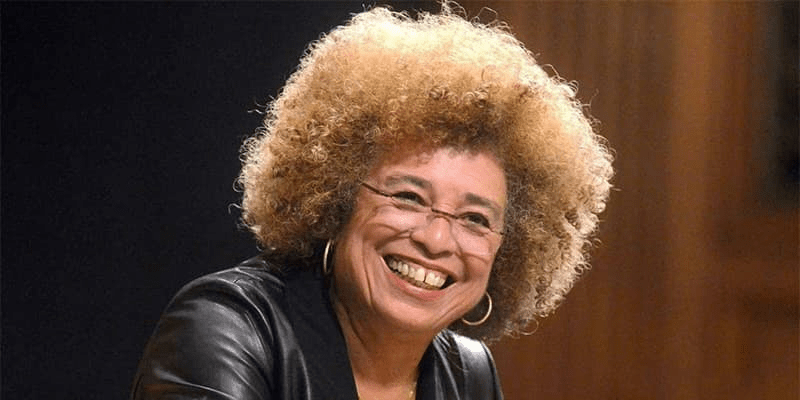
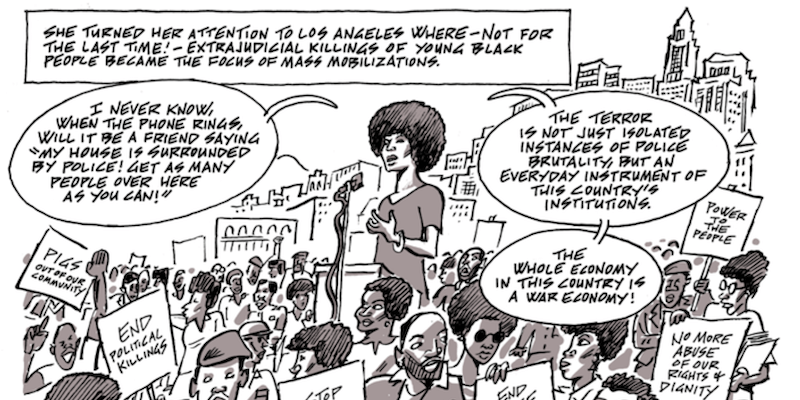
Angela Davis debuts on the FBI’s Ten Most Wanted List. In 1969, the legendary author and activist Angela Davis was a newly minted assistant philosophy processor at UCLA. But she was also an avowed Communist, and as a result, then-Governor Ronald Regan tried to have her fired before she’d begun any actual teaching. No luck: Davis’s dismissal didn’t hold up in court, and her first class had to be moved to a bigger classroom to accommodate the 2,000 students who had signed up for it—but she would finally be fired again nine months later, for “inflammatory rhetoric” in public speeches. Davis was an outspoken supporter of the Black Panthers and was fervently against the Vietnam War, but arguably her most scandalous activist activities at the time were in defense of the Soledad Brothers, three Black inmates imprisoned in Soledad, CA, who were accused of killing a white guard. In 1970, guns registered to Davis were used in an attack on the nearby Marin County Civic Center; the perpetrators hoped to take hostages to bargain for the inmates’ release, but instead left four casualties. Davis, despite not being at the scene, was charged with murder, kidnapping, and criminal conspiracy charges. She couldn’t be found, and so on August 18, 1970, by order of J. Edgar Hoover, Davis became the third woman ever to be included on the FBI’s Most Wanted List. Eight weeks later, Davis was finally arrested in a New York motel; the trial that followed catapulted her to international fame—and turned her into a revolutionary icon—as her supporters, who viewed her as a political prisoner, chanted “Free Angela!” across the globe.In 1972, after 16 months in prison, she was acquitted of all charges by an all-white jury. “It took a worldwide movement of people to acquit Miss Davis,” noted one of her attorneys, Howard Moore Jr., but it shouldn’t have. “Justice should be the routine of the system,” he added.
THIS IS WHY THEY BAN IT: “Progressive art can assist people to learn not only about the objective forces at work in the society in which they live, but also about the intensely social character of their interior lives. Ultimately, it can propel people toward social emancipation. ” –Angela Davis
Exclusive: largest data analysis of its kind counters Trump’s aggressive efforts to deny trans minors’ existence
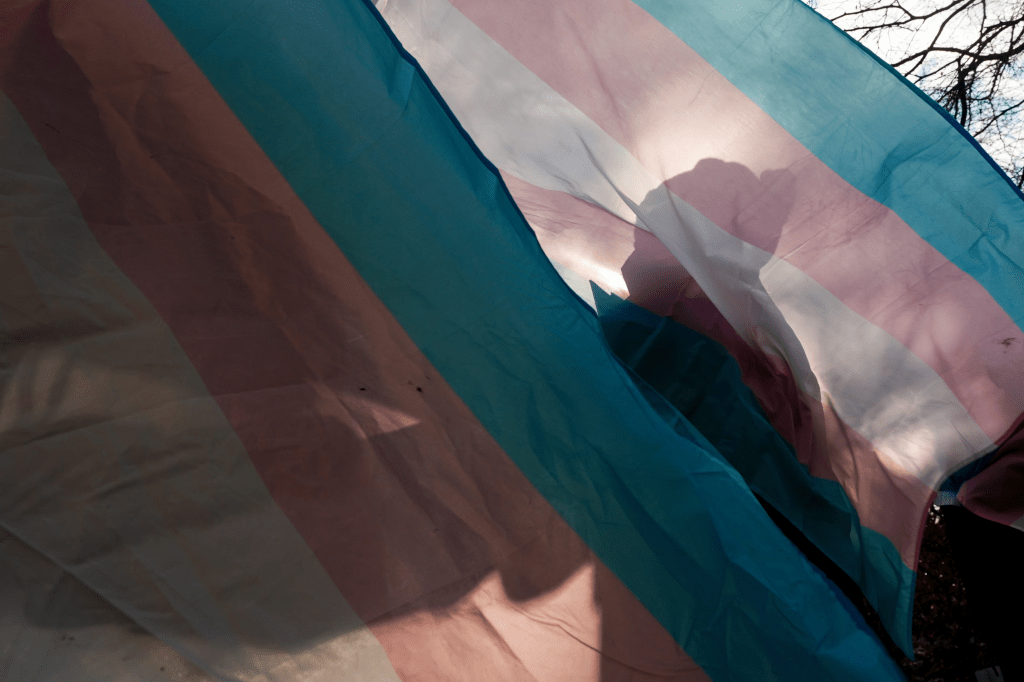
View image in fullscreen A protester is silhouetted against a trans pride flag during a pro-transgender rights protest outside of Seattle children’s hospital on 9 February. Photograph: Lindsey Wasson/AP
More than 2.8 million people now identify as transgender in the US, including an estimated 724,000 youth, according to a new data analysis that is the largest of its kind to date.
Researchers from the University of California, Los Angeles (UCLA) Williams Institute used federal surveys and data from state health agencies to identify the size and demographics of the trans population in each state.
The analysis, shared with the Guardian and released on Wednesday, documented thousands of trans youth living in all 50 states and the District of Columbia. The findings counter Donald Trump’s aggressive efforts to deny the existence of trans minors, as his administration removes references to trans people across federal agencies and widely erodes protections and programs for LGBTQ+ communities.
The report builds on federal data collection efforts that the White House is now eliminating. The authors warn their study could be the last comprehensive portrait of the nation’s trans population for a decade or more as trans people are erased from vital US surveys, including health reports and crime data analyses.
The Williams Institute primarily relied on data from 2021 to 2023 from Centers for Disease Control and Prevention (CDC) surveys and records disclosed by state health agencies. Some of the key findings include:
1% of the total US population ages 13 and older identifies as trans, including 0.8% of adults (more than 2.1 million people) and 3.3% of youth ages 13 to 17 (roughly 724,000 people).
Young adults ages 18 to 24 are significantly more likely to identify as trans (2.72%) than those 35 to 64 (0.42%) and those 65 and older (0.26%).
Of the 2.1 million trans adults, 32.7% (698,500) are trans women, 34.2% (730,500) are trans men and 33.1% (707,100) are trans non-binary people.
The trans populations are fairly consistent across regions, with 0.9% of adults in the west, midwest and north-east identifying as trans, compared with 0.7% of adults in the south.
Minnesota had the highest rate of adults who identify as trans (1.2%), and Hawaii had the highest rate of trans youth (3.6%), though the ranges were similar across states.
“Trans people live everywhere and are represented in every state,” said Dr Jody Herman, senior scholar of public policy at the Williams Institute and co-author of the report, noting the total US trans population was greater than the individual populations of more than a dozen states. “This is a substantial population that has unique concerns and barriers to getting their needs met, and lawmakers need to keep that in mind.”
The Williams Institute, a leading LGBTQ+ policy research center, has published national trans population counts since its 2011 report, which was the first of its kind as state-level data on gender identity became available. The estimates are considered the best available data and were cited by the US supreme court in its recent majority opinion upholding Tennessee’s ban on trans youth healthcare.
The quality and sources of the researchers’ data have improved from one report to the next, the researchers said, making it difficult to assess changes over time. But the researchers noted that the overall estimates of trans adults have remained relatively steady, while the latest data shows how younger people are now significantly more likely to identify as trans than older groups.
There are many factors contributing to youth identifying as trans at higher rates, including that younger people are more likely to answer these kinds of survey questions, said Dr Andrew Flores, Williams Institute distinguished visiting scholar and associate professor of government at American University.
“Younger people are growing up among other younger people who already hold more accepting attitudes toward LGBT and transgender people more broadly,” said Flores, a report co-author, citing increasingly visible signs of support, such as student walkouts in Florida in protest of anti-trans policies. “In this generation, they might be more willing and safe to identify that they are transgender, because they don’t see as much of a harm or threat as older generations.”
While some conservatives and anti-trans advocates have presented a reported rise in trans youth as a “social contagion”, suggesting youth are copying their peers, “the growth comes as people are now in an environment that allows them to fully express who they are,” Flores said.
Shifting language also affects generational differences, he said, noting how older groups were more likely to identify as lesbian or gay while younger people are more likely to identify as bisexual or pansexual. And while older trans people are more likely to identify as men or women, younger trans people more frequently identify as non-binary.
The report also found that the race and ethnicity of trans people was largely similar to broader US demographics, with Indigenous, Latino and multiracial adults slightly more likely to identify as trans than other groups.
The Trump administration, which has widely attacked data collection efforts across government, has moved to remove trans identity questions from two critical CDC behavioral health surveys and from Department of Justice surveys on crime victimization and sexual violence. The US Census Bureau has also taken steps to exclude gender identity from multiple surveys, according to the former director who resigned in February.
Those efforts followed Trump’s day-one executive order “restoring biological truth” to the government, which suggested that trans identity was “false” and directed the state department to deny trans people accurate passports.
The data loss will make it impossible for the Williams Institute to continue its analyses in their current form, and even if the next administration restored the surveys, the public would still be losing up to 10 years of data, which would be a devastating erosion of knowledge, the researchers said.
“We didn’t really have decent national data until around 10 years ago, so we just very recently got a grasp on how many people identify as trans in the US and what their characteristics are,” said Herman. “For these data sources to just suddenly disappear, it is a major setback. The population is not going to go away; we’re just not going to know more about them than what we have from our current sources.”
The data has frequently been cited by journalists, school boards, public health experts, civil rights lawyers, advocates fighting discriminatory legislation and lawmakers expanding trans rights. The researchers had hoped federal data could help illuminate how trans people were moving within the US as some have fled red states due to anti-trans laws, but that will be hard to track without national surveys, they said.
“In some policy circles, they say if you can’t be counted, you don’t count,” Flores added. “And for members of the LGBTQ+ community, to be able to see numbers that reflect their lived experiences is quite important.”
Imara Jones, founder of news organization TransLash Media, said there was no easy fix for the loss of national data backed by federal resources.
“It is meant to erase, and that erasure is meant to have real-world impacts, making it harder for people to be who they are,” Jones said.
Flores said the institute and others were discussing ways to fill the gaps and continue data collection without the federal government: “We’re not just going to close up shop. We’re going to try to find a way to keep telling these stories and be persistent.”
Hi All. These pictures caught my attention and each put a smile on my face. When I realized they were affecting my spirit like this I knew I had to share them with you all. As I was getting the post ready, I found I had this song going through my mind sung by the consummate story teller, Tom T. Hall. I miss this type of peaceful music. I hope this post brings you a touch of peace today. -randy
August 20, 1619 The first enslaved Africans brought to North America arrived in Jamestown, Virginia, aboard a Dutch ship.
August 20, 1964 A nearly $1 billion (about $5 billion in current dollars) anti-poverty measure, the Economic Opportunity Act, which created Head Start, VISTA (Volunteers In Service To America), and other programs that became part of the “War on Poverty,” was signed into law by President Lyndon Johnson. Sargent Shriver & LBJ Sargent Shriver, the first director of the Peace Corps, drafted the legislation and became director of the Office of Equal Opportunity which implemented the new law. The “Great Society”
I have been waiting for the show to clip this interview. I watched it live when he was interviewed. I was blown away by Frost. He is the kind of Democratic elected members we need and the kind of candidates we should vote for. Please give the interview a watch. Hugs
I don’t care if a person can afford to have facial surgery and does to make themselves look prettier than nature did at birth, but this woman who clearly had a lot of work to change her appearance would object to a young adult trans person would do the same thing. But the point is this person is spending millions to cosplay to her heart’s content all over the Northern Hemisphere so she can put a pretty face to the horror her department is inflicting on people. Look she went to the El Salvadorian SECOT prison dressed up for a photo op. But what they are trying to hide is she was living in a mansion paid for by the US taxpayer …. meaning paid by us and so when that got found out she moved into a water front mansion her boyfriend was living in paid for by the US Coast Guard. The grifting and corruption of this administration is unbelievable. They cut every healthcare and food assistance for the poor in the US but they demand every amenity paid for by the taxpayer and think they are due it. Hugs
—————————————————————————————————————–
BIG SPENDER
The DHS will pour a fortune into its “Stronger Border” ad campaign as Secretary Kristi Noem weathers a relentless storm of mockery.
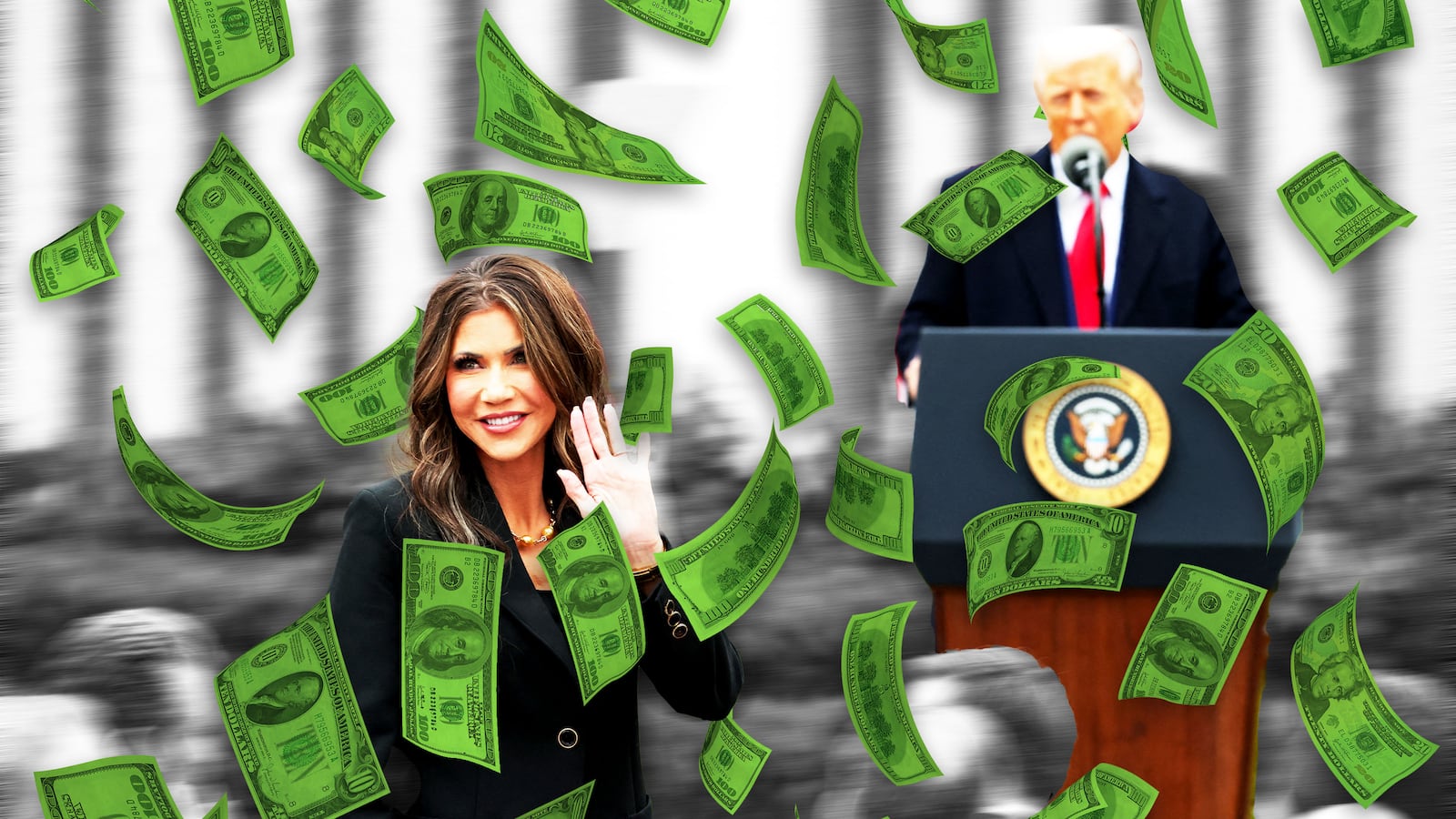
Photo Illustration by The Daily Beast/Getty/Reuters
The Trump administration is set to spend up to $50 million on a wave of taxpayer-funded PR amid the torrent of negative coverage dogging his Homeland Security Secretary Kristi Noem.
A planning forecast record posted this week by the Department for Homeland Security (DHS) pledges $20 million to $50 million as an “International Campaign Follow-on” to the “Stronger Border, Stronger America” ads that have starred Noem.
A DHS spokesperson told the Daily Beast that the spending on the campaign is not related to coverage of Noem.
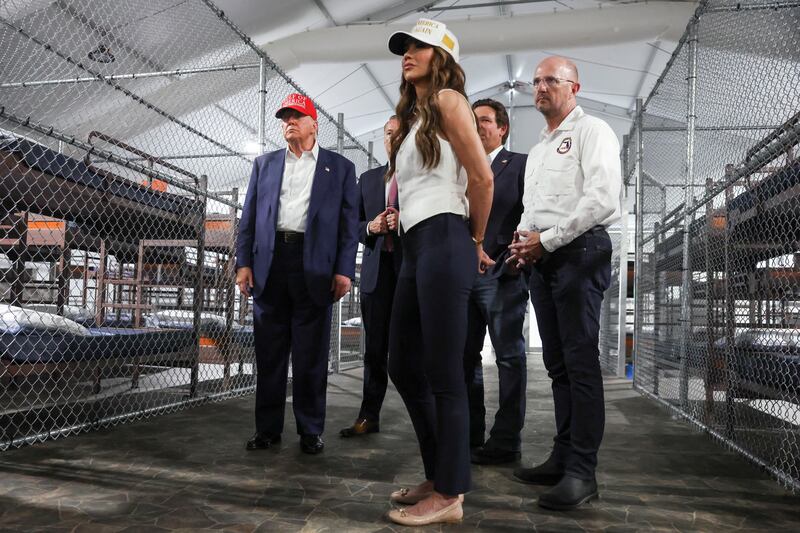
Since being appointed Trump’s DHS secretary, Noem has been skewered over her cosplays and photo-ops promoting Immigration and Customs Enforcement and Trump’s hardline deportation agenda.
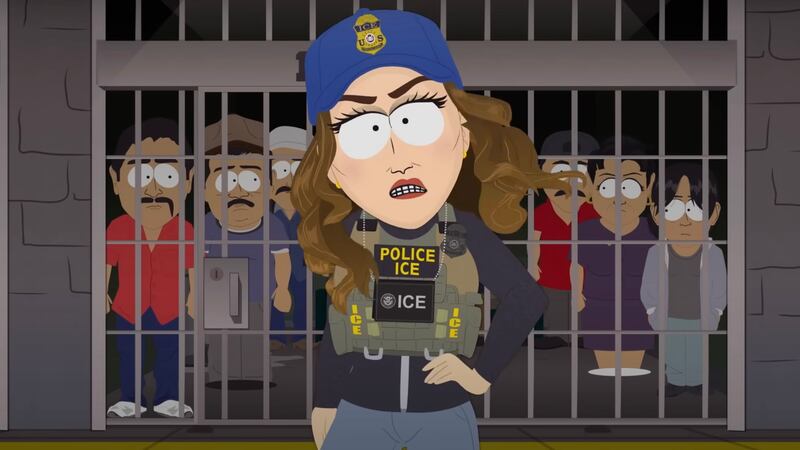
That mockery has reached a fever pitch with the latest season of South Park, which won record ratings while portraying Noem as a psychotic dog-killer—referencing her memoir admission that she shot dead her own dog—and mocked DHS’s own celebratory sizzle reels.
Noem wore an ICE vest in promotional stunts for the agency—the new tranche of spending comes as she has weathered intense mockery on ‘South Park.’TheDailyBeast/DHS
The PR campaign will be funded from September through March, listing the incumbent as People Who Think LLC—a company with ties to the GOP and Noem’s unofficial chief of staff, Corey Lewandowski, who also served as Trump’s 2016 campaign manager. Noem and Lewandowski, who are both married to other people, have denied longstanding rumors that they are romantically involved.
People Who Think was co-founded by Louisiana consultant Jay Connaughton, who worked alongside Lewandowski—described by some Homeland Security officials as Noem’s gatekeeper—on Louisiana Gov. Jeff Landry’s campaign in 2024, according to Semafor. Connaughton also worked on ads for Trump’s 2016 campaign, according to the report.
Federal data shows the company has been awarded $26.7 million this financial year, suggesting it could stand to earn nearly double that in its latest deal. The Daily Beast contacted People Who Think LLC for comment.
The new spending is the latest tranche from a pot that Semafor reported as being worth up to $200 million, which has been budgeted for Noem’s nationwide and international messaging drive. The DHS began rolling it out in February.
Early spots featured Noem praising Trump in front of American flags and warning migrants—depicted as crossing the border en masse and purportedly handing over drugs—with Noem saying “we will find you and deport you,” and “you will never return.”
Images from one of the adverts in the campaign launched earlier this year—the DHS trumpeted the spots as a “nationwide and international multimillion-dollar ad campaign warning illegal aliens to leave our country now or face deportation.”TheDailyBeast/DHS
DHS insisted after the rollout that the buys were “competitive,” but a document posted in a federal database in March shows officials at that time invoked an “unusual and compelling urgency” tied to Trump’s declaration of a national emergency at the border, according to the Los Angeles Times. The measure allows federal agencies to skip a typical competitive process, the outlet reported.
The process sparked alarm from Democrats on the House Homeland Security Committee, who wrote a letter to Noem slamming a “blatant misuse of American tax dollars,” and demanding records by April 4.
As of now, the committee hasn’t posted any DHS response.
Noem is carrying out what Trump wants—and he continues to support her by funding a PR blitz.Evelyn Hockstein/REUTERSNoem meeting with President of Costa Rica Rodrigo Chaves Robles in June—Lewandowski (second left) and Noem have both previously denied rumors of being romantically involved.Anna Moneymaker/Getty Images
Given the time that has elapsed since the previous “tender,” and the fact that tens of thousands of arrests and deportations of migrants have occurred since Trump took power in January, it is not obvious his administration and the DHS can continue to argue an “unusual and compelling urgency.”
It is also unclear whether a competitive process was used this time around.
“Just yesterday, Secretary Noem announced 1.6 million illegal aliens have left the U.S. This data reveals the world is hearing Secretary Noem’s message loud and clear: if you are in America illegally, leave now or face arrest, deportation, and fines,” the DHS spokesperson told the Daily Beast on Friday.
“Following a competitive process with multiple companies competing to deliver the best service, product, and price for American taxpayers, Safe America Media and People Who Think both earned a shared contract for this targeted national and international campaign that warns illegal aliens to leave our country now, self deport, and not to enter our country illegally or face deportation,” they said, adding that multiple “career government officials oversaw this competitive procurement process.”
Noem at the notorious CECOT prison in El Salvador in March—one of her many photo-ops since being appointed Homeland Security Secretary.Alex Brandon/Alex Brandon/Pool via REUTERS‘South Park’ has been mocking the stunts, achieiving record ratings in the process—Noem has called the parody “lazy” and “petty.”South Park/Comedy Central
The spokesperson also denied that the spending is part of an effort to counter negative coverage of Noem.
“To the Daily Beast’s chagrin, these ads are working, and illegal aliens are leaving in droves,” they said.
Henry Stout runs the neo-Nazi Aryan Freedom Network with his partner. REUTERS/Jim Urquhart
HOCHATOWN, Oklahoma – Wearing cargo shorts, flip-flops and a baseball cap shading his eyes from the sun, Dalton Henry Stout blends in easily in rural America.
Except for the insignia on his hat. It bears the skull and crossbones of the infamous “Death’s Head” SS units that oversaw Nazi Germany’s concentration camps – and the initials “AFN,” short for Aryan Freedom Network, the neo-Nazi group Stout leads with his partner.
From a modest ranch house in Texas, the couple oversee a network they say has been turbocharged by President Donald Trump’s return to the White House. They point to Trump’s rhetoric – his attacks on diversity initiatives, his hardline stance on immigration and his invocation of “Western values” – as driving a surge in interest and recruitment.
Trump “awakened a lot of people to the issues we’ve been raising for years,” Stout told Reuters. “He’s the best thing that’s happened to us.”
While the Aryan Freedom Network and other neo-Nazi groups remain on the outermost edges of American politics, broadly regarded as toxic by conservatives and mainstream America, they are increasingly at the center of far-right public demonstrations and acts of violence, according to interviews with a dozen members of extremist groups, nine experts on political extremism and a review of data on far-right violence.
Several trends have converged since Trump’s re-election, Reuters found. Trump’s rhetoric has galvanized a new wave of far-right activists, fueling growth in white supremacist ranks. Trump’s pardons of January 6 rioters and a shift in federal law enforcement’s focus toward immigration have also led many on the far right to believe that federal investigations into white nationalists are no longer a priority.
[Trump] awakened a lot of people to the issues we’ve been raising for years. He’s the best thing that’s happened to us.
Henry Stout, a leader of the white nationalist group Aryan Freedom Network
And the boundaries of the far right itself are shifting. Ideas once confined to fringe groups like the Proud Boys – who helped lead the January 6 siege – are now more visible in Republican politics, from election denialism to rhetoric portraying immigrants as “invaders.” Trump’s public support and pardons for far-right figures helped normalize those views, the researchers said. As the Make America Great Again movement has come to define the party’s identity, the line separating the far right from mainstream conservatism has grown increasingly difficult to draw, they added.
What was once extreme now blends more easily into the broader far-right, not because those extreme groups have changed, but because the terrain around them has, said Heidi Beirich, co-founder of the Global Project Against Hate and Extremism, a nonprofit that tracks hate speech and extremism. “A Proud Boy doesn’t even seem that scary anymore because of the normalization process,” she said.
That shift has coincided with a surge in white nationalist activity. White extremists are committing a growing proportion of U.S. political violence, according to the Armed Conflict Location & Event Data project, a nonprofit research outfit that tracks global conflicts. In 2020, such groups were linked to 13% of all U.S. extremist-related demonstrations and acts of political violence, or 57 of the events ACLED tracked. By 2024, they accounted for nearly 80%, or 154 events.
Ideas once confined to fringe groups like the Proud Boys are now more visible in mainstream Republican politics. REUTERS/Jim Urquhart
Trump has denied that he supports white extremism, and the White House rejects the notion that his rhetoric promotes racism.
“President Trump is a president for all Americans and hate has no place in our country,” White House spokesperson Harrison Fields said in response to questions for this story. “President Trump is focused on uniting our country, improving our economy, securing our borders, and establishing peace across the globe.” Fields also pointed to a significant rise in support for Trump among Black voters. In last year’s election, his share of the Black vote nearly doubled from 2020 to about 15%.
Trump has batted away accusations of racism. At a campaign rally last year, he declared, “I’m not a Nazi. I’m the opposite of a Nazi.” A few months earlier, he told an interviewer that he can’t be racist because he has “so many Black friends.”
Even as he has made inroads with non-white voters, Trump has consistently drawn support from white nationalist and extremist groups while using racially divisive rhetoric. He promoted the false claim that Barack Obama, the nation’s first Black president, was not born in the U.S. In his 2024 campaign, he suggested immigrants commit violent crimes because “it’s in their genes,” a remark condemned by many as racist.
Stout said his group opposes violence. Yet the Aryan Freedom Network openly advocates preparing for a “Racial Holy War.” It promotes white superiority ideology, seeks to unify elements of the broader white nationalist movement and actively recruits former members of other extremist groups.
The Trump administration has scaled back efforts to counter domestic extremism, redirecting resources toward immigration enforcement and citing the southern border as the top security threat. The Federal Bureau of Investigation has reduced staffing in its Domestic Terrorism Operations Section. The Department of Homeland Security has cut personnel in its violence prevention office.
Some specialists in domestic terrorism say these moves could embolden extremists by weakening U.S. capacity to detect and disrupt threats. The DHS and FBI have defended the cuts, saying they remain committed to fighting domestic terrorism. The FBI said in a statement it allocates resources based on threat analysis and “the investigative needs of the Bureau,” and that it remains committed to investigating domestic terrorism.
“RACIST ROYALTY”
In his first interview with any news organization, Stout met Reuters journalists in April at a restaurant in Hochatown, Oklahoma, a quiet town known for its hiking and fishing about an hour’s drive north of their Texas home. He was joined by his partner, who goes by the name Daisy Barr.
Stout says AFN is focused on staying within the law. “We got to watch our Ps and Qs,” he said. Then his tone turned apocalyptic: “And when the day comes, that will be the day – that’s when violence will solve everything.” While he offered no timeline, researchers who study domestic extremism say the comment reflects a strategy among some far-right groups: operate within the law while openly predicting a moment of upheaval.
The Aryan Freedom Network first drew national attention in 2021 after organizing a “White Unity” conference in Longview, Texas. By the following year, it was distributing flyers in cities across the country. One in Texas featured racist caricatures of Black Americans – one swinging from a street lamp amid rubble and an overturned car – alongside the caption: “At the current rate of decline what will America’s major cities look like in ten years?”
An AFN flyer found in West Bend, Wisconsin, in a plastic bag. Photo via West Bend Police Department. Image was redacted by Reuters to remove group’s website address.
Another AFN flyer, targeting immigrants. The plastic bags were weighted with wood pellets to make them easier for canvassers to toss into people’s yards. Photo via West Bend Police Department.
AFN also began staging protests, often targeting drag events and LGBTQ+ gatherings. Stout says the demonstrations were designed to attract recruits. Its conferences and annual “Aryan Fests” have become networking hubs for the far right, drawing attendees from groups such as the Ku Klux Klan and other white nationalist organizations, according to two individuals affiliated with those movements. Reuters was unable to independently verify the claim.
The pseudoscientific notion of a superior white Aryan race – essentially Germanic – was a core tenet of Hitler’s Nazi regime. AFN gatherings brim with Nazi memes: Swastikas are ritually set ablaze and chants of “white power” echo through the woods. AFN’s website pays specific tribute to violent white supremacist groups of the past, including The Order, whose members killed a Jewish radio host in 1984. Two key members responsible for the killing were sentenced to lengthy prison terms and are now deceased.
Stout’s beliefs are rooted in the Christian Identity movement, which claims that white Europeans, not Jews, are the true Israelites of biblical scripture and therefore God’s chosen people. Stout and Barr also claim that Black Americans, under Jewish influence, are leading a Communist revolution – an ideology that fuses racial supremacy with far-right conspiracy theories.
Stout, 34, and Barr, 48, were born into self-avowed white supremacist families with deep ties to the Ku Klux Klan, infamous for its white robes, burning crosses and long history of racist violence, including decades of lynchings and terrorist campaigns against Black Americans.
As a child, Stout said he attended Klan ceremonies and white nationalist youth camps. He recalls reading translations of SS training manuals from Nazi-era Germany. And while other girls were playing video games, Barr said she was wrapping torches in burlap strips, for secret KKK cross-burning ceremonies.
Though they now identify as American Nazis, their ideology is anchored in the KKK and other white extremist groups. Their families are well known to historians of the movement. Stout’s father, George Stout, was a “grand dragon” in the White Knights of Texas, a KKK offshoot. He declined to comment for this story.
Barr’s late father was a KKK “grand wizard” from Indiana who was sentenced to seven years in prison for holding two journalists at gunpoint. AFN requires members to use aliases; she chose “Daisy Barr” after the name of a female Klan leader of the 1920s who sold Klan robes and died in a car crash.
AFN leaders have links to the Ku Klux Klan. Here, a KKK member attends a gathering marking the 160th anniversary of the of the Klan’s founding, outside Maysville, Kentucky, in May. REUTERS/Jim Urquhart
One person familiar with the couple described their 2020 marriage as a union of “racist royalty.”
They filed for divorce two years later, but Stout said the split was in name only – a legal move to shield their assets in case they faced civil rights lawsuits like those that once bankrupted the Klan and Aryan Nations, a neo-Nazi group held liable in a 1999 civil suit for inciting violence.
Stout and Barr declined to share membership numbers but said AFN now has nearly twice as many chapters as the 23 it claimed in early 2023.
The Terrorism Research and Analysis Consortium, a private research group that monitors extremist movements, estimates AFN’s members have grown to between 1,000 and 1,500. “We collect and record every event of theirs,” said TRAC researcher Muskan Sangwan. Some of the earliest chapters, including those in Texas, likely began with around 100 members each, Sangwan said, suggesting the group may have had roughly 200 members in its initial stages.
Chris Magyarics, a senior researcher at the Anti-Defamation League, a Jewish advocacy organization that monitors antisemitic harassment, said he was skeptical AFN was so big but said he had no independent data on its size. “The previous largest neo-Nazi group only had a couple of hundred,” he said, referring to the National Socialist Movement, which has been in steady decline.
Reuters was unable to independently establish the extent of AFN’s membership.
Despite the uncertainty over its numbers, AFN is on the radar screens of independent researchers. Jon Lewis, a research fellow specializing in domestic extremism at George Washington University’s Program on Extremism, said the group has been “really popular” among far-right “accelerationists,” a term used by white supremacists who advocate violence to hasten a race war.
Stout said his group has benefited from the decline of the Proud Boys following the Capitol attack. Once prominent for street clashes during the Trump administration, the Proud Boys have faced legal setbacks and public scrutiny since many of its members were convicted – and later pardoned by Trump – for their roles in the January 6 Capitol riots. The group describes its ideology as “Western chauvinism.” Critics say the group uses the term “Western” rather than “white” to veil its racism, a charge the Proud Boys’ defenders deny.
Stout described groups like the Proud Boys as “civic nationalists” – movements that draw in followers with patriotic rhetoric, then serve as stepping stones toward more overtly racist organizations like AFN or the Klan.
“A lot of newbies, new people to the movement, join that type of movement before they join us,” Stout said.
Reuters was unable to reach a Proud Boy representative for comment.
Members of the Ku Klux Klan take part in a cross-burning to mark the group’s 160th anniversary, outside Maysville, Kentucky, in May. REUTERS/Jim Urquhart
WEAPONS AND RACE WAR
Although Stout said the Aryan Freedom Network rejects violence, firearms and tactical training remain central to its identity and feature prominently in its gatherings and recruitment efforts, according to a review of federal court records.
One former member, Andrew Munsinger, built and traded semi-automatic AR-15 rifles and other weapons, using a machine shop to fabricate untraceable parts, according to an FBI affidavit filed in federal court. He boasted to other AFN members of stockpiling ammunition and constructing explosive devices, and claimed to have pointed a shotgun at a sleeping prosecutor, the affidavit said.
Munsinger, who went by the alias “Thor,” was arrested last year in Minneapolis on federal charges of illegally possessing firearms. As a convicted felon, he was barred under federal law from owning weapons. He attended at least five AFN events in one year, the FBI said. Agents described him as an adherent of accelerationism, which seeks to provoke a race war through violence.
An excerpt from the federal arrest affidavit for Andrew Munsinger.
AFN is “an umbrella organization for other white-supremacist organizations,” the affidavit said. Documents relating to Munsinger’s case, including testimony from an FBI informant who infiltrated the group, offer a glimpse inside its operations: firearms training across several states, encrypted communications focused on weapons, a recruitment event at a lakeside bar in Ohio, and new members building timber swastikas in a ritualistic initiation.
Stout said he disavowed Munsinger, who was convicted by a federal jury in April of illegally possessing firearms and ammunition, as well as trafficking marijuana. He is awaiting sentencing. Munsinger and his attorney did not respond to requests for comment.
Stout said his network has links to the Klan, which has splintered and shrunk dramatically since its peak a century ago.
In May, Reuters attended a modern-day Klan ceremony held in a clearing deep within the woods on private land in northeastern Kentucky. William Bader, leader of the Trinity Knights, a small Klan faction, donned a purple silk robe and conical hood as he presided over the swearing in of about half a dozen heavily tattooed new members.
Item 1 of 5 New initiates are blindfolded and walked along a trail as part of an induction ceremony during a gathering and cross-burning marking the Klan’s anniversary outside Maysville, Kentucky, in May. REUTERS/Jim Urquhart
[1/5]New initiates are blindfolded and walked along a trail as part of an induction ceremony during a gathering and cross-burning marking the Klan’s anniversary outside Maysville, Kentucky, in May. REUTERS/Jim Urquhart
In an interview, Bader said Trump has energized the white nationalist movement. “White people,” he said, “are finally seeing something going their way for once.” Bader said he had previously attended an AFN event without elaborating.
Steve Bowers, another Klan official at the ceremony, which didn’t involve AFN, said he isn’t a fan of Trump because of his administration’s close ties with Israel. But he said many white nationalists are fully behind the president. “People think he’s going to save the white race in America,” said Bowers, dressed in a white KKK robe and hood, decorated with two blood crosses on the chest.
The Klan once claimed as many as six million members in the 1920s. It had dwindled to an estimated 2,000 to 3,000 members across 72 chapters by 2015, according to the Southern Poverty Law Center, a nonprofit that tracks extremist groups. More recent figures are unavailable, a research analyst at the center said.
AFN has adopted certain tactics and rituals of the Klan, including widespread distribution of racist flyers.
AFN’s flyers have appeared in multiple cities and towns, from Florida to Washington state, according to police reports. Stout and Barr said they view them as a recruitment tool. Police in West Bend, Wisconsin, said hundreds of flyers targeting immigrants were distributed in May. One flyer found in the Wisconsin village of Mukwonago read, “Tired of being discriminated against because you’re white? Join.”
Stout said members are instructed to distribute flyers at night – what he calls “night rides,” echoing the Klan’s term for its historic terrorism campaigns against Black people.
In another echo of the Klan, its signature cross burnings, swastikas are set alight at AFN gatherings. In an AFN video posted online, Stout stands on the bed of a pickup truck, masked and flanked by armed guards, arm raised in a Nazi salute.
Still image from AFN video shows Stout on the bed of a pickup truck, arm raised in a Nazi salute. AFN website.
Still image from AFN video found on their website
“White power!” he shouts in a hoarse Texas drawl, wearing a chest rig for rifle magazines. His audience returns the Nazi salute. “White Power!” they call out.
At the restaurant in Oklahoma, asked why he believes his group is gaining momentum, Stout offered a simple explanation.













 Scottie's Playtime