“The story we got about World War II is all wrong,” a guest told Tucker Carlson on his podcast two weeks ago. “I think that’s right,” replied Carlson. The guest, a Cornell chemistry professor named David Collum, then spelled out what he meant: “One can make the argument we should have sided with Hitler and fought Stalin.” Such sentiments might sound shocking to the uninitiated, but they are not to Carlson’s audience. In fact, the notion that the German dictator was unfairly maligned has become a running theme on Carlson’s show—and beyond.
Last September, Carlson interviewed a man named Darryl Cooper, whom he dubbed “the most important popular historian working in the United States today.” Cooper’s conception of honest history soon became clear: He suggested that British Prime Minister Winston Churchill might have been “the chief villain of the Second World War,” with Nazi Germany at best coming in second. The day after the episode aired, Cooper further downplayed Hitler’s genocidal ambitions, writing on social media that the German leader had sought peace with Europe and merely wanted “to reach an acceptable solution to the Jewish problem.” He did not explain why the Jews should have been considered a “problem” in the first place.
Enjoy a year of unlimited access to The Atlantic—including every story on our site and app, subscriber newsletters, and more.
“What is it about Hitler? Why is he the most evil?” the far-right podcaster Candace Owens asked in July 2024. “The first thing people would say is: ‘Well, an ethnic cleansing almost took place.’ And now I offer back: ‘You mean like we actually did to the Germans.’” A repeat guest on Carlson’s show, Owens defended him after his conversation with Cooper. “Many Americans are learning that WW2 history is not as black and white as we were taught and some details were purposefully omitted from our textbooks,” she wrote on X.
These Reich rehabilitators are not fringe figures. Carlson’s show ranks among the top podcasts in America. He spoke before President Donald Trump on the final night of the 2024 Republican National Convention, and his son serves as a deputy press secretary to Vice President J. D. Vance, who owes his office in part to Carlson’s advocacy. Owens has millions of followers on YouTube, Instagram, and X, and over the past six months, she has been interviewed by some of the nation’s most popular podcasters, including the comedian Theo Von and the ESPN personality Stephen A. Smith. Her output has attained sufficient notoriety that she is currently being sued by French President Emmanuel Macron and his wife, Brigitte, over her repeated claims that the French first lady was actually born a man. Cooper, the would-be World War II revisionist, publishes the top-selling history newsletter on the entire Substack platform.
Why does a potent portion of the American right seek to rehabilitate Hitler? The Nazi apologetics are partly an attention-seeking attempt at provocation—an effort to signal iconoclasm by transgressing one of society’s few remaining taboos. But there is more to the story than that. Carlson and his fellow travelers on the far right correctly identify the Second World War as a pivot point in America’s understanding of itself and its attitude toward its Jewish citizens. The country learned hard lessons from the Nazi Holocaust about the catastrophic consequences of conspiratorial prejudice. Today, a growing constituency on the right wants the nation to unlearn them.
Before World War II, the United States was a far more anti-Semitic place than it is now. Far from joining the conflict to rescue Europe’s Jews, the country was largely unsympathetic to their plight. In 1938, on the eve of the Holocaust, Gallup found that 54 percent of Americans believed that “the persecution of Jews in Europe has been partly their own fault,” and that another 11 percent thought it was “entirely” their fault. In other words, as the Nazis prepared to exterminate the Jews, most Americans blamed the victims.
The same week that the Kristallnacht pogrom left thousands of synagogues and Jewish businesses in ruins, 72 percent of Americans opposed allowing “a larger number of Jewish exiles from Germany to come to the United States to live.” Months later, 67 percent opposed a bill aimed at accepting child refugees from Germany; the idea never made it to a congressional vote. Many Americans worried, however illogically, that fleeing Jews might be German spies, a vanishingly rare occurrence. Those with suspicions included President Franklin D. Roosevelt, who suggested in 1940 that some refugees could be engaged in espionage under compulsion from the Nazis, “especially Jewish refugees.”
This climate of paranoia and hostility had deadly consequences. In 1939, the U.S. and Canada turned away the M.S. St. Louis, which carried nearly 1,000 Jewish refugees. The ship was forced to return to Europe, where hundreds of the passengers were captured and killed by the Germans. Restrained by public sentiment, Roosevelt not only kept the country’s refugee caps largely in place but also rejected pleas to bomb the Auschwitz concentration camp and the railway tracks that led to it. When the United States finally entered the war, it did so not out of any special sense of obligation to the Jews but to defend itself after the attack on Pearl Harbor.
That indifference to the Holocaust was immediately dispelled when the Allied Forces liberated several of the Nazi camps where millions of Jews had been murdered. Entering the gates of these sadistic sites, American service members came face-to-face with unspeakable Nazi atrocities—rotting piles of naked corpses, gas chambers, thousands of emaciated adults. Denial gave way to revulsion. “I thought of some of the stories I previously had read about Dachau and was glad of the chance to see for myself just to prove once and for all that what I had heard was propaganda,” Sergeant Horace Evers wrote to his family in May 1945. “But no it wasn’t propaganda at all … If anything some of the truth had been held back.”
Make your inbox more interesting with newsletters from your favorite Atlantic writers.
Dwight Eisenhower, the supreme commander of the Allied Forces in Europe and future U.S. president, personally went to Ohrdruf, a subcamp of Buchenwald and the first Nazi camp liberated by American troops. “I made the visit deliberately,” he cabled to Washington, “in order to be in position to give first-hand evidence of these things if ever, in the future, there develops a tendency to charge these allegations merely to ‘propaganda.’” Eisenhower then requested that members of Congress and prominent journalists be brought to the camps to see and document the horrors themselves. “I pray you to believe what I have said about Buchenwald,” the legendary CBS broadcaster Edward R. Murrow told his listeners after touring the camp. “I reported what I saw and heard, but only part of it. For most of it, I have no words.”
Two-thirds of Europe’s Jews had been murdered. American soldiers, drafted from across the United States, returned home bearing witness to what they had encountered. “Anti-Semitism was right there, it had been carried to the ultimate, and I knew that that was something we had to get rid of because I had experienced it,” Sergeant Leon Bass, a Black veteran whose segregated unit entered Buchenwald, later testified. In this way, the American people learned firsthand where rampant anti-Jewish prejudice led—and the country was transformed.
Americans began to understand themselves as the ones who’d defeated the Nazis and saved the Jews. Slowly but surely, anti-Semitism became un-American. But today, those lessons—like the people who learned them—are passing away, and a wave of propagandists with a very different agenda has arisen to fill the void they left behind.
Over the past few years, Tucker Carlson and his co-ideologues have begun insinuating anti-Semitic ideas into the public discourse. The former Fox News host has described Ben Shapiro, perhaps the most prominent American Jewish conservative, and those like him as foreign subversives who “don’t care about the country at all.” He has also promoted a lightly sanitized version of the white-supremacist “Great Replacement” theory that has inspired multiple anti-Semitic massacres on American soil. Candace Owens has accused Israel of involvement in the 9/11 attacks and the JFK assassination, and claimed that a Jewish pedophile cult controls the world. (Like many pushing such slanders, she has apparently discerned that replacingJews with Israel or Zionists grants age-old conspiracy theories new legitimacy.) In March, an influencer named Ian Carroll—who has a combined 3.8 million social-media followers, and whose work has been shared by Elon Musk—joined Joe Rogan, arguably the most popular podcaster in America, to expound without challenge about how a “giant group of Jewish billionaires is running a sex-trafficking operation targeting American politicians and business people.”
Before America entered World War II, reactionaries such as the famed aviator Charles Lindbergh and the Catholic radio firebrand Father Charles Coughlin inveighed against the country’s tiny Jewish population, accusing it of controlling America’s institutions and dragging the U.S. to war. “Their greatest danger to this country lies in their large ownership and influence in our motion pictures, our press, our radio and our government,” Lindbergh declared of American Jews in 1941. “Why is there persecution in Germany today?” asked Coughlin after Kristallnacht. “Jewish persecution only followed after Christians first were persecuted.” For these men and their millions of supporters, behind every perceived social and political problem lay a sinister Jewish culprit.
The 21st-century heirs of Lindbergh and Coughlin seek to turn back the clock to a time when such sentiments were seen by many as sensible rather than scandalous. These far-right figures have correctly ascertained that to change what is possible in American politics, they need to change how America talks about itself and its past. “The reason I keep focusing on this is probably the same reason you’re doing it,” Carlson told Darryl Cooper, the amateur Holocaust historian. “I think it’s central to the society we live in, the myths upon which it’s built. I think it’s also the cause of the destruction of Western civilization—these lies.”
Carlson couches his claims in layers of intellectual abstraction. Others are less coy. “Hitler burned down the trans clinics, arrested the Rothschild bankers, and gave free homes to families,” the former mixed martial artist Jake Shields told his 870,000 followers on X last week. “Does this sound like the most evil man who ever lived?” The post received 44,000 likes. (Shields has also denied that “a single Jew died in gas chambers.”) “Hitler was right about y’all,” said Myron Gaines, a manosphere podcaster with some 2 million followers across platforms, referring to Jews last year. “You guys come into a country, you push your pornography, you push your fuckin’ central banking, you push your degeneracy, you push the LGBT community, you push all this fuckin’ bullshit into a society, you destroy it from within.” These influencers are less respectable than Carlson, but their views are precisely the ones that more presentable propagandists like him are effectively working to mainstream. After Carlson’s guest last month suggested that the U.S. “should have sided with Hitler,” Shields reposted the clip.
Had Carlson and his cohort attempted their revisionism 20 years ago, they would have encountered a chorus of contradiction from real people who had experienced the history they sought to rewrite and know where its conspiratorial calumnies lead. But today, most of those people are dead, and a new generation is rising that never witnessed the Holocaust firsthand or heard about it from family and friends who did.
Late last year, David Shor, one of the Democratic Party’s top data scientists, surveyed some 130,000 voters about whether they had a “favorable” or “unfavorable” opinion of Jewish people. Hardly anyone over the age of 70 said their view was unfavorable. More than a quarter of those under 25 did. The question is not whether America’s self-understanding is changing; it’s how far that change will go—and what the consequences will be.
Yair Rosenberg is a staff writer at The Atlantic and the author of its newsletter Deep Shtetl, about the intersection of politics, culture, and religion.
These bans have been successful in part because of a toxic and ruthless ecosystem of far-right influencers, like Riley Gaines, who have formed entire careers around attacking trans athletes by prioritizing hate and misinformation.
“So much of what we see … just seems like it’s wrapped up in really hateful and negative messages that aren’t good for anyone,” says Mary Fry, a professor of sport and exercise psychology at the University of Kansas. “We’re creating issues where maybe we don’t need to.”
The anti-trans attacks in sports are also affecting cis women. Ayala, a competitive cyclist, remembers one race where she and her trans friend both made the podium. When photos of the event were posted on Facebook, people accused her of being trans, and she was added to a “list of males who have competed in female sports” maintained by Save Women’s Sports.
Earlier this year, 16-year-old AB Hernandez became the target of nationwide hate and harassment when the president of a local school board publicly doxxed the track and field athlete and outed her as transgender. Right-wing activists misgendered her and called her mom “evil;” swarms of adults showed up to heckle her at games; Charlie Kirk pushed state governor Gavin Newsom to condemn her; and President Donald Trump threatened to withhold federal funding from California over her participation.
While transgender athletes are very rare, this type of harassment towards them is playing out across the country and internationally. A trans girl was harassed at a soccer game in Bow, New Hampshire, by adult protestors wearing XX/XY armbands, representing an anti-trans sports clothing brand. And in British Columbia, a 9-year-old cis girl was accosted by a grown man who accused her of being trans and demanded that she prove her sex to him.
While research into the relative athletic capabilities of trans and cis women is ongoing, far-right groups, including the Alliance Defending Freedom and the Leadership Institute, have been putting hate before science to turn the public against trans athletes since at least 2014. And it’s working.
Laws, rules or regulations currently ban trans athletes from competing in sports consistent with their gender identity in 29 states, with 21 beginning the ban in kindergarten. The majority-conservative Supreme Court announced this month that it’ll be taking on the question of the constitutionality of the bans. Meanwhile, the federal government is pressuringstates without bans to change their policies in compliance with a Trump executive order that attempts to institute a nationwide ban.
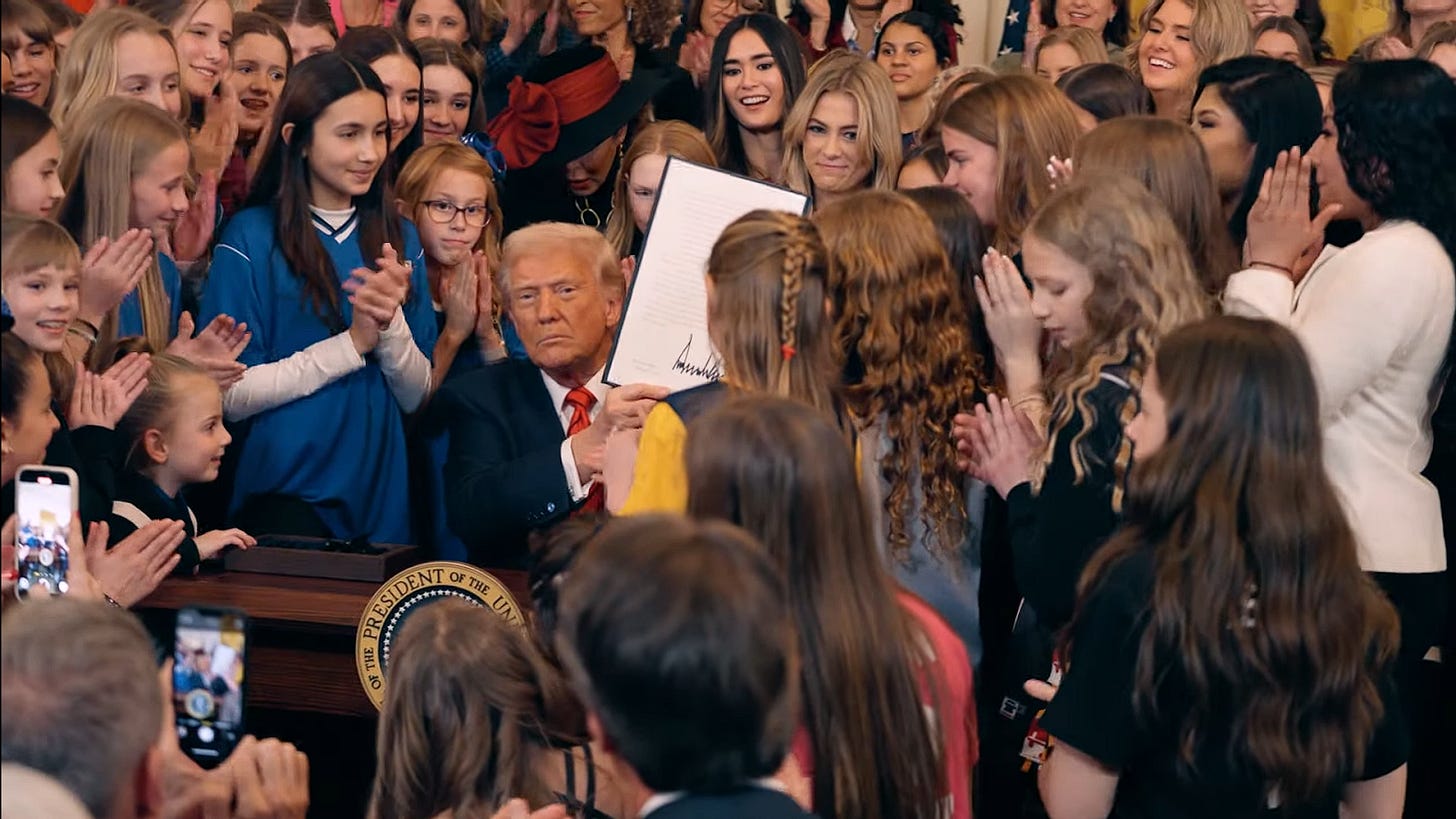
Trump signs an executive order calling for bans on trans women and girls from women’s sports. Photo by: The White House.
These bans have been successful in part because of a toxic and ruthless ecosystem of far-right influencers, like Riley Gaines, who have formed entire careers around attacking trans athletes by prioritizing hate and misinformation.
“So much of what we see … just seems like it’s wrapped up in really hateful and negative messages that aren’t good for anyone,” says Mary Fry, a professor of sport and exercise psychology at the University of Kansas. “We’re creating issues where maybe we don’t need to.”
Harassment and Mental Health
Grace McKenzie has been deeply affected by these hate campaigns. A lifelong athlete, McKenzie has stayed healthy by playing multiple sports where she’s met “amazing people.” Shortly after she transitioned in 2018, she was thrilled when she was invited to join a women’s rugby team at the afterparty of a Lesbians Who Tech conference.
Grace McKenzie. Photo courtesy of McKenzie.
“Rugby became my home, it was my first queer community, it was the space where I really discovered my own womanhood,” McKenzie told Uncloseted Media. “I could be the sometimes-masculine, soft-feminine person who play[s] rugby and loves sports.”
But that started to change in 2019, when McKenzie and others on her team started to hear rumors that World Rugby was considering a ban on trans athletes. Fearing the loss of her community, she started a petition that racked up 25,000 signatures—but it wasn’t enough, and the ban took effect in 2020.
As anti-trans rhetoric in sports has ramped up, McKenzie says she’s had soul-crushing breakdowns that have left her “sobbing uncontrollably and unconsolably.”
“It would be these waves of such intense despair and rage—it was like going through grief for five years,” she says. “I have to wake up every single day and read about another state or another group of people who say that they don’t want me to exist.”
While McKenzie says she’s found the strength to keep playing where she can, sports psychologist Erin Ayala has seen clients leave sports altogether due to the hate toward trans athletes.
“It can be really difficult when they feel like they’re doing everything right … and they still don’t belong,” says Ayala, the founder of the Minnesota-based Skadi Sport Psychology, a therapy clinic for competitive athletes. “Depression can be really high. They don’t have the strength to keep fighting to show up. And then that can further damage their mental health because they’re not getting the exercise and that sense of social support and community.”
That was the story of Andraya Yearwood, who made national headlines in high school when she and another trans girl placed first and second in Connecticut’s high school track competitions. The vitriol directed at her was intense: Parents circulated petitions to have her banned; crowds cheered for her disqualification; the anti-LGBTQ hate group Alliance Defending Freedom launched a lawsuit against the state for letting her play; and she faced a torrent of transphobic and racist harassment.
“It’s a very shitty experience,” Yearwood, now 23, told Uncloseted Media.
Fearing more harassment, she quit running in college.
“I understood that collegiate athletics is on a much larger and much more visible scale. … I just didn’t want to go through all that again for the next four years,” she says. “Track obviously meant a lot to me, and to have to let that go was difficult.”
It’s understandable that Yearwood and other trans athletes struggle when they have to ditch their favorite sport. A litany of research demonstrates that playing sports fosters camaraderie and teamwork and improves mental and physical health. Since trans people disproportionately struggle from poor mental health, social isolation and suicidality, these benefits can be especially crucial.
“In some of these cases, kids have been participating with a peer group for years, and then rules were made and all of a sudden they’re pulled away,” says Fry. “It’s a hard world to be a trans individual in, so it’d be easy to feel lonely and separated.”
Caught in the Crossfire
The anti-trans attacks in sports are also affecting cis women. Ayala, a competitive cyclist, remembers one race where she and her trans friend both made the podium. When photos of the event were posted on Facebook, people accused her of being trans, and she was added to a “list of males who have competed in female sports” maintained by Save Women’s Sports.
Ayala isn’t alone. Numerous cis female athletes have been “transvestigated,” or accused of being trans, including Serena Williams and Brittney Griner. During the 2024 Paris Olympics, Donald Trump and Elon Musk publicly accused Algerian boxer Imane Khelif of being trans after her gold medal win, as part of a wave of online hate against her. She would later file a cyberbullying complaint against Musk’s X.
While women of all races have been targeted, Black women have faced harsher scrutiny due to stereotypes that portray them as more masculine.
Yearwood remembers posts that would fixate on her muscle definition and compare her to LeBron James.
“I think that is attributed to the overall hyper-masculinization and de-feminization of Black women, and I know that’s a lot more prevalent for Black trans women,” she says. “It made it easier to come for us in the way that they did.”
Subscribe
A Big Distraction
Joanna Harper, a post-doctoral scholar at Oregon Health & Science University and one of the world’s leading researchers on the subject, says that the jury is still out on whether the differences in athletic performance between trans and cis women are significant enough to warrant policy changes.
“People want simple solutions, they want things to be black and white, they want good guys and bad guys,” Harper says, adding that the loudest voices against trans women’s participation do not actually care about what the science says.
“This idea that trans women are bigger than cis women, therefore it can’t be fair, is a very simple idea, and so it is definitely one that people who want to create trans people as villains have pushed.”
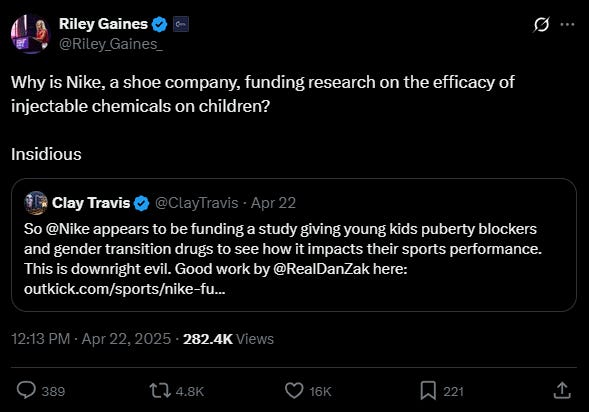
Even Harper herself has been the victim of the far-right’s anti-trans attacks. Earlier this year, she was featured in a New York Times article where she discussed a study she was working on with funding from Nike into the effects of hormone replacement therapy (HRT) on adolescents’ athletic performance.
Riley Gaines and OutKick founder Clay Travis attack Harper’s study on X.
“That Nike chose to fund a study on trans athletes doesn’t actually say that they’re supporting trans athletes. They’re merely supporting research looking into the capabilities of trans athletes,” Harper says. “You don’t know what the research will show until you get the data … but the haters don’t want any data coming out that doesn’t support what they want to say.”
Harper says this anti-trans fervor and HRT bans are making it more difficult to conduct studies in the first place.
And while the far-right argues that they are “protecting women’s sports” in their war on trans athletes, multiple athletes and experts told Uncloseted Media that this distracts from bigger issues in women’s sports, including sexualharassment by coaches and a lack of funding.
“If the real goal was to help women’s sports, they would try to increase funding [and] support for athletes,” says Harper, noting that women’s sports receive half as much money as men’s sports at the Division I collegiate level. “But that’s not what they’re doing, and it becomes pretty evident the real motivation behind these people.”
Since Trump’s reelection, Grace McKenzie has somewhat resigned herself to the likelihood of attacks on trans people getting worse. Despite this, she finds hope in building community with other trans athletes, such as the New York City-based trans basketball league Basketdolls.
“If that’s the legacy that [the anti-trans movement] wants to leave behind, good for them,” McKenzie says. “Our legacy is going to be one about hope, and collective solidarity, and mutual aid, and I would much rather be on that side of the fence.”
Meanwhile, Fry remains hopeful that conflicts can be resolved and that trans people may be able to find a place in sports over time.
“If we could all have more positive conversations and not create such a hateful environment around this issue, it would just benefit everyone.”
If objective, nonpartisan, rigorous, LGBTQ-focused journalism is important to you, please consider making a tax-deductible donation through our fiscal sponsor, Resource Impact, by clicking this button:
To win, Democrats must inspire the public in a fractured information age, engage meaningfully with the cultural shifts around race, gender, family, and migration, make democracy work despite obstructionists like Manchin and Sinema, and—most critically—deliver tangible results that improve people’s lives.
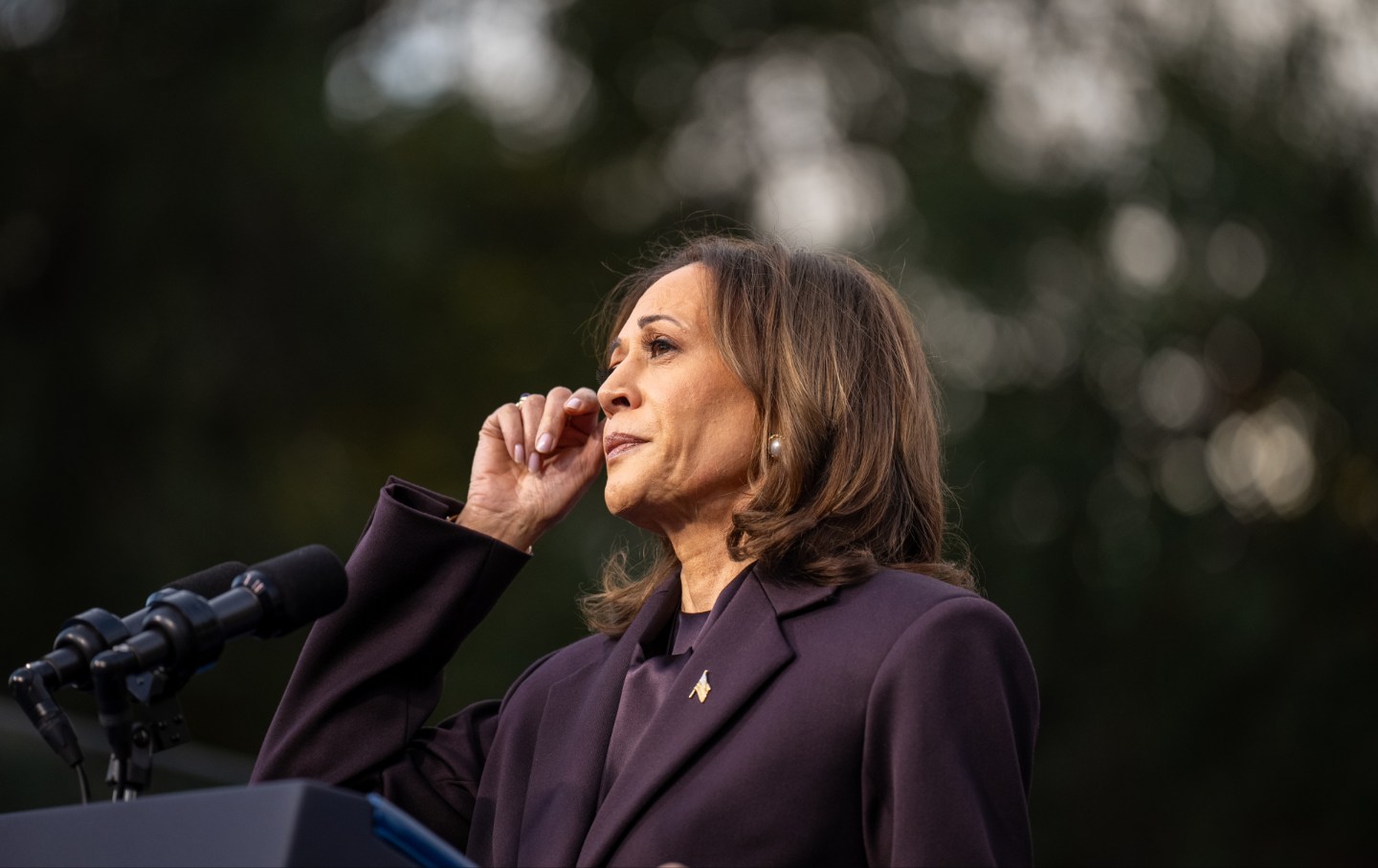
Kamala Harris pauses while speaking on stage as she concedes the election, at Howard University on November 6, 2024, in Washington, DC.
(Andrew Harnik / Getty Images)
In the aftermath of Kamala Harris’s loss, many pundits and politicians are turning to a familiar scapegoat. Critics like Adam Jentleson, a former aide to senators Harry Reid and John Fetterman, claim that “woke” advocacy groups made Democrats adopt extreme policies and drove voters away from the Democratic Party, sealing Donald Trump’s victory. But the truth is simpler—and more uncomfortable for the Democratic establishment. Despite the noise, voters didn’t reject Harris because of leftist rhetoric or activist slogans. They rejected her because she and her party failed to address the economic pain of working-class voters, who chose change over more of the same.
There’s a generation of Black and brown organizers, often the first in their families to step into positions of power, navigating institutions historically dominated by others. Alongside them are downwardly mobile white millennials, raised with expectations of stability but battered by an economy that delivers none. These activists, working within nonprofits and campaigns, fighting for causes once central to Democratic values, have somehow become scapegoats for the party’s electoral woes.
Why, after every electoral loss, is the left always the scapegoat? It’s easier to blame activists for pushing a progressive agenda than confront the real issue: the Democratic Party has long been shaped by far more powerful forces—corporate interests, lobbyists, and consultants—whose influence has neglected the real crises facing everyday Americans. We see this cycle again and again.
Contrary to establishment narratives, the Democratic leadership has often resisted advocacy organizations pushing for bold reforms on immigration, Big Tech, climate, debt, healthcare, rent, mass incarceration, Palestinian rights, and for policies like the Build Back Better agenda. This tension isn’t just about differing priorities—it reveals the actual balance of forces in the party. Corporate donors on Wall Street and Silicon Valley pour billions into campaigns, shaping agendas to suit their interests.A consultant class reaps millions from flawed strategies and failed candidates yet continues to fail upward, perpetuating a pattern of mediocrity. They, not progressives, are the roadblock preventing Democrats from becoming a populist force that could disrupt the status quo and win back voters of all stripes.
It was these elements within the party that kneecapped the Democrats’ most ambitious efforts to help ordinary Americans. The Biden administration entered with huge plans, notably Build Back Better, which would have delivered immediate relief: expanded child tax credits, free community college, universal child care and pre-K, paid leave, and more. Progressives pushed mightily for Build Back Better to pass. It was centrist obstruction—namely Senators Manchin and Sinema—that blocked those policies. The result was a patchwork of long-term measures like the Inflation Reduction Act and the Bipartisan Infrastructure Deal, whose benefits won’t be felt until 2025 at the earliest, if at all. By failing to pass Build Back Better, Democrats lost the chance to deliver easy-to-understand, tangible economic benefits and solidify their image as the party of working people.
And it was corporate Democrats—particularly lobbyists like Harris’s brother-in-law, former Uber executive Tony West, and David Plouffe—who held the most sway over Harris’s campaign. They advised her to cozy up to ultra-wealthy celebrities, Liz and Dick Cheney, and Mark Cuban, and avoid populist rhetoric that could have distanced her from the corporate elites who dominate the party. In 2024, the biggest spenders in Democratic Party politics weren’t progressives—it was AIPAC, cryptocurrency PACs, and corporate giants like Uber, all of whom poured millions into Democratic campaigns without regard for public opinion or the will of the people.
The Harris campaign’s messaging failed because, while populist economic appeals resonated with voters, the public face of the campaign was discouraged from embracing them. Instead, the focus was on issues like democracy and abortion, which, while important, couldn’t by themselves capture the priorities of working-class voters. In her public remarks and interviews, Harris, drawing on the advice of corporate leaders, frequently adopted a Wall Street–friendly tone that resonated with business interests, even if it alienated many of her core supporters.
It’s easy to forget that in 2020, Democrats saw historic turnout, driven largely by young voters who were energized by the largest left-wing and Black freedom protests since the 1960s. Biden won, and Democrats seemed to capture the nation’s hunger for justice and change, even as protesters marched with polarizing slogans like “Defund the Police.” Despite the controversy surrounding these messages, Biden triumphed decisively, calling for racial justice. The energy in the streets reflected a moment of possibility, a vision that real change was within reach. But by 2024, that grassroots energy had dissipated, and the Biden-Harris administration did little to revive it.
The loss of energy that Biden and Harris presided over showed up in youth turnout, which dropped to 42 percent in 2024, down from 50 percent in 2020 and closer to 2016 levels. However, battleground states saw higher youth turnout, around 50 percent. Young voters favored Harris over Trump by four points (51 percent to 47 percent), a sharp decline from Biden’s 25-point lead in 2020. The administration’s failure to offer a compelling narrative or deliver meaningful economic reforms alienated many young voters, especially on issues like unconditional weapons transfers to Israel.Trump capitalized on this vacuum with false promises and an anti-war message. Meanwhile, young workers, hit hardest by inflation and stagnant wages, saw little relief from the administration’s policies, leaving them feeling unseen and unmotivated. The simplest explanation may be the most accurate: after four years in opposition, Democrats under Biden had no plan for countering centrist obstruction from Manchin and Sinema. Nor did they have a clear strategy for transitioning to a new candidate, as Biden once suggested, or supporting a contested 2024 primary.
This disconnect was made worse by the administration’s lackluster communication strategy. Biden has avoided the media more than any modern president. In contrast, Mexico’s President Andrés Manuel López Obrador (AMLO) dominated the narrative with daily, three-hour, entertaining, and combative press conferences that have earned him one of the largest YouTube followings in Mexico. AMLO’s approach to the attention economy helped his party to secure another presidential term, defying global anti-incumbent trends.
Biden and Harris’s reluctance to embrace what some Democratic elites might view as “tasteless” or “uncouth” populist appeals allowed their opponents to seize the public’s attention, creating a void that ultimately drained the administration of the energy and momentum it once had. Trump’s simple, emotionally charged narrative about fixing the economy, winding down foreign wars, restoring order, and protecting “traditional” American values may have been filled with bigotry and lies. But it commanded the public discourse, pushing the Biden-Harris administration off center stage.
It’s true that some younger leftists embrace purity politics. But as Semafor’s Benjy Sarlin points out, the most polarizing moments in recent Democratic campaigns—like Beto O’Rourke’s “Hell yes” remark on gun confiscation or Julián Castro’s call to decriminalize border crossings during the 2020 primaries—were driven by the candidates themselves, not external activist pressure. Why did Kamala Harris take the positions she did in 2019? Because she was trying to distinguish herself in a crowded Democratic primary, where Bernie Sanders and Elizabeth Warren were surging and Biden seemed to have the center locked down. Ultimately, these moves were about gaining media attention in a competitive primary, not a direct result of pressure from advocacy groups—many of which, like Sunrise Movement, Working Families Party, and Justice Democrats, with which I was affiliated, have spent years working within the system to create lasting change and deliver real policy results that resonate with voters
The backlash against “wokeness” often rests on vague critiques, offering little more than cultural hand-wringing without any clear solutions. And when those solutions do emerge, they’re often morally indefensible. Jentleson’s criticism of progressive advocacy groups rings especially hollow when you consider the track record of his own political mentors. In 2010, his former boss, Harry Reid, publicly opposed the “Ground Zero mosque,” a proposed Islamic cultural center near the World Trade Center. While technically acknowledging the developers’ rights, Reid capitulated to Republican culture wars by suggesting Muslim Americans build the mosque elsewhere. This wasn’t a principled stance—it was a political maneuver that lent legitimacy to Islamophobia, feeding into narratives from figures like Sarah Palin and Newt Gingrich, who compared the center to a Nazi building next to the Holocaust Museum. In doing so, Reid allowed bigotry to flourish, leaving a vulnerable community to bear the brunt of political scapegoating.
From asylum seekers to transgender rights, today’s debates mirror the “Ground Zero mosque” controversy. From 2017 to 2020, Democrats, including Harris, were eager to condemn Trump’s cruel immigration policies. Now, however, they seem more focused on dodging the topic altogether. These are issues demanding a new approach, one that emphasizes year-round persuasion and agenda-setting over political convenience. Thermostatic public opinion might be a reality of politics, but voters appreciate when you stand for something with conviction and authenticity.
This is where movements and parties work best together: movements push the boundaries of what’s possible, creating the political space to reframe issues like transgender rights and immigration in majoritarian terms, and politicians follow when the political weather aligns with their self-interest. These two sides will clash, but it’s in that tension that progress lies.
Democrats can’t be scared of that process. They must stop ceding the narrative to far-right framing and instead invest in populist campaigns that aren’t afraid to antagonize villains, highlight the humanity of marginalized communities, and expose the Republican Party’s divide-and-conquer tactics. Only then can they build the political power necessary to shift the conversation and secure real change.
Anyone who knows me knows I’m critical of the academic jargon and misguided tactics that sometimes dominate activist circles. But to blame activists for the party’s struggles is to overlook the much larger battles they’re engaged in: 11 million undocumented Americans left in limbo, a prison system that incarcerates more people than any other in history, and an economy where three people hold more wealth than the bottom half of the country. These are the moral tests of our time—tests that any party claiming to stand for justice will be judged by. Scapegoating those pushing for change isn’t just unfair; it’s counterproductive, fracturing necessary coalitions and undermining the ability of the party to tackle the crises ahead.
Harris’s defeat should prompt serious introspection for Democrats—but not the narrow, one-sided critique Jentleson offers. Everyone, including progressive advocacy groups, has lessons to learn. The path forward isn’t about hippie-punching—it never has been. Time and again, the center-left’s response to electoral defeat has been to blame the unpopular and disruptive activists pushing for progress, whether abolitionists, suffragettes, labor unions, civil rights leaders, or environmentalists.
History reveals that oversimplified approaches often sidestep the harder questions. Success doesn’t come from rejecting the complexity of a diverse coalition but from learning to navigate it. To win, Democrats must inspire the public in a fractured information age, engage meaningfully with the cultural shifts around race, gender, family, and migration, make democracy work despite obstructionists like Manchin and Sinema, and—most critically—deliver tangible results that improve people’s lives.And if the corporate, status quo–loving forces within the party are standing in the way of that mission, they must be moved aside.
Success will come not by pointing fingers but by telling a story of transformation—with clear villains, bold vision, and conviction that democracy can, indeed, make a difference.






 Scottie's Playtime