I am posting a different article on this kidnapping and disappearing of a long time resident and family man because the right wing media keeps telling us that they are detaining the worst of the worst, only deporting the dangerous criminals. The thug in charge of ICE Tom Homan keeps mumbling that anyone protesting is wanting rapist, arsonists, murders gang drug runners in your neighborhood. This man was a green card holder and a threat to know one. They way that ICE treated his elderly wife was horrific in itself. Hugs
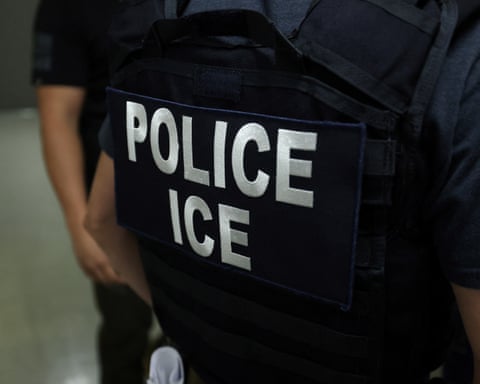
An Immigration and Customs Enforcement (Ice) agent. Photograph: Charly Triballeau/AFP/Getty Images
An 82-year-old man in Pennsylvania was secretly deported to Guatemala after visiting an immigration office last month to replace his lost green card, according to his family, who said they have not heard from him since and were initially told he was dead.
According to Morning Call, which first reported the story, longtime Allentown resident Luis Leon – who was granted political asylum in the US in 1987 after being tortured under the regime of the Chilean dictator Augusto Pinochet – lost his wallet containing the physical card that confirmed his legal residency. So he and his wife booked an appointment to get it replaced.
When he arrived at the office on 20 June, however, he was handcuffed by two Immigration and Customs Enforcement (Ice) officers, who led him away from his wife without explanation, she said. She said she herself was kept in the building for 10 hours until relatives picked her up.
The family said they made efforts to find any information on his whereabouts but learned nothing.
Then, sometime after Leon was detained, a woman purporting to be an immigration lawyer called the family, they said, claiming she could help – but did not disclose how she knew about the case, or where Leon was.
On 9 July, according to Leon’s granddaughter, the same woman called them again, claiming Leon had died.
A week later, however, they discovered from a relative in Chile that Leon was alive after all – but now in a hospital in Guatemala, a country to which he has no connection.
According to Morning Call, the relative said Leon had first been sent to an immigration detention center in Minnesota before being deported to Guatemala – despite not appearing on any Ice detention deportation lists.
Ice on Monday evening denied the Morning Call story, calling it a hoax.
Morning Call claimed it repeatedly requested confirmation and details from Ice throughout its reporting. Morning Call also claimed it was introduced to the family during a Lehigh county courthouse protest over Ice’s operations there.
It noted the family ceased responding to its requests for clarification on Monday.
A recent supreme court decision ruled the Trump administration could deport immigrants to other countries beside their country of origin.
In his nearly 40 years living in the US, Leon spent his career working in a leather manufacturing plant, and raised a family. He had since retired.
He suffers from diabetes, high blood pressure and a heart condition, according to his family, who said they are planning to fly to Guatemala to see him.
An Ice official told the Morning Call it was investigating the matter. The Guatemala Migration Institute denied that Leon was deported from the US to Guatemala.
Morning Call reported on Sunday that Leon was recovering from pneumonia in Guatemala, according to his family, and that he arrived in Guatemala City on 1 July. According to the family, reported Morning Call, his phone was taken away and Ice officers kept referring to him and other detainees as “Mario.”
It’s all a lot of money. But one party doesn’t get the amounts of dark money that the other party receives; one party has access to the US Treasury through POTUS that the other party does not have, as well.
House and Senate candidates recently filed their fundraising reports covering the first six months of 2025. OpenSecrets analyzed the data to determine which candidates have raised the most money and which ones are sitting on the biggest piles of cash.
Let’s start with a look at Senate races. Jon Ossoff (D) is seeking reelection in Georgia, where he won his first term in the most expensive Senate race in history. (That record has since been broken). During the first half of this year, he raised more money than any other candidate running in 2026.
Sen. Cory Booker (D-N.J.), who was fifth in fundraising, has the most cash on hand, with Ossoff running third after this big first-half haul.
As of today, the well-respected Cook Political Report has identified three tossup races that could determine control of the Senate in 2027: Georgia, Michigan and North Carolina. The Tar Heel State race just moved into that category because Sen. Thom Tillis (R) announced his retirement June 29, so the candidate field has not yet solidified.
The three most senior members of the House of Representatives rank among the top fundraisers this year, but they were dwarfed by Rep. Alexandria Ocasio-Cortez (D-N.Y.), who raised $6.7 million more than Rep. Mike Johnson (R-La.), the speaker of the House.
Ocasio-Cortez and Rep. Ro Khanna (D-Calif.) raised the most among Democrats and also have two of the biggest stockpiles of campaign cash heading into the second half of the year. It remains to be seen whether Rep. Elise Stefanik (R) will stand for re-election to Congress or make a run for governor of New York in 2026. Rep. Raja Krishnamoorthi (D-Ill.) is running for an open Senate seat.
This article was originally published by OpenSecrets, a nonpartisan, nonprofit organization that tracks money in politics. View the original article. (The original includes pertinent charts that make the article make better sense. I recomment clicking through; I’m not sure why their republish code doesn’t include the charts. I tried to copy them separately to insert them, but copying was not allowed. -A.)
Last year, a little-known office in the U.S. Department of Labor helped Black workers at a Texas medical center recover $900,000 in back wages, and Black workers at a Caterpillar manufacturing plant in Illinois recover $800,000, each time over allegations that those applicants lost out on jobs because of their race. Called the Office of Federal Contract Compliance Programs, this division investigates and fights employment discrimination for one-fifth of the U.S. labor force. It was created in 1965 when President Lyndon B. Johnson signed an executive order strengthening the provision of the Civil Rights Act of 1964 that banned racial discrimination by employers. The O.F.C.C.P. specifically enforced the law among businesses and institutions that contracted with the government or received federal funds. The landmark law also banned segregation and discrimination in all public places, including schools, libraries, restaurants and buses.
For more than 60 years, the executive order helped many thousands of workers who had endured discrimination. Yet despite the law, research shows that Black Americans continue to face pervasive employment discrimination at a rate that has not declined since the late 1980s.
On his second day in office, President Donald Trump labeled O.F.C.C.P.’s efforts to enforce the 1964 Civil Rights Act illegal and discriminatory — presumably against white people. He signed his own executive order revoking Johnson’s on behalf of, as he put it, “hardworking Americans who deserve a shot at the American dream.”
Within the week, Trump’s acting secretary of labor ordered the O.F.C.C.P. to “immediately cease and desist all investigative and enforcement activity” and close all open cases. A few weeks later, O.F.C.C.P.’s acting director proposed slashing its staff by 90 percent. In fewer than two months, six decades of civil rights enforcement was essentially dead.
Trump has justified these actions by claiming he is rooting out racial discrimination disguised as “diversity, equity and inclusion.” Indeed, the other federal agency charged with investigating employment discrimination, the Equal Employment Opportunity Commission, recently created a page on its website dedicated to helping white Americans file complaints based on being victimized by diversity, equity and inclusion programs.
But to see what Trump is doing as simply eliminating so-called “D.E.I.” is to misunderstand the scale and the consequences. What’s at stake is not only corporate diversity trainings, equity offices and the use of pronouns in email signatures. Many diversity, equity and inclusion programs were put in place to help ensure compliance with civil rights laws and to foster integration in a society that for most of its history explicitly discriminated against Black Americans. No court has deemed these programs illegal. Yet in the opening months of his second term, Trump has capitalized on the unpopularity of equality efforts among some Americans, glibly wielding the language of D.E.I. to initiate the broadest and most significant assault on civil rights and racial integration in this country in more than a century.
Image
President Lyndon B. Johnson meeting with civil rights leaders (from left, Rev. Dr. Martin Luther King Jr., Whitney Young and James Farmer) in January 1964, months before the signing of the Civil Rights Act.Credit…GHI/Universal History Archive/Universal Images Group, via Getty Images
Since returning to power, Trump has used his singular authority as the head of the federal government to recast the white majority as the primary victims of systemic racial discrimination — though no evidence, not even self-reporting among white people, shows this to be true. In addition to upending long-established enforcement of civil rights law in employment, he has undermined civil rights protections in housing and education and environmental policy; crippled or shuttered entire federal civil rights agencies; and retracted federal findings of civil rights violations against police departments.He has forced by mandate, threat and coercion the elimination of policies and cultural norms focused on integration and equality throughout government, education and the private sector. Trump has claimed — though he has no authority to do so — to have repealed birthright citizenship, which was embedded in the Constitution at the end of slavery to guarantee Black Americans citizenship by birthright and grants automatic citizenship to all people born on American soil.
Trump’s actions have not materialized out of nowhere. Conservatives have spent decades chipping away both at civil rights protections and the national will to address racial inequality. Since the racial reckoning of 2020, Republicans have toppled affirmative action in college admissions and waged an enormously successful campaign to make the language of equity and inclusion anathema, to label books and lessons about the nation’s history “anti-white” and “divisive” and to prohibit everything from Black studies to university diversity offices. And earlier this month, the Supreme Court, which over the years has made it increasingly challenging for Black Americans to prove discrimination, has now made it easier for straight white people to do so.
The notion that equality efforts have gone too far has proved seductive to many white Americans, who are the least likely of all groups to believe that racism is an obstacle for Black Americans. Polling shows the majority of Republicans see efforts to ameliorate racism as “making life more difficult for white Americans” and believe that racism against Black Americans was a problem in the past, but that now white Americans suffer from racism more than any other group.
And Trump’s message is most likely finding a broader audience. Pew Research Center polling on racial attitudes six months before the 2024 election showed that the percentage of Democratic voters who believed white people “benefit a great deal from advantages in society that Black people did not have” plummeted 15 points in just two years. The legal scholar Ian Haney López explained what he believes caused the rapid decline. “Many white liberals were themselves skeptical of diversity, equity and inclusion, were themselves disposed to complaints about ‘wokeness’ and its demands that people be sensitive about speech around racial issues,” he told me. “And so now when there are all these attacks on D.E.I., there are surprisingly few defenders.”
Still, the efficiency with which Trump has collapsed the civil rights and equality infrastructure of the federal government has stunned the nation’s veteran civil rights leaders. “This is a full-on assault on all that we have gained in the last 125 years,” Maya Wiley, president and chief executive of The Leadership Conference on Civil and Human Rights, told me. “Civil rights is the architecture of democracy, so the only reason you do this is because you are trying to steal democratic power from people.”
Civil rights activists fear that the threat of losing federal funds or being investigated and punished for trying to integrate, combined with the decimation of the entities charged with defending them, is creating an environment where institutions will be afraid to admit too many Black students, hire too many Black staff members or put scientific, medical or economic resources toward alleviating the singular disparities Black people still face across American life. The Trump administration is “actually creating incentives to exclude Black folks,” says LaTosha Brown, a community organizer and co-founder of Black Voters Matter.
The resounding success of the civil rights movement was in largely convincing American society that racism was wrong. But its citizens never agreed on how best to correct racism’s harms. While it seems clear that, say, when it comes to crime, passing laws alone is not enough (that’s why we have law enforcement), we can lose sight of that principle when it comes to the rights of minority groups. If you are a member of the racial majority, or the group that holds power, rights can feel both innate and abstract, invisible and assumed. But for Black Americans and other historically marginalized groups, the right to be treated as equal citizens, to be treated fairly by the government, private companies and individuals, has for most of the history of this country not been guaranteed. These rights needed to be codified and enforced precisely because the deprivation of those rights was codified and enforced for almost as long as this country existed. When in the past the federal government stopped enforcing these laws, those rights have always deteriorated.
Today, as the Trump administration is systematically taking apart the enforcement apparatus of the federal government, agency by agency, it is sending a powerful message to American institutions that discrimination will not be punished. This may once again leave Black Americans with rights that exist largely on paper.
The ‘Colorblindness’ Trap: How a Civil Rights Ideal Got Hijacked
The fall of affirmative action is part of a 50-year campaign to roll back racial progress.
March 13, 2024
No cornerof the massive federal bureaucracy is being left untouched by Trump’s dismantling of civil rights. In March, Lee Zeldin, administrator of the Environmental Protection Agency, shuttered the Office of Environmental Justice and External Civil Rights and announced he was eliminating all 10 of its regional divisions. President George H.W. Bush established the office in 1992 because he saw the disproportionate exposure to deadly pollutants, toxic waste and pesticides faced by Black people and other marginalized groups across the country as an issue that the federal government needed to address. Over three decades, the office has worked to protect communities suffering and dying from industrial pollution and to track the impacts of pollution and climate change.
To Zeldin, these efforts amounted to “D.E.I.” and “forced discrimination” — though it is unclear how or against whom. In March, the administration moved to dismiss a landmark environmental-justice suit in Louisiana against a chemical plant located in a poor, predominantly Black community where the cancer risk was so high — the highest in the country, in fact — that a nearby elementary school had to be shuttered. The government had been moving to curb the plant’s dangerous emissions, and the case was set to go to trial in April, before the administration abandoned it. The Trump administration has also terminated a settlement requiring officials in a rural Alabama town to help families in another poor Black community that had been exposed to raw sewage for decades.
Trump has scuttled the entire civil rights divisions of the Social Security Administration and the Department of Homeland Security, and closed the division in the Department of Veterans Affairs that sought to address longstanding racial disparities in how veterans receive compensation for their disabilities.
In April, Trump issued another executive order that seeks to abolish the linchpin of modern civil rights enforcement, known as “disparate impact liability.” Sixty years after the civil rights movement made racial discrimination illegal, discrimination is rarely explicit. Disparate impact recognizes that nearly all discrimination today is covert and hidden behind race-neutral policies or actions. When state legislators create new congressional maps that eliminate majority-Black districts, for instance, they are not going to declare that they are doing so to dilute Black voting power. But under disparate impact, Black residents don’t have to prove that legislators intended to discriminate. They can prove discrimination if the accused cannot show that there was a legitimate reason for the disparity and that there weren’t other actions they could have taken that would have done less harm. Without disparate impact, it would be impossible for most people who have experienced discrimination in housing or employment or education to prove it, and so its elimination would essentially gut any remaining ability to enforce civil rights law today.
In the realm of housing, the administration has repealed a federal rule making clear that cities, counties and states that receive federal funding must take seriously their obligation, enshrined in the 1968 Fair Housing Act, to take proactive steps to integrate housing. It has also slashed funding for enforcement against housing discrimination and promised to cut in half the staff of the Department of Housing and Urban Development, which enforces the Fair Housing Act.
Image
President Trump signing executive orders, including “Ending Radical and Wasteful Government D.E.I. Programs and Preferencing,” on Jan. 20, 2025, hours after being sworn into office.Credit…Anna Moneymaker/Getty Images
Civil rights enforcement at the Department of Education is similarly being taken apart. The administration announced that it was eliminating seven of the department’s 12 regional civil rights offices, which compel schools to integrate, collect educational data that reveals racial and other disparities and investigate discrimination in schools and universities.
The Education Department sent a letter to all educational institutions receiving federal funds asserting without evidence that they were engaging in “pervasive and repugnant race-based” discrimination against white and Asian students. Federal data shows that Black students are disproportionately concentrated in schools with fewer resources and less funding, and experience significant academic disparities. And yet the letter told public schools and universities that they had 14 days to purge all diversity and equity efforts — which include programs that try to help diversify teaching staffs and help Black students close the achievement gaps they suffer from nationwide — or lose access to federal funds.
This reveals another powerful tool the Trump administration is using to subvert civil rights: the might of the federal dollar. By withholding federal money from integration and equity programs, it is turning the Civil Rights Act against its aims. The law originally derived its tremendous power not just from the authority it gave the federal government to sue to force compliance but from the way it deployed federal money to incentivize integration and fair treatment. Recognizing that schools, local and state governments, universities and thousands of private employers, from airplane manufacturers to pharmaceutical companies, received billions of federal dollars to do their work, the law gave the government the power to strip funds from any organization that discriminated against not just Black people but anyone based on their race, color or nationality (and later gender, disability, sexuality and veteran status). These categories of people were called “protected classes” precisely because they belonged to marginalized groups whose rights needed protection from the majority.
It was the threat of both lawsuits and losing federal funds — a full decade after the Supreme Court’s Brown v. Board of Education decision made school segregation illegal — that finally forced recalcitrant Southern school districts to desegregate. Now the Trump administration is dismissing longstanding federal court orders against school districts that still have never fully integrated, and using the law to force the end of programs designed to eliminate racial disparities that Black and other students face.
But probably the starkest change is the redirecting of the Department of Justice away from fighting anti-Black discrimination and toward eliminating integration efforts. Harmeet Dhillon, the new head of the department’s Civil Rights Division, sent a memo to the staff making it clear the mandate going forward would be to enforce Trump’s executive orders targeting diversity programs.While Black Americans have historically relied on the federal government to vindicate their rights when facing discrimination from state and local officials, the Trump administration has moved to dismiss voting rights and civil rights cases involving police departments and close Department of Education investigations into anti-Black discrimination, at the same time that it is bringing new investigations against institutions that have diversity programs. The Civil Rights Division of the Justice Department was created by the Civil Rights Act of 1957 precisely for the purpose of protecting the voting rights of Black citizens and prosecuting crimes against civil rights workers. The remaking of the storied division into one that no longer focuses on defending the civil rights of marginalized groups has led to a mass exodus, with some 70 percent of its attorneys leaving or planning to leave, according to recent news reports.
Black Americans may now struggle to find protection of their civil rights in the private sector as well. In mid-March, the E.E.O.C.’s acting chair, Andrea Lucas, sent letters to 20 of the nation’s most prominent law firms questioning whether their employment practices, including their work to integrate the profession, are violating the 1964 Civil Rights Act. Lucas demanded that the law firms provide extensive hiring and compensation data for staff and fellowship programs, and has encouraged employees to report their firms for engaging in “potentially unlawful” diversity efforts. Lucas used the firms’ own promotion of their integration work as evidence that they may be discriminating against white people. But this claim stands in stark contrast to the data: Despite these diversity efforts, just 4.4 percent of lawyers at law firms nationwide are Black.
A few days after Lucas sent her letters, Trump announced that one of the nation’s most prestigious firms, Paul Weiss, agreed to eliminate its integration programs and allow an auditor to search out any diversity and equity employment practices, among other concessions. In a statement sent to colleagues, the firm’s chairman said it was retaining its “longstanding commitment to diversity in all of its forms,” but agreed to “follow the law with respect to our employment practices.”
By targeting these law firms, Trump seems to be trying to kneecap the private civil rights enforcement infrastructure as well. Most of the firms that received Lucas’s letter have partners or other attorneys who sit on the board of the Lawyers’ Committee for Civil Rights Under Law, which was formed in 1963 after President John F. Kennedy convened a meeting of more than 200 lawyers to help defend the rights of Black Americans. Last year, the Paul Weiss firm was recognized for its pro bono work with the organization, including partnering on suits against the white-nationalist groups the Proud Boys and the Patriot Front. Private firms and in-house corporate legal departments have donated more than one million pro bono hours to the Lawyers’ Committee and its clients in the last decade alone. Now Paul Weiss has agreed to do pro bono work for the administration. The capitulation roiled the profession.
“The Lawyers’ Committee got the commitment of America’s most prominent, most powerful law firms to assure fairness and equality through enforcement of civil rights,” says William Robinson, a former executive director of the Lawyers’ Committee. “That’s what Trump is attacking.” Trump, he said, is dismantling the Civil Rights Act “by executive fiat.”
President Trump claims that destroying what he calls “D.E.I.” will return the United States to a meritocracy, and, in his words, bring a new American “golden age.” But the metaphor reveals more than it perhaps intends. America’s last golden age was called the Gilded Age, an era around the turn of the last century known for its rapid economic growth and ostentatious wealth. But there’s a reason that era evokes an image where Black people exist outside the frame. What Trump calls the golden age, Black Americans call the Nadir, the lowest point, a term coined by the historian Rayford W. Logan to describe the period when, with the blessing of the federal government, the rights that Black Americans achieved following slavery’s demise were violently and systematically taken away.
It can be hard to imagine how quickly racial progress can disappear. But consider that during Reconstruction, Radical Republicans in Congress propelled the establishment of the first national civil rights in the country’s history. Congress passed a series of laws and constitutional amendments granting Black Americans citizenship by birthright; protecting their right to vote, hold office and serve on juries; and prohibiting discrimination in housing, public places and on public transit. Under the protection of the federal government, Black Americans were able to own land, start businesses, build schools and colleges, work middle-class jobs in the federal government, vote and serve in office. In 1870, for example, Hiram Revels became the first Black person elected to the U.S. Senate, representing Mississippi, and in 1873, Henry Hayne became the first Black man to attend the University of South Carolina, making it the only integrated public university in the South. These were stunning feats in majority-Black states that less than a decade earlier enslaved nearly all the Black people within their borders. Progress must have felt inevitable.
Image
A woodcut from 1870 depicting Hiram Revels, Republican of Mississippi, taking the oath of office to become the nation’s first Black senator.Credit…Bettmann/Getty Images
But just four years later, in 1877, the Republican Rutherford B. Hayes, following a contested presidential election, secured Southern Democratic support by agreeing to withdraw federal troops who protected Black Southerners from the violence of their former enslavers and insured their ability to cast a ballot.
Though the rights of Black Americans remained enshrined in the Constitution, almost immediately states began to pass both explicit segregation laws and so-called “race-neutral” laws such as grandfather clauses, which dictated that men whose grandfathers had cast a ballot before 1867 were the only ones guaranteed the right to vote. These laws almost completely disenfranchised Black people, of course, because before then nearly all Black people had been enslaved and were therefore unable to vote.
Forced to live under what W.E.B. Du Bois called the “veil” of codified segregation and racial oppression, Black people were vanquished from institutions, workplaces and public spaces they once shared with white Americans. Under the cover of law, states stripped Black Americans of their ability to vote, to serve on juries, to ride on integrated train cars, to shop in integrated stores. For nearly a century, there would be no more Black senators and no Black students at the University of South Carolina, as the America that could have been succumbed to the America that always was.
As racial apartheid was being systematically erected on a state level, Black people looked to the federal government for protection. But in 1913, President Woodrow Wilson, whose father was an enslaver and a chaplain in the Confederate Army, nationalized Jim Crow when he allowed the federal government to segregate its work force, putting the presidential stamp of approval on discrimination against Black citizens.
It is no accident that we remember so little of this time when Black Americans won their rights and then quickly lost them. Much of this amnesia was a consequence of a sophisticated disinformation campaign promulgated by a turn-of-the-century version of the Moms for Liberty — a group of white women called the United Daughters of the Confederacy. Following the Civil War, the United Daughters worked to cement the “Lost Cause” narrative across the South by successfully advocating that school textbooks and curriculum and public monuments valorize the white slaveholding South and justify the stripping of Black Americans’ rights. They advanced a narrative that Reconstruction had been a failure because Black people — unscrupulous, ignorant and incapable of self-governance — had ascended into positions that were rightfully white. In her 1895 textbook, “A School History of the United States,” Susan Pendleton Lee, a member of the Lexington, Va., chapter of the U.D.C. who said she aimed to give children “a just and interesting account of the whole country,” wrote that “many of the Negroes in the legislatures, in the courts of justice, and in the magistrate’s chair could neither read nor write, and were unable to understand any of the important questions of the troublous times. Government administered by such irresponsible hands, became every day more unjust and corrupt,” while “ the hard lot of the intelligent, cultivated white population … saw the States they loved so well thus ruined and degraded.”
Today conservatives rely on a similar forced forgetting, rebranding their attacks on civil rights as an attempt to defend them. This subversion reduces the 1964 Civil Rights Act to a simple mandate to make colorblindness — a blindness to the existence and saliency of race — the law of the land. It is an ahistoric interpretation that treats those who today try to use race to integrate as equivalent to those who once used race to segregate. By this logic, the Civil Rights Act itself becomes unmoored from the very legacy of anti-Blackness that forced Congress to pass the law in the first place.
But all the civil rights acts going back to the 1800s — all of them — were passed by Congress to try to end the subordination, discrimination and segregation of a people whose ancestors were enslaved. Millions of Americans living today took their first breaths in a country where, because they are Black, they were excluded by law from homes, from neighborhoods, from loans, from schools, from parks, from universities, from jobs, from stores, from restaurants, from hospitals, from libraries and, in some parts of the country, from entire professions.
There is no resemblant history for white Americans, and no evidence that white Americans today face systemic discrimination in a nation where they remain the majority and where the federal government and most institutions, especially this nation’s most elite ones, are still overwhelmingly run by white people. This is how the efforts to erase the history of racism and Black American freedom struggles intersect with the efforts to roll back civil rights. Over the last few years, in the name of equality, many Republican-led states have passed laws that forbid accurate teaching about racism and encourage the purging of books and curricula about Black Americans and other marginalized groups. President Trump is now federalizing these laws, forcing them onto states, universities and communities. He is promising to take over this nation’s most prestigious public museums and purge them of exhibits that “divide Americans based on race, or promote programs or ideologies inconsistent with Federal law and policy.”
That’s because every lesson plan and plaque that recounts slavery or legal discrimination, every commemoration that celebrates Black firsts, reminds us why civil rights laws and enforcement agencies, race-conscious research and diversity hiring and educational policies were required to begin with, and why they remain necessary today.
By deploying the Civil Rights Act against the very people it was created to protect, conservatives hope to get as close to their ultimate goal as possible: repealing it. The mainstream conservative writer Christopher Caldwell argues that the Civil Rights Act of 1964 forced upon society a new Constitution irreconcilable with the first. He has argued that efforts to enforce the law robbed the South of its democracy and created onerous rules that limited American freedoms.His analysis diminishes the fact that “democracy” in the South before the civil rights acts existed only for white people, and that the act vastly expanded freedoms for Black Americans and other marginalized groups. White men, Caldwell wrote in his 2020 book, “The Age of Entitlement: Americas Since the Sixties,” “fell asleep thinking of themselves as the people who had built this country and woke up to find themselves occupying the bottom rung of an official hierarchy of races.”
That sentiment about the Civil Rights Act is evidently shared by Mike Gonzales, a senior fellow at the Heritage Foundation, the conservative think tank that published “Project 2025.” He wrote in February that Trump is “on the warpath against the radical ’60s,” adding “many of the things that conservatives are setting out to dismantle have their origin in that fateful decade.”
An America without the ’60s, of course, is an America without civil rights, women’s rights, immigrant rights, disability rights and gay rights. It is an America where meritocracy did not and could not exist.
The astounding ambit of Trump’s first months has made it possible to imagine a future that looks eerily like the past. An America where the Constitution still stands, but Black people and other marginalized groups receive virtually no protection from the federal government, and the actions of that government instead encourage discrimination. An America where Black people may nearly disappear, first from textbooks, curriculum and museums, and then from predominantly white institutions and entire professions, such as law, medicine and science, where they are already severely underrepresented. And since conservatives are also threatening and defunding medical and other programs at historically Black colleges and have sued even Black organizations that have tried to specifically help Black people, the America Trump may be bringing about is an America that the vast majority of Black Americans alive today have never lived in — a second Nadir.
It may seem unfathomable. But history provides a warning: In this country, when the circumstances are right, the fragile norms around race can be dislodged, and freedoms can erode and then evaporate.
Read by Janina Edwards
Narration produced by Krish Seenivasan
Engineered by Alec K. Redfearn
Source photographs for top illustration: George Doyle/Stockbyte, via Getty Images; Gravity Images/The Image Bank, via Getty Images; Mint Images, via Getty Images.
Nikole Hannah-Jones is a domestic correspondent for The New York Times Magazine covering racial injustice and civil rights.
This is entirely about erasing the LGBTQ+ community from society. They teach and preach hate about us then use that acts of violence and vandalism to claim the “public” is against the LGBTQ+ representation. Why we generate such hate for just living our lives openly like they do is beyond my understanding. The people pushing hardest to erase the LGBTQ+ have only misunderstood texts in their holy book written over centuries in different cultures and languages. Yet they read it as if the words they are reading mean the same now or are correctly translated. And still that doesn’t give them the right to remove the LGBTQ+ from the public square and teach hate against us. The reasons given by the transportation secretary are meaningless garbage and complete untrue. Hugs
In a literal erasure of LGBTQ+ identity in South Florida, the city of Boynton Beach has complied with recent orders from Gov. Ron DeSantis (R) and the Trump administration to eliminate a rainbow crosswalk in the beachside city.
Video reveals a road crew painting over the once-colorful intersection at East Ocean Avenue and Southeast First Street on Wednesday morning. It’s now painted black.
Boynton Beach has “removed the inclusionary-painted intersection on the 100 block of East Ocean Avenue to ensure full compliance with state and federal transportation mandates and address safety concerns,” a statement from the city read. “The decision follows recent guidance from the U.S. Transportation Secretary and the Florida Department of Transportation.”
The Pride commemoration was first unveiled in June 2021.
The rainbow intersection has been vandalized before. During Pride month in 2023, surveillance video captured a motorcyclist burning out over the mural, leaving black tread marks across it. He then stopped to record the damage he caused.
The Pride erasure comes just days after a coordinated campaign by the Florida governor and the federal Transportation Department to remove rainbow intersections across the state.
On July 1, former Road Rules reality star and current Secretary of Transportation Sean Duffy issued a social media edict to all U.S. governors to remove the crosswalk art.
“Taxpayers expect their dollars to fund safe streets, not rainbow crosswalks,” Duffy declared. “Political banners have no place on public roads. I’m reminding recipients of @USDOT roadway funding that it’s limited to features advancing safety, and nothing else. It’s that simple.”
In the order and subsequent interviews, Duffy implies the Pride crosswalks are causing chaos on the roads and have led to traffic fatalities.
“Far too many Americans die each year to traffic fatalities to take our eye off the ball,” Duffy told the far-right Daily Signal.
“Roads are for safety,” he said somewhat incongruously, “not political messages or artwork.”
Duffy didn’t specify what percentage of the 39,345 traffic deaths in the U.S. in 2024 were caused by rainbow crosswalks.
Other cities in South Florida with rainbow intersections, including Delray Beach, Fort Lauderdale, and West Palm Beach, face the same state and federal mandates. It wasn’t immediately clear whether or how they would comply.
Other Pride crosswalks in the state have also been subject to vandalism, some repeatedly.
Florida Transportation Secretary Jared Perdue enthusiastically endorsed the federal mandate the day after it was issued.
“Florida’s proactive efforts to ensure we keep our transportation facilities free & clear of political ideologies were cemented into law by @GovRonDeSantis,” Perdue posted to socials. “Great to now have our federal partners also aligned behind this same common-sense policy.”
Rand Hoch, president of the Palm Beach County Human Rights Council, called the orders “blackmail”.
“This is just another example of the president and the governor blackmailing local governments by telling them they’re going to withhold funding so they can try to publicly erase the LGBTQ+ community,” he told the Sun-Sentinel. “This seems to be a priority of these administrations.”
Despite the public erasure, Hoch, who was present at the 2021 unveiling of the Boynton Beach Pride intersection, said LGBTQ+ people “are not going to disappear.”
Subscribe to the LGBTQ Nation newsletter and be the first to know about the latest headlines shaping LGBTQ+ communities worldwide.
Mario Guevara reports from a local police traffic enforcement area in Stone Mountain, Georgia, on 29 April 2025. Photograph: Erik S Lesser/EPA
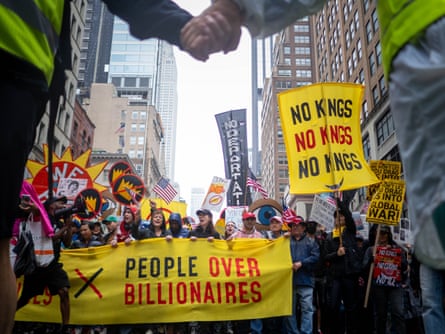
‘No Kings Day’ protests have swept the US as over 100,000 rally in New York City against the Trump administration’s policies on 14 June 2025.
Photograph: Carlos Chiossone/ZUMA Press Wire/Shutterstock
Law enforcement officers patrol as a ‘No Kings Day’ protest takes place in Dekalb county, Georgia, on 14 June 2025.
Photograph: Mike Stewart/AP
A Salvadorian reporter with an audience of millions, Mario Guevara was arrested while livestreaming a protest against Trump in June – and is still struggling for freedom
Prosecutors dropped the last remaining charges against Atlanta-area journalist Mario Guevara last week after he was arrested while livestreaming a protest in June. But the influential Salvadorian reporter remains penned up in a south Georgia detention center, fending off a deportation case, jail house extortionists and despair, people familiar with his situation told the Guardian.
Donald Trump’s administration has been extreme in unprecedented waysto undocumented immigrants. But Guevara’s treatment is a special case. Shuttled between five jail cells in Georgia since his arrest while covering the “No Kings Day” protests, the 20-plus-years veteran journalist’s sin was to document the undocumented and the way Trump’s agents have been hunting them down.
Today, according to the Committee to Protect Journalists,he’s the only reporter in the United States sleeping in a prison cell for doing his job.
‘No Kings Day’ protests have swept the US as over 100,000 rally in New York City against the Trump administration’s policies on 14 June 2025. Photograph: Carlos Chiossone/ZUMA Press Wire/Shutterstock
“For the first time in my life, I’m seeing what absolute power can do,” said Guevara’s attorney, Giovanni Díaz. “Power that doesn’t care about optics. Power that doesn’t care about the damage to human lives to achieve a result I’ve only heard about as some abstract thing that we heard about in the past, usually talking about other governments in the way that they persecute individuals. This is powerful.”
Around Atlanta, Guevara has been the person that immigrants call when they see an Immigrations and Customs Enforcement (Ice) raid going down in their neighborhood.
Guevara had been working for La Prensa Gráfica, one of El Salvador’s main newspapers, when he was attacked at a protest rally held by the leftwing group Farabundo Martí National Liberation Front (FMLN) in2003. The former paramilitary organization viewed reporters from his paper as aligned with the rightwing government, and threatened his life. He fled to the United States in 2004, seeking asylum with his wife and daughter, entering legally on a tourist visa.
He has been reporting for Spanish-language media in the United States ever since, riding a wave of Latino immigration to the Atlanta suburbs to career success and community accolades. He began reporting on immigration crackdowns under the Obama administration, one of the few reporters to note a tripling of noncriminal immigration arrests in the Atlanta area, as noted in a 2019 New York Times video profile of his work.. He meticulously documented cases and interviewed the families of arrestees. People around Atlanta began to recognize him on the street as the journalist chasing la migra.
His work continued through the Trump administration, drawing an audience of millions that followed him from Mundo Hispánico to the startup news operation he founded last year: MGNews or Noticias MG.
“It’s a unique niche that was met by Mario’s innovation and entrepreneurialism, if you will,” said Jerry Gonzalez, executive director of the Georgia Association of Latino Elected Officials and GALEO Latino Community Development Fund. “He developed a really strong relationship with the community. He developed significant trust with much of that community. And because of that, his eyeballs started increasing.”
An immigration court judge denied Guevara’s asylum claim in 2012 and issued a deportation order. Guevara’s lawyers appealed, and the court granted administrative closure of the case. He wasn’t being deported. But he wasn’t given legal residency either. Instead, the government issued him a work permit, his lawyer said. With a shrug, he went back to work.
Guevara is arguably the most-watched journalist covering Ice operations in the United States, a story that the English-language media had largely been missing, Gonzalez said. And local police were well aware of his work. He has been negotiating with them for access to immigration enforcement scenes for more than a decade.
“Mario Guevara is well known – sometimes liked sometimes not – but definitely well known by law enforcement agencies, particularly in DeKalb county and Gwinnett county, and also with federal agents, and particularly immigration agents,” Gonzalez said.
Gonzalez, among others, believes this put a target on his back in the current administration.
“It seems like law enforcement coordinated and colluded with the federal agents,” Gonzalez said. Gonzalez points to the misdemeanor traffic charges laid by the Gwinnett county sheriff’s office shortly after Guevara’s arrest in DeKalb county by the Doraville police department as evidence.
“The facts and the timeline indicate that pretty clearly to anybody that’s been following this,” he claimed. “In this regard it’s particularly troubling, given that he is a journalist and his situation. He had no reason to have been targeted for his arrest.”
The Department of Homeland Security has not responded to a request for comment about their relationship with local law enforcement. The Gwinnett county sheriff’s office said in a response to a lawmaker’s inquiry that it cooperates with Ice when deemed “mutually beneficial” but has not responded to requests for additional comment.
Doraville’s police chief, Chuck Atkinson, has not replied to an email seeking answers and fled from questions about the case at a city hearing. But Doraville’s mayor, Joseph Geierman, denied a connection between Ice and Doraville’s arrest of Guevara.
On 14 June, the day of his arrest, in Atlanta’s DeKalb county, Guevara darted around a Doraville police truck. A group of riot cops nearby took note. One shouted “last warning, sir! Get out of the road!”
Guevara was helmeted and wearing a black vest over his red shirt with the word “PRESS” in white letters. James Talley, an officer with the Doraville police department, was wearing an olive drab Swat jumpsuit with a helmet and gas mask.
A masked demonstrator set off a smoke bomb near the cops. Guevara ran into the street with a stabilized camera in hand to capture the police reaction and the crowd scampering out of the way, as was shown on a police body camera video.
Police had issued a dispersal order and were kettling protesters out of Chamblee-Tucker Road. They chased the suspected bomb thrower into the crowd, to no avail. But Guevara was in front of them on a grassy slope.
Police from DeKalb county managing the raucous protest had been taking verbal abuse from demonstrators for a while – a sharp contrast from other protests around Atlanta held that day. The protest was winding down. Body camera video from the event suggests Talley was in an arresting mood.
“Keep your eye on the guy in the red shirt,” Talley said to another Swat officer from Doraville. “If he gets to the road, lock his ass up.”
Talley pulled another police officer aside. “If he gets in the road, he’s gone,” Talley said. “He’s been warned multiple times.”
The other officer drew a finger across his chest. “The press?” Yep, Talley replied.
The three of them waited about 50ft away as a DeKalb county police officer approached Guevara on the hill, ordering him to get on the sidewalk. Guevara backed away from the officer, his attention focused on the recording, took two steps into the street, and the Doraville police pounced.
Guevara pleaded for the police to be reasonable.
“I’m with the media, officer!” Guevara said. “Let me finish!”
People shouted at the officers “That’s the press!” as they walked him handcuffed to a vehicle. “Why are you all taking him! He didn’t do nothing.”
More than one million people were watching Guevara’s livestream when he was arrested.
Trump has stepped up his rhetorical attacks on journalists since his inauguration. Last week, he described a reporter asking about warnings and emergency response in the Texas flooding disaster as “an evil person”, an epithet he has turned to with increasing frequency.
The Guevara case is a sign of increasing hostility toward a free press, said Katherine Jacobsen, a program coordinator for the Committee to Protect Journalists. She traced a through line from the Associated Press being barred from government briefings after it refused to accept the renaming of the Gulf of Mexico to the “Gulf of America”, then lawsuits and investigations reopened against media companies, then attacks on journalists covering protests in Los Angeles, then Australian writer Alistair Kitchen’s deportation seemingly in relation to his reporting on student protests.
“Next thing you know, we have Mario Guevara, a long time Spanish-language reporter in the Atlanta metro area, who is in Ice detention,” she said. “It’s growing increasingly concerning by the day.”
Guevara’s audience views it as more than an attack on press freedom, though. They view it as an attack on themselves.
“He’s a test case to push the envelope for legal immigrants that have committed no crime, to trump up charges against them,” GALEO’s Gonzalez said. “And the second piece is how to target journalists.”
Guevara’s arrest set off an immigration nightmare akin to the kind he has spent the last decade documenting.
His arrest on a Saturday led to a weekend in DeKalb county’s decaying jail and a bond hearing that Monday. A magistrate court judge granted Guevara a no-dollar bond, but by then Ice had become aware of the arrest and placed Guevara on a hold. The jail released him into Ice custody, and held him briefly in a metro Atlanta facility.
The next day, Gwinnett county charged Guevara with three misdemeanor traffic offenses, claiming that they were related to Guevara livestreaming a law enforcement operation a month earlier. The charges would be sufficient to keep him in jail and provide Ice an argument for his deportation at a federal bond hearing. The Gwinnett county sheriff’s office said Guevara’s livestreaming “compromised” investigations.
Guevara’s attorneys tried to work quickly, Diaz said. “The detained dockets are so backed up, and the immigration detention centers are so overwhelmed that what used to take us two or three days to get a bond hearing now is taking about a week,” he said.
Attorneys working for immigration enforcement argued in court that Guevara’s reporting constituted a “threat” to immigration operations.
Jacobsen with CPJ was listening to the hearing when the government made that argument.
“We felt a sense of alarm,” she said. “Alarm bells were raised by the government’s argument, as well as the judge not necessarily pushing back against the government’s argument that live streaming poses a danger to threaten law enforcement actions.”
Law enforcement officers patrol as a ‘No Kings Day’ protest takes place in Dekalb county, Georgia, on 14 June 2025. Photograph: Mike Stewart/AP
The immigration judge granted Guevara a $7,500 bond for the immigration case. But Guevara’s family was not allowed to pay it because government attorneys appealed the bond order to the board of immigration appeals. But it took seven days for the court to issue a stay to the government’s appeal. Meanwhile, Ice began playing musical jail cells with Guevara.
Over the course of the next three weeks, Ice shuttled Guevara between three different counties around Atlanta and eventually to the massive private prison Ice uses in Folkston, Georgia, 240 miles south-east of Atlanta on the Florida line.
“We weren’t surprised that they appealed, because the government’s reserving and in most cases appealing everything, even stuff where they shouldn’t appeal because they’re wasting everybody’s time,” Diaz said. “But we didn’t really know the breadth of what they were trying to do to him.”
Earlier this week, Todd Lyons, Ice’s acting director, issued a memo changing its policy on bond hearings, arguing that detainees are not entitled to those hearings before their deportation case is heard in court. Immigration advocates expect to challenge the move in court.
But Guevara is not facing a criminal charge. The Gwinnett county solicitor’s office dropped the traffic charges last week, noting that two of them could not be prosecuted because they occurred on private property – the apartment complex – and the third lacked sufficient evidence for a conviction.
For now, Ice has mostly kept Guevara in medical wards in jails even though he is healthy, Diaz said. “From the beginning, they’ve been keeping Mario under a special segregation because they’re claiming he’s a public figure. They want to make sure nothing happened to him.”
Doraville is a municipality of about 10,800 in DeKalb county with a separate police force, and had been asked to assist managing the protest in the immigrant-heavy Embry Hills neighborhood nearby. Protests have become a regular occurrence in DeKalb county since the Trump administration’s immigration raids began.
Doraville’s cops have displayed a more cooperative relationship with immigration law enforcement than many other metro Atlanta departments, and observers have raised questions about whether its police department arrested Guevara to facilitate an Ice detainer.
Geierman, the mayor, denied those accusations.
“The Doraville police department was not operating under the direction of, or in coordination with, US Immigration and Customs Enforcement (Ice) during the June 14th protest,” he said in a statement. “To the department’s knowledge, no Ice personnel were present at the event. Doraville officers were on site to support the DeKalb county sheriff’s office as part of a coordinated public safety effort.”
Observers have also questioned Guevara’s charges from Gwinnett county – ignoring traffic signs, using a communication device while driving, and reckless driving – that stemmed from an incident that occurred in May, a month before his arrest.
“Mario Guevara compromised operational integrity and jeopardized the safety of victims of the case, investigators, and Gwinnett county residents,” the department said in a statement.
But Gwinnett’s belated prosecution left his attorneys gobsmacked.
“In the narrative that they put out, they say he was livestreaming a police operation, and he was interfering,” Diaz said. “But when they went to a judge to get warrants, the only warrants the magistrate was able to sign for them was for traffic violations. I mean, that’s kind of telling.”
“I think the whole thing is suspicious,” he added. “From the beginning, just everything seemed they were really making efforts to make it difficult for him to go free.”
Marvin Lim, a Filipino American state representative whose district contains the apartment complex in Gwinnett in Guevara’s citation, has asked the sheriff’s office a detailed set of questions about the department’s relationship with federal immigration enforcement. He has not received an adequate response, he said in an open letter to the sheriff.
An array of six advocacy organizations challenged Gwinnett’s sheriff, Keybo Taylor, in a letter Tuesday over Guevara’s arrest and the sheriff’s posture toward immigration enforcement, demanding details about the relationship. GALEO, among them, also issued a separate letter Wednesday calling on Taylor to be transparent about the Guevara arrest.
Ice ‘politically targeted’ farm worker activist Juarez Zeferino, colleagues say
Read more
Guevara “was arrested while doing the vital work that journalists in a democracy do”, GALEO’s letter states. “Not only do the circumstances surrounding his incarceration and subsequent immigration detainment stir serious civil rights concerns, but they also build upon an expanding sense of fear and confusion in Georgia’s most diverse county.”
“I am being persecuted,” Guevara wrote in a 7 July letter seeking humanitarian intercession from, of all people, Nayib Bukele, El Salvador’s rightwing president.
“I am about to complete a month in jail, and I need to get out in order to continue with my life, return to my work, and support my family,” Guevara wrote. “I have lived in the United States for nearly 22 years. I had never been arrested before. In these past three weeks, I have been held in five different jails, and I believe the government is trying to tarnish my record in order to deport me as if I were a criminal.”
Guevara’s American-born son turned 21 this year, permitting him to sponsor Guevara’s green card and eventual citizenship. His application is pending, Diaz said. It may not matter.
“This is the first time I’ve ever seen a stay filed for someone who has no convictions, has almost no criminal history in 20 years, and only had pending traffic violations,” Diaz said.
“It’s clear that everybody’s working really hard to keep him detained.”
July 24, 1974 The United States Supreme Court (U.S. v. Nixon) unanimously ordered President Richard Nixon to surrender tape recordings of White House conversations regarding the Watergate affair. Speaking for the Supreme Court in front of a packed and hushed courtroom, Chief Justice Warren E. Burger (a Nixon appointee) rejected President Nixon’s claims of executive privilege (virtually total confidentiality for the White House) because the need for fair administration of criminal justice must prevail. The White House feared review of the recordings by a U.S. district judge would reveal, among other crimes, impeachable offenses. Listen to the tapes online (It’s a YouTube playlist!)
July 24, 1983 Canadians and Americans spanned the international border at Thousand Islands Bridge, linking New York and Ontario, to protest nuclear weapons and border harassment of peace activists. Thousand Islands Bridge
July 24, 1983 Women tagged a U.S. warplane with anti-nuclear graffiti at Greenham Common, an air base in England. The Greenham Common Women’s Peace Camp had been set up just outside the perimeter of the base in 1981 to get U.S. Cruise missiles, some of which were deployed at the base, out of their country. Other tactics included disrupting construction work at the base, blockading the entrance, and cutting down parts of the fence. Read more about The Greenham Common Women’s Peace Camp
A U.S. Army veteran who was arrested during an immigration raid at a Southern California marijuana farm last week said Wednesday he was sprayed with tear gas and pepper spray before being dragged from his vehicle and pinned down by federal agents who arrested him.
George Retes, 25, who works as a security guard at Glass House Farms in Camarillo, said he was arriving at work on July 10 when several federal agents surrounded his car and — despite him identifying himself as a U.S. citizen — broke his window, peppered sprayed him and dragged him out.
In this image taken from video provided by United Farm Workers, George Retes speaks about being arrested at an immigration raid at a Southern California marijuana farm during a press conference held over Zoom in Oxnard, Calif., Wednesday, July 16, 2025. (United Farm Workers via AP)
“It took two officers to nail my back and then one on my neck to arrest me even though my hands were already behind my back,” Retes said.
Massive farm raids led to hundreds being detained
The Ventura City native was detained during chaotic raids at two Southern California farms where federal authorities arrested more than 360 people, one of the largest operations since President Donald Trump took office in January. Protesters faced off against federal agents in military-style gear, and one farmworker died after falling from a greenhouse roof.
The raids came more than a month into an extended immigration crackdown by the Trump administration across Southern California that was originally centered in Los Angeles, where local officials say the federal actions are spreading fear in immigrant communities.
California Gov. Gavin Newsom spoke on the raids at a news conference Wednesday, calling Trump a “chaos agent” who has incited violence and spread fear in communities.
“You got someone who dropped 30 feet because they were scared to death and lost their life,” he said, referring to the farmworker who died in the raids. “People are quite literally disappearing with no due process, no rights.”
Retes was taken to the Metropolitan Detention Center in downtown Los Angeles, where he said he was put in a special cell on suicide watch and checked on each day after he became emotionally distraught over his ordeal and missing his 3-year-old daughter’s birthday party Saturday.
Milk is poured on a protester’s face after federal immigration agents tossed tear gas at protesters during a raid in the agriculture area of Camarillo, Calif., Thursday, July 10, 2025. (AP Photo/Michael Owen Baker)
He said federal agents never told him why he was arrested or allowed him to contact a lawyer or his family during his three-day detention. Authorities never let him shower or change clothes despite being covered in tear gas and pepper spray, Retes said, adding that his hands burned throughout the first night he spent in custody.
On Sunday, an officer had him sign a paper and walked him out of the detention center. He said he was told he faced no charges.
Retes met with silence when seeking explanation
“They gave me nothing I could wrap my head around,” Retes said, explaining that he was met with silence on his way out when he asked about being “locked up for three days with no reason and no charges.”
Tricia McLaughlin, assistant secretary of the Department of Homeland Security, confirmed Retes’ arrest but didn’t say on what charges.
“George Retes was arrested and has been released,” she said. “He has not been charged. The U.S. Attorney’s Office is reviewing his case, along with dozens of others, for potential federal charges related to the execution of the federal search warrant in Camarillo.”
A federal judge on Friday ordered the Trump administration to halt indiscriminate immigration stops and arrests without warrants in seven California counties, including Los Angeles. Immigrant advocates accused federal agents of detaining people because they looked Latino. The Justice Department appealed on Monday and asked for the order to be stayed.
The Pentagon also said Tuesday it was ending the deployment of 2,000 National Guard troops in Los Angeles. That’s roughly half the number the administration sent to the city following protests over the immigration actions. Some of those troops have been accompanying federal agents during their immigration enforcement operations.
Retes said he joined the Army at 18 and served four years, including deploying to Iraq in 2019.
“I joined the service to help better myself,” he said. “I did it because I love this (expletive) country. We are one nation and no matter what, we should be together. All this separation and stuff between everyone is just the way it shouldn’t be.”
Veteran pledges to sue federal authorities for his ordeal
Retes said he plans to sue for wrongful detention.
“The way they’re going about this entire deportation process is completely wrong, chasing people who are just working, especially trying to feed everyone here in the U.S.,” he said. “No one deserves to be treated the way they treat people.”
Retes was detained along with California State University Channel Islands professor Jonathan Caravello, also a U.S. citizen, who was arrested for throwing a tear gas canister at law enforcement, U.S. Attorney Bill Essayli posted on X.
The California Faculty Association said Caravello was taken away by agents who did not identify themselves nor inform him of why he was being taken into custody. Like Retes, the association said the professor was then held without being allowed to contact his family or an attorney.
Caravello was attempting to dislodge a tear gas canister that was stuck underneath someone’s wheelchair, witnesses told KABC-TV, the ABC affiliate in Los Angeles.
A federal judge on Monday ordered Caravello to be released on $15,000 bond. He’s scheduled to be arraigned Aug. 1.
“I want everyone to know what happened. This doesn’t just affect one person,” Retes said. “It doesn’t matter if your skin is brown. It doesn’t matter if you’re white. It doesn’t matter if you’re a veteran or you serve this country. They don’t care. They’re just there to fill a quota.” ___ Associated Press writer Jamie Ding contributed from Los Angeles.
This is a fun half from an Emma Thursday 07-17-2025
This last one is from the Nazi authoritarian cult of tRump maga who I posted a meme of getting fired and asking for money because his boss felt his was not a good fit for the company. FAFO









 Scottie's Playtime