*** Personal note*** I ran out of steam early yesterday. I only went back to bed for an hour in the morning, but by 3:30 pm, between the pain and being so tired I went to bed before 4 pm. I got up about 5:30 am. Hugs
Russia began the campaign against LGBTQ+ people by first targeting trans people as a threat to children. Then once the people got used to that line they claimed that any mention of non-cis non-straight way of living was sexualizing kids and so a threat to them. Mentioning or showing a gay person was equated with showing a kid hardcore porn. Fully nude bodies. It worked in their society. That is the play book the right wing haters / Christian nationalists have used against trans people here. How soon until they try to go the entire way to force the entire country / society to be straight and cis and that Christianity be the national religion enforced by white men who force those around them to follow their personal church doctrines. But what these nut jobs really want and understand is removing all mention and signs of being not cis or straight won’t stop LGBTQ+ people from existing. Gay, lesbian, bisexual, questioning / queer / nonbinary, and all others not straight or cis are born to straight cis parents. What these outstanding moral Christians like Congress person Randy Fine from Florida want is that non-straight and non-cis kids be harassed and assaulted like when he was in school making them afraid to come out or be themselves publicly. In other words these haters want the facade of a straight cis country such as when one of the presidents of Iran said they did not have any gay people in his country ignoring a well know community that was there. They want anyone not like them to be afraid to live their lives in case they are discovered. They think that will please their god. The god who they believe created all people also created the LGBTQ+ ones as well. They think that the all knowing god will not know people are faking it due to fear and that they will be rewarded for causing that fear in the LGBTQ+ community. Very Christian of them. Hugs
The designation could mean anybody associated with the group risks years behind bars for supporting an extremist organization — akin to terrorism charges under the nation’s criminal code.
A gay rights activist wearing a headpiece walks ahead of a squad of gay rights activists, during a traditional May Day rally in St.Petersburg, Russia, Thursday, May 1, 2014. The poster reads : ‘Love is stronger than war!’ (AP Photo, File)
A Russian court on Monday labelled the country’s top LGBTQ rights group as “extremist,” effectively outlawing the organization and paving the way to prosecute its supporters.
Russia has for years targeted LGBTQ organizations but has become even more hostile since launching its full-scale assault of Ukraine in 2022, massively accelerating the country’s hardline conservative turn.
On Monday, a court in St. Petersburg ruled in favor of a case brought by the Russian justice ministry to brand the Russian LGBT Network — a top LGBTQ rights nonprofit — “extremist.”
“The public movement has been designated as an extremist organization, and its activities are banned in Russia,” the court’s press service said on Telegram.
The hearing was held behind closed doors.
The designation could mean anybody associated with the group risks years behind bars for supporting an extremist organization — akin to terrorism charges under Russia’s criminal code.
Amnesty International in February slammed the justice ministry’s move to seek the label.
“This move reflects a deliberate strategy by the Kremlin to legitimize and weaponize homophobia in its assault on dissent and equality,” said Marie Struthers, Amnesty International’s Eastern Europe and Central Asia director.
Russian President Vladimir Putin has for years denounced anything that goes against what he calls “traditional family values” as un-Russian and influenced by the West.
In 2023, Russia’s Supreme Court banned what it called the “international social LGBT movement” as an “extremist organisation”.
As part of the crackdown, Russia has in recent years targeted LGBTQ clubs and bars, raiding them and arresting owners.
Courts have also issued fines and short-term jail sentences to people displaying LGBTQ “symbols,” such as clothes, jewelry or posters featuring the rainbow flag.
The Justice Department (DOJ) going after the Southern Poverty Law Center (SPLC) is another case where the Trump regime is going after its enemies. An enemy of hate groups, as SPLC is, is an enemy of the Trump regime.
SPLC has now been indicted on 11 counts, but remember where those indictments of James Comey and Letitia James went, straight into the trash. Donald Trump’s DOJ couldn’t obtain an indictment against the guy who threw a sandwich at Border Patrol agents. The DOJ just dropped its bogus case against Jerome Powell.
And remember the person in charge of the Justice Department is Donald Trump’s personal lawyer, who is angling to get the job permanently, or at least until Trump’s next mood swing, and he fires the Attorney General to replace him with Greg Gutfeld.
I think the mentalist who was scheduled to host last night’s White House Correspondents’ Dinner should have received combat pay. Not because of an assassination attempt, but for having to roam through Donald Trump’s empty head.
I don’t believe last night’s assassination attempt was staged or fake. I do believe there was a serious assassination attempt at last night’s WHCD dinner. I don’t want to jump into the rabbit hole of conspiracy theories. But from what we know at this point, the assassination attempt may not have been on Trump’s life, but maybe just on any cabinet member’s life that the attempted shooter could’ve found, or at least that’s how it sounds from the bits of his manifesto. I have read.
I do believe it was extremely shitty for Donald Trump to use the assassination attempt as an argument for his stupid illegal ballroom that is currently being held up by a court.
I’m infuriated by what Melania Trump tweeted today:
As a naturalized citizen and editorial cartoonist who has seen colleagues from around the world targeted, jailed, and even murdered for creating satire, I value our First Amendment. The First Lady, who is also an immigrant, should realize the importance of free speech and a free press but she lives in an entitled world and like her husband, is trying to control the news media to silence her critics. She is undermining the foundations of a democracy and is just as miserable a human being as her husband.
Donald Trump has been falling asleep during meetings lately. He’s fallen asleep during cabinet meetings, and here at the 26-minute mark, you can see that he falls asleep twice during a meeting about healthcare last week.
Tell me that he’s not falling asleep and instead is doing some deep thinking or is meditating. Yeah, I didn’t think so either.
Yesterday, I told you that I do not believe the assassination attempt was fake or staged. It’s not that I don’t believe the goons and the Trump regime would try that. It’s because I don’t believe these idiots could pull it off.
I hate this would-be assassin. First, he ruined my Saturday night. I had planned to clock out and go through at least a couple of the movies on my Netflix watchlist. Instead, I watched CNN all evening. Yeah, I’m a news buff, but I think it’s important to turn off sometimes, which I try to do on Saturdays and Sundays. I mean, I start the mornings with news programs and maybe through the middle of the day. But by late afternoon, I just want to turn all that shit off and not think about politics and, most importantly, not think about Donald Trump. This would-be assassin took my Saturday away from me. (snip-MORE)
Today, the government charged Cole Tomas Allen with attempt to assassinate the president, interstate transportation of a firearm, and discharging a firearm during a crime of violence. Prosecutors asked a judge in the District of Columbia to detain Allen in custody pending trial.
The charges filed against Allen differ from what U.S. Attorney Jeanine Pirro suggested they would be over the weekend, but, as we discussed, that was to be expected, with charging decisions remaining fluid as officials learn new information. A prosecutor indicated that the attempt to assassinate Trump was made with a 12-gauge pump action shotgun, but that Allen was also carrying a .38 caliber semi-automatic pistol, three knives, “and other dangerous paraphernalia.”
This is a criminal complaint, issued by a judge based on an agent’s affidavit, attesting to probable cause. The government will almost certainly follow up with a grand jury indictment in the next week or two. If they don’t, the judge will hold a preliminary hearing within 14 days if Allen remains in custody, 21 days if he’s released (which isn’t happening here), to determine whether probable cause exists. Federal prosecutors almost never go this route because it requires them to put their evidence on full display at this early stage in the proceedings, and unlike grand jury proceedings, where the defense doesn’t have a role, it permits cross-examination of the government’s witnesses. Expect a grand jury indictment shortly.
The lead charge here is “attempt” to assassinate the president, in violation of 18 U.S.C. 1751, so we need to understand a little bit about that crime and what prosecutors will have to prove. An attempt is referred to as an inchoate, or incomplete crime. With attempt charges, the key questions center around whether the defendant had the intent to commit the underlying crime and whether he took a substantial step—more than mere preparation—toward completing it. Here, based on the details in the government’s affidavit, which we’ll get to in a moment, its case looks solid. Allen evidenced an intent to kill the president. And the government has plenty of evidence to argue he went beyond “mere preparation” and took a substantial step toward committing the offense, since he was armed and running for the door to the ballroom, at the point when he was arrested.
The penalties for attempt and for the underlying offense are almost always the same under federal law, and that’s true here, with the statute providing for up to life imprisonment upon conviction.
Allen is also charged, as we expected last night, with violating 18 USC 924(c), which prohibits using a firearm “in furtherance of” a crime of violence. It carries a 10-year penalty if the firearm is fired, which is how Allen is charged. The complaint adds in one count of 18 U.S.C. 924(b), which makes it a crime for anyone who intends to commit a felony to transport a firearm across state lines. The punishment for that crime is up to 10 years in prison.
In order to get the complaint, the government had to provide the judge with a sworn affidavit from a federal agent. The 7-page affidavit provides some interesting details about the government’s evidence, but contains standard language advising the judge that “This affidavit is intended to show merely that there is sufficient probable cause for the requested complaint and does not set forth all of my knowledge about this matter.”
On March 2, President Trump announced he would attend the White House Correspondents’ Dinner, according to the affidavit. Allen then:
Made a hotel reservation at the Washington Hilton on April 6 for the night before, the night of, and the night after the dinner.
Traveled by train from his home near Los Angeles to Chicago, and from Chicago to Washington, D.C.
Checked into the Washington Hilton hotel the night before the dinner and remained there overnight.
We also get detail that we’ve been lacking until now about what happened when Allen approached the security checkpoint ahead of the ballroom. The affidavit recites that, “ALLEN approached and ran through the magnetometer holding a long gun. As he did so, U.S. Secret Service personnel assigned to the checkpoint heard a loud gunshot. U.S. Secret Service Officer V.G. was shot once in the chest; Officer V.G. was wearing a ballistic vest at the time. Officer V.G. drew his service weapon and fired multiple times at ALLEN, who fell to the ground and suffered minor injuries but was not shot. ALLEN was subsequently arrested.” Both of the firearms in Allen’s possession were purchased in California, which explains the transportation charge.
The affidavit also gives us a look at Allen’s full “manifesto,” some parts of which will have legal significance for the prosecution. He begins with a series of apologies to family and friends, including one that confirms his intent to kill:
“I apologize to everyone who was abused and/or murdered before this, to all those who suffered before I was able to attempt this, to all who may still suffer after, regardless of my success or failure.”
And he specifies who his targets are, “Administration officials (not including Mr. Patel): they are targets, prioritized from highest-ranking to lowest.” He writes that Secret Service agents, hotel security, Capitol police, and the National Guard are “targets only if necessary,” if they get in his way, and that hotel employees and guests are “not targets at all.” This careful delineation will be used by the government to establish his intent to assassinate the president. Although he doesn’t mention Trump by name, he writes: “And I am no longer willing to permit a pedophile, rapist, and traitor to coat my hands with his crimes,” an apparent reference to the president.
The government will offer the manifesto as evidence of the intent they have to show to convict on the attempt charge. He signed the manifesto “Cole ‘coldForce’ ‘Friendly Federal Assassin’ Allen.”
At the end, he seems to have added a rant about what he says is the Secret Service’s incompetence after he arrived at the hotel, discussing the absence of security or suspicion when he entered the hotel, before writing, “Like, if I was an Iranian agent, instead of an American citizen, I could have brought a damn Ma Deuce [This is a nickname for the M2 Browning, a heavy machine gun] in here and no one would have noticed s–t.”
The government brought its charges promptly, they appear to be based on solid evidence, and a career prosecutor was in the courtroom today, handling the case. All of which is as it should be.
Unfortunately, it’s also now all about the ballroom, after the president did a lightning-fast pivot at his hasty press conference after the incident Saturday night to say it was why the ballroom he is building at the White House is needed. We’ve already discussed why that doesn’t make sense—the president is an invited guest to the White House Correspondents’ Dinner, not the host. The dinner celebrates the freedom of the press, as in their freedom from government control, making the controversial ballroom about the last place on earth it would be appropriate to hold the dinner, unless the press association wanted to make a mockery of that treasured freedom.
In 1786, Thomas Jefferson wrote, “Our liberty depends on the freedom of the press, and that cannot be limited without being lost.” Political violence is horrific and deserves the condemnation from both sides of the political spectrum this incident is receiving. It’s fortunate that this incident did not result in any loss of life. There still needs to be a careful after-action report to ensure any mistakes that were made are not repeated. What this cannot become is an excuse to muddy up the freedom of the press or restrict any of the other constitutional rights Americans enjoy.
Stay with me tonight. This one runs a little long, but it’s all information you’ll need.
It’s likely that much of this week will be overshadowed by investigation into what happened Saturday night at the White House Correspondents’ Dinner, where Cole Thomas Allen, a 31-year-old California man with a master’s degree from Cal Tech, approached the ballroom at the Washington Hilton armed with a shotgun, a handgun and knives, and attempted to sprint through the magnetometer security checkpoint. He was stopped there. A Secret Service agent was shot, but was fortunately protected by a bulletproof vest. It’s not clear who shot him.
The White House Press Corps, still dressed in tuxedos and ball gowns, trooped into the press briefing room at the White House to hear from the President, who appeared, flanked by acting Attorney General Todd Blanche, FBI Director Kash Patel, and others. They, too, were still in tuxedos from the event.
It’s not clear who the “designated survivor” for the event was. CBS’ Margaret Brennan pointed out Sunday morning that “Five of the top six officials in the presidential line of succession were in attendance: Vice President JD Vance, House Speaker Mike Johnson, Secretary of State Marco Rubio, Treasury Secretary Scott Bessent, and Defense Secretary Pete Hegseth.”
Trump was in good spirits as he spoke, complimenting the press and laughing about the speech he had hoped to give after dinner. It was a much more affable Trump than we’ve seen in the course of the last year as he interacted with members of the media he has often been sharply critical, or dismissive of, during his first year in office. Trump went on the attack against the press even before his January 2025 inauguration, as we discussed at the time.
This was a different Trump who spoke in a very measured fashion, far more measured than usual, almost as if he saw this incident as providing the opportunity for a reset. He respectfully took questions from reporters like CNN’s Kaitlin Collins and NBC’s Garrett Haake. He was kindly toward the press; that’s the only way to characterize it. Whether that was a momentary blip or it suggests he will try to convince the media to rebuild its relationship with him remains to be seen. He did say that the Correspondents’ Dinner would be rescheduled within a month, without seeming to understand that the Correspondents’ Association puts on the dinner and controls the event.
At the press conference, Trump was asked why this keeps happening to him—this was the third attempt on his life since he announced his run for the presidency ahead of the 2024 election. He responded that he “has studied assassinations” and that it’s the “people who do the most” that assailants go after, using Abraham Lincoln as an example. Trump said that it “only happens to impactful people” and that he didn’t want to say he “was honored” by the repeated attempts on his life, but he let the implication hang in the room.
But he did not abandon politics. As he began his comments, Trump said the incident demonstrated why the ballroom he is building at the White House is needed.
Trump reiterated his comments in a Sunday morning post on Truth Social, claiming presidents have been demanding a ballroom like the one he’s building for 150 years.
His amen corner all took up the chant on Twitter, on cue.
But, as we noted above, the dinner is run by the Correspondents’ Association, not the White House. There is no reason to believe they would use a White House ballroom for a dinner designed to celebrate freedom of the press and its independence from government. Trump can make the argument he needs a safe space to entertain, but it’s a disconnect from the event last night.
Miles Taylor commented on Threads that “The WHCD shooter will be used to justify things that have nothing to do with the WHCD shooter. Mark this moment.” That seems likely.
The immediate investigation will focus on whether the shooter was a lone wolf, as it appears, or whether there is an ongoing threat. There is reporting today that Allen was a member of a group called The Wide Awakes, who appear, based on their web presence, to be committed to “radically” reimagining the future, but look to be a group of creative, peaceful people. Law enforcement will want to determine whether someone or something radicalized Allen and directed him toward violence.
There are sure to be, and there should be, questions about the Secret Service and how this happened. Asked about that during the press conference, Trump responded that he was “very impressed by the Secret Service.” But this is the third time a would-be assassin has gotten close to Trump, and one would have expected them to tighten ranks after the first attempt. Trump, however, does not seem to have viewed any of it as a failure by the Service and he was complimentary of the D.C. police, as well, in a phoner on Fox News.
It’s important to note that the Secret Service stopped Allen at the perimeter they had established. They succeeded in that sense. The real question will be whether the perimeter should have been set further back. I’ve attended the dinner multiple times and one observes layers of security that require guests to walk up the hill to the circular drive in front of the Washington Hilton before entering the hotel, but there are parties and receptions occurring in advance of the perimeter before entering the ballroom area, and, as we now know, Allen avoided scrutiny as a guest who checked into the hotel the day before the dinner. There are real questions that will have to be confronted here to ensure protection for future dinners, to say nothing of the scads of parties that happen in connection with this dinner, and other national events that are held at the Hilton.
Late Saturday evening, D.C. U.S. Attorney Jeanine Pirro announced that Allen would be arraigned on Monday. She said he will be charged with one count of assault on a federal officer using a dangerous weapon and two counts of using a firearm during a crime of violence. That could be fluid as officials learn new information. But the charges she identifies are found at 18 USC 111, which carries a 20-year maximum penalty, and 18 USC 924(c), which carries a 7-year penalty if a firearm is brandished and a 10-year penalty if it’s fired.
The motive seemed to be coming into focus throughout the day as some of Allen’s anti-administration writings were released. On Meet the Press, acting Attorney General Todd Blanche said authorities believed the suspect may have been targeting Trump administration officials, including Trump himself. The basis for that belief appears to have been examination of electronic devices and some writings. But Blanche told CNN’s Dana Bash they were still looking at the motive.
As I heard seasoned journalists, many of them friends, discuss how frightening the shooting was on air Saturday night and Sunday morning, I couldn’t help but reflect on how much worse it is for America’s children. How many of them still suffer a lingering sense of trauma from the moment a shooter crashed into their classroom or their place of worship? If there’s ever been a time to pass sensible gun control laws, it’s now. If we’re going to play politics, as Trump did with immediately pivoting to justifying his ballroom, let’s play that kind and make some good trouble.
There will be in court developments in other matters to track, as well, this week:
This Wednesday will be the last regularly scheduled day for the Supreme Court to hear oral argument this term. The Court will take up two consolidated cases, Mullin v. Doe and Trump v. Miot, and consider whether the Trump administration acted properly when it revoked protected status for Syrians and Haitians living in this country. The cases involve decisions from New York and Washington, D.C., barring the administration from stripping more than 350,000 Haitians and 6,000 Syrians of protected legal status that protects them from deportation.
The cases hit the court just last month, on March 16. The Court allowed the lower courts’ decisions to remain in place, preventing deportations, determining that it would hear the case promptly, allotting an hour for oral argument. This has all happened very quickly, with the final brief being filed just last week on Monday.
There is also news on the voting front. Friday evening, Mississippi Governor Tate Reeves announced that he was calling a special session of the legislature so that new maps could be drawn.
I don’t typically make news on a Friday afternoon, but today I am going to make an exception:
I’m calling a special session.
During the recently completed regular session, the Legislature discussed drawing new maps to comply with a decision from a federal judge from the… pic.twitter.com/wEnFw5xkHk
This redraw would be limited to state Supreme Court districts. A federal court found Mississippi’s state Supreme Court districts violated Section 2 of the Voting Rights Act and required the legislature to pass a remedial map. But it failed to do so during the regular session. A court hearing was scheduled for this week, and the court would have likely adopted its own map. So the Governor is calling this special session in hopes the court will hold off until the legislature has time to act.
In the election last November, voters ended the Republican supermajority in the legislature, but Republicans still hold a majority of the seats in both chambers and should be able to pass a map of their own devising. So the governor likely believes a map that comes out of the legislature will be superior to one created by the court.
And finally, the SAVE Act isn’t quite dead yet. We need to stay alert to any resurgence and be prepared to call our members of Congress to demand they resist its resuscitation. Trump is again demanding that his party end the filibuster and pass the Act, saying that not doing so will “lead to the worst results for a political party in the HISTORY of the United States Senate.” It reads as an acknowledgment that only voter suppression can save the Republican Party in the midterm elections.
Utah Senator Mike Lee followed up on Trump’s command with this tweet. Lee is not up for reelection until 2028. But he, too, seems to sense that this will be a dangerous election for Republicans. The SAVE Act is one of the last-ditch efforts Republicans have to suppress the vote and hold onto power this year and again in 2028. There is no mention of crafting policies designed to win the hearts and minds of American voters. It’s just about keeping eligible American citizens from voting. We must do everything we can to resist that.
If you’ve found this useful, it’s exactly the work I do every week—reading the filings, tracking the arguments, and explaining what it means before it becomes obvious. The headlines will keep coming, but understanding them takes more than a glance. That’s what this space is for. My goal is to give you clear, careful analysis you can rely on. If that’s the kind of work you value, I hope you’ll choose to subscribe.
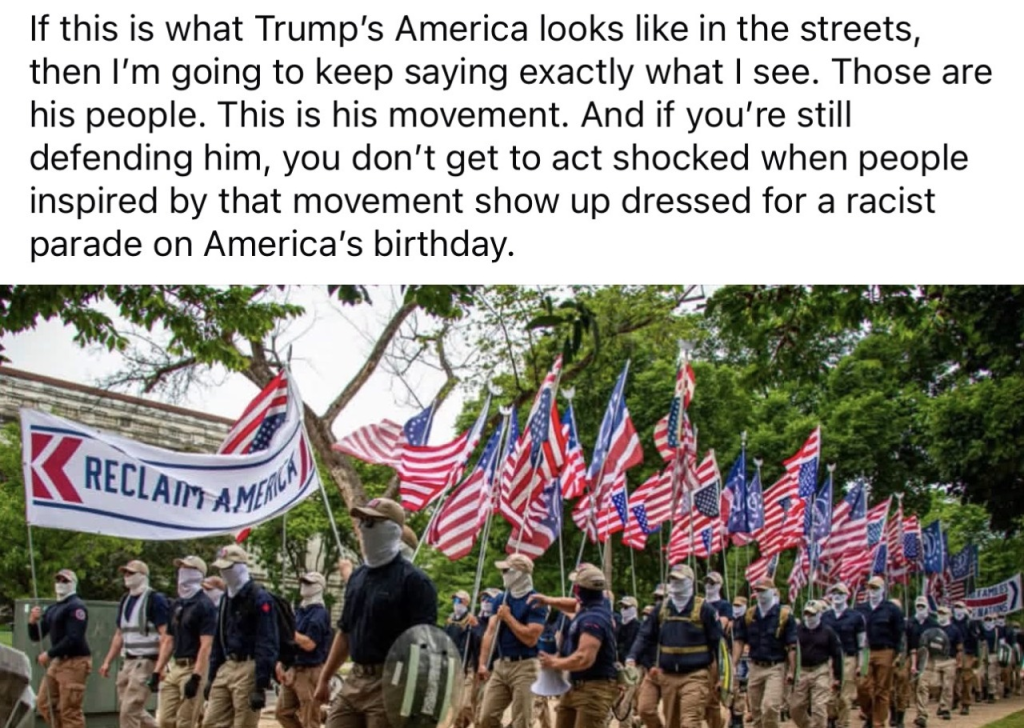
I don’t know if all republicans are racist bigots but they certainly do tolerate them in their midst. Pride month, pride flags, and black history month, MLK, and other non-white persons of note are too political, divisive, and too morally offensive to be displayed or talked about. No month to celebrate the oppressed minorities yet one to celebrate the oppressors? No pride flags on government buildings or school classrooms but confederate battle flags are OK to be displayed everywhere. Some how the people calling for the end of DEI as racist along with those saying the pride symbols and history months are divisive and too political, think displays of people wanting to own / deny rights to a group based on skin color are not divisive or political. Hugs
Two Confederate flag bearers walk across the lawn of the Mississippi State Capitol in Jackson, Miss., on Monday, July 6, 2015. A group of about 50 people participated in the rally sponsored by the Magnolia State Heritage Campaign as they opposed efforts to remove Mississippi’s 1894 Confederate-themed state flag. Five years later, in 2020, Gov. Tate Reeves would sign a bill retiring the old state flag, even as he continued declaring Confederate Heritage Month annually. AP Photo/Rogelio V. Solis
Nearly six years after signing the bill that removed the Confederate symbol from Mississippi’s state flag, Gov. Tate Reeves declared April 2026 as Confederate Heritage Month, continuing a tradition that began 33 years ago.
Though the governor does not publish the Confederate Heritage Month proclamations on any official government websites, the Mississippi Division of the Sons of Confederate Veterans posted a copy of the latest proclamation on its Facebook page. The proclamation shows that the governor signed it on April 17.
Tap or click the preview image to read Mississippi Gov. Tate Reeves’ April 17, 2026, Confederate Heritage Month proclamation. Courtesy Mississippi Division Sons of Confederate Veterans
As in past years, Reeves’ proclamation does not mention the central role of slavery and white supremacy in the Confederacy’s birth, instead speaking only vaguely about how April “is the month when, in 1861, the American Civil War began between the Confederate and Union armies, reportedly the deadliest war ever fought on American soil.”
“WHEREAS, as we honor all who lost their lives in this war, it is important for all Americans to reflect upon our nation’s past, to gain insight from our mistakes and successes, and to come to a full understanding that the lessons learned yesterday and today will carry us through tomorrow if we carefully and earnestly strive to understand and appreciate our heritage and our opportunities which lie before us,” says the governor’s proclamation. “NOW, THEREFORE, I, Tate Reeves, as Governor of the State of Mississippi, do hereby proclaim the month of April 2026 as CONFEDERATE HERITAGE MONTH in the State of Mississippi.”
Kevin M. Levin, a Boston-based historian whose work has focused heavily on the Civil War-era, wrote on his Substack, Civil War Memory, on April 18 that Reeves issued the document “with the quiet, almost regularity of a bureaucratic obligation.”
“There is no mention of what the Confederacy stood for, no celebration of Southern martial valor, no invocation of states’ rights, and—most conspicuously—no mention of slavery, even though it was the explicit cause Mississippi named when it seceded from the Union in 1861,” Levin wrote. “What the proclamation most resembles is a permission slip signed reluctantly, just legible enough to satisfy the requester and vague enough to require no defense.”
Slavery Defined the Confederacy
The Sons of Confederate Veterans is a neo-Confederate organization that espouses “Lost Cause” ideology, which promotes a revisionist version of the Civil War that whitewashes the Confederacy’s white supremacist history and downplays the role of slavery in the Civil War. SCV owns and operates Beauvoir, the museum and historic home of Confederate President Jefferson Davis, located in Biloxi, Mississippi; the organization annually receives $100,000 from the State of Mississippi for development and maintenance.
The Mississippi Division of the Sons of Confederate Veterans issued this Confederate History and Heritage Month proclamation on April 1, 2026. Courtesy Mississippi Division of Sons of Confederate Veterans
The Mississippi Division of the Sons of Confederate Veterans issued its own 2026 “Confederate History and Heritage Month” proclamation on April 1, saying that “states of the South, including Mississippi, did legally declare their independence from the United States in 1861, and … these states did form a Confederation to protect and defend themselves from an invading army.”
What the SCV proclamation left out was the defining issue that led Mississippi and other Southern states to secede from the Union—the “cause” the Confederacy fought for.
“Our position is thoroughly identified with the institution of slavery—the greatest material interest of the world,” Mississippi’s 1861 Declaration of Secession declared. “Its labor supplies the product which constitutes by far the largest and most important portions of commerce of the earth.”
The 2026 SCV proclamation, signed by Mississippi Division Commander Forrest S. Daws, says that the people of the Confederacy spent “four long years fighting and sacrificing for their independence” as part of “their commitment to defend the rights secured under the United States Constitution.”
But the historical record shows that that, too, is a revisionist view of history.
Confederate Vice President Alexander Hamilton Stephens said in a speech on March 21, 1861, that slavery “was the immediate cause of the late rupture” that led to the American Civil War and that the Confederate Constitution enshrined the idea that the enslavement of Africans to white men was “natural and normal.” Photo Public Domain / Wikimedia Commons Credit: NARA
In his 1861 Cornerstone Speech announcing the Confederate Constitution, Confederate Vice President Alexander Hamilton Stephens said that it made “great improvements upon the old constitution.”
“The new constitution has put at rest, forever, all the agitating questions relating to our peculiar institution African slavery as it exists amongst us the proper status of the negro in our form of civilization. This was the immediate cause of the late rupture and present revolution,” Stephens said. “(Thomas) Jefferson in his forecast, had anticipated this, as the ‘rock upon which the old Union would split.’ He was right. What was conjecture with him, is now a realized fact. But whether he fully comprehended the great truth upon which that rock stood and stands, may be doubted.
“The prevailing ideas entertained by him and most of the leading statesmen at the time of the formation of the old constitution, were that the enslavement of the African was in violation of the laws of nature; that it was wrong in principle, socially, morally, and politically. It was an evil they knew not well how to deal with, but the general opinion of the men of that day was that, somehow or other in the order of Providence, the institution would be evanescent and pass away.”
“This idea, though not incorporated in the constitution, was the prevailing idea at that time. … Those ideas, however, were fundamentally wrong,” Stephens continued. “They rested upon the assumption of the equality of races. This was an error. It was a sandy foundation, and the government built upon it fell when the ‘storm came and the wind blew.’ Our new government is founded upon exactly the opposite idea; its foundations are laid, its cornerstone rests, upon the great truth that the negro is not equal to the white man; that slavery subordination to the superior race is his natural and normal condition. This, our new government, is the first, in the history of the world, based upon this great physical, philosophical, and moral truth.”
The bust of Mississippi State University’s first president, Confederate Lt. Gen. Stephen D. Lee, has long been an iconic center of the Mississippi State campus from its perch on the Drill Field in front of the building bearing Lee’s name. He led efforts long after the Civil War to successfully rewrite history about the Confederacy and its documented motives out of school textbooks and classrooms, furthering the Lost Cause. Photo by Donna Ladd
In the decades after the Civil War ended, Confederate veterans, such as Mississippi State University’s inaugural president, Stephen D. Lee, and groups like SCV and the United Daughters of the Confederacy began the work of remaking history in a way that shone a more favorable light on the South—muddying the waters over the cause of the war and falsely describing it as a “war of northern aggression.”
White-supremacist leaders in Mississippi renewed efforts to enshrine Confederate heritage in the 1950s and 1960s in reaction to the rise of the Civil Rights Movement.
Young white Mississippians wave Confederate flags at civil rights marchers near Highway 7 on the outskirts of Greenwood, Miss., on June 17, 1966, weeks after James Meredith, who integrated the University of Mississippi, was shot while leading the group of marchers. AP Photo
Despite his campaign pledge to supporters of the old Confederate-themed flag not to use his power to change the flag, Gov. Reeves signed the bill retiring it, calling it “a law to turn a page in Mississippi today.”
“It is fashionable in some quarters to say our ancestors were all evil. I reject that notion. I also reject the elitist worldview that these United States are anything but the greatest nation in the history of mankind. I reject the mobs tearing down statues of our history—north and south, Union and Confederate, founding fathers and veterans,” the governor said in 2020, criticizing Black Lives Matter protesters from across the country even as he signed the bill with several Mississippi civil rights icons behind him. “I reject the chaos and lawlessness, and I am proud it has not happened in our state.”
‘An Ideology Reduced to a Form Letter’
The Mississippi Division of the Sons of Confederate Veterans’ 2026 Confederate Heritage proclamation notes that “in 1993 Mississippi Governor Kirk Fordice, understanding the importance of remembering and preserving all history, did declare the first Confederate History Month.”
Mississippi Gov. Kirk Fordice issued the first Confederate Heritage Month proclamation in 1993. During his time as governor, he courted support from white supremacist groups, including the Council of Conservative Citizens. He is seen here on Aug. 22, 1996, with (from left) Donald Wildmon of the Tupelo-based American Family Association; then-Mississippi House Rep. Phil Bryant; and Mississippi Family Council’s Forest Thigpen. Photo/Rogelio V. Solis, File Credit: AP
Since then, one Democratic governor and three Republican governors have followed Fordice’s lead.
Starting in 2016, Donna Ladd, then the editor of the Jackson Free Press and now the executive editor of the Mississippi Free Press, first reported on then-Mississippi Gov. Phil Bryant’s Confederate Heritage Month proclamations. Despite issuing Confederate Heritage Month proclamations annually for his first seven years in office between 2011 and 2018, former Gov. Phil Bryant did not issue one in 2019, his last year in office; he opted instead for a “Month of Unity” proclamation on behalf of a Christian religious organization.
The Mississippi Free Press has since reported on each of Reeves’ annual proclamations, including in 2020, 2021, 2022, 2023, 2024 and 2025.
Reeves’ ties to the Sons of Confederate Veterans stretch back long before his time as governor. In 2013, he spoke to the SCV’s national gathering in Vicksburg, Mississippi, in front of a massive Confederate battle flag and in a room decorated with smaller Confederate flags and cotton plants. After then-Lt. Gov. Reeves congratulated the organization for “keeping history for our youth,” speakers defended the Confederate “cause” and compared “Yankees” to German “Nazis” in World War II.
Then-Lt. Gov. Tate Reeves appeared at this July 2013 Sons of Confederate Veterans event in Vicksburg with a massive Confederate flag behind him. Photo via R.E. Lee Camp 239 SCV Facebook group
Long before entering politics, Reeves was part of a Millsaps College fraternity known for lionizing Confederate General Robert E. Lee and for Confederate-themed parties where members wore blackface. When it became an issue in his 2019 campaign for governor, though, he said he never participated in blackface during his time in the fraternity.
Reeves’ Democratic opponent at the time, then-Attorney General Jim Hood, was also in a fraternity at the University of Mississippi, where members wore blackface; he similarly denied ever participating.
Reeves defended issuing the proclamations in 2021.
“For the last 30 years, five Mississippi governors—Republicans and Democrats alike—have signed a proclamation recognizing the statutory state holiday and identifying April as Confederate Heritage Month,” the governor’s office said in a statement to WAPT at the time. “Gov. Reeves also signed the proclamation because he believes we can all learn from our history.”
The governor’s annual proclamation routinely notes that state law designates the last Monday in April as Confederate Memorial Day. However, state law does not require governors to issue Confederate Heritage Month proclamations.
Mississippi Gov. Tate Reeves, seen here speaking at a press conference in Ridgeland, Miss., on Thursday, April 9, 2026, has signed Confederate Heritage Month proclamations each year as governor from 2020 to 2026. MFP Photo by Rogelio V. Solis
The language in Reeves’ Confederate Heritage Month proclamations uses much of the same language as the one that former Democratic Gov. Ronnie Musgrove, who served from 2000 to 2004, issued in April 2000.
In 2023, Musgrove told the Mississippi Free Press that Confederate Heritage Month is “something that should not continue in today’s world.”
“I cannot say why the practice started, but it was one that should never have been started,” the former governor said. “It was one that I should not have signed, and it should have ended a long time ago.”
Former Republican Gov. Haley Barbour also signed Confederate Heritage Month proclamations every year between 2004 and 2016.
In his Substack post, Kevin M. Levin wrote that the earlier proclamations that began with Fordice “were issued with more ideological confidence” and as “instruments of the Lost Cause.” Now, instead, the historian wrote, they appear on Sons of Confederate Veterans Facebook groups—a sign of the Lost Cause’s “crumbling infrastructure” and that it is now “an ideology reduced to a form letter.”
“A celebration conducted in secret, or at least in silence, is not really a celebration. It is a favor done for a diminishing constituency that the issuer would prefer the broader public not notice,” he wrote.
Members of the Mississippi Poor People’s Campaign burn a Confederate battle flag at the Governor’s Mansion in Jackson, Miss., Monday, June 18, 2018. AP Photo/Rogelio V. Solis
Levin called it “the political logic of a cause in retreat.”
“The Lost Cause did not die in a single moment, not with the removal of Confederate statues after Charleston in 2015, not with Mississippi’s replacement of its Confederate-emblem state flag in 2020, and not with any particular court ruling or protest march. It has died the slower death of a story that fewer and fewer people believe, or are willing to say publicly that they believe,” the Boston historian continued. “What remains is a three-paragraph proclamation, quietly signed, quietly announced in a Facebook group, saying as little as possible about a cause its issuer is no longer willing to name.”
I had my allergy shots this morning. Ron and Diane have gone to see if they can find the casino in the next county over. I am trying to stay awake. I want to see if I can reply to a few comments before going back to bed. Fof those that don’t know I am not eating. I have one meal in the morning and spend most of my time in bed these days. My blood tests showed my red and white blood cells were all messed up. Animia? Cancer? Depression? My body breaks down under stress, and I have been stressed since November of last year. It is a lot less right now with Ron home but he still has little time for stuff at home because of the need to spend so much time with his sister. Plus he is having health issues as well. The real issue is I am tired. Just so tired I am unable to think, eat, or even engage with Ron. I find I am easily irritated, and when he reached out to touch me in bed I snaped at him for it. I have not reacted that way in a long time. I like his touch. I have lost between 8 to 10 pounds because I am not eating. I keep this up and I could get from my normal 170 t the goal of 150 pounds I want. 😀😃😉😎. Ron is concerned and says if we don’t see improvement next week I have to contact my primary care doctor. It all seems like too much work, I just want to go back to bed. The pain is less there. My right leg becomes so painful after five minutes of use I can’t really walk and I have to do the dishes with a rolling very high adjustable stool.
Anyway the video below is a great example of why real Christians are not bigots. I wish I felt up to posting more videos, it is all I seem able to do right now, just watch videos. Be well, and enjoy the Rev. explain why bigotry is a really bad thing for the Christian church. Hugs
Judge’s repeal of Trump ban on gender-affirming care for children ‘a meaningful win for patients’, experts say
A federal judge overturned the Trump administration’s ban on gender-affirming care for children on Saturday, decrying Robert F Kennedy Jr’s “wanton disregard” for the law that “causes very real harm to very real people”.
It’s another loss for Kennedy’s agenda as secretary for the US Department of Health and Human Services (HHS) under the second Trump administration – an agenda that has focused on restricting healthcare, including vaccines, abortion and gender-affirming care.
A different legal decision recently halted the agency’s attempt to raze vaccine recommendations, and new research and regulatory decisions have undermined controversial announcements by Trump and Kennedy on autism.
“Unserious leaders are unsafe,” Mustafa T Kasubhai, a US district judge in Oregon wrote in the opening to his final judgment on the gender-affirming care case, a 49-page decision that excoriated the administration for disregarding the law and overreach in its regulations. The judge also barred the administration from implementing similar policies under any other names to restrict care nationally by withholding funding.
Shannon Minter, legal director of the National Center for LGBTQ Rights, called the ruling “incredibly powerful” and “far-reaching”.
“It enjoins them from doing anything to interfere with the authority of states to regulate medical practice,” Minter said.
For healthcare providers and families who have been in limbo for months, “this is a huge, huge step forward”, said Jan Oosting, an associate professor of nursing at City University of New York (Cuny).
Khadijah Silver, director of gender justice and health equity at Lawyers for Good Government, who uses they and them pronouns, said they were “so overwhelmingly ecstatic” and “couldn’t actually process” that the ruling “was real life”.
In December, Kennedy announced that any health system providing pediatric gender-affirming care would be suspended from receiving Medicaid and Medicare funding. Medicaid and Medicare would also be banned from paying for any gender-affirming care, he said.
As nearly all major hospitals and health systems rely on Medicaid and Medicare, the proposed rule amounted to a ban on gender-affirming care for children, setting a precedent for the government limiting healthcare for any patients.
At the same time, Kennedy issued a declaration invoking a regulation to allow the HHS to exclude healthcare providers from Medicaid and Medicare when the providers no longer “meet professionally recognized standards of healthcare”. Unusually, the new rule was enforced immediately, without going through the usual rule-making process, including public comment.
Gender-affirming care often includes puberty blockers and hormones, but can also involve psychosocial support and, very rarely and after extensive medical consultation, surgery. It is widely agreed to be essential to the health of gender-expansive individuals. The Kennedy declaration claimed pediatric gender-affirming care for minors was “neither safe nor effective” and therefore fell below these standards.
Declarations like these are meant to be used for emergencies when the HHS needs to communicate the steps it’s taking to protect public health, Silver said, who added: “They have never once been abused in such a fashion to go against standards of medical care that are widely accepted … let alone to override the state’s primary authority in the regulation of medicine.”
Minter said: “This was an attempt by the federal government to impose a national ban and usurp the authority of states to regulate medical practice within their borders.”
Within eight days, the HHS general counsel, Mike Stuart, began referring health systems to the HHS office of inspector general for violating the new policy. The decision included several screenshots of posts from Stuart celebrating referrals of health systems for violating the rule.
At least 40 health systems have said the threat of losing federal funding is why they stopped providing care in recent weeks. Oregon and 21 other states sued the administration. In response, the US government argued that the Kennedy declaration was merely an individual’s personal opinion.
When the judge overturned the declaration, he called this argument “a bald-faced lie” and an attempt to “bully or gaslight” the court. The judge said the Kennedy declaration was “clearly unlawful” because it violated administrative law and the Medicare statute that forbids federal officials from exercising “any supervision or control over the practice of medicine or the manner in which medical services are provided”.
Following the judge’s preliminary injunction against the new rule in March, Children’s Minnesota began offering gender-affirming care again.
When another health system, Children’s Hospital Colorado, ceased care, patients and families sued the hospital. The case is currently before the Colorado supreme court, where judges have expressed concerns that forcing the hospital to resume care could bring federal backlash, endangering even more children. Silver noted that reversing the federal ban now could change the outcome of that case.
“This should be a huge relief and a tremendous source of protection” for families and children whose care was delayed or disrupted, Minter said. When health systems announced they would comply in advance with the directive and stop providing gender-affirming care, often effective immediately, it was “shocking and appalling behavior”, he said, but this decision “should remove that fear” and allow the care to resume.
Oosting noted that the “biggest source of fear, which was the threat of losing Medicare and Medicaid funding, is removed now, so I think that there will be reassessment by each individual hospital of what programs are going to be put back into play, what programs will have to be modified”. That’s especially true in states like New York that have laws against discrimination in healthcare, she said.
The proposed rule preventing Medicaid and Medicare from paying for gender-affirming care is also blocked by this decision, Minter said. The rule did not come before the judge because it hasn’t been finalized, but Minter reads the ruling as “effectively prohibiting those rules from being enforced as well”.
Challenges still exist for children who need gender-affirming care but may not be able to access it.
“Although this removes a major federal barrier, it doesn’t erase those state-level restrictions,” Oosting said. Some states have introduced bans on the care. In Ohio, the state’s supreme court will rule on whether a ban is constitutional in coming months.
Some families in states with bans or gaps in healthcare are once again able to access care by moving or traveling out of state – a “burdensome”, disruptive and expensive process, but an “important” one, Minter said.
Overturning the ban was a “meaningful win for patients and providers and, honestly, for healthcare integrity in the US”, Oosting said. It lessens fear and uncertainty around seeking and providing care, and it shows that “major changes in healthcare policy have to follow the law,” Oosting said – which has repercussions for other politicized changes to health regulations, like limitations on abortion. It was “a powerful tool to stop the federal government from that type of attempted overreach” in healthcare, Minter said.
The decision reinforces the fact that “the federal government can’t use Medicare and Medicaid restriction as a blunt-force instrument to control care and access to people’s bodies,” Oosting said. It’s significant not just for making gender-affirming care available again but also because it sets “the rules of the road – how far the federal government can go in terms of influencing what’s happening in a patient exam room”, she said.