July 13, 1863 Massive New York City protests decrying the first-ever wartime draft lottery led to bloody rioting over five days as a mob of 50,000 burned buildings (including looting and torching the Colored Orphan Asylum on Fifth Avenue, though the 200+ children were unharmed), stores and draft offices, and attacked police. Some clubbed, lynched, and shot large numbers of blacks, whom they blamed for the war.By the time troops returning from the Battle of Gettysburg finally restored order, 1200 had died over five days. New Yorkers, spurred on by the Democratic leadership of Tammany Hall and tired of the seemingly endless war, had been angered by President Abraham Lincoln’s recent call for 300,000 more troops. In the Shadow of Slavery: African Americans in New York City, 1626-1863 by Leslie M. Harris They especially resented the legal provision allowing a cash payment ($300 commutation fee) as a way for those with the means to avoid military service in the Union Army. Read more about the 1863 draft riots
July 13, 1905 A Declaration of Principles was issued by the Niagara Movement (the precursor to the National Association for the Advancement of Colored People) following their conference in Buffalo, New York. Matters of concern included: realization of suffrage for all black men, as well as other civil liberties; economic opportunities for black Americans, especially in the South; access to education, especially high schools, trade and technical schools, and colleges; fair treatment in the courts and an end to the convict-lease system; fair treatment in employment wherein employers brought in black workers temporarily to keep down wages, and labor unions refused membership to blacks; an end to the color line, particularly in public transporation; fair treatment for black soldiers and access to military training schools; enforcement of the 13th, 14th and 15th amendments to the U.S. Constitution passed in the wake of the Civil War. “The Negro race in America, stolen, ravished and degraded, struggling up through difficulties and oppression, needs sympathy and receives criticism; needs help and is given hindrance, needs protection and is given mob-violence, needs justice and is given charity, needs leadership and is given cowardice and apology, needs bread and is given a stone. This nation will never stand justified before God until these things are changed.” Additionally, they urged upon the African-American community: The duty to vote. The duty to respect the rights of others. The duty to work. The duty to obey the laws. The duty to be clean and orderly. The duty to send our children to school. The duty to respect ourselves, even as we respect others.
July 13, 1985 The first Live Aid concert raised $75 million for agricultural and technical assistance to Africa, many times what was expected. Described as the Woodstock of the ‘80s, the world’s biggest rock festival (in London, Philadelphia, Moscow and Sydney, Australia, simultaneously and linked by satellite) was organized by Boomtown Rats singer Bob Geldof to raise money for famine relief in Ethiopia. Bob Geldof The Republic of Ireland (Éire) gave the most donations per capita, despite being in the throes of a serious economic depression at the time. The single largest donation (£1m) came from the ruling family of Dubai (Al Maktoum). More about Live Aid ’85 Watch a video about the concert
Members of the church preached that LGBTQ+ people should be shot in the head (Google Street View)
An independent Baptist church in Indiana, Sure Foundation Baptist Church, has doubled down on a sermon which was delivered during a men’s preaching evening that called for LGBTQ+ people to take their own lives.
On Thursday (3 July), preacher Justin Zhong shared a post on the official Facebook page for the Sure Foundation Baptist Church in Indianapolis, stating he will “not apologize for preaching the Word of God”.
“I will not apologize for stating facts. I will not negotiate with terrorists, among whom the LGBTHIV crowd is full of domestic terrorists,” Zhong wrote.
“The Bible is crystal clear that sodomites (homosexuals) deserve the death penalty carried out by a government that actually cares about the law of God. We are not to take the law into our own hands.”
The statement comes after the church was criticised for the violent homophobic language used by church members during Men’s Preaching Night, which was broadcast live on Facebook.
“We should pray for their deaths”
During a sermon entitled ‘Pray the Gay Away’, member Stephen Falco said: “You ought to blow yourself in the back of the head. You’re so disgusting.”
Falco went on to rhetorically ask: “How shall we then properly pray for gay people?”
“We should pray for their deaths, plain and simple,” he answered himself.
Another church member, reported by Newsweek as Wade Rawley, said LGBTQ+ folks should be “beaten and stomped in the mud” before they “should take a gun and blow the back of their heads off”.
The christian church called for LGBTQ+ folks to be killed (Canva)
On the church’s official website, it states under its beliefs section that the congregation “believe that
sodomy (homosexuality) is a sin and an abomination before God which God punishes with the death penalty,” adding: “No sodomite (homosexual) will be allowed to attend or join Sure Foundation Baptist Church. (Leviticus 20:13, Romans 1:19-32, Deut. 23:17-18, 1 Kings 14:24, Jude 1:7)”.
In the Facebook post defending the sermon, Zhong outlined several quotes from Bible scripture with additional commentary explaining why those quotes matter and what they mean.
“The Bible says that the sodomites (homosexuals) are filled with all unrighteousness. That’s why I believe all sodomites are capable of molesting children and committing all kinds of wickedness,” Zhong wrote.
“It is hilarious that the best thing they can say to us is that we are closet homos, because they know being a homo is filthy and vile and disgusting.”
Zhong went on to say that the Sure Foundation Baptist Church is a “Bible-believing church” whereby “whatever the Bible says, we believe it”.
“We don’t care about what the world, culture, or media think. It is funny that these so-called “faith leaders” and some “Christians” do not approve of this message. This simply shows me that they do not care about the Bible.”
He continued: “Sure Foundation Baptist Church protects children from predators. We don’t separate children from their families. We expose perverts and pedophiles. No homos will ever be allowed to attend any church services.
“Sure Foundation Baptist Church is a soulwinning powerhouse. We preach the gospel of Jesus Christ and the eternal security of the believer on a weekly basis to the lost and dying world, while all those “holier than thou” Christians let the world go to hell.”
He added: “If you are sick and tired of the woke culture or churches that do not preach the whole Bible, then you should come and check us out!”
In response to comments made by members of the Sure Foundation Baptist Church, the Concerned Clergy of Indianapolis – a fellowship of “pastors and other concerned citizens who are God-fearing people who believe injustice, racism, ageism, class-ism and sexism to be contrary to the will of God” – said: “The Concerned Clergy of Indianapolis stands firmly against the harmful rhetoric recently preached that condemned all LGBTQ individuals to hell and instructed people to stay away from them.
“Such messages are not only theologically irresponsible but pastorally dangerous.”
In a further statement emailed to Newsweek, the church stated: “The Bible puts the death penalty on the LGBTQ people.
“We as Christians must believe and preach what the Bible says.
“The reason people are so shocked about all this is not many ‘Christians’ and even ‘pastors’ actually believe the Bible.
“To be clear, we only called for the government to execute those people. We are against vigilantes.”
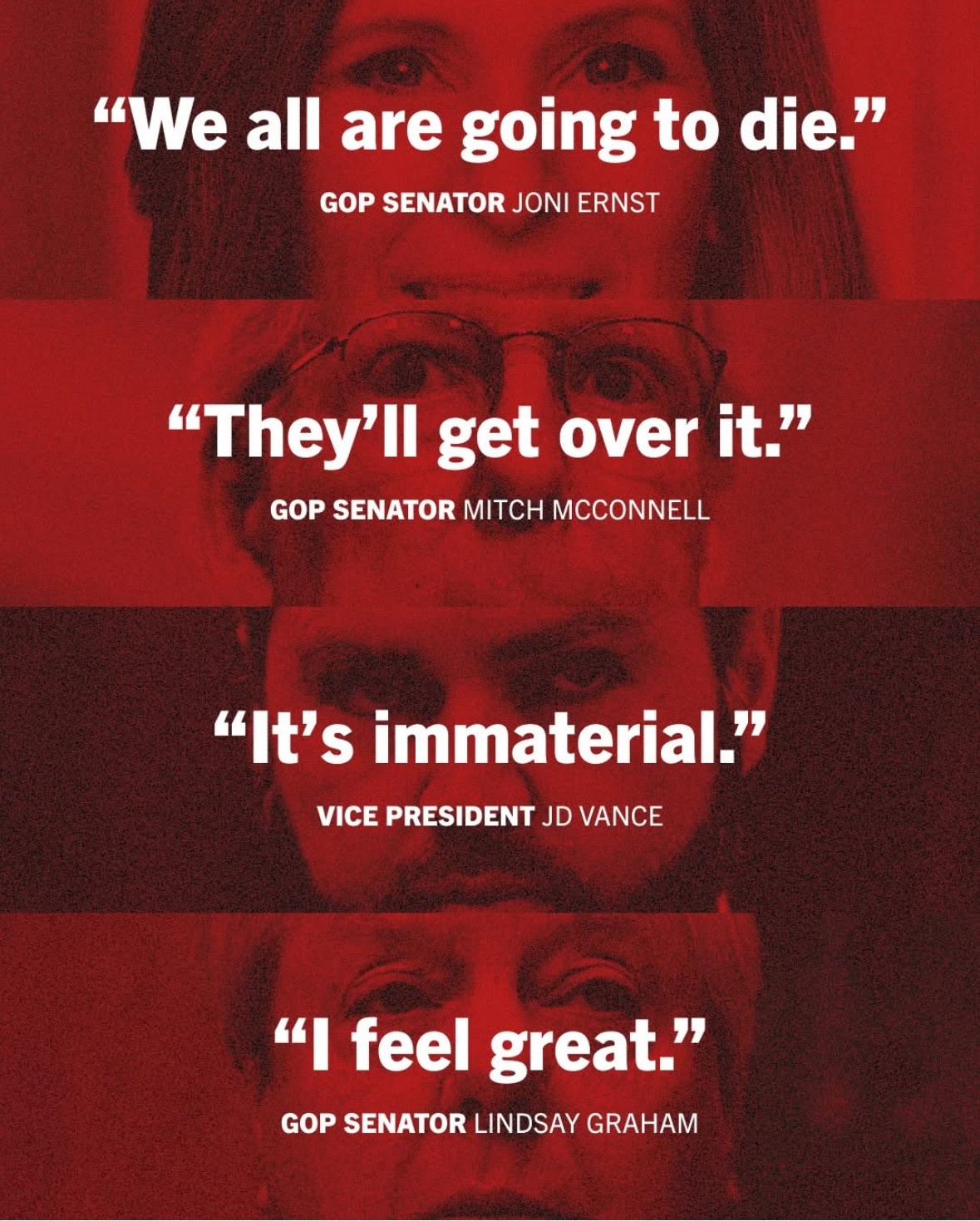
It isn’t timidity. It’s a complete reconstruction of what is acceptable rhetoric, and it makes gentler more collegial conversation and work impossible.
Whether it’s bloodshed at Glastonbury or starving people on benefits, their ‘irony poisoning’ seeps obscene ideas into the range of the possible
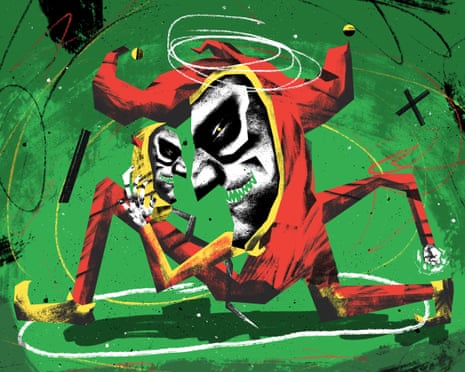
Illustration: Nate Kitch/The Guardian
Imagine the furore if a Guardian columnist suggested bombing, say, the Conservative party conference and the Tory stronghold of Arundel in Sussex. It would dominate public discussion for weeks. Despite protesting they were “only joking”, that person would never work in journalism again. Their editor would certainly be sacked. The police would probably come knocking. But when the Spectator columnist Rod Liddle speculates about bombing Glastonbury festival and Brighton, complaints are met with, “Calm down dear, can’t you take a joke?” The journalist keeps his job, as does his editor, the former justice secretary Michael Gove. There’s one rule for the left and another for the right.
The same applies to the recent comments on GB News by its regular guest Lewis Schaffer. He proposed that, to reduce the number of disabled people claiming benefits, he would “just starve them. I mean, that’s what people have to do, that’s what you’ve got to do to people, you just can’t give people money … What else can you do? Shoot them? I mean, I suggest that, but I think that’s maybe a bit strong.” The presenter, Patrick Christys replied, “Yeah, it’s just not allowed these days.”
You could call these jokes, if you think killing people is funny. Or you could call them thought experiments. Liddle suggested as much in his column: “I am merely hypothesising, in a slightly wistful kinda way.” This “humour” permits obscene ideas to seep into the range of the possible.
Academic researchers see the use of jokes to break taboos and reduce the thresholds of hate speech as a form of “strategic mainstreaming”. Far-right influencers use humour, irony and memes to inject ideas into public life that would otherwise be unacceptable. In doing so, they desensitise their audience and normalise extremism. A study of German Telegram channels found that far-right content presented seriously achieved limited reach, as did non-political humour. But when far-right extremism was presented humorously, it took off. (snip-MORE)
Sheldon Whitehouse of Rhode Island gives 300th climate speech on the US Senate floor
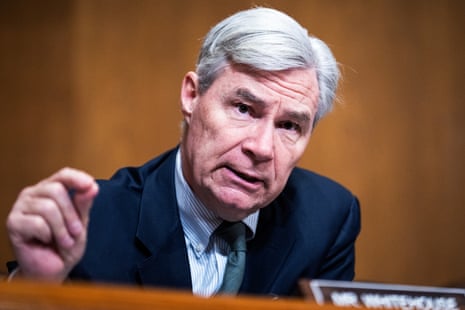
Sheldon Whitehouse at a Senate confirmation hearing on 6 February 2025. Photograph: Tom Williams/CQ-Roll Call via Getty Images
The Democratic party and the climate movement have been “too cautious and polite” and should instead be denouncing the fossil fuel industry’s “huge denial operation”, the US senator Sheldon Whitehouse said.
“The fossil fuel industry has run the biggest and most malevolent propaganda operation the country has ever seen,” the Rhode Island Democrat said in an interview Monday with the global media collaboration Covering Climate Now. “It is defending a $700-plus billion [annual] subsidy” of not being charged for the health and environmental damages caused by burning fossil fuels. “I think the more people understand that, the more they’ll be irate [that] they’ve been lied to.” But, he added, “Democrats have not done a good job of calling that out.”
Whitehouse is among the most outspoken climate champions on Capitol Hill, and on Wednesday evening, he delivered his 300th Time to Wake Up climate speech on the floor of the Senate.
He began giving these speeches in 2012, when Barack Obama was in his first term, and has consistently criticized both political parties for their lackluster response to the climate emergency. The Obama White House, he complained, for years would not even “use the word ‘climate’ and ‘change’ in the same paragraph”.
While Whitehouse slams his fellow Democrats for timidity, he blasts Republicans for being in the pocket of the fossil fuel industry, an entity whose behavior “has been downright evil”, he said. “To deliberately ignore [the laws of physics] for short-term profits that set up people for huge, really bad impacts – if that’s not a good definition of evil, I don’t know what is.” (snip-MORE)
Let’s start with the grifter in chief. I am old enough to remember when the office of president had a grave dignity that each resident of the office did their best to uphold. Now we have a carnival barker in the overall office using the presidency to hawk everything he can think of to separate his cult rubes from their money to make him profit. The presidency has become not a job to guide the nation but a profit seeking center of a crime family. But right wing media crowed non-stop about the Biden crime family over an alleged 20 thousand dollar payment. Meanwhile it was reported that tRump made almost 600 million in just the time he has been in office on a crypto scheme. And no one is stopping him. So much for the emolument clause of the constitution. Hugs
And speaking of hate for those no white …. what is the death of brown children worth these days compared to billionaires getting a tax cut to keep more money they will never need other than to claim to have it. Hugs.
It was all about not having a ship named after a gay navy hero because to these bigots somehow gay means weak. However some of the greatest military heroes are members of the LGBTQ+ community. They just needed the cover of claiming these other ships would be renamed also. There is no inclusion and diversity with these white supremacist haters. If someone thinks different from them, looks different from them, or has a different religious view from them that person must be destroyed by them. Such a person is a threat to them. Weird way to think. Hugs
Let’s talk about the attempt to whiten the US. That is what the entire goal is. It is not about removing criminals as the government just gave two convicted traffickers felon gang members asylum for at least one year and removed from jail just so they could accuse an innocent man the government deported “by accident”. These concentration camps and ICE actions are because people like Stephen Miller hate anyone not white especially if they speak Spanish which Miller can not understand which makes him sure that they are insulting him. It is about older white people scared that the brown people will do to the whites what they did to the brown people while they were in charge. Hugs
Add in the capitalist all the profit must be for us people who hate for a democratic socialist that wants to make live better for the lower incomes, along with the Christian freak out the man is Muslim claiming he will install his religious laws instead of theirs on the public, and the weirdest right wing shit like he will authorize killing all Jewish people and go on a terrorist campaign on the city, but the worst thing is corporate democrats are terrified to support the elected Democratic Party nominee because their corporate over lords don’t like he is going to do stuff for the public, for the people instead of shifting all possible profit to the wealthy like the corporate Democratic Party leadership republican lite members. Hugs
It’s rather telling that they’ve chosen to go after CNN, and NOT Apple nor the app creator. If they were serious, they’d attempt to stop it immediately by going after the app creator first and then Apple for allowing it to be available in their App Store and compatible with their iOS. (Apple could install a patch that would hinder the app.)
This is clearly about intimidating, censoring & controlling the media, and the fat fascist is just itching to destroy one of these entities.
tRump and crew do not care how many people lose their coverage. They claim those “able-bodied people” should get a job so they have healthcare. That is how out of touch most wealthy republicans are if they honestly believe that companies routinely offer health care now. Most companies either don’t or have strict requirements to qualify. The thing is republicans have been trying to cancel health care of the public, for the people since forever. Look how many times they tried to repeal the ACA / Obama care. This bill they just passed will let them roll back the subsidies and throw millions off the ACA rolls. Why? Because they don’t care, they got their healthy care so you can fuck off as it costs profits. You’re not wealthy enough to pay for care yourself than you don’t need or deserve it. Just suffer and then slink away and die. Hugs
This is the person who the cult felt was so much smarter and better than Joe Biden? I often ask how his cult could be taken in by him and the reply comes back “he speaks like we do, he hates who we hate”. WTF. Hugs
With all that is happening it is hard to keep up but we are in the land of nonsense where people with the least understanding of a subject override the advice and judgment of experts. Real scientists make judgments based on medical data / studies while these people run on emotional high that conspiracies give them. Dunning-Kruger effect. Hugs
At what point can we start calling and admitting tRump is not acting as a president of the US but as an authoritarian dictator trying hard to cement his power / authority to crush any dissent. When will our eyes be opened wide enough to see that time is short to stop the erosion of our rights and due process. The Democratic Party is not doing enough to get the message out. Hugs
As was widely reported during the 2022 and 2024 elections, hundreds of seasoned local and state election officials fled their jobs due to threats of violence by the cult. The statement below is from the Democratic Association of Secretaries of State.
So this guy who never served in the military and has no background in law enforcement will lead the army and the ATF, but is convinced he alone is smart enough and needs no help? No I think what this is about is they don’t want the civilians to find out planes to illegally use the military and to either try to stop it or tell people about it. Think on it, tRump wants complete unfettered control to use the military / Army to enforce tRump’s decrees. Maybe his taking over local or state elections apparatus to declare republicans
won when they clearly did not, to enforce voter suppression acts, or simply to back him as he demands a third
On Friday, Driscoll notified the 115 members of the Civilian Aides to the Secretary of the Army program, or CASA, an all-volunteer group that serves as the secretary’s eyes and ears in communities across the country, that their roles were being terminated.
Just last month, in a virtually unprecedented move, the service granted direct commissions at the rank of lieutenant colonel to a group of wealthy tech executives from firms including Palantir, Meta and OpenAI. Meanwhile, behind the scenes, Army planners are quietly trimming down, or outright dismantling, programs seen as peripheral to the service’s high-tech future.
as the service doubles down on its push to modernize with a Silicon Valley-style lensI can imagine where that’s headed.
July 6, 1892 In one of the worst cases of violent union-busting, a fierce battle broke out between the striking employees (members of the Amalgamated Association of Iron and Steel Workers) of Andrew Carnegie’s Homestead Steel Company and a Pinkerton Detective Agency private army brought on barges down the Monongahela River in the dead of night. Twelve were killed. Henry C. Frick, general manager of the plant in Homestead, near Pittsburgh, Pennsylvania, had been given free rein by Carnegie to quash the strike. At Frick’s request, Pennsylvania Governor Robert E. Pattison then sent 8,500 troops to intervene on behalf of the company. Read more (2 links)
July 6, 1942 In Nazi-occupied Holland, thirteen-year-old Jewish diarist Anne Frank and her family were forced to take refuge in a secret sealed-off area of an Amsterdam warehouse under threat of arrest and deportation to a concentration camp by the Einsatzgruppen (Task Force), a part of the German Gestapo. The Anne Frank Center for Mutual Respect
July 6, 1944 Irene Morgan, a 28-year-old black woman, was arrested for refusing to move to the back of the bus eleven years before Rosa Parks did so. Her legal appeal, after her conviction for breaking a Virginia law (known as a Jim Crow law) forbidding integrated seating, resulted in a 7-1 Supreme Court decision barring segregation in interstate commerce. Irene Morgan More about Irene Morgan June 3, 1946: Morgan v. Commonwealth of Virginia Zinn Ed Project
July 6, 1965 As many as 500 students in Berkeley, California, attempted to block trains carrying troops destined for Vietnam along the Santa Fe Railroad tracks; there were no casualties. Organized by the Vietnam Day Committee, this was the first civil disobedience at UC-Berkeley against the Vietnam War.
There are videos at the link below. I don’t know where we are a species right now. It seems more and more people are willing to give in to the lowest of our natures while mocking those who try to live up to the best we could be. The Christians trying to keep books that have LGBTQ+ characters out of schools can’t be bothered by the shooting of starving people including kids trying desperately to get something to eat. They are not doing anything to help, just everything they can to lash out bashing a minority group just for existing using their god to do it. Yet did not their god say to feed the hungry? To help the immigrants among you? They are so desperate to control others sexuality but they don’t care about those acting cruelty to the ones most needing help. Hypocrites, which side of god do they get to sit on? Hugs
American contractors guarding aid distribution sites in Gaza are using live ammunition and stun grenades as hungry Palestinians scramble for food, according to accounts and videos obtained by The Associated Press.
Two U.S. contractors, speaking to the AP on condition of anonymity because they were revealing their employers’ internal operations, said they were coming forward because they were disturbed by what they considered dangerous and irresponsible practices. They said the security staff hired were often unqualified, unvetted, heavily armed and seemed to have an open license to do whatever they wished.
They said their colleagues regularly lobbed stun grenades and pepper spray in the direction of the Palestinians. One contractor said bullets were fired in all directions — in the air, into the ground and at times toward the Palestinians, recalling at least one instance where he thought someone had been hit.
“There are innocent people being hurt. Badly. Needlessly,” the contractor said.
He said American staff on the sites monitor those coming to seek food and document anyone considered “suspicious.” He said they share such information with the Israeli military.
Videos provided by one of the contractors and taken at the sites show hundreds of Palestinians crowded between metal gates, jostling for aid amid the sound of bullets, stun grenades and the sting of pepper spray. Other videos include conversation between English-speaking men discussing how to disperse crowds and encouraging each other after bursts of gunfire.
The testimonies from the contractors — combined with the videos, internal reports and text messages obtained by the AP — offer a rare glimpse inside the Gaza Humanitarian Foundation, the newly created, secretive American organization backed by Israel to feed the Gaza Strip’s population. Last month, the U.S. government pledged $30 million for the group to continue operations — the first known U.S. donation to the group, whose other funding sources remain opaque.
A spokesperson for Safe Reach Solutions, the logistics company subcontracted by GHF, told the AP that there have been no serious injuries at any of their sites to date. In scattered incidents, security professionals fired live rounds into the ground and away from civilians to get their attention. That happened in the early days at the “the height of desperation where crowd control measures were necessary for the safety and security of civilians,” the spokesperson said.
Aid operation is controversial
Gaza’s more than 2 million Palestinians are living through a catastrophic humanitarian crisis. Since Hamas attacked Israel on Oct. 7, 2023, setting off the 21-month war, Israel has bombarded and laid siege to the strip, leaving many teetering on the edge of famine, according to food security experts.
For 2 1/2 months before GHF’s opening in May, Israel blocked all food, water and medicine from entering Gaza, claiming Hamas was stealing the aid being transported under a preexisting system coordinated by the United Nations. It now wants GHF to replace that U.N. system. The U.N. says its Gaza aid operations do not involve armed guards.
Over 57,000 Palestinians in Gaza have been killed since the war erupted, according to the territory’s Health Ministry, which does not distinguish between civilians and militants.
GHF is an American organization, registered in Delaware and established in February to distribute humanitarian aid during the ongoing Gaza humanitarian crisis. Since the GHF sites began operating more than a month ago, Palestinians say Israeli troops open fire almost every day toward crowds on roads heading to the distribution points, through Israeli military zones. Several hundred people have been killed and hundreds more wounded, according to Gaza’s Health Ministry and witnesses.
In response, Israel’s military says it fires only warning shots and is investigating reports of civilian harm. It denies deliberately shooting at any innocent civilians and says it’s examining how to reduce “friction with the population” in the areas surrounding the distribution centers.
AP’s reporting for this article focuses on what is happening at the sites themselves. Palestinians arriving at the sites say they are caught between Israeli and American fire, said the contractor who shared videos with the AP.
“We have come here to get food for our families. We have nothing,” he recounted Palestinians telling him. “Why does the (Israeli) army shoot at us? Why do you shoot at us?”
A spokesperson for the GHF said there are people with a “vested interest” in seeing it fail and are willing to do or say almost anything to make that happen. The spokesperson said the team is composed of seasoned humanitarian, logistics and security professionals with deep experience on the ground. The group says it has distributed the equivalent of more than 50 million meals in Gaza in its food boxes of staples.
GHF says that it has consistently shown compassionate engagement with the people of Gaza.
Throughout the war, aid distribution has been marred by chaos. Gangs have looted trucks of aid traveling to distribution centers and mobs of desperate people have also offloaded trucks before they’ve reached their destination. Earlier this month, at least 51 Palestinians were killed and more than 200 wounded while waiting for the U.N. and commercial trucks to enter the territory, according to Gaza’s Health Ministry and a local hospital. Israel’s military acknowledged several casualties as soldiers opened fire on the approaching crowd and said authorities would investigate.
Videos, texts, internal reports document havoc at food sites
AP spoke to the two contractors for UG Solutions, an American outfit subcontracted to hire security personnel for the distribution sites. They said bullets, stun grenades and pepper spray were used at nearly every distribution, even if there was no threat.
Videos of aid being dispensed at the sites seen by the AP appear to back up the frenetic scenes the contractors described. The footage was taken within the first two weeks of its distributions — about halfway into the operations.
In one video, what appear to be heavily armed American security contractors at one of the sites in Gaza discuss how to disperse Palestinians nearby. One is heard saying he has arranged for a “show of force” by Israeli tanks.
“I don’t want this to be too aggressive,” he adds, “because this is calming down.”
At that moment, bursts of gunfire erupt close by, at least 15 shots. “Whoo! Whoo!” one contractor yelps.
“I think you hit one,” one says.
Then comes a shout: “Hell, yeah, boy!”
The camera’s view is obscured by a large dirt mound.
The contractor who took the video told AP that he saw other contractors shooting in the direction of Palestinians who had just collected their food and were departing. The men shot both from a tower above the site and from atop the mound, he said. The shooting began because contractors wanted to disperse the crowd, he said, but it was unclear why they continued shooting as people were walking away.
The camera does not show who was shooting or what was being shot at. But the contractor who filmed it said he watched another contractor fire at the Palestinians and then saw a man about 60 yards (meters) away — in the same direction where the bullets were fired — drop to the ground.
This happened at the same time the men were heard talking — effectively egging each other on, he said.
In other videos furnished by the contractor, men in grey uniforms — colleagues, he said — can be seen trying to clear Palestinians who are squeezed into a narrow, fenced-in passage leading to one of the centers. The men fire pepper spray and throw stun grenades that detonate amid the crowd. The sound of gunfire can be heard. The contractor who took the video said the security personnel usually fire at the ground near the crowds or from nearby towers over their heads.
During a single distribution in June, contractors used 37 stun grenades, 27 rubber-and-smoke “scat shell” projectiles and 60 cans of pepper spray, according to internal text communications shared with the AP.
That count does not include live ammunition, the contractor who provided the videos said.
One photo shared by that contractor shows a woman lying in a donkey cart after he said she was hit in the head with part of a stun grenade.
This photo, provided by an American contractor on condition of anonymity because they were revealing their employers’ internal operations, shows a woman slumped over in a donkey cart after the contractor said she was hit in the head with part of a stun grenade at a food distribution site in Gaza run by the Gaza Humanitarian Foundation in June 2025. (AP Photo)
An internal report by Safe Reach Solutions, the logistics company subcontracted by GHF to run the sites, found that aid seekers were injured during 31% of the distributions that took place in a two-week period in June. The report did not specify the number of injuries or the cause. SRS told the AP the report refers to non-serious injuries.
More videos show frenzied scenes of Palestinians running to collect leftover food boxes at one site. Hundreds of young men crowd near low metal barriers, transferring food from boxes to bags while contractors on the other side of the barriers tell them to stay back.
Some Palestinians wince and cough from pepper spray. “You tasting that pepper spray? Yuck,” one man close to the camera can be heard saying in English.
SRS acknowledged that it’s dealing with large, hungry populations, but said the environment is secure, controlled, and ensures people can get the aid they need safely.
Verifying the videos with audio analysis
To confirm the footage is from the sites, AP geolocated the videos using aerial imagery. The AP also had the videos analyzed by two audio forensic experts who said they could identify live ammunition — including machine-gun fire — coming from the sites, in most cases within 50 to 60 meters of the camera’s microphone.
In the video where the men are heard egging each other on, the echo and acoustics of the shots indicate they’re fired from a position close to the microphone, said Rob Maher, a professor of electrical and computer engineering at Montana State University and an author and research expert in audio forensic analysis. Maher and the other analyst, Steven Beck, owner of Beck Audio Forensics, said there was no indication that the videos’ audio had been tampered with.
The analysts said that the bursts of gunfire and the pop sequences in some of the videos indicated that guns were panning in different directions and were not repeatedly aimed at a single target. They could not pinpoint exactly where the shots were coming from nor who was shooting.
GHF says the Israeli military is not deployed at the aid distribution sites. Lt. Col. Nadav Shoshani, an army spokesman, said the army is not stationed at the sites or within their immediate proximity, especially during operating hours. He said they’re run by an American company and have their own security.
One of the contractors who had been on the sites said he’d never felt a real or perceived threat by Hamas there.
SRS says that Hamas has openly threatened its aid workers and civilians receiving aid. It did not specify where people were threatened.
Palestinians carry boxes containing food and humanitarian aid packages delivered by the Gaza Humanitarian Foundation, a U.S.-backed organization approved by Israel, in Rafah, southern Gaza Strip, Tuesday, May 27, 2025. (AP Photo/Abdel Kareem Hana,File)
American analysts and Israeli soldiers work side by side, contractors say
According to the contractor who took the videos, the Israeli army is leveraging the distribution system to access information.
Both contractors said that cameras monitor distributions at each site and that American analysts and Israeli soldiers sit in a control room where the footage is screened in real time. The control room, they said, is housed in a shipping container on the Israeli side of the Kerem Shalom crossing into Gaza.
The contractor who took the videos said some cameras are equipped with facial recognition software. In live shots of the sites seen by the AP, some videos streams are labeled “analytics” — those were the ones that had the facial recognition software, said the contractor.
If a person of interest is seen on camera — and their information is already in the system — their name and age pops up on the computer screen, said the contractor. Israeli soldiers watching the screens take notes and cross-check the analysts’ information with their own drone footage from the sites, he said.
The contractor said he did not know the source of the data in the facial recognition system. The AP could not independently verify his information.
An internal SRS report from June seen by the AP said that its intel team would circulate to staff a “POI Mugs Card,” that showed photos of Palestinians taken at the sites who were deemed persons of interest.
The contractor said he and other staff were told by SRS to photograph anyone who looked “out of place.” But the criteria were not specified, he said. The contractor said the photos were also added to the facial recognition database. He did not know what was done with the information.
SRS said accusations that it gathers intelligence are false and that it has never used biometrics. It said it coordinates movements with Israeli authorities, a requirement for any aid group in Gaza.
An Israeli security official who was not named in line with the army’s protocol, said there are no security screening systems developed or operated by the army within the aid sites.