Top Democratic officials put out a new guide, entitled “Deciding to Win,” that encourages Democrats to be a little more like Republicans on “identity and cultural issues.”
Left: David Axelrod // Public domain, Middle: James Carville // JD Lasica // Wikimedia Commons, Right: David Plouffe // Noam Galai // Wikimedia Commons
Erin In The Morning is a reader-supported publication. To receive new posts and support my work, consider becoming a subscriber.
Subscribe
This week, the self-styled centrist group WelcomePAC released a document entitled “Deciding to Win”—advised on by some of the Democratic Party’s most prominent strategists, including David Axelrod, James Carville, and David Plouffe—urging Democrats to act a little more like Republicans on so-called “identity and cultural issues.” The 58-page memo reads like a compendium of the consultant class’s worst instincts, encouraging candidates to become little more than poll-tested avatars and walking focus groups, trading conviction for triangulation. While the document rarely defines which “cultural issues” it means, the few times it does make it clear: queer and transgender people stand to lose the most if this vision of the Democratic Party takes hold.
The document begins with five key pillars for the party. Some of them make a lot of sense, such as “messaging on an economic program centered on lowering costs, growing the economy, creating jobs, and expanding the social safety net,” critiquing “the outsized political and economic influence of” the “ultra-wealthy,” and support for a $15/h minimum wage. Others, though, encourage the party to abandon platforms that have been central to its identity and mission to protect the most vulnerable in society, calling for the party to “Moderate our positions where our agenda is unpopular, including on issues like immigration, public safety, energy production, and some identity and cultural issues.”
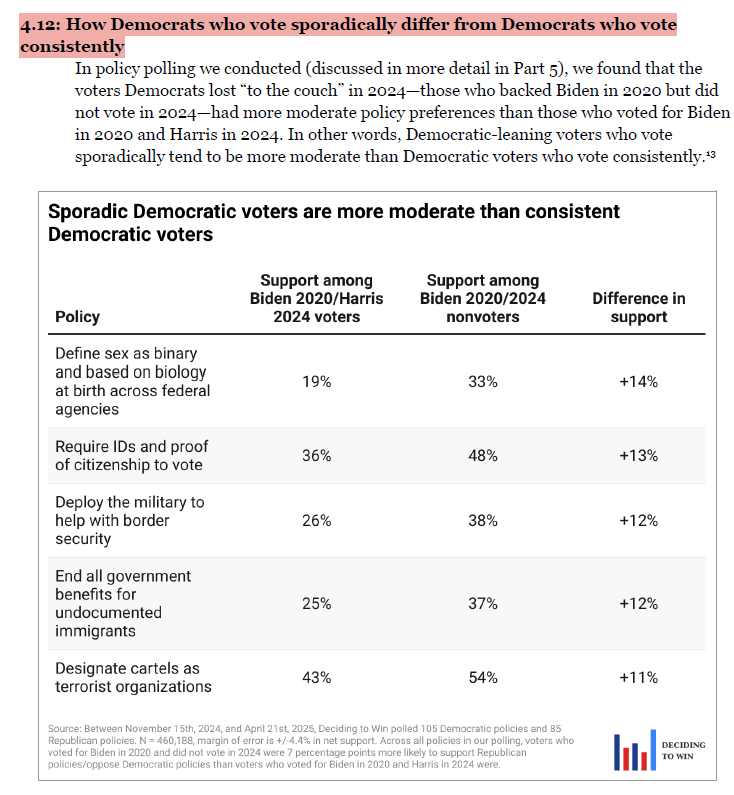
While the document rarely defines what “identity and cultural issues” means, the examples make its targets clear. Support for the Equality Act—legislation that would codify gender identity and sexual orientation as protected classes under federal law—is cited as proof the party has “moved left.” Another section lists “protecting the rights of LGBTQ+ Americans” as a priority voters supposedly don’t want Democrats to emphasize. Elsewhere, a discussion of how to mobilize voters “sitting on the couch” reveals that the most popular policy among them is “defining sex as binary and based on biology at birth across federal agencies.” Later in the document, it explicitly calls out transgender sports participation as an issue that the party should “moderate” on.
Screenshot of Deciding to Win Chart of “moderate” policies
Imagine a world where Democrats actually heeded this advice. The “define sex as binary” policy—already championed in Republican-led states and now embedded in everything the Trump administration does—has had devastating consequences for transgender Americans. It has stripped trans people of the ability to update their passports, creating serious barriers to travel; defunded organizations that affirm gender diversity; and fueled crackdowns on college campuses that allow trans students to use restrooms matching their gender identity. It’s a policy of bureaucratic erasure, one that threatens to undo decades of hard-won progress—yet it’s presented, almost casually, as a “moderate” position Democrats might adopt to win votes.
It’s a vision of politics that would turn Democrats into little more than Republican Lite—a “big tent” party spacious enough for those who despise us but not for those who most need protection. In that world, Democrats would lose not just the meaning of leadership but the very soul of why the party exists. And it’s a fantasy built on delusion: no amount of fine-tuned messaging or poll-tested calibration will ever transform the party into the perpetual winner these consultants imagine.
We don’t have to imagine what happens when Democrats follow this playbook — we’ve already seen it. In New Hampshire, Democrats capitulated on multiple anti-trans bills, including bans on youth sports participation and gender-affirming surgery, only to suffer one of the party’s worst defeats of the 2024 election cycle, losing 20 seats. By contrast, Democrats in Montana fought hard against similar measures and mounted some of the most visible resistance to anti-LGBTQ+ legislation in the country, picking up ten seats in the state House—one of the party’s strongest showings nationwide, in a state Trump carried easily. In Kentucky, Governor Andy Beshear vetoed anti-trans bills, including a sports ban, and still won reelection in a Trump +31 state. And in New York, a ballot measure enshrining gender identity protections outperformed Kamala Harris’s statewide margin by a wide margin.
Despite the evidence, a faction within the Democratic Party still treats queer and trans people as expendable—convinced that by trimming the edges of equality and tolerating “a little” discrimination, they can win back power. It’s a ruinous illusion. This kind of triangulation doesn’t blunt Republican attacks; it validates them. Every state that once embraced sports bans or “compromise” restrictions has since escalated to banning medical care, censoring books, and policing bathrooms. Capitulation has never advanced LGBTQ+ rights—not in policy, not in public opinion, not once. Democrats aren’t losing because they’ve been too loud or too firm in defending equality; they’re losing because the far right invests in its own moral narrative while Democrats second-guess theirs. The only way forward is to stand unapologetically on principle—as Andy Beshear did in Kentucky, citing it as the very reason for his success—not to chase the approval of consultants who mistake cowardice for strategy and appeasement for leadership.
Erin In The Morning is a reader-supported publication. To receive new posts and support my work, consider becoming a subscriber.
Happy Monday from Atlanta! I just tried to convince thousands at a public health conference that it’s time to reimagine systems—not just defend the status quo. I’m happy to report that tomatoes weren’t thrown my way. This is my fourth state in five days, and the highlight is actually seeing the seasons change and meeting a lot of you in person. I couldn’t be more excited to see my girls (and survive another round of the KPop Demon Hunters soundtrack).
Top: Plenary stage with Mike Osterholm; From the bottom left: Met YLE reader Krisandra Allen at the conference. Fall leaves in Idaho. My daughter welcoming me home at the airport.
This week’s Dose runs the gamut: from what’s really going on with lead in protein powders (and whether you should be worried), to a refreshing burst of leadership as 15 governors join forces to strengthen public health collaboration, to falsehoods swirling around mammograms. We’ll wrap with an infectious disease weather report and a quick note for dog owners on an FDA recall.
Let’s go!
Consumer Reports found lead in protein powders. How bad is it?
Last week, Consumer Reports released an analysis revealing elevated lead levels in several popular protein powders and shakes. Google searches for “lead in protein powder” spiked 300%, and influencers lit up social media. Depending on which news source you read, it was either a five-alarm fire or no big deal.
So what’s actually going on? Lead is everywhere—soil, food, water, and air. Thankfully, overall exposure has dropped dramatically since the 1970s, and modern lab tests can now detect vanishingly small amounts (down to parts per billion). But detection does not necessarily equal danger.
How bad is bad?That’s where things get tricky because not everyone agrees:
California limit: 0.5 mcg/day. This number comes from a very conservative calculation: regulators took the “no observable effect” level for reproductive harm for inhaled lead exposure in workplaces and divided it by 1,000. Many experts argue that this threshold is unrealistic. It’s also not linked to adverse health outcomes.
FDA’s limit: 2.2 mcg/day for kids, 8.8 mcg/day during pregnancy, and 12.5 mcg/day for other adults based on blood lead levels, toxicology data, and a built-in 10x safety factor.
European Union limit: Allows up to 3 mg/kg (3 ppm) in food supplements—roughly 90 mcg per 30-gram scoop of protein powder. In this case, the FDA is far more cautious than Europe (and that’s not usually how things go).
Back to the report: of the 23 protein supplements they tested, two-thirds exceeded “Level of Concern.” One brand (Naked Nutrition Vegan Mass Gainer) hit nearly 16 times the limit. But because Consumer Reports used California’s exceptionally strict benchmark, those numbers sound scarier than they really are.
The average American already gets 5.3 mcg of lead daily from food and the environment. That’s another reason California’s cutoff doesn’t make much sense. Still, some products identified in the report could push intake close to the pregnancy (8.8 mcg) or adult (12.5 mcg) daily thresholds.
What this means for you: Don’t worry too much. While the FDA continues to reduce lead exposure through programs like Closer to Zero and the Total Diet Study (that is, if the funding continues), there are several things we can do in our own homes, especially for parents of kids and during pregnancy.
Check to see if your protein supplement (or any supplement, really) has third-party testing for heavy metals (like USP or Informed Sport).
Advocate for more pre-market regulatory oversight in the supplement industry (which has very little, if any at all) by writing to your local representative.
Eat a diet that includes a variety of nutrient-dense foods, which helps limit exposure to specific food sources and ensures we get an array of protective nutrients.
Prioritize getting your protein from whole food sources.
Big thanks to YLE’s Megan Maisano—Registered Dietitian Nutritionist— for writing this section.
Fourteen states and Guam join forces to launch Governors’ Public Health Alliance
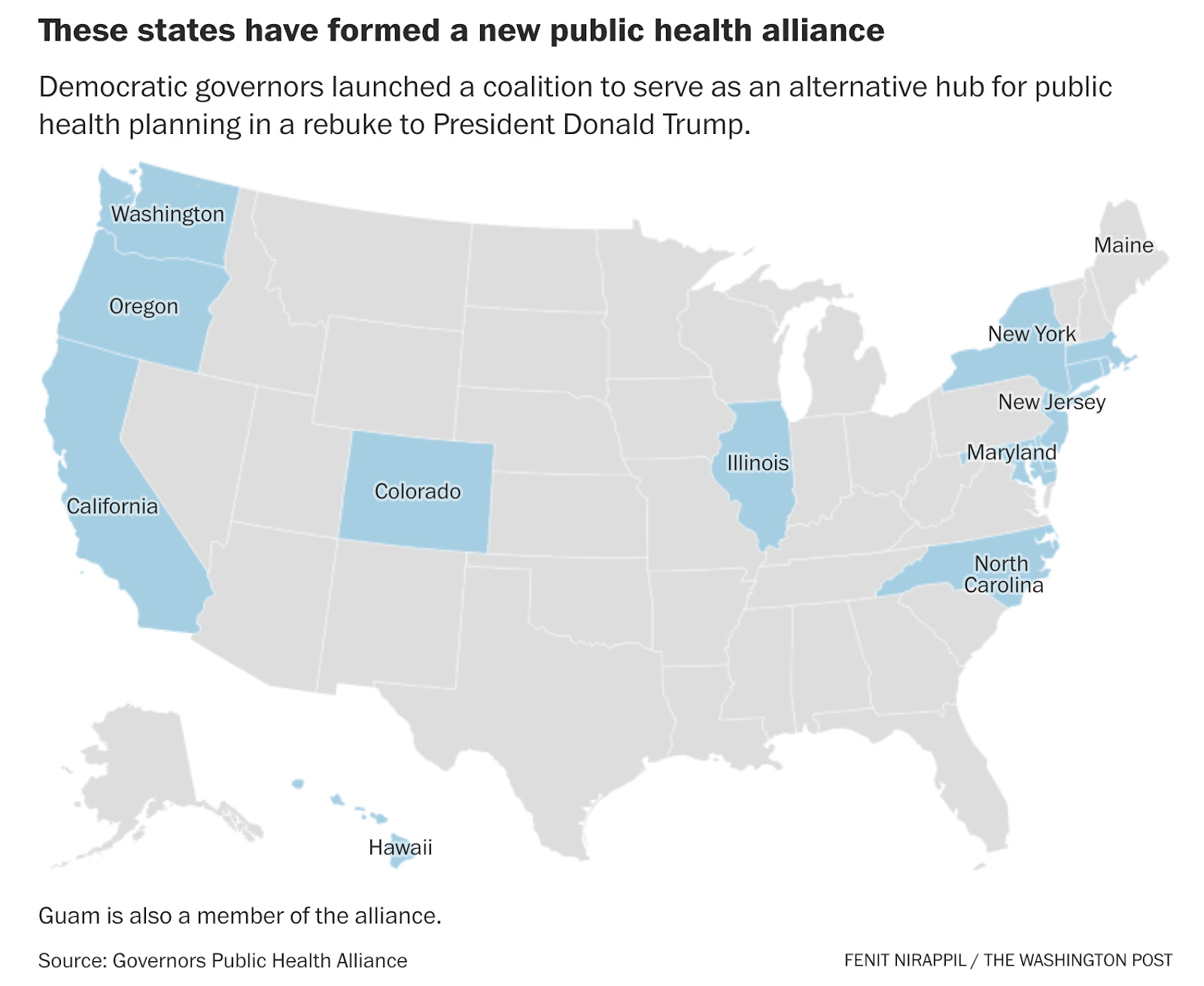
Governors from 14 states and Guam announced the creation of the bipartisan Governors’ Public Health Alliance, which is a new effort to strengthen coordination and collaboration across state lines.
Why do we need this? In the U.S., authority over health rests with the states, not the federal government. Health (encompassing both health care and public health) is not only the highest budget item for a state but also the primary reason for state bankruptcy. In other words, governors hold enormous power over your health.
Today, though, federal support is shifting fast, funding is drying up, and states are being forced to get creative. States must decide whether to maintain their public health departments (due to funding cuts), how to continue purchasing vaccines (if the federal government stops recommending them), whether to negotiate drug prices (like insulin), and more. We saw a similar challenge during the pandemic with bulk purchasing of PPE.
In general, the more coordinating, collaborating, and innovative thinking, the better.
However, I’m growing increasingly concerned about the partisan gaps in public health. Although some Republicans are on the advisory board and the initiative was framed as bipartisan, no Republican-led states have joined. This worries me for my friends in red states, like Texas, but it also has implications for everyone, as diseases don’t care about borders.
What this means for you: If your state is included, you can rest assured your governor is talking to others, which is a helpful step toward innovative solutions. You could argue it was needed before this moment, too. Public health has been siloed for far too long.
Mammograms save lives. They’ve been wrongly targeted.
Happy Breast Cancer Awareness month! Unfortunately, this month has driven some influencers to post false claims about the harms of mammograms. So let’s clear this up.
Breast cancer is the second leading cause of cancer death in women in the U.S., and accounts for 1 in 3 new cancers among women each year. (It affects men too, just at lower rates.) There is strong scientific consensus in support of routine mammograms to prevent breast cancer and detect it early:
Regular mammograms starting at age 40 are recommended for everyone, but may have even greater benefit for Black women, who are 40% more likely to die from breast cancer than white women and more likely to have aggressive cancers, younger.
There’s some critical nuance here:
With each mammogram, breast tissue is exposed to a small amount of ionizing radiation. But! We’re exposed to this type of radiation every day in our natural environment. At high doses, radiation exposure can change DNA and cause harm, but the amount of radiation exposure during a mammogram is about the same as flying from California to New York.
Organizations disagree on whether mammograms every year or every other year are optimal. Screening recommendations are based on evaluating science to maximize benefit (lives saved) while reducing patient worry, unnecessary costs, and diagnosing and treating cancers and pre-cancers that ultimately wouldn’t cause health problems—also called “overdiagnosis.” This is a balancing act.
Mammograms are just one tool for detecting cancer, and women with dense breasts or high risk for cancer (e.g., family history, known genetic predispositions, or other key risk factors) may benefit from additional screening, such as through an MRI.
For more, see YLE’s deep dive on breast cancer screening recommendations.
Infectious disease “weather report”
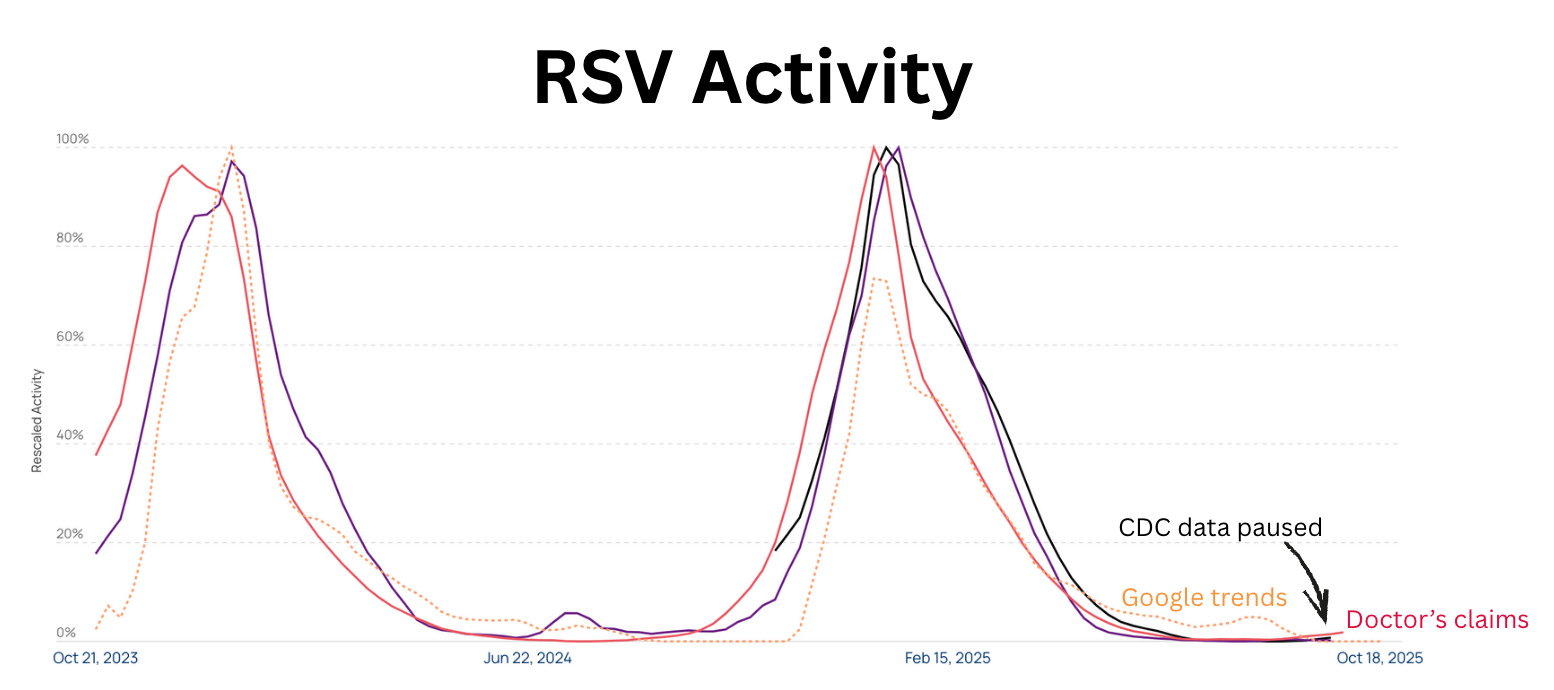
In the U.S., flu and RSV are still quiet. CDC data is still on pause because of the government shutdown, so we’re continuing to reference PopHive data. RSV activity is still low but growing in southern states, like Louisiana and Texas.
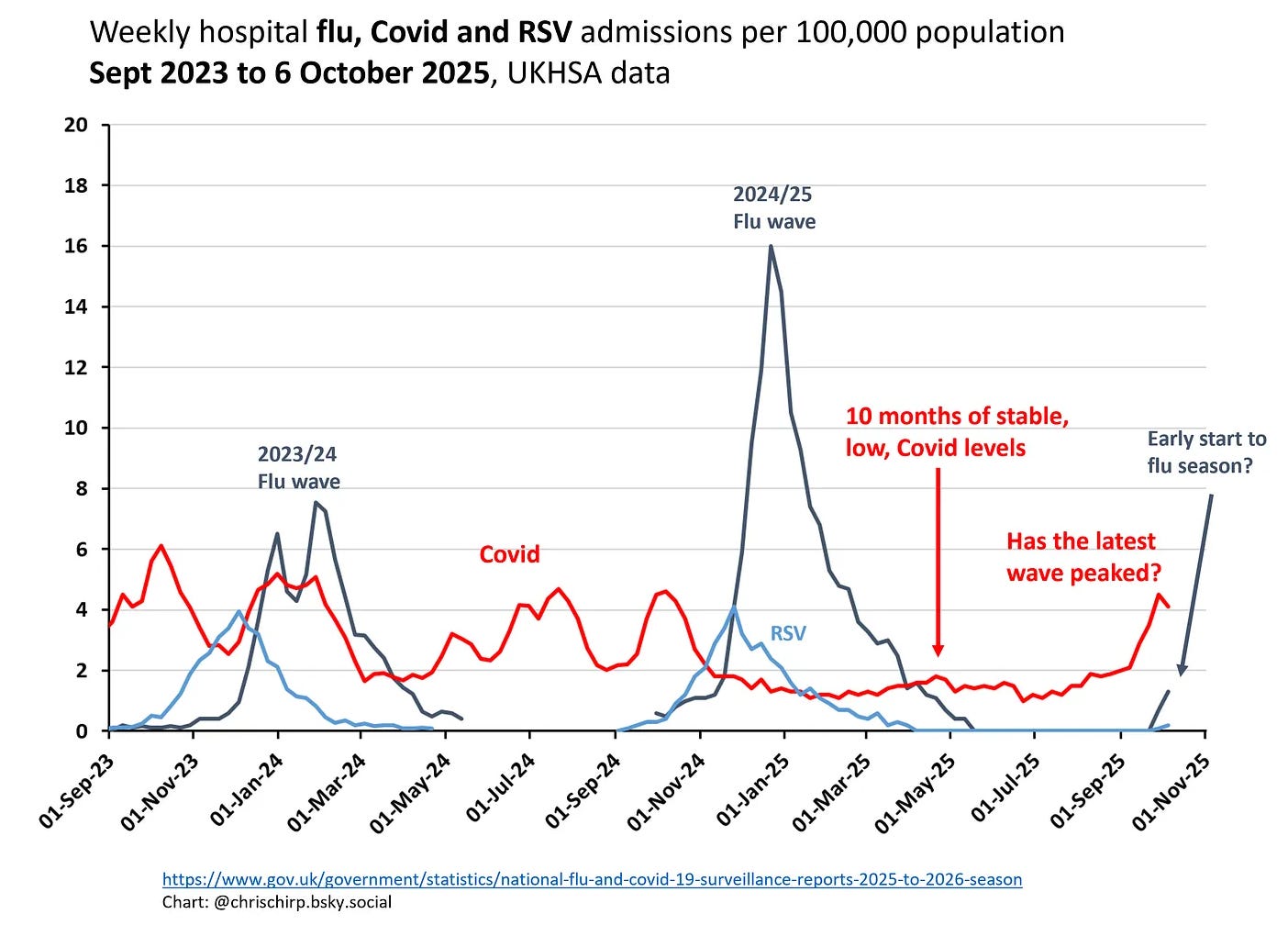
However, Covid-19 is having a moment in the U.K., with hospitalizations increasing exponentially after a 10-month lull. This isn’t driven by a dramatic variant, but rather by a lack of immunity building up over time. Flu might also be increasing, which suggests it’s coming soon (as expected) for the U.S.
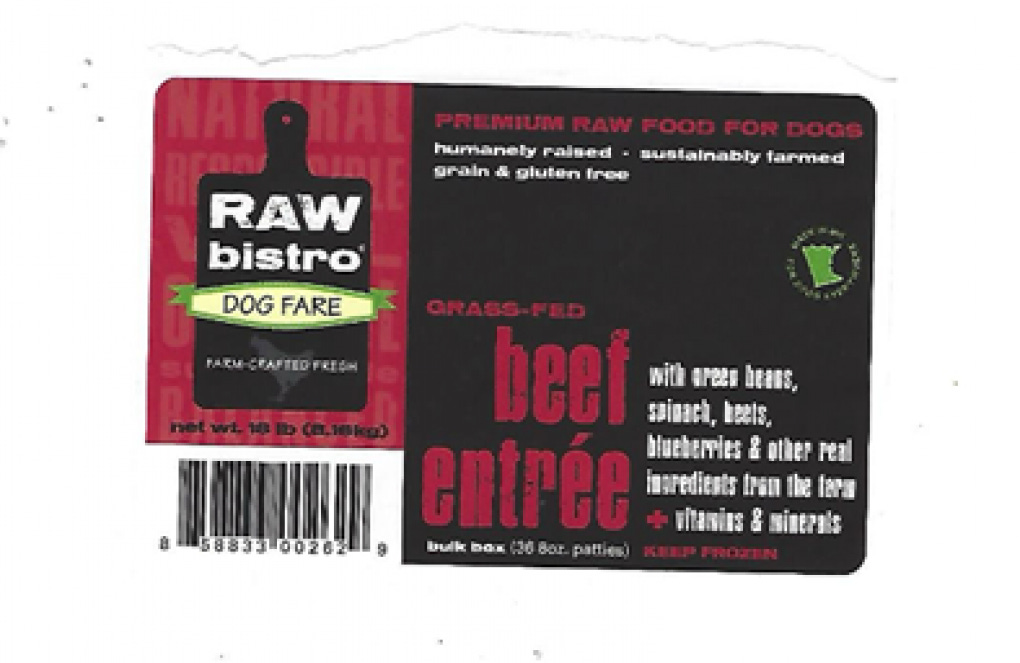
The FDA recalled Raw Bistro frozen beef dog food for possible Salmonella contamination. The recalled products were sold directly to consumers and to select distributors between Sept. 1 and Sept. 17 in California, Colorado, Illinois, and Minnesota.
Salmonella can make dogs sick, just like humans. Contaminated food can cause illness days later in dogs. And dog owners can get sick from handling contaminated food or dog bowls.
What this means for you: Check the lot numbers on your dog’s food, and toss it if they are included in the FDA recall notice. Sanitize bowls if they held contaminated food, wash your hands, and watch for warning signs in your dog: lethargy, vomiting, diarrhea, and loss of appetite. If you notice these signs, take your pet to the vet.
That’s it for this week! Share your fall leave pics in the comments below so that I can continue to live vicariously through you.
Love, YLE
Your Local Epidemiologist (YLE) is founded and operated by Dr. Katelyn Jetelina, MPH PhD—an epidemiologist, wife, and mom of two little girls. YLE is a public health newsletter that reaches over 400,000 people in more than 132 countries, with one goal: to translate the ever-evolving public health science so that people are well-equipped to make evidence-based decisions. This newsletter is free to everyone, thanks to the generous support of fellow YLE community members. To support the effort, subscribe or upgrade below:

Left: David Axelrod // Public domain, Middle: James Carville // JD Lasica // Wikimedia Commons, Right: David Plouffe // Noam Galai // Wikimedia Commons