At the South Louisiana Ice Processing Center in Basile, detainees say they were forced into hard labor – and sexually assaulted and stalked by an assistant warden
‘It is for my daughter and my family that I have endured everything that I have in this detention facility for the past 28 months.’ Illustration: Rita Liu/The Guardian
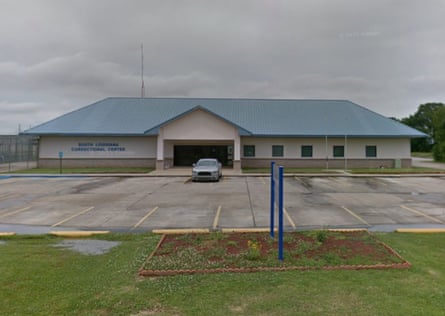
A Google Maps screenshot of the South Louisiana Ice Processing Center (SLIPC) in Basile, Louisiana.
Photograph: Google Maps
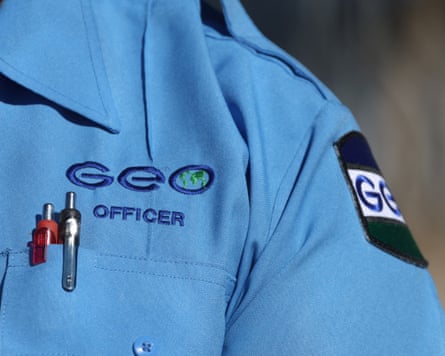
A spokesperson for Geo categorically denied the allegations detailed in the complaints.
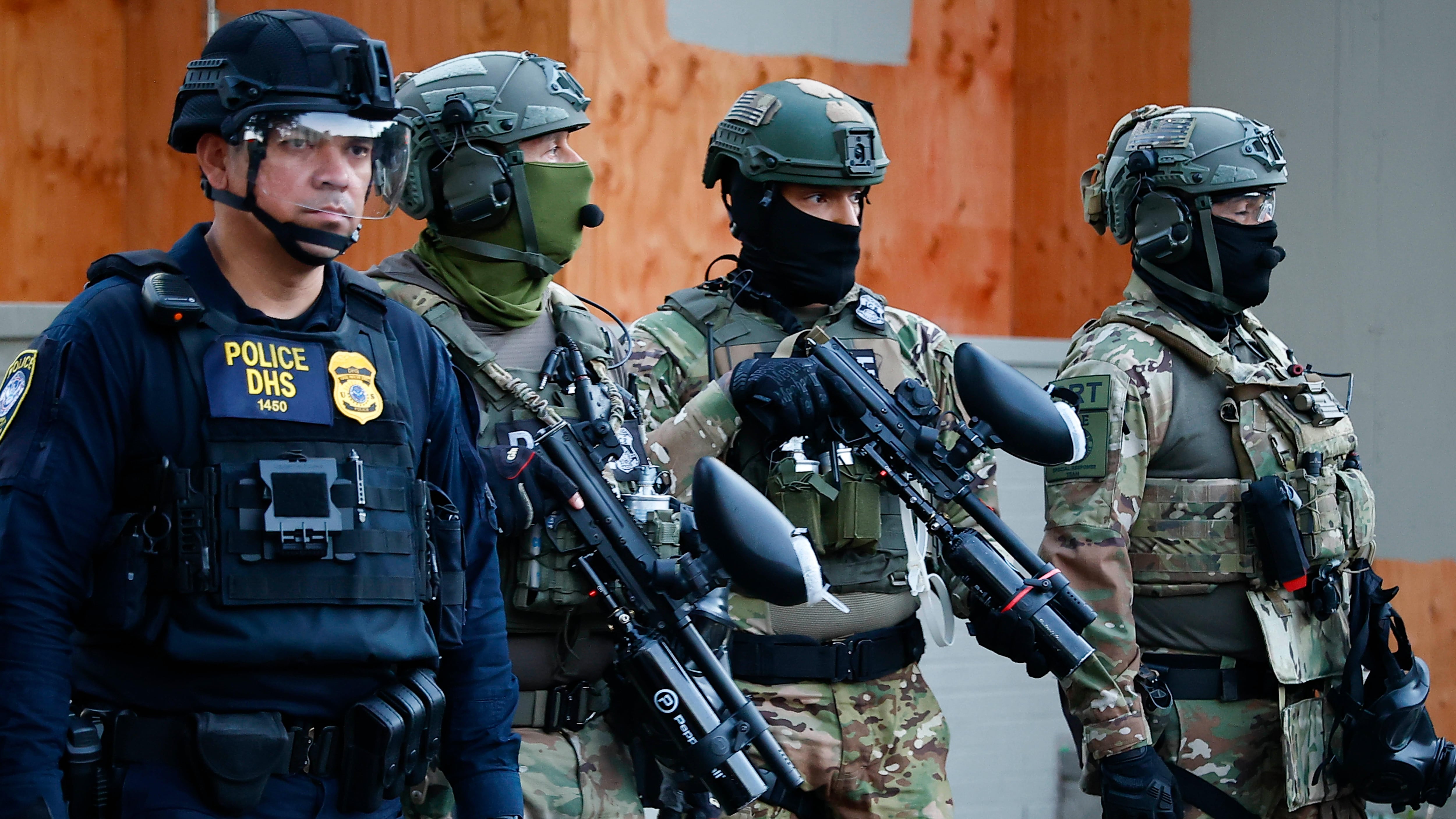
Photograph: Patrick T Fallon/AFP/Getty Images
Queer and trans immigrants at a detention facility in south Louisiana have alleged that they faced sexual harassment and abuse, medical neglect and coerced labor by staff at the facility, and that they were repeatedly ignored or faced retaliation for speaking out.
In multiple legal complaints, immigrants detained at the South Louisiana Ice Processing Center (SLIPC) in Basile, Louisiana, said they were recruited into an unsanctioned work program that forced them to perform hard manual labor for as little as $1 per day. Detainees also alleged that queer people were targeted by an assistant warden who stalked, harassed and sexually assaulted them.
Three current and former detainees who spoke to the Guardian said that, between 2023 and 2025, they endured months of abuse from an assistant warden named Manuel Reyes and his associates. In their complaints to the Department of Homeland Security (DHS) and Immigration and Customs Enforcement (Ice), the detainees also said that they faced retaliation for reporting the abuse to authorities, alleging that Reyes and other staff beat them and denied them medical treatment.
“I was treated worse than an animal,” said Mario Garcia-Valenzuela, one of the detainees. “We don’t deserve to be treated like this.”
Garcia-Valenzuela, a trans man detained at SLIPC, has alleged that, as part of the unsanctioned work program, Reyes forced him to move heavy cabinets and cinder blocks, and to clean using industrial-strength chemicals without gloves or protective gear. When Garcia-Valenzuela complained of injuries from the work program, he said, Reyes and his associates forcefully stripped him naked and mocked him.
Kenia Campos-Flores, who is trans and non-binary, told the Guardian that they suffered from persistent migraines and chest pain after exposure to cleaning chemicals they were made to use during unofficial, overnight work shifts. Campos-Flores also alleged in a complaint they were persistently sexually harassed by Reyes, who entered their dorm and stole possessions including their boxers.
Another trans detainee, Monica Renteria-Gonzalez, complained that a stripper chemical he was told to use to clean the facility floors seeped through his fabric shoes and burned the skin of his feet. On more than one occasion, while Renteria-Gonzalez was bent over cleaning, he said, Reyes came up from behind and inappropriately touched him. The assistant warden also told Renteria-Gonzalez he was watching the detainee through security cameras, including while he was showering.
A fourth detainee, identified by the pseudonym Jane Doe, is a cisgender, queer woman who said that Reyes forced her to perform oral sex on him on a “near daily basis” between February and May 2024, threatening to kill her if she refused, according to her complaint.
Doe, who was deported to the Dominican Republic in January this year, has chosen not to share her name or speak publicly because she fears that Reyes will make good on his threat to find and harm her, her lawyer said.
Taken together, the detainees’ stories present a troubling pattern of mistreatment and abuse inside SLIPC, their attorneys said. Though the alleged abuse took place across two presidential administrations, advocates worry that conditions inside detention facilities could further deteriorate amid the Trump administration’s present push to arrest and detain a record number of immigrants. Trans and queer immigrants in detention are especially vulnerable, advocates said, given that the administration is also moving to roll back key civil rights protections for LGBTQ+ people in federal custody.
The detainees’ allegations are detailed in four separate administrative complaints filed under the Federal Tort Claims Act, which allows individuals to sue the government for injuries caused by federal employees. The government has six months to adjudicate the complaints, or the claimants could move forward with a federal lawsuit. They were submitted in September by Robert F Kennedy Human Rights, the American Civil Liberties Union (ACLU) of Louisiana and the National Immigration Project. Those groups have also submitted a civil rights complaint to the DHS oversight bodies, including the office for civil rights and civil liberties (CRCL), on behalf of the detainees.
“This was a sadistic late-night work program,” said Sarah Decker, a senior staff attorney with RFK Human Rights. “It was designed to target vulnerable trans men or masculine-presenting LGBTQ people, who [Reyes] coerced into participating.”
When detainees tried to report their abuse, Decker said, Ice officials repeatedly disregarded them. Officials dismissed multiple reports of abuse in accordance with the federal Prison Rape Elimination Act (Prea), Decker said, as well as complaints to the Ice office of inspector general (OIG), the department charged with oversight of Ice.
“These people screamed for help. They filed grievances. They filed complaints under the Prison Rape Elimination Act, they filed verbal complaints through the office of the inspector general. They did everything to get help,” Decker said. “And they were systematically ignored, and complaints were buried.”
The Guardian attempted to locate Reyes though multiple means, including public records and social media searches and were unable to contact him. Reyes is not facing criminal charges for the alleged sexual abuse at the facility.
He is no longer employed at SLIPC, Decker said – he left the facility in July 2024. But, Renteria-Gonzalez and Garcia-Valenzuela, who remain detained at SLIPC, told the Guardian other staff at the facility have continued to retaliate against them, placing them in solitary confinement and denying them full access to medical care.
The DHS and Ice did not respond to the Guardian’s queries about the detainees’ allegations, nor did the agencies address whether any of the detainees’ Prea complaints were investigated.
‘It’s devastating and heartbreaking, everything that they do to us in here’
Located about 90 miles (145km) from the Gulf coast in the rural town of Basile, Louisiana, SLIPC was once a correctional facility. But in 2019, it opened as an Ice detention facility, operated by Geo Group, one of the largest private prison and surveillance firms in the US.
Over the past several years, the detention center, which houses mostly women as well as a few trans people, has attracted a string of allegations of civil and human rights violations, medical neglect and poor hygiene. In 2022, an internal inspection by the office of the immigration detention ombudsman – an independent office within the Department of Homeland Security – found that the facility had insufficient medical staffing, and had been inconsistent in addressing the medical and mental health needs of detainees. A 2025 report by the Yale Law School also found that detainees were “left hungry, cold, and in an atmosphere detainees describe as abusive”.
A Google Maps screenshot of the South Louisiana Ice Processing Center (SLIPC) in Basile, Louisiana. Photograph: Google Maps
“It’s devastating and heartbreaking, everything that they do to us in here,” said Renteria-Gonzalez, who first arrived at the facility in May 2023. “We struggle on a daily basis.”
He said his decision to remain in detention while his immigration case is under review – rather than accept deportation – has been painful.
Renteria-Gonzalez came to the US when he was 12 and has been in the country for 31 years. His eight-year-old daughter is a US citizen. “It is for my daughter and my family that I have endured everything that I have in this detention facility for the past 28 months,” he said. “It’s so that I can make it back home to her.”
Renteria-Gonzalez said Reyes first recruited him to participate in the late-night work program in September 2023, according to his complaint. Reyes would often come into his dorm late at night – at around 2 or 3am – to wake him up for his night shift.
“It’s like he lived [at the detention center] 24/7,” Renteria-Gonzalez told the Guardian.
Each recruit worked alone, during different times or in different parts of the detention facility – meaning they were often alone with Reyes, the detainees allege. During these times, Renteria-Gonzalez said, he would watch them work and probe them with invasive and inappropriate questions. “It made me feel uncomfortable,” he said. “He used to sit on his phone and asked us for personal information to look us up on Facebook and stuff.”
Sometimes, he said, Reyes entered detainees’ dorms late at night for no particular reason, and would take their used underwear and personal hygiene products. On other occasions, Renteria-Gonzalez alleged in the complaint, Reyes would stalk him as he went to and from the showers and ask invasive questions: “And after, he would say: ‘Tell me what were you doing in the shower?’”
Twice, Renteria-Gonzalez said, Reyes came up behind him and touched him inappropriately. Another SLIPC officer, according to Renteria-Gonzalez, began to sexually harass him as well, sending him explicit notes and showing him pornographic images of herself.
“I just felt overwhelmed,” he said. “I thought enough was enough.”
Eventually, he realized he wasn’t alone.
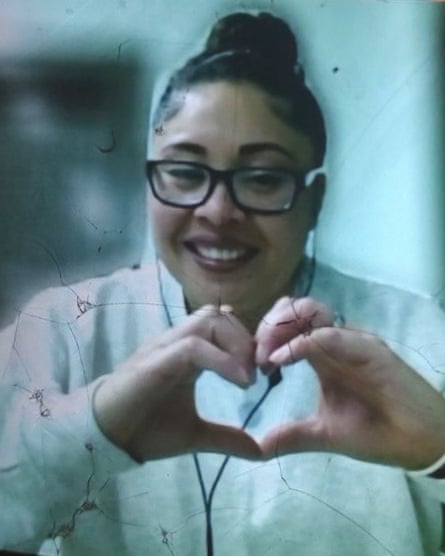
After being detained at SLIPC in February 2024, Garcia-Valenzuela said he also found himself trapped in Reyes’s unofficial work program.
Mario Garcia-Valenzuela. Photograph: Mario Garcia-Valenzuela
Garcia-Valenzuela had fled to the US in 2014 from Mexico, where he was tortured by members of a drug cartel. “I have no choice, that’s why I’m fighting,” he said. “Because I know that as soon as they deport me, I’m going to be handed over to the cartels and I’m going to be tortured and killed – ripped into pieces.”
But in SLIPC he faced a new kind of horror. He alleged that on more than one occasion he was told to move heavy metal filing cabinets back and forth across a room. When he struggled to lift the furniture, Reyes would taunt him, he said, saying: “If you think you are a man, I’m going to treat you like a man.”
In the spring of 2024, Garcia-Valenzuela reported sexual harassment on the basis of his gender, in accordance with Prea. He said he felt targeted due to his gender identity and wanted the fact he is transgender removed from his file, as a measure of protection. But an Ice officer responded that “even if we take off your transgender marker, there is no hiding that you are transgender”, noting Garcia-Valenzuela’s physical appearance, he said. To Garcia-Valenzuela’s knowledge, no follow-up investigation into Reyes was conducted.
Renteria-Gonzalez’s complaints were dismissed as well, Renteria-Gonzalez said.
A spokesperson for Geo categorically denied the allegations detailed in the complaints.
“GEO strongly disagrees with these baseless allegations, which are part of a long-standing, politically motivated, and radical campaign to abolish ICE and end federal immigration detention by attacking the federal government’s immigration facility contractors,” said Christopher V Ferreira, a Geo group spokesperson.
Ferreira added that “GEO has comprehensive policies in place for the reporting and investigation of all incidents that occur at the Center, including instances of assault and/or sexual assault. These policies are governed by standards and requirements established by the US Department of Homeland Security.”
Geo did not respond to questions about Reyes’s employment status at SLIPC.
Harsh retaliation
The detainees who filed complaints against Reyes and other SLIPC staff said that they faced harsh retaliation for doing so.
When Jane Doe filed a Prea complaint with Ice using a paper form and through the phone hotline, detailing that Reyes had sexually assaulted her, she received no response, according to her legal complaint.
But afterwards, Reyes redoubled his efforts to stalk her, the complaint alleges – and forced her to perform oral sex on him, saying he had her cornered in the facility’s “camera blind spots” where no one would see them.
When she attempted to resist, Reyes told her he had found her mother’s home address in the Dominican Republic, Doe alleges in the complaint, and told her that if she were deported, he would follow her to her family’s residence where “you won’t have any protection”.
A spokesperson for Geo categorically denied the allegations detailed in the complaints. Photograph: Patrick T Fallon/AFP/Getty Images
Jane Doe said Reyes and other staff also blocked her from accessing medical treatment for her epilepsy, even as her seizures became more severe and frequent during her time in detention, the complaint states. He repeatedly cornered Doe as she was en route to the medical center to receive treatment, and told her he would watch her on cameras while she was receiving medical evaluation. On one occasion, he told Doe he was “masturbating to her because he saw her body in medical condition when she was in an observation cell”, the complaint alleges.
“We feel so vulnerable, impotent,” Renteria-Gonzalez said.
After he reported that Reyes had sexually assaulted him, Renteria-Gonzalez said, Reyes burst into his housing unit and yelled, “You should have never put my name on it!”, in reference to the complaint to Ice. Renteria-Gonzalez said he was then placed in solitary confinement for two weeks.
After Renteria-Gonzalez reported harassment from another officer, his complaint was dismissed as “unsubstantiated” and the officer came back and told him: “They can’t do nothing to me,” according to the complaint.
Meanwhile, Garcia-Valenzuela said he was repeatedly sent to solitary confinement, he believes in retaliation for speaking out. He said staff at the detention center falsely reported that he had attempted self-harm, and needed to be placed under suicide watch, even though he had not in fact tried to hurt himself.
At one point, while Garcia-Valenzuela was in the medical isolation unit, officers delivered him a meal that consisted of a few potatoes and a few grains of cereal. There was no spoon provided, he said, and there was a note that instructed him to eat it “like a dog”.
Shortly after that incident, he said, a doctor at the facility suddenly – without explanation – stopped providing him access to medication for hand pain that had been exacerbated by his working in Reyes’s night-shift program.
He has avoided making further complaints. He tries not to speak to or make eye contact with staff, and avoids leaving his dorm. He limits trips to the restroom, he said. And rather than go to the cafeteria to warm up his food and eat, he takes his meals cold, and dines in bed. “I have to stay in the back-most corner of my bed, and eat there,” he said.
“I don’t ever feel at ease.”
Trans people in federal custody under threat
The allegations of abuse at SLIPC come at a time when the health and safety of trans people in federal custody is especially under threat, advocates say.
On the first day of his presidency, Donald Trump unveiled a flurry of executive actions targeting trans rights, rolling back anti-discrimination protections and mandating that people in immigration detention be placed in facilities based on their sex assigned at birth.
On 16 January – the last day of Joe Biden’s administration – Ice reported that 47 trans people were in Ice detention facilities around the country and that 69 had been arrested since the start of the fiscal year. As soon as Trump took office, the agency began omitting data on the number of transgender people in immigration detention from its reports.
“The government is essentially refusing to acknowledge the existence of trans people, let alone their humanity,” Decker of RFK Human Rights said.
Although a federal judge has blocked enforcement of Trump’s ban on transgender healthcare in federal prisons, Decker told the Guardian that inside detention centers, guards and staff have been emboldened to deny healthcare to trans clients, or retaliate against them for requesting care.
“I worry that the situation will only get worse from here for trans people,” she added.
The administration also closed the civil rights division of the DHS, as well as the ombudsman office overseeing immigration detention, arguing that the staff in these congressionally mandated divisions were “internal adversaries that slow down operations”.
The divisions included employees tasked with regularly visiting detention centers, investigating complaints and preparing reports for Congress. Detainees facing discrimination, neglect and abuse now have even fewer options for recourse, Decker said.
LGBTQ+ Americans consider move to Canada to escape Trump: ‘I’m afraid of living here’
Read more
It’s a scary, difficult moment to speak out, said Campos-Flores, a 37-year-old single parent of two children who came to the US from El Salvador when they were 11 years old.
During the seven months that Campos-Flores was detained at SLIPC, they would call their parents every day, just to reassure them that they were still alive. Periodically, they would beg their family and their lawyer to find ways to get them out. “I asked them to try to book me into another facility,” they said. “It was too much – just too much.”
In November 2024, they were deported – and immediately they felt a sense of relief to be freed from Reyes, they said. But they couldn’t stay away from their children, who are US citizens – so they crossed back into the US and were again apprehended.
They are currently detained at a different correctional facility in Louisiana, serving a criminal sentence for illegal re-entry. But after finishing their sentence, it is likely they will be transferred back to SLIPC before deportation – and face the same officers who harassed them, or ignored their complaints.
“But I have my 12-year-old son. He is also gay, he likes boys, and I don’t want him to experience anything like what I have experienced,” they said. They want to fight for his rights, too, they said.
Robin Abcarian, Los Angeles Times on Published in Op Eds
I had a difficult time reading the gut-wrenching accounts from the parents of gay children who are part of the Supreme Court case about conversion therapy bans and freedom of speech.
All claim their family relationships were seriously damaged by the widely discredited practice, and that their children were permanently scarred or even driven to suicide.
The case, Chiles vs. Salazar, arose from a 2019 Colorado law that outlaws conversion therapy, whose practitioners say they can change a minor’s sexual orientation or gender identity to align with heterosexual and cisgender norms. The therapy is considered harmful and ineffective by mainstream medical and mental health organizations.
At least two dozen other states have similar laws on the books, all of them good-faith attempts to prevent the lasting harm that can result when a young person is told not just that they can change who they are, but that they should change because God wants them to. The laws were inspired by the horrific experiences of gay and transgender youths whose families and churches tried to change them.
The case was brought by Kayley Chiles, a licensed counselor and practicing Christian who believes, according to her attorneys, that “people flourish when they live consistently with God’s design, including their biological sex.”
Colorado, incidentally, has never charged Chiles or anyone else in connection with the 2019 law.
Chiles is represented by the Alliance Defending Freedom, a conservative Christian law firm known for its challenges to gay and transgender rights, including one brought to the Supreme Court in 2023 by Christian web designer Lorie Smith, who did not want to be forced to create a site for a gay wedding, even though no gay couple had ever approached her to do so. The Court’s conservative majority ruled in Smith’s favor. All three liberals dissented.
As for conversion therapy, counselors often encourage clients to blame their LGBTQ+ identities on trauma, abuse or their dysfunctional families. (If it can be changed, it can’t possibly be innate, right?)
In oral arguments, it appeared the conservative justices were inclined to accept Chiles’ claim that Colorado’s ban on conversion therapy amounts to viewpoint discrimination, a violation of the 1st Amendment’s free speech guarantees. The liberal minority was more skeptical.
But proponents of the bans say there is a big difference between speech and conduct. They argue that a therapist’s attempt to change a minor’s sexual orientation or gender identity amounts to conduct, and can rightfully be regulated by states, which, after all, lawfully impose conditions on all sorts of licensed professionals. (The bans, by the way, do not apply to ministers or unlicensed practitioners, and are generally not applicable to adults.)
Each competing brief whipsawed my emotions. The 1st Amendment is sacred in so many ways, and yet states have a critical interest in protecting the health and welfare of children. How to find a balance?
After reading the brief submitted by a group of 1st Amendment scholars, I was convinced the Colorado law should be ruled unconstitutional. As they wrote of Chiles, she doesn’t hook her clients to electrodes or give them hormones, as some practitioners of conversion therapy have done in the past. “The only thing she does is talk, and listen.”
Then I turned to the parents’ briefs.
Linda Robertson, an evangelical Christian mother of four, wrote that she was terrified when her 12-year-old son Ryan confided to her in 2001 that he was gay. “Crippling fear consumed me — it stole both my appetite and my sleep. My beautiful boy was in danger and I had to do everything possible to save him.”
Robertson’s search led her to “therapists, authors and entire organizations dedicated to helping kids like Ryan resist temptation and instead become who God intended them to be.”
Ryan was angry at first, then realized, his mother wrote, that “he didn’t want to end up in hell, or be disapproved of by his parents and his church family.” Their quest to make Ryan straight led them to “fervent prayer, scripture memorization, adjustments in our parenting strategies, conversion therapy based books, audio and video recordings and live conferences with titles like, ‘You Don’t Have to be Gay’ and ‘How to Prevent Homosexuality.’ ”
They also attended a conference put on by Exodus International, the “ex-gay” group that folded in 2013 after its former founder repudiated the group’s mission and proclaimed that gay people are loved by God.
After six years, Ryan was in despair. “He still didn’t feel attracted to girls; all he felt was completely alone, abandoned and needed the pain to stop,” his mother wrote. Worse, he felt that God would never accept him or love him. Ryan died at age 20 of a drug overdose after multiple suicide attempts.
As anyone with an ounce of common sense or compassion knows, such “therapy” is a recipe for shame, anguish and failure.
Yes, there are kids who question their sexuality, their gender identity or both, and they deserve to discuss their internal conflicts with competent mental health professionals. I can easily imagine a scenario where a teenager tells a therapist they think they’re gay or trans but don’t want to be.
The job of a therapist is to guide them through their confusion to self-acceptance, not tell them what the Bible says they should be.
If recent rulings are any guide, the Supreme Court is likely to overturn the Colorado conversion therapy ban.
This would mean, in essence, that a therapist has the right to inflict harm on a struggling child in the name of free speech.
There is a video at the link below showing the restraint. Because of being restrained during abuse as a child I can not stand anything pinning my legs or arms down. When I had my left hip done the doctor required patients to be strapped into an immobilizing device. When I woke up in the hospital with it on I totally lost my shit and they had to remove it. But the doctor wouldn’t allow anyone to lay flat or sleep without it. So for weeks I slept upright in Ron’s recliner. There is no need for a torture device such as this used by ICE. It is designed to be punitive and cause people harm. Hugs
The Nigerian man described being roused with other detainees in September in the middle of the night. U.S. Immigration and Customs Enforcement officers clasped shackles on their hands and feet, he said, and told them they were being sent to Ghana, even though none of them was from there.
When they asked to speak to their attorney, he said, the officers refused and straitjacketed the already-shackled men in full-body restraint suits called the WRAP, then loaded them onto a plane for the 16-hour-flight to West Africa.
Referred to as “the burrito” or “the bag,” the WRAP has become a harrowing part of deportations for some immigrants.
“It was just like a kidnapping,” the Nigerian man, who’s part of a federal lawsuit, told The Associated Press in an interview from the detainment camp in which he and other deportees were being held in Ghana. Like others placed in the restraints interviewed by the AP, he spoke on the condition of anonymity for fear of reprisals.
The AP identified multiple examples of ICE using the black-and-yellow full-body restraint device, the WRAP, in deportations. Its use was described to the AP by five people who said they were restrained in the device, sometimes for hours, on ICE deportation flights dating to 2020. And witnesses and family members in four countries told the AP about its use on at least seven other people this year.
The AP found ICE has used the device despite internal concerns voiced in a 2023 report by the civil rights division of its parent agency, the U.S. Department of Homeland Security, in part due to reports of deaths involving use of the WRAP by local law enforcement. And the AP has identified a dozen fatal cases in the last decade where local police or jailers around the U.S. used the WRAP and autopsies determined “restraint” played a role in the death.
The WRAP is the subject of a growing number of federal lawsuits likening incorrect usage of the device to punishment and even torture, whether used in a jail or by immigration authorities during international flights. Among advocates’ concerns is that ICE is not tracking the WRAP’s use as required by federal law when officers use force.
DHS has paid Safe Restraints Inc., the WRAP’s California-based maker, $268,523 since it started purchasing the devices in late 2015 during the Obama administration. Government purchasing records show the two Trump administrations have been responsible for about 91% of that spending. ICE would not provide AP with records documenting its use of the WRAP despite multiple requests, and it’s not clear how frequently it has been used in the current and prior administrations.
The WRAP’s manufacturer says it intended the device to be a lifesaver for law enforcement confronting erratic people who were physically attacking officers or harming themselves.
But ICE officials have a much lower threshold for deploying the WRAP than the manufacturer advises, the AP found. Detainees interviewed by the AP said ICE officers used the restraints on them after they had been shackled. They said this was done to intimidate or punish them for asking to speak to their attorneys or expressing fear at being deported, often to places they fled due to violence and torture.
The West African deportee described a terrifying, hourslong experience that left his legs swollen to the point where he walked with a limp.
“They bundled me and my colleagues,” he said, “tied us up in a straitjacket.”
ICE and DHS would not answer detailed questions from the AP and refused a request for the government’s policy for when and how to use the WRAP.
“The use of restraints on detainees during deportation flights has been long standing, standard ICE protocol and an essential measure to ensure the safety and well-being of both detainees and the officers/agents accompanying them,” Tricia McLaughlin, DHS’ spokesperson, said in an email to AP. “Our practices align with those followed by other relevant authorities and is fully in line with established legal standards.”
The agency would not specify those authorities or describe its practices.
“The use of these devices is inhumane and incompatible with our nation’s fundamental values,” said Noah Baron, an attorney for the West African deportees.
Charles Hammond, CEO of Safe Restraints Inc., said his company has made a modified version of the device for ICE, with changes meant to allow people to be kept in it during flights and long bus trips.
ICE’s version includes a ring on the front of the suit that allows a subject’s cuffed hands to be attached while still allowing for limited use to eat and drink, he said. In addition, the ICE version has “soft elbow cuffs,” Hammond said, which connect in the back so a person can move for proper circulation but can’t flip an elbow out to hit someone.
This photo provided by Safe Restraints Inc., in October 2025, shows a custom version of the WRAP restraining equipment made for the U.S. Immigration and Customs Enforcement agency. (Safe Restraints via AP)
This photo provided by Safe Restraints Inc., in October 2025, shows a custom ICE version of the WRAP with soft elbow cuffs that keep the arms against the body but allow relatively free use of the hands. (Safe Restraints via AP)
An AP reporter recounted for Hammond some of the allegations made by people who had been placed in the WRAP for long flights. All of those interviewed by AP said their hands and feet were already restrained by chains. All denied fighting with officers, saying they were either crying or pleading against their deportation to countries they deemed dangerous.
Hammond said that, if true that some people were not being violent and simply protesting verbally, putting them in the WRAP could be improper use.
“That’s not the purpose of the WRAP. If (the deportee) is a current or potential risk to themselves, to officers, to staff, to the plane, restraints are justified. If it’s not, then restraints aren’t.”
‘Please help me’
Juan Antonio Pineda said he was put into “a bag” in late September and driven by immigration officers to the Mexico border. It was black with yellow stripes and had straps that immobilized his body and connected over his shoulders — the WRAP.
Pineda, who is from El Salvador, was in the U.S. legally, he said in a video from an ICE detention center in Arizona. On Sept. 3, he went to an appointment in Maryland to get permission for another year, his wife, Xiomara Ochoa, said in an interview from El Salvador. Instead, he was detained by ICE and told he’d be deported to Mexico, but the documents he was shown had someone else’s name, he said. Even so, he was sent to the Florence Service Processing Center detention facility in Arizona.
In this image from video provided by Xiomara Ochoa, Juan Antonio Pineda shows a cast for his arm as he speaks during an interview from the ICE detention center in Florence, Ariz., on Sept. 29, 2025 .(Xiomara Ochoa via AP)
Early morning on Wednesday, Sept. 24, he said officers tied his hands and legs, placed him into the “bag” and drove him four hours to the border. When he refused to sign the deportation papers, Pineda alleges officers broke his right arm and gave him a black eye before driving him back another four hours in the “bag.” The AP was unable to independently confirm how he was injured. Pineda’s video shows him with a cast on his arm and bruising on his face.
The next day, Thursday, Sept. 25, they tied him up again, put him in the bag and drove him to the border, where Mexican immigration officials turned him away, he said.
“Eight hours there and back and they don’t give me food or water or anything,” he said in the video, which his wife shared with the AP. “Please help me.”
He was ultimately deported to Mexico, Ochoa said.
ICE did not respond to multiple requests for comment from the AP regarding Pineda’s case.
In addition to the Nigerian man flown to Ghana, four others interviewed by AP said they were placed in the WRAP and carried onto deportation flights since the first Trump administration.
As U.S. immigration officials move aggressively to meet the president’s deportation goals, advocates and attorneys for immigrants are echoing the concerns of the government’s own civil rights inquiry that ICE officers aren’t trained on how to use the restraints.
“This should be a last resort type of restraint after they’ve already tried other things,” said Fatma Marouf, a Texas A&M law professor who has sued ICE over its use of the device. “Just being bound up like that can inflict a lot of psychological harm.”
Some deportees said they were left in the WRAP for an entire fight. A lawsuit filed on behalf of the Nigerian man and four others currently detained in Dema Camp, Ghana, included the allegation from one that ICE left the restraint suit on him for 16 hours, only once undoing the lower part so he could use the bathroom.
“No one should be put into a WRAP. I don’t even think they strap animals like that,” recalled a man who said he suffered a concussion and dislocated jaw being placed into the device in 2023 before a deportation flight to Cape Verde, an African island nation. AP’s review of his medical records confirmed he suffered those injuries in 2023.
“It was the most painful thing I’ve been through,” said the man, adding he was restrained most of the 10-hour flight. “Forget the assault, forget the broken jaw. Just the WRAP itself was hurtful.”
Also, the man said, the metal ring his cuffed hands were attached to — one of the ICE modifications to the WRAP designed to increase comfort — injured him. “When they slammed me face forward on the floor, that metal ring dug into my chest causing me bruising and pain which was part of my injuries that I complained about.”
ICE’s current use of the WRAP comes amid an unprecedented wave of masked federal immigration officers grabbing suspected immigrants off the street, and mounting accusations that the Trump administration has dehumanized them, including by subjecting them to cruel and unusual detention conditions.
ICE’s use of the WRAP has continued despite a 2023 report by DHS’s Office for Civil Rights and Civil Liberties, or CRCL, that raised serious concerns over the lack of policies governing its use.
ICE agreed with the internal findings on some points, a then-DHS official involved in the review said, but challenged the notion that the WRAP should be classified as a “four-point restraint,” a designation that would place more limitations on its use. The person spoke on condition of anonymity because they weren’t authorized to discuss the inquiry.
DHS largely dismantled the office that produced the 2023 report earlier this year amid widespread government firings, calling it a roadblock to enforcement operations.
“Without changes to the current training, and the lack of policy, CRCL has serious concerns about ICE’s continued use of the WRAP,” wrote the report’s authors, who cited a news article mentioning lawsuits claiming the device had led to deaths.
Use by police and in jails
Last year police officers in Virginia Beach, Virginia, placed Rolin Hill in the WRAP, saying he was being combative during an arrest at a convenience store. The officers left Hill in the device when they dropped him at the jail. Video from the jail shows deputies punching the WRAP-immobilized Hill in the head and back. Hill died in a hospital, and while the WRAP’s exact role is unknown, Hill’s death was ruled a homicide by “positional and mechanical asphyxia due to restraint with neck and torso compression.” Three of the deputies are now charged with his murder, and five were removed from their jobs.
Also last year, in Missouri, prosecutors charged five jailers in the death of Othel Moore Jr., who according to an autopsy asphyxiated in the WRAP. Jailhouse footage showed Moore, who’d also been sprayed with tear gas and placed in a “spit mask” covering his face, repeatedly told officers he couldn’t breathe.
In this image from surveillance video provided by Jefferson City Correctional Center, jailers examine Othel Moore Jr., at the Jefferson City Correctional Center in Jefferson City, Mo., on Dec. 8, 2023, who according to an autopsy asphyxiated in the WRAP restraint. (Jefferson City Correctional Center via AP)
While Hammond insists the WRAP has never been determined as the cause of death when used properly, the AP identified 43 times in which the WRAP was used by police or correctional officers in a case in which someone died. In 12 of those cases the official autopsy determined that “restraint” played some role in the death.
It was often impossible to determine the exact role the WRAP may have played, as deaths often involved the use of other potentially dangerous force on people who in several cases were high on methamphetamine.
The WRAP first appeared in law enforcement in the late 1990s, presented as an alternative to tying a subject’s hands and feet together in a practice known as “hog-tying.” It first found widespread use in California jails and today is used by more than 1,800 departments and facilities around the country, according to the manufacturer, which says it has sold more than 10,000 devices.
Many of these cases have drawn little media attention, such as the 2020 case of Alberto Pena, who was jailed on a misdemeanor criminal mischief charge after getting drunk and damaging the walls and doors at his parents’ home outside Rio Grande City, Texas. The 30-year-old became erratic on the way to the Starr County Jail, beating his own head against the inside of the patrol unit and, later, the wall of his cell.
Deputies placed Pena in the WRAP for more than two hours, where he repeatedly cried out for help and complained he could not breathe. But he was left unattended in the device for significant periods of time, court records show, and no medical attention was provided for his self-inflicted head injuries.
An autopsy ruled Pena’s death “accidental,” but a forensic pathologist hired by the family attributed Pena’s death in part to the WRAP’s “prolonged restraint” and said it “could have been averted” with proper medical care.
“The WRAP should have never been used in this situation. It was a medical emergency and he should have been taken to the hospital,” said Natasha Powers-Marakis, a former police officer and use of force expert who reviewed the case on behalf of Pena’s family as part of their wrongful death lawsuit against the county and officers who placed him in the device. The arresting officers had been told Pena suffered from bipolar disorder.
The Starr County Sheriff’s Office has denied wrongdoing and maintained Pena did not require medical care. Robert Drinkard, an attorney for the county, told AP the use of the WRAP “was neither improper nor caused Mr. Pena’s tragic death.” He added that each deputy involved in placing Pena in the WRAP had been trained in its application.
A federal judge recently dismissed the Pena family’s lawsuit, ruling the deputies were shielded from liability.
‘Carrying me like a corpse’
In the context of an ICE deportation flight, the use of restraints like the WRAP can be justified, Hammond, the manufacturer’s CEO, argues.
ICE officers have to ensure that they secure anyone who could pose a fight risk on a long flight, he said. Given the high stakes of a violent confrontation on an airplane, Hammond believes cases like those described to the AP can warrant the WRAP’s use, even if the person is already in chains.
However, properly trained agents are supposed to loosen the straps and allow enough movement so the subject can eat and drink, as well as use the bathroom.
“With the WRAP, when it is used properly, it’s a shorter fight, which is good for everybody. It prioritizes breathing, which is good for everybody. And you have no more fight and can provide medical care or mental health care or de-escalation efforts,” Hammond said.
Those placed in one of Hammond’s restraint suits, however, recount the experience as traumatic.
One of these people was first put into five-point shackles when he became dizzy and tripped while ascending the stairs to board the ICE flight to Cameroon in November 2020. The officer mistook his stumbling as resistance, he said. Immediately, camouflage-clad ICE officers quickly pushed him to the tarmac and onto a WRAP device, he said.
Soon, he felt the straps cinching around his legs and upper body.
“They bundled me like a log of wood from all the sides and they were just carrying me like a corpse,” he said.
Another man interviewed by the AP said ICE officers put him in the WRAP after he initially resisted efforts to move him onto a deportation flight in Alexandria, Louisiana, in 2020. He’d fled political violence and persecution in his native Cameroon, and was afraid to go back. He said officers took him out of his cell in front of the other detainees and put him in the WRAP, leaving him for hours in view of the others as a warning to them not to speak up.
“I told him ‘I can’t breathe,’” the man said. “He responded, ’I don’t care, I’m doing my job.’”
___
Dearen and Pineda reported from Los Angeles and Mustian reported from New York. AP journalists Ope Adetayo in Abuja, Ghana, Obed Lamy in Indianapolis and Ryan J. Foley in Iowa City, Iowa, contributed to this report. Dan Lawton also contributed.
ICE is a totally out of control rogue government agency that is simply lawless thugs. This was a civilian in medical distress in the ambulance. In a worse medical emergency the person could have died. The person was not in custody and a citizen but ICE demanded to be allowed to control them. Wake up people we have crossed all the lines. We barely have a functioning democracy. We all need to do what we can to fight this. Incredibly scary. ICE did not have the authority to hold the ambulance up but they did so at the point of a gun. What does that say about where the US is as “a nation of laws” and the republicans who for 50 years called themselves the party of law and order? Hugs
Late on Oct. 5, a Portland ambulance crew informed dispatchers over the radio that it was attempting to transport a patient from U.S. Immigration and Customs Enforcement to Legacy Emanuel Medical Center but that ICE officers were impeding its departure. Six minutes later, at 9:40 pm, according to publicly archived radio records, the medic driving the vehicle delivered an update: “We are still not being allowed to leave by ICE officers.”
Two confidential incident reports obtained by WW offer insight into what was going on inside the South Portland ICE facility at the time. The written accounts were filed by the ambulance crew members shortly after the incident—one report to their employer, American Medical Response, and another to a union representative—as documentation, as one report puts it, of a “conflict with federal agents.”
The two reports, filed by different medical workers, mirror each other’s accounts, and are consistent with publicly available audio recordings of emergency medical services radio communications, as well as 911 calls and dispatch reports obtained under public records law.
Both reports say that federal agents, in an effort to block the ambulance’s departure, stood directly in front of the vehicle. As the delay dragged on, according to the reports, the ambulance operator put the vehicle into park, causing it to lurch forward slightly.
The reports indicate the federal agents did not like this—so much so that an agent threatened to shoot and arrest the driver. The driver, frightened, asked why. An agent, according to the reports, responded that the driver had attempted to hit him with the ambulance.
“I was still in such shock,” the driver later wrote, “that they were not only accusing me of such a thing, but crowding and cornering me in the seat, pointing and screaming at me, threatening to shoot and arrest me, and not allowing the ambulance to leave the scene. This was no longer a safe scene, and in that moment, I realized that the scene had not actually been safe the entire time that they were blocking us from exiting, and that we were essentially trapped.”
The incident occurred at a contentious spot in the city. The ICE facility on South Macadam Avenue has in recent months been the scene of frequent and persistent protests, typically small in scale, which President Donald Trump has lately used to justify his effort to deploy military troops to Portland to protect federal facilities and the personnel that work in them.
Meanwhile, many, including Portland city officials, have alleged that federal agents have in several cases needlessly intensified situations that might have easily remained far more calm.
The incident described in the crew members’ two reports suggests that such hostility has been directed not only at demonstrators, but at first responders who were asked by the feds to assist. The ambulance was eventually allowed to leave the building with the patient. But the crew’s written reports of the preceding minutes offer a small but revealing sign of how on edge some federal agents working in the ICE facility are feeling—and how quick they are to take an aggressive posture when they perceive a physical threat, even from a fellow emergency worker.
WW first contacted U.S. Immigration and Customs Enforcement about the incident early last week. When WW followed up Friday, Oct. 10, with more details about what it planned to report, an ICE spokesperson wrote: “Please contact the Federal Protection Services for response.”
A subsequent email that day to the U.S. Federal Protective Service went unanswered. A media contact for the U.S. Department of Homeland Security, which contains FPS and ICE, did not respond to a request for comment either. None of the agencies responded to a follow-up email Oct. 11 asking for comment.
WW also sought comment from the ambulance crew members, the ambulance company, and the union representing the workers. None denied that the incident had occurred as described in the documents. The union added that when armed agents interfere with medical transport, they “cross a moral line.”
Public records provide greater context to the incident detailed in the crew members’ reports. The ambulance was called late in the evening on Oct. 5 to the ICE facility at 4310 S Macadam Ave. According to a publicly available dispatch document, the crew was responding to a medical call for a protester with a broken or dislocated collar bone.
By 9:13 pm, the ambulance was en route. According to a dispatch document, federal officials suggested at first that the ambulance enter the ICE facility through a side door, but then determined it should come in the main gate. The ambulance arrived on scene at 9:19. By 9:22, it had entered the building.
AMR ambulance on NE 82nd Avenue (Brian Burk)
A two-member crew was aboard. Both later documented the event in confidential reports. One record, reviewed by WW, appears on an event summary form produced for American Medical Response—the company that contracts to run ambulance services in Multnomah County. The document lists Oct. 5—the same day as the incident in question—as the “date submitted.” The other document is an email, sent by a crew member to a union representative. It is time-stamped the evening of Oct. 6.
The reports indicate that when the ambulance arrived, the patient was transferred into the vehicle without issue, and soon the crew was preparing to depart. This is consistent with other publicly available records. At 9:30 pm, the ambulance operator indicated plans over the radio to head to Legacy Emanuel Medical Center. Around 9:33 pm, dispatch records say, the ambulance seemed to be getting ready to bring the patient out.
And yet it was not emerging. What was going on? One crew member worked largely in the rear of the ambulance, while the other was sitting in the driver’s seat. Their respective reports offer consistent accounts from different vantages.
An initial delay, the driver’s report indicated, stemmed from federal agents’ desire to ride in the ambulance to the hospital. The driver recalls responding that, in the absence of arrest paperwork, officers could not ride in the ambulance, and that an agent responded this was OK—that agents would follow the ambulance to the hospital instead.
But the point was evidently not resolved. Before long, a report says, an agent again said the ambulance needed to wait for an agent who would ride along.
“I repeated again,” the driver’s report recounts, “that no officer is permitted to ride in the ambulance and that they can meet us at the hospital and that we needed to be let out of the facility. Officers then began walking away from me whenever I spoke. At that point, a group of 5-8 civilian-dressed men walked into the garage and just stared at me. No identification on any of them. I walked back to the ambulance and got into the driver’s seat. I flipped the emergency lights on and put the car into drive. I inched forward slowly out of the garage.”
At this point, a report says, a man in civilian clothes with a neck wrap covering the lower part of his face stepped in front of the ambulance and told the driver to halt. The ambulance driver, in the report, recalls telling the man not to stand in front of the ambulance, and that the man then yelled at the driver to stop, citing the risk of hitting federal agents.
The driver recalled expressing skepticism about the risk of hitting the large group of officers in full riot gear, in plain view, about 15 feet in front and to the left of the ambulance. Sensing that departure was imminent, the driver inched forward further: “The group of about 30 officers in front of the ambulance were lining up in what I assumed to be preparation for the gate to open so they could escort the ambulance off of the property,” the report says.
Time went by. The crew was anxious to get the patient to the hospital. But they were still being impeded. Several federal agents, many in riot gear, moved to stand “incredibly close” to the front of the ambulance, the driver’s report recounts. An agent approached to inform the driver of the presence of “violent protesters” outside—a new reason the ambulance could not yet leave.
Around this time, dispatchers received one of the crew’s radio messages: The ambulance was still being held up.
Public records document this period as well: “50-60 fed agents completely blocking the road,” a dispatch report said at 9:39 pm, “but AMR still not driving out yet.”
The gate to the ICE facility had opened and dozens of officers in riot gear had marched out, revealing a clear exit path. Still, according to an incident report, the smaller group of officers continued to stand directly in front of the ambulance.
Around this time, the crew member in the rear, having determined, as a report says, that the “yelling and aggressive nature of the officers had created a scene safety issue,” exited the ambulance to have a word with them.
“My partner was still in the driver’s seat,” the crew member wrote, “and I left the ambulance to attempt to calm and deescalate the situation.”
In the other report, the driver recalled observing this and moving to secure the vehicle before also getting out: “I then placed the ambulance into park, took my foot off the brake, undid my seat belt and opened the driver’s side door. I looked up and suddenly the entire group of officers…were crowded around the open car door, some of them leaning forward towards me, inches from my face.”
An agent, the driver recalled, “pointed his finger at me in a threatening manner and began viciously yelling in my face, stating, ‘DON’T YOU EVER DO THAT AGAIN, I WILL SHOOT YOU, I WILL ARREST YOU RIGHT NOW.’”
According to the driver’s report, the crew member who had been in the rear of the ambulance told the agent that the vehicle rolled forward when the driver put it in park, and that no one was trying to hit him.
To this, the report recounts, another agent replied that this was not the first time this had happened.
According to the medics, the agents continued to yell. There was also further chatter of riding in the ambulance, but in time an accord was reached: Feds would follow along in their own car.
By 9:42 pm, a crew member radioed in: They were finally en route to the hospital. The driver, in the report, recounts making this radio call, and that dispatch copied. The report says an unmarked vehicle with state license plates followed closely behind the ambulance, and upon arriving at the hospital, multiple men in civilian dress exited the vehicle and walked in.
Presented by email with details of this story, a spokesperson for Global Medical Response, the parent company of American Medical Response, did not answer WW’s questions, but said, “We are reviewing the specifics of the situation and committed to a thorough review.”
WW reached out to the two ambulance crew members. Both declined to comment.
Asked for incident reports tied to the medical call, Austin DePaolo, a spokesman for Teamsters Local 223, which represents the ambulance workers, said in an email that the union “doesn’t have any incident reports that members have given us permission to share.”
DePaolo added: “Our Teamster EMS workers answer every call with courage and compassion. When armed agents interfere with medical care, they cross a moral line that could put lives at risk. We stand firmly behind our members who work in EMS.”
Andrew Schwartz writes about health care. He’s spent years reporting on political and spiritual movements, most recently covering religion and immigration for the Chattanooga Times Free Press, and before this as a freelancer covering labor and public policy for various magazines. He began his career at the Walla Walla Union-Bulletin.
Willamette Week’s reporting has concrete impacts that change laws, force action from civic leaders, and drive compromised politicians from public office.
Fox is the tRump party media channel dedicated to ginning up as much outrage and social anxiety as possible to misinform and lie to the public. The goal is to keep the wealthy in charge and gaining ever more of the country’s money. Hugs

‘It is for my daughter and my family that I have endured everything that I have in this detention facility for the past 28 months.’ Illustration: Rita Liu/The Guardian
A Google Maps screenshot of the South Louisiana Ice Processing Center (SLIPC) in Basile, Louisiana.
Photograph: Google MapsA spokesperson for Geo categorically denied the allegations detailed in the complaints.
Photograph: Patrick T Fallon/AFP/Getty Images












 Scottie's Playtime