July 13, 1863 Massive New York City protests decrying the first-ever wartime draft lottery led to bloody rioting over five days as a mob of 50,000 burned buildings (including looting and torching the Colored Orphan Asylum on Fifth Avenue, though the 200+ children were unharmed), stores and draft offices, and attacked police. Some clubbed, lynched, and shot large numbers of blacks, whom they blamed for the war.By the time troops returning from the Battle of Gettysburg finally restored order, 1200 had died over five days. New Yorkers, spurred on by the Democratic leadership of Tammany Hall and tired of the seemingly endless war, had been angered by President Abraham Lincoln’s recent call for 300,000 more troops. In the Shadow of Slavery: African Americans in New York City, 1626-1863 by Leslie M. Harris They especially resented the legal provision allowing a cash payment ($300 commutation fee) as a way for those with the means to avoid military service in the Union Army. Read more about the 1863 draft riots
July 13, 1905 A Declaration of Principles was issued by the Niagara Movement (the precursor to the National Association for the Advancement of Colored People) following their conference in Buffalo, New York. Matters of concern included: realization of suffrage for all black men, as well as other civil liberties; economic opportunities for black Americans, especially in the South; access to education, especially high schools, trade and technical schools, and colleges; fair treatment in the courts and an end to the convict-lease system; fair treatment in employment wherein employers brought in black workers temporarily to keep down wages, and labor unions refused membership to blacks; an end to the color line, particularly in public transporation; fair treatment for black soldiers and access to military training schools; enforcement of the 13th, 14th and 15th amendments to the U.S. Constitution passed in the wake of the Civil War. “The Negro race in America, stolen, ravished and degraded, struggling up through difficulties and oppression, needs sympathy and receives criticism; needs help and is given hindrance, needs protection and is given mob-violence, needs justice and is given charity, needs leadership and is given cowardice and apology, needs bread and is given a stone. This nation will never stand justified before God until these things are changed.” Additionally, they urged upon the African-American community: The duty to vote. The duty to respect the rights of others. The duty to work. The duty to obey the laws. The duty to be clean and orderly. The duty to send our children to school. The duty to respect ourselves, even as we respect others.
July 13, 1985 The first Live Aid concert raised $75 million for agricultural and technical assistance to Africa, many times what was expected. Described as the Woodstock of the ‘80s, the world’s biggest rock festival (in London, Philadelphia, Moscow and Sydney, Australia, simultaneously and linked by satellite) was organized by Boomtown Rats singer Bob Geldof to raise money for famine relief in Ethiopia. Bob Geldof The Republic of Ireland (Éire) gave the most donations per capita, despite being in the throes of a serious economic depression at the time. The single largest donation (£1m) came from the ruling family of Dubai (Al Maktoum). More about Live Aid ’85 Watch a video about the concert
We did not record a podcast last week because Donna was traveling to Austin, where her family was celebrating Fourth of July AND the arrival of a new baby (her grand-niece!).
She expected hot, humid weather. What she got was four days of torrential rain, and the specter of over one hundred deaths from flooding in the nearby hill counties – including children at a sleep away camp that was overcome by the deluge.
One week later, this tragedy is ongoing. People are wondering how much DOGE’s cuts to the National Weather Service and NOAA factored into it. Journalist Marisa Kabas has reported that as of Monday, only 86 FEMA employees were on the ground in Texas (they usually deploy hundreds of people to disaster zones like this). “We are doing a lot less than normal,” a FEMA staffer told her.
No shit.
In the meantime, $450 million from FEMA’s budget has been allocated to that concentration camp in the swamps of Florida. And Trump’s big, ugly budget bill allocates billions to expand ICE and build more “detention centers” throughout the country.
ICE continues to terrorize immigrant communities, kidnapping law-abiding parents, gardeners, day laborers, and others who just happen to have brown skin (including US citizens).Donna returned home to Los Angeles in time for a show of military cosplay in MacArthur Park. No one got hurt in that one – but it felt like a dress rehearsal for something worse.
We talked about that and more in this week’s podcast.
We are living through history and it really sucks. Aliza says that the best way to deal with the continual onslaught of terrible events is to DO something. Anything. Volunteer in the community. Participate in events. Write postcards for candidates, donate to good causes.
And allow yourself the down time you need to muster up the energy to do it again.
We talked about some of the everyday heroes who are helping us all muster through this.
Like Joshua Aaron, the developer of the ICEBlock app that alerts people of ICE activity in their area. (Currently just for iPhones; we are anxiously awaiting news that this app will become available to Android users.)
The ACLU has done heroic work for over a century. After recording this week’s podcast, we were dismayed to learn that their Mobile Justice app Aliza has relied upon for years is no longer available.
To ensure compliance with a growing number of consumer privacy laws and the ACLU’s own privacy policies and to minimize risk with surveillance technologies currently used by law enforcement, the national office has made the decision not to renew our contract with Quadrant 2, the vendor behind Mobile Justice, and shut down the app on February 28, 2025.
But the ACLU is still a source of valuable information. Here are a couple of pages that you may want to bookmark:
There are things you can do as a bystander, too. This Yahoo article talks about New York City, but much of it applies anywhere in the U.S. It’s completely legal to film an ICE encounter, and the article has great suggestions for how to narrate and what details to include. There is advice on how your video can help, but it’s also important not to post your videos online without the consent of the person being detained.
The National Immigrant Justice Center is just one of many organizations with so much information on how to handle encounters with ICE or DHS, whether you are the target or a bystander.
The coalition of anti-authoritarian groups that has risen since the start of this regime continue to organize. The next big nationwide gathering is “Good Trouble Lives On,” which will be held in honor of the late John Lewis, around the July 17 anniversary of his death. Find an event near you here.
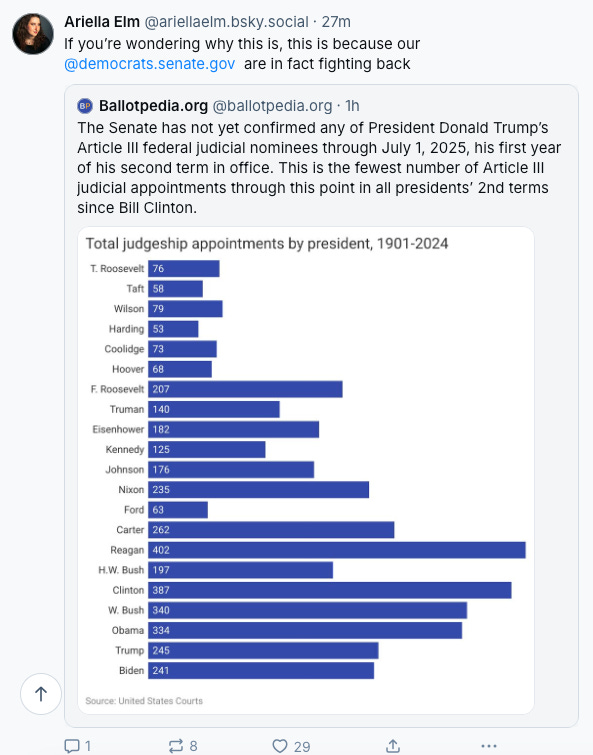
And in case you’re one of those “DO SOMETHING” people who love to bash Democrats, remember that they ARE doing something. A LOT. If you want to know what, you should follow Ariella Elm on any of the socials. She makes posts like the ones below, and daily posts like this one that list the wins for democracy and actions all over the country that are helping stem the tide of fascism, and we need to thank and elevate these soldiers for democracy.
Cuban reggaeton artist Leamsy La Figura, arrested last week in Miami-Dade on assault charges, was transferred to South Florida’s new immigration detention facility known as Alligator Alcatraz in the Everglades, the singer confirmed in a phone call.
He and other detainees claim they are enduring inhumane conditions at the site, including lack of access to water, inadequate food and denial of religious rights.
Alligator Alcatraz was built in a matter of days on a rarely used municipal airport located about 50 miles west of the City of Miami. The first group of detainees arrived at the center on July 3, according to state Attorney General James Uthmeier.
La Figura, whose real name is Leamsy Isquierdo, was charged with aggravated assault with a deadly weapon and battery. He was initially held at the Turner Guilford Knight Correctional Center (TGK) before being transferred to Alligator Alcatraz.
“There’s no water to take a bath”
In a phone call from inside the facility, La Figura described what he called horrific conditions.
“I am Leamsy La Figura. We’ve been here at Alcatraz since Friday. There’s over 400 people here. There’s no water to take a bath, it’s been four days since I’ve taken a bath,” he said.
He claimed the food at the immigration facility is scarce and unsanitary.
“They only brought a meal once a day and it had maggots. They never take off the lights for 24 hours. The mosquitoes are as big as elephants,” La Figura said.
Detainees say rights are being violated
Other detainees echoed La Figura’s concerns, alleging violations of their basic rights.
“They’re not respecting our human rights,” one man said during the same call. “We’re human beings; we’re not dogs. We’re like rats in an experiment.”
“I don’t know their motive for doing this, if it’s a form of torture. A lot of us have our residency documents and we don’t understand why we’re here,” he added.
A third detainee, who said he is Colombian, described deteriorating mental health and lack of access to necessary medical care.
“I’m on the edge of losing my mind. I’ve gone three days without taking my medicine,” he said. “It’s impossible to sleep with this white light that’s on all day.”
He also claimed his Bible was confiscated.
“They took the Bible I had and they said here there is no right to religion. And my Bible is the one thing that keeps my faith, and now I’m losing my faith,” he said.
La Figura’s girlfriend said the couple shares a 4-year-old daughter.
Florida officials respond to inhumane conditions allegations
On Tuesday, state officials responded to the allegations made by detainees at the facility, saying they are “completely false.”
“The reporting on the conditions in the facility is completely false. The facility meets all required standards and is in good working order,” said Stephanie Hartman, director of communications for the Florida Division of Emergency Management.
FDEM was the engine behind Alligator Alcatraz, using the state’s emergency management tools and funding to build, staff and operate the detention facility.
It isn’t timidity. It’s a complete reconstruction of what is acceptable rhetoric, and it makes gentler more collegial conversation and work impossible.
Whether it’s bloodshed at Glastonbury or starving people on benefits, their ‘irony poisoning’ seeps obscene ideas into the range of the possible
Illustration: Nate Kitch/The Guardian
Imagine the furore if a Guardian columnist suggested bombing, say, the Conservative party conference and the Tory stronghold of Arundel in Sussex. It would dominate public discussion for weeks. Despite protesting they were “only joking”, that person would never work in journalism again. Their editor would certainly be sacked. The police would probably come knocking. But when the Spectator columnist Rod Liddle speculates about bombing Glastonbury festival and Brighton, complaints are met with, “Calm down dear, can’t you take a joke?” The journalist keeps his job, as does his editor, the former justice secretary Michael Gove. There’s one rule for the left and another for the right.
The same applies to the recent comments on GB News by its regular guest Lewis Schaffer. He proposed that, to reduce the number of disabled people claiming benefits, he would “just starve them. I mean, that’s what people have to do, that’s what you’ve got to do to people, you just can’t give people money … What else can you do? Shoot them? I mean, I suggest that, but I think that’s maybe a bit strong.” The presenter, Patrick Christys replied, “Yeah, it’s just not allowed these days.”
You could call these jokes, if you think killing people is funny. Or you could call them thought experiments. Liddle suggested as much in his column: “I am merely hypothesising, in a slightly wistful kinda way.” This “humour” permits obscene ideas to seep into the range of the possible.
Academic researchers see the use of jokes to break taboos and reduce the thresholds of hate speech as a form of “strategic mainstreaming”. Far-right influencers use humour, irony and memes to inject ideas into public life that would otherwise be unacceptable. In doing so, they desensitise their audience and normalise extremism. A study of German Telegram channels found that far-right content presented seriously achieved limited reach, as did non-political humour. But when far-right extremism was presented humorously, it took off. (snip-MORE)
Sheldon Whitehouse of Rhode Island gives 300th climate speech on the US Senate floor
Sheldon Whitehouse at a Senate confirmation hearing on 6 February 2025. Photograph: Tom Williams/CQ-Roll Call via Getty Images
The Democratic party and the climate movement have been “too cautious and polite” and should instead be denouncing the fossil fuel industry’s “huge denial operation”, the US senator Sheldon Whitehouse said.
“The fossil fuel industry has run the biggest and most malevolent propaganda operation the country has ever seen,” the Rhode Island Democrat said in an interview Monday with the global media collaboration Covering Climate Now. “It is defending a $700-plus billion [annual] subsidy” of not being charged for the health and environmental damages caused by burning fossil fuels. “I think the more people understand that, the more they’ll be irate [that] they’ve been lied to.” But, he added, “Democrats have not done a good job of calling that out.”
Whitehouse is among the most outspoken climate champions on Capitol Hill, and on Wednesday evening, he delivered his 300th Time to Wake Up climate speech on the floor of the Senate.
He began giving these speeches in 2012, when Barack Obama was in his first term, and has consistently criticized both political parties for their lackluster response to the climate emergency. The Obama White House, he complained, for years would not even “use the word ‘climate’ and ‘change’ in the same paragraph”.
While Whitehouse slams his fellow Democrats for timidity, he blasts Republicans for being in the pocket of the fossil fuel industry, an entity whose behavior “has been downright evil”, he said. “To deliberately ignore [the laws of physics] for short-term profits that set up people for huge, really bad impacts – if that’s not a good definition of evil, I don’t know what is.” (snip-MORE)
that according to my email from WordPress on 7/10/24, I was added as an author on Scottie’s Playtime. My mission, as I understood it, is to post some posts often to keep the blog lively while Scottie recuperated from a thing, to keep track of and acknowledge/reply to comments, to thank other bloggers who link to us, and to make sure that readers who feel marginalized know we see them and want to see them here at Playtime. Scottie has the blog mission statement linked up above. I hope I’ve been doing that, and I’m so complimented by Scottie’s continuing support of the stuff I do here. I always want to make sure everyone knows I’m an old woman ally who has plenty of free mom hugs, and I also make some excellent chocolate chip cookies that are not only excellent, but healthful, and I love to share. All are welcome here.
I am up for suggestions on material, too! I’ve been posting the Peace & Justice newsletters here for a year, so they will be becoming redundant. I’m wondering about culling a little something from each one, and maybe posting them weekly, though I’m not adverse to continuing as I am. The one thing about it, some of their links are no longer active, so I’m able to search for newer info and use those links, but otherwise, the newsletters are much the same each year. (I’ve been reading and sharing them since 2002. Not here since then, but other places.😄)
I’ve really been enjoying the Queer History Substacks! I like some lusty language with my facts. However, is there something I can do to make those easier on readers? Let me know!
So, again, I’m humbly pleased that Scottie lets me post here on his blog, and is so supportive of it. I hope to continue for at least the upcoming year, and am always up for suggestions. And comments. And chocolates.
Of course, we’re all looking to save what we can, every day. This can be applied to small households larger than single resident. Give it a look! I remember doing some of this in the 80s, and I still do all I can. A penny’s a penny! Also, if you click through to read, here on the headline, | you can see funny graphics to go with many of the suggestions.
Whether you’re single or choose to live alone, it can be expensive. Finding ways to save money living alone can take some creative thinking, but there are easy ways to put some extra cash back in your wallet.
In an online forum, member Just_Throw_Away_67 posed the question to fellow people who live alone: “What random cost-saving measures have you found that work well for those living alone?”
And single people and people living solo happily shared their money-saving hacks. These are 45 of the best ways to save money if you live alone.
“I’ll start, to save money on energy I fill empty glass jars with water and store them in my fridge. It costs more to cool an empty fridge than a full one, and since I don’t eat very much my fridge is often nearly empty. Not sure how much this has saved me, but now I have water if I ever were to need it!” Just_Throw_Away_67 (Note from A.: This holds true for the freezer, too. Keep some containers of water up/out there. They help use less energy, and frankly, the ice is useful during power outages.)
“Blackout curtains because I live in the South so it’s always hot. I also have privacy film that blocks some UV rays when I do want some light. Using a floor fan in my room (where I spend the majority of my time) with the door closed to keep it cooler. Close the air vents in my guest room since it’s primarily unused to cut down on AC costs. Cook large batches of food at one time so I’m not constantly using my stove/oven.” eternally_feral
“It’s a pain to heat the whole oven for a little food. I recommend an air fryer over a toaster oven though. They’re a bit faster (and you can still make toast).” MissDisplaced
“I keep my heating and cooling low. I can wear extra layers or less to get to a comfortable temp.” Reasonable-Cold2161
“I read a tip to not bother doing a full ‘grocery shop’ trip if it doesn’t work for you/doesn’t make sense for you. Rather, if you find you’re throwing food away you couldn’t eat in time, try to do the method of going to the store of getting, say, just what you need for tonight and tomorrow’s meals, or whatever.” citynomad1
“Grocery delivery. I end up spending 50% less compared to shopping in the store.” Everydaylookwithin
“This is why I do curbside pickup. I order through the app, see what deals and coupons they have, stick to my list and don’t end up impulse buying. An added bonus is I can pick up on my way home from work and not spend time waiting in the checkout line.” zoebadwolf
“It took a little bit of up front investment, but I dumped my gigantic and ancient energy-hungry fridge a long time ago for a brand new one that is much smaller and also has a variable speed compressor for extra efficiency. The energy savings from that move alone probably paid for the fridge several times over by now.” BrewCityChaserV2
“I have a countertop dishwasher that I intentionally use only during off-peak hours. Luckily, this rental has a new refrigerator, and I run my air purifier on its 2 hour timer during those off hours (cat hair lol). Oh- I bought a Tushy bidet on sale- it pays for itself in the first year!” sk8rcruz
“I always bring my own lunch to work. I also cut up fresh veggies, put them in ziploc bags, freeze them, and then steam them later in the microwave. You can also just put a whole bag of spinach in the freezer and then steam it in the microwave. Clean with a plastic spray bottle of vinegar and dish soap. Sprinkle baking soda on carpets and rugs before vacuuming.” Unhappy-Jaguar-9362
“I have milk jugs with water in them in the fridge and freezer. I also buy in bulk. Usually the more you buy the cheaper per unit it is. I have a year supply of everything (joking) not quite but almost. I keep my air conditioner at a warmer temperature and use a fan to cool me all the way. I close blinds and curtains during the day. This cuts down on the heat in the room. Unfortunately it is dark in my apartment during the day , but this can make a difference of up to 10 degrees. This saves on cooling costs. Instead of buying single servings of food. I make a family size amount and put the leftovers in round dinner containers all ready to go for the next meal. These can also be frozen if you don’t want the same thing a couple days in a row and put in the microwave for 6 or 7 minutes.” Delightful_Helper
“I buy the family size packs of meats, divide and freeze. I also still cook big meals like when my kids were teenagers and divide them into portions and freeze. Its simply too hard to cook for one person. I make a weekly menu of the dishes I want to cook and then place my order for the grocery delivery. It does save money and since I cook a lot of casseroles, big pots of soups and stews, etc., and freeze in portions. I use my air fryer to warm the frozen dishes instead of the oven. It has almost become my hobby to have a variety of different meals through out the week without having to cook every day. Life is good 😊.” No_Guava_90
There are videos at the link below. I don’t know where we are a species right now. It seems more and more people are willing to give in to the lowest of our natures while mocking those who try to live up to the best we could be. The Christians trying to keep books that have LGBTQ+ characters out of schools can’t be bothered by the shooting of starving people including kids trying desperately to get something to eat. They are not doing anything to help, just everything they can to lash out bashing a minority group just for existing using their god to do it. Yet did not their god say to feed the hungry? To help the immigrants among you? They are so desperate to control others sexuality but they don’t care about those acting cruelty to the ones most needing help. Hypocrites, which side of god do they get to sit on? Hugs
American contractors guarding aid distribution sites in Gaza are using live ammunition and stun grenades as hungry Palestinians scramble for food, according to accounts and videos obtained by The Associated Press.
Two U.S. contractors, speaking to the AP on condition of anonymity because they were revealing their employers’ internal operations, said they were coming forward because they were disturbed by what they considered dangerous and irresponsible practices. They said the security staff hired were often unqualified, unvetted, heavily armed and seemed to have an open license to do whatever they wished.
They said their colleagues regularly lobbed stun grenades and pepper spray in the direction of the Palestinians. One contractor said bullets were fired in all directions — in the air, into the ground and at times toward the Palestinians, recalling at least one instance where he thought someone had been hit.
“There are innocent people being hurt. Badly. Needlessly,” the contractor said.
He said American staff on the sites monitor those coming to seek food and document anyone considered “suspicious.” He said they share such information with the Israeli military.
Videos provided by one of the contractors and taken at the sites show hundreds of Palestinians crowded between metal gates, jostling for aid amid the sound of bullets, stun grenades and the sting of pepper spray. Other videos include conversation between English-speaking men discussing how to disperse crowds and encouraging each other after bursts of gunfire.
The testimonies from the contractors — combined with the videos, internal reports and text messages obtained by the AP — offer a rare glimpse inside the Gaza Humanitarian Foundation, the newly created, secretive American organization backed by Israel to feed the Gaza Strip’s population. Last month, the U.S. government pledged $30 million for the group to continue operations — the first known U.S. donation to the group, whose other funding sources remain opaque.
A spokesperson for Safe Reach Solutions, the logistics company subcontracted by GHF, told the AP that there have been no serious injuries at any of their sites to date. In scattered incidents, security professionals fired live rounds into the ground and away from civilians to get their attention. That happened in the early days at the “the height of desperation where crowd control measures were necessary for the safety and security of civilians,” the spokesperson said.
Aid operation is controversial
Gaza’s more than 2 million Palestinians are living through a catastrophic humanitarian crisis. Since Hamas attacked Israel on Oct. 7, 2023, setting off the 21-month war, Israel has bombarded and laid siege to the strip, leaving many teetering on the edge of famine, according to food security experts.
For 2 1/2 months before GHF’s opening in May, Israel blocked all food, water and medicine from entering Gaza, claiming Hamas was stealing the aid being transported under a preexisting system coordinated by the United Nations. It now wants GHF to replace that U.N. system. The U.N. says its Gaza aid operations do not involve armed guards.
Over 57,000 Palestinians in Gaza have been killed since the war erupted, according to the territory’s Health Ministry, which does not distinguish between civilians and militants.
GHF is an American organization, registered in Delaware and established in February to distribute humanitarian aid during the ongoing Gaza humanitarian crisis. Since the GHF sites began operating more than a month ago, Palestinians say Israeli troops open fire almost every day toward crowds on roads heading to the distribution points, through Israeli military zones. Several hundred people have been killed and hundreds more wounded, according to Gaza’s Health Ministry and witnesses.
In response, Israel’s military says it fires only warning shots and is investigating reports of civilian harm. It denies deliberately shooting at any innocent civilians and says it’s examining how to reduce “friction with the population” in the areas surrounding the distribution centers.
AP’s reporting for this article focuses on what is happening at the sites themselves. Palestinians arriving at the sites say they are caught between Israeli and American fire, said the contractor who shared videos with the AP.
“We have come here to get food for our families. We have nothing,” he recounted Palestinians telling him. “Why does the (Israeli) army shoot at us? Why do you shoot at us?”
A spokesperson for the GHF said there are people with a “vested interest” in seeing it fail and are willing to do or say almost anything to make that happen. The spokesperson said the team is composed of seasoned humanitarian, logistics and security professionals with deep experience on the ground. The group says it has distributed the equivalent of more than 50 million meals in Gaza in its food boxes of staples.
GHF says that it has consistently shown compassionate engagement with the people of Gaza.
Throughout the war, aid distribution has been marred by chaos. Gangs have looted trucks of aid traveling to distribution centers and mobs of desperate people have also offloaded trucks before they’ve reached their destination. Earlier this month, at least 51 Palestinians were killed and more than 200 wounded while waiting for the U.N. and commercial trucks to enter the territory, according to Gaza’s Health Ministry and a local hospital. Israel’s military acknowledged several casualties as soldiers opened fire on the approaching crowd and said authorities would investigate.
Videos, texts, internal reports document havoc at food sites
AP spoke to the two contractors for UG Solutions, an American outfit subcontracted to hire security personnel for the distribution sites. They said bullets, stun grenades and pepper spray were used at nearly every distribution, even if there was no threat.
Videos of aid being dispensed at the sites seen by the AP appear to back up the frenetic scenes the contractors described. The footage was taken within the first two weeks of its distributions — about halfway into the operations.
In one video, what appear to be heavily armed American security contractors at one of the sites in Gaza discuss how to disperse Palestinians nearby. One is heard saying he has arranged for a “show of force” by Israeli tanks.
“I don’t want this to be too aggressive,” he adds, “because this is calming down.”
At that moment, bursts of gunfire erupt close by, at least 15 shots. “Whoo! Whoo!” one contractor yelps.
“I think you hit one,” one says.
Then comes a shout: “Hell, yeah, boy!”
The camera’s view is obscured by a large dirt mound.
The contractor who took the video told AP that he saw other contractors shooting in the direction of Palestinians who had just collected their food and were departing. The men shot both from a tower above the site and from atop the mound, he said. The shooting began because contractors wanted to disperse the crowd, he said, but it was unclear why they continued shooting as people were walking away.
The camera does not show who was shooting or what was being shot at. But the contractor who filmed it said he watched another contractor fire at the Palestinians and then saw a man about 60 yards (meters) away — in the same direction where the bullets were fired — drop to the ground.
This happened at the same time the men were heard talking — effectively egging each other on, he said.
In other videos furnished by the contractor, men in grey uniforms — colleagues, he said — can be seen trying to clear Palestinians who are squeezed into a narrow, fenced-in passage leading to one of the centers. The men fire pepper spray and throw stun grenades that detonate amid the crowd. The sound of gunfire can be heard. The contractor who took the video said the security personnel usually fire at the ground near the crowds or from nearby towers over their heads.
During a single distribution in June, contractors used 37 stun grenades, 27 rubber-and-smoke “scat shell” projectiles and 60 cans of pepper spray, according to internal text communications shared with the AP.
That count does not include live ammunition, the contractor who provided the videos said.
One photo shared by that contractor shows a woman lying in a donkey cart after he said she was hit in the head with part of a stun grenade.
This photo, provided by an American contractor on condition of anonymity because they were revealing their employers’ internal operations, shows a woman slumped over in a donkey cart after the contractor said she was hit in the head with part of a stun grenade at a food distribution site in Gaza run by the Gaza Humanitarian Foundation in June 2025. (AP Photo)
An internal report by Safe Reach Solutions, the logistics company subcontracted by GHF to run the sites, found that aid seekers were injured during 31% of the distributions that took place in a two-week period in June. The report did not specify the number of injuries or the cause. SRS told the AP the report refers to non-serious injuries.
More videos show frenzied scenes of Palestinians running to collect leftover food boxes at one site. Hundreds of young men crowd near low metal barriers, transferring food from boxes to bags while contractors on the other side of the barriers tell them to stay back.
Some Palestinians wince and cough from pepper spray. “You tasting that pepper spray? Yuck,” one man close to the camera can be heard saying in English.
SRS acknowledged that it’s dealing with large, hungry populations, but said the environment is secure, controlled, and ensures people can get the aid they need safely.
Verifying the videos with audio analysis
To confirm the footage is from the sites, AP geolocated the videos using aerial imagery. The AP also had the videos analyzed by two audio forensic experts who said they could identify live ammunition — including machine-gun fire — coming from the sites, in most cases within 50 to 60 meters of the camera’s microphone.
In the video where the men are heard egging each other on, the echo and acoustics of the shots indicate they’re fired from a position close to the microphone, said Rob Maher, a professor of electrical and computer engineering at Montana State University and an author and research expert in audio forensic analysis. Maher and the other analyst, Steven Beck, owner of Beck Audio Forensics, said there was no indication that the videos’ audio had been tampered with.
The analysts said that the bursts of gunfire and the pop sequences in some of the videos indicated that guns were panning in different directions and were not repeatedly aimed at a single target. They could not pinpoint exactly where the shots were coming from nor who was shooting.
GHF says the Israeli military is not deployed at the aid distribution sites. Lt. Col. Nadav Shoshani, an army spokesman, said the army is not stationed at the sites or within their immediate proximity, especially during operating hours. He said they’re run by an American company and have their own security.
One of the contractors who had been on the sites said he’d never felt a real or perceived threat by Hamas there.
SRS says that Hamas has openly threatened its aid workers and civilians receiving aid. It did not specify where people were threatened.
Palestinians carry boxes containing food and humanitarian aid packages delivered by the Gaza Humanitarian Foundation, a U.S.-backed organization approved by Israel, in Rafah, southern Gaza Strip, Tuesday, May 27, 2025. (AP Photo/Abdel Kareem Hana,File)
American analysts and Israeli soldiers work side by side, contractors say
According to the contractor who took the videos, the Israeli army is leveraging the distribution system to access information.
Both contractors said that cameras monitor distributions at each site and that American analysts and Israeli soldiers sit in a control room where the footage is screened in real time. The control room, they said, is housed in a shipping container on the Israeli side of the Kerem Shalom crossing into Gaza.
The contractor who took the videos said some cameras are equipped with facial recognition software. In live shots of the sites seen by the AP, some videos streams are labeled “analytics” — those were the ones that had the facial recognition software, said the contractor.
If a person of interest is seen on camera — and their information is already in the system — their name and age pops up on the computer screen, said the contractor. Israeli soldiers watching the screens take notes and cross-check the analysts’ information with their own drone footage from the sites, he said.
The contractor said he did not know the source of the data in the facial recognition system. The AP could not independently verify his information.
An internal SRS report from June seen by the AP said that its intel team would circulate to staff a “POI Mugs Card,” that showed photos of Palestinians taken at the sites who were deemed persons of interest.
The contractor said he and other staff were told by SRS to photograph anyone who looked “out of place.” But the criteria were not specified, he said. The contractor said the photos were also added to the facial recognition database. He did not know what was done with the information.
SRS said accusations that it gathers intelligence are false and that it has never used biometrics. It said it coordinates movements with Israeli authorities, a requirement for any aid group in Gaza.
An Israeli security official who was not named in line with the army’s protocol, said there are no security screening systems developed or operated by the army within the aid sites.
A crop field in Oxnard, California, U.S., June 18, 2025. REUTERS/Pilar Olivares
Lisa Tate is a sixth-generation farmer in Ventura County, California, an area that produces billions of dollars worth of fruit and vegetables each year, much of it hand-picked by immigrants in the U.S. illegally.
Tate knows the farms around her well. And she says she can see with her own eyes how raids carried out by agents from U.S. Immigration and Customs Enforcement in the area’s fields earlier this month, part of President Donald Trump’s migration crackdown, have frightened off workers.
“In the fields, I would say 70% of the workers are gone,” she said in an interview. “If 70% of your workforce doesn’t show up, 70% of your crop doesn’t get picked and can go bad in one day. Most Americans don’t want to do this work. Most farmers here are barely breaking even. I fear this has created a tipping point where many will go bust.”
In the vast agricultural lands north of Los Angeles, stretching from Ventura County into the state’s central valley, two farmers, two field supervisors and four immigrant farmworkers told Reuters this month that the ICE raids have led a majority of workers to stop showing up.
That means crops are not being picked and fruit and vegetables are rotting at peak harvest time, they said.
One Mexican farm supervisor, who asked not to be named, was overseeing a field being prepared for planting strawberries last week. Usually he would have 300 workers, he said. On this day he had just 80. Another supervisor at a different farm said he usually has 80 workers in a field, but today just 17.
A Guatemalan immigrant works on a crop field at a farm in the Kern County, California, U.S., June 19, 2025. REUTERS/Pilar Olivares
BAD FOR BUSINESS
Most economists and politicians acknowledge that many of America’s agricultural workers are in the country illegally, but say a sharp reduction in their numbers could have devastating impacts on the food supply chain and farm-belt economies.
Douglas Holtz-Eakin, a Republican and former director of the Congressional Budget Office, said an estimated 80% of farmworkers in the U.S. were foreign-born, with nearly half of them in the country illegally. Losing them will cause price hikes for consumers, he said.
“This is bad for supply chains, bad for the agricultural industry,” Holtz-Eakin said.
Over a third of U.S. vegetables and over three-quarters of the country’s fruits and nuts are grown in California, according to the California Department of Food and Agriculture. The state’s farms and ranches generated nearly $60 billion in agricultural sales in 2023.
If they show up to work, they don’t know if they will ever see their family again.
Migrant worker
Of the four immigrant farmworkers Reuters spoke to, two are in the country illegally. These two spoke on the condition of anonymity, out of fear of being arrested by ICE.
One, aged 54, has worked in U.S. agricultural fields for 30 years and has a wife and children in the country. He said most of his colleagues have stopped showing up for work.
“If they show up to work, they don’t know if they will ever see their family again,” he said.
The other worker in the country illegally told Reuters, “Basically, we wake up in the morning scared. We worry about the sun, the heat, and now a much bigger problem – many not returning home. I try not to get into trouble on the street. Now, whoever gets arrested for any reason gets deported.”
Item 1 of 4 An immigrant worker harvests crops during the weekend, as labor shortages risk leaving fields unpicked, in Oxnard, California, U.S., June 22, 2025. REUTERS/Pilar Olivares
[1/4]An immigrant worker harvests crops during the weekend, as labor shortages risk leaving fields unpicked, in Oxnard, California, U.S., June 22, 2025. REUTERS/Pilar Olivares
To be sure, some farmworker community groups said many workers were still returning to the fields, despite the raids, out of economic necessity.
The days following a raid may see decreased attendance in the field, but the workers soon return because they have no other sources of income, five groups told Reuters.
Workers are also taking other steps to reduce their exposure to immigration agents, like carpooling with people with legal status to work or sending U.S. citizen children to the grocery store, the groups said.
ICE CHILL
Trump conceded in a post on his Truth Social account this month that ICE raids on farmworkers – and also hotel workers – were “taking very good, long-time workers away” from those sectors, “with those jobs being almost impossible to replace.”
Trump later told reporters, “Our farmers are being hurt badly. They have very good workers.” He added, “They’re not citizens, but they’ve turned out to be great.”
He pledged to issue an order to address the impact, but no policy change has yet been enacted.
Trump has always stood up for farmers, said White House spokeswoman Anna Kelly in response to a request for comment on the impact of the ICE raids to farms. “He will continue to strengthen our agricultural industry and boost exports while keeping his promise to enforce our immigration laws,” she said.
Bernard Yaros, Lead U.S. Economist at Oxford Economics, a nonpartisan global economics advisory firm, said in a report published on June 26 that native-born workers tend not to fill the void left by immigrant workers who have left.
“Unauthorized immigrants tend to work in different occupations than those who are native-born,” he said.
ICE operations in California’s farmland were scaring even those who are authorized, said Greg Tesch, who runs a farm in central California.
Farmers and laborers in California told Reuters that many field workers have stopped showing up to pick fruit and vegetables. Emma Jehle reports.
“Nobody feels safe when they hear the word ICE, even the documented people. We know that the neighborhood is full of a combination of those with and without documents,” Tesch said.
“If things are ripe, such as our neighbors have bell peppers here, (if) they don’t harvest within two or three days, the crop is sunburned or over mature,” said Tesch. “We need the labor.”
The Reuters Tariff Watch newsletter is your daily guide to the latest global trade and tariff news. Sign up here.
Reporting by Tim Reid, Sebastian Rocandio, Pilar Olivares and Leah Douglas. Editing by Mary Milliken and Rosalba O’Brien.










 Scottie's Playtime