Hello everyone. I have slowed down posting about Ron and myself other than the home repairs. Some because I have been so tired and worn out from trying to help Ron as he worked on the new bathrooms by doing as much housework as I could around the house. But I Ron realized I was trying so hard to pitch in to help as he did the remodeling that I was getting sick / ill. He has been insisting and pushing me to not help so much. But yesterday was grand.
We had a small supper of a few hotdogs with homemade chili. I ate one. Then we picked everything up and went to bed together. We had “quality time” if you can read between the lines. Then we cuddled back and forth and fell asleep in each other’s arms. Then at around 1:20 am we both woke up to urinate … it is an old man thing. But we started talking and I was hungry as I felt my blood sugar was dropping bad. He was also hungry. So I suggested that we get up and have waffles with him showing me how to use the waffle maker. So we got up in our birthday suit to come from the bedroom to the kitchen and learned that the stuff to make a good waffle meal we did not have. So I offered to make a scrambled egg, link sausage, ham steak, and toast meal. We had the stuff but it was more than we had planned for that time. I thought he would just want to go back to bed. But he agreed. He offered to do it, but I felt I wanted to.
I got 6 eggs out, and I use a sharp knife using the sharp edge to snap the eggshell to break open the eggshells with no fragments in the bowls. Then I add a small amount of water to add fluffy ness to them. We had 6 frozen sausage links which I fried and the ham steak. I fried the sausage and ham, then I did the eggs.
Everything came out perfect and Ron was so impressed that as he ate he told me it was the most wonderful midnight meal he had ever had. I admit I had only one sausage, a quarter of the ham steak, And only one of my two pieces of toast. Ron ate the rest including my sausage, rest of my ham steak, and my second piece of toast. I was so happy and full but so tired. I picked stuff up while Ron sat in his chair and then we decided to go back to bed. I was willing as I was very happy as my belly was full and everything seemed wonderful.
Then as we laid there cuddling talking about things … Ron made me very happy with a second quality time event. He asked me … how could I refuse. I was so spent and happy … that we slept in the next morning with him still in my arms.
Today I have had little time for the blog. I did get time to add more stuff to my cartoon / meme / news item post. But mostly while Ron rested and worked on the new bathroom I did the dishes, started / did laundry, and took care of the house stuff. But all day Ron has been so concerned for my health he has tried to keep me from doing stuff, wanting me to just take the entire day off and rest. I so love that man. For supper he made me a stir fry meal with both thick noodles and angel hair pasta. I love it. I do miss the Chinese take out we sometimes still order because I love the hot / sour soup.
I apologize for the lateness of today’s blog, but I had three deadlines today. I’ll explain further in a future blog.
We have the first American pope, and to add to that, he’s from Chicago. How cool is that? I think Chicago all by itself spites Trump, but a pope who’s criticized the administration for its policies on immigration is a nice plus. Also, Pope Leo XIV is against the death penalty, racism (Trump is a racist), and understands that Climate Change is a real thing and not a “hoax” created by China.
One of the first things I was curious about with our Chicago pope was if he is a Cubs fan. The Chicago Cubs posted on their famous marquee above Addison Street at Wrigley Field that Pope Leo is a Cubs fan. They got it wrong. So did some cartoonists.
Henry Payne is already an idiot. That’s not new news. Randy Bish rushed to judgment.
But it didn’t matter to him because he just made a simple swap when he found out he was wrong.
Sorry, Randy, but this is generic cartooning. Plus, nobody should listen to you about Chicago. You’re from Pittsburgh.
What else is from Pittsburgh is this shit.
What is it? It’s ketchup. There’s nothing special about this ketchup. It’s just regular shitty Heinz ketchup, but the company was trying to trick Chicagoans to fuck up their hot dogs with it. It didn’t work, and Eater.com let them know it.
I’m sure the Pope would agree that it’s sacrilege to put ketchup on a hot dog, but since he’s the Pope, he would probably forgive you, but I won’t. How dare you put ketchup on a hot dog? What are you? Five?
I used to have a theory that people who love ketchup had mothers who couldn’t cook. I developed this theory because my ex-wife LOVED ketchup, and her mother could not cook. I hope she doesn’t read this because she’s very nice and my son’s grandmother. My father-in-law, may he rest in peace, made the best fried pork chops I’ve ever had.
I think there are only four acceptable reasons for using ketchup, and they are, for crinkle-cut fries, very bad fries, meatloaf, and if you’re five. I kid, I kid. I know some of you love your ketchup, and none of us is perfect. For example, Donald Trump LOVES ketchup. Let that sink in.
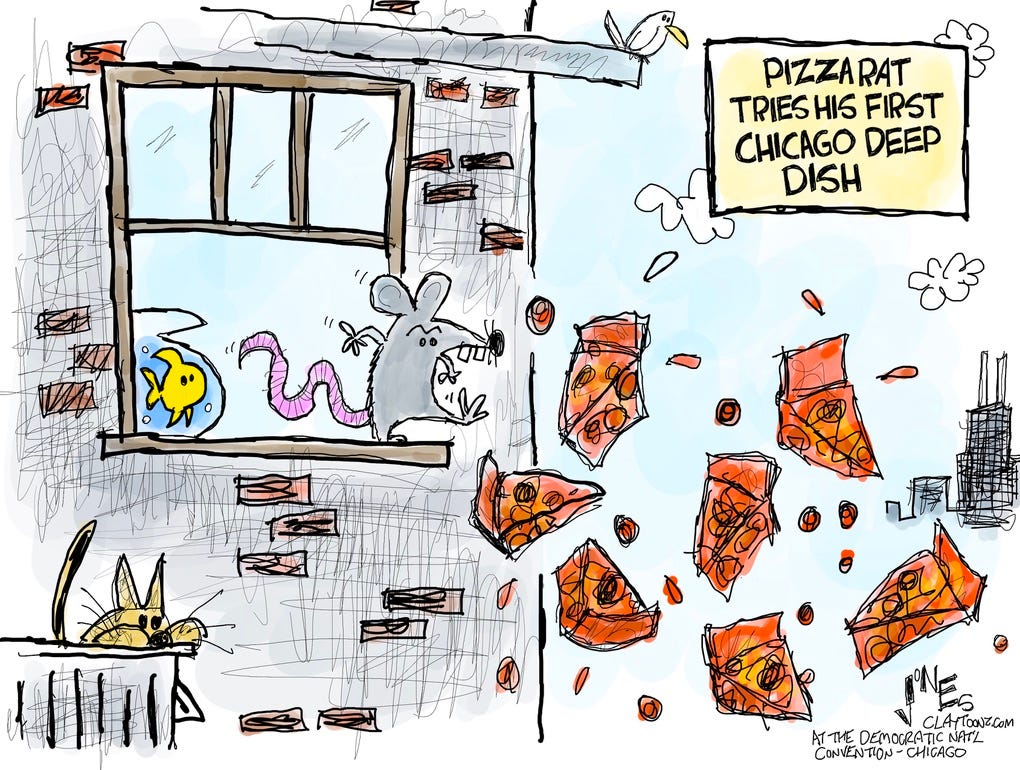
What I learned about Chicago pizza is that most Chicagoans eat more tavern-style than deep dish. Chicagoans like deep dish, but it’s more for special occasions and when they have visitors. Deep dish is more for tourists. I don’t really get deep dish, and I don’t even think it should be considered a pizza.
Do you remember Pizza Rat’s first trip to Chicago last year? He tried the deep dish.
Not a fan.
Today’s cartoon put me in the mood for tavern-style tonight, and Pizza Hut has it as a special. When I picked it up, the manager apologized because they had accidentally cut it into triangles instead of squares. A lot of Chicagoans would not stand for that, but I’m tolerant. I thought of Pope Leo, and I forgave them…this time.
Shout-out and dedication: I dedicate this cartoon to Greg Zaborniak, who introduced me to Old Style beer and tavern-style Chicago pizza last year during the Democratic convention. Thank you again, Greg.
Creative note: I didn’t know what I was going to draw today, and I also had a deadline for the Advance. And then, one of my clients contacted me wanting a cartoon on a local issue, and they wanted it today. So, I was facing three deadlines with zero ideas. But they came to me, one by one, and I knocked ‘em all down.
I deserved that pizza.
There’s a version of this cartoon without Pizza Rat. I didn’t include him because not everyone who will see this cartoon will be a regular reader of mine, and they might think the rat is an aspersion on Catholicism. So I sent it to my clients without Peezy. But then, a reader changed my mind because he thought it was a bigger sin to include a pizza without Pizza Rat. I figured I was going to hear more howls about missing Peezy than I’d hear from angry Catholics. The version at GoComics may not feature Peezy because sometimes a new file won’t override the existing file. I did resend the Peezy version to my clients, but they’ll use the one they want, and maybe not even care.
Trigger warnings for starving and abused kids / people. Sadly this is what the US government is supporting and keeping other world leaders from stopping. This was because Biden was an old person who remembered being part of Israels founding and thought they were so important that it excused everything they did. tRump doesn’t care about the human cost, he wants the value of the land or as much of the share he can get. This is sickening. Personal note. I was so lacking nutrition in my childhood that my childhood doctors were concerned enough to tell my adopting mother if I did not get more food I would never see five feet in height. I ended up in a child ICU rushed to the hospital by my grandfather and I had clinical death. Hugs
In rivers and oceans across the globe, fish are behaving strangely. Some swim faster than they should. Others take risks they’d normally avoid. Many abandon the social structures that once protected them. These shifts are not random. They point to an invisible threat flowing just beneath the surface: pharmaceutical pollution.
Drugs designed for human anxiety, pain, and insomnia are entering the world’s water systems through sewage, manufacturing waste, and improper disposal. Once there, they don’t vanish. They linger, affect wildlife, and disrupt entire ecosystems.
Bold Fish, Bigger Risks
Juvenile salmon migrating from Sweden’s River Dal to the Baltic Sea have become an unexpected case study. Researchers implanted hundreds of these fish with tiny slow-release doses of clobazam, an anti-anxiety drug commonly prescribed to humans. Tracking tags revealed something remarkable: salmon exposed to the drug completed their journey faster and in greater numbers than their drug-free peers.
According to Jack Brand, a researcher at the Swedish University of Agricultural Sciences, these medicated salmon passed through hydropower dams two to three times faster than untreated fish, likely because they were less hesitant around the turbines, NPR reports.
This boldness might sound like a survival advantage. But in ecosystems, risk-taking has consequences. When predators lurk or conditions shift, impulsive behavior can turn deadly.
Anti-anxiety drugs are altering fish behavior in the wild.
A Global Cocktail of Contaminants
The scope of contamination is staggering. Almost 1,000 pharmaceutical compounds have been detected in waterways around the world—including Antarctica. A Cary Institute report found that up to 80% of streams in the U.S. alone are polluted with pharmaceuticals and personal care products.
These compounds are potent by design. Many target receptors in the human brain, and those same receptors are found in fish and other species. Drugs like benzodiazepines, used to treat anxiety in people, also alter the stress response in fish. As a result, animals become less risk-averse, change their migration timing, or fail to form protective schools—shifts that can affect survival.
Drugged salmon are taking dangerous risks during migration.
From Lab to Wild
Previous experiments hinted at these effects. In labs, fish exposed to psychoactive drugs became more isolated and less cautious. But the new field studies from Sweden show that these behavioral changes persist—and even intensify—in the wild.
A follow-up experiment revealed that drugged salmon formed looser groups, even when a predator was nearby. The tighter a school, the safer its members. Disrupted shoaling behavior means more fish swimming solo—making them easier prey.
Michael Bertram, an ecologist leading the study, described the salmon’s altered behavior as a form of “unnatural selection,” The New York Times reports. If bolder fish survive migration but die later in predator-rich waters, the long-term outcome could be population decline, not resilience.
Predator-prey dynamics are being disrupted by pharmaceutical waste.
The Long Tail of Human Medicine
Human waste isn’t the only path these drugs take to the water. Wastewater from hospitals, improper drug disposal, and runoff from pharmaceutical manufacturing sites all contribute. Deutsche Welle reports that some wastewater treatment plants near manufacturing facilities have drug levels 1,000 times higher than others.
Yet most treatment plants are not equipped to filter out pharmaceuticals. Some drugs pass through the system unchanged. Others break into byproducts that are just as toxic.
Unknowns Beneath the Surface
Despite years of research, the full ecological impact of pharmaceutical pollution is unknown. Scientists have documented effects on hundreds of species, including reproductive issues and behavioral disruptions. A Cary Institute investigation described how certain antidepressants alter fish breeding cycles, while hormones from birth control pills can cause male fish to develop female egg cells.
As compounds accumulate in fish, they climb up the food chain. Birds, mammals, and even humans may be exposed through drinking water or consumption of contaminated seafood.
Solutions and Setbacks
There are potential fixes. Advanced treatment technologies like ozonation and membrane filtration can help. But they’re expensive and rare. Designing drugs that biodegrade safely—an approach known as green chemistry—is promising, though slow to implement.
Policy change is another lever. Currently, pharmaceutical companies are responsible for testing their own products for environmental safety. Critics argue that these reviews are insufficient and underregulated.
Improved drug disposal practices, public education, and cross-agency coordination could all make a difference. But as things stand, no pharmaceuticals are currently regulated under the EPA’s primary drinking water standards, Cary Institute reports.
The Cost of Inaction
The salmon darting through Swedish dams may seem like a scientific curiosity. But they are just one visible indicator of a much larger, invisible crisis. Every flushed pill, every untreated discharge, adds to a global experiment with no control group and no reset button.
What happens in rivers doesn’t stay there. It shapes the ocean, the land, and the web of life that connects them all.
Click and help us keep our oceans clean!(Note from A: this is a simple free Greater Good organization click-to-donate; the easily ignored ads help pay for cleaning the ocean. I’ll never know whether you click or not, I just wanted to let you know what it is.)
In the full, unedited version of Donald Trump’s recent Meet the Press interview with Kristen Welker—released online by NBC but not aired in full during the broadcast—Trump made several striking remarks that were omitted from the televised segment.
Trump on Meet the Press
Meet the Press
One such moment came when Trump claimed credit for getting Amazon founder Jeff Bezos to remove tariff impact notices from the platform. “I asked him about it and he said I don’t want to do that and he took it off immediately,” Trump said, calling Bezos “a very nice guy” and suggesting a friendly relationship between the two.
Welker: What did you say to Jeff Bezos?
Trump: He’s just a very nice guy. We have a relationship. I asked him about it and he said I don’t want to do that and he took it off immediately. pic.twitter.com/lE4xtTC4lo
The removal of such notices undermines public transparency by severing the direct link between rising consumer prices and Trump’s tariff policies.
Other remarks that were cut from the interview that aired included Trump’s insistence that prices for eggs “were down 87%” under his administration, citing White House Easter egg hunts as anecdotal proof, despite Welker reminding him the price spike was caused by a bird flu outbreak.
Trump: Eggs.. you were the one who asked me. It was the first week. I didn’t even know what you were talking about. Egg prices were so high you couldn’t buy eggs. They didn’t have any eggs.. We had Easter at the WH and we had thousands of eggs and they were down 87%.
Trump also returned to debunked claims about the 2020 election, asserting the results were “rigged” and insisting he “won a lot of court cases” despite losing the vast majority.
Trump: The election was rigged…
Welker: I don’t want to look back. You took your case to court about your allegations..
Trump: There’s no question. The election was rigged. The facts are in and it’s still being litigated.
He went further to suggest that “China is eating the tariffs” rather than U.S. consumers or businesses. That is not the reality.
Trump: What people don’t understand is.. the country eats the tariff, the company eats the tariff and it’s not passed along at all… China is eating the tariffs pic.twitter.com/oC30AQokR0
These unaired statements raise questions about editorial choices in broadcast journalism, especially as Trump continues to air grievances about 60 Minutes for what he claims was an unfairly edited interview with Vice President Kamala Harris. While time constraints are common in televised interviews, withholding full conversations—especially those containing controversial or revealing statements—can fuel partisan claims of media bias.
Releasing full interviews, as MSNBC ultimately did, could help restore public trust and offer a more complete view of political figures’ positions.
May 6, 1916 Emma Goldman and Alexander Berkman Alexander Berkman and Emma Goldman started the No Conscription League in the U.S. to discourage young men from registering for the draft which had passed Congress the previous month. This was prior to American troops’ being sent to Europe in what is known as World War I. Read the No-Conscription League Manifesto
May 6, 1944 Mohandas Gandhi, due to declining health, was released from his last imprisonment in India, having spent 2,338 days in jail during his lifetime.
May 6, 1954 Two American pilots and most of their crew died flying ammunition supply missions to French colonial troops under siege by Vietnamese insurgent troops under General Vo Nguyen Giap. James “Earthquake McGoon” McGovern and Wallace Buford became the first U.S. aviators to die in Vietnam. Pres. Dwight Eisenhower had not wanted to commit the U.S. military to Vietnam so shortly after the end of the war in Korea, so McGovern and Buford were working for an organization contracted by the CIA.
May 6, 1970 U.S. Senate hearings began on ratification of the Equal Rights Amendment (ERA) to the U.S. Constitution: “Equality of rights under the law shall not be denied or abridged by the United States or by any State on account of sex.” Similar amendments had been introduced in every Congress since 1923. Writer and editor Gloria Steinem testified: “During twelve years of working for a living, I’ve experienced much of the legal and social discrimination reserved for women in this country. I have been refused service in public restaurants, ordered out of public gathering places, and turned away from apartment rentals, all for the clearly stated, sole reason that I am a woman.” Gloria Steinem in 1970 Steinem’s full testimony more ERA history
May 6, 1973 14 cities across France saw demonstrations against their country’s nuclear weapons tests in the Pacific Ocean.
May 6, 1979 125,000 rallied in Washington, D.C. to oppose nuclear power.
China canceled 12,000 metric tons of United States pork shipments amid a high-stakes trade standoff between the superpowers, according to data released Thursday.
The move represents the biggest cancellation of pork orders since the COVID-19 pandemic disrupted supply chains and stalled economies around the world, Bloomberg News reported.
China, behind Mexico and Japan, was the U.S.’s third-biggest market for pork in 2024, importing some 475,000 metric tons valued at more than $1.1 billion.
China is the world’s biggest producer of pork, accounting for nearly 50 percent of global supply at around 57 million metric tons, according to the USDA. The U.S. was ranked third at 11 percent with 12 million metric tons.
President Trump shook the global trading system by imposing sweeping tariffs earlier this month on dozens of countries. He slapped a 145 percent tariff on Chinese goods coming into the U.S., prompting China to fire back with its own 125 percent duty.
China said Thursday that the U.S. is not engaged in talks to come up with a new trade deal, a characterization that Trump rejected later in the day.
“They had meetings this morning, and we’ve been meeting with China. And, so I think you have … as usual, I think you have your reporting wrong,” Trump told reporters Thursday.
After the tariff hikes, China inked two agricultural trade agreements with Spain, for pork and cherries, as Beijing looks to strengthen relations with European countries, Reuters reported.
U.S. pork imports are now facing a 172 percent tariff, the U.S. Meat Export Federation said, according to Bloomberg News.
This year presents an opportunity to enact tax policy changes that would ease the strain on household budgets that people in low-paid jobs and their families face and allow them to invest in their future, while ensuring that the nation’s wealthiest pay more of their fair share in taxes. Expiration is approaching for a number of provisions in the 2017 tax law[1] — which showered expensive tax cuts on the wealthy and failed to deliver on promised benefits for economic growth and workers’ earnings — so the time is ripe for a new direction.
But the economic agenda the Trump Administration and congressional Republicans are pursuing would double down on the 2017 law’s flaws by extending its skewed taxed cuts, which would further balloon deficits and deliver another trickle-down failure. And to help pay for those tax cuts, House and Senate Republicans are planning massive cuts that would take health care and food assistance away from, and make college less affordable for, millions of people with low and middle incomes.[2]
Republicans should instead pursue one of the paths they campaigned on, as articulated by Senator Josh Hawley in January: “for every Republican who has hailed the new working-class coalition that President Trump has assembled, this is the time to deliver.”[3]
A better tax bill would:
Not take health care and food assistance away from millions of people or make it harder to afford college or pay energy bills.
Prioritize tax credits that help people make ends meet as they face rising costs for groceries, clothes and other retail goods, health care, and other items:
expand the Child Tax Credit in a way that prioritizes the 17 million children in families who get less than the full credit because their families’ incomes are too low;
permanently extend the larger premium tax credits that are helping people afford health coverage;
and expand the Earned Income Tax Credit (EITC) for adults in low-paid jobs not raising children at home, including young adults just starting out who may be struggling.
Require corporations and the wealthy to pay a fairer share of tax, which will also help offset any of these tax cuts. This includes ending tax cuts for high-income people on schedule, raising taxes on very wealthy people and corporations that receive enormous breaks under the current tax code, and building an IRS capable of collecting more of the taxes that are already legally owed.
And whether as part of the tax bill or separately, Republicans in the majority should also assert Congress’ constitutional power and responsibility over trade policy and turn off the destructive tariffs the Trump Administration has imposed and threatened. Separate bills introduced by Republican and Democratic Senators and Democratic House members are a step in the right direction.[4] The Administration’s tariffs will hit low- and middle-income families particularly hard at grocery and retail stores while risking a global recession, with all the human suffering that entails.
Don’t Take Away Health Care, Food Assistance, and College Support
One easy course correction toward crafting a better tax bill would be for Republicans to simply not harm the low- and middle-income people they campaigned on helping. But the Republican budget resolution includes instructions to House committees to make $1.4 trillion in cuts to programs in their jurisdiction that could potentially harm low- and middle-income people.[5] These include instructions to the committee with jurisdiction over Medicaid to cut at least $880 billion over ten years, the committee with jurisdiction over food assistance through SNAP to cut $230 billion, and the committee with jurisdiction over student loans to cut $330 billion. These programs serve tens of millions of people: Medicaid provides health coverage that 72 million people count on; SNAP helps over 40 million people put food on the table each month; and student loans make higher education more affordable for millions of people.[6] The Republican budget resolution may also assume cuts to energy tax credits and other climate investments, which would increase utility bills, imperil energy reliability, and threaten jobs and investment nationwide.[7]
Even cuts that are a fraction of the size of the potential $880 billion cut to Medicaid and $230 billion cut to SNAP in the House instructions would cause serious harm. They would still increase costs for strapped families and leave more people uninsured and unable to afford food. And it is possible the cuts will be deeper or cover more areas, as some House and Senate members press for far larger cuts.
These cuts are all designed to help offset the cost for wasteful, $1.8 trillion tax cuts for people in the top 5 percent of incomes. (See Figure 1.)
Figure 1
At the same time the Republican agenda would raise costs for families and leave more people uninsured, the Trump Administration’s tariffs threaten volatility and price increases — and a significantly increased risk of recession and higher unemployment — that will land hardest on people who can least afford it.
Expand the Child Tax Credit and EITC, Extend Enhanced Premium Tax Credit
The 2017 tax law included some structural improvements: it doubled the standard deduction and the maximum Child Tax Credit amount while eliminating the personal exemption. These changes cut taxes for most people with low and moderate incomes, though only modestly, while simplifying the tax returns of millions of taxpayers as they reduced the number of those who need to itemize their deductions. But these changes provide only modest help to many low- and moderate-income families and more is needed in a tax bill to help families afford the basics, including the cost of health care.
Child Tax Credit
The Child Tax Credit is key in helping millions of families afford the essentials, and lifted 3.6 million people, including 2.0 million children, above the poverty line in 2023.[8] But one of its greatest design flaws is that under the 2017 tax law, it leaves 17 million children, or roughly 1 in 4 children, out of receiving the full credit because their parents’ incomes are too low. While most of the children left out of the full credit receive a partial credit, children in families without income in a given year, for reasons including job loss, health, and caregiving responsibilities, don’t receive any credit at all.
While the 2017 tax law doubled the maximum Child Tax Credit amount from $1,000 to $2,000, millions of children in families with low and moderate incomes — those who would most benefit from an increase — didn’t receive that full increase the way that children in families with higher incomes did. In fact, millions received a Child Tax Credit increase of just $75 or less from the 2017 tax law, far below the $1,000-per-child increase that higher income families received.[9]
A better tax bill would fix these flaws. The best and simplest way to do that is to provide the full Child Tax Credit amount to all children in families with low and moderate incomes. This is often called making the credit “fully refundable,” because families whose credit exceeds their income tax liability receive the full credit as a refund. As one example, the American Family Act, recently reintroduced in the House by Rep. Rosa DeLauro and others and in the Senate by Sen. Michael Bennet and others, would do just that, while also increasing the maximum credit, paying it on a monthly basis, and providing a larger amount during the first year of a child’s life, among other changes.[10]
Making the credit fully refundable would have important benefits for children in families with lower incomes. When this feature and other key expansions, including a larger maximum credit and advance monthly payments, were in effect for the credit in 2021, low-income families used the money to pay for necessities like food and housing, as well as expanding educational opportunities for their children, like through tuition and after-school programs.[11]
And the 2021 expansion, together with other pandemic relief, helped drive down the number of children experiencing poverty to a historic low in 2021. Black, Latino, and American Indian and Alaska Native children, whose families face structural racism in the nation’s economic, housing, and educational systems that depresses their earnings, experienced particularly large decreases in child poverty. But when the credit’s temporary expansions and other pandemic-era assistance expired, child poverty rates rose back up. (See Figure 2.)
Figure 2
If Republicans fail to make the full credit available to the 17 million children in families whose earnings would otherwise be too low to qualify for it, they should, at minimum, expand the credit for the millions of children who receive some but not all of the credit, similar to the approach taken by the bipartisan bill from January 2024. Fully 169 House Republicans voted for that legislation, which was negotiated and championed by House Ways and Means Chair Jason Smith. In its first year, the bill would have expanded the Child Tax Credit for more than 80 percent of the children left out of the full credit, boosting the credit for children in working families. When fully in effect, it would have reduced the number of children experiencing poverty by 500,000.[12] The expansion would have helped parents across the country who work in important occupations for low pay. (See Table 1.)
One critical reform in that legislation — which should be a top priority in the upcoming tax bill — would have allowed families with low and moderate incomes to receive the same-sized credit for each of their children. As it stands, higher-income families get the same credit amount per child; lower-income families do not. The bill would have changed this by providing the credit on a per-child basis for families with low and moderate incomes just as it is presently provided per child for higher-income families, providing substantial help to the three-quarters of children left out of the full credit who live in a family with more than one child.[13] The bill also would have increased and eventually eliminated the lower maximum credit amount that applies to families with lower incomes, often called the “refundability cap.” This improvement would allow eligible parents to receive an increase in their credit for any increase in their work earnings, which is inexplicably denied in current law.[14] Policymakers could improve on these bill changes by also phasing in the credit from the first dollar of a family’s earnings, as many Republicans have proposed in the past.[15]
TABLE 1
Bipartisan Child Tax Credit Expansion Would Have Benefited Millions of Workers and Their Families Selected occupations of parents or other caregivers who would have benefited from the expansion in the first year
Occupation
Parents or caregivers in occupation who would have benefited
Cashiers
411,000
Maids and housekeeping cleaners
343,000
Cooks
340,000
Personal care and home health aides
339,000
Janitors and building cleaners
282,000
Construction laborers
267,000
Nursing assistants
252,000
Waiters and waitresses
239,000
Truck and delivery drivers
233,000
Laborers and hand freight, stock, and material movers
215,000
Customer service representatives
212,000
Landscaping and groundskeeping workers
199,000
Retail salespeople
194,000
First-line supervisors of retail sales workers
172,000
Other agricultural workers
165,000
Carpenters
146,000
Stockers and order fillers
141,000
Childcare workers
140,000
Teaching assistants
126,000
Food preparation workers
118,000
Miscellaneous production workers, including equipment operators and tenders
116,000
Secretaries and administrative assistants, except legal, medical, and executive
101,000
Receptionists and information clerks
100,000
Notes: Parents or caregivers who would have benefited are tax filers and/or their spouses who are at least age 18, worked at least one week in the year, and reported an occupation. “Personal care and home health aides” combines nearly 238,000 personal care aides (such as escorts for the elderly or those with disabilities) with nearly 102,000 home health aides (such as in-home hospice attendants). Table shows all occupations with at least 100,000 workers estimated to benefit from the expansion. Estimates reflect a pre-pandemic economy and tax year 2023 tax rules.
Source: CBPP analysis of 2015 IRS Statistics of Income Public Use File, allocated by occupation based on CBPP analysis of the American Community Survey (ACS) for 2017-2019
Enhanced Premium Tax Credits
Another tax policy key to working families that is missing from Republicans’ current agenda is extending the enhanced premium tax credits (PTCs). The enhanced credits are critical to making health coverage in the Affordable Care Act (ACA) marketplace more affordable to millions of people — and small business owners — across the country. The enhanced PTCs spurred record enrollment in ACA marketplace insurance and contributed to record low uninsured rates. (See Figure 3.) If Congress fails to extend them, health care premiums are going to surge by an average of 79 percent for over 20 million people.[16]
Figure 3
For example:
A single individual making $32,000 (212 percent of the poverty level) would see their monthly marketplace premium more than double, from $66 to $163 — an annual increase of $1,162.[17]
A family of four making $65,000 (208 percent of the poverty level) would see their monthly marketplace premium increase from $126 to $324 — an annual increase of about $2,400. (See Figure 4 for the premium increases that a family of four would experience at different income levels.)
Figure 4
Facing dramatic spikes in their premiums, families would be forced to make hard decisions about their health coverage. Roughly 4 million people would become uninsured.[18] As a result, they would be more likely to forgo necessary care or to incur medical debt.[19]
When it comes to small businesses, the contrast between readily available policy options is stark. On the one hand is House Republicans’ focus on extending the 20 percent pass-through deduction and the estate tax exemption at its current very high level; both are billed as helping small businesses but in reality overwhelmingly benefit the wealthy.[20] Extending the enhanced PTCs, meanwhile, would prevent 2.7 million small business owners who get coverage through the ACA marketplaces from facing a steep hike in health coverage costs.[21] A better tax bill would match the rhetoric to the reality and extend the enhanced PTCs.
Earned Income Tax Credit
Then-candidate Trump’s campaign focused attention on the economic circumstances of young men, especially those who don’t go to college. But neither President Trump nor Republican members of Congress have advanced policies to date that would meaningfully help them. If Republicans truly want to help young adults, there is an easy opportunity for them to seize. Young adults in lower paying jobs who aren’t raising children at home are one of the groups largely left out of the policy success of the Earned Income Tax Credit (EITC), a policy that has intellectual origins with conservative economist Milton Friedman. These young adults do not qualify for any EITC until they turn 25, which means they miss out on critical support as they are trying to get a toe-hold in the labor market, often in low-paying, entry-level jobs. This also disproportionately harms Black and Indigenous young people, who are more likely to work in low-paying jobs due to past and present hiring discrimination, inequities in educational and housing opportunities, and other sources of inequality.[22]
But just making these young adults eligible for the EITC isn’t enough, because the maximum credit amount for adults without children at home who are currently eligible is very small, and the income range for people to qualify is too limited. Under the current EITC, more than 6 million working adults age 19 and older who aren’t raising children at home will be taxed into, or deeper into, poverty by federal income and payroll taxes in 2026 if these changes aren’t made.[23] Republicans should change the qualifying age range to include young people as well as adults aged 65 and older, increase the current paltry maximum credit amount for these adults not raising children, and expand the income range for people to qualify. These changes were made temporarily in 2021, and if they had been continued in 2026, they would increase the credit for an estimated 14.5 million adults working in various occupations for low pay, including an estimated 529,000 cooks, 358,000 truck and delivery drivers, and 269,000 construction workers. (See Table 2.)
TABLE 2
Reinstating 2021 EITC Expansion for Workers Without Children Would Benefit More Than 14 Million Workers Selected occupations of workers who would benefit in 2026
Occupation
Workers who would benefit
Cashiers
772,000
Retail salespeople
584,000
Cooks
529,000
Janitors and building cleaners
498,000
Laborers and freight, stock, and material movers, by hand
470,000
Waiters and waitresses
446,000
Customer service representatives
373,000
Stockers and order fillers
359,000
Truck and delivery drivers
358,000
Personal care aides
326,000
Maids and housekeeping cleaners
314,000
Construction laborers
269,000
Food preparation workers
250,000
Landscaping and groundskeeping workers
245,000
Childcare workers
241,000
First-line supervisors of retail sales workers
203,000
Nursing assistants
182,000
Teaching assistants
166,000
Receptionists and information clerks
164,000
Secretaries and administrative assistants, except legal, medical, and executive
161,000
Security guards and gambling surveillance officers
155,000
Elementary and middle school teachers
143,000
Miscellaneous production workers, including equipment operators and tenders
142,000
Note: Those counted as benefiting are those aged 19 and older (excluding dependents and ineligible students under age 24) who would receive a larger credit if the 2021 expansion to the EITC resumed in 2026, assuming the parameters were indexed for inflation from 2021, compared to current law. Figures are rounded to the nearest 1,000 and may not sum to totals due to rounding. See end note 23 for details on how we project 2026 tax parameters and adjust incomes to 2026 levels.
Source: CBPP analysis of March 2024 Current Population Survey (for national total) allocated by occupation based on CBPP analysis of American Community Survey (ACS) for 2017-2019, and CBO inflation projections from “Tax Parameters and Effective Marginal Tax Rates” and “Economic Projections” data files in the Budget and Economic Outlook: 2025 to 2035, January 17, 2025, https://www.cbo.gov/publication/60870.
Pay for the Tax Cuts by Requiring the Wealthy and Corporations to Pay a Fairer Share
The 2017 tax law was skewed in favor of wealthy people, failed to deliver on its economic promises, and was extremely costly. Combined with other failed trickle-down tax cuts that preceded it, first enacted under President George W. Bush, the erosion in revenue has been severe. Revenue as a share of GDP fell from about 19.5 percent in the years immediately preceding the Bush tax cuts to just 16.3 percent in the years following the Trump tax cuts, though the Congressional Budget Office (CBO) expects revenue to rise modestly to 17.1 percent of GDP in 2025.[24] In dollar terms, the difference is stark: revenues would be roughly $700 billion higher in 2025 if they were still at 19.5 percent of GDP, as in the years before the Bush tax cuts. Policymakers who support lowering deficits should seek to raise revenues as part of a sound approach to address them.
Instead of addressing this revenue erosion, the Republican budget resolution puts the upcoming tax bill on a track to compound these fiscal policy mistakes. Two steps they are taking stand out in their fiscal irresponsibility. First, the Senate would adopt, for the first time ever, a “current policy” baseline which would pretend $3.8 trillion of tax cuts do not exist. Budget law generally requires that the cost of bills that change tax and entitlement laws be evaluated by comparing revenues and costs under the legislation to their costs under the law if the legislation were not enacted. Under current law these trillions of dollars in tax cuts will expire, so extending them will cost that amount. But congressional Republicans are assuming these tax cuts will be continued and that therefore they cost nothing, fooling nobody.
Second, the Senate reconciliation instructions allow the Finance Committee to write a tax bill that adds $1.5 trillion to the underlying $3.8 trillion cost. In other words, the instructions effectively add $5.3 trillion to deficits over the nine-year period 2026-2034 (the 2017 tax cuts do not expire until the end of 2025). This would be even more fiscally irresponsible than the original 2017 tax law. (The House bill allows the Ways and Means Committee to write a bill that adds $4.5 trillion to deficits, assuming a current law baseline.)
A better tax bill would instead be fiscally responsible. It would measure the true costs of the bill using the always-used-before current-law baseline and it would be fully paid for. This should be accomplished in two steps. First, tax cuts for high-income people, who did not need them in 2017 and don’t need them now, would expire on schedule. Second, the costs of expansions in tax credits for people with low and middle incomes, and any extensions of the 2017 tax cuts for people who aren’t wealthy, would be paid for by having wealthy people and corporations pay a fairer share of tax, including taxes that are legally owed yet go uncollected.
By taking these two steps, a better tax bill would result in much lower budget deficits than the upcoming reconciliation bill prescribed under the Republican budget resolution. Achieving more fiscal responsibility in this way is also far preferable to taking away people’s health care and food assistance, increasing the cost of college, and imposing substantial tariffs (effectively tax increases), which are all changes that would fall most heavily on low- and middle-income families.
Let the Tax Cuts for Wealthy People Expire
Our country has large budget deficits and glaring unmet needs, and has experienced decades of lopsided economic growth.[25] People with incomes in the top 10 percent now account for about half of overall consumption, and wealth is highly concentrated at the very top.[26] Wealthy people do not need more large tax cuts.
Instead Republicans should reverse the tax cuts for wealthy people and allow the individual and estate tax cuts to expire as scheduled.[27] If the tax cuts were reversed for anyone with income above $400,000, for example, it would more than halve their cost, dropping it from $4.2 trillion to $1.8 trillion over ten years (2026-2035), according to estimates from the Treasury Department.[28] (See Figure 5.)
Figure 5
This is a far better approach for reducing the cost of a tax bill than the main offsets the Trump Administration and congressional Republicans are planning to rely on for their wasteful, regressive tax cuts: large cuts to programs that help people afford food and medical care, as well as enormous, sweeping tariffs on imported goods. The tariffs Trump announced through April 15 would offset a roughly similar percentage of the cost of extending the tax cuts (65 percent) as reversing the tax cuts for households making over $400,000 (57 percent), but would leave most families worse off, while preserving large tax cuts for the wealthy.[29] (See Figure 6.)
Figure 6
Provisions to Raise Revenue and Promote Fairness
Moreover, sound tax policies are readily available for Republicans to pay for tax cuts. That is true even when including the $1.8 trillion ten-year cost of extending the tax cuts for people making under $400,000,[30] and the roughly $600 billion ten-year cost for the following: changing key features of the House-passed expansion of the Child Tax Credit,[31] extending the enhanced PTCs, and expanding the EITC for working adults not raising children.[32]
Revenue should come from three main sources:
Scaling back the 2017 law’s corporate tax cuts and strengthening the international tax regime. The centerpiece of the 2017 tax law was a deep, permanent cut in the corporate tax rate from 35 percent to 21 percent[33] — a deeper cut than what the corporate community had even lobbied for.[34] The promised economic benefits of that rate cut failed to materialize and the revenue raisers were flawed; policymakers should revisit both in a better tax bill. Raising the corporate rate to 28 percent — halfway between the current rate and the pre-2017 rate — as the Biden Administration proposed would make the tax code more progressive while raising around $1 trillion over ten years (2025-2034).[35]Relatedly, Republicans reportedly want to reverse certain corporate provisions[36] in the 2017 law that were specifically designed to raise revenue to offset some of the cost of that law’s deep corporate rate cut. The provisions are often mischaracterized as “extenders.” Any effort to reverse these corporate tax increases is another reason to simultaneously reverse the corporate tax rate cut they were designed to offset.The 2017 law’s international tax rules also require reforms to better deter costly profit shifting and to better align with the global minimum tax agreement that the United States and more than 130 other nations signed in 2021.[37] The 2017 law exempted certain foreign income of U.S. multinationals from U.S. tax and added a minimum tax on certain foreign profits to try to limit incentives for foreign profit shifting. The 2017 law’s international provisions have serious design flaws, however, and leave significant room for multinationals to avoid taxes by shifting their profits to low-tax countries.[38] The Biden Administration proposed reforms to international tax rules that would address these flaws and would raise around $600 billion over ten years (2025-2034) from large multinational corporations, according to the Treasury Department.[39]
Requiring the wealthiest people to pay some annual income tax and reducing some of the special tax breaks they enjoy. To a great degree, the federal income tax is essentially voluntary for the nation’s richest people. Much of their income comes in the form of gains in the value of their stocks and other assets, and they can avoid taxes on those gains simply by holding onto their assets rather than selling them. In addition to watching their untaxed incomes grow, they can use this income to finance their lifestyles by borrowing large sums against their unrealized capital gains, without generating taxable income. And under a tax code provision known as “stepped-up basis,” when they die any income tax owed on asset gains is erased, and their heirs inherit them tax free — and indeed may never pay tax on them if they keep the cycle going. This dynamic exacerbates income and wealth inequality across generations. It also widens racial income and wealth inequalities given that the wealthiest 10 percent of white households own more than 60 percent of the country’s wealth.[40]A better tax bill would ensure that wealthy people pay some tax on the income they earn. This should be accomplished by imposing an annual minimum tax on all of their income, including unrealized capital gains. At a minimum, the tax code should not simply “erase” the tax liability of wealthy people when they die. Stepped-up basis should be eliminated.In addition to making sure that wealthy people pay some tax on all their income, a better tax bill would reduce some of the special tax breaks they get when they do pay taxes. For example, realized capital gains and dividends, which disproportionately flow to wealthy people, are generally taxed at a rate of 20 percent,[41] far below the 37 percent top rate in place in 2025 (scheduled to rise to 39.6 percent in 2026) on wages and salaries. Capital gains and dividends should be taxed at the same rate as wages and salaries.Taxing capital gains and dividends at ordinary rates for households with more than $1 million in income, combined with ending the stepped-up basis loophole, would raise about $300 billion from 2025-2034, the Treasury Department estimates.[42]Other important reforms to reduce the special tax breaks wealthy people enjoy include closing a loophole that allows certain pass-through business owners to avoid a 3.8 percent Medicare tax that others pay; ending the “carried interest” loophole, which lets private equity executives treat their compensation as capital gains in order to benefit from lower rates; and repealing the “like-kind” exchange tax break, which lets real estate developers avoid capital gains tax even when they sell buildings and receive profits. Combined, these proposals would raise another $400 billion over ten years (2025-2034), according to Treasury.[43]Policymakers could also increase the 1 percent excise tax on stock buybacks, enacted in the 2022 Inflation Reduction Act (IRA), to 4 percent, as the Biden Administration proposed. This would have the effect of treating stock buybacks more like dividends, which are the other basic way corporations distribute profits to shareholders. Increasing the rate to 4 percent would raise $165 billion over ten years (2025-2034), according to Treasury.[44]
Protecting the IRS from debilitating cuts, and replenishing and extending mandatory IRS funding to reduce the tax gap. After a decade of budget cuts severely undermined the IRS’s ability to enforce the nation’s tax laws and serve taxpayers,[45] the IRA created an $80 billion, ten-year stream of mandatory funding — that is, funding provided directly in authorizing law rather than through the annual appropriations process — to provide stable funding that the IRS could count on over a longer period. This funding has increased tax collections primarily from high-income households, while also improving customer service for all tax filers.[46] For example, the IRS recovered $1.3 billion from high-income, high-wealth individuals through efforts targeting wealthy non-filers and millionaires with delinquent tax debt.[47] But all of this rebuilding is now at grave risk. Through rescissions in the Fiscal Responsibility Act, and the appropriations bills for fiscal years 2024 and 2025, congressional Republicans eliminated virtually all the enforcement money that was part of the $80 billion in mandatory funding (of the initial $45.6 billion, $1.6 billion was obligated, $2.2 billion is still available, and the remainder was rescinded.)[48]The “Department of Government Efficiency” (DOGE) and the second Trump Administration have led a myriad of attacks on the IRS, targeting staff, enforcement funding, customer service for filers, and data privacy.[49] The Administration reportedly has an end goal of cutting the agency workforce by up to 40 percent.[50] It has made significant progress toward that aim, having fired over 7,000 IRS employees,[51] and a stunning 25 percent of IRS civil servants have reportedly taken the option to retire, provided as part of DOGE’s cutback efforts.[52]Because every dollar spent on IRS enforcement raises multiple dollars in revenue from increased tax collections, these cuts to IRS funding and staff increase deficits. Recent research found that every $1 the IRS spends auditing a very high-income taxpayer yields over $6 in revenue from audit collections, and yields $12 when revenue from increased voluntary compliance is taken into account.[53] Staff cuts on the scale the Administration is considering could severely undermine voluntary tax compliance, and revenue losses could be measured in hundreds of billions or trillions of dollars over time, if not reversed.[54] These attacks on the IRS are the exact opposite of DOGE’s claimed goals;[55] they will lose substantial revenue and encourage more tax fraud. This is unfair to honest taxpayers.Instead of decimating the IRS, policymakers should be rebuilding it so that it can perform its basic function of government, including by fully restoring the cut IRS funding first enacted in the IRA and making the mandatory funding stream permanent. The Treasury Department estimated that restoring and extending the mandatory funding would raise a net $236.7 billion over ten years by ensuring that high-income and high-wealth households pay more of the tax they already owe under current law but are failing to pay.[56]
Free IRS Tax Filing Program Should Be Built On — Not Eliminated
A better tax bill would also build on IRS efforts to make it easier for people with simple tax circumstances to file their taxes, by funding the successful new Direct File program and ensuring its permanency. Now available in 25 states, Direct File is the first electronic tax filing tool designed completely by the IRS that provides taxpayers with a no-cost option to file their taxes directly through the agency, instead of using outside tax preparation software or paying a private tax preparer.
Users report high satisfaction, increased trust in the IRS, and in many cases filing times of less than one hour.a The Treasury Department estimates that Direct File is saving users millions in filing costs.b
Yet the “Department of Government Efficiency” (DOGE) reportedly cut Direct File staff at the IRS by 30 percent, and there have been reports that the Trump Administration plans to eliminate it entirely.c Building on, rather than cutting, Direct File would be a meaningful way to reduce filing costs and improve people’s experience filing taxes.
[6] Centers for Medicare & Medicaid Services November 2024 Medicaid enrollment data, U.S. Department of Agriculture FY2024 SNAP caseload data, and U.S. Department of Education Federal Student Loan Portfolio.
[8] CBPP analysis of the March 2024 Current Population Survey, using the Supplemental Poverty Measure and counting both the refundable and non-refundable portions of the Child Tax Credit.
[12] Kris Cox et al., “About 16 Million Children in Low-Income Families Would Gain in First Year of Bipartisan Child Tax Credit Expansion,” CBPP, updated January 22, 2024, https://www.cbpp.org/research/federal-tax/about-16-million-children-in-low-income-families-would-gain-in-first-year-of. The bipartisan legislation proposed staggered improvements over three years: 2023, 2024, and 2025. We estimated that more than 80 percent of children left out of the full credit would have seen their credit rise in the first year of the expansion, and that 500,000 children would have seen their families’ incomes rise above the poverty line when the proposal was fully in effect in 2025.
[21] Treasury Department, “U.S. Department of the Treasury Releases New Data Showing 3.3 Million Small Business Owners and Self-Employed Workers Covered by Affordable Care Act Marketplaces in 2022,” September 25, 2024, https://home.treasury.gov/news/press-releases/jy2608.
[23] CBPP analysis of March 2024 Current Population Survey, using 2026 tax parameters and incomes adjusted to 2026 levels. Estimate excludes dependents. We project 2026 tax parameters using Bureau of Labor Statistics (BLS) data on the consumer price index (CPI-U) and chained consumer price index (C-CPI-U), and Congressional Budget Office (CBO) projections of the C-CPI-U. We adjust incomes to 2026 levels in several ways: we assume earnings grow at the rate of wages and salaries plus proprietors’ income per employed person aged 16 and over in Bureau of Economic Analysis (BEA) income data through 2024, BLS employment data through 2024, and CBO income and employment projections for 2026; we assume rental, interest, and dividend income grow at their rate of growth per person aged 16 and over in BEA income data through 2024 and CBO income and population projections for 2026; and we adjust all other income for changes in the CPI-U using BLS data through 2024 and CBO projections for 2026.
[27] Marr, “Yet Another Estate Tax Cut on Massive Inheritances Is a Poor Choice,” op. cit., and Jacoby, op. cit.
[28] Department of the Treasury, Office of Tax Analysis, “The Cost and Distribution of Extending Expiring Provisions of the Tax Cuts and Jobs Act of 2017,” January 10, 2025, https://home.treasury.gov/system/files/131/The-Cost-and-Distribution-of-Extending-Expiring-Provisions-of-TCJA-01102025.pdf. Treasury’s analysis reflects the Biden Administration’s pledge not to raise taxes for people making up to $400,000 a year. Its estimates of reversing the tax cuts for people with incomes above $400,000 include certain tax changes that would modestly increase tax rates for households in the top 1 percent (those with incomes over $743,247) relative to allowing all the tax cuts to fully expire. For example, the 2017 tax law’s revenue-raising provisions are assumed to be extended for all income levels rather than being allowed to expire.
[31] The January 2024 House-passed expansion of the Child Tax Credit included provisions that would have made the credit more available to children in families with low and moderate incomes — providing the credit on a per-child basis and eventually eliminating the refundability cap. (See “Child Tax Credit” section above for details.) We estimate the marginal cost of implementing these provisions for ten years (2026-2035), assuming that the extension of the 2017 tax law changes to the Child Tax Credit would be accounted for elsewhere, using the 2015 IRS Statistics of Income Public Use File. The January 2024 expansion also included a provision to index the maximum credit and refundability cap amounts to inflation, which would add roughly $190 billion over ten years.
[32] The estimate of an extension of enhanced Premium Tax Credits is from Congressional Budget Office, “Budgetary Outcomes Under Alternative Assumptions About Spending and Revenues,” May 8, 2024, https://www.cbo.gov/publication/60114; the estimate of the EITC is from Department of Treasury, “General Explanations of the Administration’s Fiscal Year 2025 Revenue Proposals,” March 11, 2024, https://home.treasury.gov/system/files/131/General-Explanations-FY2025.pdf. All estimates are for 2026-2035.
[35] Treasury Department, “General Explanations of the Administration’s Fiscal Year 2025 Revenue Proposals,” ; Joint Committee on Taxation, “Description of the Revenue Proposals Contained in the President’s Fiscal Year 2025 Budget Proposal,” JCS-1-24, November 22, 2024, https://www.jct.gov/publications/2024/jcs-1-24/. For proposals in the Biden-Harris Administration’s fiscal year 2025 budget, revenue estimates are for the decade from 2025-2034.
[41] High-income taxpayers are also subject to a 3.8 percent surtax (known as the net investment income tax) on capital gains and certain other forms of unearned income.
[42] Treasury Department, “General Explanations of the Administration’s Fiscal Year 2025 Revenue Proposals.”
[56] The Biden-Harris Administration’s 2025 budget would provide an additional $104.3 billion in mandatory funding for the IRS in 2025-2034. Treasury estimates this would increase federal revenues by $341 billion over the same period, for a net revenue increase of $236.7 billion.
April 22, 1963 The Mothers for Peace, a group made up of Catholic Workers, members of PAX (which became Pax Christi in 1972), Women Strike for Peace, Women’s International League for Peace and Freedom (WILPF), the Fellowship of Reconciliation, and others, met with Pope John XXIII to plead for a condemnation of nuclear war and the development of nonviolent resistance. About Women Strike for Peace
April 22, 1970 Banner at the first Earth Day On the first Earth Day observance, an estimated 20 million participated in peaceful demonstrations of concern for the environment across the U.S. including ten thousand grade schools and high schools, two thousand colleges across one thousand communities. 1st Earth Day, 1970 Beginnings of Earth Day from then Sen. Gaylord Nelson (D-Wisconsin) One on the 1st buttons
April 22, 1992 50,000 attended “Don’t Count On Us,” an anti-war rock concert in Belgrade, Serbia. It was to the nationalist regime of President Slobodan Milosevic an expression of the resistance within society to the military aggression he had been pursuing in the name of Serbian nationalism. Following the collapse of the Soviet Union, the various constituent republics of the former Yugoslavia—Slovenia, Croatia, Macedonia and Bosnia-Herzegovina—had declared their independence. Following a military draft call-up, fewer than 10% had reported for duty, and there was considerable dissension within what was then still called the Yugoslav People’s Army.
April 22, 1997 On Earth Day, Plowshares activists Donna and Tom Howard-Hastings used handsaws to cut down three poles in northern Wisconsin supporting the ELF (Extremely Low Frequency) transmitter for communication with submerged Trident nuclear submarines. After the poles were cut they were decorated with photos of children and posted with documents about international law and treaties outlawing nuclear weapons. They also placed stakes to mark tree seedlings under the transmission lines that they said were “doomed to the cutting bar.” They cut a section of one of the downed poles, carrying it to the nearby transmitter site where they turned themselves in to security personnel. They were then taken into custody by county sheriffs. An ABC-TV news affiliate, along with reporters from two public radio stations, were on hand to observe what happened. During the three-day jury trial on charges of sabotage and property destruction in Ashland County District Court, the defense was allowed to present several expert witnesses, including a retired Navy captain, Trident missile designer Bob Aldridge, and international law expert Francis Boyle. Both Howard-Hastings defendants were acquitted of the sabotage charge, which carried ten years and a $10,000 fine, but were convicted of destruction of property. At sentencing, they claimed the court had no jurisdiction over them, seeing that a jury had determined that their action was reasonable, and that they did not damage the national defense. They also made a passionate appeal to the judge to heed international law and the World Court decision to outlaw nuclear weapons. Donna was sentenced to 114 days she had already served, with a three-year period of probation and restitution. Tom was sentenced to one year in prison, with credit for time served and three years of intensive probation, including electronic home monitoring, and restitution. The name Laurentian Shield refers the granite geological formation at the ELF site. More Plowshares actions











 Scottie's Playtime