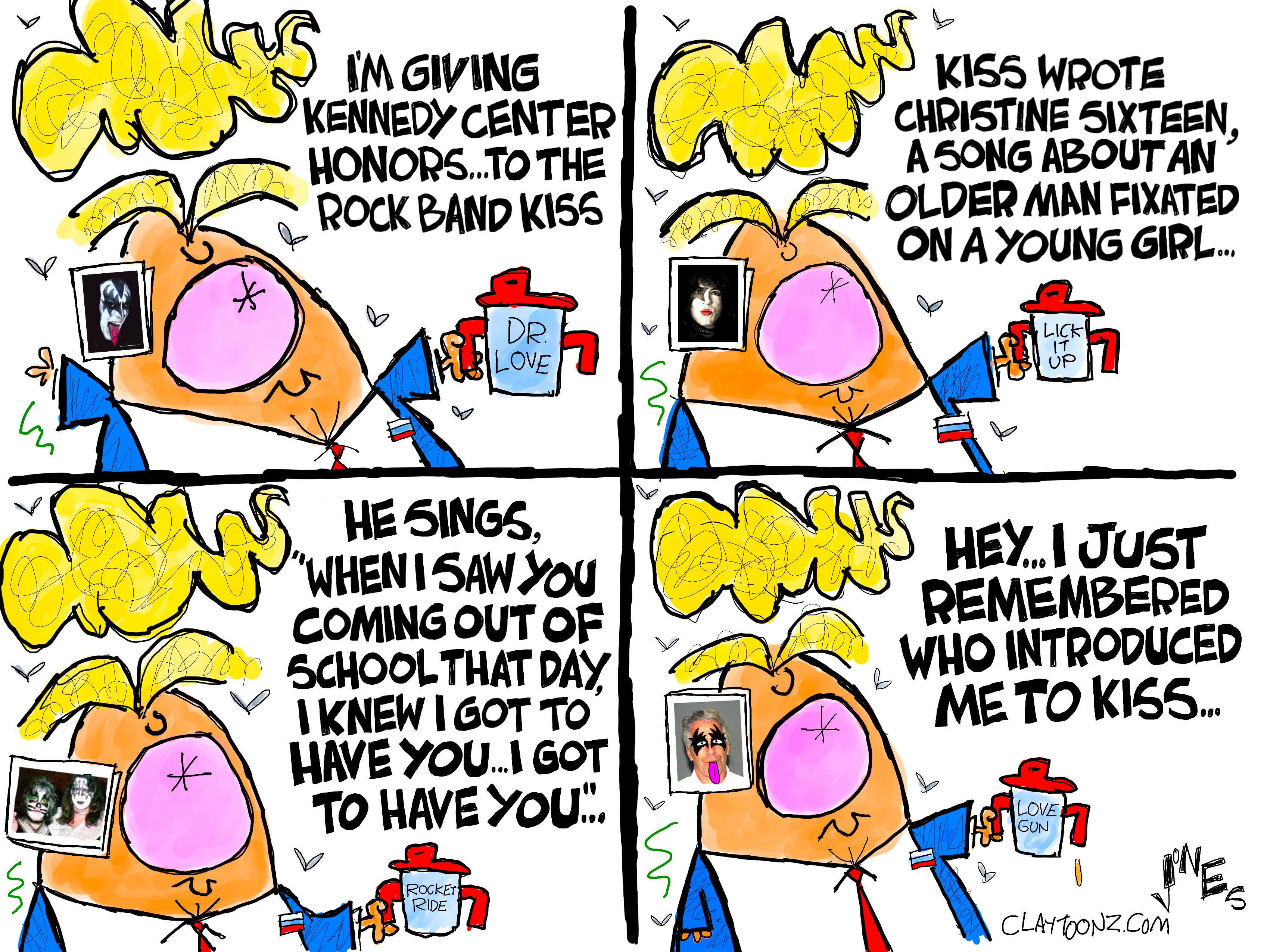
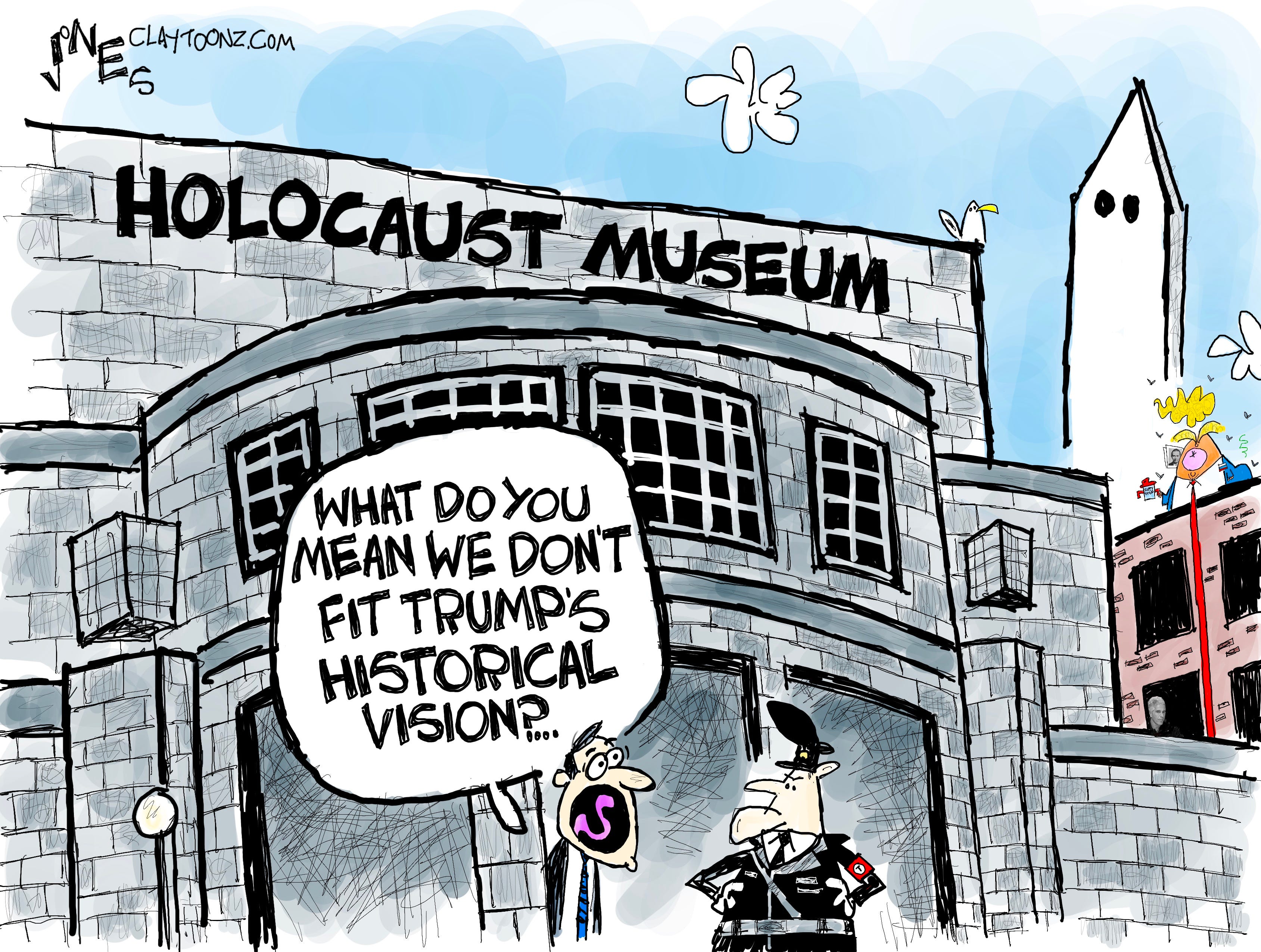
But It’s Not Funny, And Causes Far-Reaching Damages

It isn’t timidity. It’s a complete reconstruction of what is acceptable rhetoric, and it makes gentler more collegial conversation and work impossible.

How does the right tear down progressive societies? It starts with a joke

George Monbiot

Whether it’s bloodshed at Glastonbury or starving people on benefits, their ‘irony poisoning’ seeps obscene ideas into the range of the possible

illustration by Nate Kitch

Illustration: Nate Kitch/The Guardian

Imagine the furore if a Guardian columnist suggested bombing, say, the Conservative party conference and the Tory stronghold of Arundel in Sussex. It would dominate public discussion for weeks. Despite protesting they were “only joking”, that person would never work in journalism again. Their editor would certainly be sacked. The police would probably come knocking. But when the Spectator columnist Rod Liddle speculates about bombing Glastonbury festival and Brighton, complaints are met with, “Calm down dear, can’t you take a joke?” The journalist keeps his job, as does his editor, the former justice secretary Michael Gove. There’s one rule for the left and another for the right.

The same applies to the recent comments on GB News by its regular guest Lewis Schaffer. He proposed that, to reduce the number of disabled people claiming benefits, he would “just starve them. I mean, that’s what people have to do, that’s what you’ve got to do to people, you just can’t give people money … What else can you do? Shoot them? I mean, I suggest that, but I think that’s maybe a bit strong.” The presenter, Patrick Christys replied, “Yeah, it’s just not allowed these days.”

You could call these jokes, if you think killing people is funny. Or you could call them thought experiments. Liddle suggested as much in his column: “I am merely hypothesising, in a slightly wistful kinda way.” This “humour” permits obscene ideas to seep into the range of the possible.

Academic researchers see the use of jokes to break taboos and reduce the thresholds of hate speech as a form of “strategic mainstreaming”. Far-right influencers use humour, irony and memes to inject ideas into public life that would otherwise be unacceptable. In doing so, they desensitise their audience and normalise extremism. A study of German Telegram channels found that far-right content presented seriously achieved limited reach, as did non-political humour. But when far-right extremism was presented humorously, it took off. (snip-MORE)

Democrats and climate groups ‘too polite’ in fight against ‘malevolent’ fossil fuel giants, says key senator

Sheldon Whitehouse of Rhode Island gives 300th climate speech on the US Senate floor

a man in a suit speaks

Sheldon Whitehouse at a Senate confirmation hearing on 6 February 2025. Photograph: Tom Williams/CQ-Roll Call via Getty Images

The Democratic party and the climate movement have been “too cautious and polite” and should instead be denouncing the fossil fuel industry’s “huge denial operation”, the US senator Sheldon Whitehouse said.

“The fossil fuel industry has run the biggest and most malevolent propaganda operation the country has ever seen,” the Rhode Island Democrat said in an interview Monday with the global media collaboration Covering Climate Now. “It is defending a $700-plus billion [annual] subsidy” of not being charged for the health and environmental damages caused by burning fossil fuels. “I think the more people understand that, the more they’ll be irate [that] they’ve been lied to.” But, he added, “Democrats have not done a good job of calling that out.”

Whitehouse is among the most outspoken climate champions on Capitol Hill, and on Wednesday evening, he delivered his 300th Time to Wake Up climate speech on the floor of the Senate.

He began giving these speeches in 2012, when Barack Obama was in his first term, and has consistently criticized both political parties for their lackluster response to the climate emergency. The Obama White House, he complained, for years would not even “use the word ‘climate’ and ‘change’ in the same paragraph”.

While Whitehouse slams his fellow Democrats for timidity, he blasts Republicans for being in the pocket of the fossil fuel industry, an entity whose behavior “has been downright evil”, he said. “To deliberately ignore [the laws of physics] for short-term profits that set up people for huge, really bad impacts – if that’s not a good definition of evil, I don’t know what is.” (snip-MORE)

Peace & Justice History for 7/10

July 10, 1976
Ku Klux Klan (KKK) members near Georgetown, Illinois, gathered for an ill-fated cross-burning. The meeting started an hour late. When the Klansmen went to plant their cross, it was too heavy to move. Three hours later, after the cross was chopped down to a portable size, it was planted, but would not light.
Finally, the Klan members gave up and went home.


The ugly history of the KKK 
July 10, 1985

The Rainbow Warrior then
The Greenpeace flagship, Rainbow Warrior (named after a North American Indian legend), was blown up in Auckland Harbour, New Zealand, killing one and sinking the ship.
The attack had been authorized by French President François Mitterand because the environmental organization had plans to protest France’s nuclear bomb tests in the South Pacific.

The Rainbow Warrior today

https://www.peacebuttons.info/E-News/peacehistoryjuly.htm#july10

Peace & Justice History for 7/9

July 9, 1917
During World War I, Emma Goldman and Alexander Berkman, leaders of the No-Conscription League, spoke out against the war and the draft. Both were found guilty in New York City of conspiracy against the draft, fined $10,000 each and sentenced to two years’ imprisonment with the possibility of deportation at the end of their terms.

Emma Goldman and Alexander Berkman in New York, 1917, awaiting trial on charges of opposing the draft during World War I.
Emma Goldman’s address to the Jury “History is a Weapon” 
July 9, 1955

Albert Einstein
Albert Einstein, Bertrand Russell and nine other scientists warned that the development of weapons of mass destruction had created a choice between war and survival of the human species.

Bertrand Russell
The Russell-Einstein Manifesto was published in London and became the basis for the Pugwash Conference of scientists two years later.
“Here, then, is the problem which we present to you, stark and dreadful and inescapable: Shall we put an end to the human race; or shall mankind renounce war? People will not face this alternative because it is so difficult to abolish war.
The abolition of war will demand distasteful limitations of national sovereignty….”

“We have to learn to think in a new way. We have to learn to ask ourselves … what steps can be taken to prevent a military contest of which the issue must be disastrous to all parties?”
Text of the manifesto 

https://www.peacebuttons.info/E-News/peacehistoryjuly.htm#july9

Roy Wilkins, Nuke Use Illegal, & More, in Peace & Justice History for 7/8

July 8, 1777
Vermont became the first British colony in America to abolish slavery when adopting its first constitution following its breaking away from New York.
Read more on slavery in Vermont 
More on slavery in the northern states 
July 8, 1917
The Women’s Peace Crusade organized a protest against the first world war in Glasgow, Scotland. Processions from two sides of the city, accompanied by bands and banners, wound their way toward the Glasgow Green where they merged into one demonstration of some 14,000 people. 
Read about the Women’s Peace Crusade 
July 8, 1958

“Omaha Action” protestors march from Lincoln, Nebraska to the Mead ICBM construction site in 1959. Source — NSHS.
In an effort called “Omaha Action,” by the Committee for Nonviolent Action (CNVA), anti-nuclear activist Don Fortenberry was arrested after climbing a fence to protest against the building of ICBM sites in Nebraska.
Also arrested during this series of actions was internationally known peace activist A. J. Muste.

More about Omaha Action 
July 8, 1959
Vietnamese guerillas ambushed two U.S. advisors, Major Dale Buis and Sgt. Chester Ovnand, are killed by Viet Minh guerrillas at Bien Hoa, South Vietnam, making them the first U.S. casualties in Vietnam
since 1946.
July 8, 1965
Roy Wilkins became the executive director of NAACP, the National Association for the Advancement of Colored People. He had edited the organization’s magazine, Crisis, for fifteen years, and was one of the most articulate of civil rights leaders.

Roy Wilkins

the Roy Wilkins Memorial in Minneapolis
July 8, 1996
The International Court Of Justice declared that, in almost all circumstances, use of nuclear weapons is illegal.

https://www.peacebuttons.info/E-News/peacehistoryjuly.htm#july8

We are watching history repeat itself. Where is the red line?

Mother Jones with The Mill Children, & More, in Peace & Justice History for 7/7

July 7, 1863
The first military draft was instituted in the U.S. to provide troops for the Union army in the American Civil War. Once called, a draftee had the opportunity to either pay a commutation fee of $300 to be exempt from a particular battle, or to hire a replacement that would exempt him from the entire war.
July 7, 1903

The March of the Mill Children  watch a video – highly recommended
Labor organizer Mary Harris “Mother” Jones led the “March of the Mill Children” over 100 miles from Philadelphia to President Theodore Roosevelt’s Long Island summer home in Oyster Bay, New York, to publicize the harsh conditions of child labor and to demand a 55-hour work week. It is during this march, on about the 24th, she delivered her famed “The Wail of the Children” speech.
Roosevelt refused to see them.

“Fifty years ago there was a cry against slavery and men gave up their lives to stop the selling of black children on the block. Today the white child is sold for two dollars a week to the manufacturers.” –
from Mother Jones’s autobiography
 
Read more about Mother Jones 
July 7, 1957
Convened at the onset of the Cold War, a group of scientists held their first peace conference in the village of Pugwash, Nova Scotia, Canada. The mission of the Pugwash Conference was to “. . . bring scientific insight and reason to bear on threats to human security arising from science and technology in general, and above all from the catastrophic threat posed to humanity by nuclear and other weapons of mass destruction . . . .”

Bertrand Russell
Wealthy industrialist and Pugwash son Cyrus Eaton had invited the world’s greatest minds to his family home in Nova Scotia and address the emerging threat of nuclear war. The Conference became the basis for an ongoing organization that deals with issues of weapons of mass destruction. The 1995 Nobel Peace Prize was awarded to Joseph Rotblat (one of the original signatories of the Pugwash Manifesto) and to the Pugwash Conferences on Science and World Affairs.
Albert Einstein
Pugwash home 

Fifty years later . . .
25 scientists, diplomats and former military officers from 15 countries gathered for a “Revitalizing Nuclear Disarmament” strategy workshop. The meeting was held near the Thinkers’ Lodge, the site of the first meeting in 1957.
Fifty years ago from Pugwash, Nova Scotia, nuclear scientists helped alert the world to the dangers of nuclear weapons, and especially the newly developed hydrogen bomb,” said Paolo Cotta-Ramusino, Secretary General, Pugwash Conferences on Science and World Affairs. “Today, we are working with experts from around the world for global action to revitalize nuclear disarmament and the final elimination of nuclear weapons.
Senator Roméo Dallaire, Honorary Patron of the Pugwash Peace Exchange, said “It is appalling to observe the increasing potential for many regional nuclear arms races, shameless plans to modernize nuclear arsenals and bald-faced threats of pre-emptive nuclear use,” said Senator Dallaire. “Only by revitalizing discussion and implementation of disarmament leading to abolition can we ensure that these genocidal devices will never again be used.
July 7, 1977
The United States conducted its first test of the neutron bomb. The neutron bomb was a tactical thermonuclear weapon designed to cause very little physical damage through limited blast and heat but was designed to kill troops through localized but intense levels of lethal radiation.

A neutron bomb explosion at a test site
July 7, 1979
2,000 American Indian activists and anti-nuclear demonstrators marched through the Black Hills of western South Dakota to protest the development of uranium mines on sacred native lands.

https://www.peacebuttons.info/E-News/peacehistoryjuly.htm#july7

Yet More History, From the Saturday Evening Post-

No language alert!

From Closeted Citizens to Activists: High Tech Gays and the Fight for LGBTQ+ Equality in Silicon Valley

In the late 20th century, a gay social club became a major political force in the California tech industry, eventually influencing corporate policies as well as state and federal laws across the country.

Ryan Reft

In the 1980s, at a time when the federal government turned its back on the LGBTQ community, gay men and lesbians found an unlikely partner in their fight for equality: corporations.

In the face of the AIDS crisis, hostility toward LGBTQ employees forced the community to “turn from the state to business for protection, according to Margot Canaday’s Queer Career: Sexuality and Work Modern America.” Corporate America did more than federal or state governments in this regard, outpacing both the labor movement and the non-profit sector.

And it started in Silicon Valley.

While Silicon Valley was dominated by the kind of straight white men mocked in the HBO series of the same name, it also wasn’t the establishment. In these early days, for example, women made up a larger proportion of those working in computer programming. Nonconformity was seen as valuable rather than problematic. In 1987, Lotus became the “first highly visible, for-profit company” to provide same sex couples with partner benefits, according to Canaday.

Today, Silicon Valley dominates the public narrative and the economy. Granted, in our current moment, it seems paradoxical that the same industry that gave us social media platforms that often perpetuate misogyny and homophobia also served as an important battleground for the assertion of employment rights for LGBTQ workers. Yet it did, and it happened internally through employee resource groups and externally through advocacy groups.

One of the most prominent of these external advocacy organizations was the High Tech Gays (HTG). Formed in the living rooms of Silicon Valley’s San Jose in 1983, it began largely as a social group for the region’s LGTBQ tech workforce, but over time it served as an incubator for other organizations dedicated to LGBTQ political rights, inspiring members to start their own employee resource groups at their places of employment and organizing against anti-gay state referendums.

The 1980s and Silicon Valley

While San Francisco, has long been identified with LGBTQ activism, suburban Silicon Valley proved more conservative. “Even though I was ‘out’ with friends and family who knew me…I found myself being very reserved in expressing affection, talking in any depth about gay culture with them,” says Bob Correa, a California native, San Jose resident (1971-1986), and an early HTG member. “Even in the early ’80s there was a lot of prejudice back then, a heck of lot more than today,” adds his husband and one of HTG’s founders, Denny Carroll, in their 2018 interview.

Denny Carroll and Bob Correa after donating the HTG collection to the San Jose State Martin Luther King Library (Photo courtesy of HTG, Martin Luther King, Jr. Library, San Jose State University)

(snip-MORE, go read it)

Post 2 of 2 Bits of Queer History

Language alert extends to this one, too.

Queer History 331: Evelyn Hooker – Homphobes Can Suck a Big Dick, And She Proved It by Wendy🏳️‍⚧️🏳️‍🌈🌈

Read on Substack

In 1956, when the entire psychiatric establishment was convinced that homosexuality was a form of mental illness requiring treatment, cure, or containment, one woman looked at the scientific evidence and said, “This is complete bullshit.” Evelyn Hooker didn’t just challenge conventional wisdom—she demolished it with the kind of methodological precision that left her opponents scrambling for excuses and the LGBTQIA+ community with something they’d never had before: scientific proof that there was absolutely nothing wrong with them.

Evelyn Hooker - Wikipedia

But this wasn’t some abstract academic exercise conducted by a dispassionate researcher in an ivory tower. Hooker’s work was personal, political, and profoundly revolutionary in ways that extended far beyond the confines of psychological journals. She was a straight woman who risked her career to defend people she cared about, a scientist who refused to let prejudice masquerade as objective research, and a human being who understood that the difference between pathology and normalcy could literally be a matter of life and death for millions of people.

Her story is one of scientific courage in the face of institutional pressure, intellectual honesty in an era of willful ignorance, and the transformative power of rigorous methodology applied to questions that society would rather not examine too closely. It’s also the story of how one woman’s determination to follow the evidence wherever it led helped liberate an entire community from the tyranny of psychiatric pathologization, proving that sometimes the most radical act is simply insisting on the truth.

The Making of a Scientific Revolutionary (snip-MORE)

Queer History 573: Gertrude Stein and Alice Toklas by Wendy🏳️‍⚧️🏳️‍🌈🌈

The Badass Bitches Who Told Paris to Go Fuck Itself and Made Art History Anyway Read on Substack

Listen up, you beautiful fucking souls, because today we’re diving headfirst into the absolutely goddamn legendary love story that rewrote the rules of art, literature, and what it meant to be authentically, unapologetically queer in the early 20th century. We’re talking about Alice B. Toklas and Gertrude Stein – two women who said “fuck your heteronormative bullshit” and proceeded to create one of the most influential artistic partnerships in modern history.

Gertrude Stein and Alice B. Toklas' Enduring Love Story

These weren’t just two women living together because society expected spinsters to share expenses. Hell no. This was a love affair that burned so bright it illuminated the entire fucking modernist movement, and their relationship became the beating heart of Parisian avant-garde culture for nearly four decades.

The Fierce Fucking Beginning

Picture this shit: It’s 1907, and Alice Babette Toklas, a sharp-as-hell California Jewish woman with an eye for detail that could cut glass, walks into Gertrude Stein’s salon at 27 rue de Fleurus in Paris. The moment their eyes met, the world shifted on its goddamn axis. Alice later described hearing church bells ringing – not metaphorically, but literally – because apparently when your soulmate walks into the room, even the universe knows it’s time to celebrate.

Gertrude Stein wasn’t just any woman. This brilliant bitch had already established herself as a radical writer whose experimental prose was making traditional literature scholars shit their conservative pants. Born in 1874 in Pennsylvania to a German-Jewish immigrant family, Gertrude had studied psychology under William James at Harvard’s sister school, Radcliffe College. She understood the human mind in ways that would make Freud jealous as fuck.

Alice, born in 1877 in San Francisco, came from a middle-class Jewish family and had been living what society deemed an “appropriate” life for a single woman. But the moment she encountered Gertrude’s magnetic presence, all that conventional bullshit went straight out the window. Here was a woman who wrote things like “A rose is a rose is a rose” and made it sound like the most profound shit you’d ever heard.

Building Their Goddamn Empire (snip-MORE)

Maga Pastor ADMITS What They’re Really Fighting For

Post 1 of 2 Pieces of Queer History

Language Alert for the bits from Wendy! 😇

Queer History 623: Carla Antonelli – The Spanish Fireball Who Torched Franco’s Ghost by Wendy🏳️‍⚧️🏳️‍🌈🌈

Read on Substack

In the sun-scorched landscape of Spanish politics, where machismo runs deeper than olive oil and Catholic conservatism clings like barnacles to a ship’s hull, Carla Antonelli emerged like a fucking phoenix from the ashes of Franco’s repressive regime. Born Carlos Álvarez-Malvar in 1959, she didn’t just transition from male to female—she transformed from a society that wanted her dead into a political force that would reshape Spain’s understanding of transgender existence. This wasn’t some gentle evolution; this was a goddamn revolution with lipstick and legislative power.

Carla Antonelli represents more than just political firsts and broken barriers. She embodies the visceral struggle of transgender people in post-Franco Spain, where the ghost of fascist oppression still haunted every street corner and the Catholic Church’s influence seeped into every crack of social life. Her journey from underground actress to regional parliamentarian reads like a masterclass in survival, authenticity, and the raw power of refusing to be erased.

Let’s be brutally fucking honest about what Carla faced: a Spain that had spent decades under a dictator who considered LGBTQIA+ people degenerates worthy of imprisonment or worse. Franco’s regime didn’t just criminalize homosexuality and gender nonconformity—it tried to erase these identities from existence entirely. When Franco finally had the decency to die in 1975, his ideological progeny didn’t magically disappear. They lurked in institutions, in families, in the collective psyche of a nation that was slowly, painfully learning to breathe freely again.

The Making of a Revolutionary in Franco’s Shadow (snip-MORE)

Queer History 892: Ben Barres – The Badass Brain Scientist Who Fucked Up Gender Bias Forever by Wendy🏳️‍⚧️🏳️‍🌈🌈

Read on Substack

In the testosterone-soaked world of academic neuroscience, where brilliant minds wrapped in fragile egos compete to unlock the secrets of the human brain, Ben Barres stood as a goddamn force of nature who revolutionized not just our understanding of neural circuits but the entire fucking structure of scientific academia itself. Born Barbara in 1954, Ben didn’t just transition from female to male—he transformed from a marginalized outsider fighting for recognition to one of the most respected neuroscientists on the planet, all while wielding his unique perspective like a scalpel to dissect the sexist bullshit that infected his field.

Ben Barres wasn’t just another transgender scientist who happened to make discoveries. He was a revolutionary who used his lived experience of gender bias to expose the systemic discrimination that had been hiding in plain sight for decades. His story reads like a masterclass in how authenticity and scientific rigor can combine to create change that extends far beyond laboratory walls. When he died in 2017, he left behind not just groundbreaking research on glial cells and neural development, but a legacy of advocacy that continues to reshape how academia treats women, minorities, and anyone who doesn’t fit the traditional mold of what a scientist should look like.

This is the story of a brilliant mind who refused to be diminished by a world that couldn’t understand him, who channeled the fury of marginalization into scientific excellence and social change. Ben Barres proved that the best revenge against discrimination isn’t just success—it’s using that success to burn down the systems that tried to stop you in the first place.

The Early Years: A Brilliant Mind in the Wrong Package (snip-MORE)