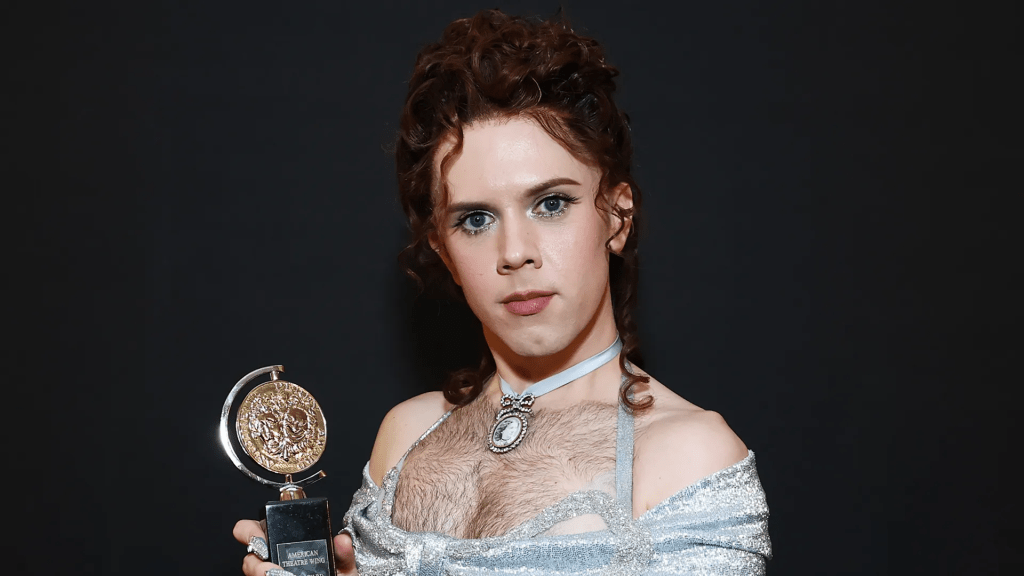
Riley Gaines turned a 5th place tie, not even in the top ranking, into a political money making bigot gig. She has made hundreds of thousands of dollars pushing people to hate trans athletes using misinformation and lies. She is a favorite of republicans to have testify in front of legislatures to help them justify making trans kids lives miserable. Wonder who is funding her? Religious bigots like billionaire Betsy DeVos. The DeVos made their money on pyramid schemes and selling Amway. All in the name of their god they lie, make things up, and misinform the public about trans people. I don’t understand the hate and bile they have for non-straight non-cis people. Makes their god look ugly. Hugs
Thank you all for reading! You’re all giving me so much strength to carry on. What a privilege to have you as interlocutors. Unfortunately, I also have bills to pay, especially in the next few weeks, so I must do a bit of self-promo, even though I really hate it.
My work is entirely powered by you, dear readers! If you want to support my goal of making a living from these comics, the best way is to subscribe at www.patreon.com/assignedmale . It can be for any amount, you can get a yearly discount, and you can cancel anytime. If you wish to show your appreciation for the work I’ve been doing lately, you can send me a coffee at www.ko-fi.com/sophielabelle .
You can also get yourself some nifty gear with my designs on it at https://sophielabelle.dashery.com . Best way to ruin the Holidays, guaranteed!
Another great (and free!) way to support my work is to react to this post and leave a comment to make sure that more people see it.
Either way, keep shining, stay hydrated, and watch your posture. Love you all!! Sophie
Definite beverage alert, though it may be choking rather than laughing.
We all knew it was inevitable: the MAGA conspiracy set is knee-deep in transvestigating Charlie Kirk and his widow, Erika Kirk.
For the blissfully offline (oh, how we envy you), “transvestigation” is a transphobic conspiracy theory advanced over the past eight years, adherents to which believe countless celebrities, politicians, and other public figures are secretly transgender. The conspiracy usually involves armchair phrenology, as believers overlay diagrams of skeletons and skulls over photographs to highlight alleged “discrepancies,” and pseudoscientific analyses of body language and posture. It’s abject nonsense that conveniently ties in with QAnon, “Pizzagate,” and other right-wing conspiracies — and nobody, not even far-right figureheads themselves, are safe from suspicion.
Transvestigators on social media started training their eyes on Erika Kirk roughly two months ago in mid-September, shortly after her husband, Turning Point USA cofounder Charlie Kirk, was shot and killed in Utah. (snip)
Comments on the post were somewhat divided, though many took Starbucs’ side. “Of course almost all models, especially agent models and Victoria secret models are mostly [trans women],” one wrote. Another simply called her a “filthy Luciferian.” Others cited a video Erika Kirk filmed over a decade ago, in which she described herself in childhood as a tomboy, as evidence that she was actually assigned male at birth. Some even took the opportunity to posthumously transvestigate Charlie Kirk as well; “that’s why Charlie Kirk seemed so feminine and emasculated because she was a transgender handler. That’s why he was so pretty,” one person wrote. (emphasis mine-A.) (snip-MORE-it’s not long)
Here’s what you need to know about Trump’s trans passport ban. By Quispe López
On November 6, the Supreme Court granted the State Department temporary permission to enforce the Trump administration’s passport ban, giving it authority to bar transgender, nonbinary, and intersex people from obtaining passports with gender markers that reflect their identity.
The decision reversed two previous injunctions ordered by lower courts, filed by the American Civil Liberties Union (ACLU) as a class action lawsuit against the State Department, Orr v. Trump, which temporarily prevented the Trump administration from enforcing its trans passport ban. The ban stems from an anti-trans executive order in which the Trump administration attempted to codify the legal definition of gender as biological sex determined “at conception.”
While the lawsuit was pending, the injunctions temporarily allowed trans, nonbinary, and intersex people to obtain passports, new or renewed, with the gender marker corresponding to their identity. Following the Supreme Court’s decision, which allows the State Department to enact the executive order while Orr v. Trump is debated, people who apply for a new or renewed passport will only be able to receive one with their sex assigned at birth. According to the ACLU, there is no guidance on what intersex people who might not have any documents with an F or M marker from around the time they were born should expect for their passports. (snip-MORE-also, not long)
For some people, gender shifts over time, often through changes in one’s sense of self. A transgender man may realize they are nonbinary and stop hormone replacement therapy. A trans woman may face so much discrimination that she represses her identity. And some trans people medically reverse their transition to live as their sex assigned at birth.
These experiences are all part of a process known as detransitioning. Although detransitioning does not have a consistent social or academic definition, it generally applies to someone who has sought a gender transition and then stopped, shifted or reversed aspects of it. Their experiences offer a deeper look at how discrimination and gender norms impact our lives, how gender-affirming care can be improved, and how identity is perhaps more fluid than previously thought.
As experts work to understand detransitioners, their vulnerabilities and their highly individualized needs, their identities are being co-opted as part of a national campaign against transgender rights. Health care access and research are being blocked by politicians for both trans people and detransitioners — while anti-trans rhetoric puts everyone at risk.
The Federal Trade Commission and the Justice Department are investigating gender-affirming care as medical fraud, and they are rooting this effort in detransitioners’ stories that fit the narrative the Trump administration wants to advance. The White House wants the National Institutes of Health to study “regret” and “detransition,” even as it cuts any federal funding for researchthat mentions the word “trans.” The U.S. Department of Education hosted a “Detrans Awareness Day” event last March. Meanwhile, its functions have been severely undermined by layoffs and budget cuts.
The White House and agencies like the Justice Department claim that gender-affirming care is mutilating children, overlooking that young trans people live happily after transition and the studies showing that adolescents who regret transition are in the minority. Government officials describe trans people and detransitioners as victims of a medical conspiracy to boost profits and force gender ideology on families. Now, they are seeking evidence to prove those claims by subpoenaing hospitals for patients’ private data, including doctors’ notes, patient addresses and Social Security numbers.
Gender-affirming care has been broadly endorsed by the medical community for its effectiveness in treating gender dysphoria, a persistent distress felt when one’s body is out of sync with their identity. The 2022 U.S. Trans Survey, which polled over 92,000 trans and nonbinary people 16 and older, found that social and medical transition were profound sources of life satisfaction. Experts and advocates agree that more research and more understanding are needed to improve trans medical care. But under Trump, they also expect transgender and intersex health to keep getting worse, not better.
The 19th spoke with two detransitioners who feel harmed and usedby the Trump administration, which has positioned itself as a protector of those who detransition. Adriana lives in New York City, where she feels safe to express herself among so many LGBTQ+ people, but has struggled to access adequate health care. Ara lives in North Carolina, a state that has several laws restricting trans rights and health care access — and where support from a mental health program and her partner has helped her navigate the challenges of detransitioning. As politicians stoke fear about gender non-conformity, their experiences offer a deeper understanding of what it means to live authentically in a politically volatile time.
Still, more young people have been exploring their identities, expanding the boundaries of gender and adding to the cultural and social norms surrounding it. Detransitioners’ experiences are part of that social evolution. Their stories of regret and pain exist alongside stories of joy and empowerment — and these are all part of a journey of self-discovery that may have turned out to be more complicated than they initially thought. The question is, will elected officials support them on this journey or cause more harm?
‘Taking away trans health care is taking away people’s lives’
As providers of trans health care have become political targets, Ara Kareis’ own routine treatments have been disrupted.
‘I just feel like such a power source’
The joy that Adriana Del Orden feels in her body could have only come through exploring her gender. She’s tired of being told that she ruined her life.
The politics of detransition
Political rhetoric doesn’t capture the complexity of detransitioning — or what taking away health care means.
Supreme Court rejects long-shot effort to overturn same-sex marriage ruling
The court turned away an appeal filed by Kim Davis, a former county clerk in Kentucky who was sued after refusing to issue a marriage license to a gay couple.
WASHINGTON — The Supreme Court on Monday turned away a long-shot attempt to overturn the landmark 2015 ruling that legalized same-sex marriage nationwide.
Without comment, the justices rejected an appeal brought by Kim Davis, a former county clerk in Kentucky who was sued in 2015 for refusing to issue marriage licenses because of her opposition to same-sex marriage based on her religious beliefs.
Her latest appeal in the case, brought a decade later, had attracted considerable attention amid fears that the court could overturn the 2015 same-sex marriage decision, Obergefell v. Hodges, in the aftermath of the 2022 ruling that overturned the landmark abortion rights decision, Roe v. Wade. (snip-MORE, with video on the page)
(I don’t know what this formatting is about. This is the 3d try, so here it is as it is.)
November 10, 1924
The Society for Human Rights, the first gay rights organization in the U.S., was founded in Chicago by Henry Gerber, a German immigrant. He had been inspired by Germany’s Scientific Humanitarian Committee, formed to oppose the oppression of men and women considered “sexual intermediates.”
Henry Gerber–founder of the Society for Human Rights
The founder of Chicago’s Society for Human Rights in 1924, the first gay rights organization in the United States, Henry Gerber was born in Bavaria as Joseph Henry Dittmar on June 29, 1892, and arrived at Ellis Island in October, 1913. With members of his family, he moved to Chicago because of its large German population. After working briefly at Montgomery Ward, he was interned as an alien during World War I. He wrote that although this was not right, he did receive three meals a day. From 1920 to 1923 he served with the U.S. Army of Occupation of Germany and during this time, he came into contact with the German homosexual emancipation movement. He subscribed to German homophile magazines and was in contact with Magnus Hirschfeld’s Scientific-Humanitarian Community in Berlin. In 1924, Gerber returned to Chicago and was hired by the post office. Gerber’s return to Chicago was amidst a backdrop of urbanization and an emerging gay subculture.
Following what Gerber had seen in Germany, he felt the need to establish an organization to protect the rights of gays and lesbians. With several friends, Gerber formed an organization which was later incorporated as The Society for Human Rights, a nonprofit corporation in the State of Illinois. The organization published a newsletter, Friendship and Freedom, which was distributed to its small membership.
In July, 1925, the society came to an abrupt end. The wife of one of the co-founders reported her husband, a reputed bisexual, to her social worker who contacted the police. Following a police raid, Gerber and several others were arrested and prosecuted for their deviancy. After three costly trials the case against Gerber was dismissed. Gerber lost his entire life savings defending himself and was fired from his job at the post office for conduct unbecoming a postal worker.
After his ordeal, Gerber moved to New York City where he reenlisted in the U.S. Army and served for 17 years. During the 1930s he managed a personal correspondence club and wrote articles in gay publications under a pseudonym. The correspondence club became a national communications network for gay men. In the 1940s, Gerber exchanged a number of letters with Manuel Boyfrank of California. Boyfrank was enthusiastic about organizing to combat homosexual oppression. Gerber offered his assistance, but refused to risk his job again. He continued his assistance through personal correspondence and numerous articles.
On December 31, 1972, Gerber died at the U.S. Soldiers’ and Airmen’s Home in Washington, D.C., at the age of 80. He lived to see the Stonewall Rebellion and the start of a new era of activist gay and lesbian liberation organizations.
Top Democratic officials put out a new guide, entitled “Deciding to Win,” that encourages Democrats to be a little more like Republicans on “identity and cultural issues.”
Left: David Axelrod // Public domain, Middle: James Carville // JD Lasica // Wikimedia Commons, Right: David Plouffe // Noam Galai // Wikimedia Commons
Erin In The Morning is a reader-supported publication. To receive new posts and support my work, consider becoming a subscriber.
Subscribe
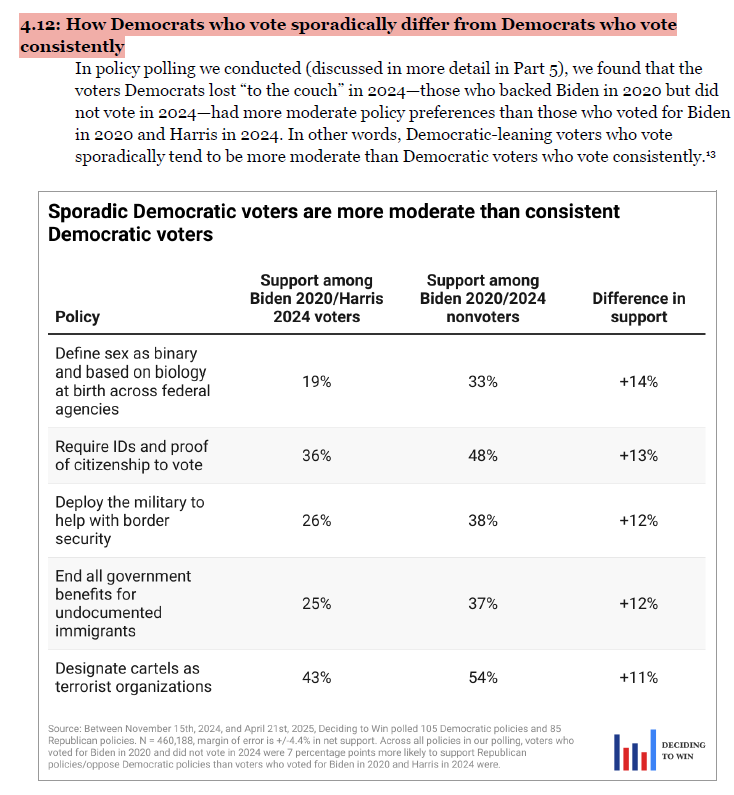
This week, the self-styled centrist group WelcomePAC released a document entitled “Deciding to Win”—advised on by some of the Democratic Party’s most prominent strategists, including David Axelrod, James Carville, and David Plouffe—urging Democrats to act a little more like Republicans on so-called “identity and cultural issues.” The 58-page memo reads like a compendium of the consultant class’s worst instincts, encouraging candidates to become little more than poll-tested avatars and walking focus groups, trading conviction for triangulation. While the document rarely defines which “cultural issues” it means, the few times it does make it clear: queer and transgender people stand to lose the most if this vision of the Democratic Party takes hold.
The document begins with five key pillars for the party. Some of them make a lot of sense, such as “messaging on an economic program centered on lowering costs, growing the economy, creating jobs, and expanding the social safety net,” critiquing “the outsized political and economic influence of” the “ultra-wealthy,” and support for a $15/h minimum wage. Others, though, encourage the party to abandon platforms that have been central to its identity and mission to protect the most vulnerable in society, calling for the party to “Moderate our positions where our agenda is unpopular, including on issues like immigration, public safety, energy production, and some identity and cultural issues.”
While the document rarely defines what “identity and cultural issues” means, the examples make its targets clear. Support for the Equality Act—legislation that would codify gender identity and sexual orientation as protected classes under federal law—is cited as proof the party has “moved left.” Another section lists “protecting the rights of LGBTQ+ Americans” as a priority voters supposedly don’t want Democrats to emphasize. Elsewhere, a discussion of how to mobilize voters “sitting on the couch” reveals that the most popular policy among them is “defining sex as binary and based on biology at birth across federal agencies.” Later in the document, it explicitly calls out transgender sports participation as an issue that the party should “moderate” on.
Screenshot of Deciding to Win Chart of “moderate” policies
Imagine a world where Democrats actually heeded this advice. The “define sex as binary” policy—already championed in Republican-led states and now embedded in everything the Trump administration does—has had devastating consequences for transgender Americans. It has stripped trans people of the ability to update their passports, creating serious barriers to travel; defunded organizations that affirm gender diversity; and fueled crackdowns on college campuses that allow trans students to use restrooms matching their gender identity. It’s a policy of bureaucratic erasure, one that threatens to undo decades of hard-won progress—yet it’s presented, almost casually, as a “moderate” position Democrats might adopt to win votes.
It’s a vision of politics that would turn Democrats into little more than Republican Lite—a “big tent” party spacious enough for those who despise us but not for those who most need protection. In that world, Democrats would lose not just the meaning of leadership but the very soul of why the party exists. And it’s a fantasy built on delusion: no amount of fine-tuned messaging or poll-tested calibration will ever transform the party into the perpetual winner these consultants imagine.
We don’t have to imagine what happens when Democrats follow this playbook — we’ve already seen it. In New Hampshire, Democrats capitulated on multiple anti-trans bills, including bans on youth sports participation and gender-affirming surgery, only to suffer one of the party’s worst defeats of the 2024 election cycle, losing 20 seats. By contrast, Democrats in Montana fought hard against similar measures and mounted some of the most visible resistance to anti-LGBTQ+ legislation in the country, picking up ten seats in the state House—one of the party’s strongest showings nationwide, in a state Trump carried easily. In Kentucky, Governor Andy Beshear vetoed anti-trans bills, including a sports ban, and still won reelection in a Trump +31 state. And in New York, a ballot measure enshrining gender identity protections outperformed Kamala Harris’s statewide margin by a wide margin.
Despite the evidence, a faction within the Democratic Party still treats queer and trans people as expendable—convinced that by trimming the edges of equality and tolerating “a little” discrimination, they can win back power. It’s a ruinous illusion. This kind of triangulation doesn’t blunt Republican attacks; it validates them. Every state that once embraced sports bans or “compromise” restrictions has since escalated to banning medical care, censoring books, and policing bathrooms. Capitulation has never advanced LGBTQ+ rights—not in policy, not in public opinion, not once. Democrats aren’t losing because they’ve been too loud or too firm in defending equality; they’re losing because the far right invests in its own moral narrative while Democrats second-guess theirs. The only way forward is to stand unapologetically on principle—as Andy Beshear did in Kentucky, citing it as the very reason for his success—not to chase the approval of consultants who mistake cowardice for strategy and appeasement for leadership.
Erin In The Morning is a reader-supported publication. To receive new posts and support my work, consider becoming a subscriber.
After the story of a cisgender man who was severely beaten over the summer while defending a trans woman went viral, strangers have helped him cover his reconstruction surgery.
33-year-old Jarod Adkison told Austin American-Statesman that he began chatting with three women while visiting Barton Springs Pool near Austin, Texas on July 26. While they were sitting by the pool, Adkison noticed three men who appeared drunk coming up and making fun of one of the women, who is trans.
“It all stemmed from the men seeing the trans lady and making a lewd gesture,” he said. (snip-MORE-click on the title to finish)
Cole Escola has been cast in the third season of Netflix’s live-action adaptation of One Piece as a fan favorite character.
The news of the actor’s casting was announced on Monday. They will be playing Bon Clay, who is described as “a master of performance and precision who is as dangerous as they are dazzling, a theatrical assassin who turns combat into art.” The character in the original manga is described as an okama, a Japanese umbrella term that can refer to gender nonconforming men, trans women, and crossdressers. So basically, Escola is perfect for the role. (snip-MORE-click through on the title)
As mentioned Wednesday, Bee observes the Global Strike for Gaza on Thursdays. So we had our Bee blog for Thursday then. And here is Peace Music from Scottie’s Playtime, for both today and yesterday, here.
For Thursday, enjoy some Three Dog Night:
Michael Seidel gave a great suggestion, so here it is for Friday: Rock On For Peace!












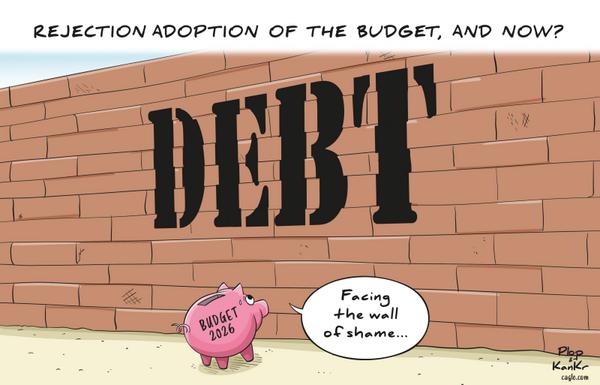


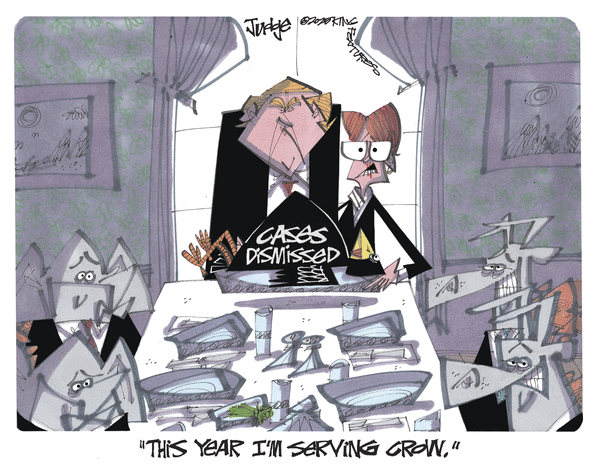






















































Left: David Axelrod // Public domain, Middle: James Carville // JD Lasica // Wikimedia Commons, Right: David Plouffe // Noam Galai // Wikimedia Commons