Providing objective, nonpartisan, rigorous, original journalism that investigates America’s anti-LGBTQ landscape and elevates everyday American heroes. Expect two rigorously reported stories every weekend.
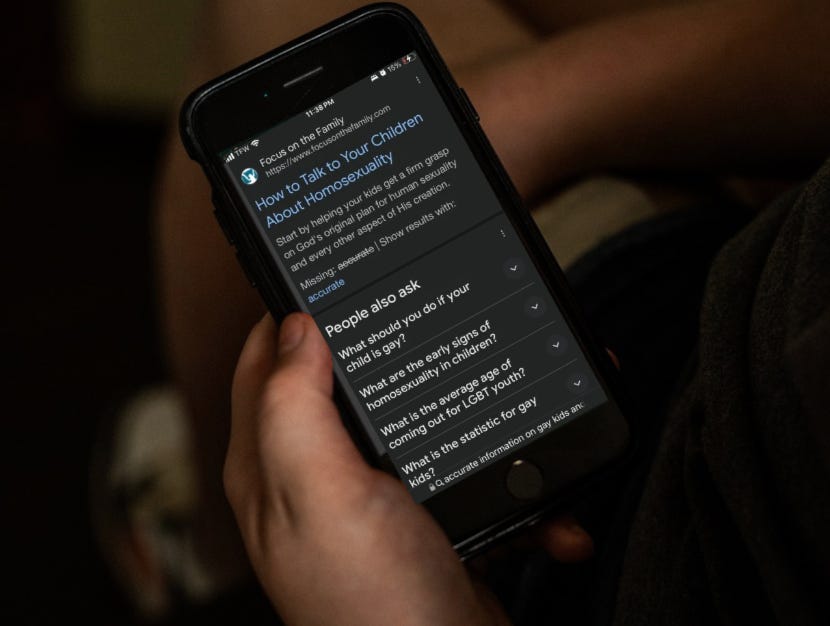
But how does Google’s algorithm decide which results show up? And how do these results influence LGBTQ kids, their parents and Americans at large who are searching for help?
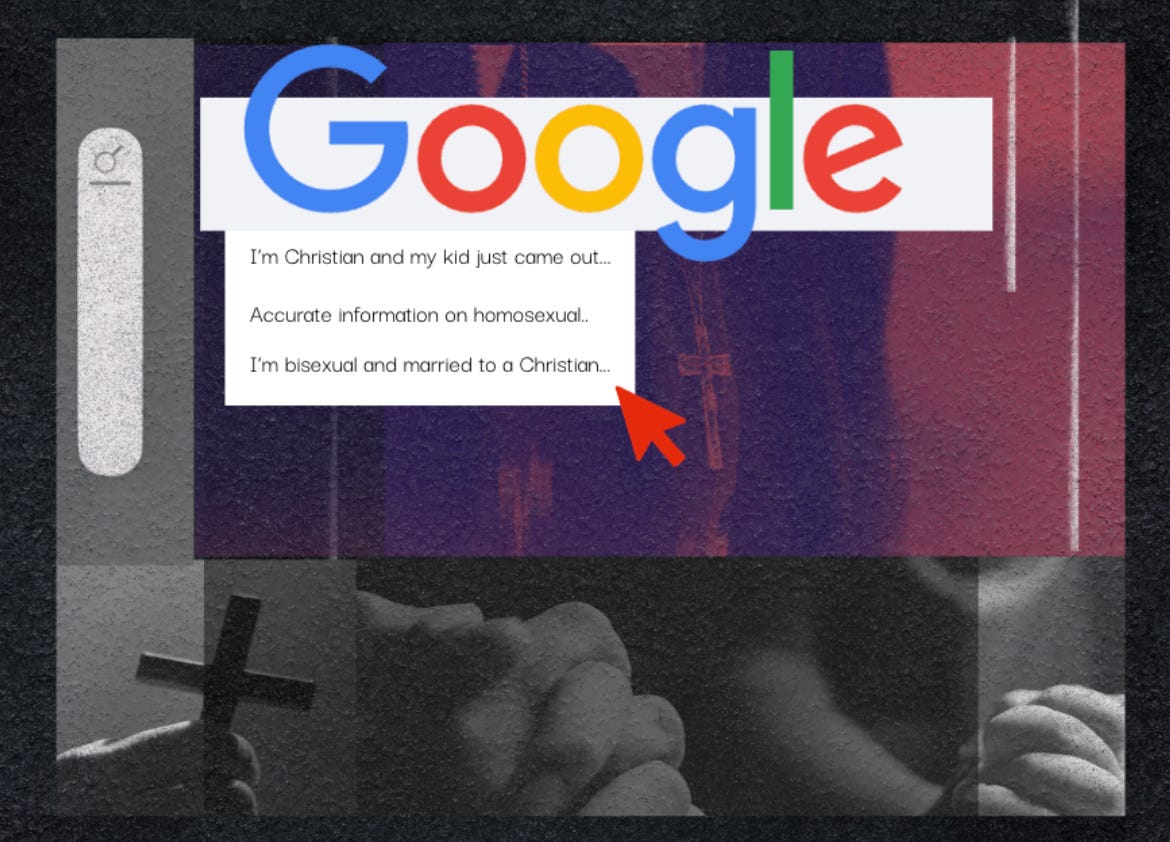
Uncloseted Media asked five Americans from around the country to Google five common queries related to LGBTQ identity, religion and parenting.
The results were alarming and raised an urgent question: With nearly 40% of LGBTQ youth seriously considering suicide just last year, what happens when a queer teen or the parent of a gay kid in crisis turns to Google?
Photos courtesy of participants Mark Just, Genna and Melanie Brown, April Samberg, Tommy O’Neil. Photo of Genna and Melanie by Kaoly Gutteriez.
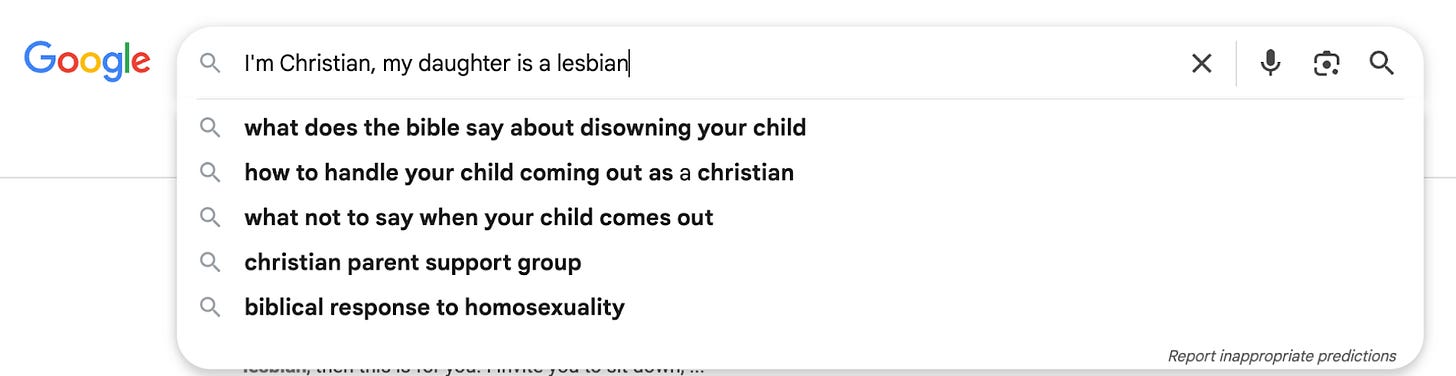
“I’m Christian, my daughter is a lesbian,” Melanie Brown, a Southern Baptist from High Point, North Carolina, types into Google.
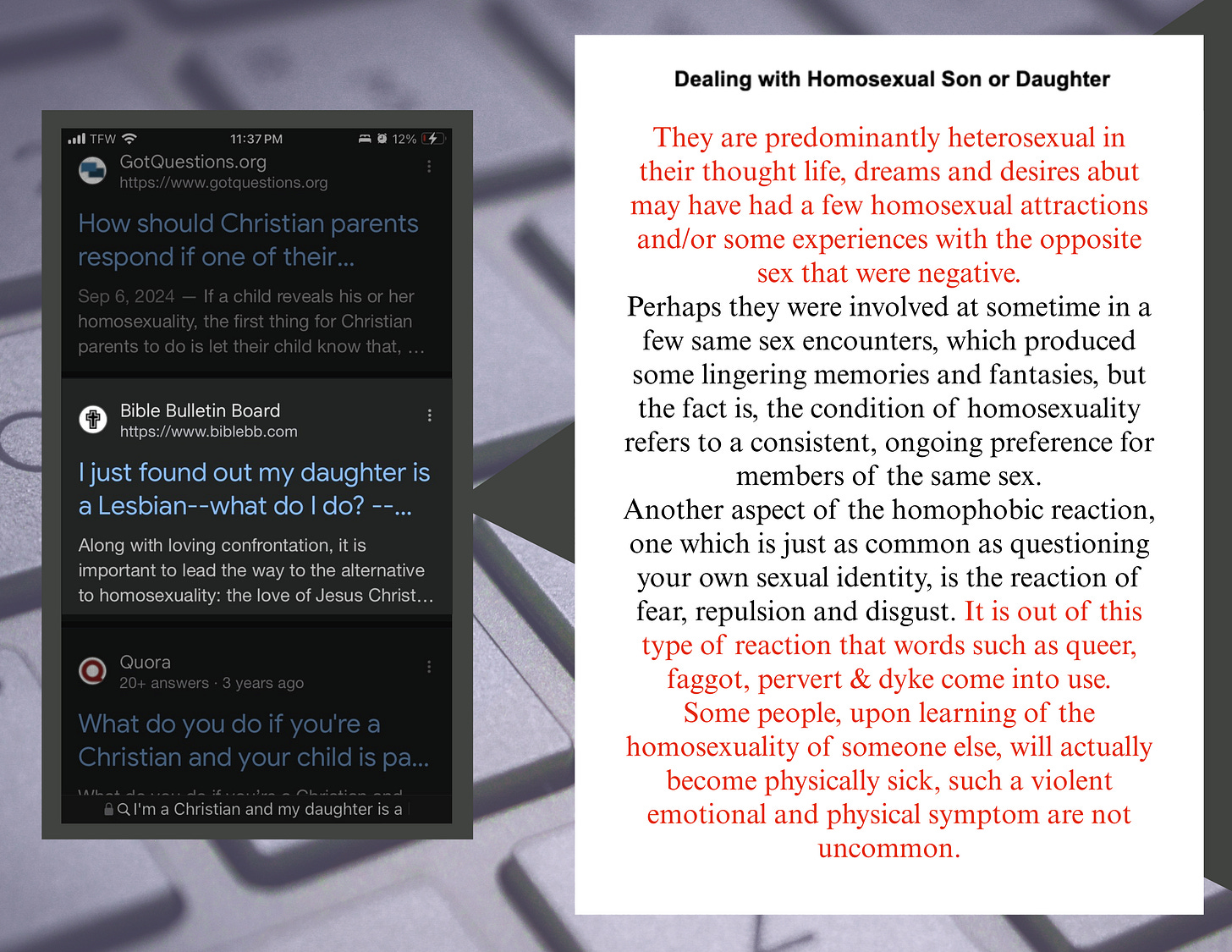
When Brown presses enter, Bible Bulletin Board comes up as the third result, with the suggestion of “offering hope for change,” and “lead[ing] the way to the alternative to homosexuality.” It goes on to explain that “homosexuality is contrary to God’s Word. It is sin and as always results in sin’s destructive effects on the individual and on those close to them.”
In the living room, Brown’s 15-year-old daughter Genna, with her dog on her lap, Googles “accurate information on gay kids and what to do.”
Focus on the Family (FOTF) is the first result. She clicks the link and lands on the platform of a hyper-religious organization known for promoting conversion therapy and labeling her sexuality as sinful.
The site, which presents itself as a reputable religious source, features a tab titled “Understanding Homosexuality” and a section under their resources for “Homosexuality.” It states: “[FOTF] is committed to upholding God’s design for the expression of human sexuality: a husband and wife in a marriage.”
It offers suggested reading on “redemption” from a gay lifestyle, along with 11 counseling resources aimed at changing sexual orientation, including The Alliance for Therapeutic Choice and Scientific Integrity, which guarantees “professional assistance … for persons who experience unwanted homosexual attractions.”
The language is intentionally padded, which means Genna and her mom—and many of the other millions of Christian parents of queer kids—may never know that Google led them to a Southern Poverty Law Center-designated anti-LGBTQ hate group. FOTF is known for its long-standing opposition to LGBTQ rights, for spreading anti-LGBTQ disinformation and for framing homosexuality and transgender identity as sinful and disordered.
Screenshot courtesy of Genna Brown. Photo by Kaoly Gutierrez.
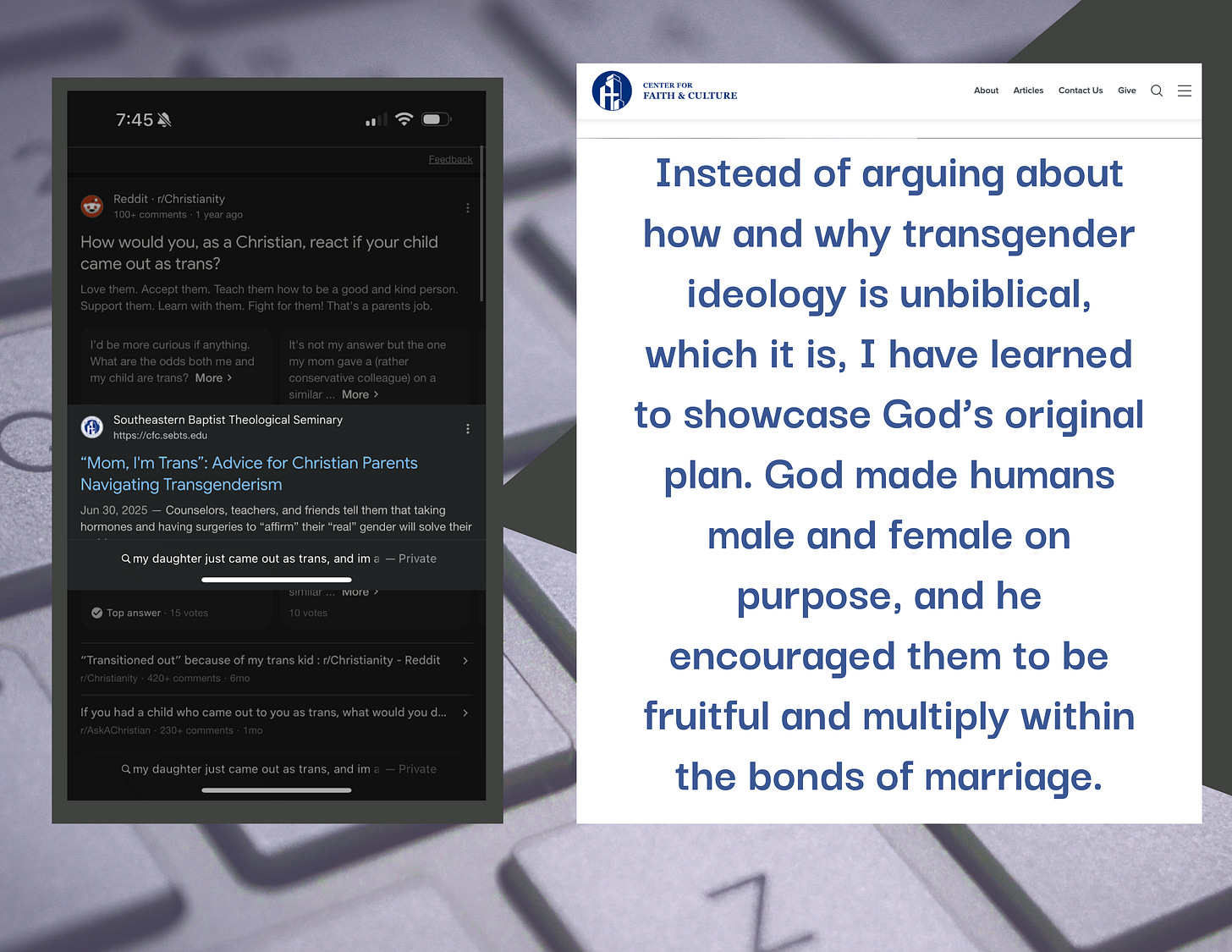
In South Boston, Virginia, Tommy O’Neil Googles, “My daughter just came out as trans and I’m a Christian.” As a father of two, he wants what’s best for his kids. According to Southeastern Baptist Theological Seminary, Google’s second result, O’Neil should recognize that God doesn’t make mistakes when assigning sex and give sympathy for those who are indoctrinated in the “transgender cult.”
Thousands of miles away in Anchorage, Alaska, 38-year-old bisexual woman April Samberg Googles, “I am bisexual and have a husband who is Christian, am I going to hell?”
The third result is once again an article by FOTF that tells April that “same-sex-attracted strugglers” and “transgender and homosexual lust and behavior are wrong.”
In Cincinnati, 44-year-old Mark Just Googles, “accurate information on homosexual kids and what to do.” FOTF is the top search result.
“I don’t feel good about it,” Just told Uncloseted Media. “It’s disturbing because if there are people out there who want to accept and understand their children or loved ones, this is what they’re being pointed to.”
“[I feel] fear for the queer kids with Christian parents who will be seeing that and thinking it’s good advice, and sorrow for the kids with parents who already have,” says Genna Brown, who was a “self-loathing, suicidal kid” who thought God would punish her for being gay before she came out to her now accepting parents. “It’s pretty awful that this is what’s being pushed for advice. This has no doubt harmed people.”
Uncloseted Media also asked folks in Taiwan, Lebanon, China, Hong Kong, Canada and India to Google similar queries. All of them had FOTF turn up as a top search result.
Subscribe
Why Does Google Allow This?
Google, like other search engines, compiles information and directs users to various websites by referencing the titles of web pages that it judges to be most reflective of what was searched.
“Google’s algorithm is notoriously a black box,” says Jesse Ringer, founder of Method and Metric, a search engine optimization (SEO) growth company. “That’s intentional to keep their competitive advantage.”
What we do know is that Google ranks search results by first crawling the web with an automated program called “spiders” to follow links from page to page and collect data.
It uses text matching to identify documents that it thinks are relevant to a query and then ranks them based on a combination of popularity, freshness, location and previous links clicked.
But for people searching for reliable information, its process can be problematic.
“Google doesn’t rank based on accuracy, but on popularity and query matching,” says Dirk Lewandowski, professor of information research and retrieval at the Hamburg University of Applied Sciences. “This is based on clicks and a network of how many other links are directed to this website. … Of course, users click what is shown in the first position. So we have kind of a rich get richer.”
How to Get a High Ranking
As websites with the highest rankings continue to receive more clicks, websites like FOTF can also employ other tactics to keep their prominent placement.
Backlinking—the process of having other web pages hyperlink back to your site—is one of the ways to maintain your high ranking.
“Backlinks are a big part of popularity. So the relationship between other websites linking to this source is a big part of Google’s algorithm,” says Ringer. “There are SEO businesses that build link farms so that the content of their clients can go higher. They create a network effect and they link to each other. It is not unreasonable to think that [FOTF] has hired either an SEO person or they’ve hired an external agency to contribute to that.”
According to Francesca Tripodi, assistant professor at the University of North Carolina School of Information and Library Science, ranking can also be gamed by matching keywords to content. Tripodi looked at the metadata of progressive and conservative companies and found that conservative content creators “are much better at doing this.”
“They are savvy at creating new sets of words and tagging their content with them,” she says. “That’s not something I’m seeing with progressive content creators.”
Tripodi says that not only does conservatism thrive online, it might be the only perspective returned.
Subscribe
“They are well-funded companies with large production budgets and effective digital marketing teams,” she wrote in a 2019 testimony about conservatism and Google searches. “This is why when you search for liberal phrases like ‘gender identity’ or ‘social justice’ the top returns … are conservative content creators.”
Google declined to speak on record with Uncloseted Media for this story.
In an email, a spokesperson said: “Like any search engine, Google indexes the content that’s available on the open web, relying on systems like keyword matching to surface relevant results. We are largely guided by local law when it comes to removing pages from search results.”
What If It’s Harmful or Illegal?
The United States notoriously protects harmful or misleading content—including anti-LGBTQ hate speech—under the First Amendment.
“The situation in [other countries] is a bit different than in America,” Lewandowski says. “For instance, Holocaust denial is illegal in Germany. So Google bans these sites, but they don’t ban them in the U.S.”
Section 230 of the U.S. law protects Americans’ freedom of expression online by implying that we should all be responsible for our own actions and statements on the internet. This law largely takes legal pressure off of Google.
And in 2003, an Oklahoma court ruled that Google’s rankings are subjective opinions and thus constitutionally protected.
Google’s policies for tamping down on harmful content “don’t apply to web results.” Thus, there is little moderation on the web pages that pop up for Americans who use the search engine.
The spokesperson for Google says that “[they] hold themselves to a high standard when it comes to legal requirements to remove pages from Google search results” and that “they don’t remove web results except for child sexual abuse, highly personal information, spam, site owner requests, and valid legal requests.”
But according to the company, “determining whether content is illegal is not always a determination that Google is equipped to make.”
Tripodi says this might be why groups like FOTF are still showing up, even though conversion therapy is illegal in 23 states. She says these groups may have found a loophole in Google’s policy by “tricking” the search engine into thinking they are providing “resources” and not simply a recommendation for conversion therapy.
Subscribe
What Can Google Do to Fix This?
“Google has a responsibility for what is coming up in their results because people trust [them],” says Lewandowski. “They think something is correct or accurate because it is number one in Google.”
Fifteen-year-old Genna Brown is one of the 85% of Americans who feel this way, according to a 2025 study.
“Isn’t the first result typically ranked most credible?” she says. “Because I typically trust the first result more.”
“It’s pretty concerning what comes up when you search for these things,” Ringer says. “There needs to be more done to educate the people who are doing the searches on understanding news and information.”
But vulnerable groups, like LGBTQ kids who are living in households where they are told they are going to hell and parents who are often confused and in crisis themselves, are being led by Google’s algorithm to believe that being queer is wrong.
“1000% yes, these results concern me,” says Genna Brown. “We’re talking about organizations that promote practices like conversion therapy, which is insane. … I wish there was some disclaimer. Like, ‘Google has determined this to be a subjective query. As such, we can’t verify the following results. Proceed with caution.’”
Tripodi says she thinks consumers are responsible for about 20% of the burden by researching and verifying the sources they learn from. But she agrees with Brown in that Google carries an ethical responsibility for the content it chooses to rank and promote.
“As a global corporation that gobbles up all other possibilities for information, Google has a responsibility to ensure that its content is accurate and not harmful,” Tripodi says. “[It’s their job] to ensure that the information that they surface is accurate and reliable because we know people trust that information.”
Uncloseted Media reached out to Focus on the Family, Southeastern Baptist Theological Seminary, and Bible Bulletin Board. They did not respond to our request for comment.
Additional reporting by Sophie Holland and Spencer Macnaughton.
If objective, nonpartisan, rigorous, LGBTQ-focused journalism is important to you, please consider making a tax-deductible donation through our fiscal sponsor, Resource Impact, by clicking this button:
To win, Democrats must inspire the public in a fractured information age, engage meaningfully with the cultural shifts around race, gender, family, and migration, make democracy work despite obstructionists like Manchin and Sinema, and—most critically—deliver tangible results that improve people’s lives.
Kamala Harris pauses while speaking on stage as she concedes the election, at Howard University on November 6, 2024, in Washington, DC.
(Andrew Harnik / Getty Images)
In the aftermath of Kamala Harris’s loss, many pundits and politicians are turning to a familiar scapegoat. Critics like Adam Jentleson, a former aide to senators Harry Reid and John Fetterman, claim that “woke” advocacy groups made Democrats adopt extreme policies and drove voters away from the Democratic Party, sealing Donald Trump’s victory. But the truth is simpler—and more uncomfortable for the Democratic establishment. Despite the noise, voters didn’t reject Harris because of leftist rhetoric or activist slogans. They rejected her because she and her party failed to address the economic pain of working-class voters, who chose change over more of the same.
There’s a generation of Black and brown organizers, often the first in their families to step into positions of power, navigating institutions historically dominated by others. Alongside them are downwardly mobile white millennials, raised with expectations of stability but battered by an economy that delivers none. These activists, working within nonprofits and campaigns, fighting for causes once central to Democratic values, have somehow become scapegoats for the party’s electoral woes.
Why, after every electoral loss, is the left always the scapegoat? It’s easier to blame activists for pushing a progressive agenda than confront the real issue: the Democratic Party has long been shaped by far more powerful forces—corporate interests, lobbyists, and consultants—whose influence has neglected the real crises facing everyday Americans. We see this cycle again and again.
Contrary to establishment narratives, the Democratic leadership has often resisted advocacy organizations pushing for bold reforms on immigration, Big Tech, climate, debt, healthcare, rent, mass incarceration, Palestinian rights, and for policies like the Build Back Better agenda. This tension isn’t just about differing priorities—it reveals the actual balance of forces in the party. Corporate donors on Wall Street and Silicon Valley pour billions into campaigns, shaping agendas to suit their interests.A consultant class reaps millions from flawed strategies and failed candidates yet continues to fail upward, perpetuating a pattern of mediocrity. They, not progressives, are the roadblock preventing Democrats from becoming a populist force that could disrupt the status quo and win back voters of all stripes.
It was these elements within the party that kneecapped the Democrats’ most ambitious efforts to help ordinary Americans. The Biden administration entered with huge plans, notably Build Back Better, which would have delivered immediate relief: expanded child tax credits, free community college, universal child care and pre-K, paid leave, and more. Progressives pushed mightily for Build Back Better to pass. It was centrist obstruction—namely Senators Manchin and Sinema—that blocked those policies. The result was a patchwork of long-term measures like the Inflation Reduction Act and the Bipartisan Infrastructure Deal, whose benefits won’t be felt until 2025 at the earliest, if at all. By failing to pass Build Back Better, Democrats lost the chance to deliver easy-to-understand, tangible economic benefits and solidify their image as the party of working people.
And it was corporate Democrats—particularly lobbyists like Harris’s brother-in-law, former Uber executive Tony West, and David Plouffe—who held the most sway over Harris’s campaign. They advised her to cozy up to ultra-wealthy celebrities, Liz and Dick Cheney, and Mark Cuban, and avoid populist rhetoric that could have distanced her from the corporate elites who dominate the party. In 2024, the biggest spenders in Democratic Party politics weren’t progressives—it was AIPAC, cryptocurrency PACs, and corporate giants like Uber, all of whom poured millions into Democratic campaigns without regard for public opinion or the will of the people.
The Harris campaign’s messaging failed because, while populist economic appeals resonated with voters, the public face of the campaign was discouraged from embracing them. Instead, the focus was on issues like democracy and abortion, which, while important, couldn’t by themselves capture the priorities of working-class voters. In her public remarks and interviews, Harris, drawing on the advice of corporate leaders, frequently adopted a Wall Street–friendly tone that resonated with business interests, even if it alienated many of her core supporters.
It’s easy to forget that in 2020, Democrats saw historic turnout, driven largely by young voters who were energized by the largest left-wing and Black freedom protests since the 1960s. Biden won, and Democrats seemed to capture the nation’s hunger for justice and change, even as protesters marched with polarizing slogans like “Defund the Police.” Despite the controversy surrounding these messages, Biden triumphed decisively, calling for racial justice. The energy in the streets reflected a moment of possibility, a vision that real change was within reach. But by 2024, that grassroots energy had dissipated, and the Biden-Harris administration did little to revive it.
The loss of energy that Biden and Harris presided over showed up in youth turnout, which dropped to 42 percent in 2024, down from 50 percent in 2020 and closer to 2016 levels. However, battleground states saw higher youth turnout, around 50 percent. Young voters favored Harris over Trump by four points (51 percent to 47 percent), a sharp decline from Biden’s 25-point lead in 2020. The administration’s failure to offer a compelling narrative or deliver meaningful economic reforms alienated many young voters, especially on issues like unconditional weapons transfers to Israel.Trump capitalized on this vacuum with false promises and an anti-war message. Meanwhile, young workers, hit hardest by inflation and stagnant wages, saw little relief from the administration’s policies, leaving them feeling unseen and unmotivated. The simplest explanation may be the most accurate: after four years in opposition, Democrats under Biden had no plan for countering centrist obstruction from Manchin and Sinema. Nor did they have a clear strategy for transitioning to a new candidate, as Biden once suggested, or supporting a contested 2024 primary.
This disconnect was made worse by the administration’s lackluster communication strategy. Biden has avoided the media more than any modern president. In contrast, Mexico’s President Andrés Manuel López Obrador (AMLO) dominated the narrative with daily, three-hour, entertaining, and combative press conferences that have earned him one of the largest YouTube followings in Mexico. AMLO’s approach to the attention economy helped his party to secure another presidential term, defying global anti-incumbent trends.
Biden and Harris’s reluctance to embrace what some Democratic elites might view as “tasteless” or “uncouth” populist appeals allowed their opponents to seize the public’s attention, creating a void that ultimately drained the administration of the energy and momentum it once had. Trump’s simple, emotionally charged narrative about fixing the economy, winding down foreign wars, restoring order, and protecting “traditional” American values may have been filled with bigotry and lies. But it commanded the public discourse, pushing the Biden-Harris administration off center stage.
It’s true that some younger leftists embrace purity politics. But as Semafor’s Benjy Sarlin points out, the most polarizing moments in recent Democratic campaigns—like Beto O’Rourke’s “Hell yes” remark on gun confiscation or Julián Castro’s call to decriminalize border crossings during the 2020 primaries—were driven by the candidates themselves, not external activist pressure. Why did Kamala Harris take the positions she did in 2019? Because she was trying to distinguish herself in a crowded Democratic primary, where Bernie Sanders and Elizabeth Warren were surging and Biden seemed to have the center locked down. Ultimately, these moves were about gaining media attention in a competitive primary, not a direct result of pressure from advocacy groups—many of which, like Sunrise Movement, Working Families Party, and Justice Democrats, with which I was affiliated, have spent years working within the system to create lasting change and deliver real policy results that resonate with voters
The backlash against “wokeness” often rests on vague critiques, offering little more than cultural hand-wringing without any clear solutions. And when those solutions do emerge, they’re often morally indefensible. Jentleson’s criticism of progressive advocacy groups rings especially hollow when you consider the track record of his own political mentors. In 2010, his former boss, Harry Reid, publicly opposed the “Ground Zero mosque,” a proposed Islamic cultural center near the World Trade Center. While technically acknowledging the developers’ rights, Reid capitulated to Republican culture wars by suggesting Muslim Americans build the mosque elsewhere. This wasn’t a principled stance—it was a political maneuver that lent legitimacy to Islamophobia, feeding into narratives from figures like Sarah Palin and Newt Gingrich, who compared the center to a Nazi building next to the Holocaust Museum. In doing so, Reid allowed bigotry to flourish, leaving a vulnerable community to bear the brunt of political scapegoating.
From asylum seekers to transgender rights, today’s debates mirror the “Ground Zero mosque” controversy. From 2017 to 2020, Democrats, including Harris, were eager to condemn Trump’s cruel immigration policies. Now, however, they seem more focused on dodging the topic altogether. These are issues demanding a new approach, one that emphasizes year-round persuasion and agenda-setting over political convenience. Thermostatic public opinion might be a reality of politics, but voters appreciate when you stand for something with conviction and authenticity.
This is where movements and parties work best together: movements push the boundaries of what’s possible, creating the political space to reframe issues like transgender rights and immigration in majoritarian terms, and politicians follow when the political weather aligns with their self-interest. These two sides will clash, but it’s in that tension that progress lies.
Democrats can’t be scared of that process. They must stop ceding the narrative to far-right framing and instead invest in populist campaigns that aren’t afraid to antagonize villains, highlight the humanity of marginalized communities, and expose the Republican Party’s divide-and-conquer tactics. Only then can they build the political power necessary to shift the conversation and secure real change.
Anyone who knows me knows I’m critical of the academic jargon and misguided tactics that sometimes dominate activist circles. But to blame activists for the party’s struggles is to overlook the much larger battles they’re engaged in: 11 million undocumented Americans left in limbo, a prison system that incarcerates more people than any other in history, and an economy where three people hold more wealth than the bottom half of the country. These are the moral tests of our time—tests that any party claiming to stand for justice will be judged by. Scapegoating those pushing for change isn’t just unfair; it’s counterproductive, fracturing necessary coalitions and undermining the ability of the party to tackle the crises ahead.
Harris’s defeat should prompt serious introspection for Democrats—but not the narrow, one-sided critique Jentleson offers. Everyone, including progressive advocacy groups, has lessons to learn. The path forward isn’t about hippie-punching—it never has been. Time and again, the center-left’s response to electoral defeat has been to blame the unpopular and disruptive activists pushing for progress, whether abolitionists, suffragettes, labor unions, civil rights leaders, or environmentalists.
History reveals that oversimplified approaches often sidestep the harder questions. Success doesn’t come from rejecting the complexity of a diverse coalition but from learning to navigate it. To win, Democrats must inspire the public in a fractured information age, engage meaningfully with the cultural shifts around race, gender, family, and migration, make democracy work despite obstructionists like Manchin and Sinema, and—most critically—deliver tangible results that improve people’s lives.And if the corporate, status quo–loving forces within the party are standing in the way of that mission, they must be moved aside.
Success will come not by pointing fingers but by telling a story of transformation—with clear villains, bold vision, and conviction that democracy can, indeed, make a difference.
This article is long but worth the read. This expert refuses to talk to trans people and has never treated a trans person. His knowledge is from what he believes to be true color by his biases, so he also ignores the views of the majority of medical societies opinions and views. The so called expert refuses to accept that anyone at any age felt they were trans without someone putting the idea in their head someway. To him it is not natural so it can’t exist. He thinks being gay is wanting to be the other sex, so a gay male wants to be female and he questions if they can be any happier as the other sex. And he is a gay man himself. This is who the anti-trans Christian haters hire to lie about trans issues so that they have cover to make bans on needed gender-affirming medical care. Plus he is a real prima donna wanting the center stage and being the star. Hugs
No. See? It’s not either one. The tiny fraction of repris- One in tens of thousands who, at this point, kind of essentially born gay, but so gay, they really are happier living as the other sex. Won’t know it until later in life, but they exist.
No 8-year-old ever said that. Eight-year-olds repeat what they’re told, and what they are getting told are from activists. It’s not credible to say that all of this existed, this was so extreme and obvious, and nobody ever noticed it, including the experts doing the research on it who could have gone either way. But everybody all of a sudden noticed it at exactly the same time when smartphones got invented and hit 15 percent. That’s just a coincidence that the demographic who is doing this the most are exactly the same demographic most given to other social contagion issues. Usually young adolescent females, the same group most likely to report suicidality. Not actual suicide, but suicidality. Most likely to report eating disorders. Most likely to dislike their bodies. All sheer coincidence!
But what about so there’s 8-year-olds can’t say that? Sure, I understand that argument. But there’s 14-year-olds, 17-year-olds, 25-year-olds, 40-year-olds. There are people of every single age.
JC:Find me one who didn’t get it from the website.
SM: Who didn’t get being transgender from a website?
JC: Ah ah ah.The “my rights, you’re hurting us,” the “suicide.” Verbatim they are all saying the same thing. None of these are their words. These are words that they’re repeating because of everybody else in their social group.
SM: I want to be clear, because I want to make sure we characterize everything accurately. Do you believe that all transgender people are trans due to social contagion?
JC: No.
SM:. So you believe a lot of people are born trans and feel that way from birth?
JC:
SM: But you said one in 10,000—
JC:We also have a cluster who, until they’re in their 40s or 50s, are just turned on by the idea of being female. They’re attracted to women. They’re not gay. They’re always men. So we have one in tens of thousands and one in tens of thousands. And then we have this 5% of the entire population which came out of nowhere when smartphones were invented. They are dominating the conversation. They, except for one in ten thousand, they are not trans. They just hate their own bodies and here’s a narrative that’s close enough that says, “It’s not me, it’s everybody else on the planet and somebody else, no effort to me, I just have to lie there, the doctor will come and fix me. It’s not that I have issues to work on because I hate my body.” Taking the easy way out.
Editor’s note: This interview was originally conducted on August 7, 2024.
James Cantor is a Canadian psychologist and sexologist who has been hired by Alliance Defending Freedom—a Southern Poverty Law Center-designated anti-LGBTQ hate group—and by Republican states to serve as an expert witness in defense of laws that ban or restrict gender-affirming health care.
Last year, Uncloseted Media interviewed Cantor for a larger investigation into expert medical witnesses paid to defend restrictions on trans kids’ access to health care.
Since then, attacks on gender-affirming care have escalated—121 anti-trans bills have been passed in state legislatures this year and a recent Supreme Court decision upheld the constitutionality of bans on gender-affirming health care for minors nationwide. Cantor, who has never treated a trans kid and whose primary research centers around pedophilia, kink and BDSM, has had his expertise called into question by some judges.
Despite this, he’s remained active since we published our article, testifying in support of gender-affirming care bans in South Carolina and North Dakota. And while Cantor didn’t speak at the Supreme Court, his expert testimonies were cited by the defendants.
Since Cantor continues to influence trans health care policy in the U.S., we decided to share a longer cut of our interview to provide more context on one of the most prolific faces in the fight over trans health care.
Watch the full interview above or read the transcript here:
Spencer Macnaughton: Tell me how you came to know Alliance Defending Freedom. How did they get to you? Or did you get to them?
James Cantor: No, they came to me. I never, in any of these controversies that I’ve been [in]—this is, I guess, the biggest one now. But I’m a sex researcher, I’ve been through several controversies.
SM: Sure.
JC: They came to me. In 2018, I guess it was, the American Academy of Pediatrics came out with a policy, essentially saying, “Do whatever the kid wants.” And I’m just reading and reading. As I went, I [knew] these papers he’s citing. This isn’t what they say. So all I did is take the policy and go through the reference list, every single one, and say, “This is what you said they said,” and then I quoted them directly. Here they are saying the opposite.Just, again, because somebody who obviously doesn’t know this field was grossly misrepresenting the science of it.
SM: So then how did they find you? Because you’re in Canada.
JC: So I published that paper as a peer-reviewed study. So when the Alliance Defending Freedom had its first couple of lawsuits on the topic, they, of course, in any issue like this, need experts to testify to what the content of the science was. They were already working with Stephen Levine, very, very well-established and well known in my field. And so he suggested to ADF, “There’s this guy who always follows the science no matter what and isn’t afraid of the politics.” So then they came to me. We did our first case together. Josephson, freedom of speech case, essentially was a professor who said what a bunch of activists didn’t want to hear. He got disciplined for it. He didn’t let them get away with it. He started his lawsuit challenging his treatment. That was the first one. Then when they say, “Oh, this guy knows how to talk.” So it was networking since then.
SM: And do you actually go? Do you zoom in or do you go? How many cases have you worked with them on?
JC: For them, just that one. All the others, I’ve been hired by the state directly. As I say, it’s really just kind of networking amongst those, and there are not many people willing to do it at all.
SM: Did they like you because of the expert testimony you gave for Alliance Defending Freedom and then they would find you? Cause it’s random to me that you’re from Canada being thrown into the mix in all these states. Is it not or no?
JC: Oh, no, not really. It’s just there are very, very few people able to talk about this and have a mastery of the science at all. But yes, so the Canadian thing really just doesn’t matter. [I’m] just a person who is well spoken, can get an idea across under pressure on the stand, [I have] experience at it. And the state AG offices are networked together in a bunch of different ways and they often have similar kinds of cases. This person knows that person who knows the other person. They’re always looking for experts for whatever their cases are. So when they start looking for someone, I was one of the first people with a peer reviewed paper on the topic. So that very quickly put me on their radar screen. And then it’s just case after case. The ADF—again, although they only hired me for that one case—they also hold events and conferences and so on. And this is one of the topics where they asked me to speak. And so many people from many offices in conservative states are also attending. So when they get a case [they think,] “Oh, I saw this guy who…”
SM: Okay, so the AG offices could go to a conference that the ADF puts on, Dr. Cantor speaks, the AG office says, “I like that,” they reach out and then could have you testify in their state. But it’s the AG officers, with that exception of the one, that would be the ones reaching out to you.
JC: Yes, exactly. So the ADF are assisting with networking like any group. They’re politically conservative. But like any other group, including the ACLU on the other side, sponsor conferences and people network. And so when they need somebody on whatever topical issue like this one, they assist the networking. But they don’t have any direct financial or other connection.
SM: How much do you get paid? How much do they pay you for that?
JC: Same as experts on the other side, 400 an hour U.S.
SM: And they pay for all flights and everything, obviously that would be paid for?
JC: Yeah, the state, yes. That’s part of their usual expert budget.
SM: And how many hours would you spend on a case typically?
JC: Uh, generally anywhere between 15 and 80.
SM: Can you make a salary off it?
JC: It’s ended up pretty much that way for me, which was an unexpected surprise.
SM: Like over 150?
JC: It varies year by year, but somewhere around there per year. But I wouldn’t call it… Again, it’s just dumb luck on my part. I’m towards the end of my career. I’m within five, six years of retiring. So I don’t have a lot to lose. As I say, this was not a plan. It just kinda happened.
SM: What’s your experience treating trans kids? Like how many have [you treated?] I’m assuming, [because] you’ve taught like you’ve treated dozens.
JC: No, I don’t treat kids at all. I’m a sex therapist. If you wanna know if whatever procedure works, you can’t ask the people who use the procedure. Easiest to understand by analogy: You will never find out if astrology works if you only ask the astrologers. If you want to know if Childhood Transition works, you can’t ask the people whose careers and practices depend on the answer being yes. You’re just going to get yes!
SM: Do you talk to kids? I’m assuming you at least talk to trans kids to learn their perspective a little bit given your expert testimony on all these cases. Like do you sit down with them? Do you try and learn—
JC: No.
SM: From them to learn about their—no?
JC: Nope.
SM: Why not?
JC: Because that is exactly the source of bias.
SM: To learn from the people who… I would disagree with that. Don’t you want to learn from the people you’re speaking on?
JC: I learn from the research about the people. An 8-year-old telling me that they were born in the wrong body? They didn’t come up with that themselves. They were told that narrative as a way to help understand themselves. What I am hearing is the accumulation of what the 8-year-old has been told.
SM: So your strategy is literally actually the opposite. Don’t talk. It’s important not to talk to trans kids about it?
JC: Along those lines. Again, it’s because the exception is really easy to exaggerate on the other side. Either side can, at least in theory, be correct. But people are taking, as the definition of expert, the one who has spoken to the most 8-year-olds, but da-da-da. They can color the picture, they can be compelling narratives, they can provide ideas for things to do research on. But the answer is going to come from the neutral, can go either way, does not have an emotional investment in what’s going on. It’s, “What would Mr. Spock say?”
SM: There’s a whole narrative from one subset of the media, mainly the right media, they’ll say, “Transgenderism, it doesn’t exist,” that kind of thing. So do you believe that transgender people exist?
JC: Again, it’s a bit of a loaded question. In the way that they’re saying it as a phenomenon doesn’t exist, that’s a bit of an overstatement. But the very concrete way the opposite extreme is discussing it isn’t exactly true either. You can’t prove things don’t exist. You can only fail to find evidence that it does exist.
SM: Do you believe that it should exist? Would our world be better off if we just didn’t have trans people?
JC: I don’t know if there is a way to answer that question.
SM: Alliance Defending Freedom’s background is alarming, not just for trans stuff but for gay issues, right? The guy who founded it coined a book called The Homosexual Agenda. They passed laws against gay marriage, against gays in the military. They’ve gone to Africa, to Eastern Europe, to promote laws against the entire umbrella of the LGBTQ community. Why affiliate yourself with a group like that, especially as an openly gay man?
JC: That’s an excellent question. First, the way they came to me was exactly the right way. Hand extended, “Dr. Cantor, we disagree probably on every single other issue but this one, but we can work together on this one.” That’s what a liberal is supposed to say. If they’re willing to overlook and work with the gay Jew, who’s the bad guy if I’m saying, “No, I’m sorry, your religious views, I won’t tolerate.” The shoe was on the other foot. I am willing to work with people I disagree with on the other issues. We will be on the opposite side on that issue. We will be on the same side on this issue. So if anybody ever, for any issue asks, “Why is Cantor on whatever side,” there’s gonna be a stack of science behind it.
SM: You mentioned earlier that we shouldn’t be listening to people who are getting paid to have their livelihood like pediatricians make these decisions, right?
JC: That’s standard medical ethics, it’s in every conflict of interest policy, including the associations who have disregarded their own conflict of interest.
SM: Right. But you’re getting paid almost $150,000 to argue against it. So isn’t that the same thing?
JC: No, as I said, that’s what I was saying, has been the same for 20 years. Now it’s associated with money for me to say—
SM: Right, but your argument is that we shouldn’t be listening to those people, but you’re still getting paid to make the argument.
JC:I’ve been expressing these issues for no money in my original paper before any of these laws, never mind lawsuits, existed. It was just the money and the cases came because of the opinion I had already expressed rather than the other way around. And then, I developed an opinion that was convenient because it was marketable. I gave it away for free. Really at this point, my plan for the money was that there would be a couple of cases for a little while so I could take a couple months off afterwards to do the writing that I don’t get to do as much as I used to. That was the plan. Then when there was this flood of cases, I don’t have time to do that and that’s when I mostly shut down my private practice.
SM: Marketable is an interesting word. What do you think makes your opinion so marketable?
JC: A combination of things. One is just my knowledge of science. Their Jedi mind tricks don’t work on me. A lot of lawyers’ questions are loaded questions or come down to people’s fundamental understanding or misunderstanding of science. And because I have a mastery of it, their subtle illogic that other people would not notice or let slide don’t affect me. I’m able to correct it. And part of it, I’m just a natural communicator. I’m good with audiences. I don’t mind being on stage. My adrenaline, let’s say, is under control.
SM: I bet you could bring it in a courtroom.
JC: I look like an expert.
SM: Right, what do you mean you look like an expert?
JC: They tell me that. I just have the right amount of age, gray hair, bit of an accent. I look like an expert. Ohio, oh, they just announced we won the Ohio case. There was a television camera for the news back here and then the courtrooms up here. The next day on social media, all I kept hearing was what a good hair day I was having.
SM: Do you like the feeling of, it feels like a star a little bit, maybe?
JC: I was president of the RPI Players when I was an undergrad. I’ve always enjoyed theater. If I could sing, I’d be on Broadway. So no, I do enjoy a stage. I do enjoy the media. If I could wave a wand, my real career goal was to be the Carl Sagan of sex.
Subscribe for LGBTQ-focused, accountability journalism.
Subscribe
SM: Oh, wow. Okay. And when you go to the courtroom, do you crank it up a little bit? Like, what do you do to kind of bring it in the courtroom?
JC: It’s a subtle part to be cast in, in that overdoing it, the overacting doesn’t help. I have be in character as Dr. Cantor.
SM: Hmm, okay.
JC: So clear, succinct, direct, confident, but not overdoing it either. Not effusive. The hardest part for me is suppressing jokes. I become the Lord of the pith.
SM: Ooh, what does that mean?
JC: Oh, pithy, short, succinct, and I am indeed much more oriented towards being pithy. To get the idea across in a concrete way that gives people the “aha!” Even if they don’t agree with me, they understand what I am thinking and saying. For example, one of the ones that came together in my head relatively recently when you were asking before about what boils down to conflict of interest. I started out by explaining the relevant policies, what’s in it, what’s not in it, why they are the way they are, all of which was absolutely true. And after reading a couple of pages, people went, “Oh, okay.” But when it hit me to say, “You can’t find out if astrology is real by just asking astrologers,” that’s when people went, “Oh, duh! Of course!”
SM: There was obviously a theater kid in you when you were younger. Is this kind of, it feels camp a little bit, going into American courtrooms and kind of like testifying. Is there a part of that that it’s a bit of fulfilling a dream in that respect?
JC: In an unexpected way. It wasn’t a dream in a way that I ever went, “I wish I could.” If anything, it was the opposite. I don’t know about fun, but I enjoyed the challenge and it was a very, very different kind of a thing to do. But being the, loud mouthed New Yorker theater queen that I am, oh, that’s another one of the jokes I used. Whenever they set up a deposition for me, I always kind of have to say, “I’m the most deposed queen in the world.” The first time I was going in court, we were just laughing. Oh, I’ve forgotten her name. My Cousin Vinny. Right, when she comes in, big New York accent.
SM: Yes.
JC: So we replayed that in my head a lot. And the more recent one, do you watch Schmigadoon?
SM: No.
JC: She was in Ally McBeal. She played the lawyer and she comes down in a trapeze and she’s now doing the bells and whistles is the performance she’s giving in the courtroom.
SM: And you felt like her a little bit, like Ally?
JC: “Felt like her.” It was just teasing about a performer on stage, enjoying an audience. And here I’m doing it in a courtroom. So I’m not afraid of it. I’m not intimidated by it. Where most scientists are not like that.
SM: How many trans-related cases in the U.S. have you testified for as expert witness? There was the one with ADF and then how many from their respective states?
JC: I could send you the whole list, it’s about 30-ish.
SM: When you speak for ADF, how much do they pay you? If I can ask.
JC: Oh, it’s not paid to me. It’s like a conference presentation to bring together lawyers, you know, on similar sides.
SM: What’s the biggest one you’ve ever spoken at? Like, how many people go to these things?
JC: The largest ADF one was their Summit, they call it. I guess that was 500-ish?
SM: They’re obviously a legal behemoth, right? So they know what’s up when it comes to the law. What kind of legal tips and tricks do they give you before you go in and Ally McBeal testify?
JC: The particular person that they had me working with is the Yoda to my Ben Kenobi. He has been absolutely wonderful to work with. His training, his knowledge of the strategizing and of the performance aspects in court have been—his advice has been dead on from the beginning.
SM: What are the best points of advice?
JC: It’s really more about his description of the points of view of the several different audiences. The judge, the jury, the other officers, the experts on the other side, and the mindset I need to be in in testimony, in the different kinds of testimony at the different phases of the case. For example, before anything goes to trial, each expert gets deposed. The point is, and it’s a full day, eight hour day, where the lawyers for the other side get to ask you whatever they want for eight hours. And the way that my trainer was explaining that to me was to help me appreciate that I’m not going to counter-argue. There’s no point to it. There’s nobody to convince. There’s no audience here. The judge isn’t going to see or read every word of it. The judge is only going to the parts the other side wants them to see. So a deposition is the portion at which I can lose ground, but not gain any. So once I was aware that, oh, okay, so this is deflecting. This is not counter-attacking. This isn’t making my argument. This is my defending my argument or, what it largely came out to be, untwisting their trick questions. So even if they weren’t testing me, they come out of it with, “Nothing’s gonna work on this guy.” And then the other one for a lot of the cases, the mindset he described to me was the judge is never going to be an expert on this.
It’s not the judge’s job to be an expert on this, and usually it just boils down to experts on the one side, experts on the other side, and everybody else knows they don’t know. So really the job is [to] tie myself up with dynamite and throw myself on the other expert and neutralize us both.
SM: What does that mean?
JC: It’s really probably not going to happen, that the judge listens to me and decides, “Oh, that’s the scientifically superior argument.” That’s not what happens. In a lot of ways, my favorite part of it is rebutting the arguments of the other side. Here’s what they said, here’s what the citation they’re referring to actually says, oh gosh, it’s the opposite. From the judge’s point of view, it’s just expert versus expert. It’s a mutually assured destruction. They destroy each other. And then from the judge’s point of view, let’s just get back to the legal issue.
SM: Right, because the judge isn’t necessarily going to be able to infer what’s methodologically sound evidence-based research versus what’s not.
JC: Typically not on their own.
SM: What would you say to the many many trans kids and their families across the United States who say, “You’re hurting us, you are hurting us, this is essential care, we need this.”
JC: No 8-year-old ever said that. Eight-year-olds repeat what they’re told, and what they are getting told are from activists. It’s not credible to say that all of this existed, this was so extreme and obvious, and nobody ever noticed it, including the experts doing the research on it who could have gone either way. But everybody all of a sudden noticed it at exactly the same time when smartphones got invented and hit 15 percent. That’s just a coincidence that the demographic who is doing this the most are exactly the same demographic most given to other social contagion issues. Usually young adolescent females, the same group most likely to report suicidality. Not actual suicide, but suicidality. Most likely to report eating disorders. Most likely to dislike their bodies. All sheer coincidence!
SM: But what about so there’s 8-year-olds can’t say that? Sure, I understand that argument. But there’s 14-year-olds, 17-year-olds, 25-year-olds, 40-year-olds. There are people of every single age.
JC: Find me one who didn’t get it from the website.
SM: Who didn’t get being transgender from a website?
JC: Ah ah ah.The “my rights, you’re hurting us,” the “suicide.” Verbatim they are all saying the same thing. None of these are their words. These are words that they’re repeating because of everybody else in their social group.
SM: I want to be clear, because I want to make sure we characterize everything accurately. Do you believe that all transgender people are trans due to social contagion?
JC: No.
SM:. So you believe a lot of people are born trans and feel that way from birth?
JC:
SM: But you said one in 10,000—
JC: We also have a cluster who, until they’re in their 40s or 50s, are just turned on by the idea of being female. They’re attracted to women. They’re not gay. They’re always men. So we have one in tens of thousands and one in tens of thousands. And then we have this 5% of the entire population which came out of nowhere when smartphones were invented. They are dominating the conversation. They, except for one in ten thousand, they are not trans. They just hate their own bodies and here’s a narrative that’s close enough that says, “It’s not me, it’s everybody else on the planet and somebody else, no effort to me, I just have to lie there, the doctor will come and fix me. It’s not that I have issues to work on because I hate my body.” Taking the easy way out.
Why would Donald Trump talk about becoming an American dictator…again?
NBC News reporter: Before signing a series of executive orders aimed at reducing crime in D.C. and across the nation, Trump referred to his critics bashing him for sending the National Guard to D.C., claiming that some people think they might “like a dictator.”
Referring to militarizing our cities, Trump said, “They say, ‘We don’t need him, freedom freedom. He’s a dictator. He’s a dictator.’ A lot of people are saying, ‘Maybe we like a dictator’…You send in troops, and instead of being praised they’re saying you’re trying to take over the republic. These people are sick.”
Before the election, Trump talked about “deleting” parts of the Constitution he doesn’t like. Then, he talked about becoming a dictator for one day. Now, he says some people in this country want a dictator, but to whom is he referring to that would be that dictator? I think we all know the answer. The dictator talk is so disturbing that everyone missed that part where he whines that he’s not being praised. (snip-MORE; go read it!)
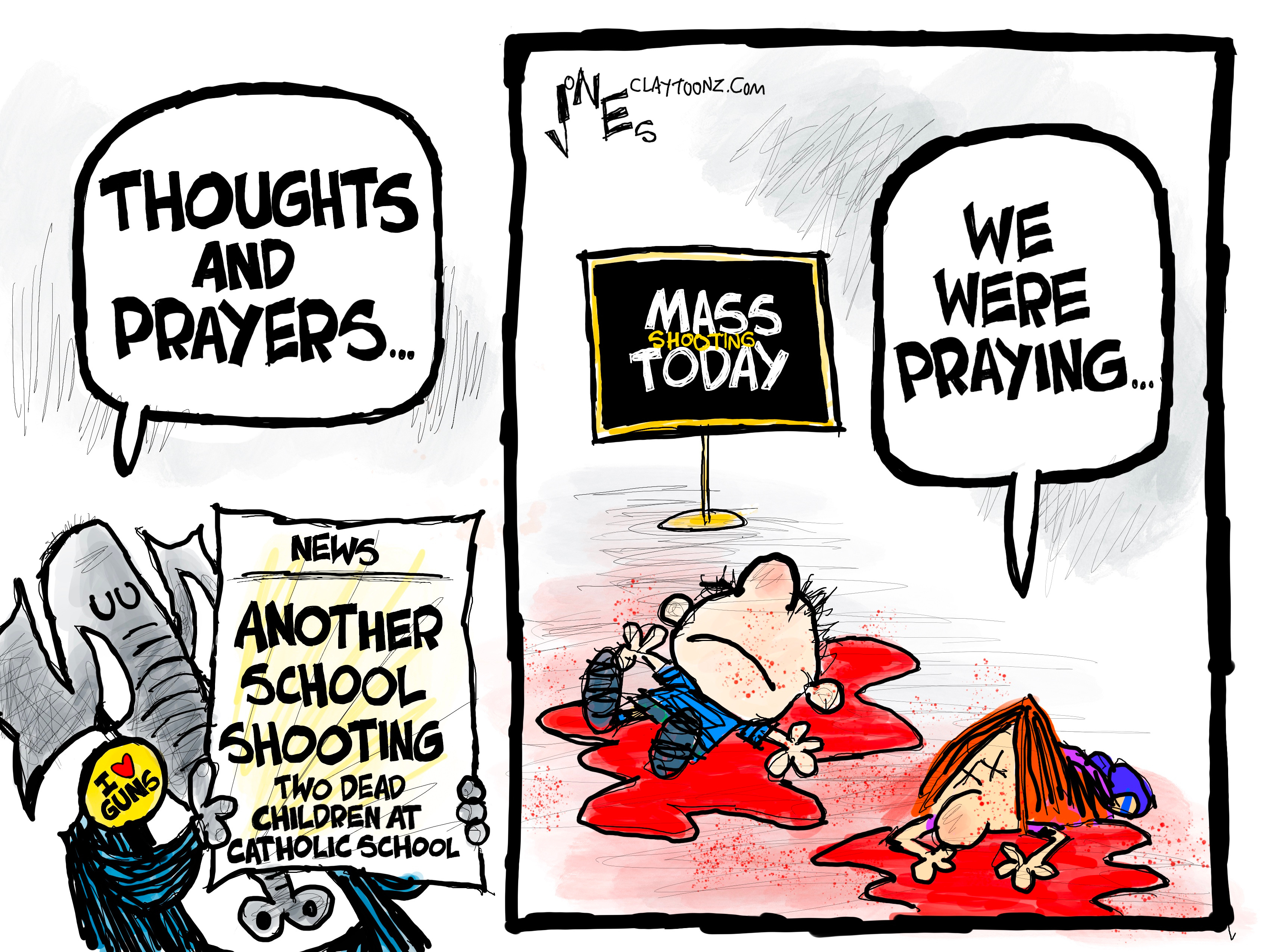
(The money graf: “Even the shooter offered “thoughts and prayers” to the intended victims. So, quite frankly, every single Republican’s answer to this isn’t any better than the shooter’s solution.”)
Another mass shooting and another opportunity for Republicans to give us empty thoughts and prayers instead of real solutions. You can’t find a solution when you can’t even identify the problem.
Today’s mass shooting just so happened to take place during a Mass.
An 8-year-old and a 10-year-old were killed while sitting in pews during a Mass at the Annunciation Church in Minneapolis, Minnesota. At least 17 people have been injured. The students were from the adjacent Annunciation Catholic School.
Robin Westman, a 23-year-old, has been identified as the shooter and shot through the windows from outside the church. Westman identified as a woman and had changed her name from Robert to Robin. The right-wing fucknuts are going to love this, but they’ll ignore the parts about the mental issues and racism.
The shooter left a manifesto that called for the destruction of Israel and included racist slurs. Westman flashed a white supremacy sign in a video that showed the shooter’s massive gun collection. The shooter admired those responsible for the massacres at Sandy Hook Elementary School, the Tree of Life Synagogue in Pittsburgh, and the mosque shootings in Christchurch, New Zealand, among others. (snip-MORE, and it’s good info)
There’s a saying in the legal system that a good prosecutor can get a grand jury to indict a ham sandwich. It’s a criticism of the prosecutorial system because a prosecutor has near-total control of the evidence presented to a grand jury, the defense is not present, and the jury only has to be convinced a crime was committed without a real burden of proof, and on the flimsiest charges.
On Tuesday, a grand jury in Washington, DC, refused to indict Sean Charles Dunn, who is accused of throwing a Subway sandwich at a Border Patrol agent. This is a huge loss for US Attorney Jeanine Pirro, who was hired only because Donald Trump liked the way she looked on Fox News. She’s very hateful and always outraged. This is also a failure for Attorney General Pam Bondi, who declared the sandwich attack was part of the “deep state.
I don’t think we have to worry about a “deep state” if the worst they can do is throw sandwiches at cops.
Anyone charged with a federal felony must be indicted by a grand jury. The problem for Trump’s regime is that the voters in Washington, DC, are some of the most intelligent, most educated, and most aware of the issues. These are not West Virginia voters. You would think that if you wanted to indict someone with a felony, you wouldn’t call a grand jury while the city is occupied by the military.
You would think that with the government’s reaction to the sandwich attack, the accused had used one of the weapons used to murder children at a Catholic Church in Minneapolis this week. The Trump regime and Republicans have more outrage over an assault by a sandwich than outrage over a school shooting. (snip-MORE if you can handle it)
Celeste Yim, the first out nonbinary writer for Saturday Night Live, announced they are leaving the show this week after five years.
Yim, who was hired as an SNL staff writer in 2020 and promoted to writing supervisor in 2023, announced their decision to leave the show after its 50th season in an Instagram post late Sunday night.
“Lorne [Michaels] hired me over the phone when I was 23 and the job literally made all of my dreams come true BUT it was also grueling and I slept in my office every week BUT my friends helped me with everything BUT I got yelled at by random famous men BUT some famous girls too BUT I loved it and I laughed every day and it’s where I grew up,” Yim wrote in the post.
(snip-embedded Instagram on the page)
“I hate when other people say this but it’s true that I was the first ever out trans person to be a writer for SNL,” the scribe wrote. “I always felt honored to be working within the long tradition of queer writing at the show,” Yim added, joking that “Chevy [Chase] is nonbinary!” (Chase was a cast member and hosted Weekend Update in the first season of the long-running series.) Yim also vowed to keep writing comedy in the face of anti-trans oppression. “I feel so powerless to protect trans people in the world but writing connects us and makes us permanent, so it’s what I will continue to do,” they wrote.
“Thank you Bowen for changing my life and for making me feel normal,” Yim wrote on Instagram this week. (Yim also recently wrote for Yang and Matt Rogers’ Las Culturistas Awards, held earlier this month.) Their statement also thanked “every SNL assistant and production crew member who ever made any part of anything I ever wrote.”
Yim’s time on SNL saw an influx of queer and nonbinary cast members like Molly Kearney and Punkie Johnson, both of whom have since left the show. At the same time, SNL also earned backlash from LGBTQ+ viewers by inviting hosts like Shane Gillis and Dave Chappelle, both of whom have made homophobic and transphobic comments on stage; when Chappelle hosted SNL in 2022, a nonbinary writer — widely believed, but not confirmed, to be Yim — asked to sit out for the week, after which Chappelle made a joke calling the writer “a they” during dress rehearsal (which did not appear in the final show).
“Thank you to my family and friends who love me still even though I did not see them very much,” Yim wrote in their departure announcement. “And thank you all for your support. For writing to me and for wearing my sketches as Halloween costumes. […] I try to imagine my younger self learning about me. I would be amazed. But then I’d be like…Wait, why are you dressed like that…”
Yim’s comments were full of current and former SNL cast members and writers expressing wholehearted support, including Yang, Ego Nwodim, and Jane Wickline, as well as non-SNL celebs like Padma Lakshmi, Jeremy O. Harris, and Ziwe.
“My baby,” cast member (and L’Eggs icon) Aidy Bryant wrote simply, summing it up.
After all, George Washington and all were just regular people before they became part of the government. It really is up to all of us. If you click the article title just below this, all the embeds are there. This is from The Root.
From where you stand, it may look like you’re just watching unimaginable stuff go down, and nobody’s stepping in to stop it. In only eight months of his second term, President Donald Trump has managed to undermine the Constitution, disrupt the economy, send military troops to cities without congressional approval and divide the country over immigration, civil rights and more. It seems like there’s nothing regular Americans can do to stop him as he continues to complete the missions of his 2024 campaign, but many political leaders are offering suggestions to fight back in ways never seen before.
From journalist Toure to former Texas Rep. Beto O’Rourke, these powerful voices are urging folks to rebel against the Trump administration, and here’s exactly how they say it needs to be done.
Former Congressman Beto O’Rourke
(snip-Insta on the page linked above; text continues)
“If we’re not willing to play hardball right now, it is over,” former Texas Rep. Beto O’Rourke said during an interview. The Democrat continued comparing the rise of German dictator Adolf Hitler to how American society is handling President Trump now. He urged the Press, opposing political parties and every American to pay attention to Trump’s attempt to rewrite the Constitution, defy the federal courts and attack U.S. citizens before something unredeemable happens. “I don’t know if I’m saying that is going to happen in America,” O’Rourke said referring to Nazi Germany. “But this moment sure as hell rhymes with the 1930s, and if we don’t pay attention, we’re going to lose it.”
Roland Martin
(snip-again, Insta embedded on the page linked above, text continues)
Journalist Roland Martin has told Americans to put down the Tiktoks and fight back. During one video clip, he says “What we are talking about is a battle that’s generational,” Martin passionately began. As Trump continues to suggest red states move to redistrict their congressional seats in Republicans’ favor, Martin called out exactly how this will erase Black voices. “They could wipe out with one Goddamn ruling more than 30 Black Congressional seats,” he said.
Former Vice President Al Gore
On the list of avid critics of Trump is former Vice President Al Gore. During an event in April, Gore didn’t hold back his critiques, and like some others on this list, he compared the Trump administration to Hitler’s regime. He said Trump’s team is “trying to create their own preferred version of reality” to achieve their objectives similar to the Nazi Party. “It was uniquely evil, full stop,” Gore continued. But there are important lessons from the history of that emergent evil.”
Director Marshall Herskovitz
(snip-Insta, etc.)
“We must have what they call a popular uprising,” American director Herskovitz said before adding that in order for this movement to be successful, it would have to be peaceful. “This is not a revolt,” he continued. The producer mapped out his proposed plan. According to him, it would only take 12 to 15 million Americans to protest in the streets “day after day after day,” he said. Step two of the plan includes a “general” strike. “I’m not going to work… My store’s not open; my resturant’s not open. I’m not paying my taxes.” Only then would the country see true change similar to the results of the Arab Spring in 2011– the series of pro-democracy and anti-government uprisings which spread across the Middle East.
Congressman Jerry Nadler
NEW YORK, NEW YORK – JUNE 18: Rep. Jerrold Nadler (D-NY) arrives to view proceedings in immigration court at the Jacob K. Javitz Federal Building on June 18, 2025 in New York City. Rep. Jerrold Nadler (D-NY), Rep. Dan Goldman (D-NY), NYC Comptroller and Mayoral Candidate Brad Lander and Council Member Alexa Avilés visited immigration courts to watch proceedings a day after NYC Comptroller and Mayoral Candidate Brad Lander was arrested by federal agents while accompanying a person out of a courtroom as people continue to be detained following immigration court hearings. (Photo by Michael M. Santiago/Getty Images)
N.Y. Rep. Jerry Nadler released a six-page letter to the American people urging them to take action against Trump. “We cannot wait four years to vote Mr. Trump out of office,” he said before adding, “To achieve this, we must keep our eyes on two important goals: depressing Trump’s public support and dividing the Congressional GOP from him and from each other.” Nadler’s plan focuses on holding the administration accountable for unconstitutional acts and “exposing his Republican enablers in Congress.”
Former U.S. AG Eric Holder
(snip-Insta, etc.)
During an interview with MSNBC, former U.S. Attorney General Eric Holder said Trump’s current actions are “remarkably similar” to that of Europe in the 1930s– when Hitler rose to power. Because of this, Holder said all Americans need to be on high alert. “There’s a treadmill that we’re potentially getting on here that could result in the erosion of rights for American citizens,” he told the network.
Rep. Alexandria Ocasio-Cortez
N.Y. Rep. Alexandria Ocasio-Cortez stands strong as a controversial yet influential Democrat. Like many of her colleagues, she has remained steady in her criticism towards Trump, and during a rally in California, she said the key to defeating him rest in the hands of Americans. “Community is the most powerful building block we have to defeat authoritarianism and root out corruption,” she told the crowd.
NYT Columnist Charles M. Blow
(snip-TikTok embedded on page linked above, text continues)
Charles M. Blow of the New York Times referenced esteemed author Toni Morrison in his advice to fight back. “If you are taking a break from politics right now… good for you. There’s nothing to be ashamed of,” he began on TikTok. “You’re actually going to need the energy that you’re storing now for the fight to come in the next four years.” He added, “You can’t always stay in the crisis,” quoting Morrison from a 1977 interview. The writer encouraged Americans to “recenter what you love” in order to “remember why you fight.”
Congresswoman Lois Frankel
WASHINGTON, DC – MAY 12: Rep. Lois Frankel (D-FL) speaks during a news conference to celebrate the passage of legislation that will place statues of former Supreme Court associate justices Ruth Bader Ginsburg and Sandra Day O’ Connor in the U.S. Capitol on May 12, 2022 in Washington, DC. The Democratic leaders were joined by Scott O’ Connor, son of Justice O’ Connor, and Professor Kelsi Corkran, former clerk for Justice Ginsburg. (Photo by Chip Somodevilla/Getty Images)
Fla. Rep. Lois Frankel has an entire page on her website dedicated to ways Americans can help rebel against Trump. “He promised to lower costs, instead, he’s unleashing chaos and cruelty while his rubber-stamp Republicans in Congress are pushing a draconian budget that slashes Medicaid and food assistance—programs millions rely on to get by,” she said. Frankel continued telling folks to call and email their local representatives to voice their complaints, attend town halls and even share their own personal stories.
Greed v. Young Americans
(snip-TikTok etc.)
@geiggfcg on TikTok told younger Americans (ages 45 and younger) to wake up and get to the streets to protest. Why? Because older generations like the baby boomers– including Trump– have ruined the county with their greed, according to the TikToker. “You have been screwed over royally,” he told his followers. From the lack of affordable colleges to the growing cost to buy a home, @geiggfcg said young Americans will deal with the consequences of their parent’s greed. He went on to reference Trump “Big Beautiful Bill Act,” which promised to make major cuts to medicaid, add trillions to the national debt and also cut food stamps for millions by 2027.
Local Resistance Movements
(snip-TikTok, etc.)
“Donald Trump’s unpopularity is growing, and this era is going to end,” declared @indivisibleguide on TikTok. In order to ensure this happens, the movement is urging folks to get involved in their local communities and to organize. “You should host a community resistance gathering,” the TikToker said.
FEMA Fights Back
WASHINGTON, DC – OCTOBER 8: The Federal Emergency Management Agency Headquarters, in Washington is photographed on October 8, 2024 in Washington, DC. FEMA is running low on personnel, with only 9% of staff available as Hurricane Milton, with 175 mph winds, approaches Tampa, FL; Compared to 25% availability in previous years. (Photo by Kent Nishimura/Getty Images)
Nearly 200 employees at the Federal Emergency Management Agency (FEMA) signed a written letter expressing concerns that Trump’s “unqualified” government appointees could have long-lasting impact on Americans everywhere. NBC reported that 21 of those employees have been put on leave in response.
Peaceful March Against Trump
(snip-TikTok etc.)
ack in April, thousands of Americans across the nation flooded the streets in order to protest against Trump. In this video, a large group of demonstrators are gathered in Milwaukee all against the 47th president.
Army General Mark Milley
(snip-TikTok etc.)
Retired Army Gen. Mark Milley has been an avid critic of the Trump administration for years. In fact, his critiques of Trump even prompted Defense Secretary Pete Hegseth to pull Milley’s security clearance and protective detail back in January. Still, Milley has remained outspoken about why Americans need to stand strong against Trump. “We don’t take an oath to a tribe… We don’t take an oath to a king or queen or to a tyrant or a dictator,” Milley said. “And we don’t take an oath to a wannabe dictator.”
Journalist Toure
(snip-TikTok etc.)
For journalist Toure, the key to fighting back against Trump and his administration is to hold those doing his bidding accountable. “The pathway out of this is accountability– Not for Trump but for everybody who holds up his order,” he said on TikTok. “‘I was just following orders’ is not sufficient.” Instead, he said the licensed lawyers and licensed pilots who carry out Trumps wishes– such as deporting migrants against court orders and defending the president’s alleged unconstitutional actions in court– need to lose their licenses.
Calif. Gov. Gavin Newsom
SACRAMENTO, CALIFORNIA – AUGUST 21: California Gov. Gavin Newsom looks on during a bill signing event related to redrawing the state’s congressional maps on August 21, 2025 in Sacramento, California. In a move to counter Texas House Republicans’ plan to redraw the state’s congressional maps ahead of the 2026 midterm elections, California Democrats took up a proposed constitutional amendment to temporarily redraw their own congressional maps, potentially creating five additional U.S. House seats for their party. (Photo by Justin Sullivan/Getty Images)
While many Democrats are conflicted about going as low as Trump, who is known for ripping into his enemies with low blows and jabs online– Calif. Gov. Gavin Newsom seems to have no mercy. The two men have gone back and forth for years, but ever since Trump returned to the White House, Newsom has been fighting the president’s fire with fire, we previously reported. Most recently, Trump has encouraged red states to rezone their voting districts in order to gain more Republican seats come the 2026 midterms. In direct response to that, Newsom promised to do the same in his state.