
I wouldn’t be me if I didn’t post some comedy & fun shorts, and I haven’t put in much comedy beyond Trae, and Josh. Enjoy!
Category: Love
Advance Advice For May Day
which is a classical strike day, and one is scheduled this year (though only for a day.) Anyway, some tips from the Smart Ones:
May 1 General Strike: The Very Best Reason to Stay Home and Read
by Carrie S · Apr 23, 2026 at 2:00 am · View all 3 comments
NB: originally this post was published under Sarah’s byline. This post is by CarrieS.
On May 1, you can fight fascism by staying home with a good book. A coalition of organizations across the country is calling for a general strike. This strike calls for no school, no work, and no shopping.
May Day Strong is made up of a coalition including but not limited to Indivisible, 50501, Sunrise Movement, and MoveOn. Many of the coalitions joining May Day Strong are local, so in addition to visiting the May Day Strong website, you should also keep an eye on your local groups.
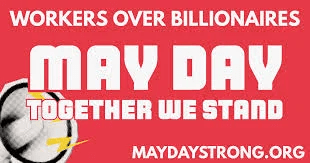
In addition to withdrawing your labor and your commerce, you can join your community to make the strike even more visible. There will be a lot of demonstrations around the country and local sources are often the best places to get information about them. Because this is a one-day strike, it’s important to be as visible as possible and demonstrate just how many workers, students, and shoppers are on the side of democracy.
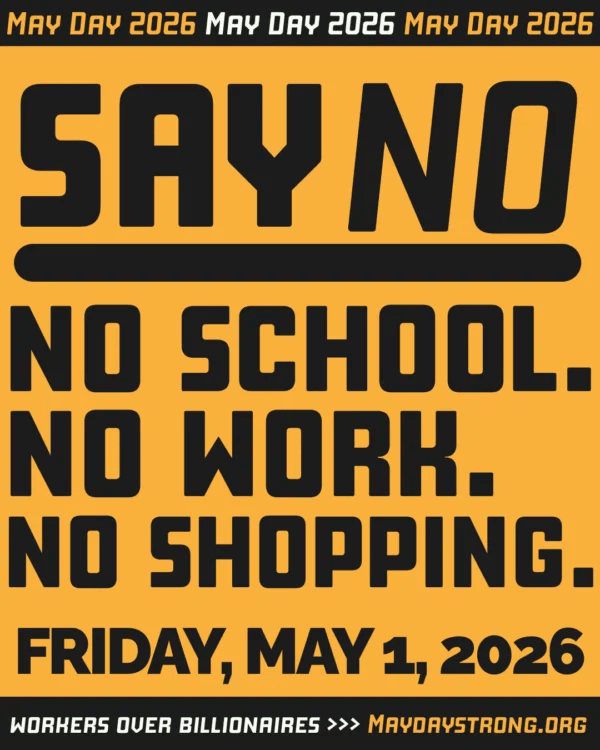
Here’s what the strike demands (taken from the main webpage):
- That we tax the rich so our families, not their fortunes, come first,
- No ICE. No war. No private army serving authoritarian power.
- Expand democracy. Hands off our vote.
How is this relevant to the SBTB community? In addition to the fact that we support the causes that this strike promotes, strikes are an important part of feminist history. Women have been crucial in the success of the labor movement in the U.S.A., as leaders, strikers, volunteers, and educators. Here a just a few examples:
- I’ve previously written about Dolores Huerta, who co-founded the United Farm Workers Association.
- Our Kickass Woman coming up in May will be Emma Tenayuca, a Mexican-American woman from Texas, who led a strike of 12,000 pecan shellers in 1938.
- The Mink Brigade was the name given to wealthy society women who supported the garment workers’ strikes in the early 1900’s. By marching and picketing along with workers, they lent prestige and respectability to the cause, and their presence tended to reduce violence from police.
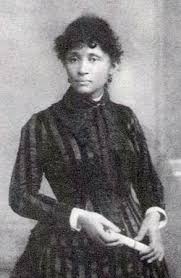
- Lucy Parsons
- Lucy Parsons led a march of 80,000 people in 1886 in the first May Day Parade. Among other causes, she championed the 8-hour workday.
- Ai-jen Poo has been organizing domestic workers since 1996 and is currently the president of National Domestic Workers Alliance and the director of Caring Across Generations. Domestic workers had been considered too difficult to organize, making Ai-jen Poo’s success all the more remarkable.
- My personal favorite, Emma Goldman, was a Russian Jewish immigrant who was described as “The most dangerous woman in America.” Despite dedicating her life to her work, she always prioritized joy. She is credited as saying, “If I can’t dance, I don’t want to be part of your revolution,” but what she actually said was:
I did not believe that a Cause which stood for a beautiful ideal, for anarchism, for release and freedom from conventions and prejudice, should demand the denial of life and joy. . . If it meant that, I did not want it.
The Zinn Education Project has a wonderful list of women in the U.S.A. labor movement. You can also find stories of women in the labor movement at the National Park Service website.
I’m closing with my favorite version of “Bread and Roses,” performed by Judy Collins and choir. In 1911, Helen Todd, a suffragist and labor rights activist, used the phrase “Bread and roses” in one of her speeches:
Not at once; but woman is the mothering element in the world and her vote will go toward helping forward the time when life’s Bread, which is home, shelter and security, and the Roses of life, music, education, nature and books, shall be the heritage of every child that is born in the country, in the government of which she has a voice.
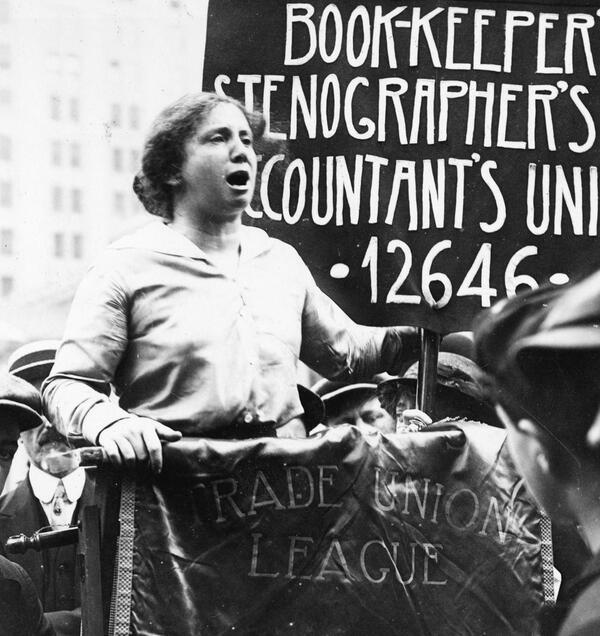
Rose Schneiderman
Rose Schneiderman, a remarkable woman who was born in Poland, came to America as a child, and campaigned for suffrage as well as improved safety condition for workers, used the phrase in her speeches, including this one from 1912:
What the woman who labors wants is the right to live, not simply exist — the right to life as the rich woman has the right to life, and the sun and music and art. You have nothing that the humblest worker has not a right to have also. The worker must have bread, but she must have roses, too. Help, you women of privilege, give her the ballot to fight with.
In 1911, James Oppenheim wrote a poem inspired by the slogan. Mimi Farina set to music in 1974. The song will forever be associated with the Lawrence Textile Strike, also known as the Bread and Roses Strike, of 1912. This strike was largely organized and conducted by women, who, along with children, made up the majority of the workforce in the mills.
Women have always been crucial to the success of strikes in America and worldwide. Why stop now? On May 1, protest, march, or stay home and read, but if you are able, join the strike.
No work, no school, and no shopping: by ceasing these three actions, we honor our past and our future.
4th Amendment Workplaces
When ICE Shows Up, These Businesses Will Be Ready
Across the U.S., training, resources and hotlines have emerged to help workplaces exercise their rights in the case of an ICE raid.
By: Emily Nonko
Last April, at the James Beard Foundation’s Chef Action Summit, food industry leaders gathered to discuss the political and economic landscape with one concern hanging grimly in the air: undocumented and immigrant workers were increasingly afraid to come into work after ICE raids ramped up at the outset of Trump’s second term.
But it just so happened the summit took place in Asheville, North Carolina, where activists had already asked, “What would it take to make this the safest state for immigrants in the south?” as Andrew Willis Garcés, senior strategist with the immigrant justice organization Siembra NC, puts it.
One answer: 4th Amendment Workplaces, a framework developed by Siembra NC and launched at the summit to help restaurants and other businesses train up on legally vetted protocols to defend employees against ICE. The idea quickly took hold — there are now over 1,000 4th Amendment Workplaces across North Carolina, with 4th Amendment Workplace resolutions passed in three cities and similar efforts underway across 12 states.
It’s emerged as perhaps the most powerful workforce training to help businesses prepare for ICE raids, but it is not the only one. Across the country, training, resources and hotlines have been developed for workplaces, alongside an effort to harness the wider labor movement as a force against ICE.
Though the ICE raids that make the news often take place on the street, workplaces are in fact a frequent target. “We’ve seen ICE this year go into workplaces more than a lot of other kinds of places where people are gathered,” Willis Garcés explains. “With workplaces, there’s usually an open door you can walk through.”
According to the American Immigration Council, ICE publicly reported at least 40 worksite enforcement actions resulting in over 1,100 arrests within the first seven months of the current Trump administration. Businesses employing noncitizen workers — restaurants, car washes, automotive shops, bakeries, nail salons — are typically targeted. ICE has also scaled up large raids at workplaces like meatpacking and manufacturing plants.
These raids often represent legal violations, which 4th Amendment Workplaces raise awareness around. The Fourth Amendment to the U.S. Constitution guarantees “the right of the people to be secure in their persons, houses, papers and effects, against unreasonable searches and seizures” without a warrant based on probable cause — that is, reason to believe that a crime may have been committed.
In North Carolina, volunteers canvas businesses across the state to share what it means to be a 4th Amendment Workplace: identify invalid ICE warrants, secure private employee areas, document unconstitutional actions and defend all workers, no matter their immigration status. Resources include a workplace guide, organizing toolkit, posters signaling opposition to unconstitutional search and seizures, employee handouts and tips for designating private employee areas.
Workplaces can request dedicated training, in which organizers help business owners and employees develop workplace-specific protocol, and lead them through roleplaying scenarios. “We help you think through … what would you do right after the fact? What would you do to preserve footage, how do you support families left behind, what’s the immediate triage that needs to happen [after a raid]?” explains Willis Garcés.
Scuppernong Books of Greensboro was an early adopter, participating in training, promoting itself as a 4th Amendment Workplace, hiring a lawyer, regularly keeping staff informed of ICE response protocol, even publishing a book on how to resist ICE. Co-owner Steve Mitchell says it is “absolutely essential” for business owners to step up on behalf of employees, especially if the owners are white and legally protected residents: “It’s important for people like us to say that this isn’t right, and we’re going to stand on this side of the issue.”
Even though there hasn’t been a heavy ICE presence in Greensboro, the bookstore’s work with Siembra NC “gives us some sense of confidence,” Mitchell says. “Whether that’s misplaced or not, it at least helps us know what our rights are in that situation.” He adds that using Siembra’s model has made the business feel connected to a broader network of activists.
Willis Garcés describes that model as “plug and play,” easily adaptable outside the state and across a variety of workplaces. Siembra NC recruited small businesses first, with the goal of expansion into higher-targer workplaces like factories and farms.
Today, some North Carolina farmers display giant vinyl banners about their constitutional rights, a riff on Siembra NC’s signage. In Oregon, organizers dubbed themselves “Baddies for the Fourth.” In Minneapolis, the 4th Amendment Workplace was a central demand in a public-pressure campaign around Target.
There have been other efforts to develop localized training. In New York, Nonviolent Peaceforce trains mostly within the city’s Asian American community, which it has worked with since the pandemic. Last year, ICE raids erupted across the city’s Chinatown.
Nonviolent Peaceforce’s in-person training happens with trusted community partners and focuses on de-escalation and self-regulation tactics, alongside scenario and role-playing. “We came to develop scenarios really at the request of community members who felt that they really needed to know what it was like to be in the moment,” says Roz Lee, head of the organization’s U.S. efforts. She says simple tactics to slow things down — like introducing yourself, asking ICE agents their name, asking for a warrant and taking time to inspect it — can shift a potentially intense and traumatic interaction.
Other groups have tied the urgency around ICE to larger labor organizing efforts. Emergency Workplace Organizing Committee (EWOC) emerged to help non-unionized labor organize in response to COVID-19. More recently, EWOC developed resources for resisting ICE, which are tied to broader workplace organizing tactics like facilitating conversation among employees, building a committee and planning collective action together.
“These steps are very universal, whether you work in an office, in a kitchen, at a nonprofit,” says Wes Holing, an EWOC organizer. “If you’re talking about bread-and-butter issues, or you’re talking about a workplace that’s safe from ICE, you’re still ultimately fighting for a place that respects you as a person.”
This January, EWOC partnered with Twin Cities Democratic Socialists of America to hold a No-Work Workshop to train workers on their rights and protections to participate in the Anti-ICE General Strike. It was part of a much larger mobilization among Minneapolis residents and businesses responding to Operation Metro Surge.
The city mobilized far beyond one-off trainings; instead, an entire ecosystem emerged. “The sheer volume, the sheer magnitude of mobilization … it felt like every single person I knew was extremely active,” says Mike Urbanski, who helps lead legal observer training with Monarca. Monarca is a project under the immigrant justice organization Unidos MN, which canvassed businesses in Twin Cities’ immigrant communities. They’d then direct people to Monarca’s ICE hotline as well as its two-hour, in-person training, which focuses on “upstander” legal observation tactics.
Monarca’s trainings were also shared through social media, word of mouth and within community spaces and houses of worship. “We could post a training with 1,000 people in Minneapolis and fill it within four or five days,” Urbanski says, “And most of those people would come, and another 100 people would just show up.”
The Workers Solidarity Circle also canvassed and shared resources among Twin Cities businesses, channeling that energy into the Minneapolis Worker’s Assembly this February, which brought together over 300 unionized and non-unionized workers across sectors. “It was about building working class power and coordinated strike action, to really push people into action and not wait on managers, bosses or labor officials to save us,” says organizer Aminah Sheikh.
Now that Operation Metrosurge has wound down, organizers have turned their attention to this upcoming May Day: organizing strike committees, holding strike trainings, conducting labor education and committing unions and community organizations to strike on May 1st. Sheikh says there is a growing realization that workers must build political power far beyond their workplace.
“Listen, in order for us to really stop — abolish — ICE, like people are saying, from the grassroots,” she says, “then we need to do economic disruption.”
From MUTTS & Jane Goodall

| FETCH THIS PRINT |
| “There is hope in the resilience of nature.”Jane Goodall |
It Is Earth Day, 2026

Oh! There are so many things that need to be done, so many of them about which we can do little but still all we can; however, today, I think it’s important that each of us gets outside as best we’re able. I think we should take a minute or two to simply appreciate our Earth, and take joy in its beauty and wonder as best we can; reconnect to it. I hope everyone who reads here is able to get at least a bit of time outside today (don’t get struck by lightning, or anything else unsafe!), and can just be with our planet and its inhabitants. There is peace to be found, which will build strength to continue. But, mostly, everything isn’t all about our battles. Hearing birdsong, watching squirrels frolic, and seeing butterflies flutter, is good for us.
Enjoy a video from Artemis II:


https://peacebuttons.info/orderpp-the-ecology-corner.htm#geac
And Trae Says-
Josh Day, Next Day!
All device protection from beverage spray protocol should be observed.
A Little Monday Mix
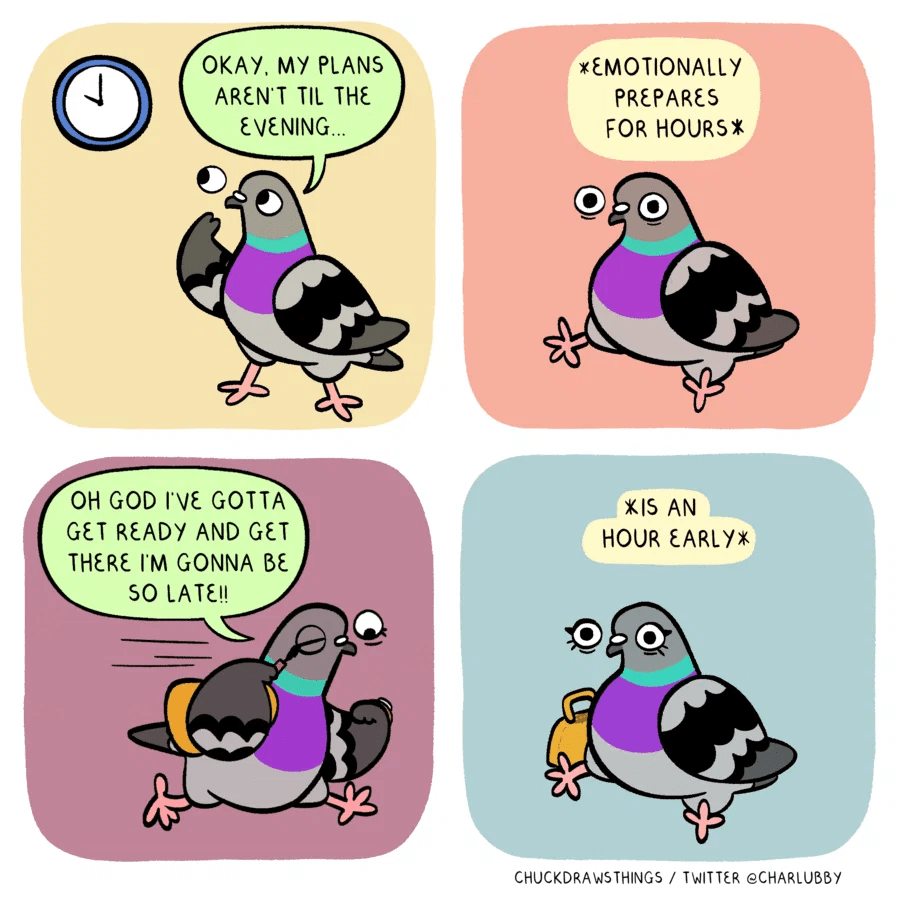
I am riding with a friend to a Humane Society board meeting this evening. I don’t tend to leave the house much in the evenings; I prefer daytime stuff, and tucking up in the evening. But, I do want to get back into helping the shelter, and they need board members, so I’m going. It is causing me anxiety; I think I’d rather drive myself, but it’ll be fine. So Chuck Drew A Thing, and here it is below:
https://www.gocomics.com/chuckdrawsthings/2026/04/17
And here’s a local news story that is pertinent to Playtime’s interests, I think.
Wichita’s “Rosie the Riveter,” B-29 DOC volunteer Connie Palacioz dies at 101
WICHITA, Kan. (KWCH) – Connie Palacioz, a World War II-era “Rosie the Riveter” who helped build B-29 Superfortress bombers in Wichita and later spent decades volunteering with the restored B-29 DOC aircraft, has died. She was 101.
During World War II, more than six million women entered the workforce in a variety of roles, including factory work that was crucial to the war effort.
Palacioz went to work at The Boeing Co. in Wichita at age 17 and served as a riveter on the B-29 production line from 1943 to 1945. The Wichita factory built 1,644 B-29 Superfortress bombers during the war.
In 2000, when B-29 DOC returned to Wichita for restoration, Palacioz was 75 years old. She joined the team working to return the aircraft to flight, according to a statement from Doc’s Friends, Inc., the non-profit she volunteered at.
“She was the first one up when she was on tour with us, and the last one to leave the airplane. She was so proud of what she and her volunteers and what she and her team had built,” said B-29 DOC Executive Director Josh Wells.
Palacioz remained an active member of the organization for 26 years. She served as an advocate for the nonprofit’s mission while sharing her own story and those of other women who worked in wartime production.
“Connie’s life journey was inspiring, and it’s been our great honor to have shared her legacy and life story through B-29 DOC,” Wells said in a statement. “Not only was Connie a Wichita and Kansas legend, but her story and work during World War II on the B-29 Superfortress production line also made her a national hero.”
Wells also shared the impact Palacioz had on his life.
“She was an inspiration to me. She was an inspiration to many people, and I think she’s a trailblazer,” Wells said.
Not only was Palacioz a trailblazer for women, she was also a supporter of civil rights, as she worked with a minority coworker when no one else would.
“Jerry was African-American, and Mom said, ‘that’s fine with me, I’m a minority, I’m Mexican, I’ll work with her.’ Then they wanted to separate them, and they didn’t separate,” said Tish Nielsen, Palacioz’s daughter.
Palacioz often reflected on her role in the wartime effort while speaking with visitors to the aircraft.
“When visitors come and they ask us, and then I tell them that I worked there and that I did this, and everything is still in order,” Palacioz said. “You know, I always tell them there were seven rivets missing when it was in the desert.”
“I wish all the others that worked with me could be here, but of course, they are gone,” she said. “But, I don’t know, it’s been great. It just is something that I can’t tell you exactly how, but I feel wonderful to be here.”
For many years, Palacioz’s story was unknown, even to her daughter, which Nielsen pointed to as a sign of her humility.
“When you would ask her, ‘why didn’t you tell us you were Rosie the Riveter?’ She said, ‘Well, I was just doing my job.’ And that’s the way she was,” Nielsen said.
Wells said it’s important to keep stories like Palacioz’s alive.
“It’s very important that we carry on their stories and honor people like Connie, to make sure that the next generation knows about them,” Wells said.
Nielsen said the thing she’ll remember most about her mother is her faith and her hard work throughout life.
“I would say she was a very faithful, faith-filled woman, who was very determined, and enjoyed life,” Nielsen said.
Funeral services are pending. A public celebration of life will be planned, according to the statement.
Monday, Back To It!
Enjoy a couple of political ones that are good, and uplifting. First, Sen. Prof. Warren tells us a bit about Zach Wahls:
Next, well, you can see it’s gonna be nice before you even tap Play. But tap Play!
How About Some Shorts?
Not necessarily about current events; if so, it’s snark, short, and sweet. Have some fun!
Dance a little!
Heh. Some justice.

