Category: Military
This is how the new US works. How long will we remain a world power?
Peace & Justice History for 2/22

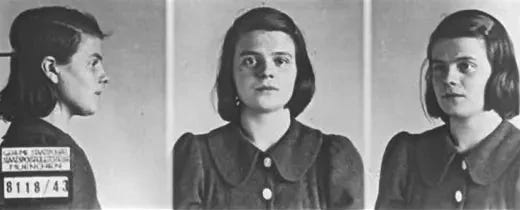
| February 22, 1943 Sophie Scholl, a 22-year-old White Rose (Weisse Rose) activist at Munich University, was executed after being convicted of urging students to rise up and overthrow the Nazi government. ![]() There are many memorials in Bavaria and Germany to Sophie and her group, the White Rose, but little is known outside of Germany. They were medical students who organized nonviolent resistance to Hitler, and were arrested for printing and distributing anti-Nazi flyers. Sophie, her brother Hans, a former member of Hitler Youth who started White Rose, and Christof Probst, the three young people in the photo, were executed. Few White Rose members survived the war which is why the story is not well known. ![]() Film made about Sophie Scholl’s courage & watch the trailer Traute Lafrenz, Last Survivor Of Anti-Nazi Resistance Group, Dead At 103 |
| February 22, 1967 Indonesian President Sukarno (born Kusno Sosrodihardjo) surrendered all executive authority to military chief-of-staff General Suharto, remaining president in title only. Sukarno had begun the movement for Indonesian independence from Dutch colonial control in 1927. They were supplanted by the Japanese during World War II, but independence was realized following Japan’s defeat. Sukarno was elected president but had declared himself president for life in 1963. Following a failed communist-led coup within the military, Suharto launched a purge of Indonesian communists that resulted in hundreds of thousands of deaths. In 1967 he assumed full power, and in 1968 was elected president and remained in power for 32 years. He was also responsible for Indonesia’s 1975 invasion of East Timor, which left an estimated 100,000 Timorese dead from famine, disease and warfare. See The Year of Living Dangerously for an excellent dramatic re-creation of the time.(trailer) More on Suharto And more on Sukarno |
| February 22, 1974 Farmer Sam Lovejoy toppled the weather tower for a proposed nuclear power plant in Montague, Massachusetts. This was the first act of civil disobedience against the dangers of nuclear power in the U.S. Lovejoy turned himself in to the police, was tried but not convicted. ![]() Sam Lovejoy The full story of Sam Lovejoy’s action Ballad of Sam Lovejoy by Rob Skelton |
| February 22, 1997 Nearly 35,000 marched in Paris against a new anti-immigration bill. Many of the demonstrators chanted “First, second or third generation, we are all children of immigrants.” Another 5,000 movie directors, writers, painters, actors, translators, journalists and teachers signed petitions pledging civil disobedience. |
https://www.peacebuttons.info/E-News/peacehistoryfebruary.htm#february22
The Art of The Deal
Trump, The Great Negotiator, sells out Ukraine – and the UK’s favourite grifter is behind him every step of the way.
The Russian nothingburger is back on the menu, by Ann Telnaes
If you ever had doubt Trump is in the pocket of Putin. Read on Substack

Peace & Justice History for 2/19

As well, Feb. 19th is the annual Day of Remembrance of Pres. Roosevelt’s E.O. 9066, interning Japanese-Americans.
| February 19, 1919 A Pan-African Congress was organized by W.E.B. DuBois in Paris, France, to coincide with the Versailles Peace Conference after World War I. DuBois, sociologist, historian, novelist, playwright, and cultural critic, served as special representative of the NAACP (National Association for the Advancement of Colored People), and was assisted by Blaise Diagne, a member of the French Parliament from the West African colony of Senegal. ![]() W.E.B. DuBois, founder of the NAACP and convener for the Pan-African Congress in Paris. The Congress’s aim was to call the issue of “international protection of the natives of Africa” to the attention of the United States and the European colonial powers who were making momentous decisions on the nature of the post-war world. DuBois was a moving spirit behind the growing struggle for self-determination among Africans, both on the continent and in the diaspora, and the Pan-African Congresses helped to bring the issues of this struggle to world attention. The Pan-African Congress was re-convened in 1921, 1923, 1927, and 1945. ![]() Attendees at the Pan-African Congress. More about W.E.B. DuBois More depth on the Pan-African Congresses |
| February 19, 1942 President Franklin D. Roosevelt, ten weeks after the Japanese attack on Pearl Harbor, issued a directive ordering all Japanese Americans (Nisei) evacuated from the West Coast of the U.S., and forcing them to live in concentration camps. Executive Order 9066 authorized the Secretary of War and military commanders “to prescribe military areas . . . from which any or all persons may be excluded.” ![]() San Francisco Chronicle February 27, 1942 Photo by Dorothea Lange ![]() Japanese American residents board the bus for Camp Harmony, 1942. There was strong support from California Attorney General Earl Warren (later U.S. Supreme Court Chief Justice), liberal journalist Walter Lippmann and Time magazine—which referred to California as “Japan’s Sudetenland” ![]() Japanese-American child on bus to concentration camp. photo: Dorothea Lange 112,000 citizens of Japanese ancestry were relocated, losing their businesses, homes, and belongings to the white residents of their former neighborhoods.This day is referred to as the “Day of Remembrance.” It has been commemorated every year for 67 years to remind Americans of that miscarriage of justice, and to ensure such things do not happen again. Children of the camps Note: In the entire course of the war, 10 people were convicted of spying for Japan, all of whom were Caucasian Day of Remembrance “Not Enough People Know About Day of Remembrance” |
| February 19, 1972 Paul McCartney’s song, “Give Ireland Back to the Irish,” was immediately banned from airplay by the BBC. Opening of the song: Give Ireland back to the Irish Don’t make them have to take it away Give Ireland back to the irish Make Ireland Irish today Great Britain you are tremendous And nobody knows like me But really what are you doin’ In the land across the sea Tell me how would you like it If on your way to work You were stopped by Irish soldiers Would you lie down do nothing Would you give in, or go berserk? Paul McCartney and “Wings” rehearse the song |
https://www.peacebuttons.info/E-News/peacehistoryfebruary.htm#february19
Let’s talk about how Trump, Bragg, names, and what’s next….
Peace & Justice History for 2/15

| February 15, 1898 The man-of-war (battleship) USS Maine was sunk in Cuba’s Havana Harbor as the result of an explosion, 260 American naval personnel dying as a result, another 58 wounded. An insurrection against Spanish colonial rule in Cuba had persisted for years, and brutal Spanish tactics had engendered strong American reaction. That is why Consul General Fitzhugh Lee had asked President William McKinley to send the Maine “for the moral effect it might have.” Spain’s Governor-General Weyler had forced 300,000 Cubans into towns and cities to insulate them from the insurgents but had made no preparations for their food, housing or health care. Half of the reconcentrados, as they were called, died as a result. Pres. McKinley had tried since coming into office to reach a settlement through negotiation but Spain rejected his efforts. Following the sinking of the Maine, popular opinion in the U.S. moved toward war with Spain, partially in response to inflammatory press coverage. Congress then voted McKinley $50,000,000 to be used for the national defense at his discretion, and provided for a contingent increase of the army to 100,000 men. The cause of the explosion ??? |
| February 15, 1998 About 2,000 people – including a tractor convoy consisting of over 100 farmers – staged a demonstration in the north German town of Ahaus in protest against the planned shipment of nuclear waste to a storage facility in the town. A consignment of full CASTOR (Casks for Storage and Transport of Radioactive Material) containers was expected at the Ahaus interim nuclear storage site within the next two weeks. |
| February 15, 2002 President George W. Bush approved Nevada’s Yucca Mountain as the site for long-term disposal of 70,000 metric tons (77,000 tons) of highly radioactive nuclear power plant waste. 12 years and $6.8 billion worth of study and construction had gone into the site 90 miles from Las Vegas. ![]() It is officially estimated that, by the time it is completed in 2017, the total construction cost will be $23 billion. 2000 additional metric tons of such waste are generated by U.S. nuclear power plants each year, leading to concerns that the facility would be full shortly after its opening. All such waste is currently stored onsite at individual nuclear power plants. ![]() Problems with the Yucca Mountain site What are the alternatives FAQs on Yucca Mountain |
| February 15, 2003 The world said NO to war… In the single largest day of protest in world history, millions on 6 continents demonstrated against the U.S./U.K. plans to invade Iraq. Reported totals included 1 to 2 million in London and Rome; 1.3 million in Barcelona, Spain (a city of 1.5 million); 500,000 each in Berlin, Paris, Madrid, and New York. Smaller demonstrations were held in over 600 cities and towns across the U.S., including tens of thousands in several cities, and 150,000 the following day in San Francisco. Total participation is estimated at 25 million in more than 100 countries. ![]() |
https://www.peacebuttons.info/E-News/peacehistoryfebruary.htm#february15
Peace & Justice History for 2/14

| February 14, 1957 The organization that would shortly be called the Southern Christian Leadership Conference (SCLC) chose its leadership at a meeting in New Orleans. Reverend Martin Luther King, Jr. and Reverend Ralph David Abernathy led the group which sought to coordinate civil rights protests throughout the South. Organizers of bus boycotts, inspired by the one in Montgomery, Alabama, had met in Atlanta a month earlier. During that meeting, Dr. Abernathy’s home and church were bombed. ![]() Reverend Ralph David Abernathy and Rev. Martin Luther King, Jr. Southern Christian Leadership Conference history |
February 14, 1971![]() President Richard Nixon ordered a secret taping system to be installed for his offices in the White House. Listen in on the presidents |
| February 14, 1989 At a meeting of the presidents of Nicaragua, Honduras, Guatemala, Costa Rica, and El Salvador, the Sandinista government of Nicaragua agreed to release a number of political prisoners and hold free elections within a year. In return, Honduras promised to close bases established by the U.S. for and used by the anti-Sandinista Contra rebels. Just over one year later, elections were held (with international observers including former President Jimmy Carter) though the nation was threatened with a continuing U.S. economic boycott, and was experiencing ongoing Contra violence. The Sandanista Front candidate was defeated 55% to 41%. |
Peace & Justice History for 12/13

| February 13, 1912 Labor leader Mary Harris “Mother” Jones was placed under house arrest at Pratt (Kanawha Co.), West Virginia, for inciting to riot. An organizer for the United Mine Workers, she had come to the Paint Creek and Cabin Creek mines where a long and nasty struggle had escalated. ![]() Jones was known for her fiery (and often obscene) verbal attacks on coal operators and politicians. A native of Ireland, she had been organizing for more than 15 years.The coal operators had hired mine guards to intimidate the workers and discourage formation of a union. Besides asking to be paid what other area miners were making, the union demanded • the right to organize • recognition of their rights to free speech and assembly • an end to blacklisting of union organizers • alternatives to company stores • an end to the practice of using mine guards • prohibition of cribbing • installation of scales at all mines for accurately weighing coal unions be allowed to hire their own checkweighmen to make sure the companies’ checkweighmen were not cheating the miners who were not paid hourly, but by the ton. 68 years old (though claiming to be over 80) and suffering from pneumonia, Jones was never charged with a crime (martial law had been declared). A few weeks later, the new governor, Henry Hatfield, was sworn in and examined Mother Jones (he was also a doctor) but refused to release her from house arrest for two months. Mother Jones biography Mother Jones magazine (They have a great free newsletter!) |
| February 13, 1960 France became the world’s fourth nuclear power, conducting its first plutonium bomb test at the Reggane base in the Sahara Desert in what was then French Algeria. “Gerboise Bleue” was detonated from a 330-foot tower and had a yield of 60-70 kilotons (equivalent to nearly 70,000 tons of TNT). ![]() |
| February 13, 1967 Carrying huge photos of Vietnamese children who had been victims of Napalm (a flammable defoliant used extensively in the war there), 2,500 members of the group Women Strike for Peace stormed the Pentagon, demanding to see “the generals who send our sons to Vietnam.” When Pentagon guards locked the main entrance doors, the women took off their shoes and banged on the doors with their heels. ![]() ![]() They were eventually allowed inside, but Defense Secretary Robert McNamara would not meet with them. Senator Jacob Javits (R-New York) agreed to meet a few hundred of the women, but he was booed by the women when he denied the U.S. was using toxic gas in Vietnam. |
| February 13, 1968 Five soldiers were arrested at a pray-in for peace in Vietnam at Fort Jackson, South Carolina. Two were court-martialed for refusing to stop praying. The pray-in was repeated a year later. |
| February 13, 1991 Two precision-guided missiles destroyed the Amiriyah subterranean bunker in Baghdad while being used as an air-raid shelter by 408 Iraqi civilians during the first Gulf War. The resulting deaths of all inside made it the single most lethal incident for non-combatants in modern air warfare. The U.S. had detected signals coming from the bunker and considered it a military command and control center. ![]() There was an antenna atop the bunker but it was connected by cable to the actual command center 300 yards away, which was not hit by the 2000 lb. bombs which landed precisely on their intended target, penetrating ten feet of hardened concrete. Only 3% of the 250,000 bombs and missiles fired during that conflict were considered such “smart bombs.” ![]() Visitors tour the Amiriyah Bunker. The Iraqi government has preserved the bunker as a public memorial. |
https://www.peacebuttons.info/E-News/peacehistoryfebruary.htm#february13