
Another food aid worker in Gaza murdered by Israeli military

| December 1, 1891 The International Peace Bureau was launched in Rome, Italy, “. . . to coordinate the activities of the various peace societies and promote the concept of peaceful settlement of international disputes.” The organization won the Nobel Peace Prize in 1910 for its work, and is headquartered in Bern, Switzerland.  |
| December 1, 1948 Following a brief but bloody civil war in 1948, Costa Rican President Jose Figueres helped draft a constitution that abolished the military and guaranteed free election with universal suffrage (all adult citizens can vote).  Money not spent on a military allowed the country to adequately fund health care and education, yielding one of the highest literacy rates on the continent, ninety-six percent. This is judged to be a factor in the nation’s never having fallen prey to corruption, dictatorships, or the bloodshed that has marred the history of much of the region. Costa Rica stands apart |
| December 1, 1955 Rosa Parks, a black seamstress active in the local NAACP, was arrested by police in Montgomery, Alabama, after refusing to give up her seat on the bus to a white man. Mrs. Parks faced a fine for breaking the segregation laws which said blacks had to vacate their seats if there were white passengers left standing. The same bus driver had thrown her off his bus twelve years prior for refusing to enter through the rear door.  Rosa Parks Mrs. Parks had not been the first to defy the Jim Crow (the system of legalized or de jure segregation) law but her arrest sparked the year-long Montgomery Bus Boycott, organized by a young Baptist minister named Martin Luther King, Jr. The Montgomery bus company couldn’t survive without the revenue from its black passengers who, for the next year, created car pools and other means to avoid using the city busses.  The bus restored in Henry Ford Museum The boycott was successful and Mrs. Parks became known as the “mother of the civil rights movement.“ The story of the bus Rosa Parks biography Arrest record of Rosa Parks |
| December 1, 1959 Representatives of 12 countries, including the United States and the Soviet Union, signed a treaty in Washington setting aside Antarctica as a scientific preserve, free from military activity. President Eisenhower said the treaty and its guarantees “constitute a significant advance toward the goal of a peaceful world with justice.” |
December 1, 1966 Comedian Dick Gregory was convicted in Olympia, Washington for his participation in a Nisqually Native American fishing rights protest.  Interview with Dick Gregory |
| December 1, 1969 A lottery was held to determine which young men would be drafted into the armed services for the ongoing Vietnam War. A large glass container held 366 blue plastic balls each marked with a birth date. The drawing determined the order of induction for draft-eligible men between 18 and 26 years old, and was broadcast live nationally. The first draft lottery was held in 1942.  Rep. Alexander Pirnie, R-NY, draws the first capsule in the draft lottery held on December 1, 1969. The capsule contained the date, September 14. |
| December 1, 1997 A silent march of women in Khartoum, Sudan, protesting conscription, was met by a police attack and the arrest of 37 women. |
https://www.peacebuttons.info/E-News/peacehistorydecember.htm#december1
| November 29, 1864 A U.S. Army cavalry regiment under Colonel J. M. Chivington (a Methodist missionary and candidate for Congress), acting on orders from Colorado’s Governor, John Evans, and ignoring a white surrender flag flying just below a U.S. flag, attacked sleeping Cheyenne and Arapaho Indians, killing nearly 500, in what became known as the Sand Creek Massacre. Captain Silas Soule, however, not only refused to follow Chivington’s lead at Sand Creek, but ordered his troops not to participate in the attack. The Indians, led by Black Kettle, had been ordered away from Fort Lyon four days before, with the promise that they would be safe. Virtually all of the victims, mostly women and children, were tortured and scalped; many women, including the pregnant, were mutilated. Nine of 900 cavalrymen were killed. A local newspaper called this “a brilliant feat of arms,” and stated the soldiers had “covered themselves with glory.” At first, Chivington was widely praised for his “victory” at the Battle of Sand Creek, and he and his troops were honored with a parade in Denver. However, rumors of drunken soldiers butchering unarmed women and children began to circulate, and Congress ordered a formal investigation of the massacre. Chivington was eventually threatened with court martial by the U.S. Army, but as he had already left his military post, no criminal charges were ever filed against him Eyewitness Congressional testimony of John S. Smith, a white Indian agent and interpreter   Two different paintings of the Sand Creek Massacre |
November 29, 1963 Earl Warren and LBJ U.S. President Lyndon B. Johnson establishes the Warren Commission to investigate the assassination of President John F. Kennedy. More about The Warren Commission |
| November 29, 1967 U.S. Secretary of Defense Robert McNamara announces his resignation during the Vietnam War.  Robert McNamara The Fog of War a movie about the Vietnam War |
https://www.peacebuttons.info/E-News/peacehistorynovember.htm#november29
November 28, 1891 Early IBEW delegates The National Brotherhood of Electrical Workers (now International, the IBEW) was founded when 10 men met at Stolley’s Dance Hall in St. Louis, Missouri. Their goal: the joining together of electricians in a common organization to make a better life for all.  The original logo adopted at the First Convention. Read more |
November 28, 1905 The political party Sinn Fein (meaning “we ourselves” in Gaelic) was founded in Dublin by Irish nationalist Arthur Griffith. Its objective was to end British rule in Ireland and seek national self-determination as a sovereign state.  Sinn Fein’s story of its origins |
| November 28, 1991 The U.S. Congress passed the Comprehensive Threat Reduction Act (the Nunn-Lugar legislation), which provided up to $400 million to assist with the destruction of Soviet nuclear and chemical warheads. The legislation was initiated by Senator Sam Nunn (D-Georgia) and Senator Richard Lugar (R-Indiana). |
https://www.peacebuttons.info/E-News/peacehistorynovember.htm#november28
| November 26, 1968 U.N. General Assembly passed a resolution against capital punishment following an official report which said, “Examination of the number of murders before and after the abolition of the death penalty does not support the theory that capital punishment has a unique deterrent effect.” More on capital punishment and homicide |
| November 26, 1970 American Indian activists marked Thanksgiving with a National Day of Mourning for Native Americans by occupying Plymouth Rock in Massachusetts, the alleged landing spot of the Pilgrims’ arrival in Massachusetts colony. Led by Wamsutta Frank James, an Aquinnah Wampanoag elder and music teacher, over 200 Indians seized the Mayflower II and painted Plymouth Rock red.  Day of Mourning demo in downtown Plymouth James had refused to speak at a state dinner the night before commemorating the 350th anniversary of the landing, and went on to organize United American Indians of New England. Wamsutta Frank James’ suppressed speech video footage 2022 National Day of Mourning |
| November 26, 1983 President Ronald Reagan ordered military assistance to Iraq in the war Saddam Hussein had begun by invading Iran. To prevent an Iraqi military collapse, the Reagan administration supplied battlefield intelligence on Iranian troop buildups to the Iraqis, sometimes through third parties such as Saudi Arabia. National Security Decision Directive 114, signed on that day, stated that the United States would do “whatever was necessary and legal” to prevent Iraq from losing the war with Iran. It called for heightened regional military cooperation to defend oil facilities, and measures to improve U.S. military capabilities in the Persian Gulf. The assistance was granted despite frequent and consistent reports of Iraqi use of chemical weapons, a clear violation of the 1925 Geneva Protocol. Mustard gas had been used against Iranian troops and against “human wave” attacks by thousands of Basij (Popular Mobilization Army or People’s Army) volunteers. The full story on U.S.-Iraq relations at that time The Geneva Protocol |
https://www.peacebuttons.info/E-News/peacehistorynovember.htm#november26
| November 21, 1945 200,000 members of the United Auto Workers went on strike against General Motors, the first major strike following World War II. The UAW’s demand for a 30% wage increase was based on the increase in the cost of living during the war (28% according to the Department of Labor), the wartime freeze on wages, and the cut in the average workweek with the disappearance of overtime pay in manufacturing.   But the UAW also considered profits and prices a subject for negotiation, a position rejected by GM. The union did not merely say that labor was entitled to enough wages to live on. It also said that labor was entitled to share in the wealth produced by industry. “… Unless we get a more realistic distribution of America’s wealth, we won’t get enough to keep this machine going.”–Walter Reuther, UAW President More about the strike |
| November 21, 1973 President Richard Nixon’s attorney, J. Fred Buzhardt, revealed the existence of an 18 1/2-minute gap in one of the subpoenaed White House tape recordings of Watergate conversations made by President Richard Nixon in the days after the Watergate break-in.The erasure was blamed on an accident by Nixon’s private secretary, Rose Mary Woods, but scientific analysis determined the erasures to be deliberate. White House Chief of Staff Alexander Haig later attributed the gap to “sinister forces.” 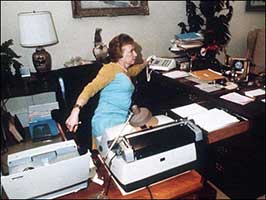 Rose Mary Woods, demonstrating how she might have created the Watergate tape gap More about Rose Mary Woods |
| November 21, 1974 Both Houses of Congress voted to override President Gerald Ford’s veto of updates to the Freedom of Information Act. Originally passed in 1966, it required federal agencies to release information upon request to citizens and journalists.The amendments put an end to governmental resistance to compliance, including excessive fees, bureaucratic delays, and the need to sometimes resort to expensive litigation to force the government to share copies of documents. Ford advisors Chief of Staff Donald Rumsfeld, his deputy Dick Cheney, and government lawyer Antonin Scalia advised him to veto it.  Chief of Staff Donald Rumsfeld, President Gerald Ford and Deputy Chief of Staff Richard Cheney April 28, 1975 What was the dispute? |
| November 21, 1975 The Senate Select Committee to Study Governmental Operations with Respect to Intelligence Activities, led by Senator Frank Church (D-Idaho), issued a report charging U.S. government officials were behind assassination plots against two foreign leaders – Fidel Castro (Cuba) and Patrice Lumumba (Congo), and were heavily involved in at least three other plots: Rafael Trujillo (Dominican Republic), Ngo Dinh Diem (Vietnam), Rene Schneider (Chile). 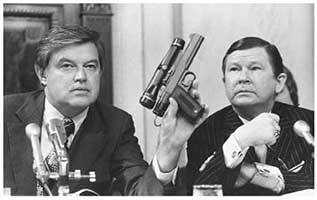 Senator Frank Church, left, chairman of the Senate Select Intelligence Committee, displays a poison dart gun as co-chairman Senator John Tower (R-TX) watches. The committee, a precursor to the Senate Intelligence Committee, was established to look into misuse of and abuse by intelligence agencies, particularly the CIA and FBI, some of which had been revealed by the Watergate investigations.      Fidel Castro / Patrice Lumumba / Rafael Trujillo / Ngo Dinh Diem / Rene Schneider Read more |
| November 21, 1981 More than 350,000 demonstrated in Amsterdam against U.S. nuclear-armed cruise missiles on European soil. |
| November 21, 1985 A full-scale summit conference, the first of five between the President Ronald Reagan of the U.S. and General Secretary Mikhail Gorbachev of the Soviet Union concluded. There was optimism over beginning a more productive and cooperative relationship between the two countries, each of which had thousands of nuclear warheads targeted at the other.The U.S. had proposed building a space-based anti-ballistic missile system, commonly known as “Star Wars,” which the Soviets had strongly opposed as an escalation of the nuclear arms race.In an unofficial meeting the previous evening, President Reagan had noted that he and Gorbachev were meeting for the first time at this level and had little practice. Nevertheless, having read the history of previous summit meetings, he had concluded that those earlier leaders had not accomplished very much. Therefore, he suggested that he and Gorbachev say, “To hell with the past, we’ll do it our way and get something done.” Gorbachev concurred.  Reagan and Gorbachev at their first summit |
| November 21, 1986 National Security Council member Oliver North and his secretary, Fawn Hall, began shredding documents that would have exposed their participation in a range of illegal activities regarding the sale of arms to Iran in an attempt to free hostages, and the diversion of the proceeds to an insurgent Nicaraguan group known as the contras.  Fawn Hall  Oliver North More on Fawn Hall |
| November 21, 1995 China officially charged well-known human rights activist and political dissident Wei Jingsheng with trying to “overthrow the government.” Wei had not been seen for a year and a half after disappearing into police custody after meeting with a U.S. assistant secretary of state for human rights and humanitarian affairs.“If the people allow the power holders, in the peoples’ name, to violate and ignore the rights of some of the people then, at the same time, they are giving the power holders the power to violate the rights of all the people.” “ Most people wait until others are standing to make their move, very few are willing to stand up first or to stand alone. That’s why my friends call me a fool! But I don’t have any regrets.” – Wei Jingsheng  Wei Jingsheng He had been imprisoned previously for his involvement with the Democracy Wall movement, including years in solitary confinement. He had also spoken out on behalf of the Tibetans. |
https://www.peacebuttons.info/E-News/peacehistorynovember.htm#november21
This is a completely different video than the one I posted before. I am sorry that I posted that one. I hated the glitches in it. So I trashed it. I did it before I looked to see if It had comments. If you left comments please put them on this one. This one is longer and more in depth, but done with a higher resolution and done at 3 am this morning so I sound better and more coherent. There are no glitches of either video or audio that I could see / hear. I hope you will enjoy it. Today I am going to dump both computers starting at 12:30 pm. I have the laptop running if I need it. Hugs. Scottie
I read a bunch of headlines I have in open tabs and I talk about the stories they pertain to briefly. Nothing in depth, just generalized information in the public sphere of information. If there is a topic you wish me to cover in more detail please mention it in the comments. Hugs
It is OK and great to stop the video at the 8:30 mark. After that it gets seriously stupid. But before that it has a lot to say that is true and said in a semi comedic way. Hugs
The Associated Press reports:
Pete Hegseth, the Army National Guard veteran and Fox News host nominated by Donald Trump to lead the Department of Defense, was flagged as a possible “Insider Threat” by a fellow service member due to a tattoo on his bicep that’s associated with white supremacist groups.
Hegseth, who has downplayed the role of military members and veterans in the Jan. 6, 2021, attack and railed against the Pentagon’s subsequent efforts to address extremism in the ranks, has said he was pulled by his District of Columbia National Guard unit from guarding Joe Biden’s January 2021 inauguration. He’s said he was unfairly identified as an extremist due to a cross tattoo on his chest.
This week, however, a fellow Guard member who was the unit’s security manager and on an anti-terrorism team at the time, shared with The Associated Press an email he sent to the unit’s leadership flagging a different tattoo reading “Deus Vult” that’s been used by white supremacists, concerned it was an indication of an “Insider Threat.”
Read the full article. Last month Hegseth sat for an interview with anti-LGBTQ Christian nationalist Kirk Cameron.


