February 6, 1899 Spain agreed to abandon all claims of sovereignty over Cuba, the cession of Puerto Rico and Guam, the cession of the Philippine Islands; and in exchange the U.S. agreed to pay $20,000,000 in a treaty ratified by the U.S. Senate on this day. The previous July the U.S. took control of Gantanamo Bay, blockaded Cuba’s other ports and destroyed the Spanish fleet at Santiago Bay. The U.S. Army, landed at Guanica, near Ponce, Puerto Rico, and shortly took possession of the island with the exception of San Juan. The Spanish Pacific fleet was destroyed and the U.S. took control of Manila, the capital, and Luzon, the main island of the Philippines a few weeks later.
February 6, 1943 The U.S. government required the 110,000 disposessed Japanese Americans forcibly held in concentration (internment) camps to answer loyalty surveys. Some of the interned were U.S. citizens, and some volunteered to serve in the armed forces during the war with Japan. The Nisei, as they were known, were kept in the camps until the end of World War II. The Manzanar Relocation Center, a one of the concentration camps where Japanese-Americans were forced to live throughout World War II.
February 6, 1956 Autherine Lucy was excluded from classes just three days after becoming the first black person allowed to attend the University of Alabama. Her suspension “for her own safety” followed three days of riots over her Supreme Court-ordered enrollment. Autherine J. Lucy and her attorney Thurgood Marshall Crowds of students, townspeople and members of the Ku Klux Klan shouted, “Kill her!” among other things. It is unclear why the University did not suspend the students who were among the rioters. Lucy had originally applied for graduate study in library science in 1952, and had been accepted until the University realized her race, and claimed state law prevented her admission. A graduate of traditionally black Miles College, she was only admitted with the help of the National Association for Colored People Legal Defense and Education Fund (NAACP-LDEF) and lawyers Thurgood Marshall (later a Supreme Court justice), Constance Baker Motley (future federal judge) and Arthur Shores (elected to Birmingham City Council). Read more
February 6, 1959 The United States successfully test-fired its first intercontinental ballistic missile (ICBM), known as Titan, from Cape Canaveral. It was a two-stage rocket designed to carry nuclear warheads.Titans were also capable of boosting satellites and spacecraft into orbit. Before the last was produced in 2002, they launched several two-man Gemini missions in the 1960s and launched the first spacecraft to land on Mars. First test launch of Titan booster rocket from Cape Canaveral, Florida.
February 6, 1961 The civil rights jail-in movement began when ten negro students in Rock Hill, South Carolina, were arrested for requesting service at a segregated lunch counter. They refused to post bail and demanded jail time rather than paying fines, refusing to acknowledge any legitimacy of the laws under which they were arrested. More about Charles Sherrod Reverend Martin Luther King, Jr. wrote to Charles Sherrod, Diane Nash and the others in jail: ‘‘You have inspired all of us by such demonstrative courage and faith. It is good to know that there still remains a creative minority who would rather lose in a cause that will ultimately win than to win in a cause that will ultimately lose.’’
February 6, 1985 The Molesworth Common Peace Camp, just outside the Royal Air Force Base there, was evicted by the British Army. The 300 inhabitants and their many supporters had been nonviolently protesting the siting of nuclear-tipped U.S. cruise missiles at the base. Peace camps were established at several locations in Europe in the early 1980s to protest the destabilizing nuclear weapons buildup. Molesworth Common peace camp
The world is on fire and none of us can do much to stop it on our own, but we can each do a little to stop it, and those actions add up to a massive resistance.
Red state residents recognize the shock and awe doctrine that we are all seeing from the first few days of the Trump administration. It’s something we have a lot of experience working with. Our nervous systems are already familiar with the constant attacks on democracy — the constant need to keep up with our lawmakers and pushback on our lawmakers.
I live in Missouri. I have lived under the tyranny of a GOP supermajority for two decades.
It’s not easy, but I have learned to make calls and post and write and then get outside. Do the work and take a break.
My emboldened lawmakers do whatever they want. They will not honor the will of the people and they need constant pushback from the people. We have been fighting in this way for over two decades.
The only way to stop them is through constant resistance. Because screw them and their authoritarian instincts. We didn’t elect Kings and I won’t have a boot on my neck and I won’t stand for one on my neighbor’s neck.
We can’t be shocked into silence.
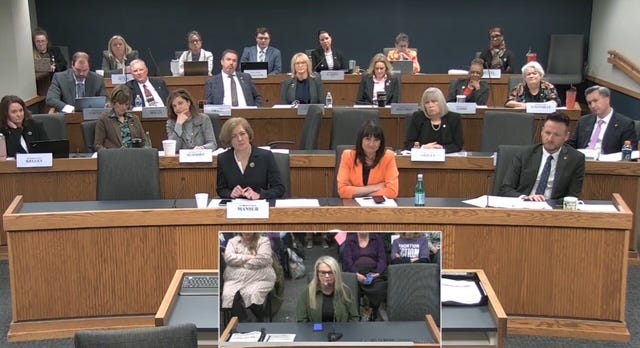
My testimony against SJR 54, Jefferson City, MO. 2/4/25.
Yesterday, I drove to the Missouri Capitol to testify against something that has already been resolved. Abortion.
I thought I would share my testimony to the committee. This was my one thing yesterday. This was my act of defiance and resistance.
Here is my testimony:
Hello. My name is Jess Piper and I am here to testify against HJR 54. This resolution is an attempt to overturn the will of Missouri voters.
The Republicans who are behind this fake resolution claim to represent rural people. They don’t and I am here to set that record straight.
I am a rural mom to five and grandmother to four. I live in Northwest Missouri and I am angry about the overreach of the Missouri GOP. I am here to testify on the disrespect – the absolute disdain – shown to every Missouri voter by some of the folks in this room.
Amendment 3 passed in Missouri. There is no reason why I had to drive eight hours round trip to testify against an abortion restriction. Why can’t you just accept the will of your constituents?
I collected signatures for Amendment 3 in some of the most rural areas of this state. Brookfield is a town of 4,000 and when I pulled up to set up my table and gather signatures, there were folks in the parking lot waiting. A woman signed her name and then texted her Bible group to remind them to come sign the amendment.
Ever heard of Marceline? The town has a population of 2,000. A woman I met in Marceline chored her animals and farm – and then came to sign the amendment in overalls and mucks.
She knew what she was signing, and I am here to give her voice. It’s hard to get your chores done and make it all the way to Jeff City to testify against legislation and your own lawmakers who won’t honor your vote or your voice.
I bet many of you know where Maryville is. We were able to get a few hundred signatures in that town. Maryville is a “huge urban space” in the middle of cornfields, population 11k. They even have a Starbucks. I sat at that coffee shop for hours one afternoon to get signatures. When I was about to pack up, a man named Gordon came in to add his name to the petition.
Gordon is 86 years old. He uses a walker and drove all the way to town and proudly signed his name to a petition to make sure his great-granddaughters would not suffer under the tyranny of an abortion ban.
I am here to remind you that lawmakers who would overturn the will of Missourians should remember they serve the folks who sent them here, and many of those folks voted to approve abortion rights in this state.
Those people include the Bible group from Brookfield and the farmer from Marceline and the great-grandfather from Maryville.
I am also here to express my disgust with the Missouri GOP. You claim to be the party of “small government” but that is a lie. You want to control books, curriculum, teachers, children’s private parts, and every uterus in the state. You overreach into the lives of Missouri citizens each day.
You can’t be the party of “small government” when your members act like tyrants. Do better.
It’s as easy as that.
Well, it wasn’t that easy — I had to drive all day to speak for 3 minutes, but it was worth every mile. They were forced to listen to someone they have tried to disenfranchise. They were forced to see my face and listen to my scathing review of their tenure. They couldn’t escape me or the dozens who testified against the resolution to ban abortion…again.
I know how hard every day is, but do one thing today.
Share an article with friends and then call your Congressional Rep to demand they hold the line with Musk. Call your Senators and demand they do the same. Call you AG and demand they stand with the American people on the biggest data breach in American history — sue Elon for stealing the data of the people of their state.
And then go outside if you can.
Don’t be paralyzed in front of the television or your phone. Doomscrolling without action will make you crazy and exhaust you. That’s the point of shock and awe.
Do one thing. And then rest.
Rinse. Repeat.
~Jess
P.S. I am so thankful for the Abortion Action group and the Missouri ACLU who planned the resistance event at the Capitol. There were so many Missourians there to oppose SJR 54, that we filled the hearing room and an overflow room. The hearing went on for several hours with testimony opposing the resolution.
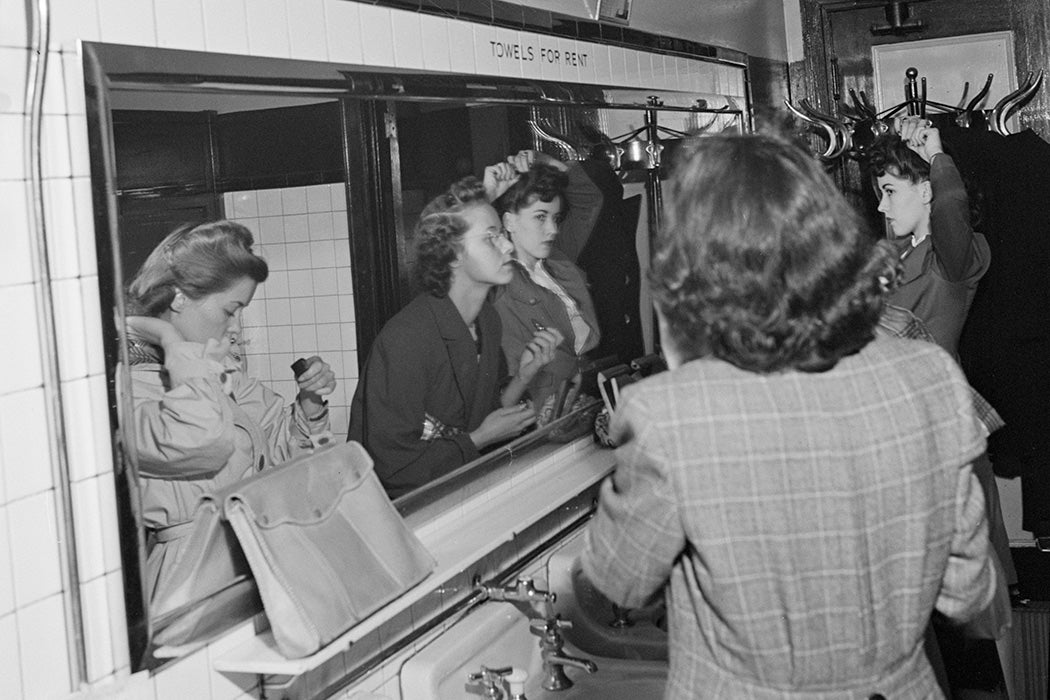
Women’s entry into public life around the turn of the twentieth century was a major catalyst for the creation of sex-segregated public restrooms. As scholar Daphne Spain writes, female civic reformers lobbied municipal governments to make cities more inclusive places for women, pushing for amenities such as health clinics and kindergartens. And in both small towns and big cities, notes historian Peter C. Baldwin, women worked to ensure the availability of public toilets. The first gender-segregated public bathrooms afforded women privacy, safety, and autonomy—if, that is, the women were white and of means; otherwise, access to bathrooms served as a tool of segregation. The history of the women’s bathrooms in the United States is a story of who does—and who doesn’t—get to belong in public life.
The first public bathrooms in the United States appeared in the late 1800s. Pub owners offered them to paying customers to drum up business and keep drinkers drinking. But, as Baldwin notes, pubs and saloons were improper, unwelcoming, and sometimes dangerous environments for women, and were effectively male-only establishments whose facilities only catered to men.
Just a few decades later, according to Spain, women had begun to challenge their “proper place” in society. While middle- and upper-class women increasingly ventured out of the home into the burgeoning urban environment to shop and to socialize, their lower-class counterparts increasingly found work in factories and other non-domestic environments where they could earn their own money. And some, many of whom belonged to the upper classes, forced their way into political and civic life, lobbying for, and winning, suffrage. Changing social stations pushed women and men together in public. They shared sidewalks, transportation, parks, stores, and restaurants. Women entered public life, and standards of decorum shifted to accommodate them, though certainly not to include them—gender segregation became a paramount concern, according to Baldwin, for preserving the modesty and propriety of women. Still, a dramatic shift had occurred: Men no longer wielded a monopoly on public life.
In the absence of an available pub bathroom, men were accustomed to relieving themselves in the street. Not only did that suddenly seem crass in mixed company, but the new science of germ theory made it clear that using the city as a toilet posed a health hazard, Baldwin says. Urban designers, physicians, and civic groups lobbied municipal governments in Chicago, Boston, New York, and elsewhere to provide a sanitary solution to the problem of human waste.
The first public toilets, euphemistically called “comfort stations,” appeared in American cities in the 1890s, according to Baldwin. By 1919, roughly one hundred cities, including Denver, Cleveland, Detroit, Philadelphia, and Seattle made toilet facilities available to the public for free or a small fee. Some were funded by health-minded philanthropists and reformers concerned not only with physical cleanliness, but “moral cleanliness,” writes sociologist Alexander K. Davis. They believed the two were intrinsically linked.
Comfort stations were gender segregated but not gender equal. While men were afforded the opportunity to take care of their most basic needs—the need to relieve themselves—women were not given the same. Women’s facilities were often smaller and had fewer toilets than the men’s, writes Baldwin, and were consistently inferior to the semi-private “customers only” bathrooms available in the “Adamless Eden” of a department store, as one such store owner Spain quotes called them; these were available only to patrons.
For those women denied the privilege of department store entry owing to race or lack of means, the comfort station was the only option for getting some privacy in public. Businesses, manufacturing plants, offices, and government buildings almost entirely lacked gender-segregated bathrooms, and because it was scandalous for a woman to enter a bathroom that men used, the lack of women’s toilets sent a clear signal about who was and wasn’t welcome in a particular space. Without equitable access, women were not able to fully participate in life outside the home. If you can’t empty your bladder or your bowels with dignity, it’s hard to be away from home for long.
Public stations were expensive to maintain and quickly became dirty and malodorous. Many were underground or in secluded areas and were dangerous for female users. Baldwin points out that by the early 1920s, cities cut budgets and patrons abandoned the cause, so stations fell into disrepair almost as soon as they appeared, and some of the same women’s groups that had petitioned for their creation eventually pressed for their closure. The provision of bathrooms became largely the remit of private business owners who could provide or restrict access as they pleased.
Women’s restroom at the Arizona Biltmore in Phoenix, AZ, 1930s via Wikimedia Commons
Though the truly public bathroom—where access is free to all—is increasingly rare today, the semi-public toilet is taken for granted. The ladies’ room in restaurants, bars, airports, train and bus stations, hotel lobbies, schools, and event venues remains one of the few spaces where men are strictly prohibited. Though many are accessible only to those who can patronize a business or afford a ticket for travel.
It’s such an important part of female culture that the women’s bathroom is a convenient prop in movies, TV, and books. Writers set a scene in the ladies’ room, where women gather to complain, cry, confide, confess, gossip, preen, or bully. And though such scenes sometimes lean on tired tropes of female behavior, the gender-segregated bathroom is a place to exist beyond the gaze and reach of men. Here, women speak candidly about feelings, bodies, periods, sex, romantic partners, friends, jobs, and family.
“They offer a space for bonding, the exchange of information, and personal recovery,” writes scholar Christine Overall. “Sex-segregated toilets provide ‘the element of sociability important to many women, who also use the women’s room as a refuge, ‘a place to feel safe, both physically safe but also psychologically safe.’” On the wall and in stalls, it’s not uncommon to see phone numbers for domestic violence helplines or, in bar bathrooms, instructions for ordering an “angel shot”: a coded way to ask a bartender for help in the face of harassment.
Of course, the ladies’ room by design isn’t a safe space for all women.
“At various points in US history, the absence of toilet facilities has signaled to [B]lacks, to women, to workers, to people with disabilities, to transgender people, and to homeless people that they are outsiders to the body politic and that there is no room for them in public space,” writes the feminist scholar Judith Plaskow. If these bathrooms are supposedly for the public, then by virtue of excluding certain people, the message is that their needs are not for consideration.
Access to public space in the US has even been explicitly exclusionary. When the Boston-based advocacy organization Women’s Educational and Industrial Union pressed for the creation of health clinics and lunch rooms in the early twentieth century, it made it clear that their goal was to segregate classes and create spaces, Spain explains, where only “middle-class and elite women could appear without being declassed and working women could appear in public without having their virtue questioned by being ‘on the streets.’”
In the Jim Crow south, writes Baldwin, Black women had to use separate bathrooms, typically older and poorly maintained, and were not afforded the privacy of gender-segregated facilities. In some cases, Black people in the segregated South had no access to public bathrooms at all.
Now, the current campaigns of exclusion seek to bar transgender women from accessing the ladies’ room. In 2016, the North Carolina state legislature passed “the bathroom bill,” which forced people to use the bathroom that corresponds to the gender they were assigned at birth. The next year, eight more states moved to impose similar restrictions. North Carolina’s bill was met with such anger on behalf of the LGBTQ community that some elements were quickly scrapped, and the remainder was left to lapse in 2020. While campaigns for equity have made such laws and restrictions exceedingly unpopular, they have not yet made them extinct.
The edits to the webpage offer a glimpse into how far the Trump administration will go in refusing to acknowledge today’s inequalities as it purges federal initiatives promoting diversity, equity and inclusion.
Vera Rubin was an astronomer who earned the National Medal of Science for her research on dark matter, an invisible substance that makes up much of the universe. Credit: AIP Emilio Segrè Visual Archives, Rubin Collection
During his first presidential term, Donald Trump signed a congressional act naming a federally funded observatory after the late astronomer Vera Rubin. The act celebrated her landmark research on dark matter — the invisible, mysterious substance that makes up much of the universe — and noted that she was an outspoken advocate for the equal treatment and representation of women in science.
“Vera herself offers an excellent example of what can happen when more minds participate in science,” the observatory’s website said of Rubin — up until recently.
By Monday morning, a section of her online biography titled, “She advocated for women in science,” was gone. It reappeared in a stripped-down form later that day amid a chaotic federal government response to Trump’s campaign against diversity, equity and inclusion programs.
While there are far more seismic changes afoot in America than the revision of three paragraphs on a website, the page’s edit trail provides an opportunity to peer into how institutions and agencies are navigating the new administration’s intolerance of anything perceived as “woke” and illuminates a calculation officials must make in answering a wide-open question:
How far is too far when it comes to acknowledging inequality and advocating against it?
“Vera Rubin, whose career began in the 1960s, faced a lot of barriers simply because she was a woman,” the altered section of the bio began. “She persisted in studying science when her male advisors told her she shouldn’t,” and she balanced her career with raising children, a rarity at the time. “Her strength in overcoming these challenges is admirable on its own, but Vera worked even harder to help other women navigate what was, during her career, a very male-dominated field.”
That first paragraph disappeared temporarily, then reappeared, untouched, midday Monday.
That was not the case for the paragraph that followed: “Science is still a male-dominated field, but Rubin Observatory is working to increase participation from women and other people who have historically been excluded from science. Rubin Observatory welcomes everyone who wants to contribute to science, and takes steps to lower or eliminate barriers that exclude those with less privilege.”
That paragraph was gone as of Thursday afternoon, as was the assertion that Rubin shows what can happen when “more minds” participate in science. The word “more” was replaced with “many,” shifting the meaning.
“I’m sure Vera would be absolutely furious,” said Jacqueline Mitton, an astronomer and author who co-wrote a biography of Rubin’s life. Mitton said the phrase “more minds” implies that “you want minds from people from every different background,” an idea that follows naturally from the now-deleted text on systemic barriers.
She said Rubin, who died in 2016, would want the observatory named after her to continue her work advocating for women and other groups who have long been underrepresented in science.
It’s unclear who ordered the specific alterations of Rubin’s biography. The White House, the observatory and the federal agencies that fund it, the National Science Foundation and the Department of Energy, did not respond to questions from ProPublica.
The observatory’s page on diversity, equity and inclusion was also missing Thursday afternoon. An archived version from Dec. 19 shows that it described the institution’s efforts “to ensure fair and unbiased execution” of the hiring process, including training hiring committee members “on unconscious bias.” The DEI program also included educational and public outreach efforts, such as “meeting web accessibility standards” and plans to build partnerships with “organizations serving audiences traditionally under-represented” in science and technology.
Similar revisions are taking shape across the country as companies have reversed their DEI policies and the Trump administration has placed employees working on DEI initiatives on leave.
If the changes to Rubin’s biography are any indication of what remains acceptable under Trump’s vision for the federal government, then certain facts about historical disparities are safe for now. But any recognition that these biases persist appears to be in the crosshairs.
The U.S. Air Force even pulled training videos about Black airmen and civilian women pilots who served in World War II. (The Air Force later said it would continue to show the videos in training, but certain material related to diversity would be suspended for review.)
One of Rubin’s favorite sayings was, “Half of all brains are in women,” Mitton said. Her book recounts how Rubin challenged sexist language in science publications, advocated for women to take leadership roles in professional organizations and declined to speak at an event in 1972 held at a club where women were only allowed to enter through a back door.
Jacqueline Hewitt, who was a graduate student when she met Rubin at conferences, said she was inspired by Rubin’s research and how she never hid the fact that she had kids. “It was really important to see someone who could succeed,” said Hewitt, the Julius A. Stratton professor of physics at the Massachusetts Institute of Technology. “It felt like you could succeed also.”
Rubin was awarded the National Medal of Science by then-President Bill Clinton in 1993. The observatory, located in a part of Chile where conditions are ideal for observational astronomy, was named after her in 2019 and includes a powerful telescope; it will “soon witness the explosions of millions of dying stars” and “capture the cosmos in exquisite detail,” according to its website.
Mitton said the observatory is a memorial that continues Rubin’s mission to include not just many people in astronomy, but more of those who haven’t historically gotten a chance to make their mark.
“It’s very sad that’s being undermined,” she said, “because the job isn’t done.” (Snip)
Florida Gov. Ron DeSantis (R) wants to make ballot initiatives impossible.FL already requires 60% support to pass—abortion rights & legal weed failed despite 56-57% support in 2024.Last decade, voters passed amendments to end gerrymandering & restore voting rights, which DeSantis also undermined
Several other intelligence agencies continue to favor the natural-origin theory, and there is no evidence SARS-CoV-2, the virus behind the pandemic, was in any laboratory before the outbreak.
The conspiracy nut jobs are in power now, who needs evidence and facts for something to be true.
All that valuable oceanfront property. Much too nice for those dirty people. The Israeli military has already done a good job of demolition. We need to rebuild for people who will appreciate the beauty of the place and be willing to pay to maintain it. /s
Has Oklahoma already become a theocracy? Is the will of the people not important, or only the doctrines of the fundamentalist Christ the majority of these people belong to so their god will be happy is important. The voters don’t matter, the wants and needs of those who elect the lawmakers don’t matter, only pleasing their one version of a god out of 1100 other versions of god. To hell with the rights of the people, to hell with the instruction of the woke hippy Jesus, just push the hates and desires of white males cis straight males to dominate and run everything. As Roger says if they win how long will they start warring with each other for the top positions of speaking for their god? Hugs
Sen. Dusty Deevers, R-Elgin, announced on Tuesday a bold slate of eight legislative measures aimed at restoring moral sanity in Oklahoma. Together, these bills set a course for pushing back against the moral decay foisted upon Oklahoma by the far-left’s march through our institutions to destroy the moral foundations upon which the United States and Christian Civilization had long rested.
“Sadly, the left’s century-long assault on morality and decency has been so successful that some have come to accept as normal a society that is drowning in hardcore pornography, prenatal homicide, and sexual performances for children. None of this is normal. Each one of these evils is a result of a policy choice to not stand for what we know is right. Opposing these evils does not mean we are extremists. It means we are sane,” Deevers said.
“Contrary to what the left would have us believe, it doesn’t have to be this way. We can and should imagine and move toward a society that celebrates virtue in the public square rather than vice. We can restore normalcy, decency, and morality; we can protect the most vulnerable, restore a high view of marriage, and shield children from explicit material that can warp their innocent minds. We simply must have the courage to stand against the most radical and degenerate elements of the far-left.”
SB456 seeks to protect the lives of all preborn children in Oklahoma by closing the self-managed abortion loophole. While clinics may be prohibited from performing abortions, pro-life laws currently being enforced allow mothers to order abortion pills online and administer them herself. Recent research from the Foundation to Abolish Abortion shows that an estimated 3,274 self-managed abortions are taking place annually in Oklahoma.
SB593 – Prohibiting Pornography in Oklahoma
The bill prohibits pornography in general, providing for criminal penalties of up to 10 years in prison for production, distribution, or possession. It also provides heightened 10-to-30-year criminal penalties for organized pornography trafficking. “Pornography is both degenerate material and a highly addictive drug,” Deevers said. “It ruins marriages, ruins lives, destroys innocence, warps young people’s perception of the opposite sex, turns women into objects, turns men into objects, degrades human dignity, and corrodes the moral fabric of society. Any decent society will stand against this plague with the full weight of the law.”
SB550 – Prohibiting Drag Performances for Children
SB550 would ensure that Oklahoma kids are not subjected to adult cabaret performances including Drag Queen Story Hour. Under the provisions of the bill, the performer would be subject to a prison sentence of one-to-five years, while the organizer of the event would face up to one year behind bars.
SB228 – The Covenant Marriage Act
The Covenant Marriage Act would allow for couples in Oklahoma to opt into a covenant marriage, based on the traditional understanding of marriage as a binding legal contract with meaningful vows to one another. Covenant marriages would only be able to be dissolved in cases of abuse, adultery, or abandonment. Couples who opt into a covenant marriage would be eligible for a $2,500 tax credit.
SB829 – Prohibiting No-Fault Divorce
This bill would end no-fault divorce in Oklahoma by removing “incompatibility” as a justification for divorce, leaving abandonment, gross neglect, extreme cruelty, habitual drunkenness, insanity for a period of five years, adultery, unknown pregnancy, and fraudulent contract as the available justifications. It also establishes that the at-fault parent must pay restitution to the victims of divorce–that is, the children–in the form of a trust fund that they get access to when they turn 18.
Deever’s appeared here in January 2024 when he first tried to make viewing porn and sexting a consenting person a felony.
In March 2024, he declared during a Oklahoma House floor speech that all federal regulations are “against God’s law.”
In September 2024, he declared that people who vote for Kamala Harris are “possessed by demons.”
As you’ve probably already guessed, Deever’s is a pastor.
I just now learned that today is International Compliment Day, and you know I’m here for that-I love giving compliments! Stay As Wonderful As You Are! (Also enjoy this toon, which is funny, but unfortunately on topic. YOU Are Still AWESOME!)
January 22, 1953 The Arthur Miller drama, ”The Crucible,” opened on Broadway. It was a parable that reflected the climate of fear that pervaded American society and the politics of its time, witchcraft in the late 17th century, communism in the mid-20th. In both times there existed also the fear of false accusation. From the New York Times review of the Broadway revival in November 2001: “Today, the play is a cautionary tale of astounding immediacy. Its themes include the pathology of rumor, the arrogance of the religiously righteous, the dangers of private panic in the face of public terror, and the individual’s difficulty in acting rationally in the face of mob hysteria.” scene from the original production Read the playwright’s reasons for writing it:
January 22, 1973 Women won control of their reproductive rights when the U.S. Supreme Court ruled in Roe v. Wade that Americans have a constitutional right to privacy, and thus women may terminate a pregnancy before the last 10 weeks. Only during the last trimester, when a fetus can survive outside the womb, would states be permitted to regulate abortion of a healthy pregnancy. Prior to the Court’s ruling that the decision was private and belonged to the pregnant woman, abortion was essentially illegal in all states except New York (as of 1970). About the decision History of New York’s law
January 22, 2001 President George W. Bush signed a memorandum the day after his inauguration reinstating full restrictions on U.S. overseas aid that might go to any program that provided abortions or considered them an option for women. Known as the Mexico City policy, or global gag rule, first signed by President Ronald Reagan, it had been withdrawn by President Bill Clinton as soon as he took office.







 Scottie's Playtime