Trigger warning. This is difficult to watch. ICE threatens a woman who stands up to them and threatens her. Lots of yelling and swearing.
An immigration attorney goes after ICE gang Gestapo thugs who pretend they know the laws and make claims that the lawyer shoots down with ease. However at the start one of the gang thugs reacts angrily and shoves her, then gets in her face to threaten her claiming she shoved him. She told him she was an attorney which seemed to give him pause even though he ran his mouth at her making threats to detain her or take her down, which is a euphemism for a beating. Hugs
ICE is not following any police procedures or laws. They are disregarding all civil right granted by law or the constitution. ICE white supremacist gang thugs believe they have no restraint or can be held accountable in any way. I see their criminal actions in almost every clip and the way they use their weapons is horribly wrong. I was trained in pepper spray and can tell you that we had to be sprayed to be certified. I can bet none of them did. Because they wouldn’t do it at point-blank range as then it is no longer nonlethal but very lethal. In this clip a woman describes being picked up by ICE and harmed, harassed, taunted, threatened, and she is a citizen. She said ICE had no qualms about detaining her nor harming her. Plus ICE is proudly damaging people’s cars and phones and there is no one to go to for repairment. So the citizen must pay the costs for the ICE thug’s temper tantrums. Land of the free much? Hugs
Randy in a post asked the question I think many ask here. Why do I champion the trans community so forcefully? Nan asked me a few years ago if I was feeling like I was trans, and no I am a cis gay male and happy in it. Although if not for my past I would have liked to be free to explore a more feminine side of myself. Ron and I do have trans people in our family but I have never met them. The truth is in the page why I do this. I want to give a voice to those that have no voice and right now the most targeted unfairly groups are trans people / kids and brown skinned people ICE is going after. Why do I put so much effort in to giving them a voice? Because as an abused little boy people in my town knew I was being abuse but no one gave me a voice, no one spoke up for me. Hugs.
How Americans are manipulated by online misinformation and political rhetoric.
Joseph McConville’s first memory of being online was at 13 years old when he started playing Neopets, a virtual pet game, at his home in Boynton Beach, Fla. At the time, he had no clue that just months later, the internet would suck him into the alt-right.
As a young, white man, McConville says he was taught to believe that he’d have everything he wanted.
He started to realize this dream wouldn’t come to fruition when he was pulled out of private school as his parents struggled during the 2008 recession.
McConville quickly graduated from kids games to popular social media sites like Myspace and Facebook. But it was when he found FunnyJunk.com in ninth grade that he started being exposed to alt-right content.
The website gave users the ability to upload memes and upvote popular content. When McConville began using it, he was initially exposed to dark humor and edgy right-wing memes.
He then migrated to 4chan, a website known for hosting anonymous, fringe, right-wing communities, where he started engaging with content used to stoke extremist meaning —pushing us vs. them narratives that alienated McConville from his multicultural South Florida community.
“Everyone else is wrong. … These guys are right. These guys get it,” says McConville. The deeper he got, the more anger he felt—especially towards transgender people.
“It’s all a psyop … there’s a big trans psyop to destroy manhood,” McConville remembers believing for nearly a decade. “It’s all about making men hate themselves, to become women, to weaken the American hegemony.”
McConville, now 30, eventually found his way out of the alt-right world around 2018 when he was deradicalized by a friend who had previously been a part of the community.
But since then, the pervasiveness of this thinking has grown. What was once conspiratorial thinking on fringe websites has now become commonplace. “The [2016] Trump election changed a lot of things, it all became serious,” McConville told Uncloseted Media and GAY TIMES. “You feel like, ‘Wow, we’re actually being listened to—we’re changing the mainstream talking points.’”
Transgender Americans have been one of the biggest targets of this alt-right rhetoric, and it’s effective. Since 2022, Americans have increased their favorability towards laws limiting protections for trans people and have become less favorable towards policies safeguarding them.
The site of Charlie Kirk’s assassination after it took place. (KSL News Utah)
This change in public perception may be because of the growing claims that falsely link transgender people as perpetrators of mass violence and domestic terrorism. After Charlie Kirk’s death in September, these narratives reached a boiling point.
But how did Americans get taken to believe this anti-LGBTQ lie? And what does it say about how people can be brainwashed to hate?
Who’s Pushing the False Link Between Trans People and Domestic Terrorism?
One reason many Americans began to believe that trans people are more likely to be linked to terrorism is because trusted sources in mainstream conservative spaces are telling them it’s true. Even though the overwhelming majority of mass shooters are cisgender men, the Heritage Foundation, notably behind Project 2025, recommended the FBI create a category of domestic terrorism called Transgender Ideology-Inspired Violent Extremism, which suggests transgender people pose an imminent threat.
“I think some people know that this is false, but push it,” Thekla Morgenroth, a professor of psychology at Purdue University, told Uncloseted Media and GAY TIMES. “It’s worth giving false information if you get people on your side and support your opinion, and I think that is malicious.”
Unlike when McConville was in the alt-right, many of the people behind the rhetoric today hold powerful positions in the government. After a shooting in August at a Minnesota Catholic school perpetrated by a transgender person, Rep. Lauren Boebert falsely said there was a “pattern of transgender violence in our country.” Trump officials and other members of Congress used this as an excuse to attack gender-affirming care. And Harmeet Dhillon, an assistant attorney general at the Department of Justice, has insisted that hormone replacement therapy played a role in the shooting, although officials do not believe the perpetrator was using hormones.
This narrative has bled into the mainstream media who are used to trusting government sources. Just a few hours after Kirk was pronounced dead, The Wall Street Journal and other media outlets picked up claims from the Bureau of Alcohol, Tobacco, Firearms and Explosives that the bullet case engravings pointed to a motive related to “transgender ideology,” a term coined by transphobic commentators. The bullet casings ultimately did not have any reference to transgender people.
Nevertheless, suspicions around this shooter being connected to the transgender community spread like wildfire.
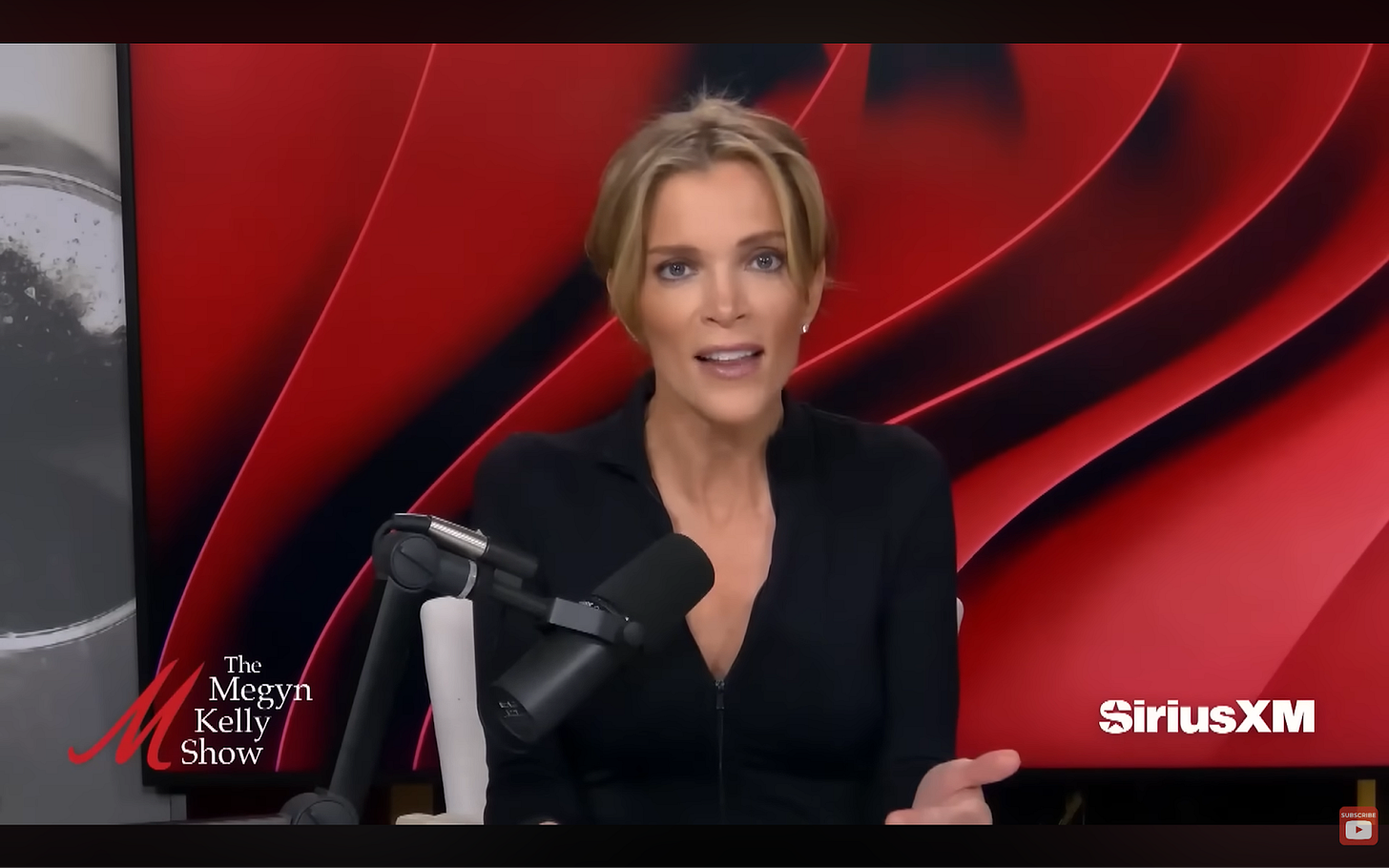
Megyn Kelly in her video. (Megyn Kelly on YouTube)
Former Fox News personality Megyn Kelly posted a video titled “Megyn Kelly Reveals the Truth About the ‘Trans’ Phrases Found on Ammo of Gun Which Shot Charlie Kirk,” to YouTube on Sept. 11, 2025, where she falsely told over 4 million subscribers, “There’s a particularly high percentage [of transgender people] committing crimes these days and it is responsible and important to say so.” The video now has 2.1 million views and Kelly has not retracted these comments.
Her followers—who believed her false claims—began calling for extreme action in the video’s comment section. @WonkoTheDork wrote, “Trans insanity needs to end. I don’t care how, this has to stop.” And @kathleenbarton-m6c wrote, “As an American, I completely agree that this [Trans] movement needs to be completely eradicated.”
Referencing Kirk as a martyr, Texas Attorney General Ken Paxton took it a step further, writing in a press release that “corrupted ideologies like transgenderism and Antifa are a cancer on our culture and have unleashed their deranged and drugged-up foot soldiers on the American people.”
The Social Psychology of Transphobia
Morgenroth thinks many people who endorse rhetoric around transgender domestic terrorism are threatened or afraid of otherness and of the breaking of traditional gender norms.
“People are very attached to the way that they think about gender because it gives them a sense of certainty—it gives them a sense of who they are and who they’re not,” they say.
Morgenroth says people come up with justifications for their discomfort, even if they don’t make sense.
“‘Here’s an explanation for why I should be scared. I’m gonna endorse that and I’m gonna believe that regardless of whether that makes logical sense or not,’” they told Uncloseted Media and GAY TIMES. “I think that’s what’s happening and why people are so willing to endorse these conspiracy beliefs or theories about trans people.”
Joseph Vandello, a psychology professor at the University of South Florida, says that when influential figures ramp up a threat, it triggers an emotional response of fear or anger, which leads to a desire to punish or exclude people.
“This is the same playbook that people were using against gay people going back to the 1970s or against other kinds of marginalized or minority groups like Jews,” Vandello told Uncloseted Media and GAY TIMES, referencing the gay panic of that era. “I think there’s this idea that if you frame the issue in terms of a threat, then it becomes an issue of moral protection of the community.”
Another One Down the Rabbit Hole
Vandello says many young men fall for anti-trans narratives because they confirm their place of privilege in the world and validate their insecurities. He coined the term “precarious manhood,” which is the idea that manhood is a social status that has to be won and can be lost. His research indicates that threats to one’s sense of manhood—like trans and queer identities—provoke not only insecurity, but aggression.
Jordan Peterson (right) being interviewed by Sean Hannity in 2025. (Fox News)
Ten years ago, Justin Brown-Ramsey became a case study of precarious manhood, lashing out when he began thinking that trans people were a threat. At 18 years old, and in search of an escape from his parents’ divorce, he started binge-watching YouTube lectures from Jordan Peterson, a clinical psychologist who’s best known as an outspoken anti-trans thought leader and has said that using someone’s preferred pronouns is the road to authoritarianism.
“He has a degree, he’s working at an institution, it seems like if that’s the kind of guy that has this opinion, I should probably also have that opinion,” Brown-Ramsey told Uncloseted Media and GAY TIMES.
This intellectualized version of transphobia appealed to the sense of insecurity Brown-Ramsey faced growing up in a household with strictly enforced gender roles.
Eventually, Brown-Ramsey became an active participant in anti-trans rhetoric. As an anonymous keyboard warrior, he’d fight in the YouTube comments against the #MeToo, feminist and trans rights movements.
Near the end of his senior year of high school, Brown-Ramsey brought this hatred into the real world against another classmate.
“They mentioned they were trans, and I recall always taking issue with that for seemingly no reason, and being just generally antagonistic about that,” says Brown-Ramsey, now 28.
He purposefully misgendered the student in class and started lashing out against friends, family and romantic partners until he was almost totally isolated.
“I think over time, the less acceptable my behavior was for people in person, the more it became acceptable to lean into the online version of that,” he says. “It went from those lecture videos to watching long rant videos about trans people and gay people, or seeking out stuff that was more 4chan-adjacent.”
Brown-Ramsey, who eventually left the alt-right after deeply engaging with U.S. history in college, believes he was manipulated to hate trans people because it helped him displace his anger about other elements of his life. “I think it was the fact that I was lower working class or lower middle class, and didn’t have an economic future ahead of me,” he says. “I was like, ‘Well if the world is that way then I just might as well be hateful and try to be more powerful than somebody.’”
Undercover in the Alt-Right
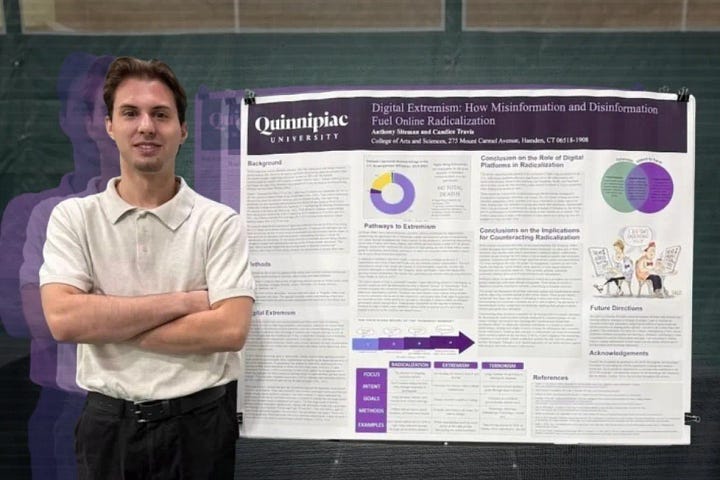
Anthony Siteman (Photo courtesy of Siteman, design by Sam Donndelinger)
This phenomenon of young men getting drawn in by alt-right algorithms fascinated 21-year-old Anthony Siteman, who started investigating online extremism ahead of the 2024 presidential election.
“My main goal was to understand how and why people became radicalized,” Siteman, a senior at Quinnipiac University, told Uncloseted Media.
Siteman immersed himself on right-wing sites like Rumble and Gab as well as encrypted messaging apps like Telegram where he joined channels that included Proud Boys. He noticed trends that draw people in: all caps text, red alarm emojis and inflammatory language, which all trigger a sense of urgency and concern.
He saw constant racist, sexist and transphobic language, but also violent videos and memes created from the livestreamed footage of the 2019 mosque shootings in New Zealand that left 51 people dead.
Even though he entered this project to learn about indoctrination, sometimes he felt his own views slipping. “ I was really questioning myself and what I believed,” he says, adding that he had to turn to his professor to keep him grounded. “They make you really question all of reality.”
“Social media companies are feeding people more extreme content, more emotional content,” Vandello says. He explained that emotionality is what has made the online alt-right successful at manipulating users against transgender people.
Siteman agrees: “ It’s always framed about fear, anger, and just some sense of belonging.”
The Way Out
Siteman believes that to exit these spaces, people outside the alt-right should use empathetic communication to help those in their network who have been radicalized.
For Brown-Ramsey, it was a professor that pulled him out.
“Unlike online spaces, where I curated the information that I wanted to see, and the algorithm fed me more of the same bigoted, hateful content, college was perhaps the first time I was required to engage with media outside of my usual diet,” Brown-Ramsey published in an essay about his experience.
Brown-Ramsey had to read books aloud in class like “Narrative of the Life of Frederick Douglass,” which detailed the abolitionist’s experience being born into slavery. “The narrative turned a mirror onto me and, in upsetting detail, showed me that my inclinations toward antagonizing those who looked, acted, or believed differently than myself [were the same beliefs that] led to Douglass’ dehumanization,” he wrote.
“That trajectory is really just me learning, ‘Why should I be at odds with a trans person if both of us work crappy jobs and can’t pay our bills?’ Obviously, that’s not who I should be angry at, but it took a while to get around to that,” Brown-Ramsey says.
If objective, nonpartisan, rigorous, LGBTQ-focused journalism is important to you, please consider making a tax-deductible donation through our fiscal sponsor, Resource Impact, by clicking this button:
Why I do these posts. This is three days of Joe My God that got away way from me. So why do I do these long news posts? Because I comb the Joe My God comment section for the best memes and snarkiest comments. It dawned on me I could post his news articles for those that want to read them. But three days is a lot to go throw and it is much easier just to quickly scan and snatch the comments rather than post them. So I need some inputs from everyone. Are these posts worth it? Or would you rather go to Joe My God yourselves. Or I can keep doing these. Up to you. Hugs
—————————————————————————————————————————-
tRumps Grifts / Scams / Ripping off the rubes / tRump’s ego / tRump’s Crimes / tRump’s health / Republican grifts & payouts for supporting tRump / other trump scammers
The Trump Golf Tracker estimates that the president’s golf trips have cost taxpayers some $110,600,000 so far in 2025. But that estimate, which was based on a 2019 Government Accountability Office (GAO) report on four golf trips during his first term, doesn’t even take into account the month of December.
The right wing media / the media arms of the GOP & Republican Party / The over the top thuggery and complete disrespect for common decency / Ask if you would like your child to act this way …. because maga does want their kids to be this crass as it makes them feel good / Kennedy Center debacle
The video was shared by Vice President JD Vance. FBI director Kash Patel said he is aware of the video and the FBI is investigating. The YouTuber says he is uncovering new fraud in Minnesota, but media outlets like KSTP reported more than a year ago about more than 62 investigations into Minnesota child care centers.
What this is really about is they are afraid Walz will run for office and win as he is so well liked. They are trying to gin up a fake scandal to Benghazi him like they did with Hillary Clinton. I posted yesterday how fake and full of lies / misinformation the “report” the YouTuber did was. In the article above this one you can see how the Republican Party had a hand in helping the right wing influencer to push a fake story. The state has been investigating these things for several years. Hugs
$175 billion for a “golden dome” that experts doubt would actually work, but only $2 billion in humanitarian aid for the United Nations. It’s what Jesus would want.
Space based weapons are forbidden by treaties that the US signed. That said do we have space based weapons … well I was sending commands somewhere for something when I was in the Army Sat coms / intel unit. You decide. Hugs
Maga hate fail / tRump lost in court / tRump supporters doing what they do not want you to know about / ICE lies / tRump’s DOJ / Misinformation / Trying to change history by spewing & omitting facts or what really happened
The emails, which were made public as part of a newly unsealed judicial order, largely reflected communications about the case that Robert E. McGuire, the acting U.S. attorney in Nashville, had with members of his staff and with Aakash Singh, a top official in Mr. Blanche’s office. They raised serious questions about whether the Justice Department had misled Judge Waverly D. Crenshaw Jr., who is overseeing the case, by telling him that local prosecutors had acted alone in charging Mr. Abrego Garcia.
Hate / Bigotry / DEI / White Supremacy / Christian Nationalism / US aid to only white countries or white dominated areas / US Healthcare / For Profit drug prices rip off the US public /
The civil probes are proceeding under the umbrella of the False Claims Act, which has traditionally been used to go after contractors who bill the government for work that was never performed or inflate the cost of services rendered.
The U.S. slashed its aid spending this year, and leading Western donors such as Germany also pared back assistance as they pivoted to increased defense spending, triggering a severe funding crunch for the United Nations.
U.N. data shows total U.S. humanitarian contributions to the U.N. fell to about $3.38 billion in 2025, equating to about 14.8% of the global sum. This was down sharply from $14.1 billion the prior year, and a peak of $17.2 billion in 2022.
The idea behind the legislation originated with the Alliance Defending Freedom, a conservative Christian legal advocacy group that has gained prominence for its work to incorporate religion in public spaces.
West last appeared here for his bill that would create a database of abortion patients.
In 2024, we heard from West for his bill to ban Pride flags at public schools and government buildings.
He appeared here in 2023 for his bill that would make it a felony to perform drag in the view of minors. His bill called for a $20,000 fine and up to two years in prison.
West first appeared here in 2021 when Gov. Kevin Stitt signed his bill making it legal to run over protesters.
The tweet below refers to West’s attempt to pass this same bill earlier this year.
tRump’s attack on Colorado because they won’t bow to the whim of the tyrant. His withholding money is illegal but no republican will stand up to the demented king.
This is entirely about white grievance and the loss of automatic white privilege. These people believe any white person is better than any black person and they do not want people of color to rise in any company or corporation past basic level worker. They have had white privilege for so long that equality seems like oppression to them. They do not want a country where everyone is equal and all have the same rights. They are demanding a return to a white male dominated society that gave automatic superiority to white people. They also don’t want women or the LGBTQ+ to have rights or be fairly treated in the work force. Hugs
A sign on the wall of the U.S. Department of Justice building in Washington, D.C., U.S., November 14, 2025. REUTERS/Elizabeth Frantz
The Trump administration has launched investigations into the use of diversity initiatives in hiring and promotion at major U.S. companies, the Wall Street Journal reported on Sunday.
Google (GOOGL.O), opens new tab and Verizon (VZ.N), opens new tab are among a list of companies that have received Justice Department demands for documents and information about their workplace programs, the report said, citing people familiar with the investigations.
Reuters could not immediately verify the report. Verizon, Google, and the Justice Department did not immediately respond to requests for comments.
The probes are being conducted under the False Claims Act, the report said, adding that companies under scrutiny include sectors like automotive, pharmaceuticals, defense, and utilities, and some have met in person with Justice Department officials.
The False Claims Act is a federal civil law that allows the government to recover funds lost due to fraud.
President Donald Trump moved quickly after taking office in January to eradicate federal DEI programs and discourage them in the private sector and education, including by directing the firing of diversity officers at federal agencies and pulling grant funding for a wide range of programs
Reporting by Mihika Sharma in Bengaluru; Editing by Ronojoy Mazumdar and Rashmi Aich
Ellie House and Mike Wendling Gainesboro, Tennessee
BBC/Ellie House
Real estate developer Josh Abbotoy on the site of his planned future development outside Gainesboro. Abbotoy’s customers, including two self-described Christian nationalists, have caused controversy locally
As Josh Abbotoy gazes out at lush green woods and pastureland nestled among Tennessee’s Appalachian hills, he describes what he intends to build here: a neighbourhood with dozens of residential lots, centred around a working farm and, crucially, a church.
“A customer might very well buy and build roughly where we’re standing right now,” he says as we hike up to the top of a ridge.
Mr Abbotoy is founder of the real estate company Ridgerunner, which has bought land here and in neighbouring Kentucky. But his is no garden-variety housing development.
Mr Abbotoy is prominent in US conservative circles and describes his development as an “affinity-based community” – marketed to people not only interested in the peace and quiet of rural life, but in a constellation of right-wing ideals.
“Faith, family and freedom,” he says. “Those are the values that we try to celebrate.”
BBC/Mike Wendling
Josh Abbotoy points to a map of his development in the Ridgerunner offices in Gainesboro
Initially he didn’t attract much local attention after setting up shop in Jackson County.
But in late 2024, a local TV news report broadcast controversial statements made by two of Mr Abbotoy’s first, and most outspoken, customers: Andrew Isker, a pastor and author originally from Minnesota, and C Jay Engel, a businessman from California.
They are self-described “Christian nationalists” who question modern values, such as whether female suffrage and the civil rights movement were good ideas, and call for mass deportations of legal immigrants far in excess of President Donald Trump’s current plan. Another thing they sometimes say: “Repeal the 20th Century.”
The TV report raised an alarm bell amongst some local residents.
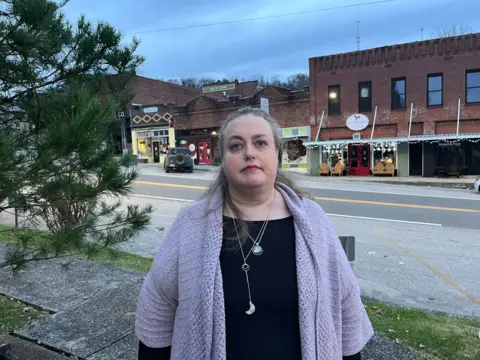
“You don’t know who these people are, or what they’re capable of,” says Nan Coons, a middle-aged woman who spoke in a firm southern accent during a recent interview near the town square in Gainesboro – of which this land is a part.
“And so it’s scary.”
Although Abbotoy himself does not identify as a Christian nationalist, he says concerns about his tenants are overblown.
The Ridgerunner development has since drawn national attention. And people in Gainesboro, home to around 900 people and one traffic light, have now found themselves in the middle of a dispute that is a proxy for much bigger political battles.
Podcasters move in
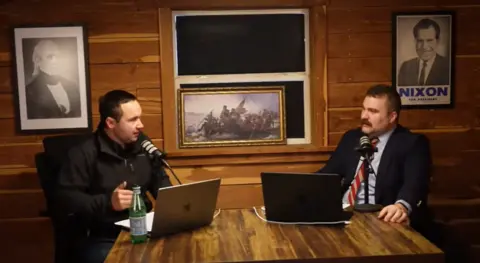
Mr Isker and Mr Engel announced their move to Gainesboro last year on their podcast Contra Mundum – Latin for “against the world”.
On their show, which is now recorded in a studio within Ridgerunner’s Gainesboro office, they have encouraged their fans to move into small communities, seek local influence, and join them in their fight to put strict conservative Christian values at the heart of American governance.
“If you could build places where you can take political power,” Mr Isker said on one episode, “which might mean sitting on the [board of] county commissioners, or even having the ear of the county commissioners and sheriff… being able to do those things is extremely, extremely valuable.”
Contra Mundum
C Jay Engel (l) and Andrew Isker (r) shown during an episode of their podcast
On X, Mr Engel has popularised the idea of “heritage Americans” – a fuzzy concept but one that applies mainly to Anglo-Protestants whose ancestors arrived in the US at least a century ago. He says it is not explicitly white, but it does have “strong ethnic correlations”.
He’s called for mass deportations of immigrants – including legal ones – writing: “Peoples like Indians, or South East Asians or Ecuadorians or immigrated Africans are the least capable of fitting in and should be sent home immediately.”
In their broadcasts and writings they have also expressed anti-gay sentiments. The podcasters deny they are white nationalists.
Both are Ridgerunner customers, and Mr Isker’s church will move into the community’s chapel when it’s complete.
The ‘resistance’
Their hardcore views have alarmed residents, with some locals setting up an informal resistance group.
“I believe that they have been attempting to brand our town and our county as a headquarters for their ideology of Christian nationalism,” says town matriarch Diana Mandli, a prominent local businesswoman who until recently owned a pub on Gainesboro’s central square
Late last year, Mandli led the charge by writing a message on a chalkboard outside her business: “If you are a person or group who promotes the inferiority or oppression of others, please eat somewhere else.”
BBC/Mike Wendling
More signs opposed to the new development followed. When people caught wind that the Ridgerunner guys were holding a meeting at a nearby fast food joint, dozens turned up to confront them.
Ms Coons, whose ancestors have lived in Gainesboro since around the time of the US Revolutionary War, says she engaged Mr Engel in conversation.
“He explained to me that what they’re promoting is what he called ‘family voting’… one vote per family, and of course, the husband in that family would be the one voting” with women frozen out of the electorate.
Mr Engel has since said publicly that it’s not “wrong” for women to vote, although he does support the idea of household suffrage.
BBC/Mike Wendling
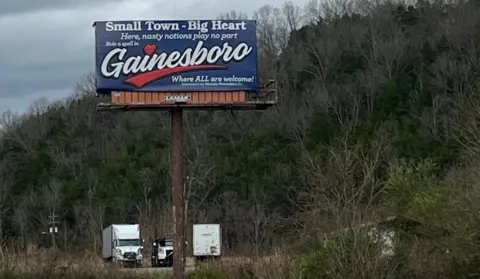
Local residents put up a billboard outside of town
In a county that voted 80% for Donald Trump in the last election, Ms Coons is used to living next door to neighbours with conservative views.
But she and others came away from the protest convinced more than ever that the beliefs of their new neighbours were too extreme.
They say they don’t want to run them out of town, but intend to sound the alarm about what they say are extreme views, as well as thwart any future attempt to take over the local government.
“This is where we have to draw the line,” Ms Coons says.
What is Christian nationalism?
Christian nationalism is a nebulous worldview without a single coherent definition.
At the extreme end, as outlined by theorists including author Stephen Wolfe, Christian nationalists advocate for rule by a “Christian prince” – an all-powerful religious dictator, who reigns over the civil authorities and leads his subjects to “godliness”.
Less extreme versions take the form of calls for Christian law to be explicitly enshrined in American legal codes, for religious leaders to get heavily involved in politics, or simply for an acknowledgement of the Christian background of America’s founding fathers.
This multiplicity of definitions has created a strategic ambiguity that experts say has helped Christian nationalism seep into the mainstream.
Big ideas or far-right plan?
Mr Abbotoy’s development is still in the early stages – his company is building roads and organising sanitation infrastructure. When the BBC visited in November, workers were busy knocking down a decrepit old barn, one of many that dot the Appalachian landscape.
But business is brisk. Around half of the lots are already under contract. Mr Abbotoy anticipates that the first houses will be built and new customers will begin moving in at the beginning of 2027.
BBC/Ellie House
Building on the Brewington Farms site will start within months, with new residents moving in soon, in just over a year
Many of his customers, he says, are moving to heavily Republican Tennessee from Democratic-majority states like California and New York.
“People want to live in communities where they feel like they share important values with their neighbours,” he says.
Mr Abbotoy says he doesn’t call himself a Christian nationalist, but describes the criticism of his customers as “absurd” and says they have no intention to try to take over local government.
“They’re talking about big ideas and books,” he says. As for some of their more controversial views, he insists that “rolling back the 20th Century can mean a lot of things. A lot of conservatives would say we took a lot of wrong turns.”
Mr Isker and Mr Engel did not respond to multiple requests for comment and a list of questions.
BBC/Ellie House
Nan Coons belongs to an informal group of Gainesboro residents who are alarmed at their new Christian nationalist neighbours
Small-town fight goes nationwide
The fight here in Gainesboro has drawn in players far from small-town Tennessee.
Mr Abbotoy, who was educated at Harvard Law School, is also a partner at a conservative venture capital fund, New Founding, and a founder of the American Reformer, a website that has published the writings of a number of other prominent Christian nationalists.
His opponents meanwhile have received research assistance and advice from a national organisation, States at the Core, established last year to tackle authoritarianism in small communities. It is funded by a constellation of left-wing organisations. States at the Core declined our request for an interview.
The men of Ridgerunner have pointed to the organisation as evidence that the pushback against their project has been orchestrated by powerful liberals. The locals say this is ridiculous.
“Nobody’s cut me a cheque to say anything,” Ms Coons says.
In Gainesboro, people on all sides see a much bigger story – one of large-scale political fights playing out in rural America.
Republicans have made huge gains in rural areas this century, and in 2024 Trump stretched his lead in rural communities, winning 69% of the vote. The Democratic Congressional Campaign Committee recently announced a reported eight-figure investment ahead of the 2026 midterm elections, a chunk of which will be dedicated to winning rural voters.
“There’s definitely a renewed, [Democratic Party] focus on rural engagement,” Mr Abbotoy says. “And at the same time, there’s been a wave of people moving to small town America precisely because they like the Bible Belt, they like the conservative traditional culture.”
But Nan Coons and her allies say they aren’t ready to concede rural areas like her hometown to Christian nationalists.
“If we are going to turn this tide, it starts on your street, it starts in your neighbourhood, it starts in your small town,” she says.
“I have to stand for something, and this is where I stand.”
More tRump stupidity / tRump putting his branding everywhere / is he the president or chief architect / Fluffing tRump’s ego / tRump’s grifting / tRump’s lies & misinformation
That’s $100,000/head. tRump doesn’t care as he spends the taxpayers money / countries treasury like a drunk spending other peoples money. He is a tryant in that he thiinks that money is his todo what he wants even though the law states that only congress controls spending. This is human traficing plain and simple. Hugs
In September 2025, Turner’s agency sponsored a far-right anti-LGBTQ extremist to lead a massive Christian nationalist rally on Washington DC’s National Mall, the first-ever such event formally sanctioned by the federal government.
In June, it was reported that Turner is moving to take over the former National Science Foundation building as his agency’s headquarters, where he has demanded a full-floor executive suite, a private dining room, and parking for his five personal cars.
It is not lost on me that the above story is a woman with a career telling other woman they need to be stay at home mothers / trad wives to please a man because of religious dogma. Hugs
Yarborough appeared here last month for his bill that would ban Pride flags at government buildings, including public schools.
He appeared here in April 2025 for his bill that would ban thousands of books, including classic novels, over sexual content.
Yarborough appeared here March 2025 for his bill that would ban civil rights ordinances enacted by cities and counties, including, presumably, LGBTQ protections.
He first appeared on JMG in 2010, when as a member of the Jacksonville City Council he declared that gays, Muslims, and atheists should not be permitted to hold public office, otherwise God will smite the country.
In April 2023, lawmakers approved Yarborough’s ban on drag shows before minors. Yarborough is also the author several anti-trans bills.
Borrero appeared here in 2023 for a ban on Pride flags that died in committee. He tried again last year, but that attempt died after passage in its first committee hearing.
Borerro first appeared on JMG in January 2022 for his successful bill mandating that Florida public schools recognize an annual “Victims Of Communism Day.”
Oltmann appeared here last year when he called for executing Joe Biden, adding, “I want to send the mainstream media to the gallows, radical leftists to the gallows, traitors to our nation to the gallows, and they all kind of fit in the same bucket.”
In 2022, he appeared here when he announced that he would lead a “well-armed action” to install Kari Lake as governor of Arizona.
In 2021, he appeared here when he called for executing the 19 Republican Senators who voted to avert a government shutdown.
2025 has been filled with relentless and unprecedented attacks against the LGBTQ community in the U.S. President Donald Trump’s anti-LGBTQ policies have spilled over to countries abroad, including heading north to some conservative Canadian provinces like Alberta.
Despite this, there have been moments of hope. Here is Uncloseted Media’s 2025 LGBTQ year in review.
Jan. 1
Liechtenstein’s Marriage Act, passed in 2024, officially takes effect, opening marriage to same-sex couples and aligning the microstate with 21 other European nations that already recognize same-sex marriage.
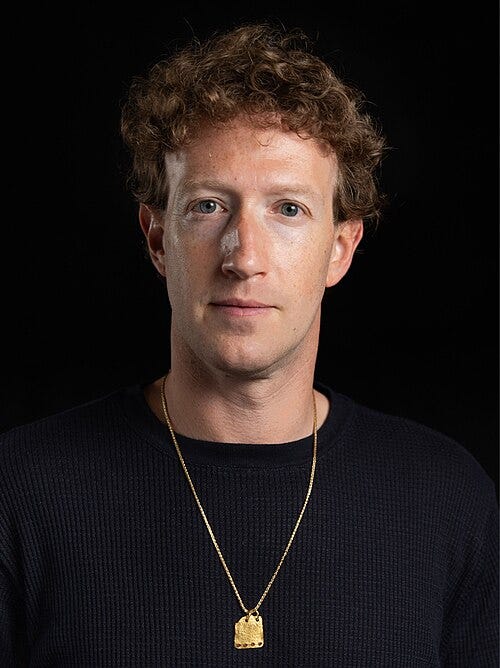
Meta introduces new rules to their platforms. They remove their third-party fact-checking program and roll back hate speech restrictions, which allows anti-LGBTQ rhetoric to flourish. A report by Uncloseted Media identifies users who spew trans and homophobic language. One user wrote, “Look at this disgusting piece of fag shit here !” Another told someone to go to “the insane asylum where you belong, tranny freak.” Both of these comments are still up on the platform.
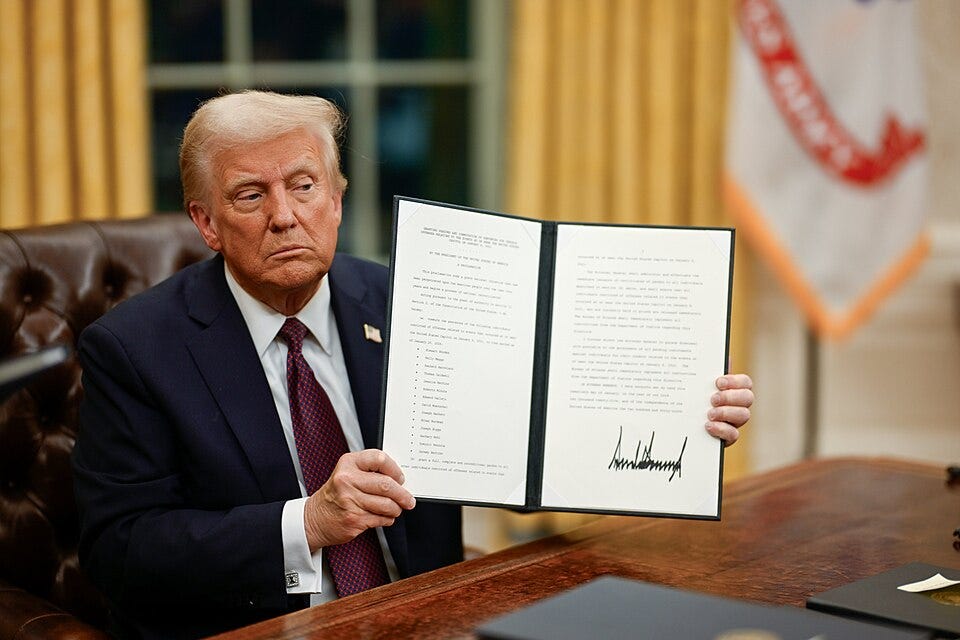
On the first day of his second term, President Trump signs an executive order titled “Defending Women from Gender Ideology Extremism and Restoring Biological Truth to the Federal Government.” The order forces federal agencies to treat sex as a fixed male and female binary “assigned at conception,” calls for “gender” to be scrubbed from federal guidance, halts federal funding for gender-affirming care and mandates trans women in prison to be sent to male facilities. Trump also issues a stop-work order for PEPFAR, the biggest HIV/AIDS relief program in the world. This kicks off a broader pattern of cuts to HIV prevention and research.
Over the next three months, Trump continues his attacks on the LGBTQ community by signing another executive order that bans trans women and girls from competing on sports teams that match their gender identity. He also directs agencies to curb gender-affirming care for anyone under 19 and to strip funding from schools that allow social transition, inclusive bathrooms or the use of affirming names and pronouns.
Jan. 23
Same-sex marriage becomes the law of the land in Thailand, making it the first country in Southeast Asia to recognize marriage equality and equal adoption rights for gay couples.
Jan. 27
The Idaho House passes a resolution urging the U.S. Supreme Court (SCOTUS) to revisit and overturn Obergefell v. Hodges, signaling a renewed appetite to attack marriage equality at the federal level.
Feb. 6
Australia amends its federal Criminal Code to add sexual orientation, gender identity and intersex status as protected characteristics in hate-crime law. This creates stronger penalties for perpetrators of anti-LGBTQ hate crimes across the country.
Feb. 13
Sam Nordquist, a trans man from Minnesota, is found dead in Upstate New York after a woman he met online kidnapped and tortured him for weeks in a hotel room. Seven people connected to his death have been charged with murder. Sam’s friend, Jax Seeger, spoke to Uncloseted following the tragedy:
“From my understanding, they came out and said it wasn’t a hate crime … and part of their reasoning was because one or two of the suspects self-identified within the [LGBTQ] community. … Like, you can’t say that just because they identified as LGBTQ, they’re incapable of committing a hate crime. Sammy wasn’t just physically abused. He was psychologically abused and they didn’t go into what that consisted of, but I think that’s something to keep in mind. As well as just the level of abuse you know? Trans people deserve the same respect and the same love as everyone else.”
The week after our interview with Seeger, prosecutors upgrade the charges against Nordquist’s accused killers to first-degree murder.
Feb. 14
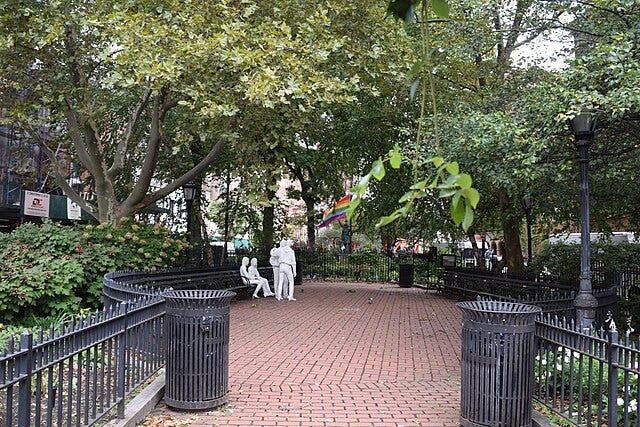
The Stonewall National Monument. Photo by TheCatalyst31.
The National Park Service (NPS) erases mentions of transgender people from the Stonewall memorial, furthering conservative efforts to push “LGB” without the “T.” A few months later, NPS would go on to remove mentions of bisexuals as well.
Feb. 25
Mexico City Pride 2025. Photo by Wotancito.
Mexico City’s Congress approves a resolution to reform the Law for the Recognition and Attention of LGBTTTI+ Persons. This move effectively recognizes nonbinary people.
Feb. 28
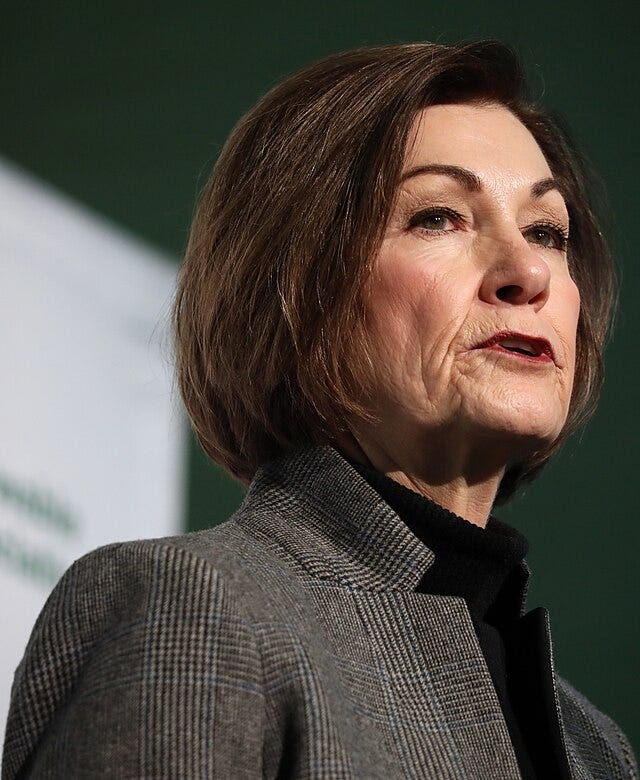
Kim Reynolds in 2024. Photo by Gage Skidmore.
Iowa Gov. Kim Reynolds signs SF 418 into law. This move officially removes “gender identity” from the Iowa Civil Rights Act’s list of protected classes in housing, employment and public accommodations. Iowa becomes the first state to remove civil rights from a previously protected group.
March 27
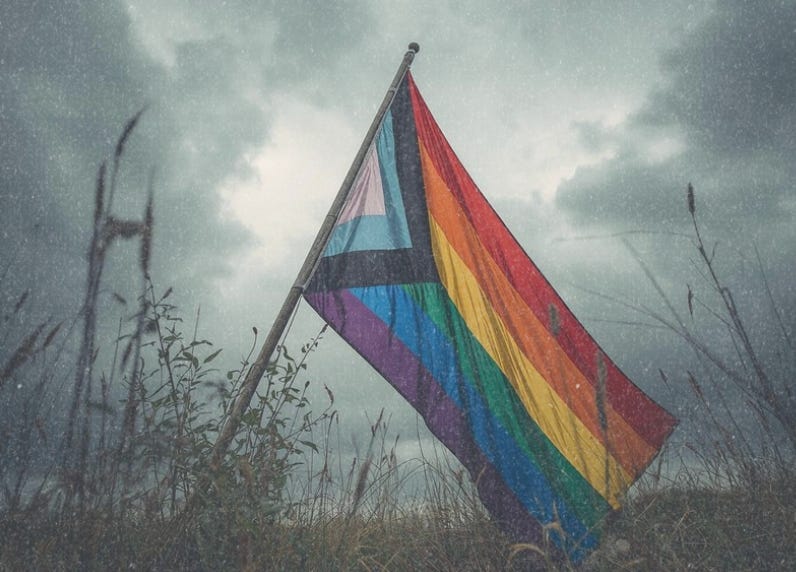
Gov. Spencer Cox announces that Utah will become the first state to ban LGBTQ pride flags in government buildings and public schools, effective May 7. While the move is framed as a “neutrality” measure, it is widely seen as part of a broader effort to erase public displays of queer identity. In protest, the Utah Pride Center unveils what it calls “the world’s largest transgender flag” in front of Utah’s State Capitol building in Salt Lake City.
April 4
A conversion therapy ban in New South Wales (NSW), Australia, goes into effect. This makes it illegal for therapists and religious leaders to practice conversion therapy on gay and trans people. In a media release, the NSW attorney general writes:
“This follows ongoing work by the NSW Government to progress reforms that ensure all members of our community feel valued, respected and equal.”
“This report not only rejects health care best practices for transgender people — it goes a step further by recommending conversion therapy, though under a new, rebranded name, ‘exploratory therapy’. Despite the report’s claims, this is, in fact, the same harmful practice of conversion therapy, just using friendlier language.”
May 6
Trump’s transgender military ban goes into effect. The change requires active trans service members to self-separate from the military or risk losing some of their Veterans Affairs benefits. Alaina Kupec, a retired transgender U.S. Navy lieutenant, says the decision punishes people who are qualified and want to serve the country:
“[This is] a really dark day for our country where basically we’re allowed to discriminate against a class of people.”
May 19
A Russian court fines Apple roughly $130,000 for four offenses, including the violation of Russia’s expanded “LGBT propaganda” law. The Russian law labels the “international LGBT movement” as extremist and treats queer visibility as a threat to state security. Anything that promotes “non-traditional sexual relations” violates the law.
May 30
Puerto Rico’s Supreme Court rules that residents can request an “X” gender marker on their birth certificates. This move explicitly recognizes nonbinary people and strengthens case law around self-determined gender in the U.S. territory.
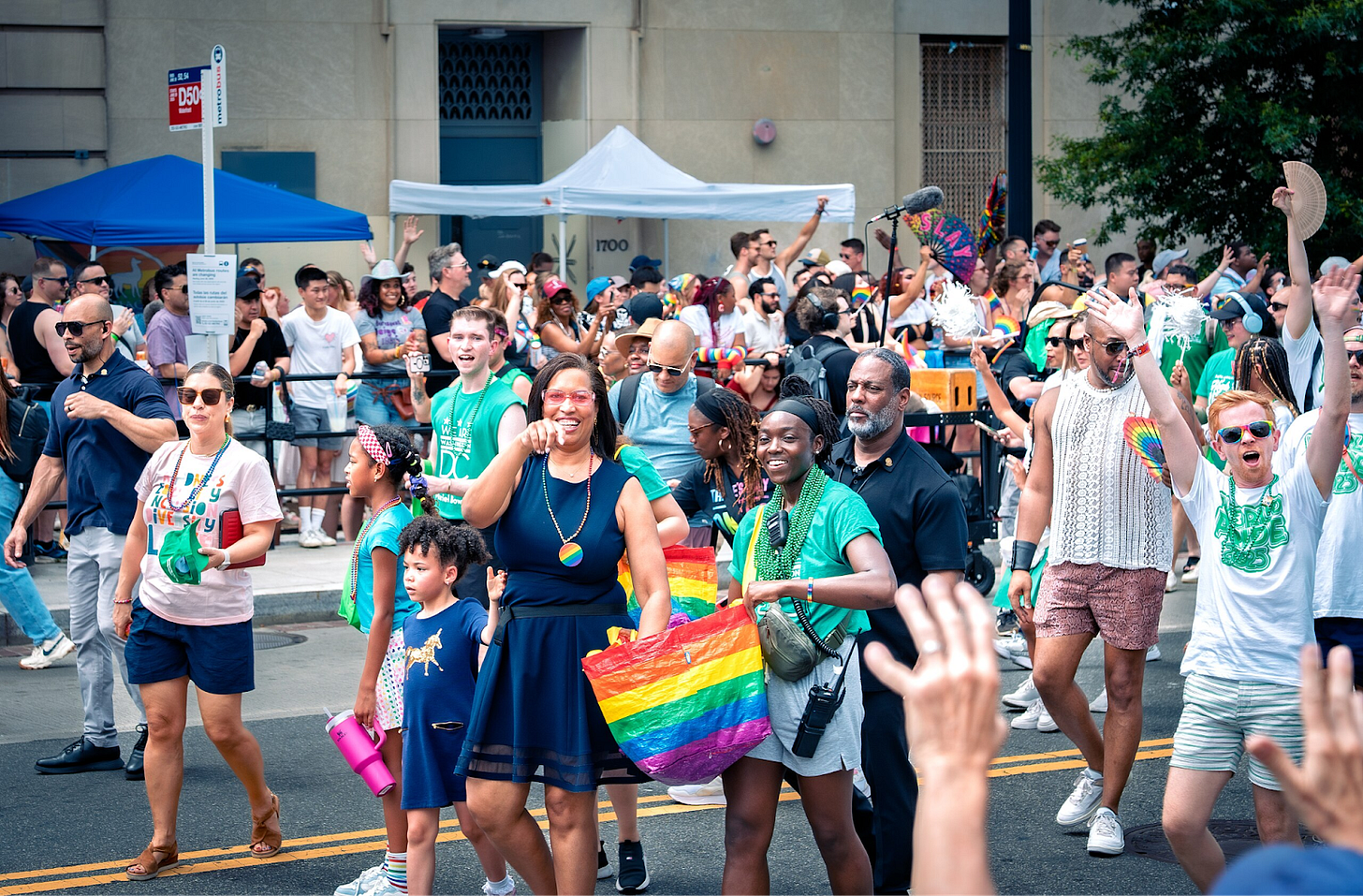
Amid relentless attacks from the federal government, WorldPride takes place in Washington D.C. Ahead of the event, the African Human Rights Coalition calls for a boycott because of Trump’s swath of anti-LGBTQ policies. While roughly 1.2 million people attend, The Washington Post reports that the turnout is less than half of what organizers expected.
June 18
In a 6–3 decision, SCOTUS upholds Tennessee’s law banning gender-affirming care for minors, including puberty blockers and hormones. The ruling signals that similar bans in other Republican-controlled states are likely to stand, sharply narrowing access to medically recommended care for trans youth nationwide. Ten days after the ruling, five trans youth speak to Uncloseted Media, with Dylan Brandt, 20, saying:
“Lawmakers don’t need to be involved in my doctor visits. They have no right. They have no knowledge. … They’ve got a lane and they should stay in it.”
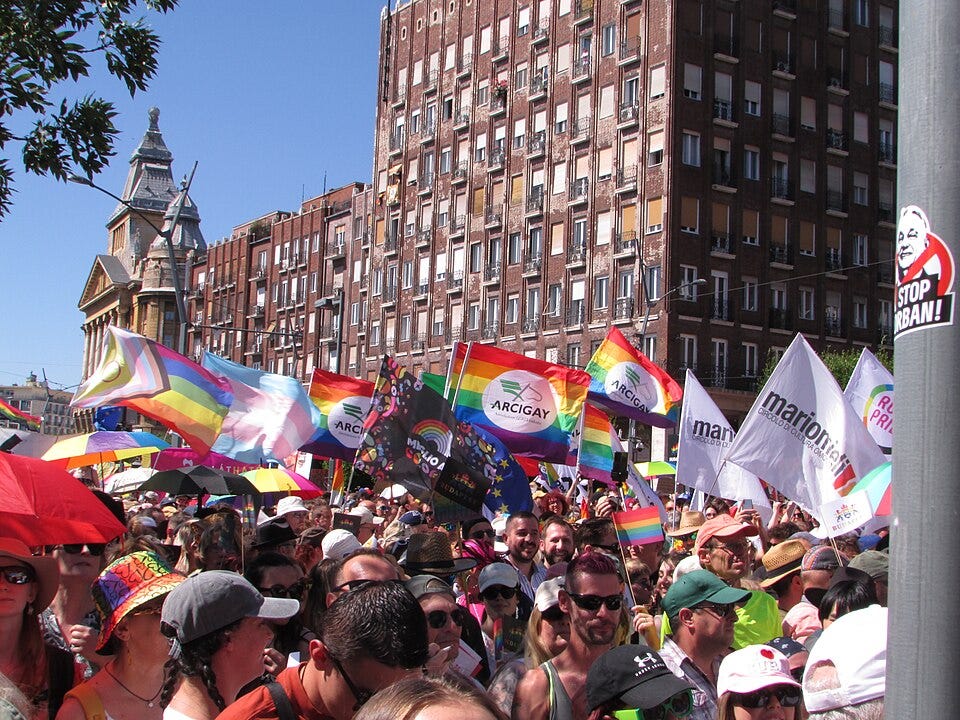
In defiance of a government ban on Pride events, roughly 100,000 people march the streets of Budapest, Hungary, to celebrate. The march was seen as both a showing of support for LGBTQ rights and a protest against Prime Minister Viktor Orbán’s conservative government.
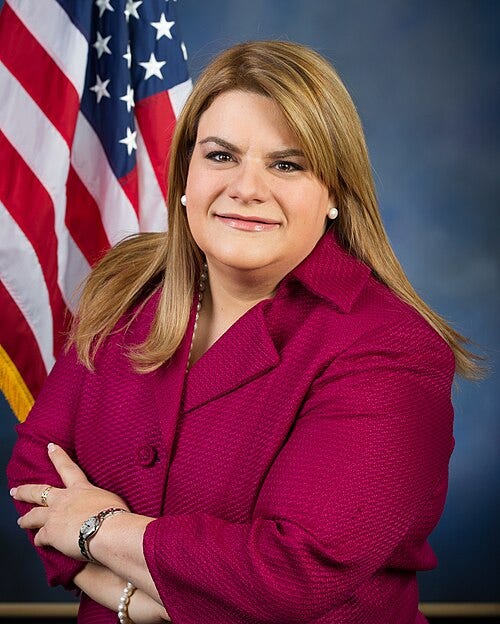
Puerto Rico’s governor, Jenniffer González-Colón, signs one of the harshest anti-trans health care laws in the northern hemisphere. The law bans gender-affirming care for anyone under 21 and threatens to cut off public funding for hospitals that don’t comply. It also threatens doctors with up to 15 years in prison and loss of licensure for violations. Puerto Rico’s LGBTQ+ Federation and GLAAD release a joint statement condemning the bill:
“Banning this care and stripping the rights of parents to make the best medical decisions for their families would create unbearable burdens for the most marginalized in Puerto Rico. Lawmakers must vote to protect access to health care that saves lives, and allow families to make private health care decisions that help loved ones be themselves, be safe, and to thrive.”
July 17
The Trump administration shuts down the LGBTQ suicide hotline, a life-saving resource that had received over 1.3 million calls, chats and texts since it launched in 2022. Genna Brown, a 16-year-old queer kid in North Carolina, who had used the hotline, spoke with Uncloseted Media about the impact it had on her mental health:
“I was an extremely self-loathing, suicidal kid who was under the impression that God hated me and I was gonna burn in hell for eternity. … Connecting with someone who gets it was really helpful. … Because at home, I was so isolated and I didn’t really interact with other queer people.”
July 18
Cuba’s National Assembly passes a law allowing trans people to change their legal gender without any requirement for genital surgery. In a post on X, Minister of Justice Oscar Silvera Martínez writes that the new law “will allow the country to have a modern civil registry” provided by “the issuance of digital documents with full validity and efficiency.”
July 29
In a move hailed by human rights groups, the Caribbean nation of St. Lucia strikes down colonial-era laws criminalizing “buggery,” effectively decriminalizing consensual same-sex intimacy between adults.
Aug. 20
In the middle of the night, Florida’s Department of Transportation paints over a rainbow crosswalk made to honor the victims of the Pulse nightclub terrorist attack that left 49 people dead. Advocates respond in protest by installing rainbow-colored bike racks.
Sept. 1
Burkina Faso’s Transitional Legislative Assembly passes a law explicitly criminalizing homosexuality. The law imposes a two- to five-year prison sentence and fines on people convicted of same-sex activity, deepening the criminalization of queer people in West Africa.
Sept. 10
The assassination of Charlie Kirk at Utah Valley University (UVU) kicks off a wave of anti-trans vitriol, including calls to criminalize the community and designate them as terrorists. In September, Uncloseted Media interviewed five current and former LGBTQ students at UVU. Simone Goodheart, a trans woman who had recently attended the school, spoke about how students were suggesting she was the murderer and how they were harassing her on campus:
“I would say a few of them were asking me to share my school schedule, which thankfully I’m not a student right now. But like damn, if that was the case? A few of them just make awful comments about my appearance, who I am as a person. Basically they just wanted to make sense [of it], but also they wanted to get their outrage out. Because yeah, somebody they cared for died. They are going through the grieving process and like there is outrage and frustration but they were misdirected and misconnected and just utilized by awful algorithms that try to boost the most amount of outrage possible in order to encourage engagement.”
Sept. 26
Slovakia’s parliament passes a constitutional amendment that formally recognizes only two genders, restricts legal gender transition and prohibits adoption by same-sex couples nationwide.
Oct. 6
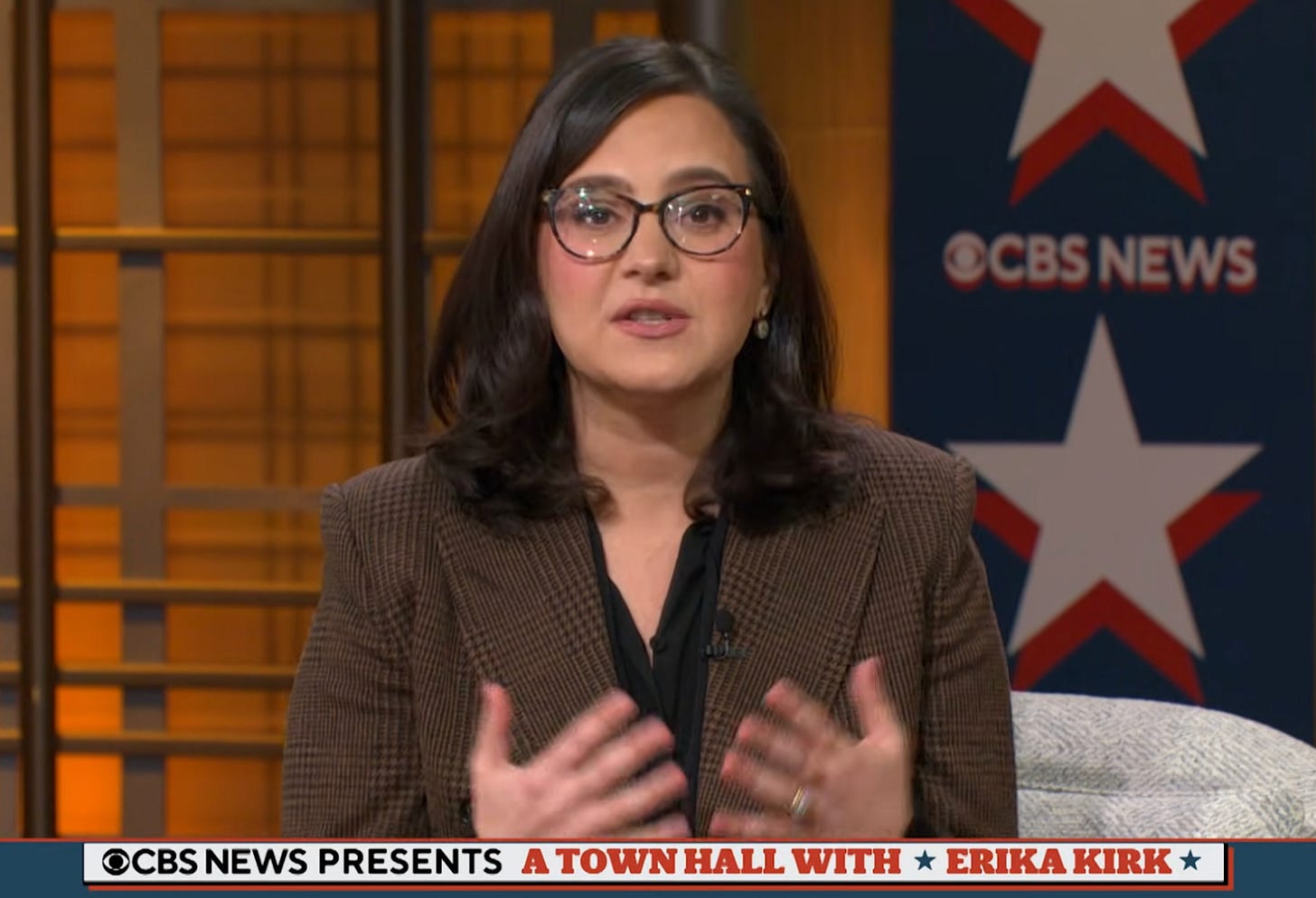
Bari Weiss hosting a CBS News Town Hall with Erika Kirk. Screenshot/CBS News.
Bari Weiss is appointed editor-in-chief of CBS News, making her the first openly gay person to lead the network. Weiss often angles herself as an independent thinker and is known for criticizing the mainstream media. She has no experience in broadcast news and has surrounded herself in controversy, accusing former colleagues at The New York Times of bullying her. She has also railed against Diversity, Equity and Inclusion (DEI) initiatives, writing articles with headlines such as “Bari Weiss: End DEI.”
“It is time to end DEI for good. No more standing by as people are encouraged to segregate themselves. No more forced declarations that you will prioritize identity over excellence. No more compelled speech. No more going along with little lies for the sake of being polite.”
Oct. 7
SCOTUS appears poised to rule against a Colorado law that bans the discredited practice of conversion therapy on minors. The justices repeatedly question the state over whether the law hinders free speech.
The high-stakes case could roll back the rights of LGBTQ youth across the country. Colorado is one of more than 20 states that have banned conversion practices, and a ruling in favor of removing the ban could make those laws in other states vulnerable to similar challenges.
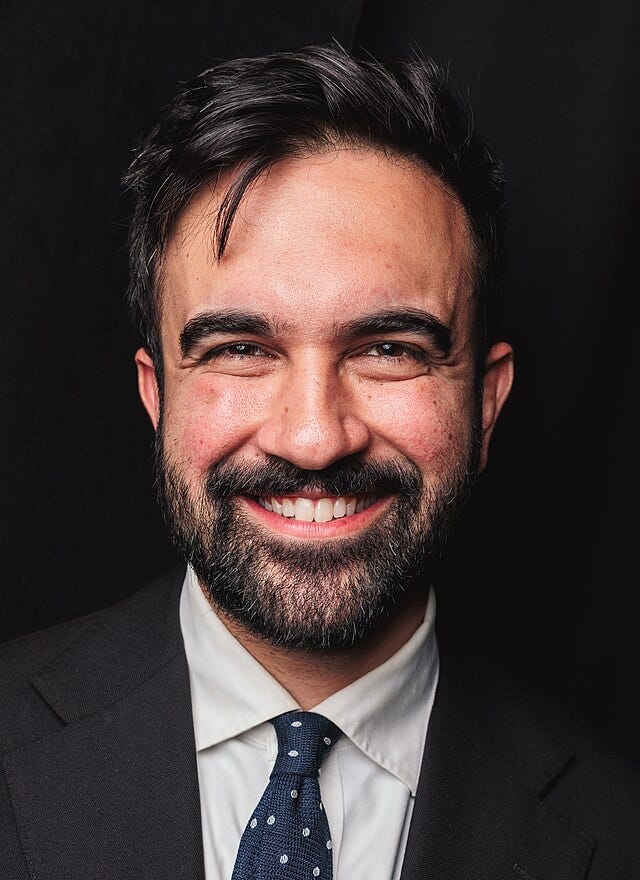
Zohran Mamdani, one of the most outspokenly pro-trans politicians in the country, is elected mayor of New York City. Meanwhile, anti-LGBTQ Republicans are defeated in Virginia’s and New Jersey’s gubernatorial elections. On the night of his win, Mamdani reaffirms his support for those who elected him:
“In this moment of political darkness, New York will be the light. Here, we believe in standing up for those we love, whether you are an immigrant, a member of the trans community, one of the many black women that Donald Trump has fired from a federal job, a single mom still waiting for the cost of groceries to go down, or anyone else with their back against the wall. Your struggle is ours, too.”
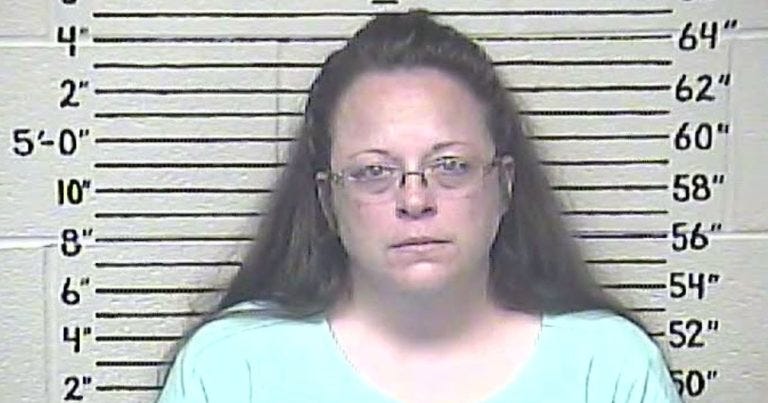
In a massive win for gay rights, SCOTUS rejects Kim Davis’ appeal and won’t revisit the landmark decision that legalized same-sex marriage nationwide in 2015. This signifies a major defeat for the new push to overturn the ruling, which was spearheaded by Davis and her lawyers from Liberty Counsel.
Nov. 17
Across Alberta, Canada, anti-trans legislation takes effect. A trans sports ban for students also forces sports organizations and schools to collect sensitive personal information that risks outing trans and gender diverse youth. Alberta Premier Danielle Smith announces plans to circumvent legal opposition to the province’s ban on gender-affirming care for minors by invoking the notwithstanding clause, a constitutional provision that will stop such challenges for five years. The measure was also used in Alberta in 2000 to advance legislation opposing gay marriage.
Nov. 19
New Zealand’s health minister, Simeon Brown, announces a halt to new prescriptions of puberty blockers for minors with gender dysphoria. Brown says the ban will remain until a British clinical trial is completed. Existing patients can continue treatment.
Nov. 25
The European Union’s (EU) top court rules that member states must recognize same-sex marriages contracted in any EU country for purposes such as residence and free movement, binding more conservative governments such as Poland, Bulgaria, Romania and Slovakia to acknowledge queer couples’ marital status even if they refuse to perform such marriages at home.
Dec. 2
ADF International, the global arm of U.S. anti-LGBTQ legal group Alliance Defending Freedom, publicly backs a South Australian woman threatening legal action over a Headspace Berri mental-health presentation that mentioned LGBTQ issues, incest and bestiality in a classroom context. Elenie Poulos, an expert on the intersection of religious and political discourses, describes their impact as “huge,” saying:
“They have a very longstanding and aggressive approach to the rights of LGBTIQ people. They fight it in the courts in the US, they fight it politically, locally and in communities, and their aggressive anti-gay stance is extremely harmful.”
Dec. 18
Robert F. Kennedy Jr. and Dr. Oz announcerestrictive measures designed to block minors’ access to gender-affirming care. The plan proposes federal Medicare and Medicaid cuts to all hospitals that provide this care to minors. “The multitude of efforts we are seeing from federal legislators to strip transgender and nonbinary youth of the health care they need is deeply troubling,” says Rodrigo Heng-Lehtinen of The Trevor Project.
Dec. 21
CBS News shelves a planned 60 Minutes segment on men deported to CECOT, an infamous prison in El Salvador. Internal sources indicate that the move to cancel the story came from the network’s editor-in-chief Bari Weiss, who reportedly raised concerns about the Trump administration’s lack of response to the reporter’s outreach.
If objective, nonpartisan, rigorous, LGBTQ-focused journalism is important to you, please consider making a tax-deductible donation through our fiscal sponsor, Resource Impact, by clicking this button:










 Scottie's Playtime
_(cropped).jpg)
.jpg)

#/media/File:2025.06.07_World_Pride,_Washington,_DC_USA_158135_05745_(54582538995).jpg)

.jpg)
.jpg)