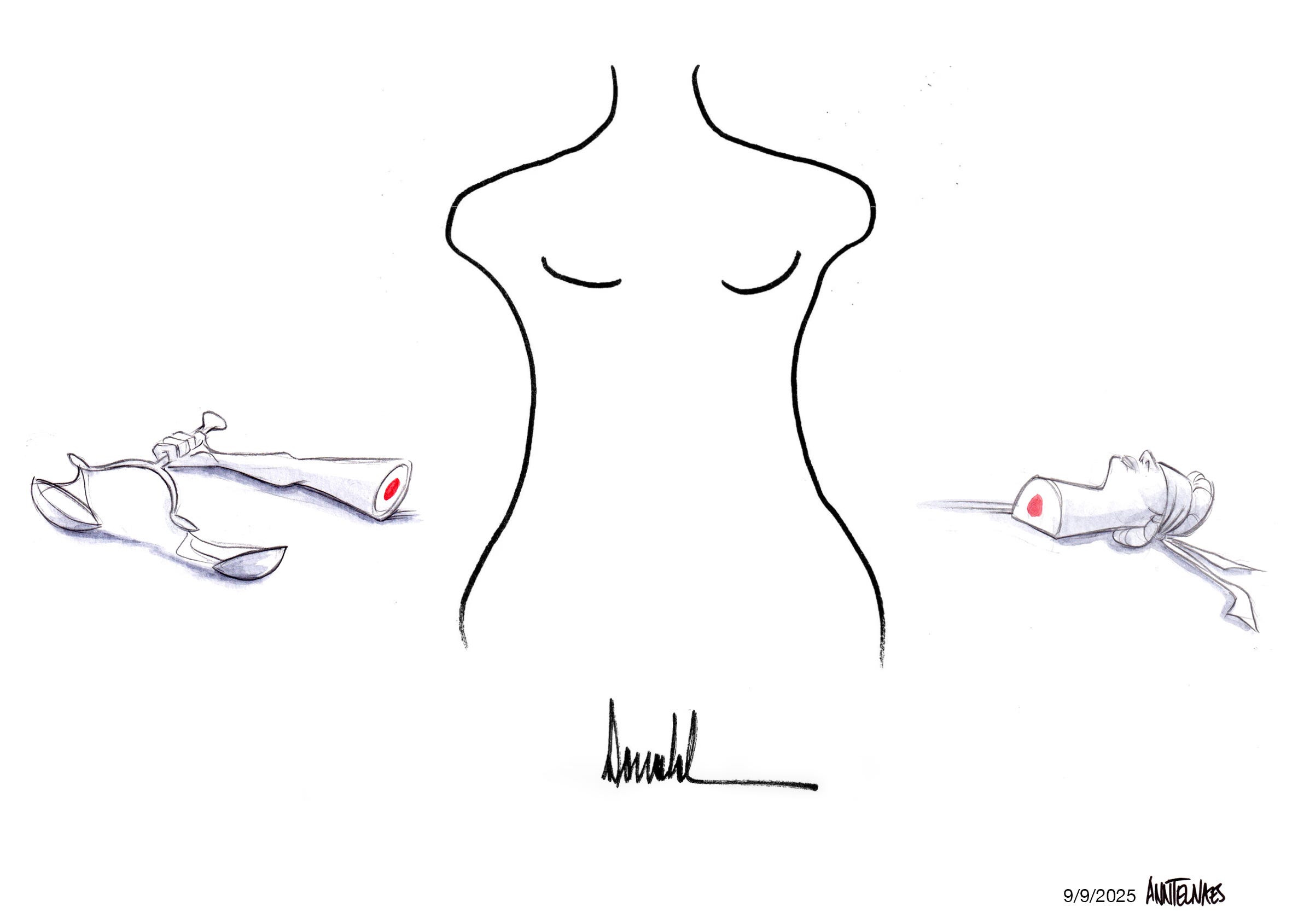
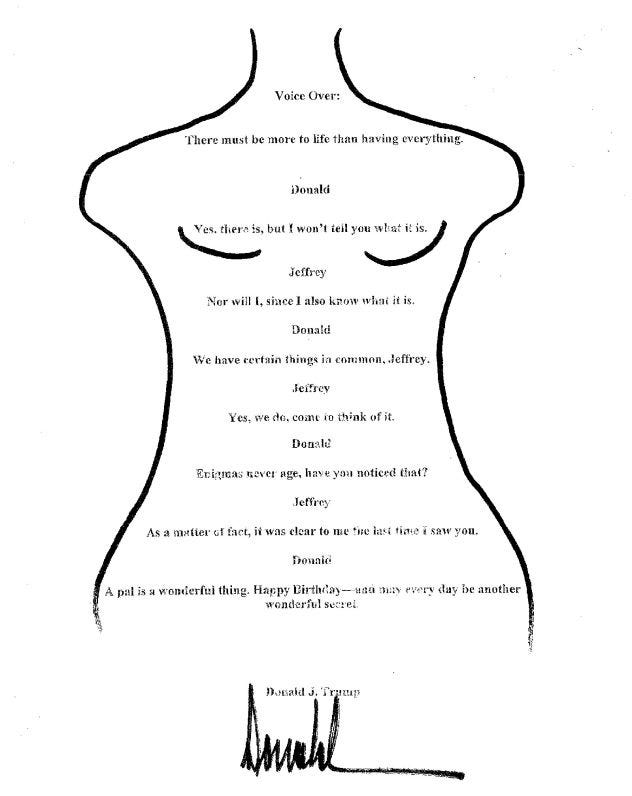
When I first saw Trump’s drawing for Epstein’s birthday book, something immediately caught my eye. Putting aside the horrible context for the sketch, the fact he drew a female body with no head or arms was really disturbing to me.
=====
Leavitt To Beaver by Clay Jones
The White House says it’s not Trump’s signature on the birthday card Read on Substack
When The Wall Street Journal reported that Donald Trump sent his best friend and pedophile Jeffrey Epstein a card and drawing for his 50th birthday in 2003, Trump said it didn’t exist. It was reported that the drawing was lewd.
Yesterday, we found out that it does exist, as the Democrats on the House Oversight Committee subpoenaed the “birthday book” from Jeffrey Epstein’s estate. The drawing and note are lewd…and really weird.
The sketch is an outline of a woman’s body with text of an imaginary conversation between Trump and Epstein. At the bottom, Trump’s signature of just his first name appears to be the drawn woman’s pubic hair. (snip-MORE)
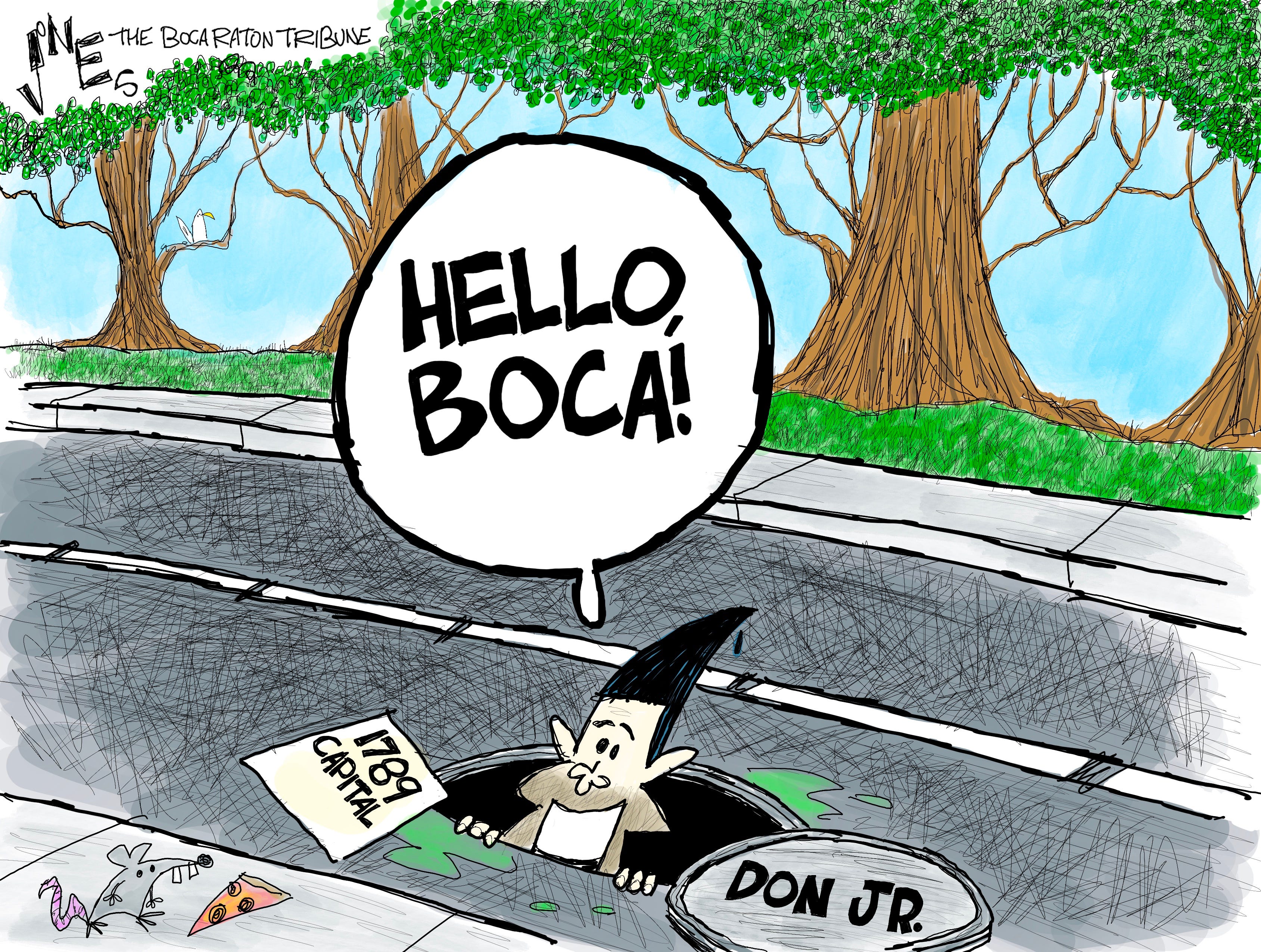
This cartoon was drawn for the Boca Raton Tribune. Apparently, Donald Trump Jr’s new real estate firm has plans for Boca Raton, which is already struggling with other tasteless capitalist groups.
Corrections: Please email all typos, boo-boos, and any other mistakes to clayjonz@gmail.com. If you put it in the comments, I may not see it until hours or days later. Thanks.
Creative note: I don’t like the way my trees turned out. I’ll do a better job the next time I have to draw Banyan trees for Boca. (snip-MORE)
Citizenship Blues by Clay Jones
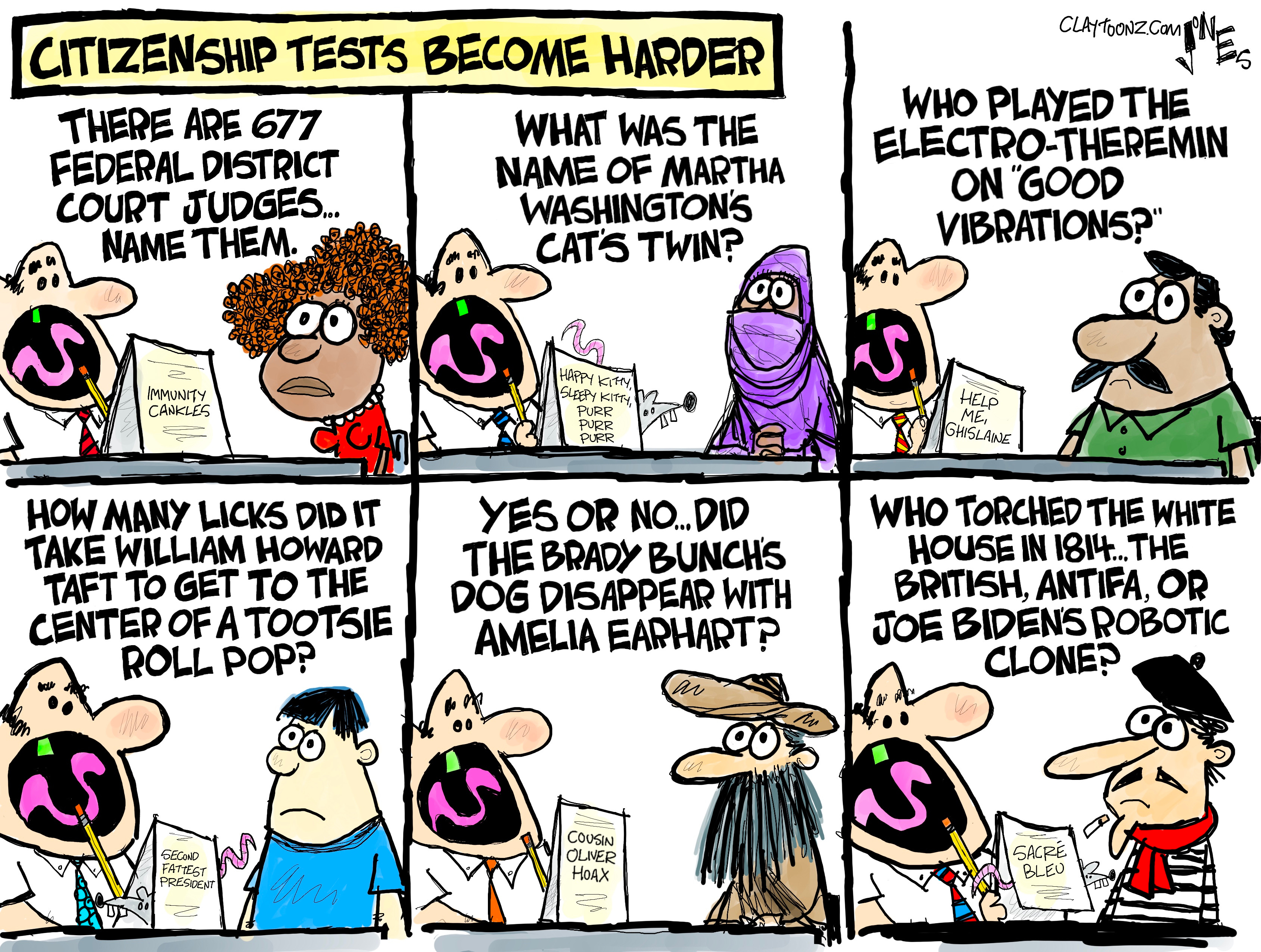
The citizenship test is going to become more difficult Read on Substack
Republicans don’t just hate illegal immigration. They hate most immigration, even legal.
During his first term, Trump complained about people immigrating to the United States from “shithole” countries, and wondered why we couldn’t get more people from nations like Norway. You know, majority White nations.
During the campaign last year, Trump held a fundraiser in Palm Beach with millionaires and bemoaned the lack of immigrants from “nice” countries.
Trump said to the millionaires, “And when I said, you know, ‘Why can’t we allow people to come in from nice countries,’ I’m trying to be nice. Nice countries, you know, like Denmark, Switzerland? Do we have any people coming in from Denmark? How about Switzerland? How about Norway?” You know, White countries.
Except, people from the “nice” countries, like Denmark, Switzerland, and Norway, don’t want to come to an asshole country. These nations are ranked as some of the happiest in the world. Why would they want to come to the angriest? They know we have an ugly orange garden gnome as our leader. Guess what nation they’re talking about when they complain about immigrants from shithole countries.
Trump also complained of criticism over his “shithole countries” comment, saying, “And you know, they took that as a very terrible comment, but I felt it was fine.” Of course, he felt it was fine. It was racist. (snip-MORE)
September 10, 1897 Nineteen unarmed striking coal miners were killed and 36 more wounded in Lattimer (near Hazleton), Pennsylvania, for refusing to disperse, by a posse organized by the Luzerne County sheriff. The strikers, most of whom were shot in the back, were originally brought in as strike-breakers, but later created their own union. The background and details
September 10, 1963 Twenty black students entered public schools in Birmingham, Tuskegee and Mobile, Alabama. The Governor George C. Wallace had ordered Alabama state troopers to stop the federal court-ordered integration of Alabama’s elementary and high schools. President John Kennedy responded by calling out the Alabama National Guard to protect the students and to see the order enforced. President Kennedy spoke that day at American University’s commencement, saying, “Peace need not be impractical, war not inevitable . . . There is not peace in many of our cities because there is not freedom.”
September 10, 1996 Sheryl Crow’s second album was banned from Wal-Mart stores because the song she co-wrote with Tad Wadhams, “Love Is A Good Thing” opens with “Watch out sister, watch out brother, Watch our children while they kill each other With a gun they bought at Wal-Mart discount stores….” Read more about this eventand an update
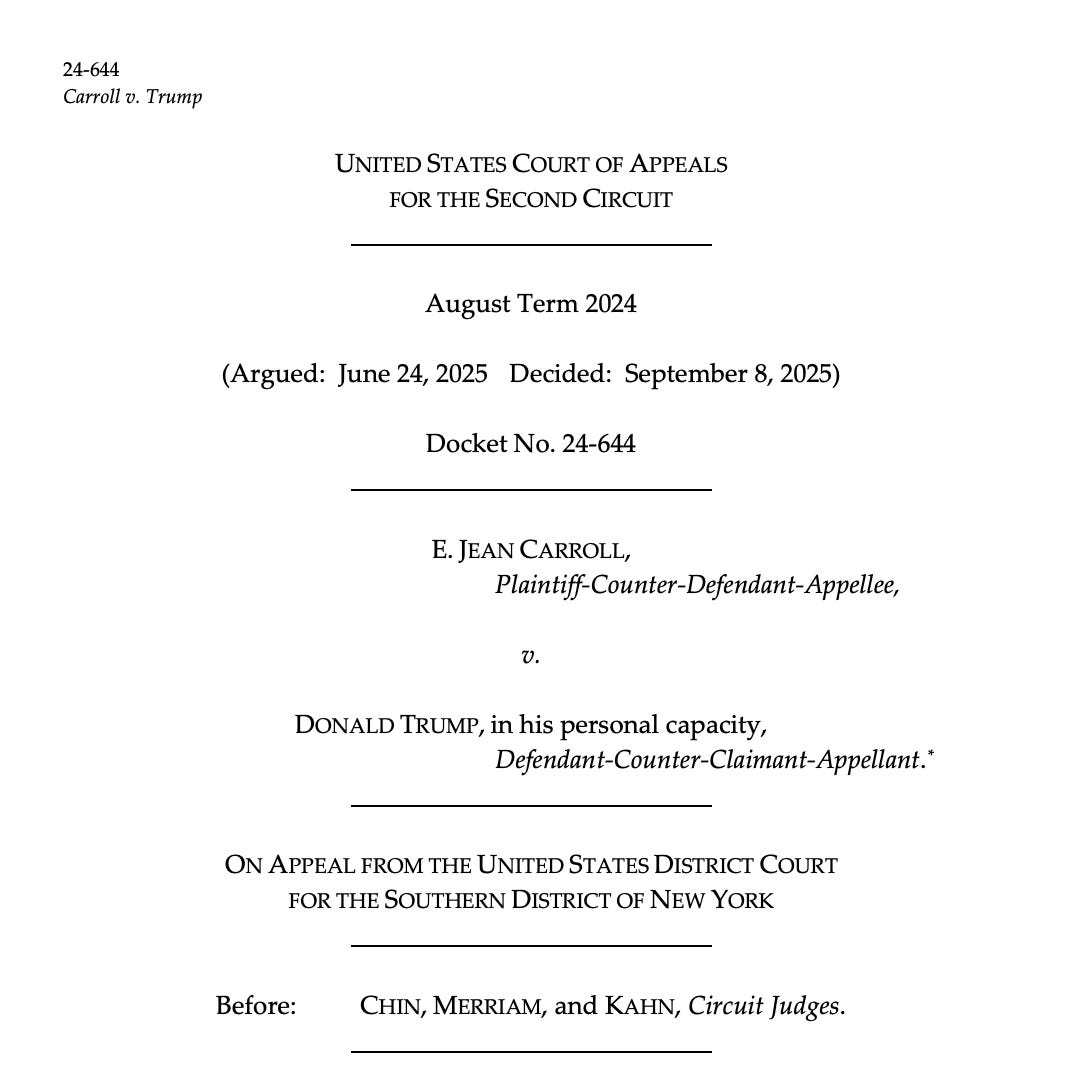
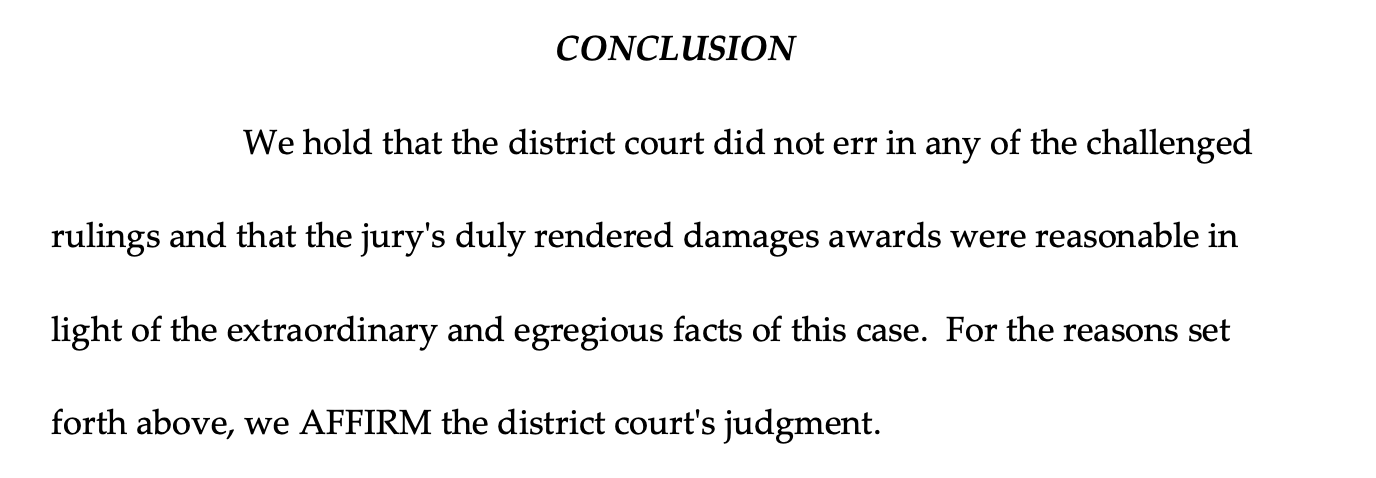
I asked Robbie Kaplan, the lawyer who tried the case, how she felt after learning that the Court of Appeals for the Second Circuit affirmed the $83.3 million verdict a jury awarded E. Jean Carroll in her defamation case against Donald Trump. This is what Kaplan told me: “Both the amazing and brave E. Jean Carroll and I could hardly be happier about today’s decision from the Second Circuit. It has been a long road to get here, and we are not at the end of the road yet, but as the opinion makes clear: ‘The starting point is the now-indisputable fact that a jury found in Carroll II that Trump sexually abused Carroll in 1996, and … that, based on the jury’s findings, Carroll did not lie and that Trump uttered falsehoods in his statements accusing her of lying and acting with improper motivations.’”
The Second Circuit affirmed the verdict against Trump on the same day that Trump’s birthday missive to Jeffrey Epstein became public. Trump says he didn’t send it, but the signature is extremely similar to verified Trump signatures on notes he wrote to both George Conway and Hillary Clinton. The birthday message is in the distinctive Sharpie marker scrawl Trump is known for. But Trump is insisting it isn’t his, a strange hill to die on since his friendship with Epstein is well documented. A jury believed E. Jean when she said Trump sexually assaulted her. The jury of public opinion may well believe Trump sent this incriminating note to Epstein.
Trump will undoubtedly try to appeal the case to the Supreme Court. It will be up to the Court to decide whether to hear the case or let the Second Circuit’s opinion stand.
The 70-page opinion starts like this: “A jury found that then-President Trump acted with common law malice when he made defamatory statements about Carroll in June 2019 and awarded compensatory and punitive damages. Trump appeals, arguing that he is entitled to presidential immunity or, in the alternative, a new trial. Trump also contends that the jury’s damages award is excessive and must be remitted.” The court then writes one word, “AFFIRMED,” which means that the jury’s verdict stands. You can read the full opinion here.
Last December, the Second Circuit affirmed the verdict in the case referred to as “Carroll II”—the second defamation case Carroll filed against Trump, which confusingly went to trial first (because Trump bogged down “Carroll I” in appeals). The jury in Carroll II returned a $5 million verdict against Trump.
In this case, Carroll I, Carroll’s lawyer, Robbie Kaplan, argued to the jury that if a $5 million verdict was insufficient to stop Trump’s defamation of Carroll, then they needed to return a larger verdict that they believed would stop his misconduct. That’s what they did. The verdict was for $83.3 million.
Trump asked the Court of Appeals to reverse for two reasons:
He argued that the Supreme Court’s decision about presidential immunity in criminal cases in Trump v. United States means the Second Circuit erred when it refused to afford him immunity in this civil case, even though it involves an assault that occurred decades before he became the president. Beyond that, while he defamed Carroll while he was in office the first time, his comments were about an entirely personal matter that had nothing to do with the office he held. The court declined to reverse on this ground. They held Trump had waived the immunity argument by not making it at the proper time before the lower court.
Trump also challenged the district court’s grant of partial summary judgment in favor of Carroll and other procedural rulings. The trial court held that a jury had already found that Trump sexually assaulted Carroll in the first trial and that finding was binding in the second case. That decision reflects the well-known principle of collateral estoppel, and the Court ruled there was no reason to disturb it because the identical issue was decided in the prior action and Trump had a full and fair opportunity to litigate the issue during those proceedings.
Trump has frequently been able to twist courts and delays to his advantage. He did that here for a time. But that clock seems to have run out on him. The Supreme Court would have to up end its existing jurisprudence on basic procedural issues to rule for Trump here.
A jury believed E. Jean Carroll. That’s the bottom line. In our system, we leave decisions about disputed facts and what happened to juries. The jury here deliberated and found against Donald Trump. That decision should remain in place. In an era where so much damage is being done to women’s legal standing, it’s essential that we be believed when we have the courage to speak out about sexual assault. Carroll did that. She told friends about the attack at the time in occurred but had been too intimidated by threats she would lose her job and her livelihood if she spoke up to move forward then.
If we can do nothing else for women in an era where abortion rights, more properly understood as the right to receive lifesaving medical care, and other rights have been taken away, we can do this: we can believe them when they summon the courage to come forward and reveal a rape or a sexual assault. Maybe if our nation had done that sooner, we wouldn’t have had a Trump presidency at all.
WASHINGTON (AP) — Law enforcement officials on Sunday removed a peace vigil that had stood outside the White House for more than four decades after President Donald Trump ordered it to be taken down as part of the clearing of homeless encampments in the nation’s capital.
Philipos Melaku-Bello, a volunteer who has manned the vigil for years, told The Associated Press that the Park Police removed it early Sunday morning. He said officials justified the removal by mislabeling the memorial as a shelter.
Philipos Melaku-Bello gestures the peace sign at the White House Peace Vigil in Lafayatte Park across the street from the White House in Washington, Friday, Sept. 5, 2025. (AP Photo/Pablo Martinez Monsivais)
“The difference between an encampment and a vigil is that an encampment is where homeless people live,” Melaku-Bello said. “As you can see, I don’t have a bed. I have signs and it is covered by the First Amendment right to freedom of speech and freedom of expression.”
The White House confirmed the removal, telling AP in a statement that the vigil was a “hazard to those visiting the White House and the surrounding areas.” (snip)
The vigil was started in 1981 by activist William Thomas to promote nuclear disarmament and an end to global conflicts. It is believed to be the longest continuous anti-war protest in U.S. history. When Thomas died in 2009, other protesters like Melaku-Bello manned the tiny tent and the banner, which read “Live by the bomb, die by the bomb,” around the clock to avoid it being dismantled by authorities. (snip-MORE)
Sam Seder and Emma Vigeland unpack Bernie Sanders’s high-energy “Fight Oligarchy” rally featuring Zohran Mamdani. They discuss the disconnect between this grassroots enthusiasm and the lack of support from mainstream Democratic leaders. The MR crew argues that this demonstrates a core ideological conflict within the Democratic Party itself.
————————————————————————————————————————————-
Republican Josh Breecheen spews Islamophobic rhetoric at a recent town hall, connecting to a broader pattern of fear-mongering and political attacks against Muslims in America. Emma Vigeland and Francesca Fiorentini draw a direct line from the “Sharia law” conspiracies of the Bush and Obama eras to the current dehumanization of Muslim Americans and the use of technology from the war on terror against citizens at home.
——————————————————————————————————————————————–
The latest jobs report paints a grim picture, with job losses under Donald Trump’s administration mounting and key industries sliding into decline. While Trump’s team struggles to blame Biden while also promising explosive growth in the future, economists and analysts are sounding the alarm that a US recession, or worse, is near.
Billionaire hedge fund manager, Ray Dalio, is in the news for warning about the dangers of extreme wealth inequality. Sam Seder and Emma Vigeland highlight how Dalio’s comments, which are a major news story because of his status, echo what many others have been saying for years.
The U.S. government has acknowledged Donald Trump’s military strike on a boat in international waters, resulting in the deaths of 11 individuals. This action, targeting Venezuelans en route to Trinidad, has raised significant questions about Trump’s legal authority behind such a strike, particularly given the lack of clear evidence of the individuals’ involvement in drug trafficking or any threat to U.S. interests. Despite the gravity of the situation, the incident has reportedly garnered minimal attention in mainstream news, with some segments of the media appearing to endorse the action.
Trump was asked about a bizarre video showing someone throwing bags out of a second-floor White House window by Peter Doocy of Fox News. Trump insisted that the video was “AI-generated” because, according to him, the windows of the White House are “heavily armored and bulletproof,” sealed shut, and each one weighs 600 pounds. Trump also added that if anything “really bad” were to happen, he could simply “blame AI.”
Hey if these people can outright lie about the LGBTQ+ community, willing to let LGBTQ+ kids die or be pushed via violence into the closet hiding who they really were, what is faking your expertise. I already posted about a sexologist who had no experience with trans kids testifying to red state legislatures enabling his bigotry to further the harm to trans kids by giving an excuse for theirs. These people are on a mission that is far from pure but one driven by hate and bigotry to make all kids pretend to be straight and cis in the hope that they can force all adults to pretend to be straight and cis also. If they can’t force the adults to pretend to be straight or cis at least they can stop the trans adults from looking like the gender they identify with in hopes of stopping those that are passing as the gender they identify as. This they hope will mark those people in ways that make their life harder. Again their lies are OK for them because either they think their god approves or their hate is that great so nothing but the mission matters. Hugs
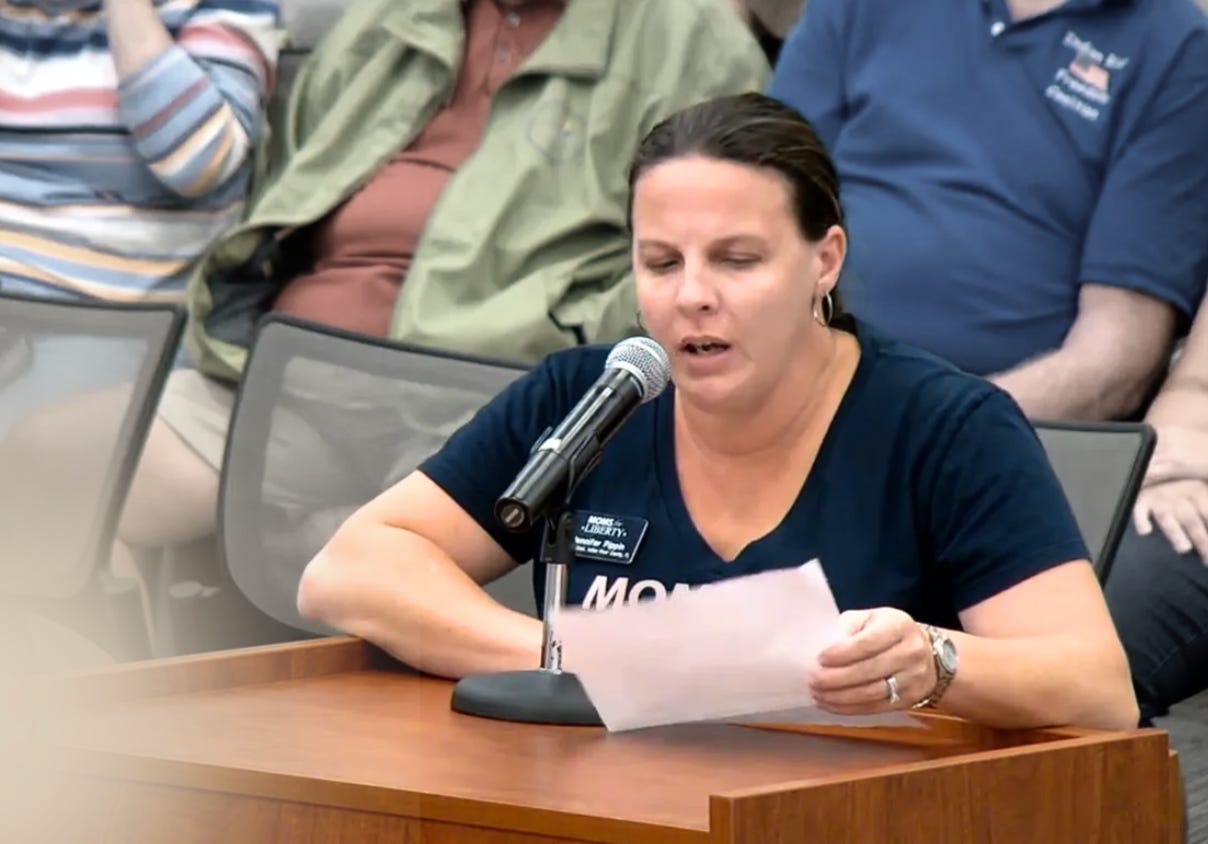
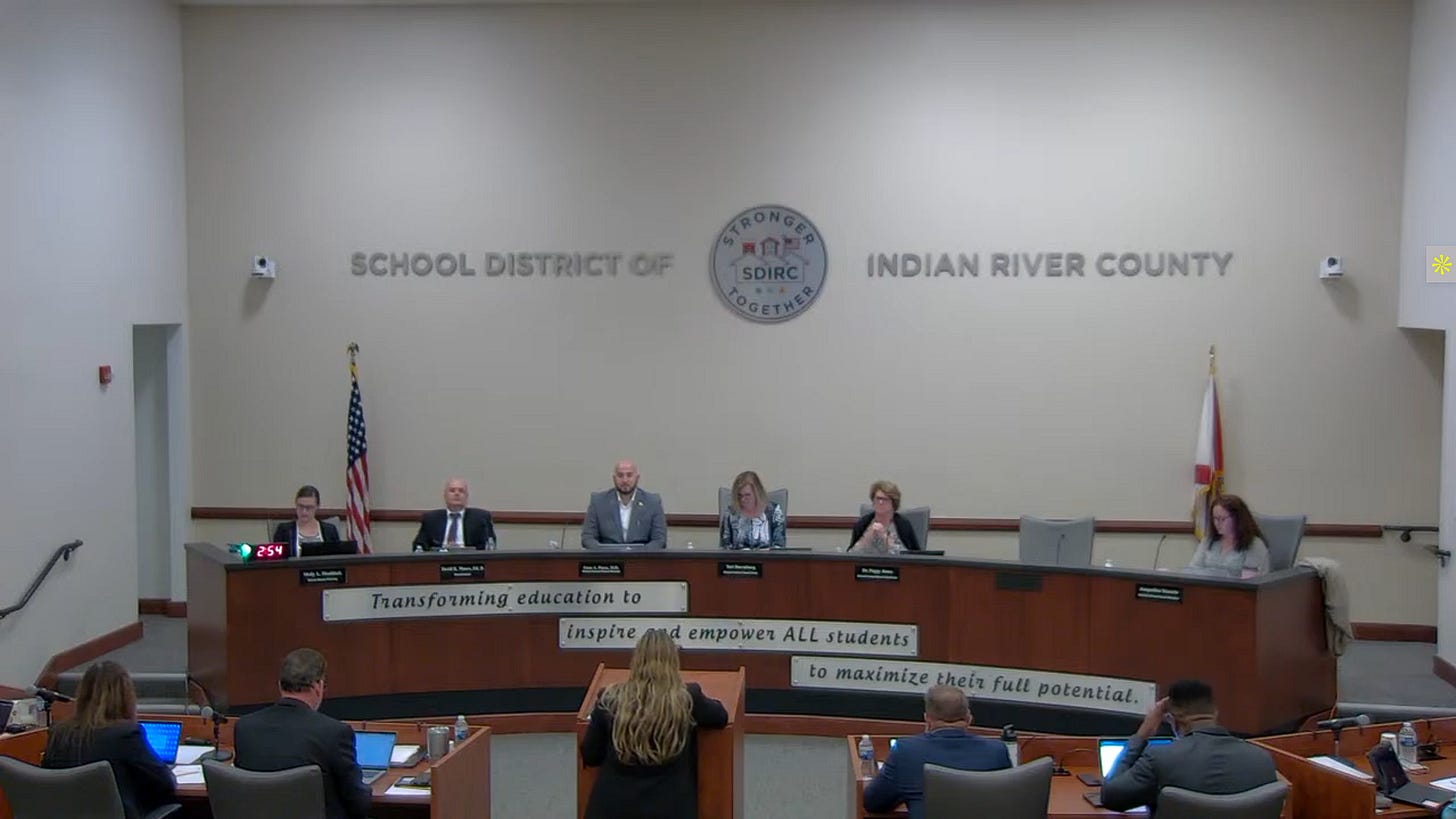
Pippin testifying in favor of book bans at a school board meeting in 2023 (screenshot / YouTube).
Subscribe
Jennifer Pippin has repeatedly claimed to be an operating room nurse. USA TODAY, the New York Times, TC Palm and other publications have cited her as such. In 2020, Pippin argued that wearing masks to prevent the spread of COVID-19 was unnecessary, citing her professional expertise.
“As a registered nurse, I’ve learned a bit. I’ve learned a whole lot more though that they won’t tell you in nursing school,” she wrote in a 2020 Facebook post. “Not wearing a mask is NOT A RISK. Not to me and not to anyone else.”
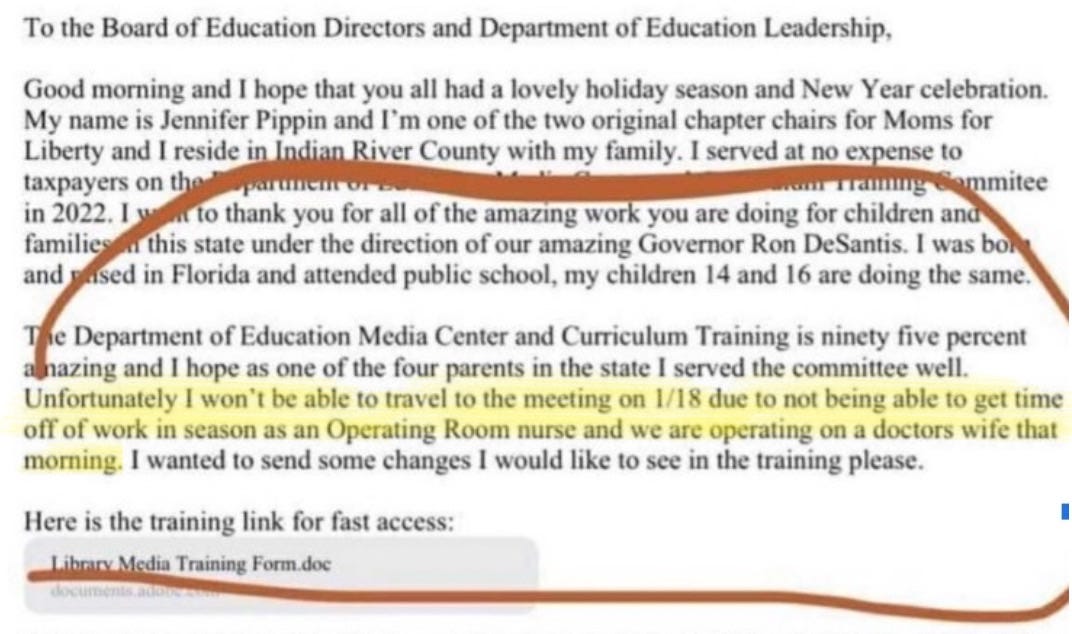
Pippin, now the chair of one of Moms for Liberty’s (M4L) first chapters in Indian River County, Florida, has also mentioned having “medical licenses” while speaking about the group’s accomplishments at a school board meeting. And in an email chain with Florida’s Department of Education, she wrote that she couldn’t make it to a meeting because she was “operating on a doctors wife.”
(Screenshot received from The Florida Fruit Loop, highlight added).
However, allegations have surfaced that these statements might not be true, and the community is growing frustrated. On Facebook, one user decried “the utter misinformation that has spewed out of [Pippin’s] mouth any time she’s shared her thoughts about public health issues.” Another sarcastically wrote that they were “shocked … to find out Jenny is a liar!!”
“We reported this years ago, but because [M4L] were so powerful politically here in Florida with Ron DeSantis, we had no voice, nobody cared,” Cindy Gibbs, a local parent and former school board candidate, told Uncloseted Media.
Subscribe for LGBTQ focused, accountability journalism.
Subscribe
Is She Really a Nurse?
Despite Pippin’s claims of being a nurse, there is a stack of evidence suggesting otherwise. One individual shared screenshots of emails they received from a Florida Department of Health (DOH) official in 2024 after they filed a complaint against Pippin when they noticed her license wasn’t turning up in database searches. In one email, the DOH official states that Pippin had been under investigation since April 1, 2024, for potentially misrepresenting herself as a nurse and that no license had been found.
Uncloseted Media also filed a public records request with the DOH for the license. In an email, they said they were “unable to find anyone licensed by the department matching the information … provided.” The department did not respond to a request for further comment.
In addition, Uncloseted Media was unable to find any license associated with Pippin in the Florida Department of Health’s medical license database or the NURSYS database, which records multi-state licensees. We also checked the certification database for the Competency and Credentialing Institute, which certifies certain specialized nurses including operating room specialists, and found nothing.
While records do exist for Jennifer Hughes Pippin, a nutritionist and dietician at Florida State College in Jacksonville, her listed address and social media profiles do not match the Pippin from Indian River County.
The Florida Nurses Association also did not find any record of Pippin’s membership.
Multiple sources and news articles say Pippin was formerly employed by the Cleveland Clinic Indian River Hospital. Despite this, Uncloseted Media was unable to confirm she held a position there. The hospital declined to comment on the status of current or former employees as a matter of policy.
The only employment information we found listed for Pippin later than 2021 was in a Sebastian City Council meeting agenda from 2023, where she says she is “self employed” working for Organize Me!, a gig-based home cleaning service.
Why It Matters
Falsely presenting as a nurse is a phenomenon that has been on the rise since the start of the COVID-19 pandemic.
Pippin’s case, though, is of particular interest because she is often cited as an influential figure in Florida politics. In her role with M4L, Pippin has filed hundreds of requests to ban books—many of which include LGBTQ or racial justice themes—from school libraries. Some of the books she’s requested to ban include a graphic novel adaptation of “The Diary of Anne Frank” and “All Boys Aren’t Blue,” a memoir about growing up Black and queer.
In 2022, Pippin was also appointed by the Florida Department of Education to a workgroup of parents tasked with developing a training for state educators to comply with the classroom censorship laws signed by Governor Ron DeSantis, who has spoken at a M4L summit. One of these laws is the notorious “Don’t Say Gay” law, which prohibits educators from teaching about sexual orientation or gender identity.
And earlier this summer, she filed a complaint against a Vero Beach wine bar for hosting an all-
ages drag event, which she alleges contained performances with sexual themes. The bar’s owner, who is also a city official, denies the allegations.
This is not M4L’s first brush with controversy. The group’s co-founder, Bridget Ziegler, allegedly assisted her husband in sexually assaulting another woman. An Indiana chapter came under fire for quoting Adolf Hitler in a 2023 newsletter. And the group has hosted speakers who’ve spread medical misinformation on multiple occasions, claiming that doctors are “sterilizing and mutilating [trans] children” and that gender-affirming health care is “snake oil.”
Subscribe
Pippin’s Response
When presented with these allegations, Pippin did not provide any evidence of a nursing license. In an email, she told Uncloseted Media that she was “surprised to see these allegations being raised again — especially considering they were addressed over a year ago.” She pointed to a prior case involving stalking and said the answers about whether she is a licensed nurse can be found via that case. However, the case and its associated documents are not available online.
Pippin testifying before the Indian River County School Board (screenshot/YouTube).
Pippin has previously stated that the reason her license is not publicly accessible is because she was ordered to “hide [it] from the public for five years” after filing a fraud suit in 2020 against someone who she says had used her license to file for unemployment. In emails with Uncloseted Media, she reaffirmed this story.
While Uncloseted Media was unable to verify the existence of this fraud case, experts say that such a decision from the court would be “unusual.”
“We have fought to make nurses licenses private and have been unable to do so even in at-risk areas,” says Willa Fuller, executive director of the Florida Nurses Association.
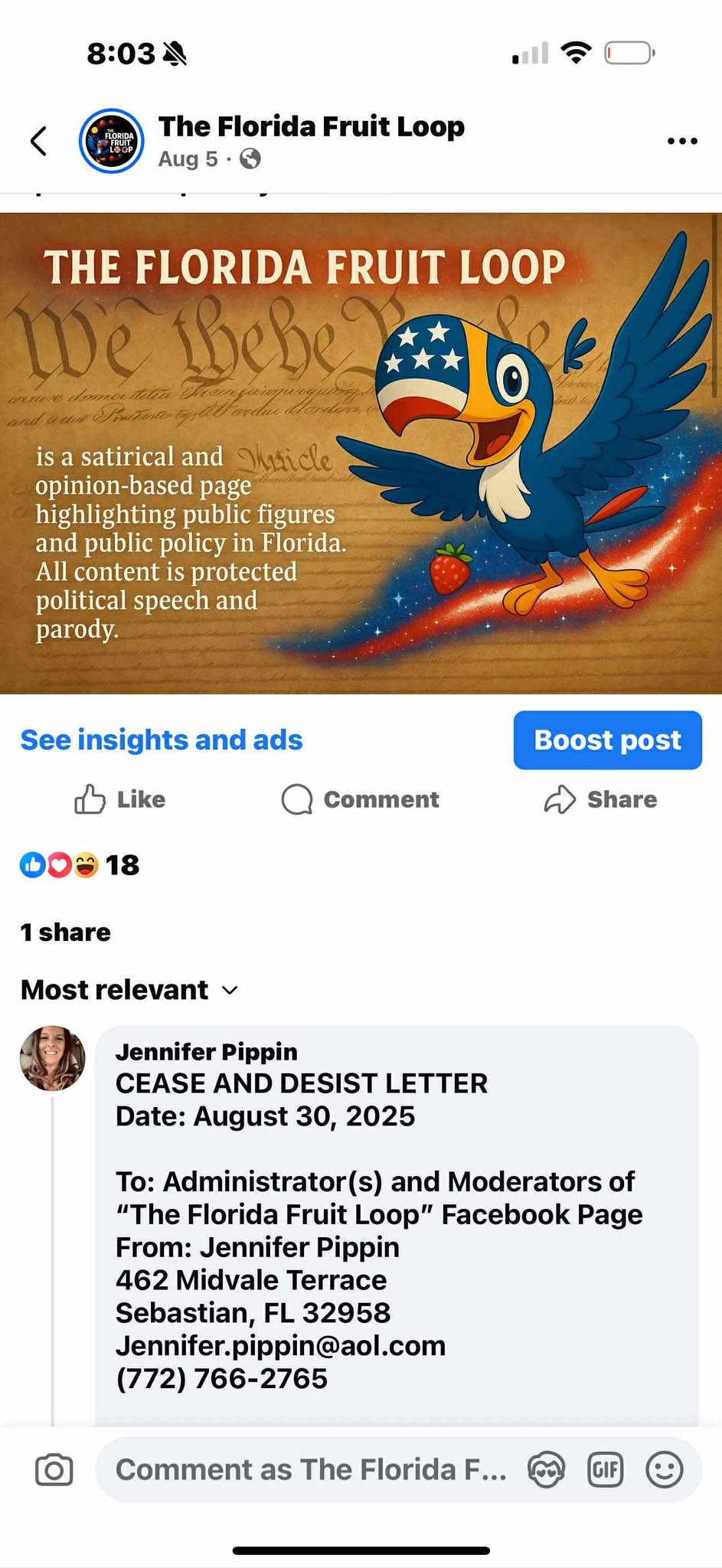
Multiple people in Indian River County say that Pippin’s questionable nursing status has been an open secret for years, but the issue didn’t start attracting wider attention until it was covered by The Florida Fruit Loop, a local Facebook page that promises to provide “a daily dose of MAGA butthurt.” Last weekend, Pippin left a note in the page’s comments titled “CEASE AND DESIST LETTER,” where she called multiple statements made by the page defamatory. However, the notice does not mention or dispute any allegations made about her nursing license.
The intro to Pippin’s comment (screenshot received from The Florida Fruit Loop).
The Implications
Falsely presenting as a nurse is a crime in Florida under certain circumstances, with one woman being arrested in the state for this just last month. However, in emails reviewed by Uncloseted Media, a DOH official cautioned that the laws only apply in specific cases.
“For those statutes where an unlicensed person is allegedly holding themselves out as a licensed healthcare provider to apply, the Subject would need to hold themselves out / lead the public to believe they are a current and active licensee,” the official wrote.
While the full results of Pippin’s investigation have not yet been released, the individual who corresponded with the DOH says the department later informed them that their complaint “lacked … a criminal finding.”
The DOH official did note, though, that the video of Pippin’s testimony before the school district could be considered a violation. Pippin has also publicly used the formal title “registered nurse” on multiple occasions, including in a rant against masking posted to the Republican Club of Indian River’s Facebook page in 2020; in a Department of Education report; and in Vero News.
“She has been out here presenting herself as an authority on things in the world of health care and education,” says Cindy Gibbs. “And the groups of people that she associates herself with … just keep generating and regenerating the same stuff: ‘oh, Jennifer knows things because she’s a registered nurse.’”
If objective, nonpartisan, rigorous, LGBTQ-focused journalism is important to you, please consider making a tax-deductible donation through our fiscal sponsor, Resource Impact, by clicking this button:
(I admit this CI story is some pretty quick thinking/delivery for Republicans. It’ll probably work with the Qanon folk.)
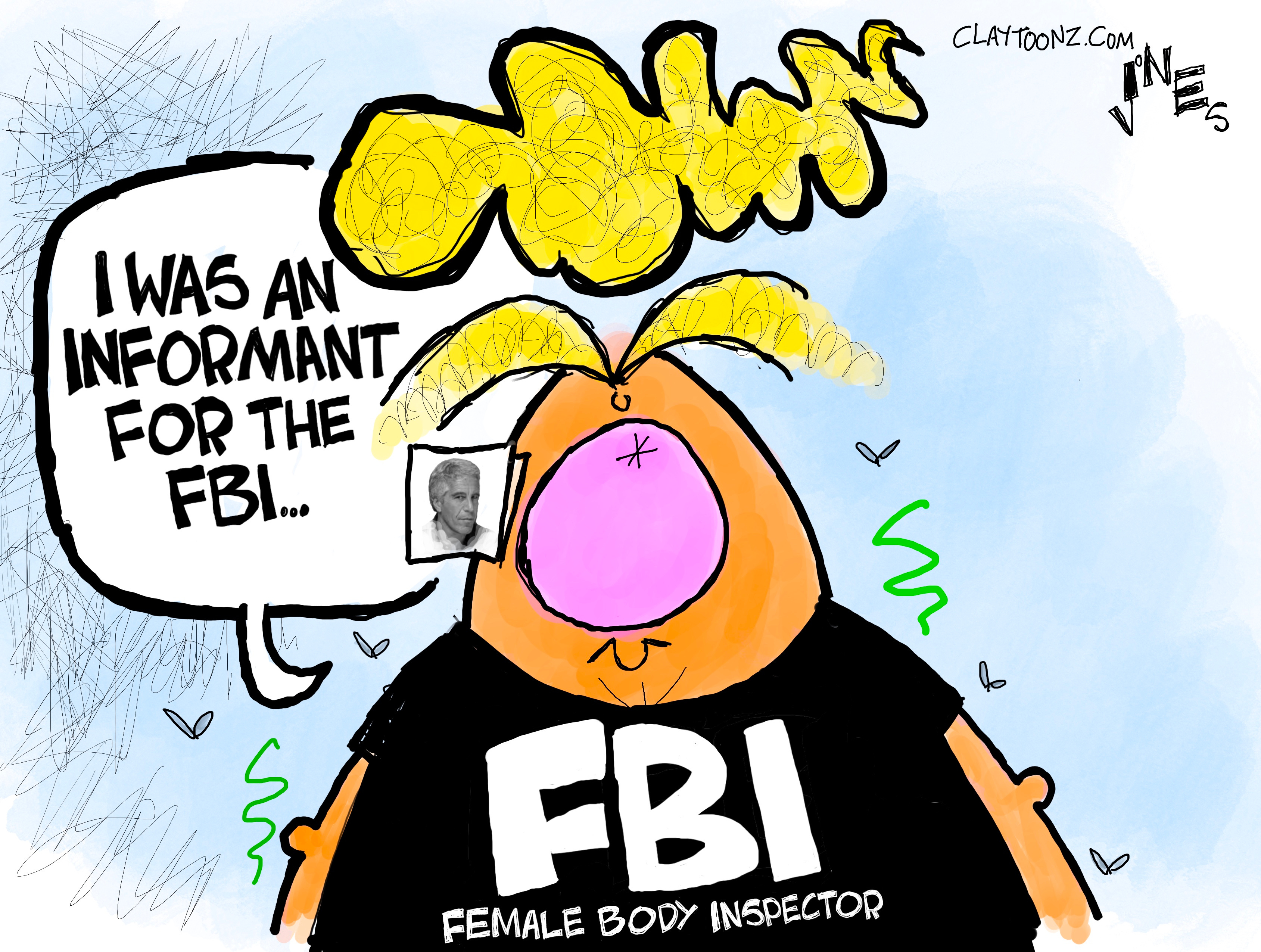
Agent Orange by Clay Jones
Speaker Mike Johnson claims Trump was an FBI informant, spying on Jeffrey Epstein Read on Substack
If you believe Donald Trump was an FBI informant in the Epstein case, then I have a slightly used Venezuelan speedboat I will sell to you…cheap.
Speaker of the House Mike Johnson claimed yesterday that Donald Trump was an FBI informant in its investigation of Jeffrey Epstein.
Johson was questioned by CNN reporter Manu Raju about how Trump has been using the term “hoax” a lot in regard to Epstein. Johnson argued that it was not about downplaying Epstein’s abuse of underage girls, but attacks and accusations against Trump’s relationship with Epstein.
Johnson said, “What Trump is referring to is the hoax that the Democrats are using to try to attack him.” But why would Trump use that regarding a press conference last week of survivors of Epstein, where nobody accused Trump of any wrongdoing? That doesn’t make sense, unless Trump was trying to intercept something he believed they would accuse him of. (snip-there are more than 3 comics here, so commentary is snipped, but Highly Recommended Reading.)
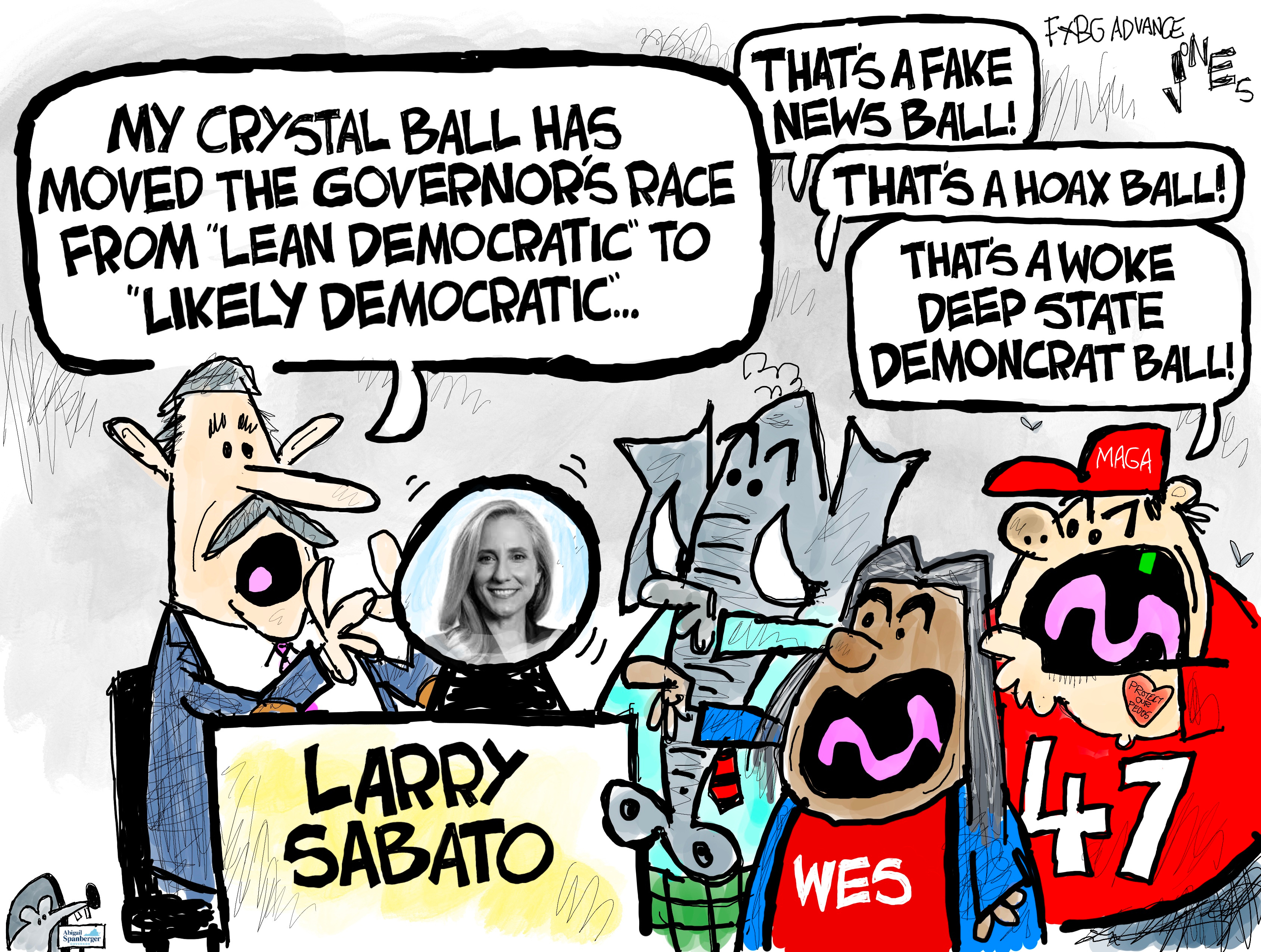
Crystal Ball, Fake Ball, Hoax Ball, Woke Ball by Clay Jones
The Advance wrote this to go with my cartoon today: “The races for Lt. Governor and Attorney General are tightening, but the race for governor in Virginia as we head into early voting — it begins September 19 — looks about as one-sided as a governor’s race in Virginia is likely to get in the current political environment. Abigail Spanberger has consistently been at least 5 points ahead of her Republican opponent, Winsome Earle-Sears, in every poll to this point. No one is suggesting landslide-like numbers of Spanberger (even Mark Robinson polled 40% in the North Carolina gubernatorial election in 2024 — and candidates don’t get much worse than Robinson), but this is her race to lose. When numbers don’t go the Republicans’ way these days, how do they respond? Blame the messenger. Clay Jones has noticed.”
I did notice.
I was hanging out at J. Brian’s Tap Room last week, and a stranger sat next to me and started chatting. I guess I have one of those faces.
Anywhosies, I forgot what topic he started with, but for some weird reason, he started talking about the governor’s race. He’s from Virginia but lives in Florida, and golly gee whiskers, he sure did think Florida was a great place. He described himself as a moderate who leans right, which means he’s downplaying it and is a MAGAt. But he was nice. A little dense and outside reality, but nice.
At one point, he said, “See? Two people who disagree on politics can have a civil conversation.” And I replied, “Yeah? See how civil I’ve been despite you being full of shit and gaslight?” Warning, it’s not just online where I don’t tolerate bullshit. I won’t start screaming at you, but if you dish out bullshit to me in the real world, I’ll tell you what I think. I’m not afraid of MAGA fuckers. (snip-MORE)
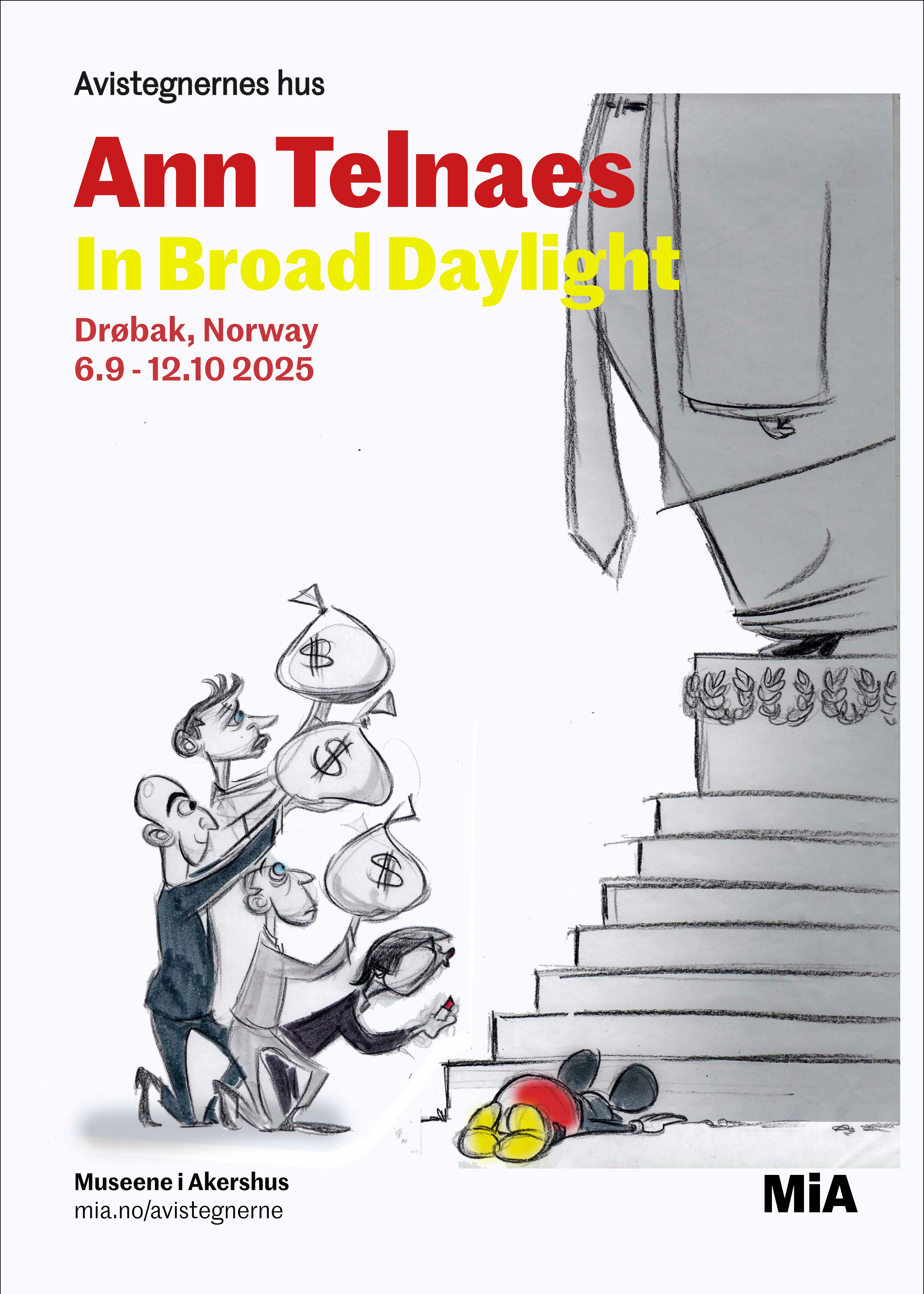
Exhibition in Norway by Ann Telnaes
If you’re lucky enough to be visiting or living in Norway Read on Substack
The Museene i Akershus (MIA) just opened an exhibition of my work and is offering a number of prints for sale. It runs from September 6 – October 12, 2025.
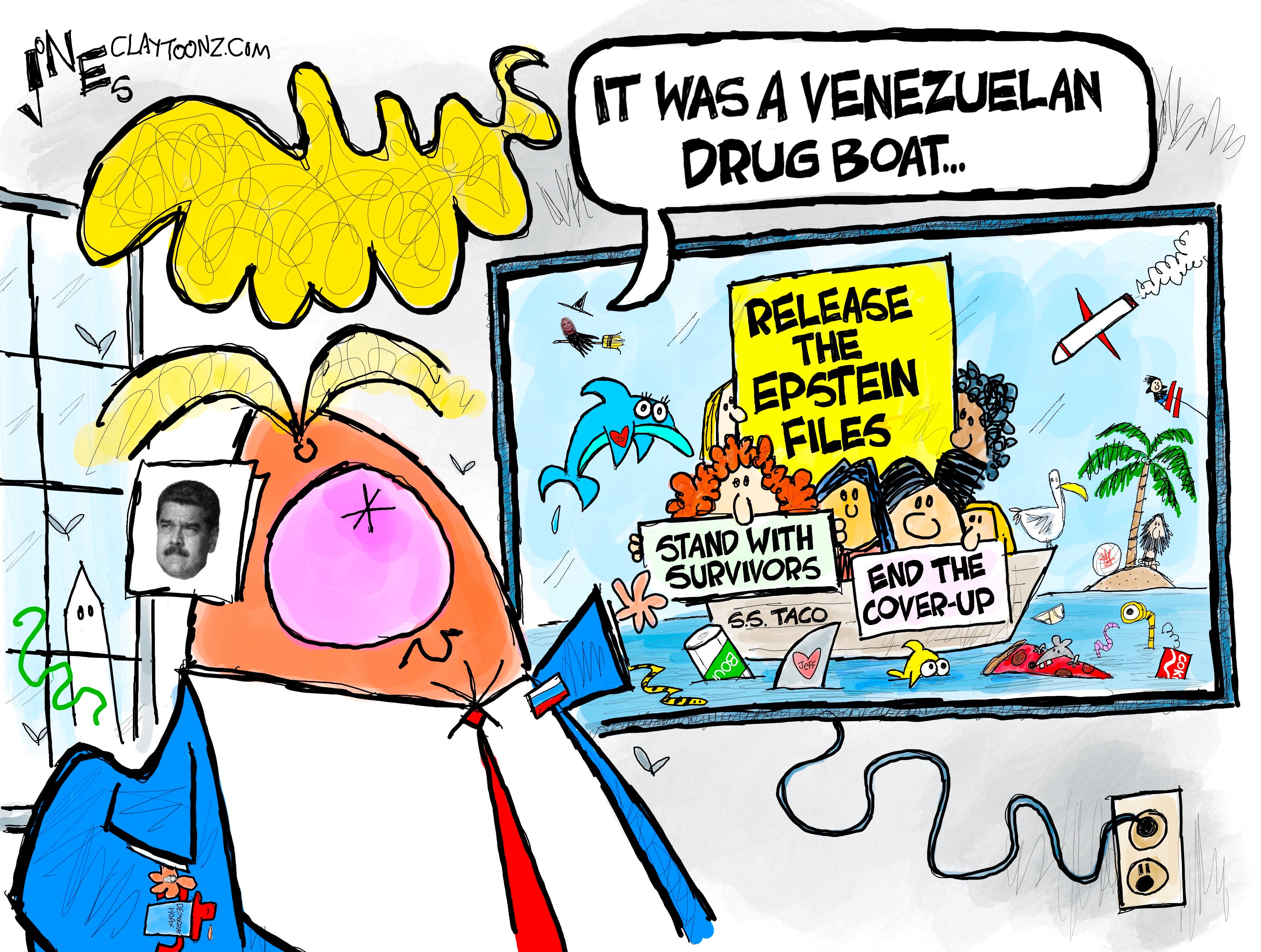
Epstein File Missile Strike by Clay Jones
Would Trump conduct a missile strike to keep the Epstein Files covered up? Read on Substack
I can’t figure out why Trump and Nicolás Maduro are not besties yet. And I say “yet” because at one time, Trump and Kim Jong Un were at each other’s throats, figuratively.
Maduro is a dictator, which is what Trump is trying to be. He has manipulated the courts to increase his power. He has dismantled democratic institutions that would challenge his authority. His legislature is a mere puppet to pass his agenda. He’s crashed his economy. He runs sham elections. He doesn’t seem to want to ever leave office. He’s serving a third term. He stayed in office despite losing an election. He surrounded himself with sycophants and lickspittles. He’s suppressing opposition. He describes all accusations against him as hoaxes. He likes to glorify himself as all dictators do. He uses the military to maintain his power. His government has seized corporations. He’s friends with Vladimir Putin. He’s even survived assassination attempts. And like Trump, most of his constituents hate him.
Why Maduro isn’t eating chocolate cake at MAGA-Lardo is beyond me. But instead, Trump hates the guy, and we may soon be at war with Venezuela. (snip-MORE)
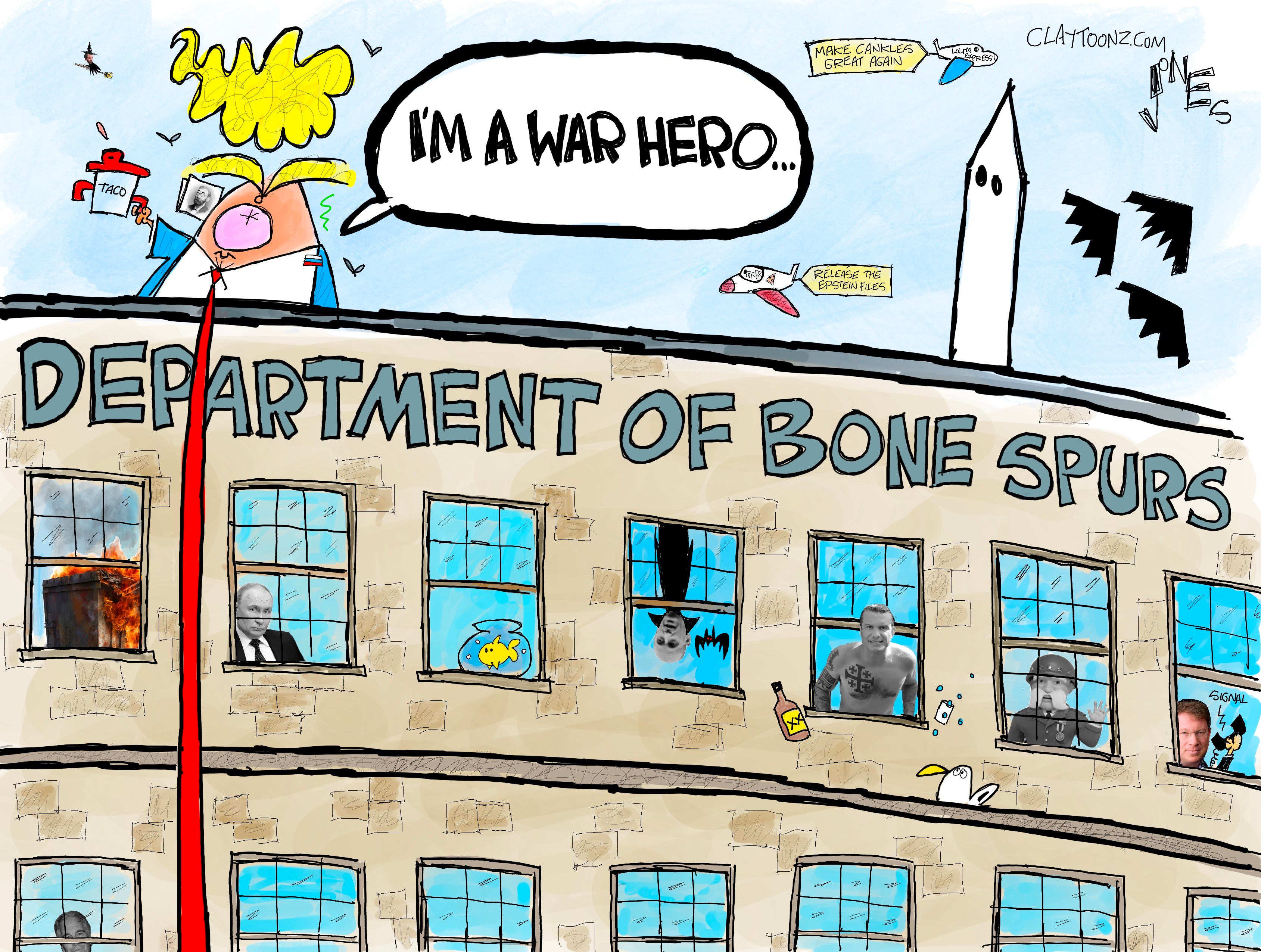
Do we have a military for defense or to wage war? President Harry Truman, who made the decision to drop atomic bombs on Hiroshima and Nagasaki, believed it was for defense. Truman signed the law that turned the War Department into the Defense Department. Today, Donald Trump plans to sign an Executive Order to revert the Defense Department back to the War Department. Does anyone think Donald Trump is smarter or a better president than Harry Truman?
Just like the renaming of the Gulf of Mexico to the “Gulf of America,” this is a stupid idea. When Trump renamed the Gulf of Mexico, he told the world that America was xenophobic. Now, he’s telling the world that America has a tiny penis.
We are always prepared to defend our nation, which is why “Defense” is appropriate, and hopefully, more accurate. “War” means we’re either at war or looking for a fight. Remember when Trump boasted about not getting us into any foreign wars? And “War” is a bad look for a guy lobbying for a Nobel Peace Prize. (snip-MORE)