
https://newrepublic.com/article/214482/trump-dhs-secret-police-spying-anti-ice-americans
Court papers reveal that the Department of Homeland Security’s covert surveillance of anti-ICE groups is much darker than it first appeared. Welcome to Donald Trump’s America.
Samuel Corum/Getty ImagesIt’s time to familiarize yourselves with the names “Operation Puppet Master” and “Operation Keyhole.” If those nefarious phrases evoke to you the U.S. government’s domestic spying on leftist groups in the 1960s and 1970s, it’s for good reason. The terms are coinages of today’s Department of Homeland Security, and they’re associated with a massive covert surveillance effort that DHS unleashed earlier this year to track anti-Immigration and Customs Enforcement protests in Minneapolis, where Donald Trump’s violent paramilitary invasion triggered months of intense civil conflict.
We just learned about the broad outlines of this domestic surveillance from newly released court papers related to the ongoing prosecution of a handful of protesters. As The New York Times reported, the papers show that DHS began surveilling left-leaning groups—including a union, a climate change group, and others—after ICE killed Alex Pretti in January. This has entailed seeking financial records and infiltrating protest meetings that are protected by the First Amendment.
But you can get a far more vivid picture of these undercover surveillance operations—and how brazenly they were conducted against American citizens—if you read deep into the court papers. The documents—which are attached as exhibits to a motion filed by lawyers for one of the protesters facing prosecution and are available on Pacer—include investigative reports that were transmitted by the undercover agents themselves about meetings they infiltrated.
It’s jarring, revealing stuff. The reports show that covert agents surreptitiously attended well over a dozen protest meetings organized by groups like the Sunrise Movement and various small socialist organizations. In some cases the agents secretly recorded the gatherings.
What’s more, in at least one case, an undercover agent may have tried to influence the conduct of meeting organizers. One report from an agent describes a meeting in late January of the Sunrise Movement at a Minneapolis public library. While spying on the proceedings, the agent seems to have learned that the organization’s intention was nonviolent: As the agent notes in his own investigative report, “it was made clear” at the meeting that the organization is “focused on peaceful protests.”
Yet after this discovery, the agent then approached a meeting organizer and made a surprising proposition. The agent told the organizer “he works in construction” and is willing to build things to assist “with more direct action protests,” the report reads, adding that the agent stressed “that going to jail did not bother him.”
That sounds like the agent may have signaled a willingness to engage in something illegal, to bait the group into moving in that direction, argues Kevin Riach, the lawyer for one of the protesters who is being prosecuted, Isaac Sant.
“This is an effort to entice someone who’s shown no inclination to commit a crime into committing one,” Riach told me. “What this tells us is that there wasn’t actual criminal activity to be investigated. They had to invent it. That’s not how this is supposed to work—not in this country, anyway.”
In other cases, undercover agents infiltrated these meetings only to find that the protesters turned out to be awfully innocuous. One agent covertly attended a meeting in February and found that it “was more of a panel discussion,” where there was “no discussion, or call for, violence toward law enforcement.”
Similarly, another agent’s report described infiltrating a meeting in Ann Arbor, Michigan, of organizers who said they sympathized with the Minneapolis anti-ICE resistance. (The papers show that DHS’s surveillance reached into other states beyond Minnesota.) This agent reported initiating a conversation with a married churchgoing couple, and the woman told the agent she’d traveled to Uganda to assist “in the construction of a hospital.”
In short, we’re not exactly talking about the Weather Underground bombers here.
Indeed, as Substacker Brian Kaylor notes, a number of these undercover operations were even conducted in churches where protesters had organized. Several of the pastors were kept entirely in the dark about law enforcement’s infiltration of their houses of worship.
The absurdity of all this is overwhelming. In some cases, the Keystone Kops vibe is strong: One agent attended a May meeting in Minneapolis, only to report that his “concealed body-worn audio recorder erroneously fell to the floor of the gymnasium.” The agent left without the device and had to return later to retrieve it.
Interestingly, the investigative reports also offer a glimpse of culture clashes between protesters and the agents who spied on them. One agent attended a Minneapolis meeting in February and reported, perhaps with distaste, on a female protester “with they/them pronouns” and “bright green short hair” and a “nose ring.”
As writer John Ganz has noted, Trump’s secret police force is made up of the MAGA “demimonde” and the “Trumpenproletarian mob.” And indeed, Trump’s political project has long been all about turning loose “his” people—law enforcement, biker gangs, coal miners, Ultimate Fighting enthusiasts—against the leftist enemy that inhabits blue America. The centrality of violence to all this is not disguised in the least. ICE recruitment targets MAGA-adjacent UFC fanbases and people who show an interest in paramilitary tactical equipment or military recruitment. ICE messaging openly glorifies military-style operations in urban areas—that is, in blue America’s diverse, cosmopolitan strongholds. Trump talks about Minneapolis as akin to an enemy country populated with undesirables who must be purged by MAGA patriots.
Now we’re learning that this war on blue America also includes extensive undercover surveillance. Many of these agents appear to have been drawn largely from Homeland Security Investigations, the arm of ICE that’s supposed to be focused on serious, complex, transnational crimes. They’ve now been reduced to standing around in parking lots writing down protesters’ license plate numbers and using sleazy deception tactics to spy on fellow Americans whose only crime is sympathy with immigrants.
Violence is precisely what spawned this undercover spying operation, but the real culprit was the violence of the government, not of the protesters. As Lisa Needham writes at Public Notice, we shouldn’t lose sight of how quickly ICE’s invasion of Minneapolis devolved into lethal state violence against Americans. It was just after ICE’s arrival in the city that an agent gunned down Renee Good in her car, with Pretti’s killing by federal agents following around two weeks later.
The outpouring of public protest in the face of this invasion apparently helped prompt DHS to launch its massive undercover surveillance operation directed at Americans, on the theory that the protests were being organized by larger, more sinister forces. The government dubbed this “Operation Puppet Master.”
But it’s unclear what all this surreptitious spying is even turning up. The Times notes that none of the groups targeted by it have been charged. And while the surveillance supposedly helped produce that aforementioned indictment of a handful of protesters, in reality the spying has swept far, far beyond those targets. The main result has been a discovery process that has now exposed the depth and breadth of the government’s massive spying operation for all to see.
There’s one other big unknown here. The document declaring the opening of Operation Puppet Master contains another vague reference: It says this effort has also been sanctioned under something called “Operation Keyhole.” Yet it’s unclear what this even is. As Kevin Riach, the lawyer, told me: “This suggests there’s some broader surveillance operation underway that we have yet to learn about.”
When I asked DHS what the phrase “Operation Keyhole” describes, the agency declined to comment.
Trump’s mass deportations have become akin to a Forever War. The expansion of ICE has poured tens of billions of dollars into the growth of Trump’s very own paramilitary army. This has included the stockpiling of enormous amounts of heavy military-style tactical equipment and weaponry, furnished by private contractors who resemble war profiteers.
And so, just as we saw under George W. Bush’s Forever Wars, we’re witnessing the growth of a massive public-private bureaucracy that’s metastasizing in unnerving new directions. It now appears to entail extensive domestic surveillance operations as well. We’ve only just begun to scratch the surface of it all. As always seems to happen with Forever Wars, we may never even learn all that much about many of the darkest atrocities perpetrated in its name.
Normally I color the paragraphs. I won’t do that for this post as I want the author’s words to stand on their own as the author intends them. The information is important. We have seen the rise of hate again after decades of forcing racism under the rocks it should have stayed under. But powerful people with money are doing everything possible to forment hate and bigotry to promote themselves as superior. We must fight against the idea and return to moving forward with equality and fairness in the world and the US. Hugs
https://www.confrontthehate.com/p/white-nationalist-eyes-local-news
At an invitation-only gathering in Italy, far-right leaders mapped out strategies to target rural America while local press coverage vanishes.
As economic pressures gut local newsrooms across the country, white nationalist figures see an untapped opening: stepping into media deserts where there are few journalists left to sound the alarm.
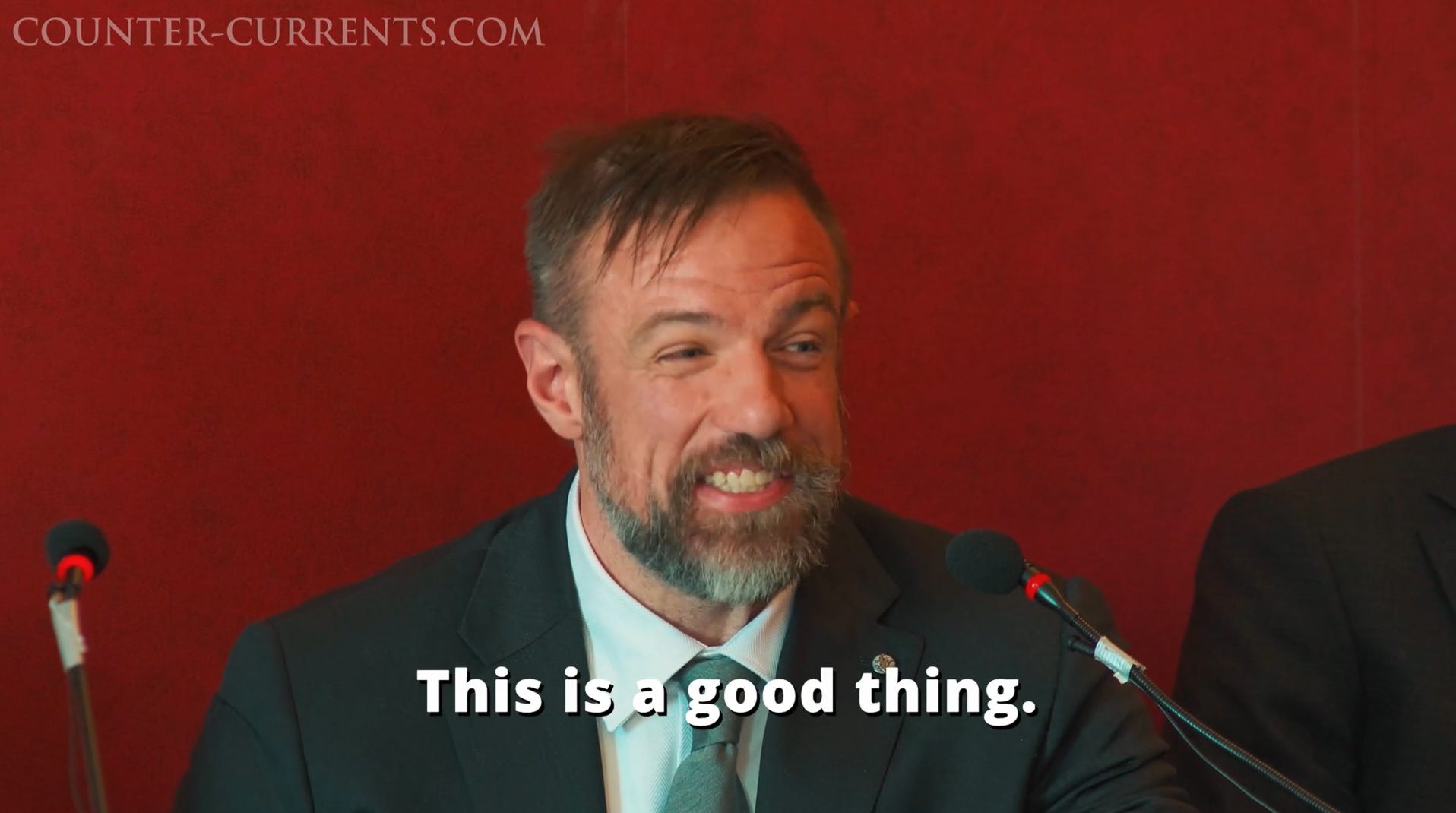
“Local media has been dying all over America, which means that there’s essentially no real way to hold local governments accountable—and they can do whatever they want,” Kevin DeAnna told an invitation-only gathering of approximately 50 white nationalists in Rome.
Breaking into a broad smile, he excitedly added: “You should be fantasizing about this. This is a good thing.”
DeAnna, a prolific propagandist who has operated under a variety of pseudonyms and who has called for turning the country into a White ethnostate, celebrated the decline of local media earlier this year during an annual retreat hosted by the white nationalist Counter Currents publishing house.
“So, if you wanna get the most bang for your buck, activate rural America—‘cause that’s where White people are,” DeAnna argued in a video that was just recently posted online.
“And these are White people that are not voting. These are White people who are angry and who are radical and have no one talking to them.”
According to the most recent report from the Northwestern University’s Medill School, the “steady, unrelenting decline of local newspapers … is leading to an ever-rising number of news deserts, now 213 counties.”
That collapse of local press coverage in rural America creates a dangerous vacuum—one that allows extremist networks to operate without accountability.
Filling that void is precisely why I launched ConfrontTheHate.com.
‘Pitch to a Billionaire’
DeAnna’s remarks were part of a “Pitch to a Billionaire” panel during the Rome retreat that focused on how white nationalists could solicit funding from the world’s wealthiest people.
Ironically, the white nationalist figure met with tech billionaire Peter Thiel in 2016, according to reporting by BuzzFeed and the Southern Poverty Law Center.
“DeAnna’s work under the pseudonym ‘Gregory Hood’ drew upon foundational white nationalist and neo-Nazi texts that have inspired numerous acts of domestic terrorism,” SPLC senior researcher Hannah Gais wrote.
For the panel discussion, DeAnna proposed that “the single most effective way to build political power with the least investment would be to start a political action committee and get-out-the-vote effort for White rural voters.”
Rural areas have an outsized political influence in America, he asserted, and “it requires very little money and very little turnout to win a lot of these elections.”
Embracing the widely discredited “constitutional sheriffs” notion that county sheriffs have enormous power to nullify federal and state laws, DeAnna pushed for a focus on electing sheriffs who would take the law into their own hands.
He argued:
“I think you could take over a whole county with ten people. It would not take much…. Ten people who have some idea how to campaign, and we’re talking unlocking tens of millions of dollars, jobs for twenty, thirty, forty, fifty people, real state authority, real law enforcement power, setting up a fortress that leftists can’t even go into without losing everything.”
Other billionaire pitches
Jared Taylor, David Zsutty, Kevin DeAnna (Photo: Screenshot, Counter Currents)
Among those joining DeAnna for the discussion was Jared Taylor, who publishes the American Renaissance website and hosts an annual gathering of white nationalists, neo-Nazis, and other extremists at a Tennessee state park.
Taylor suggested approaching a far-right billionaire with a plea to become “the George Soros for our side,” funding white nationalist groups around the world.
“I’m not asking you to fund yet another media company or another think tank. I’m asking you to endow an entire movement,” Taylor’s pitch continued.
“Campaigns for mayor, state house, city council can be swayed with twenty thousand dollars, thirty thousand dollars.”
Another white nationalist activist, attorney and former neo-Nazi David Zsutty, made the case for a billionaire to fund lawsuits to target their enemies.
“If you are the defendant, whether it be in a civil or criminal case, you have already lost—the only question is how much,” Zsutty said.
“Even if you recover attorney fees, which are usually quite substantial, you will never recover the lost time, stress, and effort.”
Counter Currents editor Greg Johnson has described the annual gathering as “private, invitation-only retreats for our writers, donors, and friends” to “foster real-world fellowships and collaborations.”
This year’s retreat took place inside the Rome headquarters of CasaPound, a prominent Italian neo-fascist group that Johnson himself characterized as a “militant organization.”
It is not clear who funds these gatherings.
Have you noticed a decline in local news coverage in your own community? Let me know in the comments below.
Action steps you can take:
- Share this post on social media to help this independent project grow.
- Become a paid subscriber to support independent watchdog journalism.
- Subscribe to my YouTube page, and watch, like, and share the videos.
- Send me your ideas!
Confront the Hate. Find the Hope.
This broadcast has important information on the trans issue being pushed by bigots in women’s sports. They discuss how this really is an attack on the rights of all women making them inferior to men in our society. It is part of project 2025 to lower the rights of women using trans people. Hugs
 Greg OwenAugust 21, 2026, 3:00 pm EDTNew Jersey Gov. Mikie Sherrill (D) on Thursday signed a robust defense of transgender rights and women’s bodily autonomy, shielding individuals from out-of-state investigations over medical care associated with gender identity and abortion.
“If Greg Abbott or Ron DeSantis tries to investigate someone who came to New Jersey to access care, we will protect anyone seeking care that is legal here in New Jersey from investigations in other states,” Sherrill said at a signing ceremony reported by the New Jersey Monitor.
The jab at the Republican governors of Texas and Florida comes after both have sought the medical records of residents or organizations seeking or providing abortions and gender-affirming care in their own states and others in pursuit of prosecuting them.
The expansive bill passed the New Jersey Assembly and Senate in June in party-line votes. It takes effect immediately.
Addressing both abortion and gender-affirming care in the same bill is the rare instance where Democrats have used transgender rights to their political advantage, building a broader indictment against the Trump administration and its enablers.
“This isn’t just about abortion. Republicans in Washington are trying to control people’s lives. That’s why the White House has relentlessly attacked our transgender community as well,” Sherrill said. “They’ve pulled tactics straight out of the Red Scare playbook to restrict transgender people’s healthcare.”
As well as protecting patients from out-of-state investigations, the law creates a new criminal charge for individuals in New Jersey who block access or intentionally intimidate those seeking gender-affirming or reproductive healthcare at facilities that provide it.
Patients and providers may also sue those who do so for damages, attorney fees, and other relief, a tactic employed by red state legislatures targeting transgender people using restrooms that align with their gender identity.
New Jersey is “a beacon of hope for everyone who understands democracy,” said state Sen. Teresa Ruiz (D), a chief sponsor of the bill and the Senate’s majority leader. “You can’t tell us what we can read on a library shelf but want to be up in our uterus in an exam room,” she said.
The bill’s signing comes as the Trump administration scored a win this week in its effort to subpoena the records of a Washington State-based telehealth clinic that provides gender-affirming care. The Ninth Circuit Court of Appeals upheld a Department of Justice administrative subpoena seeking the personal and confidential health records of trans youth who have used the service.
The department has issued at least 20 subpoenas to gender-affirming care providers in its anti-trans intimidation campaign. Challenges to the subpoenas have overwhelmingly prevailed, with judges labeling the efforts a “fishing expedition” intended to “harass” and “intimidate,” and to end gender-affirming care through “fear.”
Simone Kraus, a transgender woman from Sussex County, called the new law in New Jersey “a profound milestone.”
“As a trans woman who has walked this path, who knows the deeply personal and necessary journey of receiving gender-confirmation surgery, this hits home in a way policies and legal briefs rarely can capture,” she said. “New Jersey is making it clear today that what happens in a doctor’s office is strictly between the patients and the doctors. Politicians do not have a say.”
Subscribe to the LGBTQ Nation newsletter and be the first to know about the latest headlines shaping LGBTQ+ communities worldwide.
https://www.notus.org/health-science/nih-holding-up-medical-research-funding-status-19
Hundreds of grants, including for maternal health, contraceptives and drug abuse, are in limbo, subject to political reviews.
The Trump administration is implementing more political oversight of grants. Alex Brandon/AP
It used to be that once a National Institutes of Health grant award hit “status 19,” the money was about to go out the door.
That’s not the case anymore. The Trump administration has enacted an unprecedented political review process, pushing hundreds of awards into limbo. Status 19 — an administrative code describing awards with senior leadership sign-off — is being used as the holding cell.
Current and former career staff say this extra review by senior leaders is occurring after grants have undergone peer review, been approved by multiple offices in NIH, and screened for red-flag words around race, gender or other behavioral and social sciences. The extra political reviews are required not only for newly funded grants but also for annual payment installments for previously awarded projects.
As a result, some grants are lingering in status 19 for weeks or even months, gumming up the works as grant officers try to get awards out the door ahead of the new fiscal year starting in October. Flagged grants reviewed by NOTUS had to do with maternal health, contraceptive use, aging, dementia and opioid abuse.
“The notion that Francis Collins or Mike Lauer would ever have reviewed individual grants like this is so beyond the realm of comprehension,” a senior career staffer said, referring to the former directors of NIH and its Office of Extramural Research. “It’s laughable to me.”
A second senior NIH official called status 19 a “graveyard for grants.” The NIH staffers were granted anonymity because they weren’t authorized to speak to the media.
As one of the largest grant funders in the federal government, NIH’s process is a prime example of how the Trump administration is implementing more political oversight of grants across a wide swath of agencies, even as its efforts to formalize those reviews face pushback.
Senate Republicans voted to temporarily block a White House regulation to formalize political review, which has already led to delays in posting and awarding grants at the Centers for Disease Control and Prevention, the Substance Abuse and Mental Health Services Administration, the Department of Interior and other agencies.
Researchers, patient advocates and biotech companies are outraged by the proposed regulation, which the White House is seeking to implement by Oct. 1 but could be blocked until December if the House also approves a delay.
Senior NIH leaders sent around a new agency review flowchart in May outlining additional steps once an award hits status 19. The flowchart, viewed by NOTUS, mandates a review by the NIH Office of Extramural Research (OER) and an HHS counselor before grantees are given a notice of award. There are no political appointees at OER, but its director reports to NIH Director and Trump appointee Jay Bhattacharya.
As a result of the extra reviews, the number of grants sitting for weeks in status 19 have surged. Around 8% of new grant awards are sitting in status 19 for anywhere from two to seven weeks, according to internal data shared with NOTUS.
In past years, around 11% of first-time awards had been released to the recipients within a week. This year, it’s 2%.
The delays are even more pronounced for annual payment installments for ongoing grants. The vast majority previously left status 19 within three days; now it takes 53 days to get 90% of payments out the door.
Lauer, who served as NIH’s extramural research director from 2015 to February 2025, said he couldn’t recall a time when a political appointee — including the NIH director — halted awarding of a research grant after it had gone through the review and approval process.
“Status 19 was not something I thought about,” Lauer told NOTUS.
NIH career staff stress that by the time grant awards reach status 19, they have been through dozens of editing and review steps. They’ve undergone peer review and a second look by an advisory council. Grant officers have gone through a checklist, including confirming that women and racial minorities have been appropriately included, something required by statute.
In grants reviewed by NOTUS, HHS or EOR staff flagged words including “diverse,” “equity,” “structural” and “underrepresented” and asked for clarification about what the researchers meant by them. In one project, a staffer wrote that the word “structural” could include concepts that are inconsistent with NIH priorities.
They asked for more clarification in projects that focused on health disparities or racial groups. Officials wrote that focusing on specific racial groups required more justification. In one project that expressed support for scholars and researchers from a variety of backgrounds, an official responded that the language could raise legal concerns if interpreted as targeting people based on demographics.
In multiple flagged grants, officials expressed concerns that they weren’t worth funding because their only practical use might be to support the writing of new laws.
HHS spokeswoman Emily Hilliard disputed the notion that status 19 is being used to hold up grants under extra political reviews. She said grants can remain in status 19 for five to 10 days while they are given final review by the Office of Extramural Research.
“There is no political appointee review stage in the NIH grant review process,” Hilliard said in a statement. “OER’s review is a longstanding part of NIH’s grant review process.”
Lauer said releasing grant money might face occasional delays, but it was almost always because Congress had failed to pass a budget for NIH, leading to uncertainty about how much total grant funding would be available.
Trump appointees are also conducting extra layers of review to the notices posted by the government to let researchers know money is available for specific projects or programs. Researchers say they’ve seen more delays in posting those notices — another obstacle in getting grant funding out the door.
“It’s this black box of HHS review,” said Colleen Kelley, an associate dean for research at Emory University.
Author