“In almost every single case, the reason was anti-trans discrimination in the form of pressure to ‘detransition’ from one’s family, friends, or community.”
Erin In The Morning is a reader-supported publication. To receive new posts and support my work, consider becoming a subscriber.
Upgrade to paid
A report on the largest survey ever of trans Americans’ health was released on Wednesday, June 11, and its findings reaffirmed what many academics, health care providers and trans people already know: gender-affirming care saves and improves lives, but transphobia often dissuades people from pursuing or continuing it when they need it most.
Over 84,000 trans, nonbinary and gender nonconforming people aged 18 and up responded to the 2022 U.S. Transgender Survey, spearheaded by Advocates for Trans Equality (A4TE). Of respondents who had transitioned, 9% had gone back to living as their sex assigned at birth at some point in their lives, at least for a short while—but in almost every single case, the reason was anti-trans discrimination from one’s family, friends, or community.
“Social and structural explanations dominated the reasons why respondents reported going back to living in their sex assigned at birth at some point,” the report found. “Only 4% of people who went back to living in their sex assigned at birth for a while cited that their reason was because they realized that gender transition was not for them. When considering all respondents who had transitioned, this number equates to only 0.36%.”
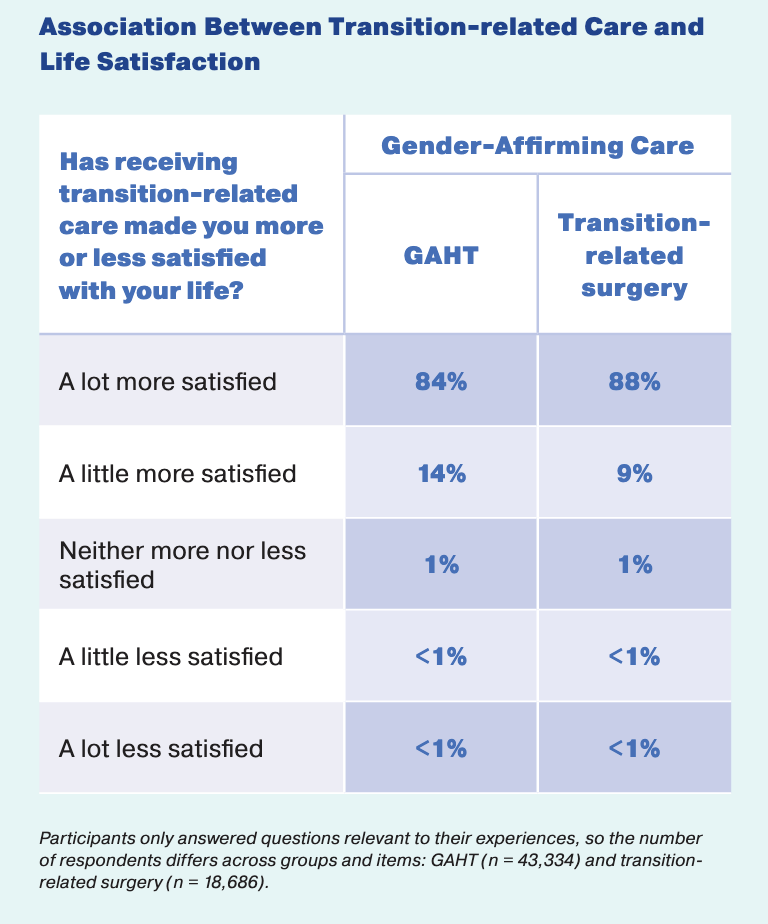
Meanwhile, respondents who received gender-affirming hormone therapy (GAHT) or gender-affirming surgery overwhelmingly reported feeling “more satisfied” with their lives—98% and 97% respectively.
Graphic courtesy of the 2022 U.S. Transgender Survey – Health and Wellbeing Report
This watershed report contradicts the popular narrative being circulated by mainstream media, far-right politicians and anti-trans groups that transgender people are “detransitioning” en masse due to life-shattering “transition regret.” In reality, it shows gender diverse people are living rich and vibrant lives—so long as they are provided the space, support and care they need from their health care providers and communities.
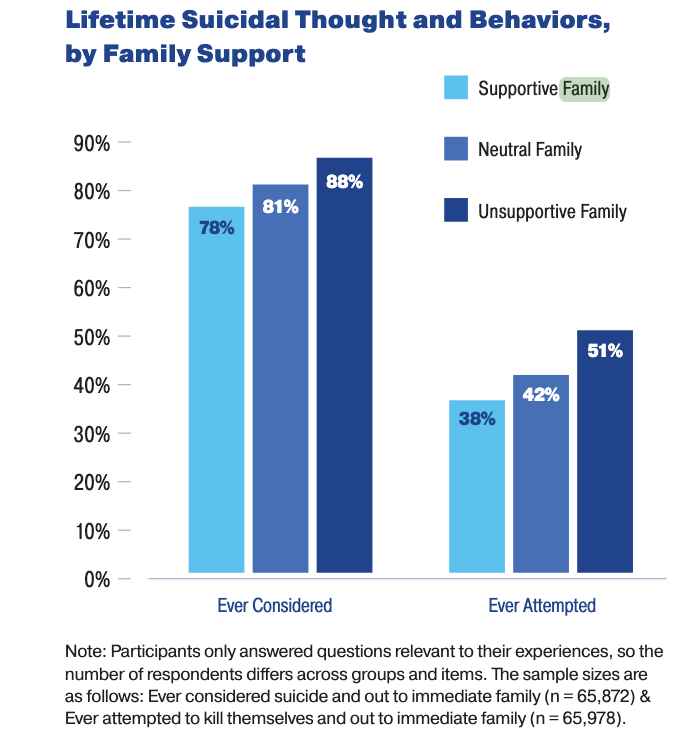
The survey found a trans person’s overall health and wellbeing also heavily depends upon rates of familial support, a factor that has a profound influence over a trans person’s lifetime experience of suicidality.
Graphic courtesy of the 2022 U.S. Transgender Survey – Health and Wellbeing Report
The survey has been released in increments as researchers at A4TE wade through the unprecedented amounts of data from trans people who lent their voice to the project. It is a much-needed, comprehensive overview on the challenges—and victories—seen in trans health care since the prior iteration of the study. The report is especially vital considering the Trump Administration moved to remove transgender people from the U.S. Census and other government websites, rendering trans communities potentially invisible, and robbing researchers of crucial data informing public policy decisions.
“Having real concrete and rigorous data about the realities of trans people’s day-to-day lives is also a vital part of dispelling all of those assumptions and stereotypes that plague the public discourse about our community,” said Olivia Hunt, A4TE’s Director of Federal Policy, during a press briefing this week.
The report also touched upon trans people’s access to health care, which increased between 2015 and 2022; the quality of care, as trust between doctors and trans patients has improved; disparities between trans people across racial groups, which showed trans people of color are generally more prone to experience discrimination compared to white trans people; and the mental health challenges facing the trans community, as 44% of respondents met the criteria for serious psychological distress, compared to less than 4% of the general U.S. population.
Many of these issues have likely been exacerbated since the data was collected. The lead-up to President Donald Trump’s return to the Oval Office incited a new wave of anti-trans animus, impeding access to care and stirring up transphobic vitriol and harassment.
“From 2015 to 2022, state-level policy environments became more protective in some ways for trans people; however, in 2022 alone, when the USTS was administered, 315 anti-LGBTQ bills were introduced across the country, many of which harm trans and nonbinary people’s access to healthcare, participation in sports, access to public facilities, or other facets of public life,” the report says.
“This political landscape has only worsened since the administration of the 2022 USTS, with the introduction of 571 anti-LGBTQ nationwide in 2023 and 489 in 2024,” it continues. “At the time of writing, data on trans and nonbinary people has been erased from federal health surveys. As funding for LGBTQ research is stripped away, the USTS has become an ever more critical resource on the lived experiences of trans and nonbinary people.”
Nonetheless, trans life and trans joy has persisted, as testimonies featured in the U.S. Trans Survey demonstrate.
“I have thrived in the past 12 months in transition, I have a genuine smile on my face most days & laugh with genuine joy,” wrote Charlotte, a trans woman, in her survey response. “I have grown into the woman I was meant to be.”
And as Roo, a nonbinary person, wrote: “Once I learned what it meant to be trans, I never looked back. I traded in my Regina George-esque life for a future with a balding head and a predisposition for a beer gut. I’ve never been more happy to be alive—every single day. ”
Erin In The Morning is a reader-supported publication. To receive new posts and support my work, consider becoming a subscriber.
Remember when the right freaked out because bike riding Biden fell on the Air Force 1 stairs as he ran up them? Where are they now? Remember when tRump needed a General to walk him down the ramp? Well now tRump has falling on the Air Force 1 stairs. So where is the outrage on the right? tRump rides a gold cart on the green so he is supper fit, but Bide riding and exercising Biden in their mind was a feeble old man days into his term. Hugs
June 9, 1872 Julia Ward Howe, an abolitionist and the composer of “Battle Hymn of the Republic,” tried to establish the Mothers’ Peace Day Observance on the second Sunday in June. In 1872 the first such celebration was held and the meetings continued for several years. Her idea was widely accepted, but she was never able to get the day recognized as an official holiday. Mothers’ Peace Day was the predecessor of the Mothers’ Day holiday in the United States now celebrated on the third Sunday of May. Julia Ward Howe ca.1898 Her proclamation read in part: “As men have often forsaken the plough and the anvil at the summons of war, Let women now leave all that may be left of home For a great and earnest day of counsel. Let them meet first, as women, to bewail and commemorate the dead. Let them solemnly take counsel with each other as to the means Whereby the great human family can live in peace….”
June 9, 1954 Special Counsel for the U.S. Army Joseph N. Welch confronted Senator Joseph P. McCarthy (R-Wisconsin) during hearings into alleged communist infiltration of the Army Signal Corps.McCarthy had attacked a member of Welch’s law firm, Frederick G. Fischer, among many others, as a communist. This was alleged due to Fischer’s prior membership in the National Lawyers Guild. The Guild was the nation’s first racially integrated bar association. Army counsel Joseph N. Welch (l) confronts Senator Joseph McCarthy (r) Welch was outraged by the attempt to destroy the reputation and career of someone of whose integrity he had no doubt: “Until this moment, senator, I think I never gauged your cruelty or recklessness . . . . Have you no sense of decency, sir? At long last, have you left no sense of decency?” The entire hearings and this encounter were seen live on television, the first congressional committee hearings ever to be broadcast. McCarthy’s ability to make such accusations was soon greatly diminished. Watch the confrontation National Lawyers Guild, since 1937 and today
June 9, 1984 150,000 marched in London, England, for nuclear disarmament, protesting the presence of U.S. cruise missiles on British soil.
June 9, 1993 Police banned a vigil by Women in Black (Zene u Crnom) in Belgrade, Serbia. Who are the Women in Black? Women in Black demonstrations combine art & politics
First you know this man was threatened all the way back to the US that his family would be rounded up and tortured if he told of what happened to him in that prison. I wonder if they had to wait until injuries healed before they could let the public see him? Ron says they maybe starved him and had to feed him again to build up his weight and looks. Poor man I hope he is able to safely get his story out. It is clear the charges against him are fraudulent and made up. Just like the government kept saying he was an MS 13 gang member which two courts found he was not. Also he was living in Maryland and his court case is being heard in DC so why is the Justice department trying his new charges in Tennessee? Why not add the charges to the case being heard now in DC. Clearly they hope to get a much more conservative and racist court there than they would in the northern states. I am surprised they did not charge him in Texas. Hugs.
Mistakenly deported Salvadoran native Kilmar Abrego Garcia appeared in a Tennessee courtroom Friday, hours after he was brought back to the United States to face criminal charges for allegedly transporting undocumented migrants within the U.S.
More than two months after the Trump administration admitted it mistakenly deported Abrego Garcia from Maryland to his native El Salvador, a two-count indictment unsealed Friday alleges that he participated in a years long conspiracy to haul undocumented migrants from Texas to the interior of the country.
The return of Abrego Garcia from his native El Salvador follows a series of court battles in which the Trump administration repeatedly said it was unable to bring him back, drawing the country toward the brink of a constitutional crisis when the administration failed to heed the Supreme Court’s order to facilitate his return.
MORE: Justice Department investigating 2022 Abrego Garcia traffic stop: Sources
He made his initial court appearance Friday evening in the Middle District of Tennessee, answering “Yes, I understand” in Spanish when U.S. Magistrate Judge Barbara Holmes asked him if he understood the charges against him.
Judge Homes set a hearing for June 13, where Abrego Garcia will be arraigned on charges and the judge will take up the government’s motion to hold him in pre-trial detention on the grounds that he “poses a danger to the community and a serious risk of flight” He will remain in federal custody in Tennessee pending next week’s hearing.
“If convicted at trial, the defendant faces a maximum punishment of 10 years’ imprisonment for ‘each alien’ he transported,” said the government’s motion for detention, which also contained an allegation — not included in the indictment — that one of Abrego Garcia’s co-conspirators told authorities that Abrego Garcia participated in the murder of a rival gang member’s mother in El Salvador.
Abrego Garcia’s attorney, in an online press briefing, called the charges against his client “an abuse of power.”
Kilmar Abrego Garcia is placed in the back seat of a truck by ICE agents after arriving in Nashville, Tenn., June 6, 2025.
ABC News
“They’ll stop at nothing at all — even some of the most preposterous charges imaginable — just to avoid admitting that they made a mistake, which is what everyone knows happened in this case,” said attorney Simon Sandoval-Moshenberg.
“Mr. Garcia is going to be vigorously defending the charges against him,” the attorney said.
The decision to pursue the indictment against Abrego Garcia led to the abrupt departure of Ben Schrader, a high-ranking federal prosecutor in Tennessee, sources briefed on Schrader’s decision told ABC News. Schrader’s resignation was prompted by concerns that the case was being pursued for political reasons, the sources said.
Schrader, who spent 15 years in the U.S. Attorney’s Office in Nashville and was most recently the chief of the criminal division, declined to comment when contacted by ABC News.
The alleged conspiracy spanned nearly a decade and involved the domestic transport of thousands of noncitizens from Mexico and Central America, including some children, in exchange for thousands of dollars, according to the indictment.
Abrego Garcia is alleged to have participated in more than 100 such trips, according to the indictment. Among those allegedly transported were members of the Salvadoran gang MS-13, sources familiar with the investigation said.
MORE: Timeline: Wrongful deportation of Kilmar Abrego Garcia to El Salvador
Abrego Garcia is the only member of the alleged conspiracy charged in the indictment.
Attorney General Pam Bondi, at a Friday afternoon press conference, thanked Salvadoran President Nayib Bukele for “agreeing to return Abrego Garcia to the United States.”
“Our government presented El Salvador with an arrest warrant and they agreed to return him to our country,” Bondi said.
Bondi said that if Abrego Garcia is convicted of the charges, upon the completion of his sentence he will be deported back to his home country of El Salvador.
“The grand jury found that over the past nine years, Abrego Garcia has played a significant role in an alien smuggling ring,” Bondi said. “They found this was his full time job, not a contractor. He was a smuggler of humans and children and women. He made over 100 trips, the grand jury found, smuggling people throughout our country.”
Attorney General Pam Bondi speaks as Deputy Attorney General Todd Blanche listens during a news conference about Kilmar Abrego Garcia at the Justice Department, June 6, 2025, in Washington.
Julia Demaree Nikhinson/AP
In a statement to ABC News, Abrego Garcia’s attorney said that he’s going to keep fighting to ensure Abrego Garcia receives a fair trial.
“From the beginning, this case has made one thing painfully clear: The government had the power to bring him back at any time. Instead, they chose to play games with the court and with a man’s life,” Sandoval-Moshenberg said. “We’re not just fighting for Kilmar — we’re fighting to ensure due process rights are protected for everyone. Because tomorrow, this could be any one of us — if we let power go unchecked, if we ignore our Constitution.”
Abrego Garcia, a Salvadoran native who had been living with his wife and children in Maryland, was deported in March to El Salvador’s CECOT mega-prison — despite a 2019 court order barring his deportation to that country due to fear of persecution — after the Trump administration claimed he was a member of the criminal gang MS-13. His wife and attorneys deny that he is an MS-13 member.
The Trump administration has acknowledged in court filings that Abrego Garcia’s removal to El Salvador in March was in error, because it violated a U.S. immigration court order in 2019 that shielded Abrego Garcia from deportation to his native country, according to immigration court records. An immigration judge had determined that Abrego Garcia would likely face persecution there by local gangs that had allegedly terrorized him and his family.
The administration argued, however, that Abrego Garcia should not be returned to the U.S. because he is a member of the transnational Salvadoran gang MS-13, a claim his family and attorneys have denied. In recent weeks, Trump administration officials have been publicizing Abrego Garcia’s interactions with police over the years, despite a lack of corresponding criminal charges.
After Abrego Garcia’s family filed a lawsuit over his deportation, U.S. District Judge Paula Xinis in Maryland ordered the Trump administration to facilitate his return to the United States. The U.S. Supreme Court affirmed that ruling on April 10.
Abrego Garcia was initially sent to El Salvador’s notorious CECOT prison but was believed to have later been transferred to a different facility in the country.
The criminal investigation that led to the charges was launched in April as federal authorities began scrutinizing the circumstances of a 2022 traffic stop of Abrego Garcia by the Tennessee Highway Patrol, according to the sources. Abrego Garcia was pulled over for speeding in a vehicle with eight passengers and told police they had been working construction in Missouri.
According to body camera footage of the 2022 traffic stop, the Tennessee troopers — after questioning Abrego Garcia — discussed among themselves their suspicions that Abrego Garcia might be transporting people for money because nine people were traveling without luggage, but Abrego Garcia was not ticketed or charged.
The officers ultimately allowed Abrego Garcia to drive on with just a warning about an expired driver’s license, according to a report about the stop released last month by the U.S. Department of Homeland Security.
Asked what circumstances have changed since Abrego Garcia was not taken in custody during that traffic stop in Tennessee, Bondi replied, “What has changed is Donald Trump is now president of the United States, and our borders are again secure, and thanks to the bright light that has been shined on Abrego Garcia — this investigation continued with actually amazing police work, and we were able to track this case and stop this international smuggling ring from continuing.”
Asked by ABC News’ Pierre Thomas asked whether this should be seen as resolving the separate civil case in Maryland in which a federal judge ordered the government to facilitate Abrego Garcia’s return, Deputy Attorney General Todd Blanche said, “There’s a big difference between what the state of play was before the indictment and after the indictment. And so the reason why he is back and was returned was because an arrest warrant which was presented to the government and in El Salvador. So there’s, there’s a big difference there as far as whether it makes the ongoing litigation in Maryland moot. I would think so, but we don’t know about this. He just landed today.”
As ABC News first reported last month, the Justice Department had been quietly investigating the Tenessee traffic stop. As part of the probe, federal agents in late April visited a federal prison in Talladega, Alabama to question Jose Ramon Hernandez-Reyes, a convicted felon who was the registered owner of the vehicle Abrego Garcia was driving when stopped on Interstate 40 east of Nashville, sources previously told ABC News. Hernandez-Reyes was not present at the traffic stop.
MORE: Newly released video shows Abrego Garcia’s 2022 Tennessee traffic stop
Hernandez-Reyes, 38, is currently serving a 30-month sentence for illegally re-entering the U.S. after a prior felony conviction for illegal transportation of aliens.
After being granted limited immunity, Hernandez-Reyes allegedly told investigators that he previously operated a “taxi service” based in Baltimore. He claimed to have met Abrego Garcia around 2015 and claimed to have hired him on multiple occasions to transport undocumented migrants from Texas to various locations in the United States, sources told ABC News.
When details of the Tennessee traffic stop were first publicized, Abrego Garcia’s wife said her husband sometimes transported groups of fellow construction workers between job sites.
“Unfortunately, Kilmar is currently imprisoned without contact with the outside world, which means he cannot respond to the claims,” Jennifer Vasquez Sura said in mid-April.
Sen. Chris Van Hollen of Maryland, who flew to El Salvador and met with Abrego Garcia shortly after his deportation, said Friday that the Trump administration had “relented” regarding his return.
“After months of ignoring our Constitution, it seems the Trump Admin has relented to our demands for compliance with court orders and due process for Kilmar Abrego Garcia,” Van Hollen posted on X. “This has never been about the man — it’s about his constitutional rights & the rights of all.”
Abrego Garcia entered the U.S. illegally as a teenager in 2012, according to court records. He had been living in Maryland for the past 13 years, and married Vasquez Sura, a U.S. citizen, in 2019. The couple has one child together.
ABC News’ Laura Romero contributed to this report.
Ann Arbor (Informed Comment) – Harald Ringbauer et al. writing in Nature report on a genetic study of the ancient Phoenicians that is really going to anger Lebanese Christian nationalists. In fact, it contains a profound lesson for nationalists and nationalism in general, which is that the whole thing is a scam thought up in the last 250 years.
The 19th century racist thinker Ernest Renan saw a racial distinction between “Aryans” and “Semites.” From that point of view, the Punic wars between Rome and Carthage had a racial element, since Phoenicians were classed as “Semites.” But it turns out it was all a tiff among people we would now class as Italians.
The Phoenicians had been thought to be a unified civilization that began in what is today Lebanon. Well, they did start off in what is today Lebanon. But the “unified civilization” bit turns out to be a misconception.
The Phoenicians developed an alphabet. Like most alphabets, the letters had originally been pictograms. The Hebrew, Aramaic and Arabic, as well as the Greek and Roman alphabets (we still use the latter) derived from the Phoenician. For instance a picture of waves stood for water (ma’), and that became our M, which still looks like waves. Or a circle stood for eye (`ayn), which became our ‘o.’
Since the Phoenicians founded city-states all around the Mediterranean and left inscriptions in that alphabet, scholars had assumed that they were a related people. Phoenician settlements in the western Mediterranean were called “Punic,” but the language and customs were the same.
Regarding the Lebanese origins of this civlizational complex, Ringbauer et al. write, “We find that individuals from the Levantine Phoenician site of Akhziv in present-day Israel cluster together with previously published Bronze and Iron Age Levantine individuals, including from Megiddo in present-day Israel and the Phoenician cities of Sidon and Beirut in present-day Lebanon.” That is, they looked at ancient individuals from around the Levant and found that they all had shared haplotypes, i.e. they were Canaanites. Phoenicians, Hebrews, Nabataeans, etc. were all Canaanites culturally and genetically.
Now imagine the scientists’ astonishment when they looked at DNA from individuals who had lived in Phoenician cities such as Ibiza off Spain or Carthage in Tunisia to find that it did not display the ancient haplotypes or genetic sequences associated with Levantine peoples.
They write, “However, a mitochondrial genome from Carthage and whole-genome data from 12 individuals from the nearby rural Punic site of Kerkouane show substantial south European ancestry as well as indigenous North African ancestry. Partial North African ancestry was also found in genome-wide data from eight individuals from two Punic sites in Sardinia, combined with a broad eastern Mediterranean ancestry. Together with analysis of the whole-genome sequence of an individual from Ibiza, which was also interpreted to harbour eastern Mediterranean ancestry, this suggested that Punic people had complex ancestry.”
They observe of these “Phoenicians of the middle and western Mediterranean, “They are broadly distributed with a primary mode overlapping Bronze and Iron Age individuals from Sicily and the Aegean, regardless of sampled location.” There were only three exceptions: two persons from Sicily and one from Sardinia showed Canaanite genetic heritage.
In all the other 119 samples from “Punic” sites, the genetic heritage was mixed, showing patterns similar to those in ancient Greece and Sicily. After around 550 BC, when Carthage was founded by the “Phoenicians” in what is now Tunisia, some North African [Amazigh] genetic heritage starts to circulate among some of them. But this was a minority population. The authors observe, “Even in North Africa, 10 out of the 27 individuals from Kerkouane and 5 out of the 17 individuals from Carthage can be modelled with no indigenous North African ancestry, and 84% of individuals from these sites have more than 50% Sicilian–Aegean ancestry, making it the dominant ancestry component also in North African Punic sites.”
Also, the Iberians were mostly not Iberians. “Only two Iberian individuals, from Ibiza and Cádiz, had confidently high proportions of Bronze Age Iberian ancestry… Instead, Punic sites in the western Mediterranean share similar ancestry distributions of predominantly Sicilian–Aegean or North African origin.”
So how did all this happen? The authors hypothesize that Lebanese Phoenicians colonized Sicily, which had earlier had Greek colonies, and the Sicilians adopted Phoenician language, religion and culture. They they were the ones who struck out west, establishing Phoenician colonies in the central and western Mediterranean.
Ringbauer and his colleagues explain, “A critical question raised by our results is how and when Canaanite–Phoenician culture and language were adopted by people without any detectable Levantine ancestry. One hypothesis is that, after Levantine Phoenicians founded settlements in the central and western Mediterranean in the early first millennium bce, these communities continuously incorporated people with Sicilian–Aegean ancestry.”
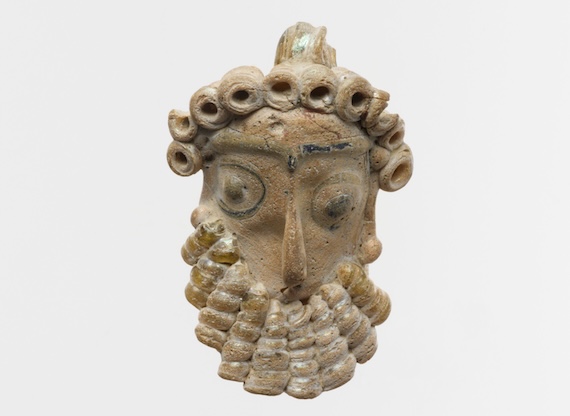
Glass head pendant, Phoenician or Carthaginian, ca. 450–300 BCE. Metropolitan Museum. Public Domain.
Reporting on the study for a Nature briefing, Ewen Callaway quotes Ringbauer as asking how it was that many Mediterranean peoples abandoned their own local cultures for that of the Phoenicians. “Does this mean Phoenician culture was like a franchise that others could adopt? That’s one for the archaeologists.”
Of course they were a franchise. So were the ancient Greeks, whose culture was adopted by so many Egyptians in places like Alexandria. As late as the 200s and 300s, there are no Arabic or Aramaic inscriptions in and around Damascus, only Greek ones. Ashkenazi Jews in Europe were also a franchise, which was joined by many gentiles — especially but not only women.
Nineteenth century European theorists of nationalism confused language groups with kinship groups, assuming that people who spoke a language were a “race,” perhaps even a “pure” one.
Today many Lebanese Christians claim to be “Phoenicians,” as though it was a pure “race” unconnected to the “Arabs.” And they take pride in Carthage, a Phoenician city, and in the Phoenician outposts of Spain, imagining they were all “Lebanese.” Ringbauer has knocked that down.
There are no nations or races of that sort. There are no “Aryans” and “Semites.” This was a linguistic distinction that was stupidly racialized. Racial “nation” was all a fevered racist fantasy. Even modern genetics only traces two lines of ancestry, the Y chromosome and the mitochondrial DNA of the X chromosome, whereas we have millions of ancestors. We’re all mongrels, all mixed up, and people in the Mediterranean basin all have a common ancestor from not so long ago. All humans have one likely only 200,000 years ago.