The last few days, I have been driving Ron from different stores to other places he wants to go. Yes he can still drive, but since the doctor talked to him about possible dementia he wants me to drive him everywhere. Plus I have caught him in several forgetful moments the last two days like forgetting to lock a door or forgetting to do something else important, he now shrinks like I hit him when I remind him of it.
It tears the shit out of me. I have never hit or abused Ron, but to see him cringe like I did as a child waiting for the blow … It is killing me. I find my self talking very gently around him, which then bothers him. I find myself checking up behind him like tonight he is cooking supper and I helped him get sauces out and small dishes. Then he noticed me checking the setting on the stove and oven.
That set him off, you don’t trust me. My response was Ron love you asked me what stuff we should get out and have with our supper. I feel this is a rollercoaster I am not prepared for as with my own memories of abuse hitting I go in and out of that same roller coaster. I can not have two of us cycling at the same time.
I have changed how I do my pills so it is clear and no doubt when I take them. I have added a note suggested by Suze to my desk reminding me to take my evening insulin. Again thanks to Suze I added a phone alarm to both Ron’s phone and mine that alert him to take his pills. It worked today, as I walked around trying to figure out why that sound was playing and Ron told me … it is time for me to take my pills.
Right now this is the best I can do. To say I am worried or scared is a large understatement. Please keep suggestions coming. Hugs
Oh a major issue has developed with my computers that I need to dump them and reset them to fix. But not today, not now, and hopefully I have a few days to do it. Tomorrow morning I have to get up at 5AM to get us ready for Ron’s brain scan first thing in the morning. Love to all that care about us, best wishes for all, and hugs for those that want them. Scottie
March 17, 1966 Cesar Chavez and the National Farm Workers Association left Delano for Sacramento, the capital of California, a 340-mile march which would take three weeks. They were calling public attention to the plight of farm workers and for their struggle for the right to organize a union.
March 17, 1968 In London’s Trafalgar Square, at the largest anti-Vietnam War protest in Britain to date, 25,000 people marched. They were demonstrating against American action in Vietnam and British support for the United States policy. Some then attempted to storm the U.S. Embassy, resulting in 200 arrests and fifty taken to hospital, nearly half police officers.
March 17, 1978 The oil supertanker Amoco Cadiz ran aground and, in the worst oil spill ever, lost its entire cargo of 1,619,048 barrels (223,000 tons).A slick 18 miles wide and 80 miles long polluted approximately 200 miles of France’s Brittany coastline. The Amoco Cadiz disaster was the first marine environmental catastrophe to be covered by the world’s media in real time. one of the victims Read more
March 17, 2003 President George W. Bush warned U.N. weapons inspectors to leave the Iraq within 48 hours. They were in country searching for weapons of mass destruction (WMD), conducting 900 inspections at 500 locations in four months.Bush had given Saddam Hussein the same amount of time to step down from power or suffer the consequences of the planned invasion. Hans Blix, the chief weapons inspector, and Mohamed El Baradei, head of the International Atomic Energy Agency, and the inspectors had found no WMDs, or any evidence of a renewed Iraqi nuclear weapons program. Despite increasing cooperation from Iraqi authorities relenting to international pressure, the inspectors were unable to complete their work due to the American threat of war. U.N. weapons inspectors in Iraq before they were forced to leave by President George W. Bush Hans Blix’s report to the UN Security Council just ten days earlier
“I stopped breathing and my heart skipped. My pants were down around my ankles, and no one else was within earshot.”
By Rey Katz Mar 11, 2025, 08:25 AM EDT Updated Mar 11, 2025
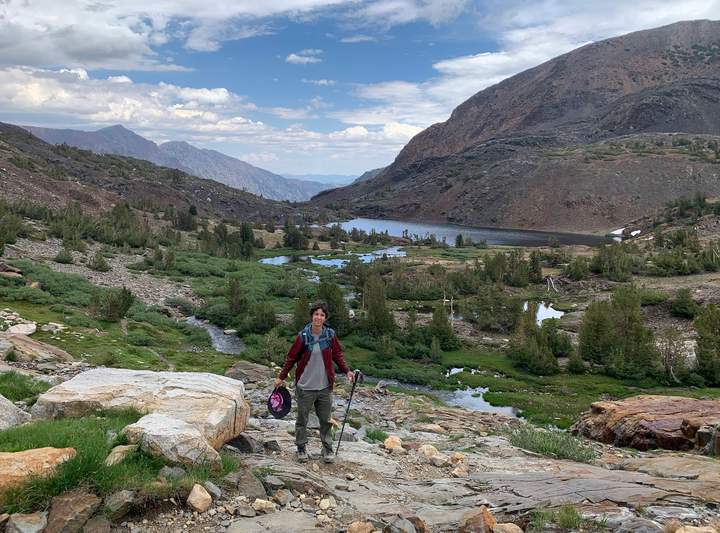
The author hiking just outside Yosemite National Park in July 2024, after cutting their hair short, holding their pink hat.
“Hello? Are you a male or female in there?” a rumbling voice called into the women’s restroom. A man’s boots stepped across the threshold, clunking on the tile floor, as I sat alone in the stall closest to the door.
I stopped breathing and my heart skipped. My pants were down around my ankles, and no one else was within earshot.
My hands went to where my freshly shorn curls used to be — fingers twining into my 2 remaining inches of hair — and I wondered if I had made a mistake. I had been using women’s restrooms my entire life, from when I had long braided pigtails and my mom taught me to lay down two layers of toilet paper on the seat, to my road trip around California as a white, skinny, short, nonbinary person in my early 30s.
***
My partner and I were on an adventure. We had sublet our apartment and were camping in a van for the summer. We slept every night on a memory foam mattress in the van and cooked most of our meals outdoors on a propane stove. Immersed in nature, at a distance from society and community, I could recognize my true self more clearly, and I took the opportunity to explore a more masculine appearance.
I don’t have much experience with people thinking I might be a man. Growing up, people always assumed I was a girl. I still can’t cut my hair without shame, hearing women’s voices in my head: “Oh, but your hair is so lovely, you should keep it long.” It’s as if I hurt my community every time I do it.
Despite the shame, I had cut my hair earlier that week, camped alongside a beautiful, remote river. I trimmed a couple of inches off to give myself the 2-inch-long “men’s” cut I usually give my partner. He is supportive of whatever hair length I want for myself. I squinted into a little travel mirror and lopped off chunks, feeling bits of hair drift down my bare shoulders. Finished with the trim, I dove into the brown river water and scrubbed my scalp with my fingers. I floated in the sun, naked and unjudged by the birds watching me from the trees.
I didn’t feel judged for my haircut until we traveled back into town. While I was washing my face at the sink in a restroom, someone peeked in and then left. I put my glasses back on and walked out. A woman with long hair was standing outside, uncertain, wearing a long skirt. As she turned to face me, I said hello.
“Is this the women’s room?” she asked.
“Yes,” I answered curtly, forced a smile, and walked away quickly, past the word “Women” in 6-inch green painted letters on the wooden wall of the building.
I guess I had been gendered as too-butch-to-be-in-the-women’s-room. Affirming? Slightly. But it was a preview to an unsolvable problem. If I’m not supposed to be in the women’s room, but I also can’t use the men’s, how can I use the bathroom?
***
My partner and I found a lovely city park with a picnic area and gazebo to eat breakfast in after camping on National Forest land nearby. After a mug of coffee, I visited the public restroom. I didn’t expect a stranger to yell at me through the flimsy stall door.
“Hello? Are you a male or female?”
I was the only person using the restroom — the kids who had been in there a minute ago had left. I felt this man’s eyes on my sneakers and blue hiking pants under the stall. I was scared this harassment could escalate if I didn’t say something to diffuse the situation. I gulped and called back, “Hello?”
“Oh, you’re a female. My bad.” He sounded reassured by my quavering voice. I heard his footsteps leaving the room. My heart raced as I fumbled with toilet paper, fingers shaking. I felt nauseated.
My voice had immediately identified me as the “female” I didn’t feel myself to be — and all it took was two syllables. But my “female” voice had also saved me from further harassment. Would that man have dragged me out of the stall if I sounded “like a man” or remained quiet? Would he have looked under the stall? Would he have tried to check what was between my legs while my pants were down? Did he have any idea how much of a violation these real and imagined threats were to me?
And why was a man even in the women’s room, questioning me? Did a kid’s mother report me to her husband for looking too much like a man in the women’s room? Perhaps they were alarmed that I, with my short hair, had been in the restroom with their young kids. I felt physically ill at the troubling thought that someone would assume I would do anything harmful to children. I hadn’t said anything, made eye contact with anyone or done anything other than sit quietly in the stall in the room that matches my assigned sex at birth.
I felt bad for looking masculine to make myself more comfortable, because I didn’t want to make anyone else uncomfortable. Some part of me longed to return to my habit of looking more like a woman, but I also felt sick from not feeling right in my body.
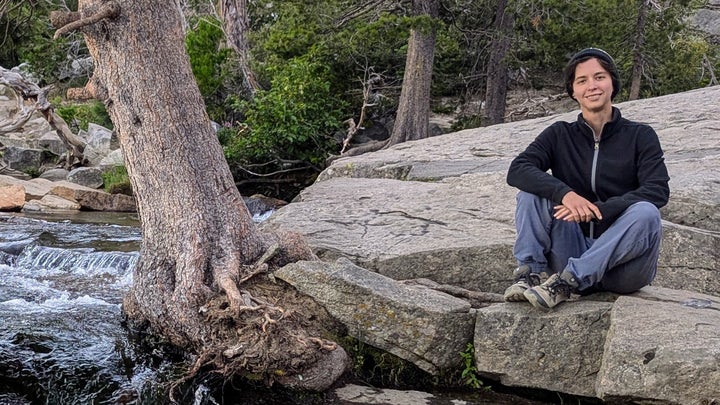
The author sitting beside a mountain stream in August 2024, wearing the same hat, jacket, pants and shoes they had on during the bathroom incident earlier that day.
I can empathize with these strangers viewing me and my body as a threat because I have also viewed my body as a threat. I have been unhappy with the shape of my body, my appearance in the mirror and the tone of my voice. And to have that thrown back in my face in such a vulnerable moment — pants down, defenseless, forced by my body’s very personal needs to be in this gendered room — hit close to home.
It did not occur to me to call the police, because the last thing I needed was to wait around for law enforcement to judge my qualifications to use a bathroom and give a police report about someone I hadn’t actually seen. Instead, I texted a friend — a woman with short hair — to tell her my story of being harassed in the bathroom and share how uncomfortable that made me. She responded that women have screamed after seeing her in the restroom, and she’d had security called on her. My experience seemed mild by comparison. I appreciated her perspective.
For the next several days, I felt intensely conflicted and full of gender dysphoria. I was tense and nervous using public restrooms. I wore my pink hat, forced a big smile and strode in confidently, femininely, trying to look like the kind of woman no one would object to. But I’m not a woman. I came out as a transmasculine, nonbinary person in my late 20s — a person who feels more like a boy than a girl on the inside. A person whose anxiety and depression eased once I no longer had to hide who I am.
I have to choose between a women’s or men’s restroom in most public spaces, as unisex bathrooms are uncommon. Laws restricting bathroom access, which are becoming more prevalent in the United States, attempt to define sex based on whether an individual can produce eggs or sperm. In practice, people look at your body shape, clothes and hair and make an assumption about which restroom you should use. Most people assume I would use the women’s room, so that’s what I continue to use. Trans women often have harder choices. Anyone who pushes back on my use of the women’s room suspects that I am a trans woman. They correctly identify me as trans, but in the incorrect direction.
Trans women are the target of these “bathroom bills” and may encounter harassment and violence in either restroom. Being legally required to use the “wrong” restroom can out people as trans, which can be dangerous for them.
Trans women may need to go more frequently on average. One of the most common testosterone blockers, spironolactone, is a diuretic which means you need to pee often while taking it. The constant stress of navigating public spaces as a trans person with a filling bladder is incredibly — literally — painful.
At the park the day of the bathroom incident in August 2024, the author was wearing a hat, glasses and a fleece jacket.
***
A couple of weeks later, my partner and I returned to the same city park. After relaxing at the picnic tables, I walked over to the bathroom. A new porcelain toilet sat whimsically outside the building, prepped for installation. Uh oh, I thought, rounding the corner to see a plumber with a pickup truck. A “closed for cleaning” sign was braced across the door of the women’s restroom.
The plumber, burly, with a beard, glanced at me and asked, “You need to use the restroom?” gesturing to the men’s door. I nodded, but looked back to peer past the closed sign into the women’s room.
“Oh, you want to use that one?” he asked, squinting at me. It was a cold morning. I was bundled up in a knit cap and two layered jackets. Looking at me, the plumber honestly seemed to think I was heading for the men’s. I shrugged and took what I hoped was a few casual steps toward the men’s room.
“Use the toilet in the last stall,” he prompted me. Perhaps the other plumbing hadn’t been hooked up yet.
“All right, thanks,” I said, pitching my voice down, trying to sound like I’d meant to go in the men’s room all along.
I used the toilet in the empty men’s room to pee, washed my hands, walked out, nodded to the plumber and walked off. I felt rattled but also surprisingly comfortable. Someone had told me that I could use that bathroom, that stall, and I felt validated in doing the right thing. It was the opposite of being questioned for being in the women’s room. I hadn’t made anyone else uncomfortable by existing. Was that a success? Is not making anyone uncomfortable except myself a healthy baseline?
***
Although that experience felt validating, using the “wrong” bathroom can have very real consequences. In California, I didn’t face legal consequences for using a men’s bathroom. If I had instead been in Florida and refused to leave the men’s bathroom if asked, I could have been charged with criminal trespass, likely a first-degree misdemeanor, which carries a prison term of up to one year or a $1,000 fine.
Proponents of “bathroom bills” claim they protect children from predators, but assaulting children in restrooms (or anywhere else) is already illegal. A bathroom law doesn’t physically prevent male abusers already willing to break the law from stepping into women’s spaces. However, these laws can prevent trans women from comfortably and legally using any public bathroom, including restrooms in their workplace.
U.S. Rep. Nancy Mace introduced the Protecting Women’s Private Spaces Act in November 2024. If enacted, this law would prohibit transgender individuals from using restrooms that align with their gender identity on federal property, specifically targeting U.S. Rep. Sarah McBride, the first openly transgender member of Congress, who would no longer be allowed to use the women’s bathroom at her workplace in the Capitol.
The author relaxing in a camp chair behind the van, with short hair and wearing masculine clothes, in September 2024.
I am lucky I don’t work in a place where I can’t use the bathroom, but navigating my gender identity is still a constant struggle — not solely with myself, but with everyone I interact with. I have to justify my gender expression to strangers and negotiate with them, whether or not our interactions are negative or positive. So why do I subject myself to this frustration? Because it would hurt more to hide myself every moment of every day.
Finding more authentic ways to express myself feels like a weight that I wasn’t aware of has been lifted off my chest, and suddenly, I can breathe deeply, newly grounded in the reality of my body. Swimming in the river after I cut my hair, I felt distantly afraid but excited about what was to come. I felt grateful I took this step toward my true self.
Rey Katz is a nonbinary writer, MIT alum, small-business owner, and black belt in Kokikai Aikido. They are working on a memoir about coming of age as a nonbinary martial artist. Check out their relatable true stories at Amplify Respect and small biz services at reykatz.com.
Simply very bad news. Precisely what Project 2025/Agenda 47/Republican National Platform said they want to do. I’m sorry; I don’t like to bring bad news. But people need to prepare. This is written in editorial/opinion style, but facts are within and there are citations. For people like us who need time to prepare for austerity, it’s news we ought to read.
Also, there are Senator names included for who we should write to regarding this bill. That’s our last chance. Shutdown is on Republicans, not Democrats, no matter how they try to deflect. We need to tell the Dem senators to speak what’s in this bill, every chance they get, and to refuse to vote in favor, pointing at Republicans the entire time.
There are parts in the article complaining about Democrats and their choices, etc., et. m. Read it if you want (you’ll have to click through for it,) but it won’t help anyone to read more complaining about Democrats. We the people need to energize Dem. Senators to speak out, and to vote no. Especially the speak out portion; Sen. Mark Kelly does that especially well, and is among those the author of this piece feels is wavering. I intend to start first thing in the morning, and I hope all of us will devote some time to this. It’s vital.
Without the luxury of Republicans falling apart, Democrats in the Senate need to decide whether to prevent a dangerous and harmful budget that shrinks the power of Congress in the government. Since operating on principle goes against their “adults in the room” mindset, they are wavering on what to do. But it should be an open-and-shut case.
A normal continuing resolution funds the government at the same level as the previous budget. This bill does not. It cuts non-defense discretionary spending by $13 billion below last year’s level, while increasing military spending by $6 billion. It zeroes out funding for programs that fund homeless shelters and prevent child abuse. It cuts health care funding for clinics and hospitals, emergency preparedness for communities, clean water projects and tribal assistance. Meanwhile, it adds money for mass deportations, just as Immigrations and Customs Enforcement has illegally detained a green card holder for his political beliefs.
Most of the budget cuts are achieved by removing earmarks, which members of Congress put in to direct projects. But usually when earmarks are removed, the money goes back to the agency to decide how to distribute it. This maneuver cuts the earmarks and the money.
The House Republican bill also fails to fix a carryover of a $20 billion rescission to IRS money from the Inflation Reduction Act, effectively doubling that cut. This was kind of pre-ordained when Democrats punted on this in a prior continuing resolution last December, but it still means that practically all of the IRA’s funding for greater enforcement of tax collection is now gone.
The bill not only adds $6 billion to the Department of Defense’s enormous budget, but adds $8 billion in “transfer authority” that allows the agency to shift spending where they deem important, a flexibility no other agency gets.
While Republicans tout a $6 billion increase in veterans health care in the bill, they neglect to mention the removal of a $23 billion appropriation to the Toxic Exposure Fund to implement the PACT Act, which cares for veterans exposed to burn pits and other cancer-causing chemicals. While there’s an extra $2.2 billion for the Federal Emergency Management Agency’s disaster relief fund, there’s no additional money to support the rebuilding in southern California after the January wildfires.
But most important, the bill grants an open invitation to Trump and Elon Musk to continue to ignore Congress and toss out disfavored spending. Vice President JD Vance, while selling the deal to House Republicans, stated outright that “Trump would continue cutting federal funding with his Department of Government Efficiency initiative and pursue impoundment — that is, holding back money appropriated by Congress.” This has been reiterated by others in the Trump administration.
In fact, the House Republican bill gives the president more leeway to move money around. It appropriates money for things that Musk has eliminated, meaning that money can operate as a floating slush fund for Trump’s priorities, as long as the courts don’t roll back the illegal impoundments.
… The Trump administration is saying that they will sign a bill appropriating specific funding, and then go about cutting funding anyway. If you’re a member of Congress, you’re being told that your work product doesn’t matter, that the constitutional power of the purse doesn’t matter, and that there’s no guarantee that anything you pass will actually reach the people you serve.
I can see why Republicans would take this deal: they want budget cuts but know they don’t have the votes for them, so they’re plenty happy to outsource that to the president, even if it turns Congress into a separate and unequal branch of government. But why would Democrats willingly submit to a fake budget on paper that can be so easily circumvented? As Rep. Greg Casar (D-TX), chair of the Congressional Progressive Caucus, said on X, “The Republican spending plan will supercharge Musk’s theft from working people to pay for billionaire tax cuts. Senate Democrats must stop it.”
…
So far, only Sen. John Fetterman (D-PA) has committed to voting yes. But as Josh Marshall has documented at Talking Points Memo, a number of Senate Democrats have stated no position on the bill, leaving their options open. In general, senators have been hedging their bets until forced to make a decision. That time has come.
Credible sources indicate that the most likely Democrats to offer up the remaining seven votes to avoid a shutdown are Mark Kelly (D-AZ), Ruben Gallego (D-AZ), Michael Bennet (D-CO), John Hickenlooper (D-CO), Jon Ossoff (D-GA), Gary Peters (D-MI), Elissa Slotkin (D-MI), Maggie Hassan (D-NH), and Mark Warner (D-VA).
Hi all. I love Erin Reed and her substack Erin In the morning. I don’t subscribe to many but I do hers. Here is something for all those that say European countries are reversing on gender affirming care or cite the horrible bias of the debunked Cass review. Hugs.
—————————————————————————————————————
The recommendations, released by the Association of the Scientific Medical Societies in Germany, come at a time when US politicians erroneously claim that Europe is “pulling back” on transgender care.
Erin In The Morning is a reader-supported publication. To receive new posts and support my work, consider becoming a subscriber.
Upgrade to paid
In recent years, U.S. politicians have selectively framed European healthcare policies to justify restrictions on transgender care, seizing on a handful of conservative policies to claim that “Europe is pulling back.” The most extreme example, the United Kingdom’s Cass Review, has been wielded to justify a near-total ban on puberty blockers and even cited in U.S. Supreme Court arguments. But new medical guidelines from Germany, Austria, and Switzerland tell a different story. These countries have reaffirmed the importance of gender-affirming care for transgender youth and issued sharp critiques of the Cass Review, calling out its severe methodological flaws and misrepresentations.
The guidelines, released Friday in German, span more than 400 pages and represent the collective expertise of 26 medical and psychotherapeutic professional organizations, along with two self-representation organizations from Germany, Austria, and Switzerland. Their stated goal is “to provide guidance to all professionals in the healthcare system who deal with young transgender and non-binary people for the best possible professionally informed care based on the current state of medical knowledge.”
Transgender medical guidelines and associated medical organizations recommending them.
From the outset, the guidelines explain the importance of gender affirming care, stating that there are “no proven effective treatment alternative without body-modifying medical measures for a [person with] permanently persistent gender incongruence.”
Importantly, the guidelines were developed with those who are experts in the fields of gender affirming care having a voice at the table, unlike the Cass Review: “Current guidelines, which are published by medical societies, were predominantly developed by clinical experts for the field of application and are based on an integrated synthesis of the assessment of available evidence and the broadest possible expert consensus.”
The guidelines directly recommend puberty blockers and individualized, prioritized care for transgender youth undergoing physical changes.In the section on puberty blockers, the guidelines state with a strong recommendation: “If, in individual cases, the progressive pubertal maturation development creates a time pressure in which health damage would be expected due to longer waiting times to avert irreversible bodily changes (e.g. male voice change), access to child and adolescent psychiatric or psychotherapeutic clarification and medical treatment optionsshould be granted as quickly as possible.”
The guidelines also deliver a strong critique of the Cass Review, the report currently being used to justify bans on gender-affirming care in the United Kingdom and leveraged in other countries to further restrictions. German medical societies deem the Cass Review largely inapplicable to their own guidelines due to its numerous methodological shortcomings. One of their sharpest criticisms focuses on the lack of transparency regarding those who advised and produced the review, as well as the limited expertise of those involved.
“Medical professional societies were not recognizably involved in the preparation of the report. A so-called “Assurance Group” was appointed, but it was explicitly not involved in the development of recommendations for the Cass Review. There are reports that an “Advisory Board” was also established. The composition and specific contribution of this “Advisory Board” are not documented (Ruuska et al., 2024; Cass, 2024),” read the guidelines.
They also criticize the Cass Review and NHS’s recommendation of “psychotherapy” for gender dysphoria as without evidence and as potentially harmful: “Psychotherapy is recommended for co-incident disorders, for which there is already an indication due to the co-incident disorder itself. However, it is also recommended or the ‘management of [GD] associated distress.’ None of the studies included in the review in question were able to show a reduction in gender dysphoria through psychotherapy.”
The new German, Austrian, and Swiss guidelines mark a significant advancement for transgender healthcare in those countries, reinforcing a growing trend in Europe toward expanding, not restricting, access to gender-affirming care.They join the ranks of nations like Spain and France, which have taken more progressive stances on transgender rights, including medical care. More importantly, they dismantle the false narrative that Europe is “pulling back” on transgender care.In reality, it is the United States that stands as an outlier, with its regressive policies placing it far to the right of much of the Western world.
Erin In The Morning is a reader-supported publication. To receive new posts and support my work, consider becoming a subscriber.
Story March 07, 2025 (Watch and/or listen on the page, linked just above.)
Republicans in Congress are pushing forward budget plans that would cut trillions in federal spending and give trillions more in tax cuts that disproportionately benefit corporations and the ultra-rich. This week, hundreds of faith leaders gathered on the Christian holy day of Ash Wednesday on Capitol Hill to voice their opposition. “There’s no way you can do the kinds of cuts they’re talking about — it’s mathematically impossible — without touching Social Security, Medicare and Medicaid,” says Bishop William Barber, one of the participants. Barber also reflects on the 60th anniversary of Bloody Sunday, when civil rights marchers were brutalized in Selma, Alabama, and stresses that economic justice was always at the heart of the movement alongside ending segregation and winning voting rights.
Transcript
This is a rush transcript. Copy may not be in its final form.
AMY GOODMAN: This is Democracy Now!, democracynow.org, The War and Peace Report. I’m Amy Goodman.
House Republicans narrowly adopted a budget proposal last week to cut as much as $2 trillion in spending over a 10-year period, in part to fund Trump’s tax cuts. A new analysis by the Congressional Budget Office shows the proposed budget would require massive cuts to Medicaid spending. Meanwhile, Elon Musk, the richest man in the world, has warned the U.S. government will go bankrupt without his Department of Government Efficiency, DOGE, which is working to slash a trillion dollars from the deficit.
This week, hundreds of faith leaders gathered to mark the Christian holy day of Ash Wednesday on Capitol Hill and to protest the impact the proposed cuts could have on the poor and the vulnerable. This is Bishop William Barber speaking at the protest Wednesday.
BISHOP WILLIAM BARBER II: If an unelected technocrat can delete the financial commitments of a government established for the people and by the people, and we don’t say anything, we betray our moral commitments to liberty.
AMY GOODMAN: Faith leaders also shared findings of a new report Wednesday called “The High Moral Stake: Our Budget, Our Future,” which details how President Trump and the Republican Party are taking more essential services and money away from working people while cutting taxes for the wealthiest. It was authored by Institute for Policy Studies, the Economic Policy Institute and Repairers of the Breach.
For more, we’re joined from North Carolina by Bishop William Barber, president and senior lecturer at Repairers of the Breach, national co-chair of the Poor People’s Campaign, founding director of the Center for Public Theology and Public Policy at Yale Divinity School. He’s co-author of the new book White Poverty: How Exposing Myths About Race and Class Can Reconstruct American Democracy.
Bishop Barber, welcome back to Democracy Now! on this 60th anniversary of Bloody Sunday, when voting rights activists marched — tried to march over the Edmund Pettus Bridge, led by John Lewis, and were beaten down by Alabama state troopers. Five months later, the Voting Rights Act would be signed by President Johnson. Your thoughts on putting history and this moment together, and what you were demanding on Wednesday?
BISHOP WILLIAM BARBER II: Well, thank you so much, Amy.
As I was listening to that song, “We Shall Overcome,” there’s another line that says, “We are not afraid.” And I want to thank Representative Green for his courage and showing the way of courage. He’s a dear friend of mine. He’s exactly right: You cannot wait until a dictator is in charge. You must challenge the way toward that dictatorship.
And we must remember, on this day 60 years ago, we did see that Bloody Sunday, but for nearly 40 years, Amelia Boynton, who was also beaten that day, a woman that John Lewis held in his arms, they have been working against voter suppression in that particular city. They also connected the issues of voter suppression and voter denial to economic injustice. Remember, the voting piece was supposed to be a part of the Civil Rights Act of ’64 along with raising the minimum wage to a living wage, and those things were gutted out of the ’64 Civil Rights Act, which made the ’65 march and the ’65 Voting Rights Act necessary.
At the end of that march, when they finally did reach Montgomery, Dr. King gave an amazing sermon. And he chose not to just talk about voting rights, but he chose to connect voting rights to economic injustice. And in that sermon, he said that the greatest fear of the greedy oligarchs in this country was for the masses of Black people and poor white people to join together and form a voting bloc that could fundamentally shift the economic architecture of the nation, and that every time this possibility becomes possible, the forces of extremism and the forces of division sow that division to keep it from happening.
I think we see that here today, what’s going on with this Congress. And it’s amazing to me, for instance, that they would censure Representative Green. They didn’t censure our sister out of Georgia. They didn’t censure the man who called Obama a liar on the floor. It’s a strange time that — the cheering, the applauding. But I think we are in a crisis of civilization, really, not just a crisis of democracy. It’s going to call people to have to stand, regardless of where they are.
So, what we’re dealing with right now, Amy, before I even talk about the specific policy, is this immoral philosophy that’s at work. Number one, they are operating off of the deliberate attempt to use executive orders as a way of intentionally violating the Constitution, thereby creating enough confusion to distract people from what’s going on in the Congress, because what happens in the Congress has the weight of the law, and EO doesn’t have the weight of law.
Number two, we are seeing the tyranny of technology and the dehumanization of people.
Number three, we’re seeing the attempt to make people justify their existence, which has its roots in racism, apartheid and Nazism.
Number four, we’re seeing the denial of equality on every front.
Five, we’re seeing the outright violation of freedom of speech, due to the process — due process and equal protection under the law for all persons, and an attempt to end birthright citizenship.
Number six, we are seeing the outright betrayal of liberty.
Number seven, we are seeing the idolatry of the certainty of white supremacy, that some people can decide who’s in, who’s out, who’s right, who’s wrong.
And number eight, we’re seeing the misuse of religious Christian nationalism in an attempt to falsely claim that their immoral actions are moral.
This is what is underneath, if you will, what we see going on. It is dangerous. It leads us to dictatorships and worse. And we must be courageous in this moment. I think that what you saw happen with Representative Green is just the tip of the kind of pushback we’re going to see as the weather gets warmer and as people see more and more the kind of damage that’s being suggested by this current budget and this current Congress. (snip-MORE; watch/listen on the page)
Bill Nye the Science Guy speaks to people protesting the Trump administration’s federal funding cuts during the Stand-Up for Science Rally in Washington DC, Friday, March 7, 2025. Photo by Dominic Gwinn.
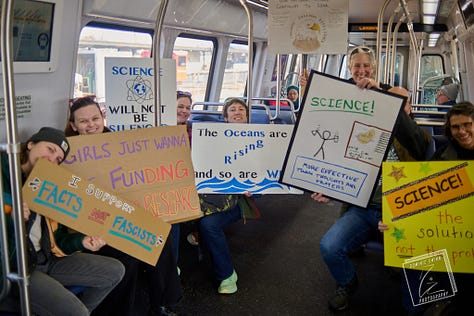
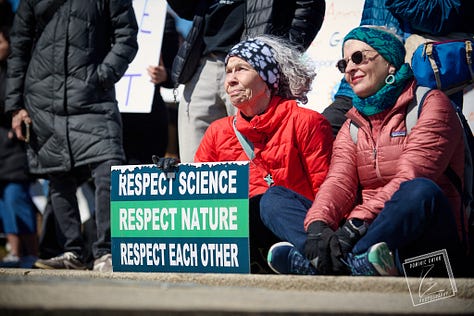
On Friday, nerds all over the US staged rallies to protest the Trump administration’s cuts to federal funding research. Thousands rallied on the steps of the Lincoln Memorial in Washington DC to plead about the benefits of funding science and research in the knowns, known-unknowns, and unknown-unknowns.
Like so many DC rallies before it, the steps of the Lincoln Memorial were transformed into a temporary stage. There wasn’t a big, black riser with rows of cameras and media crews. There weren’t throngs of journalists roaming around and shoving microphones in the faces of flag waving attendees. The crowd didn’t have any kind of uniform apparel, like colored hats and/or armbands.
With a few exceptions, like Bill Nye the Science Guy, and patients who owe their lives to federally funded medical research, a number of speakers were fairly boring. They stood awkwardly at podium and told corny jokes that fell flat. At one point, some of the older folks sang out-of-tune folk songs.
These were scientists. They proudly identify as nerds. They’ve dedicated their careers to saving lives and the planet we’ve all been mucking up for generations. And now many of them were facing unemployment because a merry band of bigots, buffoons, and bros decided science is, like, queer, or whatever.
People in the crowd cheered on speakers — their colleagues and fellow researchers — who lamented the loss of funding that didn’t just help find cures for cancers and disease, create new technologies, or reveal secrets of the universe; they were pissed there was no money for things like coolant used in specialized freezers that preserve decades of biological specimens.
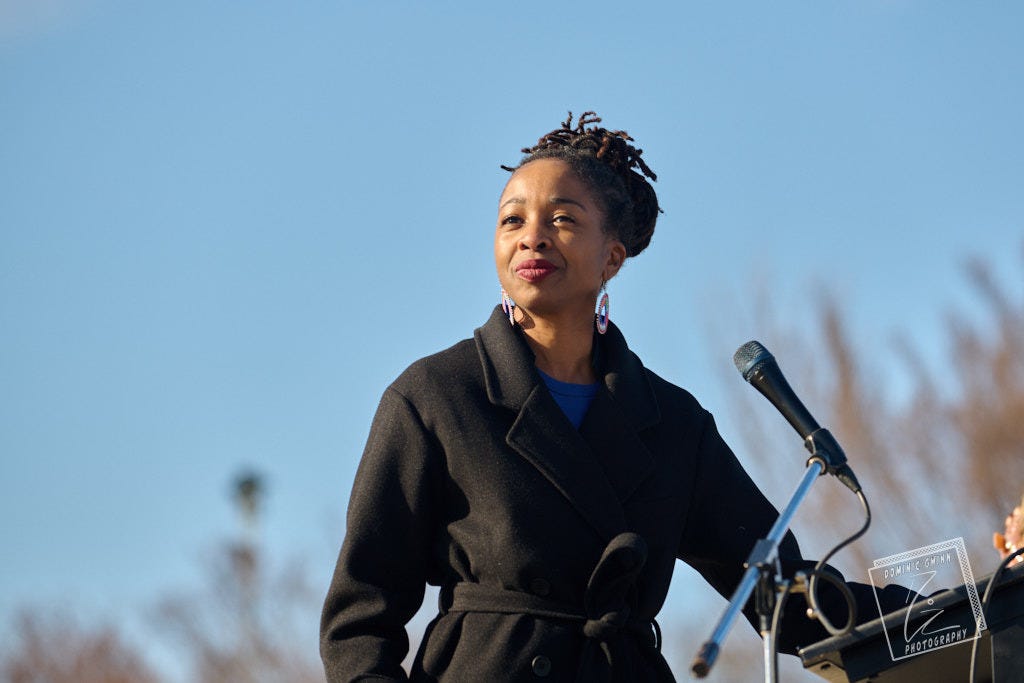
Dr. Allison Agawu speaks to people protesting the Trump administration’s federal funding cuts during the Stand-Up for Science Rally in Washington DC, Friday, March 7, 2025. Photo by Dominic Gwinn.
“This will lead to more deaths,” summarized Dr. Allison Agawu, Professor of Adult and Pediatric Infectious Diseases at Johns Hopkins University School of Medicine. “Science is a beautiful art built on a canvas of ideas. The best science comes from diverse ideas, from diverse people with diverse perspectives, spurring innovation and progress … We collectively reject that inclusion, diversity, equity and access are bad words. In fact, programs championing these ideals should be celebrated and expanded, as that is how we get the best science and the best outcomes.”
A retired mathematician from the National Security Agency explained that it could be difficult for people to understand why research jobs were important. Not everything can be easily described in an elevator pitch. “Are there places we could cut,” they said, “Sure, but people just don’t understand what we do. We can’t talk about it. I know my work saved lives.”
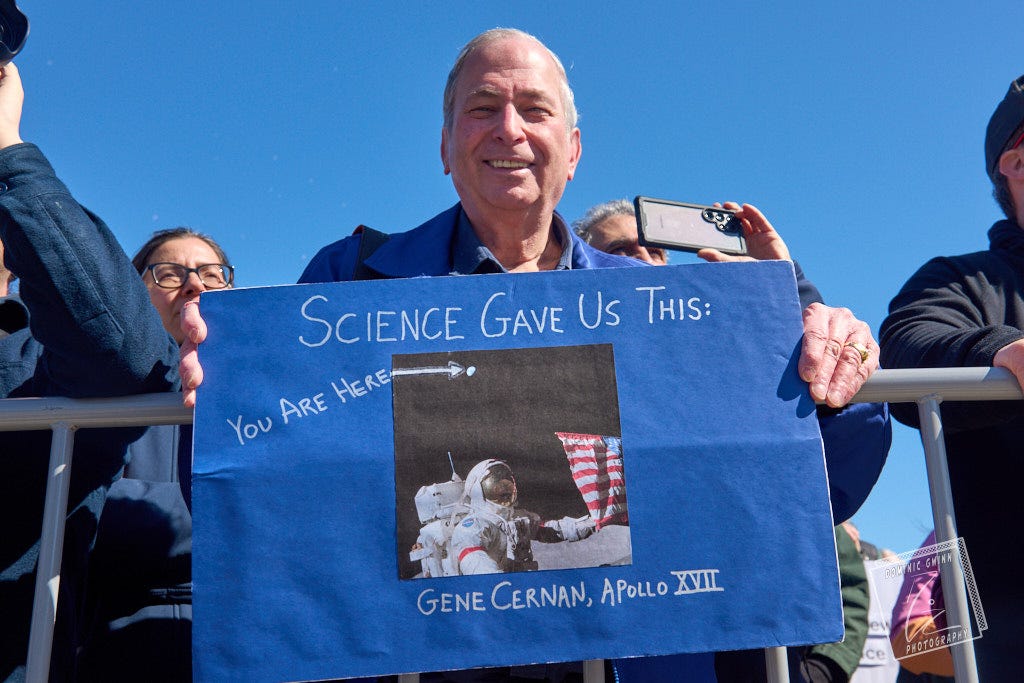
Lloyd Franklin, 64, stood at the front of the stage wearing a blue NASA jacket. He is a retired aerospace engineer who, like many kids, grew up wanting to be an astronaut. He held a sign with a photo of Apollo astronaut Gene Cernan from 1972. Cernan is taking a selfie while holding the American flag as the Earth, a pale blue dot, floats in over his shoulder. It was the last time humans walked on the Moon.
Above the photo on Franklin’s sign were the words: “Science gave us this.”
“I know this is important,” Franklin said. “I know we have to make a stand.”
Lloyd Franklin, 64, protests the Trump administration’s federal funding cuts during the Stand-Up for Science Rally in Washington DC, Friday, March 7, 2025. Photo by Dominic Gwinn.
These types of protests have been happening almost daily over the last few weeks. Much of this is being carried out by federal workers themselves through private, encrypted chats and public message boards. Mustering a sizable crowd on short notice in the middle of the week in DC can be a Herculean task, but they have been showing up to protest regularly since congressional Republicans turned a blind-eye to Donald Trump’s sweeping cuts to federal agencies.
If they get any media attention, it’s from struggling freelancers or niche bloggers. National broadcasters or their local affiliates are not really showing up to show hundreds of federal workers protesting on the evening news. There’s a massacre being carried out in broad daylight and the pathetic reality is that much of the DC press corps is either too scared to do their jobs, or they just don’t care.