
Category: Science / Medical Information
Good Commentary Here
This was linked in a substack I was reading, I found it worthy of sharing, and also of the author getting the clicks on their own page.
(Also Not April Fools. I’m gettin’ to it! Probably.)
It’s Time for a Republican Sickout
If you can’t find the strength to take a stand, at least lie down.
Hello, Congressional Republicans who still care about the republic! I know you’re out there because I kept hearing how differently Trump’s cabinet confirmations would have gone if only the votes have been secret.
We have reached a crisis point. We have reached so many crisis points. We reached like three new crisis points between me starting and finishing this article.
We have flipped our foreign policy so radically that we are now the villain of the world. All decision on that end seems to have been handed over to Putin and a bunch of preening technofascists. Our economy is crashing toward a depression and the only trick the Trump Administration pony has is more insane tariffs. High-level cabinet members endangered the lives of our servicemembers by discussing classified information on the already-hacked Signal app, and that doesn’t even cover gloating over civilian deaths, adding a journalist to the group text, and further damaging our relationship with Europe. The Trump administration is trying to start wars with freaking Denmark and Canada. DENMARK AND CANADA, for chrissakes.
And the most insane thing is that this is an abridged list. There are paragraphs and paragraphs of human rights horrors that I have skipped.
This is it. You are a part of an authoritarian government, a twisted and vile parody of what we once had. Elon Musk is stripping it for parts and awarding himself lucrative contracts while Donald Trump threatens Republican judges and lobs all of our state secrets straight to Putin.
The window for stopping this is small and vanishing. The most patriotic thing you could do is stand up and impeach Donald Trump, but, whether it’s due to a fear of Trump or fear of his zealots, you’re not doing that. The second most patriotic thing you could do is resign and leave your seat open to a flip by the Democrats. But you don’t seem to be doing that either. So here it is: The third most patriotic thing you can do, your last option for saving your beloved country from falling completely into authoritarianism: Get sick.
Get terribly sick and refuse to discuss your personal health information during this challenging time. Or get just a little bit sick and keep insisting that you’ll be as right as rain in a week or two. Have a family emergency. Or just take some dearly needed personal time.
Just drop out for a while. Hole up at home or get out of the country if you need to and let some trusted Democrats know that they’ll have the majority for a while and the time and leeway to move. (BE SURE YOU KNOW WHO IS ON THE SIGNAL CHAT.)
But what if someone is blackmailing me?
No offense, but this is bigger than you. Putin wants to break the United States. And he wants to break the United States so that he can roll over Western Europe. Do you really want to go to your grave knowing that you held onto your secret at the expense of Permanent Global Fascism? For that matter, do you really think complying now will stop them from burning you with it when you become inconvenient later?
Let’s be honest: A lot of us are already kind of assuming that you’re being blackmailed. And the fact that you’ve abandonedyour principles when the stakes are so high is making people think that the thing you’re being blackmailed over is much worse than what it probably really is. If Matt Gaetz can brazen it out, what on earth must you be hiding?
The good news is that there is nothing better for blowing your blackmail material straight out of the news cycle than a fiery Presidential impeachment that the nation can’t stop watching. There’s no better time to get out from under someone’s thumb.
But if the Democrats are smart, they’ll remove Johnson and prosecute Vance for the Signal debacle. That means a Democratic President will be in. I’ll lose some of my own power. What about that?
More real talk: Donald Trump has screwed the Republican party’s chances for decades at a minimum. You are now the party that let the Nazis in. You are the party that closed the national parks and tried to put Grandma out on the street. You are the party that kneecapped scientific research right when it looked like there might be a cure for pancreatic cancer. You are the party that crashed the stock market, the party that made us hated by the world, the party that let Musk and Putin take the reins. You are the party that just came out as pro-measles and made room for polio. The Republican Party is going the way of the Know-Nothings. You’re going to have to scrap it and start over.
And that’s if we ever have real elections again.
The only hope of you, personally, ever coming back into power is if Trump gets impeached and you become a zealous reformer. Toss out everyone who helped Trump, Musk, Thiel and Putin, support real jail time, and legislate us back out of Citizens United. Throw the bastards out and keep on throwing or you are surely getting tossed out yourself.
You can start right now, of course. That would be ideal. But you can also start after you take a little break to let the Democrats get the ball rolling.
Can’t I just keep my head down and appease Trump until things are magically better?
No. If you have read this far instead of screaming about George Soros and fake Venezuelan gang members, you are a Republican who thoughtcrimes against Trump. He and his barrel of vipers who the nonbelievers are. You won’t make it.
Fascists always need a villain to rail against. They always have a list. It is not a question of whether you are on the list, it’s a question of how far down you are. Right now, it’s foreign students and random brown people with innocent tattoos, but Trump is going to crave new meat and fresh news stories soon. You know that he needs to ritually humiliate and cast out a Republican every so often to reassert his dominance. You’re higher up the list than you think.
And if we hit the era of No Real Elections, which is more likely every day, there is no way you are keeping your elected position. Only perfect toadying cult members will make it through, and there is no way you can tap dance fast enough to make up for the past.
Besides: Is “enthusiastic supporter of the fascist regime” the way you want your grandchildren to remember you?
If you aren’t moved by the idea of saving the democratic republic we’ve all grown fond of, think about the fact that your only path to staying in your elected office is to get Trump out of his, and your chance to do that is slipping away.
It’s time to come down with a severe but undefined and conveniently curable medical issue. Play hooky. Go AWOL. Bunk out. Chuck a sickie. But do it quickly.
If you can’t bring yourself to impeach Donald Trump, you need to get the hell out of the way so someone else can. (snip)
Crazy Republican stuff from Joe My God
I was going through Joe My God for news and memes. I found these stories either outrageous enough or so crazy I felt I should share them. Hugs.
Not much to say about the RFK ones.
So much for cutting fraud, waste, and inefficacies. Hugs
CRT and DEI hate from the right is all about racism and bigotry. It is so clear that to them a mediocre white male is better than the most talented gifted woman, person of color, or anyone LGBTQ+. It doesn’t matter to them how good and educated anyone is if they are not a white male they are inferior to any white man. These people, these Nazi wannabees in charge of our government are desperate to enshrine in the law that white males are always better than anyone else. Why do they feel so inferior that they need to get rid of any attempts to allow others the same opportunities they have, to have shows and movies that represent the entirety of the population / society? What are they afraid of. Hugs

Talk about corruption much? The last voter give away he ran he first called it a lottery that anyone voting for a republican could win. But when he was taken to court because that was illegal he admitted that it was all a preplanned scam. Musk had already picked the winner which was some GOP insider. Seems he did the same thing here. Yet maga cult falls for it all the time. Hugs

Gee tRump is banning refugees from most other countries, trying hard to close the Southern border, revoking the visas and green cards of legal non-white residents … yet opening the door to white South Africans. Begging the white people who formerly keep the black people as impoverished near slaves in their own country to move here. tRump influenced by the South African immigrant currently screwing up every department of the government maybe, you know the guy that gave the Nazi salute? Or self avowed white supremacist Stephen Miller? The reason given is the South African government is being mean to white people and taking their land. That is not what the law says. The fact is that the whites took the farm land from the blacks and they couldn’t legally own it. The law seeks to balance that ownership out fairly. The law has safeguards for the white owners. The law says … expropriate land from private parties if it’s in the public interest and allows for expropriation without compensation, but only if negotiations for a reasonable settlement have failed, the government says. It says it does not allow land to be taken arbitrarily. Hugs
So much for lowering prices on … groceries. You know that word that seemed to fascinate tRump. Guess cars are not eggs. And yes why would billionaires and millionaires care if prices rise and the lower incomes can’t afford to live, it won’t stop them from eating, from having homes, from driving nice cars. Hugs
Why not let the Department Of Defense, the upper ranks and people who understand the military and its equipment / abilities. Why farm the work out to a political regressive think tank that wants desperately wants a 1950s world. From the article … It outlines, in broad and sometimes partisan detail, the execution of Trump’s vision to prepare for and win a potential war against Beijing and defend the United States from threats in the “near abroad,” including Greenland and the Panama Canal. Hugs
In the land of the free where we are supposed to have freedom of speech and the right to protest. But anyone that says anything supporting the Palestinians being exterminated and going through a genocide done by Israel. Any acknowledgment of what Israel is doing the administration now claims is an antisemitic attack on Jewish people. That is wrong! It is a gross lie and crazy misinformation made to vilify the people who are correct. Oh I have a post cued up to make about the father shipped by mistake to El Salvador but PINO tRump refuses to bring him back. After all he is brown you know. The real reason these people are being targeted is some are brown and others are Muslim, or both Hugs
I think the constitution is very clear. After this term he can’t serve as either president or vice president. The 22nd forbids more than two terms, and the 12th forbids anyone who can not be president from being the vice president. Plus with his mental decline so clear he soon will be sitting in a corner talking to the wall where he thinks there are people listening to him. The way he eats and his health he will be lucky if he doesn’t have a health emergency before the end of the year much less by 2028. I wonder if he says this stuff just for distraction? He does think he is entitled to anything he wants and always has. Hugs
Laverne Cox On The Importance of Trans Issues & Stories
Some news items I wanted to post that got lost in the short time I have to share stuff.
These four articles come from March 17 / 18th and I really wish I could have posted them then. Hugs
How many eggs can you send? U.S. asks countries to help lower soaring prices
The above is the tRump admin trying to get other countries with higher standards in their food to send us their eggs to protect tRump from the soaring prices.
————————————————————————————————————————–
Hungary To Use Facial Recognition Against LGBTQs
This scares me because the fundamentalist and white cis straight male supremacists will demand it be used here. First on trans people to protect the children then expand it to the entire LGBTQ+ as they have been doing everything else they tried to use against trans kids / people.
Famed Navajo Code Talkers Axed From Pentagon Sites
Yes I know that these were restored. But now tRump is demanding Vance who is on the board of the Smithson and the National Zoo to remove all illegal (purge) references to race, gender, the LGBTQ+ and so much more. He is demanding a national landmark the US government doesn’t control to toe the fundamentalist straight cis white supremacy Christians agenda to deny anything but them into history or society. We really are seeing a complete take over of society and we must do all we can to prevent the rollback of all rights and equality of anyone not white straight cis Christian males. This is horrifyingly scary. Because these hate groups have learned if they can control information, control education, control what is considered good or bad by their standards they can force the youngest people in the country to voice that belief and grow up to enforce it. It is what theocratic Islamic nations do. Are we now a nation taken over by theocratic Christian fundamentalist demanding a change in even the constitution to force everyone to follow their god and their rules? Please kill me first.
Kentucky Republicans Overturn Ex-Gay Torture Ban
Every accredited organization except those directly driven by fundamentalist religiously motivated agree this is simply torture. The religious just simply refuse to believe sexual orientation is not a choice and no one wants to be like that no matter what has to be done to change it. Including electroshock therapy to the genitals. Think of yourself, gay straight, or any other orientation. If you are cis and straight, how much conversion therapy would it take to make you believe you were gay / lesbian and desire that. How could who you are attracted to be changed. That all comes from the idea that it is a mental illness and a sickness that needs to be cured. Which the majority of medical organizations reject, agreeing it is an inborn part of a fetus development. Plus if you could change a sexual orientation … look at my childhood. I was forced to please sexually both males and females. But the only rapes that totally crashed me in the military was the one by a woman with more rank than me who demanded I have sex with her … four times. The last time I was so upset and humiliated that I ran nude up the stairs of the housing unit for higher enlisted and pounded on my soon to be E-7’s door. I was sobbing incoherently. I have been raped all my life and was able to stand that. Why did what this woman force me to do reduced me to that state? Because it was against my very nature of who I was. I was having same sex relations with another young guy and loving it. What she was forcing me to do was against everything I felt inside. That is what the people of these gay conversions want to do.
Some of them think that being gay is a choice because … well when did they decide instead of men they would like to have sex with women? No they just felt it, but what gay / lesbian people feel is not valid and must be forced to change. The rest of this group feels their interpretations of their view of what their god wants must be enforced on everyone even those that don’t follow their god. Because it is their god and he must be pleased because their god hates what they hate. Even if it is not in the bible or they misunderstood it, their hate preacher told them it was so. They can not let others live their lives, everyone must live by their church dictates. Why??? Because only that way their god will love them? I am an atheist that is willing to let religious people believe as they wish as long as they don’t try to force their beliefs on others. You do you … but why can’t they do the same. They insist that no one can be different from them and their beliefs. That is scary just that they think like that and more that they are now running the US government.
PS. When James was a newly teen of 13 his parents went to the Florida Keys with a group of us. They always stayed apart even though they asked to be part of the caravan of RV going. Well I caused an issue. His … maybe abusive parents had lots of tattoos and were highly Catholic religious … even had a statue of the mother Mary in the entrance of their home. Yes the husband ruled the house and told the wife what she would do at all times. Which included the abuse of the child which is where we came in. In a year or so after this even the boy started staying at our home because he was not allowed home until the mother was there. I had seen a young kid come in with a Mohawk. The boy had his hair shaved on both sides of his head and long in the front and back. We had already talked to their son at our table because the parents they were trying to force the boy to get Christian tattoos.
When I spoke up and said there is …. next hair cut … it will look grand on him. His stepdad exploded and said he wouldn’t ever allow the boy in the house with that and he would hold him down and shave all his hair off. As anyone can imagine I got triggered, I had been held down and had my hair cut. I flew up from the table as Ron was grabbing at me and yelled you want him to have tattoos which is against the bible but a simple haircut which can be changed or grow back and has no mentioned in the bible upsets you so much you’re threatening the kid. I loudly said, “What the fuck is wrong with you”! They took the boy from our table and left his meal uneaten. I was furious. Others who did not know of my childhood tried to calm me down. The family of the boy left that day from our group at the campground. Next time the boy came to our home his hair was cut short and the parents never went on another trip with us. Hugs
FL GOP Advances Ban On City Diversity Initiatives
Again an attempt to turn the country into a while male cis straight only nation. How much clearer can it be. And all these republicans or most of them are fundamentalist Christians who were funded by their church in a steal run to get elected. This not what the publican wants. But these republican fundamentalist groups understand … politicians can force change in public opinion if they support something loud and forcefully enough. Which is one why Kamala Harris l think lost the election, the democrats refused to respond to the attacks on trans people fearing it would hurt them. That is how you bring people along to a new understanding. The republicans are doing it in reverse of what the progressive movement did with government support in the early 2000s. Now that democrats have retreated only the hard right republicans are getting their voices heard returning the countries view to pre-rights for LGBTQ+ people. Hugs
Abundant Beauty
The roofs are shining from the rain./The sparrows tritter as they fly,/And with a windy April grace/The little clouds go by. by Worriedman
Sara Teasdale – “April” Read on Substack
The rest of the poem-
Yet the back-yards are bare and brown
With only one unchanging tree–
I could not be so sure of Spring
Save that it sings in me.
Sara Teasdale is a great poet!
Melting snow and cold March rain bring the April flowers.
Daffodils,-




Crocus –



This lovely lady was at the stable yesterday.


She stayed 20 foot away from me for quite awhile, then finally decided I was worth a visit –

The first clematis blooms –


Mandevilla, also known as rocktrumpet or dipladenia ( it’s not a dipladenia – the two are often confused – I can’t remember the difference)

A cat for Caturday!

That’s all I have room for – Thanks for dropping by! (snip)
I’ve Seen Cartoons About This …
also it’s been talked about on “Grey’s Anatomy.” This is real, and exciting.
Tiny robots powered by magnets could one day do brain surgery
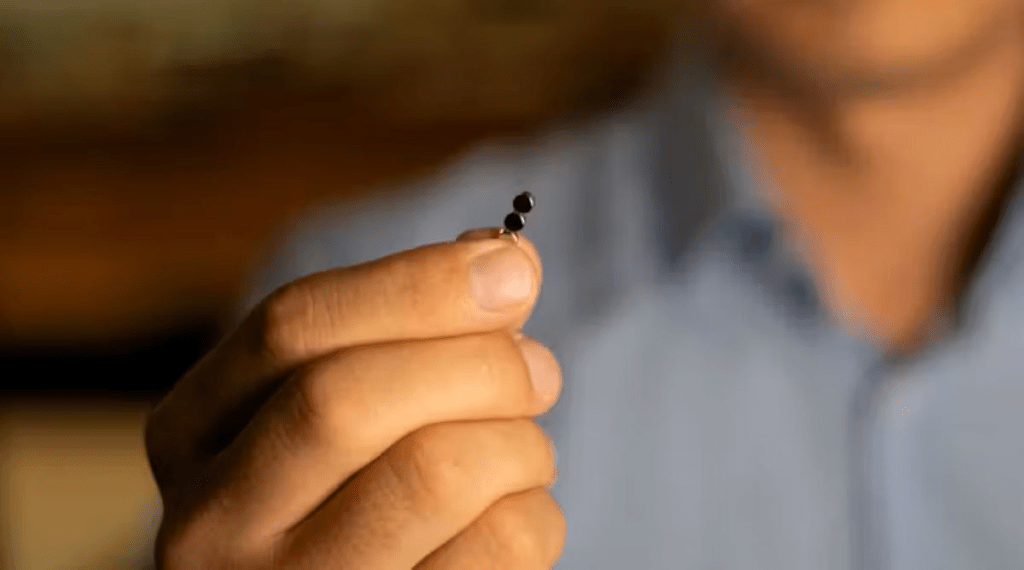
Robot tools powered by magnets (Supplied)
Most brain surgery requires doctors to remove part of the skull to access hard-to-reach areas or tumours. It’s invasive, risky, and it takes a long time for the patient to recover.
We have developed new, tiny robotic surgical tools that may let surgeons perform “keyhole surgery” on the brain. Despite their small size, our tools can mimic the full range of motion of a surgeon’s wrist, creating new possibilities for less-invasive brain surgery.
Robotic surgical tools (around 8 millimetres in diameter) have been used for decades in keyhole surgery for other parts of the body. The challenge has been making a tool small enough (3mm in diameter) for neurosurgery.
In a project led by the University of Toronto, where I was a postdoctoral fellow, we collaborated with The Hospital for Sick Children (SickKids) in Canada to develop a set of very small neurosurgery tools.
The tools are only about 3mm in diameter. In a paper published in Science Robotics, we demonstrated these tools could grip, pull and cut tissue.
Their extremely small size is possible as they are powered not by motors but by external magnetic fields.

Current robotic surgical tools are typically driven by cables connected to electric motors. They work in much the same way as human fingers, which are manipulated by tendons in the hand connected to muscles in the wrist.
However, pulleys smaller than several millimetres wide to control the instruments are weak and prone to friction, stretch and fracture. This creates challenges in scaling down the instruments, because of difficulties in making the parts of the system, assembling the mechanisms and managing friction in the cables.
Magnetic controls
The new robotic system consists of two parts. The first is the tiny tools themselves: a gripper, a scalpel and a set of forceps. The second part is what we call a “coil table”, which is a surgical table with several electromagnetic coils embedded inside.
In this design, the patient would be positioned with their head on top of the embedded coils, and the robotic tools would be inserted into the brain via a small incision.

By altering the amount of electricity flowing into the coils, we can manipulate the magnetic fields, causing the tools to grip, pull or cut tissue as desired.
In open brain surgery, the surgeon relies on their own dexterous wrist to pivot the tools and tilt their tips to access hard-to-reach areas, such as removing a tumour inside the central cavity of the brain. Unlike other tools, our robotic neurosurgical tools can mimic this with “wristed” movements.
Surprising precision
We tested the tools in pre-clinical trials where we simulated the mechanical properties of the brain tissue they would need to work with. In some tests, we used pieces of tofu and raspberry placed inside a model of the brain.
We compared the performance of these magnetically operated tools with that of standard tools handled by trained surgeons.
We found the cuts made with the magnetic scalpel were consistent and narrow, with an average width of 0.3–0.4mm. That was even more precise than those from traditional hand tools, which ranged from 0.6 to 2.1mm.

As for the grippers, they could pick up the target 76% of the time.

We were surprised by how well the robotic tools performed. However, there is still a long way to go until this technology could help patients. It can take years, even decades, to develop medical devices, especially surgical robots.
This study is part of a broader project based on years of work led by Eric Diller from the University of Toronto, an expert on magnet-driven micro-robots.
Now, the team wants to make sure the robotic arm and magnetic system can fit comfortably in a hospital operating room. The team also wants to make it compatible with imaging systems such as fluoroscopy, which uses x-rays. After that, the tools may be ready for clinical trials.
We’re excited about the potential for a new era of minimally invasive neurosurgical tools.
Changyan He, Lecturer, School of Engineering, University of Newcastle
This article is republished from The Conversation under a Creative Commons license. Read the original article.
Peace & Justice History for 3/28
| March 28, 1799 The New York state legislature enacted a law mandating the gradual end of slavery. Children of slaves would not be emancipated until they had served their parent’s “holder” and reached their mid-twenties. It was not until 1827 that a subsequent law declared, “every person born within this state, whether white or colored, is free.” ========================================= March 28, 1918 2,000 in the city and province of Quebec, Canada, demonstrated at the culmination of the conscription crisis during the “Great War” (World War I). High casualty rates in Europe forced the Ottawa, Ontario, national government to institute a draft. The Canadiens resisted military service in support of Great Britain’s foreign policy. The protests continued for five days over the Easter weekend.  Anti-Conscription Parade in Victoria Square, Montreal, Quebec, May 24, 1917.The gathering in this photo looks calm. Riots nearly a year later resulted in the death of four demonstrators in Quebec City. Read more ========================================= March 28, 1964 Three hundred were arrested during a sit-down protest at U.S. Air Force headquarters in Ruislip, England. The protest was organized by the Committee of 100, a group using nonviolent direct action to campaign for British unilateral nuclear disarmament. Conceived by the president of the Committee for Nuclear Disarmament, Bertrand Russell (he resigned this post soon after), and a young American academic named Ralph Schoenman, they proposed mass civil disobedience in resisting nuclear weapons, challenging the authorities to “fill the jails” with the intention of causing prison overload and large-scale disorder .  Police in Ruislip arrested men and women demonstrators indiscriminately. photo: John ‘Hoppy’ Hopkins. They were committed to nonviolence, and on arrest would go limp so as to create maximum disruption without conflict. ========================================== March 28, 1968 Martin Luther King, Jr., led a march in support of striking sanitation workers in Memphis, Tennessee. Shortly after its start, violence broke out followed by looting; one 16-year-old black boy was killed, 60 people were injured, and over 150 arrested. Police dispersed the rioters with mace, batons and teargas. National Guard troops are called in and sealed off black neighborhoods; martial law was declared by nightfall. Despite the violence, King insisted on returning to the city and the sanitation workers’ side the following week. Two alternative views of what happened that day in Memphis, and what followed ========================================== March 28, 1979 In the worst nuclear accident in U.S. history, a cooling system on the Unit Two reactor failed at Three Mile Island (TMI) in Middletown, Pennsylvania.  This led to a partial meltdown that uncovered the reactor’s core. Radioactive steam leaked into the atmosphere, prompting fears for the safety of the plant’s 500 workers and the surrounding community. More from nearby Dickinson College  Three Mile Island accident timeline with photos ========================================= March 28, 2001 After being delayed by massive anti-nuclear protests en route, 60 tons of nuclear waste arrived by train at Dannenberg, Germany. Though the government has agreed to phase out German reliance on nuclear power, some plants will continue to operate until 2021. The waste fuel rods sent to France for reprocessing had to return to Germany for permanent long-term storage. Transported through Germany by train, and then by truck to their permanent site in Gorleben, movement of the 28 glass casks was considered an unacceptable safety risk to residents. Protesters blocked the tracks, sometimes chaining themselves in place, to stop the shipment. 20,000 police were required to allow the train’s passage. Protester Jürgen Sattari said he considered the operation a success. “We want to stop the convoy,” he said. “Of course we know we can’t halt it indefinitely, but we can drive up the political price.” More on the broad-based struggle against nuclear waste in Germany |
https://www.peacebuttons.info/E-News/peacehistorymarch.htm#march28
2 For Women’s History Month
Today Would Have Been Aretha Franklin’s 82nd Birthday
Rest in power, queen.
By Frances Langum — March 25, 2025
================================
Snippet:
During the same week as the president’s address to Congress, RepresentWomen held our annual Democracy Solutions Summit (DSS). This solutions-oriented event allowed us to imagine what our democracy could look like with better policies and better representation.
Here, women leaders, elected officials, advocates and experts discussed the problems facing our democracy and uplifted actionable solutions to improve women’s representation and strengthen our democracy overall. This year’s summit addressed the critical need for more women in local, state and federal leadership roles.
The Democracy Solutions Summit clearly contrasts with the uncertainty of Trump’s address to Congress. The DSS is the only democracy summit featuring only women speakers and panelists committed to actionable, data-driven solutions and building coalitions that bolster American democracy at this critical time. Furthermore, our research has found that when multiple structural solutions are combined, we can bolster women’s representation in every level of government.
Complete recordings of the summit are available online, but here is a quick recap of all three days. (snip-More)
Peace & Justice History for 3/23
| March 23, 1918 The trial of 101 Wobblies (members of the Industrial Workers of the World or IWW) began in Chicago, for opposition to World War I. In September 1917, 165 IWW members were arrested for conspiring to hinder the draft, encourage desertion, and intimidate others in connection with labor disputes. The trial lasted five months, the longest criminal trial in American history at the time.The jury found them all guilty. The judge sentenced IWW leader “Big Bill” Haywood and 14 others to 20 years in prison; 33 were given 10 years, the rest shorter sentences. They were fined a total of $2,500,000 and the IWW was shattered as a result. Haywood jumped bail and fled to the Soviet Union, where he remained until his death 10 years later.  “Big Bill” Haywood Read more |
March 23, 1942 The U.S. government began moving all those of Japanese ancestry, including some native-born U.S. citizens (known as nisei), from their west coast homes to indefinite imprisonment in detention centers, beginning with Manzanar in California which eventually held more than 10,000 Americans. Located on 60,000 acres west of Los Angeles, it is now a national historic site; only 3 of the original 800 buildings remain. Gallery of photos and other materials about Manzanar |
| March 23, 1961 Army Major Lawrence Robert Bailey was the first recorded American to be held as a prisoner of war in Southeast Asia. One of eight crew members of a C-47 surveillance aircraft shot down over Laos, Bailey was held by the Pathet Lao for 17 months, losing one-third of his body weight (down to 53 kg, or 117 lbs) during that time. The other occupants of the plane are presumed to have died in the crash; Bailey always wore a parachute. |
March 23, 1984 USS Queenfish nuclear submarine student die-in outside the U.S. Consulate. One thousand boats, known informally as the Auckland Harbour Peace Squadron, demonstrated against arrival of the nuclear submarine, U.S.S. Queenfish in New Zealand. |
https://www.peacebuttons.info/E-News/peacehistorymarch.htm#march23

