WELLINGTON, New Zealand (AP) — On the frozen edge of the world, staying in practice as a professional musician takes ingenuity, grit and a plastic instrument for schoolchildren that’s guaranteed not to freeze to your fingers or face.
Natalie Paine is a French horn player in New Zealand’s navy who since October has been among 21 military members stationed in Antarctica. There, her melodies drift across the frozen Ross Sea from perhaps the most remote practice room on Earth.
“It’s beautiful and very inspiring,” Paine told the Associated Press. “I’ll sit there by the window and I will do my routine and play music in my time off, which is not very often.”
An unlikely journey to the ice
The story of how she arrived in Antarctica is an unlikely one. Paine grew up in the hot, dry climate of Adelaide, Australia, where she dreamed of visiting the frozen continent as a scientist.
She studied music at university instead, putting Antarctica out of her mind. Years later however, as a musician in New Zealand’s navy, Paine learned members of the country’s military were stationed in Antarctica to support the work of scientists.
When she asked, her instructor said any military member could win one of the coveted assignments.
“My eyes lit up and I was like, what? Even a musician?” Paine said. “He’s like, heck yeah, why not?”
The most remote practice room on Earth
Her dream was revived but enacting it wasn’t simple. It took four years of unsuccessful applications before Paine landed a posting as a communications operator.
It’s a consuming job, worked in six-day stretches that leave little time for music. Paine monitors radio, phone, email and other communications traffic at New Zealand’s mission at Scott Base, sometimes speaking to people on the ice who haven’t heard other voices for weeks.
In whatever window she can find, Paine squeezes in scales and mouth exercises, going to great lengths not to disturb others on round-the-clock shifts. That means slipping out of the main base to a hut built in 1957 under the leadership of explorer Sir Edmund Hillary as New Zealand established its presence in Antarctica.
While she plays by the window, watching seals on the ice, Paine finds new musical motifs bubbling up.
“There’s so much beauty and it’s not tame either, it’s this wild, untamed beauty of the land around you and the animals as well,” she said. “It’s just so overwhelming, spiritually, emotionally, physically sometimes as well.”
A hostile climate prompts ingenuity
Her practical dilemmas included finding an instrument suitable for Antarctica — something hardy, lighter than a brass French horn and less likely to freeze to her hands. The winner, called a jHorn, isn’t elegant.
“It was designed to be a beginner brass instrument for children,” said Paine. “So it was like, super compact, super light plastic, very durable, nowhere near as much maintenance required.”
New Zealand’s navy doesn’t have records of another military musician being posted to Antarctica so Paine, who will be there until March, could be the first. Her presence has delighted Scott Base and she has provided live music for ceremonies, such as the changing of the flag, instead of the usual tunes from a speaker.
“I had to have ski gloves on with double layers and hand warmers on the inside to be able to hold the trumpet and still my fingers were freezing,” she said. Paine is, however, likely one of the few musicians to perform a solo Antarctic concert in minus 21 degrees Celsius (minus 6 Fahrenheit).
She said the collective effort between nations to work together on the frozen content had a familiar theme. It reminded her of music.
“Music is the universal language and it’s something that reminds us that we’re all connected,” she said. “It brings that connection back to home, back to land and back to the people you’re with as well.”
Last week when I was flying home I was scanning the ocean because I’m always certain that I’ll see Godzilla or a sea serpent if I look hard enough, but instead I saw a rainbow from the plane window and it was a perfect circle over the ocean. I was so excited I hit my head on the window and scared the person behind me. I didn’t have time to capture it on my phone but I shook Victor awake and was like, “YOU’LL NEVER BELIEVE WHAT I JUST SAW OUTSIDE THE WINDOW” and he said, “Was it a colonial woman churning butter on the wing?” and I was like, “…yep…that’s exactly what it was” because a circular rainbow feels anticlimactic after that guess.
Aaanyway, that leads to this week’s drawing, which I’m fairly certain counts as a scientific illustration:
American Bird Conservancy has changed its page. It seems even easier to use. Here are some bits about this week’s bird.
About
Most woodpecker species in the United States and Canada display a mix of black, white, and red plumage, but don’t tell the Lewis’s Woodpecker. Its unusual mix of colors includes a red face, pink belly, glossy green back, crown, and nape, and silver-gray collar. The bird is simply stunning.
Lewis’s Woodpecker also differs from other members of its family in many of its foraging styles and food choices. In the summer, the bird eats mostly insects, catching them in flight by swooping out from a perch like a flycatcher or by foraging in flight like a swallow. Wide, rounded wings give the bird a buoyant, straight-line flight, more like a jay or crow than a woodpecker. The bird seldom excavates for wood-boring insects; unlike other woodpeckers, this species lacks the strong head and neck muscles needed to drill into hard wood.
In the fall, Lewis’s Woodpeckers switch to eating nuts and fruit, chopping up acorns and other nuts and caching them in bark crevices for later consumption. During the winter, they aggressively guard these storage areas against intruders, including other woodpecker species.
Ornithologist Alexander Wilson described the species in 1811 and named it for Meriwether Lewis, who observed the bird in 1805 during the Lewis and Clark expedition.
Threats
Birds around the world are declining, and many of them, like Lewis’s Woodpecker, are facing urgent, acute threats. Moreover, all birds, from the rarest species to familiar backyard birds, are made more vulnerable by the cumulative impacts of threats like habitat loss and invasive species.
Habitat Loss
Surveys indicate that Lewis’s Woodpecker populations may have declined by about 60 percent since the 1960s, and much of the reduction is likely due to loss or alteration of suitable nesting habitat. Like all other woodpeckers, the Lewis’s Woodpecker requires cavities in snags (standing, dead, or partly dead trees) for nesting. Logging, the suppression of wildfires, and grazing have altered many of the western forests where the species is found. The changes to the landscape often result in large areas dominated by trees that are the same age, leaving few dead or decaying trees available for the birds’ nests.
Pesticides take a heavy toll on birds in a variety of ways. Birds can be harmed by direct poisoning from pesticides, lose insect prey to pesticides sprayed on crops and lawns, or be slowly poisoned by ingesting small mammal prey that have themselves ingested rodenticides. Lewis’s Woodpeckers are likely exposed to pesticides in orchards and other agricultural settings.
Off Trøndelag’s coast, long lines of kelp now do double duty. They grow fast. They also lock away carbon. A new pilot farm near Frøya aims to turn that promise into measurable removal of CO₂ from the air, according to DNV.
The site spans 20 hectares and carries up to 55,000 meters of kelp lines. First seedlings went in last November. The goal is proof of concept, then scale.
How the Pilot Works
The three-year Joint Industry Project, JIP Seaweed Carbon Solutions, brings SINTEF together with DNV, Equinor, Aker BP, Wintershall Dea, and Ocean Rainforest, with a total budget of NOK 50 million, Safety4Sea reports.
Researchers expect an initial harvest of about 150 tons of kelp after 8–10 months at sea. Early estimates suggest that biomass could represent roughly 15 tons of captured CO₂. This is a test bed for methods that can be replicated and expanded, DNV explains.
There’s a second step, as kelp becomes biochar. That process stabilizes carbon for the long term and can improve soils on land, SINTEF’s team told Safety4Sea. The project is designed to test both the removal and the storage.
A Long History, A New Mission
Seaweed isn’t new here. Norwegians have cultivated kelp since the 18th and 19th centuries for fertilizer and feed. Scientists advanced modern methods in the 1930s, laying the groundwork for today’s farms, according to SeaweedFarming.com. Cold, nutrient-rich waters support species like Laminaria and Saccharina. They grow quickly and draw down dissolved carbon and nitrogen.
The country’s aquaculture backbone also helps. Norway already runs one of the world’s most advanced seafood sectors. That expertise now extends to macroalgae.
Policy, Permits, and Ecosystems
Commercial cultivation began receiving specific permits in 2014, and activity has expanded across several coastal counties, according to a study in Aquaculture International. Researchers detailed the risks that accompany scale: genetic interaction with wild kelp, habitat impacts, disease, and space conflicts. Integrated Multi-Trophic Aquaculture, where seaweed grows alongside finfish, can recycle nutrients from farms and reduce eutrophication pressures.
Engineering for Open Water
Getting beyond sheltered bays is crucial. One path is the “Seaweed Carrier,” a sheet-like offshore system that lets kelp move with waves in deeper, more exposed water. It supports mechanical harvesting and industrial output without using land, Business Norway explains. The same approach can enhance water quality by absorbing CO₂ and “lost” nutrients.
The Frøya project is small in tonnage but big in intent. It links Norway’s long kelp lineage with new climate tech: fast-growing macroalgae, verified carbon accounting, and durable storage as biochar. If these methods prove reliable at sea and on shore, Norway will have more than a farm. It will have a blueprint for ocean-based carbon removal that others can copy.
November 14, 1910 Eugene Ely performed the first airplane takeoff from a ship. His Curtiss pusher flew from the deck of the U.S.S. Birmingham in Hampton Roads, Virginia.By January he would execute the first (takeoff and) landing on a warship, the U.S.S. Pennsylvania. Captain Washington I. Chambers of the Navy Department had been interested in the military uses for the seven-year-old invention. Naval flight training started shortly thereafter. More of the whole story.
November 14, 1954 “Ten Million Americans Mobilized for Justice” began a campaign to collect 10 million signatures on a petition urging the Senate not to censure Senator Joseph McCarthy (R-Wisconsin). The motion of censure against Senator McCarthy was for obstructing a Senate committee and for acting inexcusably and reprehensibly toward a U.S. soldier appearing before his own committee. McCarthy had used his Senate Permanent Investigations Subcommittee to publicly denounce thousands as subversive, especially within the federal government, many without any justification. The political views of most were painted as treasonable and conspiratorial, rather than differing political views. The petition effort fell about nine million signatures short. More on Joe McCarthy
November 14, 2000 Florida Secretary of State Katherine Harris, simultaneously co-chair of George W. Bush’s Florida presidential campaign organization and the public official responsible for the conduct of the election itself, certified Governor Bush’s fragile 300-vote lead over Vice President Al Gore in the 2000 presidential election. Katherine Harris Florida Judge Terry Lewis gave Harris the authority to accept or reject a follow-up manual recount from some counties where the count was open to question. Harris rejected the manual recounts.
from the end of the shutdown,-and I have huge hope that we the people will continue to stand together to help each other through the days!-we do get the Astronomy Photo of the Day again!
Explanation: Few cosmic vistas can excite the imagination like The Great Nebula in Orion. Visible as a faint, bland celestial smudge to the naked-eye, the nearest large star-forming region sprawls across this sharp colorful telescopic image. Designated M42 in the Messier Catalog, the Orion Nebula’s glowing gas and dust surrounds hot, young stars. About 40 light-years across, M42 is at the edge of an immense interstellar molecular cloud only 1,500 light-years away that lies within the same spiral arm of our Milky Way galaxy as the Sun. Including dusty bluish reflection nebula NGC 1977, also known as the Running Man nebula at left in the frame, the natal nebulae represent only a small fraction of our galactic neighborhood’s wealth of star-forming material. Within the well-studied stellar nursery, astronomers have also identified what appear to be numerous infant solar systems.
For some people, gender shifts over time, often through changes in one’s sense of self. A transgender man may realize they are nonbinary and stop hormone replacement therapy. A trans woman may face so much discrimination that she represses her identity. And some trans people medically reverse their transition to live as their sex assigned at birth.
These experiences are all part of a process known as detransitioning. Although detransitioning does not have a consistent social or academic definition, it generally applies to someone who has sought a gender transition and then stopped, shifted or reversed aspects of it. Their experiences offer a deeper look at how discrimination and gender norms impact our lives, how gender-affirming care can be improved, and how identity is perhaps more fluid than previously thought.
As experts work to understand detransitioners, their vulnerabilities and their highly individualized needs, their identities are being co-opted as part of a national campaign against transgender rights. Health care access and research are being blocked by politicians for both trans people and detransitioners — while anti-trans rhetoric puts everyone at risk.
The Federal Trade Commission and the Justice Department are investigating gender-affirming care as medical fraud, and they are rooting this effort in detransitioners’ stories that fit the narrative the Trump administration wants to advance. The White House wants the National Institutes of Health to study “regret” and “detransition,” even as it cuts any federal funding for researchthat mentions the word “trans.” The U.S. Department of Education hosted a “Detrans Awareness Day” event last March. Meanwhile, its functions have been severely undermined by layoffs and budget cuts.
The White House and agencies like the Justice Department claim that gender-affirming care is mutilating children, overlooking that young trans people live happily after transition and the studies showing that adolescents who regret transition are in the minority. Government officials describe trans people and detransitioners as victims of a medical conspiracy to boost profits and force gender ideology on families. Now, they are seeking evidence to prove those claims by subpoenaing hospitals for patients’ private data, including doctors’ notes, patient addresses and Social Security numbers.
Gender-affirming care has been broadly endorsed by the medical community for its effectiveness in treating gender dysphoria, a persistent distress felt when one’s body is out of sync with their identity. The 2022 U.S. Trans Survey, which polled over 92,000 trans and nonbinary people 16 and older, found that social and medical transition were profound sources of life satisfaction. Experts and advocates agree that more research and more understanding are needed to improve trans medical care. But under Trump, they also expect transgender and intersex health to keep getting worse, not better.
The 19th spoke with two detransitioners who feel harmed and usedby the Trump administration, which has positioned itself as a protector of those who detransition. Adriana lives in New York City, where she feels safe to express herself among so many LGBTQ+ people, but has struggled to access adequate health care. Ara lives in North Carolina, a state that has several laws restricting trans rights and health care access — and where support from a mental health program and her partner has helped her navigate the challenges of detransitioning. As politicians stoke fear about gender non-conformity, their experiences offer a deeper understanding of what it means to live authentically in a politically volatile time.
Still, more young people have been exploring their identities, expanding the boundaries of gender and adding to the cultural and social norms surrounding it. Detransitioners’ experiences are part of that social evolution. Their stories of regret and pain exist alongside stories of joy and empowerment — and these are all part of a journey of self-discovery that may have turned out to be more complicated than they initially thought. The question is, will elected officials support them on this journey or cause more harm?
‘Taking away trans health care is taking away people’s lives’
As providers of trans health care have become political targets, Ara Kareis’ own routine treatments have been disrupted.
‘I just feel like such a power source’
The joy that Adriana Del Orden feels in her body could have only come through exploring her gender. She’s tired of being told that she ruined her life.
The politics of detransition
Political rhetoric doesn’t capture the complexity of detransitioning — or what taking away health care means.
The shutdown may finally be coming to an end. Our health care costs, unfortunately, will not. I’ll be back on Wednesday with a deep dive into just how spectacularly absurd our health care system has become.
In the meantime, RSV and flu are picking up speed, and a concerning infant formula recall has been linked to a rare botulism cluster, thanks to a small but mighty team in California. The FDA is expected to remove the black box warning from hormone replacement therapy—a move that’s scientifically sound but bound to spark drama from HHS. We also have new blood pressure guidelines that could make prevention a lot more personal. And amidst it all, a few more pieces of genuinely good news to end on a high note.
Let’s dive in!
Disease “weather” report: RSV and flu gaining momentum
It will take some time for the CDC data systems to ramp up again after being offline for over 40 days. For now, we’ll continue to rely on the alternative sources, such as Dr. Caitlin Rivers’ updates and the PopHive dashboards.
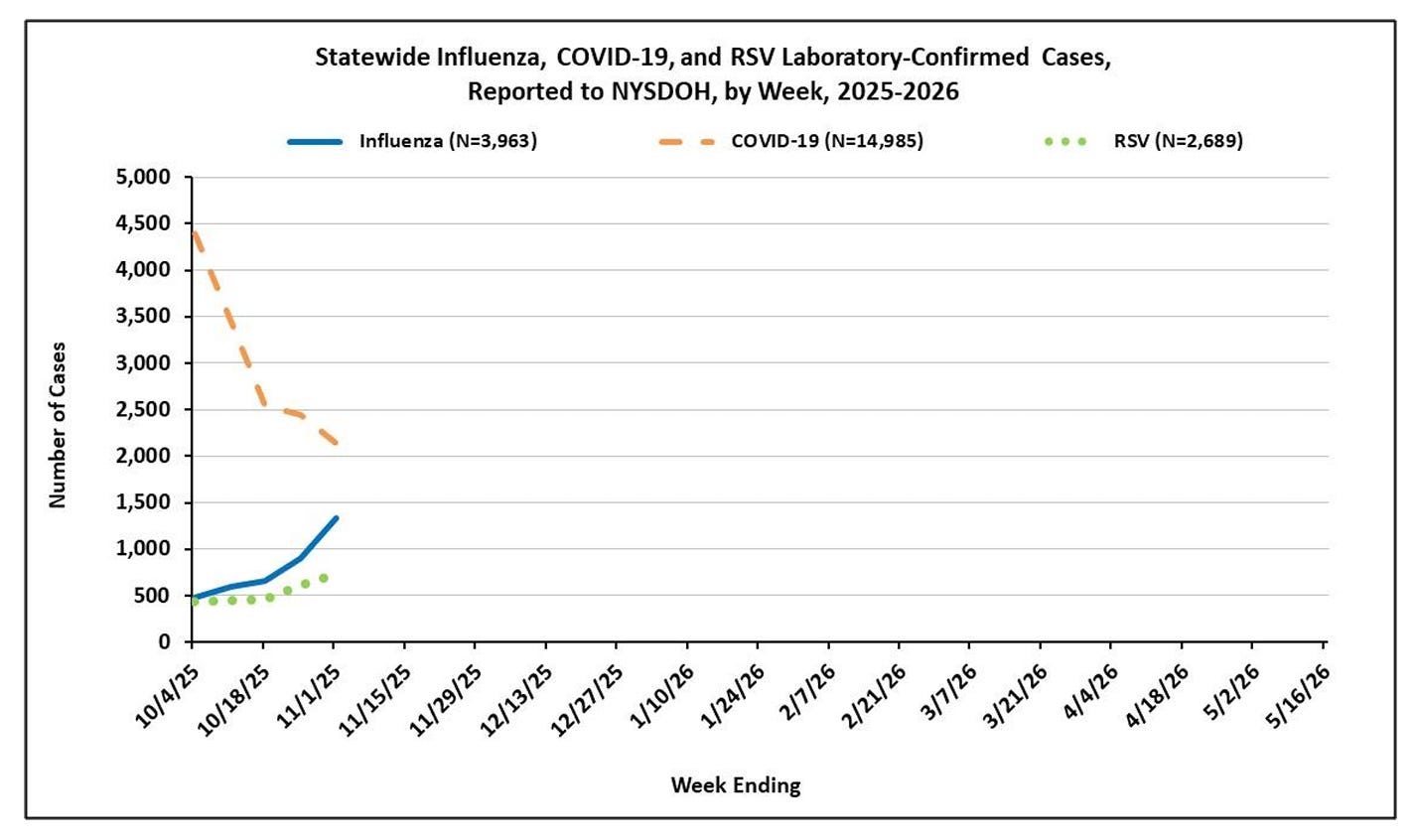
RSV continues to climb slowly but steadily, especially among children under five. National growth is still linear—not yet exponential—but that acceleration could occur at any time.
Theflu remains relatively low but is beginning to increase, particularly among young children. As Dr. Rivers notes, “Hawaii has moved to moderate activity, Arizona has surpassed its seasonal baseline, and New York cases jumped 49% in the past week.”
Source: New York State Department of Health Respiratory Surveillance Report
U.S. childhood flu vaccination rates have dropped from 62% to 49% over the past five years. Last year saw one of the deadliest seasons on record, with 280 pediatric deaths—the highest since tracking began in 2004. About 90% of those children weren’t fully vaccinated. Our deadliest flu season came at a time of historically low vaccination rates, which can’t be a coincidence. We don’t yet know this season’s coverage, but if it falls further, we could be facing another tragic record.
Covid-19 remains in a lull, though we typically see a winter rise starting in mid-to-late November.
I’m really hoping these three viruses don’t peak simultaneously. Hospitals strain under just a bad flu season; I couldn’t imagine the “big three” all at the same time. Historically, their peaks have staggered, but given how little we truly understand about these overlapping patterns, that may have been more a matter of luck than a rule. Time will tell.
What this means for you: This is the best time to get vaccinated. It’s certainly not too late.
Infant formula outbreak and Listeria in pasta
Over the weekend, a troubling cluster of infant botulism cases was linked to ByHeart Whole Nutrition Infant Formula. Even during a government shutdown and an increasingly challenging environment, outbreak teams have been working around the clock to protect our most vulnerable.
What this is: Infant botulism is extremely rare but serious. It occurs when Clostridium botulinum spores—commonly found in soil, dust, and some foods—germinate in a baby’s intestines and release toxins that can paralyze muscles, interfere with breathing, and require intensive care. In a typical year, the U.S. sees 160–180 cases, often linked to environmental exposure or foods like honey. Even a small cluster of cases is a clear red flag.
What we know:Clostridium botulinum spores have been detected in ByHeart infant formula, resulting in the hospitalization of 13 infants across 10 states. The California Department of Public Health (CDPH) played a key role in identifying this cluster. CDPH is the only source in the world for BabyBIG—the lifesaving antitoxin—and manages all clinician calls and treatment distribution. Their team noticed a spike in requests and discovered that the affected infants all consumed the same formula brand, prompting an alert to CDC. Importantly, ByHeart produces just 1% of U.S. infant formula, so this alone is unlikely to cause a national shortage. (Be sure to sign up for YLE CA for a deeper dive this Thursday.)
What we don’t know: Epidemiologists are investigating whether contamination is truly confined to ByHeart or reflects a broader issue in the manufacturing or ingredient sourcing process.
What to do:Stop using ByHeart Whole Nutrition Infant Formula immediately. Retailers should pull it from shelves, including Amazon, Kroger, Walmart, Whole Foods, Target, and Sam’s Club.
There is also the ongoing Listeria outbreak associated with frozen pasta dishes, including some sold at Trader Joe’s and other grocery chains. We’ve covered this before, but according to the agency’s ongoing investigation, two more brands of food are linked to the outbreak. There’s a long list of recalled products you can find here. Throw out immediately.
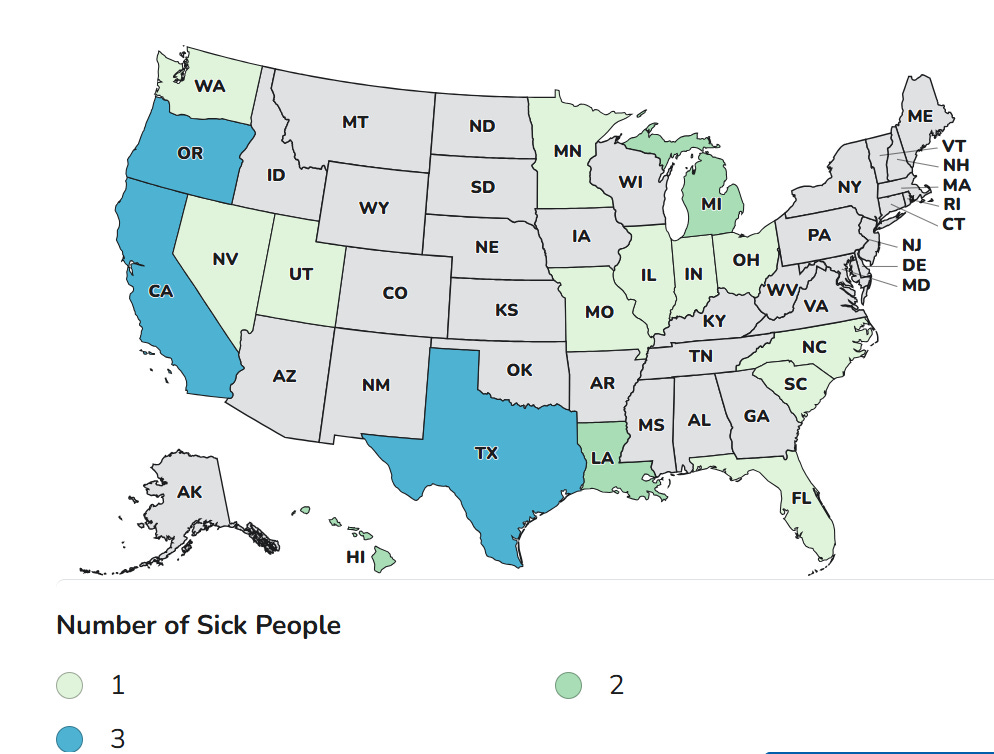
In total, there have been 27 illnesses reported, 25 hospitalizations, and six deaths in 18 states since late September.
Number of cases associated with the pasta Listeria outbreak. Source: CDC
HRT ‘black box’ warning may be gone soon
Word is that the FDA will remove the black box warning from hormone replacement therapy (HRT) this week. (It may now be pushed back with the government reopening.) If this announcement reflects the HRT review conducted at HHS last month, it will likely be messy and riddled with inaccuracies. However, if you look at the science without the drama, removing the black label is not unreasonable.
The black box warning—the strictest warning label, meant for drugs with potentially life-threatening risks—was enacted after a 2002 Women’s Health Initiative study found increased risks of stroke and breast cancer. Since then, research has revealed crucial nuance: risks depend on timing, dose, and delivery. Starting HRT earlier, using low-dose or localized estrogen, and tailoring therapy to each woman can be both effective and safe.
What this story is really about: Menopause is universal, yet too often misunderstood. While the science continues to evolve, the major problem is that clinical practice and training have lagged far behind. Women deserve evidence-based care, informed clinicians, and the freedom to make choices rooted in both science and compassion. We are still far from what is needed for women.
POLL
(snip-poll won’t embed here; go to the Substack page. The question is if readers would like to see a deep dive into HRT. If you wish to vote, click “read on Substack”, above.)
New blood pressure guidelines
Major new blood pressure guidelines dropped for the first time in years.
At the center of the update is an enhanced assessment tool called the PREVENT calculator, developed by the American Heart Association. It’s designed to estimate a person’s 10-year risk of cardiovascular disease using factors like blood pressure, cholesterol, smoking, and diabetes. The model was built using data from 6.5 million U.S. adults aged 30 to 79, making it one of the most representative tools available.
Here’s what stands out:
A new threshold for medication. The key number to watch is 7.5%. If your 10-year risk of heart disease is at or above that level, physicians are now encouraged to consider medication even if your blood pressure hovers around 130/80 mmHg. If your risk is below that, lifestyle changes, like healthy eating, exercising, and better stress management, remain the first step.
A focus on home monitoring.The guidelines also emphasize checking blood pressure at home. Growing evidence shows that home readings may actually be more accurate predictors of long-term risk than in-office measurements. So spending $45 on an arm monitor if you have hypertension might be a great (even lifesaving!) idea.
What this means for you: This makes heart health more personalized than ever. You can calculate your own 10-year risk using the PREVENT calculator (although you will need some pretty specific numbers from your last blood panel). Regardless, aim for blood pressure readings below 130/80, and use these new tools to guide smarter—and earlier—prevention.
Good news!
Here are some of the great things worth highlighting:
The American Academy of Pediatrics (AAP) is standing up for science. The organization filed an updated lawsuit last week against HHS Secretary Robert F. Kennedy, Jr., asking a court to disband a panel (ACIP) appointed by RFK Jr. and to overturn recent decisions made by that panel. Then, to proceed under court supervision. The legal move is a direct push to restore expert-led vaccine policymaking.
The Vaccine Integrity Project (VIP) is stepping up on Hep B. With the next ACIP meeting coming up in early December, where the agenda will likely include the Hepatitis B vaccine for infants, the childhood vaccination schedule, and HPV—VIP, an independent group of scientists formed in response to waning trust in RFK Jr.’s ACIP, is conducting an evidence review ahead of what could be a contentious meeting. Their work helps ensure the science remains front and center.
Vaping among youth has seen a decline; but we still have a long way to go. A new study has found that the number of U.S. teens vaping has decreased overall. That’s progress. But among those who still do it, vaping is becoming more frequent and harder to quit—signs that use is shifting from experimentation toward dependence for some. If you have a teen who vapes, check out the EX Program, which is a free, anonymous text-messaging program designed specifically for young people who vape. There’s also SmokefreeTXT for Teens.
Question grab bag: You ask, we answer!
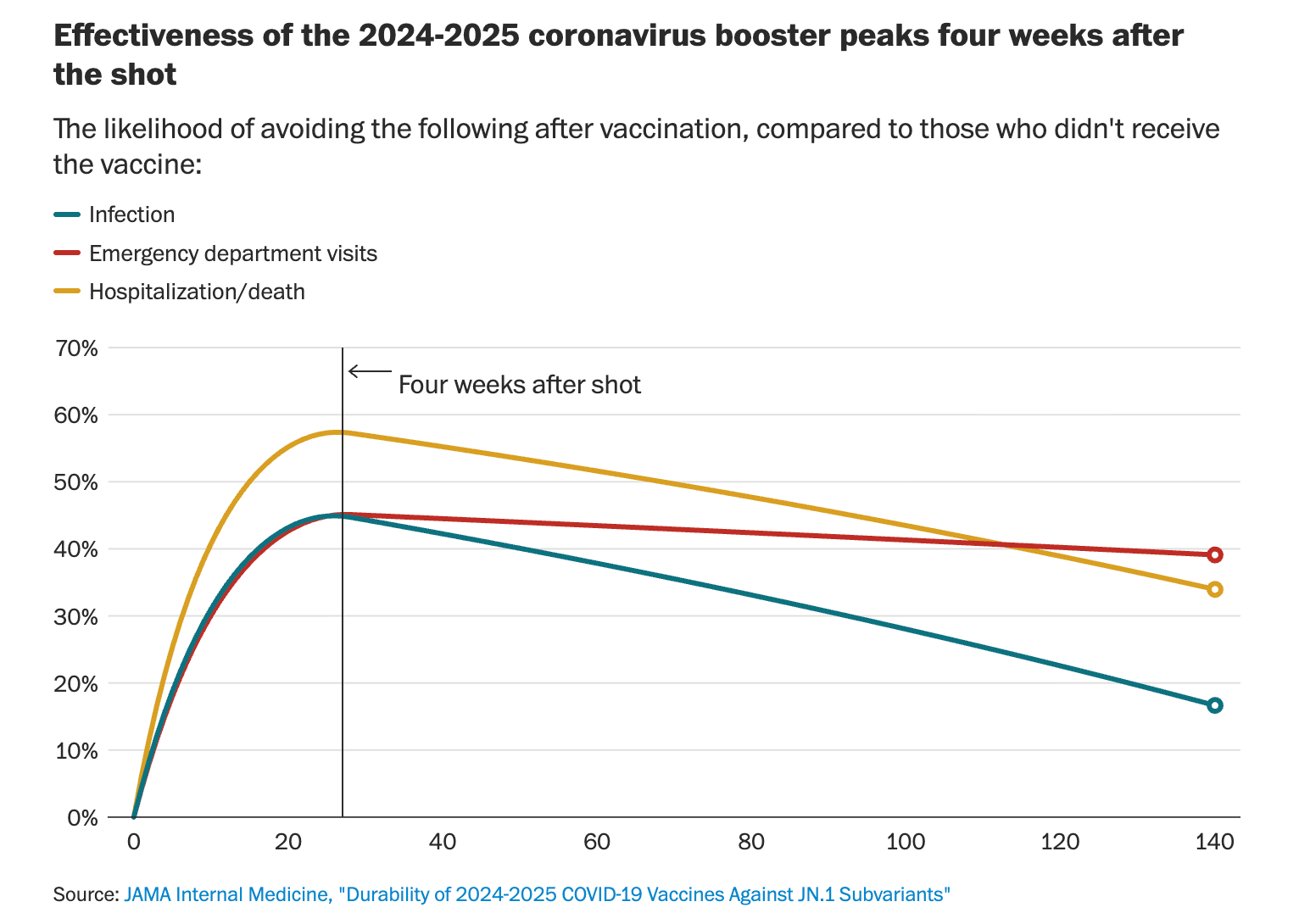
How long does the Covid-19 vaccine last? I got mine in September, do I need to get another?
A study published last week confirmed what we’ve consistently seen: protection against Covid-19 wanes over time. A study of more than 1.8 million Americans from the previous season showed protection against infection and severe disease declined after 4-5 months. The findings underscore the benefit of getting a Covid-19 vaccine every six months, especially for adults over 65, who accounted for nearly 80% of hospitalizations in the study.
In case you missed it
Help shape our AI + Health conversation. Thanks to everyone who responded to our survey last week! We’re running the AI and health survey to hear your thoughts on using tools like ChatGPT, Claude, Copilot, and PerplexityAI to get health information. If you missed it, take the survey here.
New York YLE’s Marisa discussed the state reaching a historic low in youth tobacco use.
California YLE Matt discussed the impact of ICE raids on access to healthcare.





 Scottie's Playtime