If they weren’t so pathetic, you might could possibly be sad for some MAGAts. Take Juanita Broaddrick as an example, whose entire national profile is built upon debunked claims she was raped by Bill Clinton in the 1970s and who is now a full-fledged lying MAGAt.
After Canada’s Conservative Party Leader Pierre Poilievre distanced himself from Donald Trump, Broaddrick claimed he would lose the election because Canada loved Trump so much, which didn’t make any sense.
If Canadians loved Trump so much, then why did they just elect Liberal Mark Carney to become their new Prime Minister? That’s like denying Trump’s current favorability numbers. They suck.
There’s also the fact that Trump lost this election for the Conservatives. The Conservatives were ahead by double digits when Trump entered office last January, then he started barking at Canada, waged a tariff war, and repeatedly insulted them by claiming they should be America’s 51st state.
If Donald Trump had kept his mouth shut and had waited at least 100 days for his stupid tariff war, Poilievre would be Prime Minister today.
Yesterday, thanks to Donald Trump, Canadian Liberals won. Trump is now internationally toxic. Everything Trump touches…dies. Super Bowl champion running back Sequon Barkley played golf with Trump a few days ago, and now I expect his knees to give out during the preseason. Trump is poison. I would tell you to ask Elon, but he hasn’t figured it out yet.
Pierre didn’t just lose his race for Prime Minister, he also lost his seat in parliament. (snip-MORE)
A four-year old cancer patient deported by Ann Telnaes
The boy and his sister, both U.S. citizens, were deported to Honduras with their undocumented mother Read on Substack
I enjoy this man’s commentary. He’s always seemed to know whereof he speaks. Every weekend I intend to post this newsletter, and every weekend gets by me without me getting it done. This is a copy-paste of my newsletter; I receive it in email from “The Nation” magazine. All links within are live.
A retirement for the ages Illinois Senator Dick Durbin, who has been in Congress or the Senate for nearly my entire life, has announced that he will not seek reelection in 2026. The 80-year-old’s retirement will touch off a firestorm of a Democratic primary in Illinois, and I’m already dreading the prospect of a heap of progressives jumping into the race, cannibalizing each other, and clearing the path for the wealthiest available moderate white man to buy the nomination. If progressives could just coalesce around one candidate and stick together, they’d win this thing. Then again, if I had wheels, I’d be a wagon. In any event, Durbin’s long overdue retirement is more important to what I cover than the primary, because Durbin is the ranking member of the Senate Judiciary Committee, which controls the judicial nomination process. He was the head of the committee during Joe Biden’s presidency—a job he got by literally pulling rank over the guy who was best suited for the post (according to me), Senator Sheldon Whitehouse. The last four Democratic leaders on Judiciary have been, pretty much, a disaster. Durbin was preceded by Diane Feinstein, who was preceded by Patrick Leahy, who was preceded by Joe Biden. All four of these people were establishment moderates who were more concerned with formalities and courtesies than fighting for control of the courts. It was during their watch that the Federalist Society was able to overrun the judiciary with Republican judges who have literally taken away constitutional rights and redefined the law as a tool of the Republican political agenda. The Judiciary Committee desperately needs new, energetic leadership, to say nothing of a fighting spirit. I can only hope that Durbin’s retirement marks the end of the era of Democrats’ getting punked on judicial nominations.
The Bad and The Ugly SCOTUSblog, a popular website that reports on the Supreme Court, has been acquired by the right-wing media outlet The Dispatch. The acquisition likely marks the end of one of the few nonpartisan sources of information about the Supreme Court and plunges yet another independent outlet into the dark morass of the white-wing media ecosystem. I have a ton of respect for the website’s senior editor, Amy Howe, and I know she will fight like hell to retain the site’s nonpartisan independence. But this ain’t no fairy tale. When you lie down with dogs, you wake up with fleas.The number of young people who are incarcerated is going down, but the racial disparities among the children we put behind bars are “the highest in decades.” Black and Native American children are getting the worst of it, according to NPR. Pope Francis died. Francis was from Argentina. He was the first pope from Latin America, the first pope from the Southern Hemisphere, the first Jesuit pope, and the first pope born and raised outside of Europe since the 8th century. He was also one of the most progressive popes in the history of that office, though admittedly that’s a bit like saying he was the least fungal fungus. For my lapsed-Catholic part, I liked him. I hope the next pope is the second pope who can claim to be most of these things. Secretary of Defense Pete Hegseth has been caught up in yet more Signal-inspired controversy. I know I’m supposed to care, but I don’t. They put a Fox News host in charge of the American military; what the hell did people think was going to happen? Decency? Competence? A group of bigoted parents went before the Supreme Court this week and asked the justices to allow them to object to books in school that mention gay people. The Republican justices on the court fell all over themselves to agree with the parents. I am once again asking bigoted religious wing nuts to homeschool their children and leave the rest of us who want to live in a society alone.
Inspired Takes In The Nation, my colleague Joan Walsh took on the Trump administration’s ridiculous and sexist obsession with white birth rates. For my part, I am willing to help the administration accomplish its goals: If it really wants white birth rates to go up, all it has to do is make most white people poor again. The lesson from literally all today’s high-income societies is that birth rates go down as economic prosperity goes up, so the solution is actually pretty simple. Maybe that’s the real reason behind Trump’s tariffs? Contraband Camp has put out a “Trump Administration Discrimination Database.” So now, whenever your MAGA uncle says, “Point to one thing Trump has done that is racist,” you have a reference source. I used to feed my dog a “raw food” diet. It made sense to me, in an unthinking way (dog = wolf = murderous carnivore = “Aww… who’s the good girl who wants to feast on the raw viscera of your slain enemies?”). The fru-fru suburban veterinarian I go to didn’t immediately tell me it was a bad idea. But then, I happened to run into my old, hardscrabble city veterinarian and she basically said, “What the fuck? Don’t do that. I thought you were a smart person?” She then gave me some research. Now, we’re back to kibble. For people who don’t have the benefit of knowing a frank-talking vet, Emmet Frazier explains in The Nation why your fully domesticated dog doesn’t need to be eating rabbit liver.
Worst Argument of the Week This isn’t really an argument, but I read a story in Gothamist that almost made me cry. The Trump administration has largely cut off funding for legal aid programs that would provide lawyers to immigrant children sent here without their parents or legal guardians. That has forced thousands of children in New York City to go through the court process—which can lead to their deportation (among other things)—with no legal representation. We’re talking about children as young as 4 being hauled into a courtroom without a lawyer. I do not know what kind of sick fucks think this is OK. I cannot fathom the base, racist, cruelty and inhumanity you have to be comfortable with to think that Trump is right to cut this funding. I cannot conceive of the argument one might make to support this. All I know is that whatever argument one has for making this OK is wrong.
What I Wrote I was not prepared to engage with a Supreme Court decision at 1 o’clock on Saturday morning, but I’m very glad the court was still working. It issued a ruling that prevented Trump from deporting another group of immigrants, and in so doing, probably saved some of their lives. The Harvard lawsuit against the Trump administration over his illegal and unconstitutional freeze of the university’s research funding is very strong. Harvard should win, if winning in court still matters.
In News Unrelated to the Ongoing Chaos You should watch Andor. The first episode of its second season just came out and, trust me, you should just watch it. Forget that it’s part of the Star Wars franchise. Forget that it’s another Disney-owned media property looking to milk that franchise for all its worth. This show is about fighting fascism. It is the most relevant piece of dramatic fiction of this era.
April 26, 1954 The Geneva Conference began for the purpose of bringing to an end the conflicts in Korea and Indochina. This followed the defeat of the French in Vietnam at Dien Bien Phu. France had been trying to reassert colonial control over Indochina following World War II. The conferees included Cambodia, France, Laos, the People’s Republic of China, the Democratic Republic of Vietnam, the Soviet Union, Vietnam, the U.S. and the United Kingdom. As a result, Vietnam was temporarily partitioned pending elections on reunification to be held in 1956; those elections were never held.
April 26, 1966 Rodolfo “Corky” Gonzales Rodolfo “Corky” Gonzales founded the Crusade for Justice, a Chicano activist group, in Denver, Colorado, and marked his departure from the Democratic Party. It was the beginning of a nationalist strategy for the attainment of Chicano civil rights. Read more video Democracy Now
April 26, 1968 A national student strike against the Vietnam war enlisted as many as one million high school and college students across the U.S.
April 26, 1986 A major accident occurred at the Chernobyl nuclear power plant in the Ukraine near the border with Belarus, both then part of the Soviet Union (Union of Soviet Socialist Republics). An explosion and fire in the No. 4 reactor sent radioactivity into the atmosphere. Only after Swedish authorities reported the fallout over their country 1385 km away (860 miles), did Soviet authorities reluctantly admit that an accident had occurred. During a fire that burned for 10 days, 190 tons of toxic materials were expelled into the atmosphere (3% of the reactor core). Winds blew 70% of the radioactive material into neighboring Belarus. The explosion at Chernobyl was the world’s largest-scale nuclear accident. Approximately 134 power-station workers were exposed to extremely high doses of radiation directly after the accident. About 31 of these people died within 3 months. Another 25,000 “liquidators”—Soviet soldiers and firefighters who were involved in clean-up operations — have died since the incident of diseases such as lung cancer, leukemia, and cardiovascular disease. 400,000 were evacuated and over 2,000 towns and villages were bulldozed to the ground in areas considered permanently contaminated. Deaths and illnesses directly attributable to radiation exposure continue. “Chernobyl is a global environment event of a new kind. It is characterized by the presence of thousands of environmental refugees, long-term contamination of land, water and air, and possibly irreparable damage to ecosystems.” – Christine K. Durbak, Chairwoman of the World Information Transfer, New York Chernobyl for Kids
April 26, 1998 Bishop Juan Gerardi Conedera Bishop Juan Gerardi Conedera, a leading human rights activist in Guatemala, was bludgeoned to death two days after a report he had compiled was made public. The report blamed the U.S.-backed Guatemalan military government and its agencies for atrocities committed during Guatemala’s 36-year civil war. About Bishop Gerardi’s murder (Democracy Now)
April 25, 1945 Delegates from some 50 countries met in San Francisco for the United Nations Conference on International Organization. Over the next two months they would negotiate the principles and structure of the United Nations. Pres. Franklin D. Roosevelt had just died and had been working on his speech to the conference: “The work, my friends, is peace; more than an end of this war—an end to the beginning of all wars . . . As we go forward toward the greatest contribution that any generation of human beings can make in this world—the contribution of lasting peace—I ask you to keep up your faith . . . .”
April 25, 1969 The Reverend Ralph David Abernathy, head of the Southern Christian Leadership Conference, and 100 others were arrested while picketing a Charleston, South Carolina, hospital to support unionization by its workers. Read more about Reverend Ralph David Abernathy
April 25, 1974 A peaceful uprising by both the army and civilians, known as the Carnation Revolution (Revolução dos Cravos), ended 48 years of fascism in Portugal. People holding red carnations urged soldiers not to resist the overthrow and many placed the flowers in the muzzles of their rifles. The regime killed four before giving in to the popular resistance. Lisbon demonstration ’74 Read more about the Carnation Revolution
April 25, 1983 Women in Canberra, Australia, laid a wreath to remember women of all countries raped during wartime.
April 25, 1987 Tens of thousands marched on Washington, D.C. to demand an end to U.S.-sponsored and -supported wars in Central America.
April 25, 1993 Nearly one million marched for homosexual rights and liberation in Washington, D.C. Health Care Rally at April 25, 1993 The AIDS quilt on display as part of the event.
April 25, 2004 The March for Women’s Lives drew a record 1.15 million people to Washington, D.C. The marchers wanted to protect legal and safe access to reproductive services including abortion, birth control and emergency contraception. Organized by a coalition that included the National Organization for Women (NOW), Black Women’s Health Imperative, Feminist Majority, National Abortion Rights Action League (NARAL), the National Latina Institute for Reproductive Health, and Planned Parenthood, along with the American Civil Liberties Union (ACLU). The March for Women’s Lives was the largest protest in U.S. history. Read more
April 19, 1911 More than 6,000 Grand Rapids, Michigan, furniture workers—Germans, Dutch, Lithuanians, and Poles—put down their tools and struck 59 factories in what became known as the Great Furniture Strike. For four months they campaigned and picketed for higher pay, shorter hours, and an end to the piecework pay system that was common in the plants of America’s “Furniture City.” Although the strike ended after four months without a resolution, Gordon Olson, Grand Rapids city historian emeritus, said once employees returned to work, most owners did increase pay and reduce hours.
April 19, 1943 On the eve of Passover, the Warsaw Ghetto Uprising began when Nazi forces attempted to clear out the Jewish ghetto in Warsaw, Poland, to send them to concentration camps. The Germans were met by unexpected gunfire from Jewish resistance fighters. The destruction of the ghetto had been ordered in February by SS Chief Heinrich Himmler: “An overall plan for the razing of the ghetto is to be submitted to me. In any case we must achieve the disappearance from sight of the living-space for 500,000 sub-humans (Untermenschen) that has existed up to now, but could never be suitable for Germans, and reduce the size of this city of millions—Warsaw—which has always been a center of corruption and revolt.”
These two women, soon to be executed, were members of the Jewish resistance. ” …Jews and Jewesses shot from two pistols at the same time… The Jewesses carried loaded pistols in their clothing with the safety catches off… At the last moment, they would pull hand grenades out…and throw them at the soldiers….” Captured Jews in the Warsaw Ghetto Uprising Learn more about The Warsaw Ghetto Uprising (it’s the search page for the national Holocaust Museum.)
April 19, 1971 As a prelude to a massive anti-war protest, Vietnam Veterans Against the War (VVAW) began a five-day demonstration in Washington, D.C. The generally peaceful protest was called Dewey Canyon III in honor of the operation of the same name conducted in Laos. They lobbied their congressmen, laid wreaths at Arlington National Cemetery, and staged mock “search-and-destroy” missions. Read more about this action
April 19, 1997 Two Swedish Plowshares peace activists, Cecelia Redner, a priest in the Church of Sweden, and Marija Fischer, a student, entered the Bufors Arms factory in Karlskoga, Sweden, planted an apple tree and attempted to disarm a naval cannon being exported to Indonesia. Cecelia was charged with attempt to commit malicious damage and Marija with assisting in what was called the Choose Life Disarmament Action. Both were also charged with violating a law which protects facilities “important to society.” Both women were convicted, arguing over repeated interruptions by the judge, that, in Redner’s words, “When my country is arming a dictator I am not allowed to be passive and obedient, since it would make me guilty to the crime of genocide in East Timor. I know what is going on and I cannot only blame the Indonesian dictatorship or my own government.” Fischer added, “We tried to prevent a crime, and that is an obligation according to our law.” Redner was sentenced to fines and three years of correctional education. Fischer was sentenced to fines and two years’ suspended sentence. Both the prosecutor and defendants appealed the case. No jail sentences were imposed.
Let’s make one thing clear. The immigrants the Trump regime seized off the street and sent to a Salvadoran prison were NOT deported. To be deported, you have to go through due process. Immigrants who are deported usually have to face a judge. The people sent to the prison in El Salvador never faced a judge before being shipped off or received due process. They were not deported. They were kidnapped.
And this prison in El Salvador, where the president referred to himself as the “coolest” dictator, isn’t so much a prison as it is a concentration camp or a gulag.
Mona Charen wrote, “We are outsourcing torture and murder. What kind of president, what kind of political party, can look at that with satisfaction?” And what American can not at least wonder about their own security?”
Speaking to the “cool” dictator while he was visiting the White House yesterday (and you thought it got weird when Zelensky visited), Donald Trump told President Nayib Bukele (He deserves a “sic” too. Sic) that “home growns” should be next. He said, “The home growns. You gotta build about five more places. It’s not big enough.” By the way, the cool dictator didn’t wear a suit and tie either. See what you started, Elon?
But what does Trump mean by “home growns?” He’s referencing American citizens, even those born in the United States, that he deems to be criminals, and they should be sent to rot in a Salvadoran super-max prison where human rights are not a thing.
Then Trump told reporters, “I just asked the president — it’s this massive complex that he built, jail complex — I said, ‘Can you build some more of them please?’ As many as we can get out of our country.”
He added, “If they’re criminals, and if they hit people with baseball bats over the head that happen to be 90 years old, if they rape 87-year-old women in Coney Island, Brooklyn, yeah, yeah that includes them.” Or, if they testify against you, or do their jobs in the Justice Department in prosecuting people who start insurrections and steal classified documents, or they draw mean cartoons about you, yeah, yeah, that includes them.
The prison Trump is referring to and that he wants duplicated several times over is a so-called “terrorism confinement center” (CECOT). Prisoners are kept in their cells for at least 23-and-a-half hours a day. They are starved and beaten. There’s no fresh water. People are tortured. There have been 368 deaths in the prison, and it’s only been around since 2022.
Trump said, “They’re great facilities. Very strong facilities. They don’t play games.” You know, games like due process, civil rights, and human rights…”games” like that.
Trump claims all the bad people he sent there without due process are gang members. Still, there’s a new report that claims 90 percent are not gang members, including Abrego Garcia, 29, a Maryland father who was sent to El Salvador on March 15, despite a 2019 court order prohibiting the return to his home country for fear of persecution by a gang there.
The Supreme Court has ordered the Trump regime to bring Garcia back home. The regime has admitted Garcia was mistakenly sent to this gulag, but the regime doesn’t want to bring him back. The dictator, El Salvador’s dictator, not ours, refuses to send Garcia back to the US. The decision by SCOTUS was unanimous. In case you’re a Republican, “unanimous” means all of them. Do you know how rare it is for all nine members of the Supreme Court to agree on anything? They can’t agree on lunch. There was a near revolt the time it was Clarence’s turn to choose, and he picked Blimpies.
So, if the regime can snatch legal residents off the street, then why can’t they do the same to US citizens? You may believe the Constitution protects you, and yeah…it’s supposed to. But the Constitution didn’t protect Abrego Garcia, Rumeysa Ozturk, Mahmoud Khalil, or Mohsen Mahdawi, who was arrested yesterday during an interview as part of his application for US citizenship. Ozturk, Khalil, and Mahdawi were arrested and then detained in Louisiana for protesting Israel’s bombardment of Gaza.
If you do get snatched up and sent away, you won’t be able to argue for your constitutional rights from a concentration camp in Central America that doesn’t even have toilets. The people who would argue for your rights may not even know you’re missing until you’re swatting at flying buzzy stingy things in a gulag in a Salvadoran mangrove swamp. They have jungles, snakes, giant spiders, crocodiles, gang bangers, and Blimpies down there. You won’t like it. I have two friends from El Salvador, and neither wants to go back…ever. And they weren’t in a concentration camp.
You know how people look at Indiana and say, “I don’t wanna be stuck there.” It’s kinda the same with Latin America and El Salvador. It’s the Indiana of the Americas.
Douglas Dunn, a friend of mine, posted on this cartoon at Facebook, “You are only as legal — you are only as much a U.S. citizen — as the nearest ICE agent (or his boss) says you are, if they can take you WITHOUT DUE PROCESS so you never get the chance to prove you are a citizen.” Doug is a great writer. He writes gooder than I do.
Trump has made it clear that he won’t bring you back, even if a federal court orders it, even if that court is the Supreme Court voting 9-0. Even Clarence and Sammy ordered Trump to bring Garcia back…with some Blimpies.
They can’t really start deporting American citizens, can they?
Last Friday, Nicole Micheroni, an American immigration lawyer born in Massachusetts, received a letter from the Department of Homeland Security (dog-killer Kristi Noem’s agency), saying her parole status has been revoked and she must self-deport within seven days. The letter (which was snail-mailed with a legal stamp and everything, so you know they’re serious) also said if she doesn’t self deport, then the government will take action. The letter ended with, “Again, DHS is terminating your parole. Do not attempt to remain in the United States – the federal government will find you. Please depart the United States immediately.”
Micheroni made calls and found out the letter was legitimate but intended for someone else. Maybe DHS is practicing for when they do start kicking Americans out of America. But still, if I was Ms. Micheroni, I’d sleep with one eye open for the next seven days, or four years, give or take.
Creative note: I’m never comfortable drawing myself, so consider this kinda-sorta me. When I put myself in a cartoon, I’m afraid I’ll come off as having delusions of grandeur, as though I think I’m important enough that the regime is paying attention to me. I also don’t want to be too kind to myself or even make myself too ugly. I’m still not happy with the self-caricature GoComics is using now (and I never sent this to them. I sent it to Cartooning for Peace. But maybe I should leave it alone in case the regime uses it like a mugshot when they come looking to snatch me off the street and send me to El Salvador.
Music note: I listened to The Beatles and The Rolling Stones. Are you a Beatles or Stones person? Tell me in the comments. I’m more Beatles than Stones.
Drawn in 30 seconds (Sorry for the earworm): (snip-Go see)
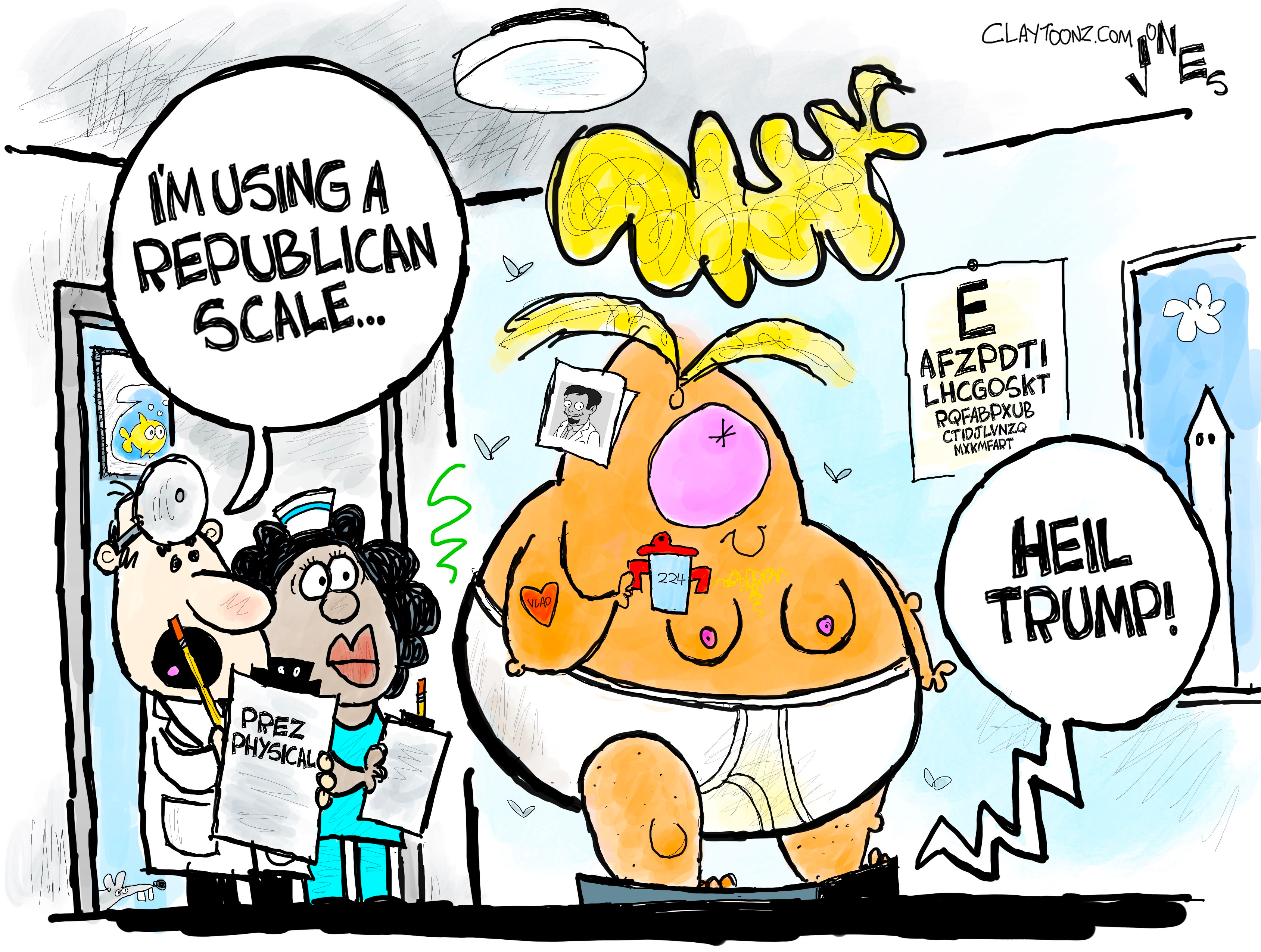
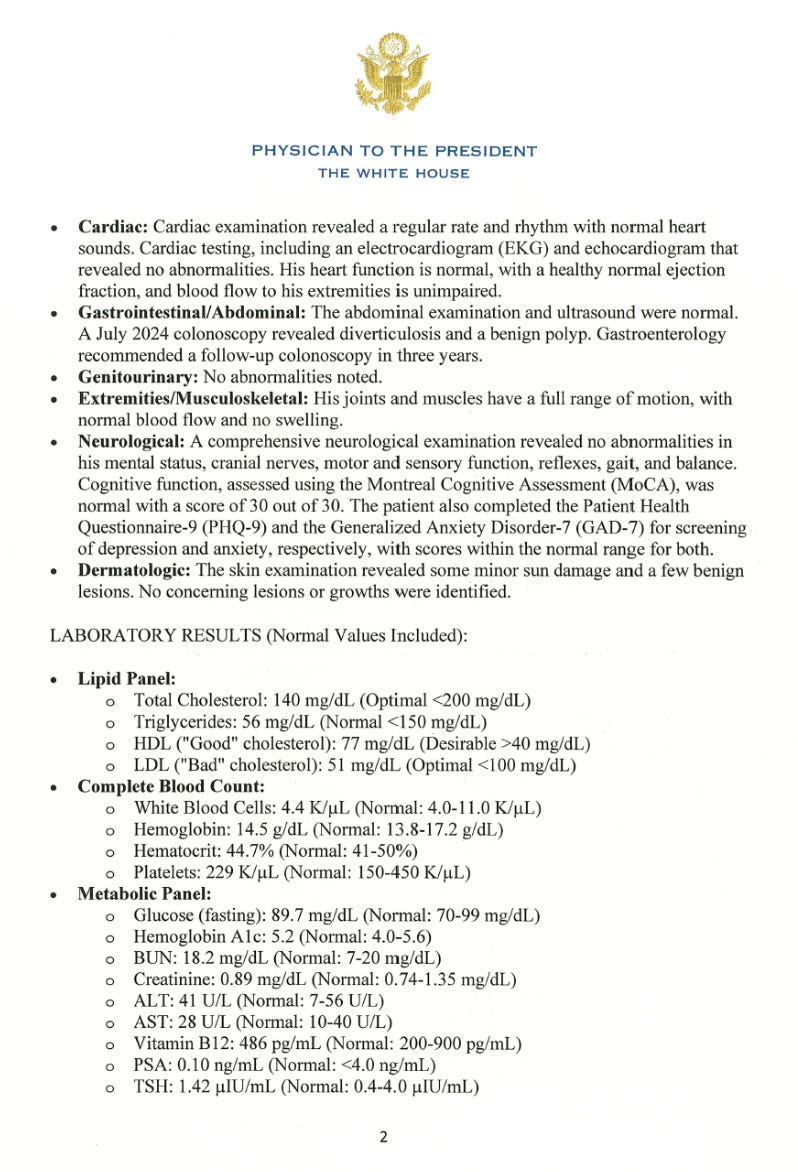
Rep. Jack Kimble tweeted that “President Trump is now 6’3” 224 pounds with 4.8% body fat. We might lose him to the NFL draft.”
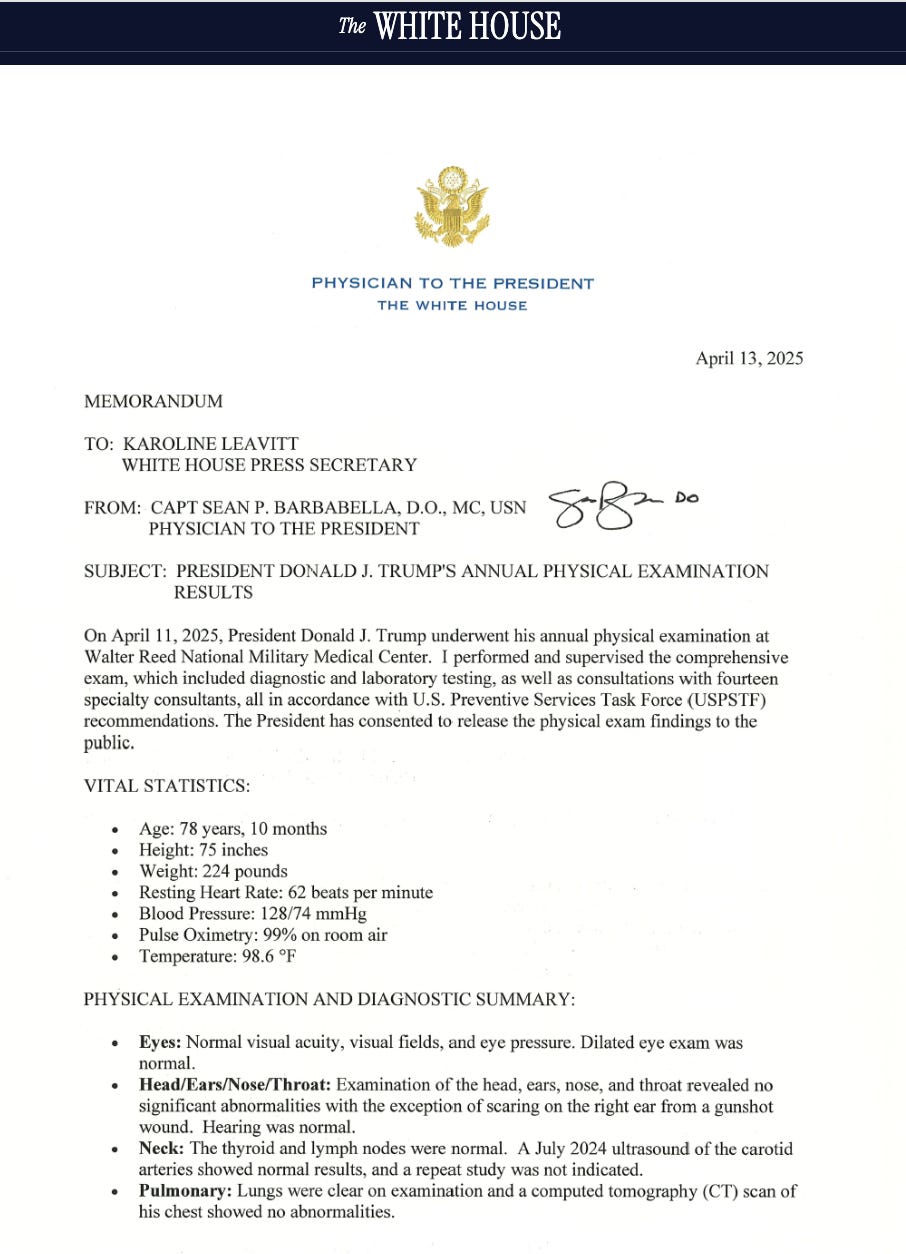
Captain Barbarella, the physician to the president (sic), failed to hide in his memorandum about Donald Trump’s physical that he’s a Trump sycophant. Or at least he failed to hide that he was controlled by a member of the cult.
His doctor’s name is actually Captain Sean Barbabella and NOT Barbarella, the title of the 1968 Jane Fonda space sex movie (I’ve never seen it). If congressman Kimble can accidentally refer to the El Salvadore President Nayib Bukele as President Bukake, I can use Barbarella. Also, I don’t know what “bukake” means because I’m a good boy.
While the report of the exam looks like it was written by a real doctor in most of the details, there are still little bits included to make it political and cultist.
For example, when the memorandum mentions his hearing, it mentions “scarring on the right ear from a gunshot wound,” reminding us that Trump was shot is a superhero to survive it (unlike that sucker standing behind him). The doc also wrote that Trump’s “active lifestyle continues to contribute significantly to his well-being,” with one of those activities being his “frequent victories in golf events,” which makes him “fully fit” to be president (sic).
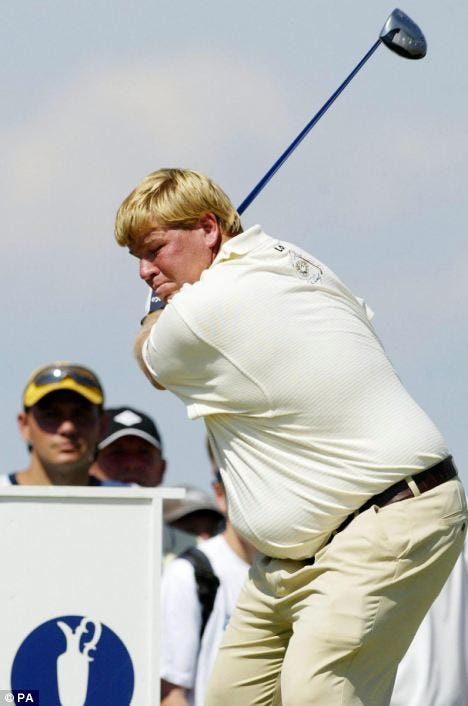
So it’s not the golfing that makes him physically fit to be president, but the golf victories. See what he did there? It’s like the champion is a Greek Adonis, but all the losers are donut-eating hose beasts. Have you seen John Daly? He also claims he’s 215 pounds.
Just how physically active is golfing when you don’t walk the course? Trump doesn’t even like stairs. Yes, there are elevators in the White House, and fortunately for Trump, one of them is a freight elevator. That brings us to Trump’s weight.
Captain Barbarella reports that Captain Big Mac only weighs 224 pounds. He also reports that Trump is 75 inches tall, which is six feet and three inches. I call bullshit.
Here’s what the White House released:
Unless you care about the president’s (sic) health (and I do not), it doesn’t matter to you or me what he weighs or how tall he is. What is important is that they’re dishonest. What’s important is the depth into which this regime sinks the cult into the government.
Trump, who is 78, needs to appear as a Superman to his cult. I’m shocked the memo mentions he takes aspirin for cardiac prevention. As we’ve learned, they lie about everything.
Right now, the regime is lying to the Supreme Court by claiming they can’t have a man they illegally snatched off the street and sent to a prison in El Salvador brought back to this country.
When Trump was running for president in 2016, Dr. Harold Bornstein stated that Trump would be the “healthiest individual ever elected to the presidency.” A couple of years later, we learned that Trump had dictated that letter, which didn’t surprise anyone. A doctor should lose his medical license over that. And it wouldn’t surprise us to learn he dictated “224” and “75 inches” to Captain Barbarella and wouldn’t allow him to mention that Trump’s cholesterol is just Big Mac Secret Sauce. His first White House physician was a lying alcoholic lunatic, Dr. Ronny Jackson, who doesn’t practice medicine anymore and is now in a place where he can’t hurt anybody, Congress.
Ronny Jackson claimed that Trump could live to be 200, and judging from the way our luck works, that might be true.
The memo does show that despite spreading debunked lies about vaccines, like his Health Secretary does, Trump is up to date on vaccines.
The part we should care about, and is more absurd than claiming he weighs 224 pounds, is the claim he scored 30 out of 30 on a cognitive test. I checked to be sure the memo didn’t state that he also has hands that are not tiny.
Anyone who believes Trump, the shark boat battery guy, scored 30 out of 30 on a cognitive test needs to take a cognitive test. I don’t believe this doctor would let us know if Trump scored less than 30.
Trump’s last presidential physical had him at 244 pounds. His 2023 arrest in Georgia listed him at 215 (they don’t weigh the prisoners but take their word for how much they weigh), and this exam says he’s 224.
If Trump does weigh 224 pounds, then that’s 224 pounds of walking/talking bullshit.
The one number that’s accurate about Trump is 34, as in 34 felony convictions.
Creative note: I still have a few other ideas I wrote last week that I want to get to, but I knew last night that I needed to cover this today. This idea hit me shortly after I woke up.
Music Note: I listened to The Beatles.
Drawn in 30 Seconds (with music): Sorry for the earworm. (Snip-go see/listen!)
Karla Jay remembers joining the second night of street protests during the 1969 Stonewall uprising in New York City. For her, and for so many other LGBTQ+ people, something had shifted: People were angry. They didn’t want things to go back to normal — because normal meant police raids. Normal meant living underground. It meant hiding who they were at their jobs and from their families. They wanted a radical change.
Radical change meant organizing. Jay joined a meeting with the Gay Liberation Front, which would become the incubator for the modern LGBTQ+ political movement and proliferate in chapters across the country. At those meetings, she remembers discussing what freedom could look like. Holding hands with a lover while walking down the street, without fear of getting beaten up, one person said. Another said they’d like to get married. At the time, those dreams seemed impossible.
Jay, now 78, is worried that history will repeat itself. She’s worried that LGBTQ+ people will be put in the dark again by the draconian policies of a second Trump administration.
“Are things worse than they were before Stonewall? Not yet,” she said. “It’s certainly possible that people will have to go back to underground lives, that trans people will have to flee to Canada, but it’s not worse yet.”
The 19th spoke with severalLGBTQ+ elders, including Jay, about what survival looks like under a hostile political regime and what advice they would give to young LGBTQ+ people right now.
“We have forgotten that the laws are written to protect property and not to protect people. They’re written to protect White men and their property, and historically, women and children were their property,” she said. “To expect justice from people who write laws to protect themselves has been a fundamental error of the lesbian, gay, bisexual, trans community.”
To fight back, LGBTQ+ Americans need to organize, Jay said. That starts with thinking locally — supporting local artists, independent stores and small presses, as well as LGBTQ+ organizations taking demonstrable political action and protecting queer culture.
“See what you can do without going crazy. If you can focus on one thing and you can spend one hour a week, or you can spend one day a week, that’s much better than being depressed and doing nothing,” she said. “Because the person you’re going to help is yourself. This is the time for all of us to step up.”
Renee Imperato (far right) poses with other demonstrators during a protest outside the Stonewall Inn, after the word transgender was erased from the National Park Service’s webpage, in New York, on February 14, 2025. (Courtesy of Renee Imperato)
Renata Ramos feels obligated to share her experiences with young people.As a 63-year-old trans Latina,she wants young people to know that so many of their elders have already been through hard times — which means that they can make it, too, including during this moment.
“I’m not scared in the least. Because we have fought so many battles — the elders. We have fought so many battles, with medicine, with HIV, with marching on Washington, with watching our friends die,” she said. “It’s been one war after another in our community that we have always won. We have always been resilient. We have always stood strong. We have always fought for our truth, and we’re still here. They haven’t been able to erase us.”
As Ramos watches the Trump administration use the power of the federal government to target transgender Americans and erase LGBTQ+ history, she’s not afraid for herself. She’s afraid for young LGBTQ+ people, especially young trans people who now find themselves at the center of a growing political and cultural war. If someone transitioned six months ago, she said, they now have a target on their back — and little to no experience with what that feels like.
“They don’t know what it is like to be a soldier going into war, as far as social issues. So I fear for them,” she said. “Who wouldn’t be scared?”
Criss Christoff Smith has seen firsthand what that fear can look like. On January 28, at 3 a.m., he received a phone call from an LGBTQ+ person who was considering taking their own life. This was a stranger —someone who admired from afar Smith’s advocacy as a Black trans man and Jamaican immigrant. This was someone who had been considering a gender transition for years, Smith said, who was now feeling broken. He spoke with them for two hours.
“It’s been quite dark,” Smith said. The onslaught of policies targeting marginalized people and the turbocharged news cycle are working to keep Black and trans people in a constant state of fear and uncertainty, he said.
“I tell everyone in my community, you have to stop responding to those alerts and just try to go inward,” he said. “Find a space of peace and spirituality.”
To Smith, who is 64, looking inward can mean reflecting on what’s still here. Although the Trump administration is going to make daily life harder for LGBTQ+ people, he said, laws can’t be undone with the stroke of a pen on an executive order. LGBTQ+ Americans need to find whatever source of strength and peace they can find right now — and try to remove themselves from the daily fray as much as possible — while still finding ways to take action.
“This is the time when we really have to find community, where we really have to hone in on our spiritual feelings and try to talk to someone. Don’t keep it to yourself,” he said. Joining protests or lobbying days at state capitols are great ways to find community in-person, Smith said — to be around like-minded people and to not feel so alone.
“That’s the best space to be in, not home alone and in your feelings and in your mind, because we can get lost there thinking negatively. So we have to stay positive and stay with like-minded people, and have those people constantly around you to reassure you and just hold you tight in that space,” he said.
Protests against the administration’s hostile LGBTQ+ policies have been ongoing — including outside the Stonewall National Monument. In at least one way, history is already repeating itself.
The National Park Service deleted all references to transgender and queer people from its web page honoring the 1969 Stonewall uprising — the most well-known moment from LGBTQ+ history in the country — leaving references to only lesbian, gay and bisexual people. Hundreds gathered in New York City to protest. Among them was Renee Imperato, a 76-year-old trans woman and New York native.
“Protests like this are our survival,” she told The 19th over email. “The rhetoric of this administration is driving a violent onslaught against our community. The Stonewall Rebellion is not over. We are at war, and we are still fighting back. What other choice do we have?”
Jay, herself an old hand at joining protests and demonstrations, said that she’s been afraid before every one of them. She’s lost sleep the night before and feared for her safety — but she did it anyway.
“I’m afraid I’ll be beaten. I’m afraid I’ll be arrested. But if you don’t do something even though you’re afraid, they win,” she said.
April 10, 1516 In what was the first ghetto, Jews in Venice, Italy, were forced to live in a specific, restricted area of the city known as Campo del Ghetto Nuovo. The word “ghetto” comes from the Venetian word “geto,” meaning foundry. Prior to becoming an exclusively Jewish neighborhood, the Venice ghetto was the site of a foundry. After its establishment the city’s Jews, who were allowed to attend to their business during the day (though required to wear a yellow badge or scarf indicating their religion), were forced to return to the ghetto where gates were locked to keep them inside overnight. Venice also restricted the living quarters of Germans and Turks, all to satisfy the demands of the Roman Catholic Church. The site of the Ghetto Nouvo today
April 10, 1971 Ninety-year-old Jeannette Rankin, the first female member of Congress (R-Montana), and the only one to vote against U.S. entry into both World Wars, led 8000 in protest of the Vietnam War in a women’s peace march on the Pentagon.
April 10, 1972 Charlie Chaplin received an honorary Oscar for “the incalculable effect he has had in making motion pictures the art form of this century.” The British native’s political views had previously been criticized, as had been his failure to apply for U.S. citizenship. Pressed for back taxes and accused of supporting subversive causes during the McCarthy era, Chaplin left the United States in 1952.Informed that he would not be welcomed back, he retorted, “I wouldn’t go back there if Jesus Christ were president.” He returned briefly from exile, however, to accept this award and received the longest standing ovation in Academy Award history, lasting a full five minutes. Charlie Chaplin, one of PBS’s American Masters
April 10, 1981 The United Nations Convention on Certain Conventional Weapons (also known as the Inhumane Weapons Convention) started gathering signatures of nations willing to abide by its limitations. Currently, 109 countries have agreed to ban or limit munitions that cause unnecessary or unjustifiable suffering to combatants, or affect civilians indiscriminately. So far the restrictions cover mines, booby traps, incendiary weapons (such as Napalm) and blinding laser weapons. This Life photograph of a naked child running down a street in Vietnam screaming in agony captures the effects of Napalm. Nick Ut’s photograph of Kim Phuk, taken in 1972, won the Pulitzer Prize ( Associated Press). Not all country signatories have agreed to all its provisions How militaries think about incendiary weapons
April 10, 1994 France, Belgium, the U.S., among other countries airlifted their nationals out of Rwanda as the wholesale slaughter of Tutsis at the hands of the Hutu majority proceeded. Rwandan employees of Western governments were left behind. The International Red Cross was already estimating the death toll in the tens of thousands.
April 10, 1998 The Northern Ireland peace talks ended with an historic accord—called the Good Friday Agreement—reached after nearly two years of talks and 30 years of conflict. Former U.S. Sen. George Mitchell (D-Maine) was chair of the talks which established a Northern Irish Assembly for both the Irish Catholic republicans and the British Anglican unionists. Senator George Mitchell
April 9, 1898 Ida Wells-Barnett, a journalist, speaker and advocate for suffrage, wrote to President William McKinley requesting federal action against those who lynched the U.S. Postmaster of Lake City, South Carolina. Ida Wells-Barnett Though the federal government had previously refused to involve itself with the thousands of lynchings, leaving them to be dealt with at the state level, Ms. Wells-Barnett insisted that a postmaster’s murder was a federal matter. “We most earnestly desire that national legislation be enacted for the suppression of the national crime of lynching . . . . Her open letter to President McKinley ============================================= April 9, 1947 The first freedom ride, the “Journey of Reconciliation,” left Washington, D.C. to travel through four states of the upper South.In response to a Supreme Court decision (Morgan v. Virginia) outlawing segregation on interstate busses, the group of both black and white Americans rode together despite “Jim Crow” state laws making it illegal. Together on the bus, and arrested several times for being so, were George Houser, Bayard Rustin, James Peck, Igal Roodenko, Nathan Wright, Conrad Lynn, Wallace Nelson, Andrew Johnson, Eugene Stanley, Dennis Banks, William Worthy, Louis Adams, Joseph Felmet, Worth Randle and Homer Jack. Two African-American members of the group, Rustin and Johnson, served on a chain gang for 30 days after their conviction in North Carolina. The integrated bus tour was sponsored by CORE (Congress for Racial Equality) and FOR (Fellowship of Reconciliation) Read more about the freedom rides ============================================== April 9, 1981 Members of the Bigstone Cree band of indigenous people ended a 250-mile march to the capital, Edmonton, to highlight their economic plight in northern Alberta, Canada. ============================================== April 9, 1995 Former Secretary of Defense Robert McNamara first publicly acknowledged error in prosecution of the war in Vietnam. “Yet we were wrong, terribly wrong. We owe it to future generations to explain why.” Robert McNamara, Fog of War ============================================== April 9, 2000 Jubilee 2000 National Mobilization Day in Washington, D.C. brought together individuals and groups demanding cancellation of third world debt. “Every child in Africa is born with a financial burden which a lifetime’s work cannot repay. The debt is a new form of slavery as vicious as the slave trade.” Jubilee USA Network