A U.S. Army veteran who was arrested during an immigration raid at a Southern California marijuana farm last week said Wednesday he was sprayed with tear gas and pepper spray before being dragged from his vehicle and pinned down by federal agents who arrested him.
George Retes, 25, who works as a security guard at Glass House Farms in Camarillo, said he was arriving at work on July 10 when several federal agents surrounded his car and — despite him identifying himself as a U.S. citizen — broke his window, peppered sprayed him and dragged him out.
In this image taken from video provided by United Farm Workers, George Retes speaks about being arrested at an immigration raid at a Southern California marijuana farm during a press conference held over Zoom in Oxnard, Calif., Wednesday, July 16, 2025. (United Farm Workers via AP)
“It took two officers to nail my back and then one on my neck to arrest me even though my hands were already behind my back,” Retes said.
Massive farm raids led to hundreds being detained
The Ventura City native was detained during chaotic raids at two Southern California farms where federal authorities arrested more than 360 people, one of the largest operations since President Donald Trump took office in January. Protesters faced off against federal agents in military-style gear, and one farmworker died after falling from a greenhouse roof.
The raids came more than a month into an extended immigration crackdown by the Trump administration across Southern California that was originally centered in Los Angeles, where local officials say the federal actions are spreading fear in immigrant communities.
California Gov. Gavin Newsom spoke on the raids at a news conference Wednesday, calling Trump a “chaos agent” who has incited violence and spread fear in communities.
“You got someone who dropped 30 feet because they were scared to death and lost their life,” he said, referring to the farmworker who died in the raids. “People are quite literally disappearing with no due process, no rights.”
Retes was taken to the Metropolitan Detention Center in downtown Los Angeles, where he said he was put in a special cell on suicide watch and checked on each day after he became emotionally distraught over his ordeal and missing his 3-year-old daughter’s birthday party Saturday.
Milk is poured on a protester’s face after federal immigration agents tossed tear gas at protesters during a raid in the agriculture area of Camarillo, Calif., Thursday, July 10, 2025. (AP Photo/Michael Owen Baker)
He said federal agents never told him why he was arrested or allowed him to contact a lawyer or his family during his three-day detention. Authorities never let him shower or change clothes despite being covered in tear gas and pepper spray, Retes said, adding that his hands burned throughout the first night he spent in custody.
On Sunday, an officer had him sign a paper and walked him out of the detention center. He said he was told he faced no charges.
Retes met with silence when seeking explanation
“They gave me nothing I could wrap my head around,” Retes said, explaining that he was met with silence on his way out when he asked about being “locked up for three days with no reason and no charges.”
Tricia McLaughlin, assistant secretary of the Department of Homeland Security, confirmed Retes’ arrest but didn’t say on what charges.
“George Retes was arrested and has been released,” she said. “He has not been charged. The U.S. Attorney’s Office is reviewing his case, along with dozens of others, for potential federal charges related to the execution of the federal search warrant in Camarillo.”
A federal judge on Friday ordered the Trump administration to halt indiscriminate immigration stops and arrests without warrants in seven California counties, including Los Angeles. Immigrant advocates accused federal agents of detaining people because they looked Latino. The Justice Department appealed on Monday and asked for the order to be stayed.
The Pentagon also said Tuesday it was ending the deployment of 2,000 National Guard troops in Los Angeles. That’s roughly half the number the administration sent to the city following protests over the immigration actions. Some of those troops have been accompanying federal agents during their immigration enforcement operations.
Retes said he joined the Army at 18 and served four years, including deploying to Iraq in 2019.
“I joined the service to help better myself,” he said. “I did it because I love this (expletive) country. We are one nation and no matter what, we should be together. All this separation and stuff between everyone is just the way it shouldn’t be.”
Veteran pledges to sue federal authorities for his ordeal
Retes said he plans to sue for wrongful detention.
“The way they’re going about this entire deportation process is completely wrong, chasing people who are just working, especially trying to feed everyone here in the U.S.,” he said. “No one deserves to be treated the way they treat people.”
Retes was detained along with California State University Channel Islands professor Jonathan Caravello, also a U.S. citizen, who was arrested for throwing a tear gas canister at law enforcement, U.S. Attorney Bill Essayli posted on X.
The California Faculty Association said Caravello was taken away by agents who did not identify themselves nor inform him of why he was being taken into custody. Like Retes, the association said the professor was then held without being allowed to contact his family or an attorney.
Caravello was attempting to dislodge a tear gas canister that was stuck underneath someone’s wheelchair, witnesses told KABC-TV, the ABC affiliate in Los Angeles.
A federal judge on Monday ordered Caravello to be released on $15,000 bond. He’s scheduled to be arraigned Aug. 1.
“I want everyone to know what happened. This doesn’t just affect one person,” Retes said. “It doesn’t matter if your skin is brown. It doesn’t matter if you’re white. It doesn’t matter if you’re a veteran or you serve this country. They don’t care. They’re just there to fill a quota.” ___ Associated Press writer Jamie Ding contributed from Los Angeles.
July 23, 1846 Author Henry David Thoreau was jailed for refusing to pay the poll tax as a protest against the Mexican war, which in turn led to his writing “Civil Disobedience.” This essay became a source of inspiration for Leo Tolstoy, Mahatma Gandhi, and Martin Luther King, Jr. From Thoreau’s essay: “Unjust laws exist: shall we be content to obey them, or shall we endeavor to amend them, and obey them until we have succeeded, or shall we transgress them at once?” Daguerreotype of Henry David Thoreau Out of Thoreau’s jailing grew a legend: The great American philosopher Ralph Waldo Emerson visited Thoreau in jail. Emerson asked, “Henry, why are you here?” Thoreau replied, “Why are you not here? Under a government which imprisons unjustly, the true place for a just man is also a prison.” Thoreau was not alone in his opposition: Thomas Corwin of Ohio denounced the war as merely the latest example of American injustice to Mexico: “If I were a Mexican I would tell you,‘Have you not room enough in your own country to bury your dead.’” Henry Clay [former speaker of the House and presidential candidate] declared, “This is no war of defense, but one of unnecessary and offensive aggression.” Abraham Lincoln also opposed the war, and lost his seat in Congress as a result. The entire essay (in annotated form)
July 23, 1967 Detroiters angry at loss of jobs and, especially, at the abusive and virtually all-white police department, started rioting in what became known as the Detroit Rebellion. The intitiating incident was an early-morning raid on a blind pig (Detroit for after-hours drinking club) on 12th Street. The violence spread elsewhere in the city, and led to President Lyndon Johnson’s calling out 8000 members of the National Guard. Order was not restored for six days. In the end, there were 43 known dead, 347 injured, 3800 arrested, 1000 families homeless. Thirteen hundred buildings burned to the ground and twenty-seven hundred businesses were looted. Online documentary on all aspects of what happened, “Ashes to Hope” The Rebellion from a 40-year perspective
This is a fun half from an Emma Thursday 07-17-2025
This last one is from the Nazi authoritarian cult of tRump maga who I posted a meme of getting fired and asking for money because his boss felt his was not a good fit for the company. FAFO
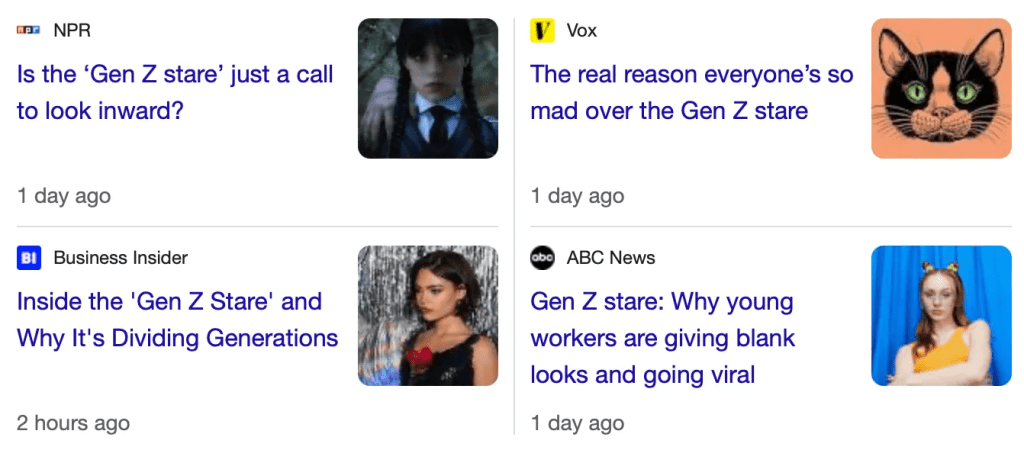
Legacy media is very concerned with the ‘Gen Z Stare’
In the past week, there’s been robust discourse in legacy media about the so-called ‘Gen Z Stare’ and the bursts of generational conflict it reportedly captures.
It’s gotten write-ups by The New York Times, The Washington Post, USA Today, The Boston Globe, NBC News, ABC News, CNBC, Newsweek, Indy100, Axios, Fortune, Vox, Vice, Business Insider, The Independent, Forbes, Buzzfeed, Slate, HuffPost, Glamour, People, and Marie Claire, among others.
As a millennial, I am apparently urged to be concerned about this phenomenon of Gen Z folks supposedly failing to appropriately interact with me through sufficiently pleasant facial expressions, so I thought it might be helpful to offer my thoughts:
The sitting president of the United States is currently covering up a massive sex trafficking operation that targeted children and likely implicates a number of powerful people who are currently out in the world and free to continue preying on children.
The sitting president of the United States just successfully pressured Paramount and CBS to cancel the #1 late-night talk show on broadcast television as part of what appears to be a blatant bribery deal because the host has been critical of him.
The sitting president of the United States just got the extremist Republican majority in Congress to strip 11 million Americans of health care coverage by the end of 2026 and upwards of 17 million Americans when you account for new federal work requirements. (snip-MORE; it’s succinct and quick, and it’s all good facts for grocery/other places lines, for discussion.)
I would like people to compare the “tough guy” speech given by the ICE person about removing child molesters and kidnappers, rescuing children from forced labor, the worst criminals, murders, making mom and pop safe with the four crimes they mentioned that of the dozens and dozens arrested were accused of. One guy was charged with fentanyl distribution, one was charged with trespass, a third was charged with driving without a license and refusing to show identification. Wow mom and pop are so much safer now that the worst of the worst are in detention with no due process. Let’s be clear, they are going after legal immigrants, they are going after those following the rules, they are showing up at places where these people are working and looking for work because the goal is to remove all the brown people. It is that simple, it is a white supremacy thing driven by racist like Stephen Miller who hates Spanish speaking people and those with brown skin. They held a US citizen veteran for three days with no due process and no explanation. Take a guess of his skin color? Brown? Great guess and correct. These gang thugs are not trying to make the US safer for anyone, they are determined to make it whiter. At the 5:21 mark ICE thugs abruptly stop their car in the middle of the street and with guns and tasers ready while masked and in no uniform they rush a woman who is a well known activist who has been openly filming them for weeks. This is an attempt to cause fear and stop people from viewing and reporting their actions. This is such a 1930s Hitler’s Germany moment in the US. And Vaush talks about how the nation if flooded with guns and these masked people with no uniforms rushing at people could be shot by people in reasonable fear for their lives as Roger also has been saying. Hugs
July 19, 1848 The first Women’s Rights Convention in the U.S. was held at Seneca Falls, New York. Its “Declaration of Sentiments” launched the movement of women to be included in the constitution.The Declaration used as a model the U.S. Declaration of Independence, demanding that the rights of women as individuals be acknowledged and respected by society. It was signed by sixty-eight women and thirty-two men. The impetus came from Elizabeth Cady Stanton and Lucretia Mott, both of whom had been excluded, along with all the other female American delegates, from the World Anti-Slavery Convention (London, 1840) because of their sex. Frederick Douglass, the former slave and abolitionist leader attended the convention and supported the resolution for women’s suffrage. When suffrage finally became a reality in 1920, seventy-two years after this first organized demand in 1848, only one signer of the Seneca Falls Declaration, Charlotte Woodward, then a young worker in a glove manufactory, had lived long enough to cast her first ballot. The Seneca Falls Convention and the Early Suffrage Movement The Declaration of Sentiments
July 19, 1958 Several black teenagers, members of the local NAACP chapter (National Association for the Advancement of Colored People), entered downtown Wichita’s Dockum Drug Store (then the largest drugstore chain in Kansas) and sat down at the lunch counter. Wichita sit-in sculpture The store refused to serve them because of their race. They returned at least twice a week for the next several weeks. They sat quietly all afternoon, creating no disturbance, but refused to leave without being served. Though the police once chased them away, they were breaking no law, only asking to make a purchase, a violation of store policy. This was the first instance of a sit-in to protest segregationist policies. Less than a month later, a white man around 40 walked in and looked at those sitting in for several minutes. Then he looked at the store manager, and said, “Serve them. I’m losing too much money.” That man was the owner of the Dockum drug store chain. That day the lawyer for the local NAACP branch called the store’s state offices, and was told by the chain’s vice president that “he had instructed all of his managers, clerks, etc. (statewide), to serve all people without regard to race, creed or color.”
July 19, 1974 Martha Tranquill of Sacramento, California, was sentenced to nine months’ prison time for refusing to pay her federal taxes as a protest against the Vietnam War.
July 19, 1993 President Bill Clinton announced regulations to implement his “Don’t Ask, Don’t Tell” policy regarding gays in the military, saying that the armed services should put an end to “witch hunts.” The policy was developed by General Colin Powell, then Chair of the Joint Chiefs of Staff, and eventually summarized as “don’t ask, don’t tell, don’t pursue, don’t harass.”
July 19, 2000 A federal administrative law judge ordered white supremacist Ryan Wilson to pay $1.1 million in damages to fair housing advocate Bonnie Jouhari and her daughter, Dani. The decision stemmed from threats made against Jouhari by Wilson and his Philadelphia neo-Nazi group, ALPA HQ.
In my recent post about participating in a French journalism festival, I mentioned that the publisher of the satirical magazine Charlie Hebdo appeared on one of the cartoonists’ panel discussions. Due to the high security around him, his participation wasn’t advertised and had, at least to my count, five armed bodyguards who followed him around constantly. Those murders at the offices of Charlie Hebdo were 10 years ago and this man still has to have around the clock protection.
I drew and wrote quite a bit about the issue of free speech during that time and it still infuriates me that some people feel they have the right to threaten (and even kill) cartoonists just because they feel offended. While most of the world were in solidarity after the massacre, the discussion in the U.S. turned to questions about limiting speech…coming even from the so-called liberals in the media.
And now we have another editorial cartoonist receiving death threats because of a cartoon he drew about the Texas floods. Right wing commentators and even several news outlets are describing the cartoon by Adam Zyglis as “mocking” the flood survivors, which of course it is not. It is a legitimate comment about the Republican hypocrisy of attacking government programs except when natural disasters affect them.
Margaret Sullivan has a good piece about how social media, the “right-wing outrage machine” (although I’d argue the left also engages in this), and ignorance of an editorial cartoon’s purpose all figure into these potentially dangerous situations.
(my graphic essay after the 2015 Charlie Hebdo massacre)
(snip-go see it on Substack; just click through. The comic turns quite small with a copy/paste, and enlarging it makes it blurry. -A.)
———————————
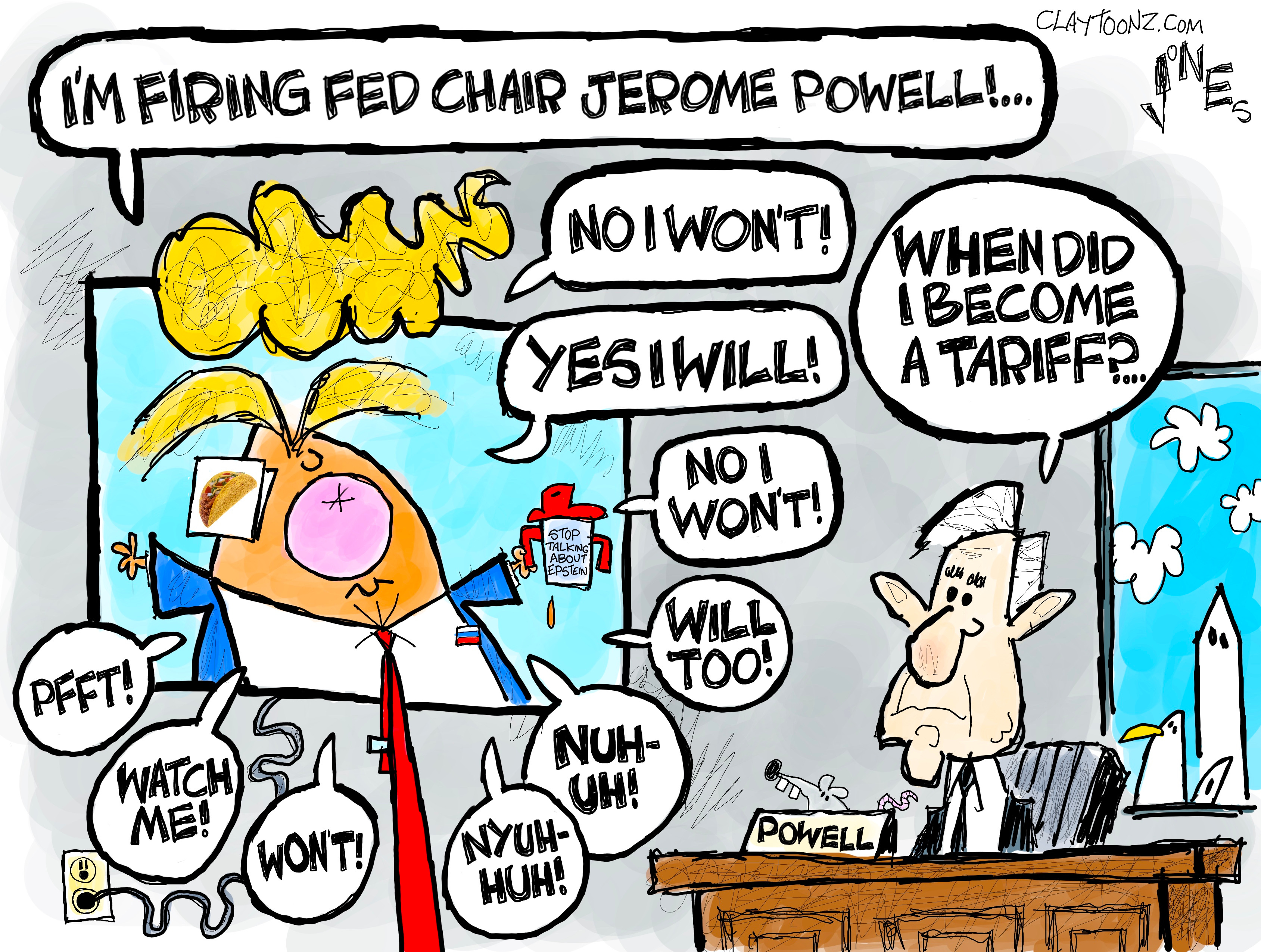
Fed TACO by Clay Jones
If Fed Chair Jerome Powell gets a hankering for Tacos today, we know why Read on Substack
Donald Trump hates Jerome Powell, which puts Powell in a non-exclusive club. Donald Trump hates a lot of people. Am I on that list?
Jerome Powell, of course, is the Chair of the Federal Reserve. Last night, TACO met with about a dozen House Republicans and asked their opinions on whether or not he should fire Powell. Trump even showed them a letter he wrote firing Powell. He just hasn’t sent it yet.
Asked today by the press in the Oval Office about this letter and the imminent firing of Powell, Trump said it’s very unlikely.
Did Trump just TACO Jerome Powell? Trump earned the nickname TACO from his tariff threats, where he threatens to place tariffs on nations, then backs off, and threatens again, then backs off. Wall Street has started to ignore Trump’s tariff threats, which created “Trump Always Chickens Out.” It’s the acronym for TACO.
Calling Trump TACO upsets him greatly, but he’s still chickening out with the tariffs.
Speaking of tariffs, in June, our nation had its first surplus in nine years. Wow! The surplus is $27 billion, though the national debt is still over $36 trillion (year to date is over $1 trillion). MAGAts are celebrating this, praising Trump, and calling him a genius for this surplus they think was paid by other nations, forgetting that tariffs are taxes. Trump raised taxes on Americans, and it’s the American taxpayer from where this $27 billion surplus came from.
Republicans, do not ever play a shell game because you will lose. On the other hand, I just created a new game, Republican. Come play with me. (snip-MORE)
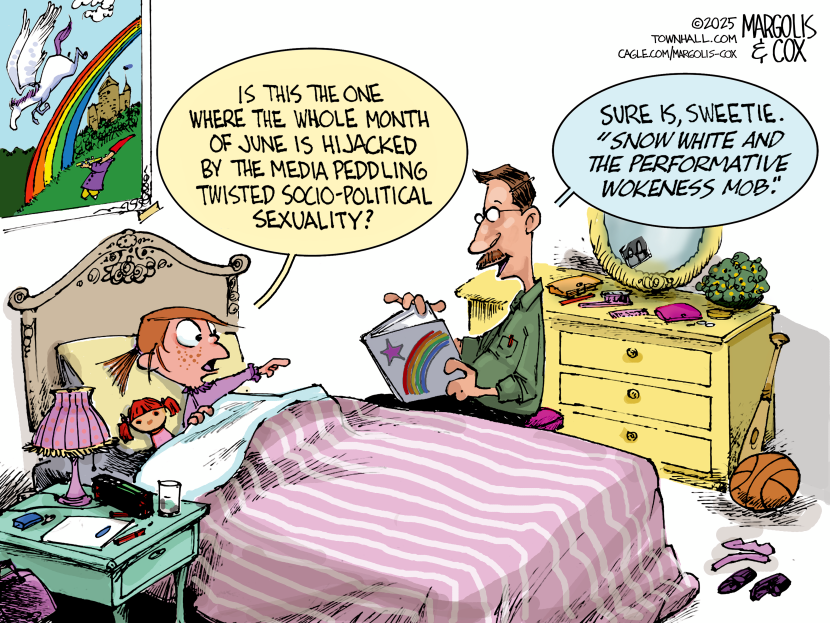
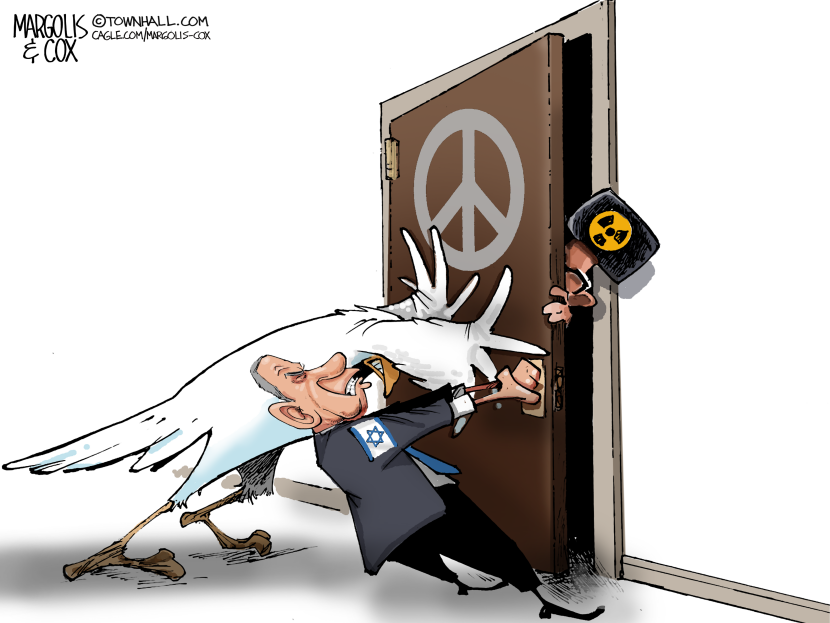
Margolis & Cox by Clay Jones
(Note from A.-this one’s long, but I left it whole so we can check our comics sources. The names are interesting, though I’ve seen some of the work, and wondered about it. -A.)
I’m gonna get in trouble again, but it’s good trouble Read on Substack
There’s a duo who create cartoons together, which is my first issue with these guys.
Though there’s no set rule for it, political cartooning is supposed to be a solo craft. I don’t even take ideas from readers. Here, we have a writer feeding ideas to an artist, and they’re terrible ideas. The cartoons are worse than the vitriolic bigotry shit out by Gary Varvel, Steve Kelley, and Mike Lester (if you think I just pissed some cartoonists off, I’m just getting warmed up, baby). At least those dudes can suck on their own. But the MargoCox goons work for Townhall, a very racist right-wing propaganda outlet. Based on that alone, no legitimate news publication should be publishing their cartoons/propaganda, and no syndicate should be distributing them. Unfortunately, Politico publishes them as they’re syndicated by Cagle Cartoons, owned by Daryl Cagle.
In the past, Cagle was also the syndicate for the “anonymous” cartoonist, who was Canadian Cameron Cardow, a racist conspiracy theorist pretending to be an American in fear for his life from liberals, wokeness, and trans people. Politico published his work, too, no matter that it violated every journalism ethics policy in existence. Instead of the racist Cameron, why couldn’t Canada just send us more black squirrels?
I’m pretty sure the first syndicate that will distribute AI-created “cartoons” will be Cagle, and Politico will be waiting to publish them. I’m shocked Cagle isn’t selling lying racist antisemitic conspiracy theorist MAGAt Ben Garrison’s cartoons. He draws Trump with muscles. Take note, MargoCox.
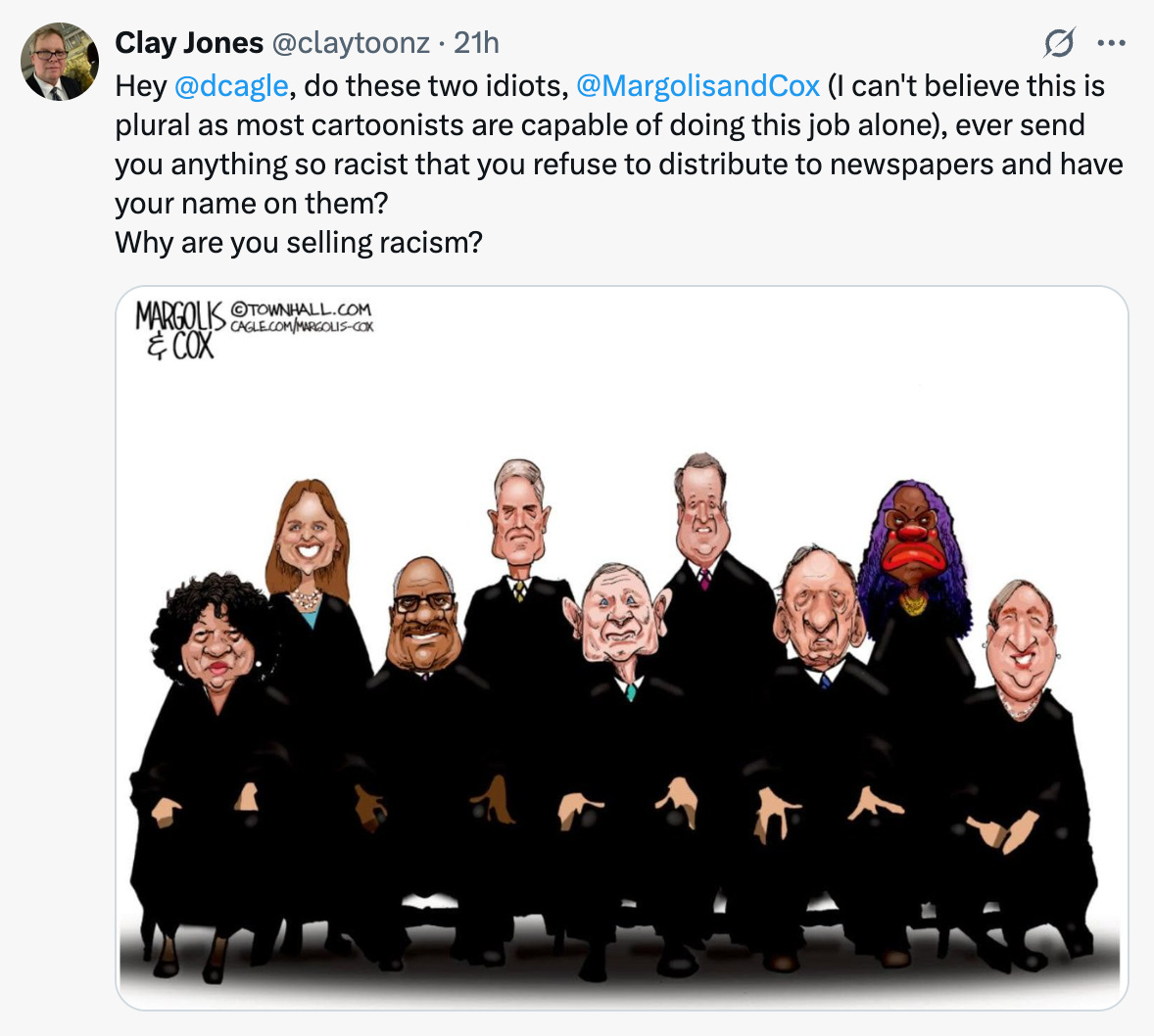
But MargoCox has been producing horrible cartoons, many typical of other conservative cartoons with bigotry and lies, but also boring and bad writing for the most part. They’re a two-man trope machine. Last week, they produced something extremely racist.
If Margo wrote it, then Cox should have refused to draw it. I don’t know these guys, but I’m going to have to assume they’re both equally racist bags of dicks (and after a brand new encounter with them today, I’m not assuming anymore). As for Cagle Cartoons, the syndicate should have said no. Daryl Cagle should have refused to have his name on it.
I took issue with this, so I tweeted and posted this to Facebook (which at this time has 156 comments) on Sunday.
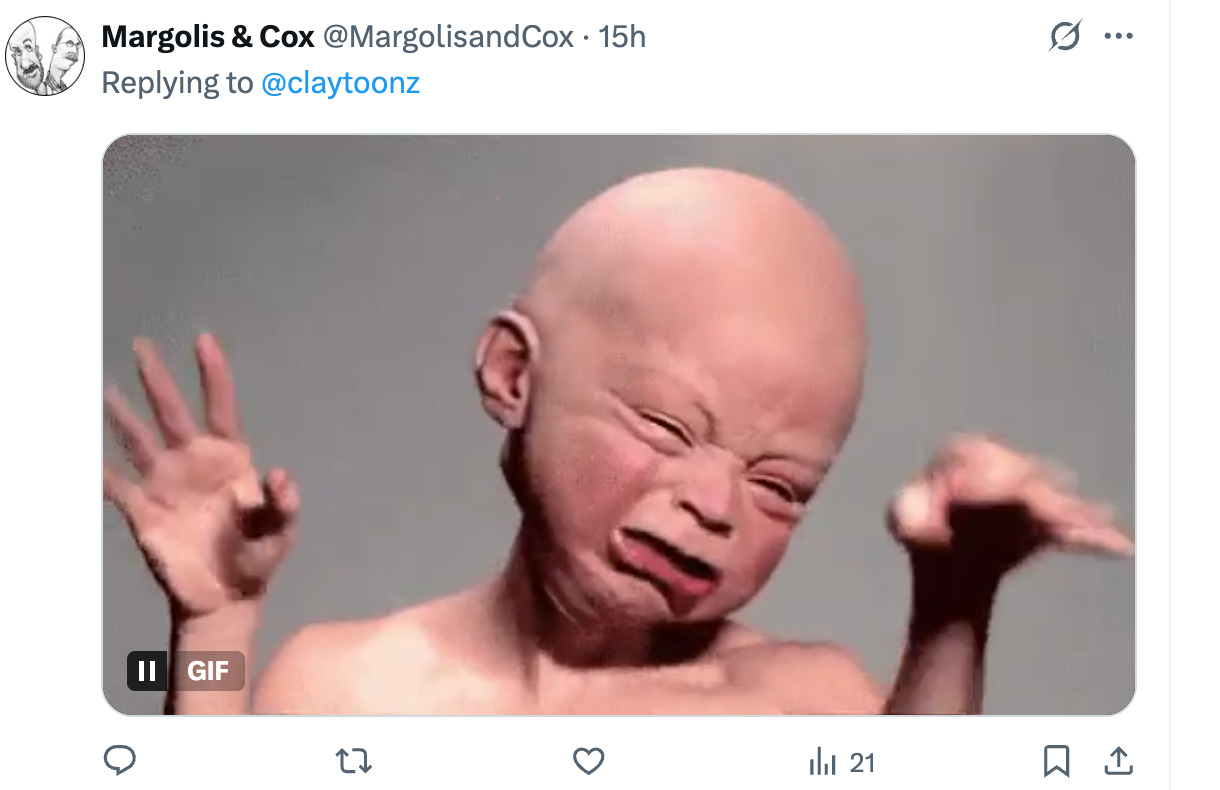
I hate posting the cartoon here, but you have to see it to understand the extent of the racism. It’s like old-timey minstrel shit. I got a reply from Margocox, but it was just a nonsensical GIF.
To me, it comes off as “neener neener, I owned you by being racist. Tee-hee.” If I’m wrong, feel free to inform me what this shit is. I think the guys are proud to be racist. Later, they posted another gif, but this time to my Facebook page.
I did not hear from Daryl Cagle…or did I?
I got a message from a friend late Sunday night who works for Cagle. He said he had to call “bullshit” on my post about Cagle and MargoCox. He said that the cartoon duo worked for Townhall and not Cagle, which I thought I had been clear about. I know how a syndicate works. I own a syndicate.
He said that this specific cartoon hadn’t been sent to Cagle for syndication yet and was not in their database, and that he couldn’t even find it. He demanded to know where I found the cartoon. I told him…
How could I find the cartoon, and he couldn’t?
He explained that it was on Cagle’s website, but NOT on the syndicate website. Yeah, I’m confused. It’s sitting right there, on Cagle’s site with Cagle’s name on it. What up with that? But then he did a whatabout (which should be only a MAGAt technique, but it’s what he did) and said I never go after another syndicate for this kind of stuff, but I do, and I have called out other racist, gaslighting, conspiracy theorist cartoonists in the past. He’s known me for decades, so this can’t be the first time he’s seen me call out cartoonists. In fact, he’s secretly messaged me in the past to feed me dirt on other cartoonists, hoping I would publish it (other cartoonists do this too).
But as for the cartoon NOT being on the syndication site, it is, and presented here with the pricing list.
Cagle is definitely selling this racist cartoon.
I asked my friend, who may not be my friend anymore, if Cagle had sent him to talk to me. It took him a while to reply. Are you familiar with messenger services where you can see that the other person is replying, or trying to…and you see the dots while they’re typing, then they stop, start again, stop, start again, all because the person is trying to formulate how he wants to say something. There was a lot of that.
But he finally got his denial through, saying he hadn’t talked to Cagle about it. I replied, “He’s talking to you right now, isn’t he?” I never got another reply to the conversation he initiated. That was two days ago.
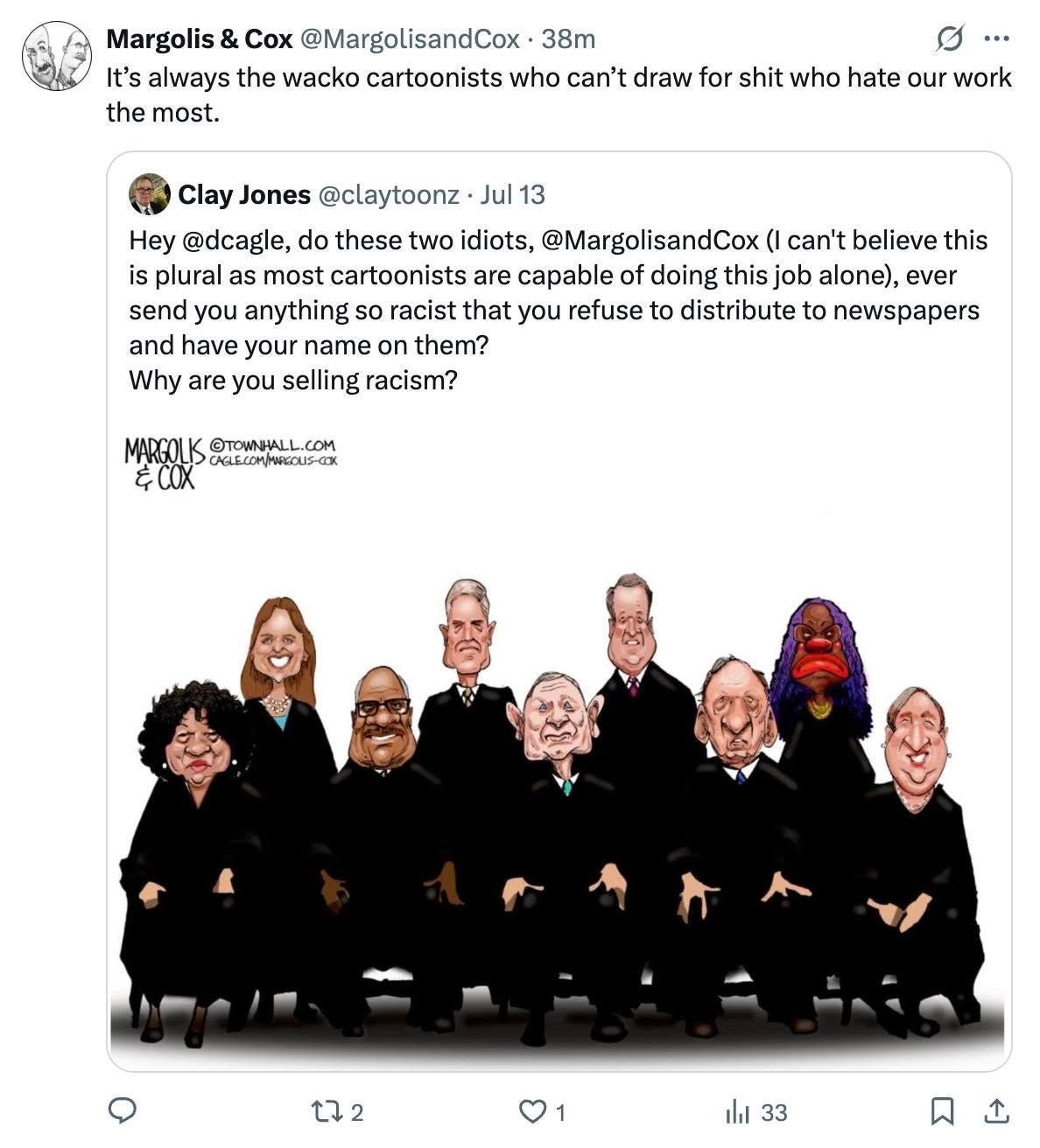
Today, Margolis & Cox came after me, not by defending themselves from accusations of racism, but by attacking my art skills, as if that has anything to do with their racism.
Only right-wing MAGAt trolls attack my drawing ability because it changes the subject and tries to put the onus on me. It’s also stupid criticism when it takes two of them to produce the rancid, bigoted tropes they crap out. I replied, saying that it doesn’t matter how well you draw if the ideas are shit. And their racist ideas are shit.
Of course, I was accused of trying to cancel them, and they’re right. I’m trying to cancel racism. They, with Daryl Cagle’s help, are advancing racism. In addition to racism, you should see all the homophobic crap they’re selling. Homophobic cartoons like this, and this, and this. Also, fellas…don’t talk about my art until you figure out how doors work.
I don’t know which one was coming at me, Margo or Cox, but it demanded that I defend myself from their attacks on my art (roll your eyes) and said there was nothing racist about drawing a black woman as a clown, except these art critics didn’t draw her as a clown. All they did was give her giant lips.
They said I was a “mediocre” cartoonist, jealous of them, and that being “printed” means they don’t “suck.” It’s like talking to very racist and stupid children. I really don’t like to boast about my success, and I don’t think I am that successful, but guys…I’m published more than the two of you put together, and I have more awards at this time than you will ever see, unless the Daily Stormer gives out cartoon awards.
And you can’t brag about being syndicated when your cartoons are sold by the same guy who sells Gary McCoy and the “Anonymous” cartoonist.
This went on for a while with them, and I quickly learned it was pointless to talk to the moron twins because they’re like insecure and immature little boys… little stupid racist boys. If someone were able to make them listen to why their cartoon is racist, they wouldn’t have the intellectual bandwidth combined to comprehend. They’re too stupid to be drawing political cartoons, and much too stupid to be syndicated. But I’ve also learned over the years that Cagle will syndicate anyone if it’ll get him a nickel. He exercises zero civic responsibility.
Syndicates need to be responsible for the stuff they put out. If they can’t, then they shouldn’t sell it. When I asked Cagle a couple of years ago on Twitter to justify syndicating the anonymous cartoonist, his answer was, “I don’t see a problem with it,” which is not an answer.
Now, he’s not replying to this. Why not? Because he can’t justify it. His only reason for carrying this shit is that it might sell. But he needs to explain why he sells racist cartoons. This is beyond a different viewpoint or a counterpoint. He can’t argue it’s not racist, because it is, and the comments from his employee indicate that they know it’s racist. Why was he so upset in the first place? Because I “accused” Cagle of selling a racist cartoon, which I have proven they are doing.
One of Cagle’s cartoonists, Gary McCoy, has had multiple newspapers apologize to their readers for his racist cartoons, with one paper even pulling cartoons altogether over it. This happens with Gary’s work TIME after TIME after TIMEafterTIME, and Cagle continues to sell his racist cartoons. I don’t understand why Cagle continues to carry McCoy despite his racism, because McCoy’s cartoons suck. They can’t be bringing in that much revenue, can they?
What I propose, since Daryl Cagle refuses responsibility for selling racism, is that all of his cartoonists, the ones whose work he syndicates, need to tell him he needs to stop.
A few cartoonists commented on my initial post about MargoCox, outraged over their racism. A few of those are Lalo Alcaraz, Chris Britt, Marc Murphy, John Kovalic, Kevin Necessary, Bob Krieger, Phil Hands, Gary Huck, and Steve Brodner. Other cartoonists need to step up, even those syndicated by Cagle, and denounce racism in political cartooning.
Guys, you are in the business of publishing your opinions…publish your opinion on this. Speak up, or at least speak to Daryl. Tell him to cut out the bullshit. This should go double for the good cartoonists who are in Cagle’s stable. I’m looking at you, some of whom are my friends who I respect greatly, Pat Bagley, Adam Zyglis, Ed Wexler, Michael de Adder, Rick McKee, Bill Day, Jeff Koterba, John Cole, and Alexandra Bowman. For the love of god, for the love of this industry, say something.
I’m asking my colleagues to stand up against racism in our industry, because we know Daryl never will.
A friend of mine, who is a Black woman, said about this, “It’s sad but the good thing as Black women is that we are used to this type of hate to the point where we expect it, and since we have so much experience with it, we are able to rise above it because that’s the only other choice that we have.”
One last note: MargoCox told me that calling them out “will not end well for me.”
The comments will be open for everyone on this blog, because the accused and the ones I’ve called out deserve the opportunity to reply.






 Scottie's Playtime