
Category: Vote / Voting
Josh Johnson Explains The Upcoming Holiday:
Would ’twere…
but, it’s The Onion. Enjoy!
FDA Recalls 40,000 Gallons Of RFK Jr. Milk
Contaminated Teats Of Health Secretary Produced Tainted Dairy Products

Vats full of milk secreted by Robert F. Kennedy Jr. formed the backdrop for an FDA press conference.
WASHINGTON—In what experts are already calling one of the worst outbreaks of foodborne illness in decades, the U.S. Food and Drug Administration issued an urgent recall Tuesday for 40,000 gallons of RFK Jr. milk.
The recall, which covers all milk produced by the body of Health and Human Services Secretary Robert F. Kennedy Jr., was issued following widespread reports of high fever, nausea, arthritis-like symptoms, and uncontrollable diarrhea among consumers. The FDA urged Americans to throw out any RFK Jr. milk they had in their refrigerators, saying those affected would be entitled to a full refund and should take a 60-day course of the antibiotic ciprofloxacin.
“If you purchased a jug of milk pumped from Secretary Kennedy’s breasts on or after Mar. 4, 2026, you may have noticed a sulfurous smell, streaks of red pus, or visible effervescence in the liquid,” said FDA Commissioner Marty Makary, stressing that anyone who experienced blindness or vertigo after drinking the beverage should consult a healthcare provider immediately, especially if they were pregnant. “We also ask that consumers dispose of the milk by incineration instead of dumping it down the drain, which could result in the substance entering rivers and streams and cause mass aquatic die-offs.”
“We acknowledge our error in ever allowing this man’s milk to make it onto store shelves in the first place,” Makary added.

According to sources, the recalled Kennedy dairy has been sold at wellness retailers and health food co-ops in all 50 states and includes processed RFK Jr. milk products sold under names such as Bobby Butter, Hyannis Port Farms Cheddar, and Kennedy’s Curse-Reversing Longevity Yogurt. Many of these products have been touted through official channels by the secretary himself, who as a central pillar of his “Make America Healthy Again” campaign has strongly encouraged consumption of his body’s milk.
FDA officials said the RFK Jr. milk was contaminated with E. coli, salmonella, listeria, and a previously unknown pathogen scientists have named Robertococcus kenneddi, which appears to have proliferated exclusively in the squalid and unsanitary conditions in which Kennedy lives. Inspectors described “appalling” conditions in the Georgetown residence where much of his milk was pumped, citing moldy, sweat-soaked gym equipment, five-gallon buckets of rancid beef tallow, and the rotting carcasses of several unidentifiable marine mammals.
“The spread of bacteria by RFK Jr. milk has led to numerous confirmed cases of sepsis, meningitis, and necrosis of the tongue,” said FDA microbiologist Hana Steiner, adding that she had long warned friends and relatives against consuming the poorly regulated substance. “People will say Kennedy should have been pasteurizing his milk, and of course he should have, but I’m not sure it would have mattered. A lot of these bacteria have mutated in the dank, humid piles of unwashed jeans found on the floor of his home, and many have become antibiotic-resistant thanks to his frequent swims in sewage-tainted waters.”
While the FDA has ordered an indefinite halt to the distribution of RFK Jr. milk, some MAHA diehards have decried the crackdown as federal overreach, with Kennedy himself criticizing scientists who have questioned his milk’s safety.
“The probiotic cultures in my milk are a feature, not a bug, and any negative reactions people have experienced are the result of a lack of ferments in the American diet,” Kennedy said in a recent video message in which he is seen pumping and drinking a bright yellow glass of his own milk to demonstrate its safety. “There are no dangerous additives in here, just pure, natural goodness. Americans have neglected their gut microbiomes for so long that even the gentle, nourishing milk of their health and human services secretary upsets their stomachs. That’s how bad things have gotten.”
“The obvious answer is for people to drink more of my milk, not less,” Kennedy continued. “It’ll take more than some misguided recall to stop me from lactating for the health and longevity of this nation.”
PRIDE News On Monday
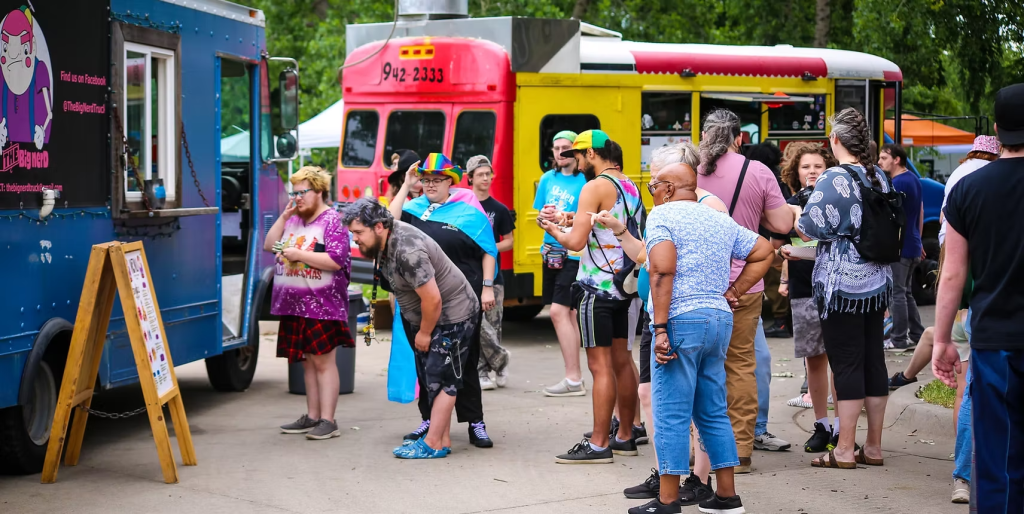
I think I posted about the Big Gay Market last year here on Scottie’s. It’s really cool, and it was Sunday 6/14 this year. It always makes me reminisce about, among other things, when I first came upon Scottie’s blog.
It was named “Scottie’s Toybox” at the time, with the same tagline, “Come See What I Share.” It sounded like Big Gay Fun to me, so I clicked through from MPS one time, and sure enough, there was a little big gay fun, a few resources for queer and other marginalized groups, and some issues on which people could take action if they cared to, along with a little general news. It was another time, it now seems. Anyway, Scottie transitioned to Playtime not as long a while back, I think due to Word Press anomalies, or something. I may not recall that correctly; I was a reader/sometime commenter, and it was nice. The Big Gay Market always reminds me of that, and I smile! 🏳🌈
Because of some election results and the associated removal of rights from, well, about everyone, but everyone isn’t as unsafe as those who are marginalized; and the scope of the blog has changed as well.
But on Big Gay Market day, I like to post about it. I bet everyone has a bright spot like this by them, and I know Scottie and I would like to know about those, too! Below is a report about, then the home page of Wichita’s Big Gay Market. Relax and enjoy!
A news report/interview from our local CBS affiliate.
(I dislike this channel, for its owner is an evil corporation and they’ve dumbed things down significantly, but as far as Google knows, they’re the only channel who has covered the Big Gay Market this year. For the record, I saw a short report on our local NBC affiliate at 5 PM, too, but can’t find it online Sunday evening. You can watch/listen on the page; it’s a short interview with the founder.)
ICT Big Gay Market returns for its 5th year in Wichita
WICHITA, Kan. (KWCH) – The 5th Annual ICT Big Gay Market returns Sunday, June 14, bringing a full day of vendors, food and family-friendly activities to Central Riverside Park. Organizer and founder James Boyd says the event is designed to feel like a “huge farmers market” that is welcoming to all ages and packed with things to see, taste, and shop, with nearly 150 vendors expected this year.
Admission is free, but attendees can choose to purchase a Market button. You do not need a button to attend, but some vendors will offer special discounts to button holders. Button proceeds go toward a $2,000 Trades Scholarship through WSU; once that goal is reached, remaining funds will help support next year’s market.
Event details
- What: 5th Annual ICT Big Gay Market
- When: 9:00 a.m. – 4:00 p.m. Sunday, June 14
- Where: Central Riverside Park, 720 North Nims St., Wichita
- Cost: Free to attend (optional Market button available)
Copyright 2026 KWCH. All rights reserved. To report a correction or typo, please email news@kwch.com
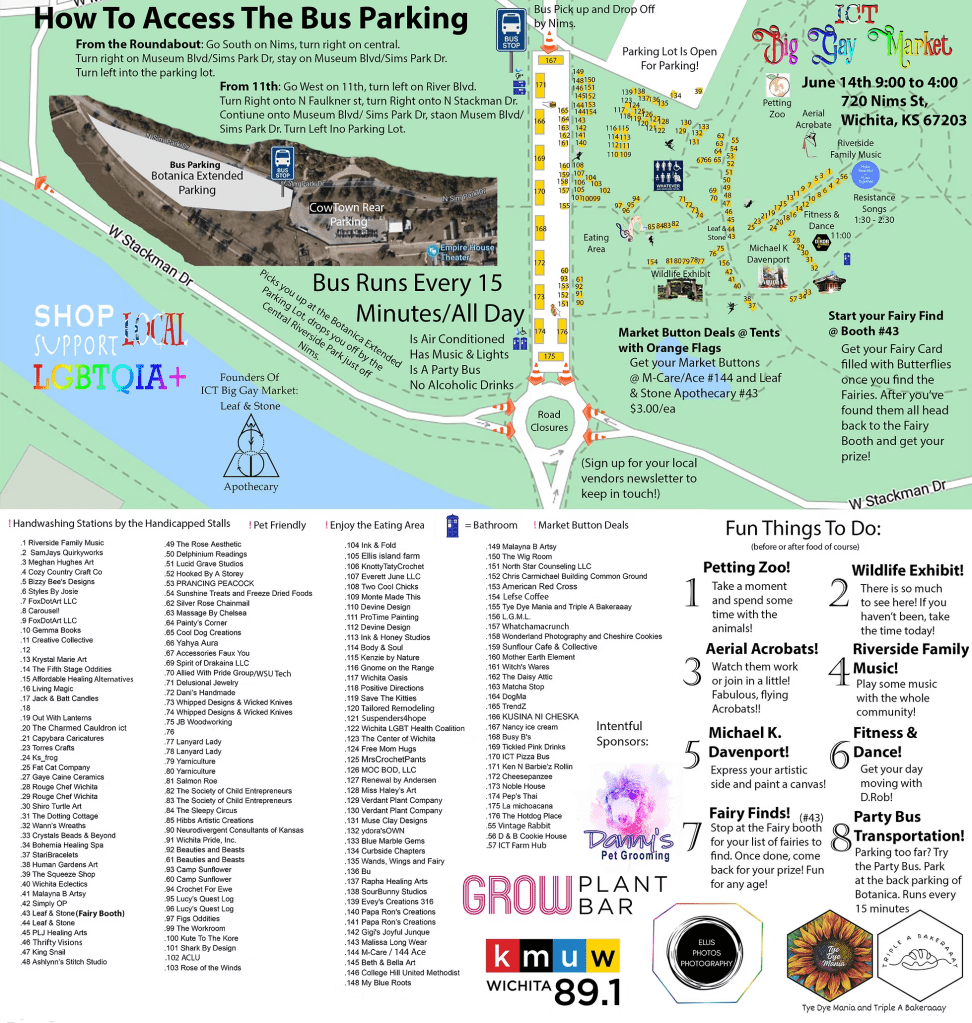
Central Riverside Park June 14th 9:am to 4:pm
720 North Nims st Wichita, KS 67203
A Community of Makers
No Entry Fee Required !
Wether your looking for a day out and a meal, some shopping or chilling to local music this can be a fun time for everyone! Local creators from all around Wichita have come together to show support to our local LGBTQ community!
2026 has come so quickly it’s hard to believe we are celebrating our 5th season of ICT Big Gay Market!

Jeff & James put together a community scholarship that supports the futures of soon to be students at WSU TECH! Our goal is to help one person with a $2,000.00 boost to their passion. We all help out where we can, you can donate to this scholarship here:
Republicans block dffort to bar federal troops from polling places causing concern
This Elephant Is All Of Us
Open Windows, Clay Jones
Don’t Cry For Me, MAGAtina
Trump’s name has been removed from the Kennedy Center… we think
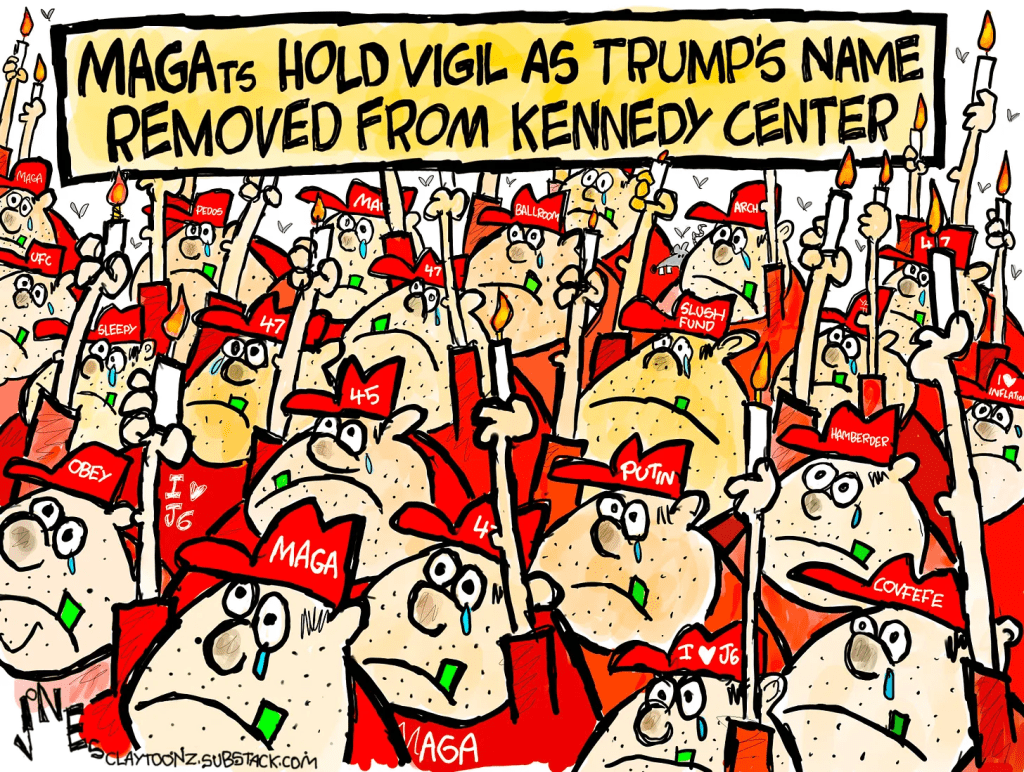
As MAGAts roam about Washington, DC today amidst all the hoopla for Donald Trump’s huge, giant UFC birthday party tomorrow, which he is using to desecrate the White House South lawn, his name has been removed from the Kennedy Center, thus making the city look a little less like Pyongyang.
Trump has been on a warpath to put his face and name all over Washington, DC. Banners hang in front of federal agencies, bearing his face as though he were Chairman Mao. One of the landmarks he was insistent upon desecrating is the Kennedy Center. (snip-MORE)
The fight America wants to see
A KO to end Trump’s political career

Claytoonz
199+
Courtside Celebrities
Did you suffer from courtside celebrity overload while watching the New York Knicks during the NBA finals?
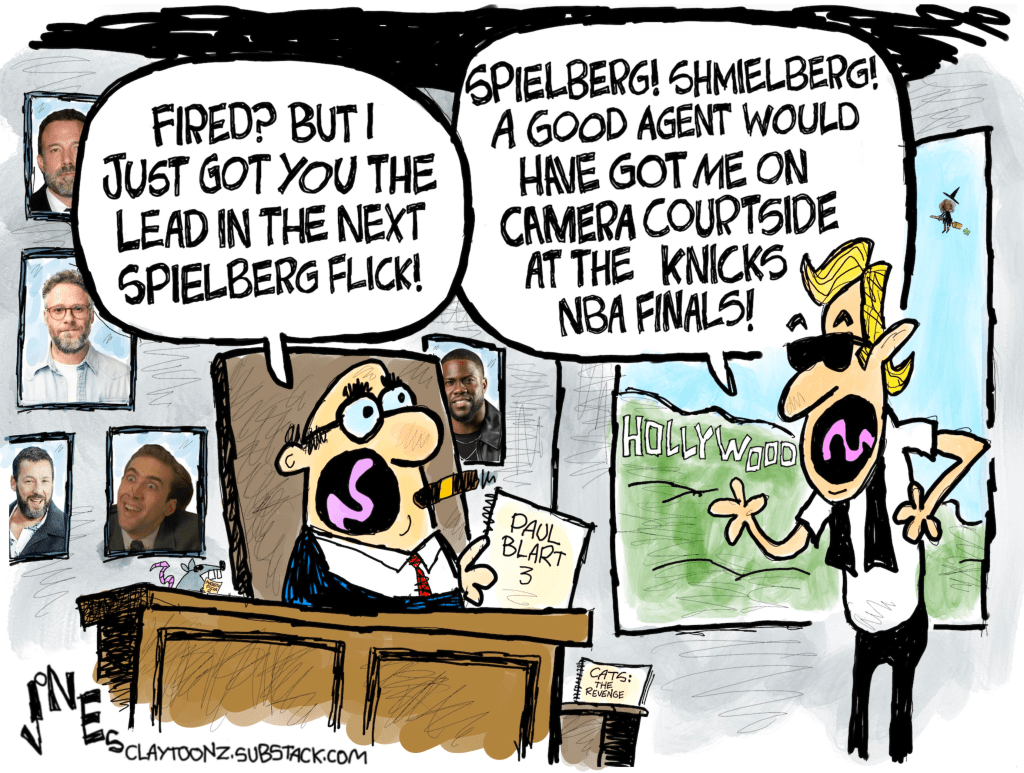
There have always been celebrities courtside during basketball games for the Los Angeles Lakers and the New York Knicks. For other teams, like the Oklahoma City Thunder, not so much. New York and Los Angeles are homes to thousands of celebrities. No matter the sport, you’re going to see some celebrities. And the bigger the game, the more celebrities we will see. And when the New York Knicks hosted their first NBA finals since 1999 this week, there were dozens of celebrities in attendance.
Just off the top of my head, we saw Larry David, Jerry, Seinfeld, Tracy Morgan, Ben Stiller, Taylor Swift, and of course, Spike Lee, who I believe is at every Knicks game, whether it’s important or not. Of course, some celebrities care more about being seen than they actually care about the game, and they end up falling asleep, like Donald Trump did last Tuesday night. Apparently, we traded Trump for Taylor Swift for Thursday’s game, which most would say is an upgrade. (snip-MORE)
Especially For Scottie, Because He
especially loves when Riley Gaines catches heck, especially with a bonus of Nancy Mace!
Nancy Mace Is The Riley Gaines Of Swimming Toward The South Carolina Governor’s Mansion!
Doktor Zoom
In the latest round of primary elections, voters in four states chose candidates for the November general elections, and something something national consequences, something something Donald Trump’s continued clammy grip on the Republican Party, yadda yadda. Primaries were held Tuesday in Maine, South Carolina, Nevada, and North Dakota. And in California, vote counting in last week’s primary for governor was complete enough that Republican Steve Hilton, a former Fox News host, secured the second spot in the at-large gubernatorial primary, so it’ll be him and Democrat Xavier Becerra facing each other in November. Funny how Democrats somehow only frauded up the LA mayor’s race, while the very same vote count process put Hilton on the ballot.
One might even think the cries of fraud were complete bullshit!
(snip-we know about Maine. Lets get Dems elected to our legislature!! Click through if you wish to read it, though.)
South Carolina: Nancy Mace Out, Lindsey Graham Persists Like A Bad Odor
In the Palmetto State, Rep. James Clyburn (D) easily won his primary and is likely to hold the seat, for an 18th term in the House. Clyburn benefited from the Republican-dominated state Lege’s decision to not join the rest of the former Confederacy in redrawing every last majority-Black congressional district out of existence this year.
But before you get carried away and accuse South Carolina Republicans of having a fit of decency or ethics, several top Goopers in the Lege said last month they opposed redistricting because early voting was already underway for this very primary. Still, that’s better than Louisiana, slightly, in the voting rights race to the bottom. For this year.
The really big outcome from South Carolina was that Rep. Nancy Mace, of the House Republican Batshit Awful Caucus, finished fifth — dead last — in the state’s gubernatorial primary. After this year, she’s both out of Congress and maybe even out of elected office forever, though here we note that the evil baddies in slasher flicks never seem to stay dead, either.
True to hateful bigoted form, Mace was an asshole right up to the final days of the primary, pandering to xenophobes by introducing a constitutional amendment that would ban naturalized citizens from serving in Congress, serving as federal judges, or serving in any position requiring Senate confirmation. She insisted that three of her Democratic colleagues in the House — Reps. Ilhan Omar (Minnesota), Shri Thanedar (Michigan), and Pramila Jayapal (Washington) — are “all making clear every single day their loyalty is not to America.” Jesus, what a vile person.
While campaigning in Greenville County earlier this month, Mace screeched, “I didn’t come out of a slum in India. I am born and made here in America.” Gosh, we sure feel bad about Trump turning against her after she called for releasing the Epstein Files.
Trump’s endorsed GOP candidate in the governor’s primary, Lt. Gov. Pamela “not Nancy Mace” Evette, wasn’t able to get enough votes to secure the nomination outright, and will go up against state Attorney General Alan Wilson in a runoff on June 23. Mace endorsed Wilson, probably out of spite, although last year she had attacked Wilson, baselessly claiming he was protecting defendants accused of child sex abuse.
Always being very mature, after Trump endorsed Evette, Mace immediately went to Twitter and Facebook to lie about it in an attempt to gaslight voters.
“Pamela Evette is NOT ENDORSED by DONALD TRUMP,” Mace wrote, incorrectly. “Do not believe her LIES.” Mace posted an AI-generated image of herself posing with Trump.
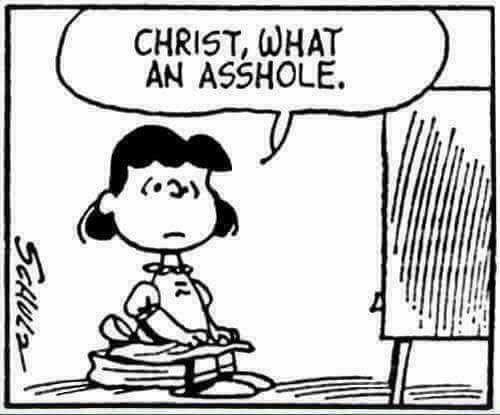
Oh, and speaking of assholes, Lindsey Graham easily fended off a primary challenge from self-funded business guy Mark Lynch, clearing the 50-percent threshold to avoid a runoff with 56 percent of the primary vote. Trump had unironically warned that it’d be a “DISASTER for the Republican Party” if Lynch won, which, hmmm, sounds vaguely familiar to something we heard a decade ago … what was that?
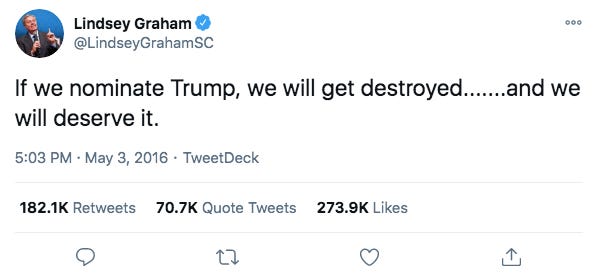
Oh yeah, that.
In the Democratic primary for Senate, Dr. Annie Andrews, who we like a hell of a lot, won the chance to run a long-shot bid against Graham. It’s a weird year, but probably not weird enough to dislodge Graham from the seat he’s clinging to like a goddamn candiru fish.
(snip; MORE re NV and ND; click on through! I wanted to cheer everyone with Nancy Mace being called the Riley Gaines of her election.)
PRIDE On Friday

Politics almost broke them. Instead, they found power in community.
Mo Turner — queer, Muslim and Black — faced discrimination and censure in the Oklahoma legislature. They have found healing through activism.
This story was originally reported by Orion Rummler of The 19th. Meet Orion and read more of their reporting on gender, politics and policy.
Mo Turner doesn’t often think about their time in the Oklahoma House of Representatives.
In that building, they were Mauree — the first out nonbinary state legislator in United States history; the first Muslim elected in Oklahoma; a Black, queer, gender non-conforming lawmaker in one of the most conservative states in the country. Elected at 27 to represent House District 88, which includes much of Oklahoma City, they stepped into a political institution that had never belonged to someone like them before.
The job almost broke them. Turner left office in November 2024, four years into their tenure, after the work took a toll on their health. They are still recovering.
“I spent January 2026 walking. And weeping. And reading,” Turner said. After the legislature took over their life, they had to find a way back to who they were before a national spotlight brought constant harassment, abuse and stress. They’ve found solace in a particular song near the end of the Hamilton musical, when the eponymous founding father takes long, quiet walks after losing his son and stepping away from politics.
Turner’s own walks can go on for three hours.
If there’s one lesson Turner took from their time at the statehouse, it’s that politics won’t help communities. People will.

“I want people to understand that policy is not coming to save you,” they said. “We get justice, we get faith, we get warm meals, we get community right here when we start talking to folks.”
Although the United States is a representative democracy, our political system still rejects anyone who strays too far from the norm. Turner’s story shows how far from equal the nation’s politics still are — and how being an out LGBTQ+ elected official today is just as revolutionary as it was five decades ago.
The violence holding democracy back
Elaine Noble was the first openly LGBTQ+ person ever elected to a state legislature, serving two terms in the Massachusetts House of Representatives in the 1970s. She described the campaign as ugly: her car was destroyed, her windows were shot through, her headquarters were vandalized. The harassment she received from colleagues in the statehouse was ugly, too. She routinely heard obscene profanities. Once, someone left human feces on her desk. Another time, a man stopped her as she walked to work and spat on her.
These are not just scenes from a distant past. Political violence against LGBTQ+ candidates is rising, according to a new report from the Victory Institute. Many LGBTQ+ candidates who ran for office between 2023 and 2025 experienced death threats on the trail. One candidate said their house was shot up by a neighbor. Another said that someone posted in a local newspaper’s online thread that a bullet should be put through their brain. Another candidate was shoved off a porch while door-knocking.
Some LGBTQ+ candidates receive death threats on social media at least once a week, according to the Victory Institute. A number of them respond to those threats by limiting voter engagement. Some avoid door-knocking and social media. Others decline public events entirely.

Rising violence against LGBTQ+ candidates doesn’t just scar candidates; it scars democracy, according to the authors of the report.
“This is changing who feels able to run for office, how candidates are showing up in their campaigns, whether they can even remain in public life at all,” said Pooja Prabhakaran, director of elected and appointed officials engagement at the LGBTQ+ Victory Institute. “The broader piece of it is, who is able to serve and participate in democracy?”
Death threats against Turner began as soon as they entered office. They received voicemails filled with racial slurs and obscene emails targeting their religion and LGBTQ+ identity. As a freshman lawmaker, they were surprised to learn that not everyone was treated that way. They thought death threats were commonplace.
Turner has dealt with harassment on a larger scale than many other LGBTQ+ candidates do, Prabhakaran said. For other trans people or LGBTQ+ people of color who consider running for office, there is a chilling effect: Do they want to be subjected to the same treatment?
Threats against Turner escalated after they were censured by the Oklahoma House of Representatives in 2023, during their second term. They were accused by the Republican leadership of “harboring a fugitive” — a trans person who went to the statehouse with their partner to protest a bill that would ban gender-affirming care for minors.
At the protest, the couple got into a scuffle with a state trooper after one of them threw water at a state representative. One was arrested. The other sought out Turner’s office.

“This person’s spouse was just arrested. They came to my office to process. That’s what happened,” Turner told The 19th at the time, in 2023. “I let folks get their affairs in order, because everyone was in agreeance that they were going to go ahead and turn themselves over.”
Democrats said Turner cooperated with law enforcement during the search for the protester. Still, they were punished. Republicans asked Turner for a formal apology in exchange for keeping their committee assignments. They declined.
“I think an apology for loving the people of Oklahoma is something that I cannot do,” they said at a press conference following the censure.
Many constituents already saw Turner as a trusted confidant. People would call to ask where they should move to escape anti-LGBTQ+ laws and how to crowdfund to help someone travel for an abortion. As politics restricted daily life, more and more people came to Turner for help.
Now, after earning that trust, they were silenced. They couldn’t shape legislation through committees or join caucus discussions to speak on behalf of voters in their district.
The threatening calls and emails got worse.
Some political violence is based on a candidate’s beliefs. Some of it is driven by a desire to intimidate them out of politics altogether because of their identity. Those who challenge the status quo often face the most backlash, said Kelly Dittmar, director of research at the Center for American Women and Politics at Rutgers University. And those conditions don’t just stop once someone gets into office, she said.
“I can have an elected position, but my power in that position is very much influenced by all of these other dynamics that are not formalized,” Dittmar said. There’s a difference between politics as usual within a two-party system, where everyone jockeys for influence, and being seen as a threat for being different or a minority, she said.
Hostile territory
In 2023, Oklahoma lawmakers introduced 35 anti-LGBTQ+ bills, according to the American Civil Liberties Union (ACLU) — a lot more than most other states at the time. They passed laws enabling broad discrimination against trans people and restricting young students from learning about LGBTQ+ people. Inside the statehouse, Turner felt demoralized.
The next year, their Republican colleagues introduced 55 anti-LGBTQ+ bills. Oklahoma already had few legal protections for LGBTQ+ people, and things only got worse.
“I’m going into a job that doesn’t care about me in a state that it feels like doesn’t care about me,” they said, reflecting on how they felt at the time.
Still, Turner was making an impact. As the first out transgender lawmaker in Oklahoma’s statehouse, they inspired young people. Students told Turner that they had never cared about politics until seeing them in office. High school and middle school students would approach them in the capitol to ask questions about their tenure for class reports.
They represented more than just House District 88. They represented younger generations of queer people in Oklahoma and beyond. Turner felt the weight of the responsibility. That’s what made it so hard for them to leave.
Turner found an ally in then-Rep. Monroe Nichols, a Democrat who now serves as the first Black mayor of Tulsa. Nichols was the only one who seemed to genuinely care that Turner was receiving death threats. He was the only one who made them feel human.
“I do think that there was solidarity in him being a Black man from Tulsa of all places, understanding what it looked like to feel discrimination or oppression,” Turner said.

Once Turner took office, there were eight Black legislators in the Oklahoma statehouse — a record. Currently, there are six. Most politicians in the building are White. The status quo of power in Oklahoma is very much White, cisgender, heterosexual and male, said Dittmar of Rutgers University. And those who break that mold are seen by others as a threat, she said.
Then there’s this: In a state like Oklahoma, Democrats have very little leverage. On top of the low pay and high stress, there’s a small chance of achieving any concrete policy wins. Republicans sponsor most state laws because 80 percent of the lawmakers are Republicans. Barely any bill passes without Republican support. Being in the minority party means taking on the steep personal costs of being in office in exchange for little payoff.
Toward the end of those four long years, Turner didn’t feel like a good legislator anymore. In their words, they were phoning it in. Although they did spark a committee hearing on repealing the state’s HIV criminalization law, none of their bills advanced.
Turner would frequently sit in their car in the parking lot before work, trying to breathe through the rising panic and find the will to go inside. Walking into the statehouse each day was taking a deep toll on them.
The stress grew until they landed in the emergency room. At the beginning of their last legislative session, they were diagnosed with multiple sclerosis and underwent a procedure to have cancerous cells removed from their body. That health scare followed bouts of migraines, panic attacks and depression.
As their health cratered, they felt alone. After their visit to the emergency room, none of their colleagues checked to see how they were doing.
Turner knew something had to change. They were worried for their nephew, Anthony, whom they are raising on their own. While juggling their job and all the harassment that came with it, they were setting up daycare and school drop-offs — everything that comes with being a single parent. Sometimes, Anthony would join them on the House floor if work ran late. But they had to leave by 7 p.m. to make it home at a reasonable time for dinner, bath and bedtime.
“I remember one day thinking, I would like to see him grow up,” they said.
So they left. They walked away from politics.
“It was a tough decision to make because I know that representation matters. And some days, me just showing up to work is the representation that people need,” they said.
This is the passion that still fuels Turner: showing up for Oklahomans and showing up for young LGBTQ+ people who don’t feel heard by their elected representatives.
What real change looks like
In March, Turner went back to the statehouse to help a friend, the executive director at Freedom Oklahoma,a state LGBTQ+ advocacy group, monitor anti-trans bills. But the building is still full of red tape: Initially, they were barred from entering the gallery by statehouse security. The experience became a reminder of why they left.
To actually make change in their community, Turner knew they would have to work outside of politics.
Here’s how: They’re working with the immigrant advocacy group Dream Action Oklahoma, making and distributing zines on how bystanders can intervene when Immigration and Customs Enforcement agents are out making arrests. They help serve community breakfast with the Foundation for Liberating Minds, a Black-led abolitionist group based in Oklahoma. And in their new job, they get to work with LGBTQ+ students from across the country.
Turner is the director of public policy and advocacy at GLISTEN, a national nonprofit that lobbies for LGBTQ+ students. They’re working to expand GLISTEN’s National Student Council, a leadership program for high schoolers. They’re working on the curriculum for that program and thinking about how these students want to grow. Many of them want to become activists, or already are. These students represent a future that is rapidly changing, regardless of how many anti-LGBTQ+ laws are passed; more and more young people are identifying as queer and trans.

Working with students is a bright spot for Turner. Their organization is asking LGBTQ+ students about their experiences, their school policies and what they think needs to be different. And amid so much anti-LGBTQ+ hostility in politics, kids are making it clear that they’re ready to make change on their own terms.
“Youth aren’t just saying, ‘Oh, god, policy is so bad, whatever.’ They’re saying, ‘No, maybe I will run for office. Or ‘I’ll work on my friend’s campaign.’ They’re being outspoken,” Turner said. “Our power lies in the streets, outside of any state legislature, and it always will.”
Turner doesn’t think they will ever go back to politics. But that doesn’t mean they’ve stopped paying attention. They still keep tabs on bills moving through Oklahoma’s legislature. Lately, they said, things have been going from bad to worse.
The legislature just passed a law to create criminal penalties for providing gender-affirming care to minors and adults. No public funds or property may be used to provide the care, which threatens state university hospitals. The state Medicaid program will also no longer cover gender-affirming care for any patients.
This bill is just another step in stripping health care from all Oklahomans, Turner said. They want people to respond to laws like this by doing more than signing a petition or calling their local reps. They can reach out directly to state agencies, donate to local healthcare fundraisers or just talk to their neighbors.
“When the government fails us, what do we have?” they said. For Turner, the answer is clear: community.
In a way, Turner has returned to their home turf as an activist. Before elected office, Turner worked with local branches of the ACLU, the NAACP and the Council on American-Islamic Relations. They learned the ways of the statehouse and now they know how to push for change outside.
And they don’t plan on leaving the state or their community in House District 88. Their brother went to college in this district. They worked an internship here. They met friends at Picasso Cafe and The Red Cup and had first kisses at local bars. Oklahoma City feels like such a queer place to them, and they have fallen in love with it.
“This is my home. I love it,” they said. “I’m going to stay and fight.”
Susan Collins, Short & Sweet
(Normally, I hold with the idea of not giving a candidate’s opposition name-advertising, but it is a strategy that can work if one of our own candidates are getting dragged through the mud. Platner’s not the first. Keep it short, sweet, and truthful, like this.)

