Definite beverage alert, though it may be choking rather than laughing.
We all knew it was inevitable: the MAGA conspiracy set is knee-deep in transvestigating Charlie Kirk and his widow, Erika Kirk.
For the blissfully offline (oh, how we envy you), “transvestigation” is a transphobic conspiracy theory advanced over the past eight years, adherents to which believe countless celebrities, politicians, and other public figures are secretly transgender. The conspiracy usually involves armchair phrenology, as believers overlay diagrams of skeletons and skulls over photographs to highlight alleged “discrepancies,” and pseudoscientific analyses of body language and posture. It’s abject nonsense that conveniently ties in with QAnon, “Pizzagate,” and other right-wing conspiracies — and nobody, not even far-right figureheads themselves, are safe from suspicion.
Transvestigators on social media started training their eyes on Erika Kirk roughly two months ago in mid-September, shortly after her husband, Turning Point USA cofounder Charlie Kirk, was shot and killed in Utah. (snip)
Comments on the post were somewhat divided, though many took Starbucs’ side. “Of course almost all models, especially agent models and Victoria secret models are mostly [trans women],” one wrote. Another simply called her a “filthy Luciferian.” Others cited a video Erika Kirk filmed over a decade ago, in which she described herself in childhood as a tomboy, as evidence that she was actually assigned male at birth. Some even took the opportunity to posthumously transvestigate Charlie Kirk as well; “that’s why Charlie Kirk seemed so feminine and emasculated because she was a transgender handler. That’s why he was so pretty,” one person wrote. (emphasis mine-A.) (snip-MORE-it’s not long)
Here’s what you need to know about Trump’s trans passport ban. By Quispe López
On November 6, the Supreme Court granted the State Department temporary permission to enforce the Trump administration’s passport ban, giving it authority to bar transgender, nonbinary, and intersex people from obtaining passports with gender markers that reflect their identity.
The decision reversed two previous injunctions ordered by lower courts, filed by the American Civil Liberties Union (ACLU) as a class action lawsuit against the State Department, Orr v. Trump, which temporarily prevented the Trump administration from enforcing its trans passport ban. The ban stems from an anti-trans executive order in which the Trump administration attempted to codify the legal definition of gender as biological sex determined “at conception.”
While the lawsuit was pending, the injunctions temporarily allowed trans, nonbinary, and intersex people to obtain passports, new or renewed, with the gender marker corresponding to their identity. Following the Supreme Court’s decision, which allows the State Department to enact the executive order while Orr v. Trump is debated, people who apply for a new or renewed passport will only be able to receive one with their sex assigned at birth. According to the ACLU, there is no guidance on what intersex people who might not have any documents with an F or M marker from around the time they were born should expect for their passports. (snip-MORE-also, not long)
November 14, 1910 Eugene Ely performed the first airplane takeoff from a ship. His Curtiss pusher flew from the deck of the U.S.S. Birmingham in Hampton Roads, Virginia.By January he would execute the first (takeoff and) landing on a warship, the U.S.S. Pennsylvania. Captain Washington I. Chambers of the Navy Department had been interested in the military uses for the seven-year-old invention. Naval flight training started shortly thereafter. More of the whole story.
November 14, 1954 “Ten Million Americans Mobilized for Justice” began a campaign to collect 10 million signatures on a petition urging the Senate not to censure Senator Joseph McCarthy (R-Wisconsin). The motion of censure against Senator McCarthy was for obstructing a Senate committee and for acting inexcusably and reprehensibly toward a U.S. soldier appearing before his own committee. McCarthy had used his Senate Permanent Investigations Subcommittee to publicly denounce thousands as subversive, especially within the federal government, many without any justification. The political views of most were painted as treasonable and conspiratorial, rather than differing political views. The petition effort fell about nine million signatures short. More on Joe McCarthy
November 14, 2000 Florida Secretary of State Katherine Harris, simultaneously co-chair of George W. Bush’s Florida presidential campaign organization and the public official responsible for the conduct of the election itself, certified Governor Bush’s fragile 300-vote lead over Vice President Al Gore in the 2000 presidential election. Katherine Harris Florida Judge Terry Lewis gave Harris the authority to accept or reject a follow-up manual recount from some counties where the count was open to question. Harris rejected the manual recounts.
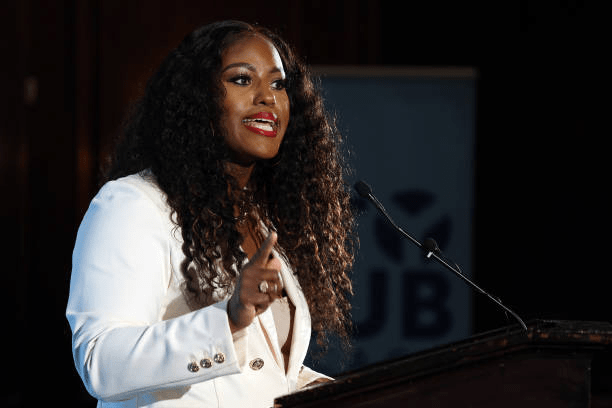
Chicago Teachers Union President Stacy Davis Gates speaks to the City Club of Chicago at Maggiano’s Banquets on Grand Avenue on Tuesday, March 5, 2024. (Terrence Antonio James/Chicago Tribune/Tribune News Service via Getty Images)
In the heart of Chicago, one Black woman has emerged as a powerhouse in the American labor movement: Stacy Davis Gates, President of the Chicago Teachers Union (CTU) and leader of the Illinois Federation of Teachers (IFT). At a time when public education, health care, and resources feel under siege, Davis Gates has positioned herself at the intersection of activism, advocacy, and community leadership — standing up to President Donald Trump’s political attacks by defending families and public education.
A steadfast advocate for Chicagoans, the union boss has her eyes set on the prosperity of Black residents in her city by any means necessary, leading a fearless charge against militarized operations including ICE and the National Guard — deployed under Trump’s direction. And since Chicago’s been targeted by the administration, Davis Gates hasn’t flinched in the face of terror. (snip-so much MORE-go read it; it’s not long)
Here’s the latest signature. This was done on my iPad, which was a little sad for me because I hadn’t used it in over a month. I had to reboot my Procreate program, and there was some lag. Don’t worry, baby. Daddy’s coming home.
A hard part about writing my signature is controlling my arm and applying pressure. Someone mentioned that I should strum one of my guitars as physical therapy, but I think there are better exercises. Plus, not being able to strum a guitar only makes me sad. It’s almost as sad as not being able to draw.
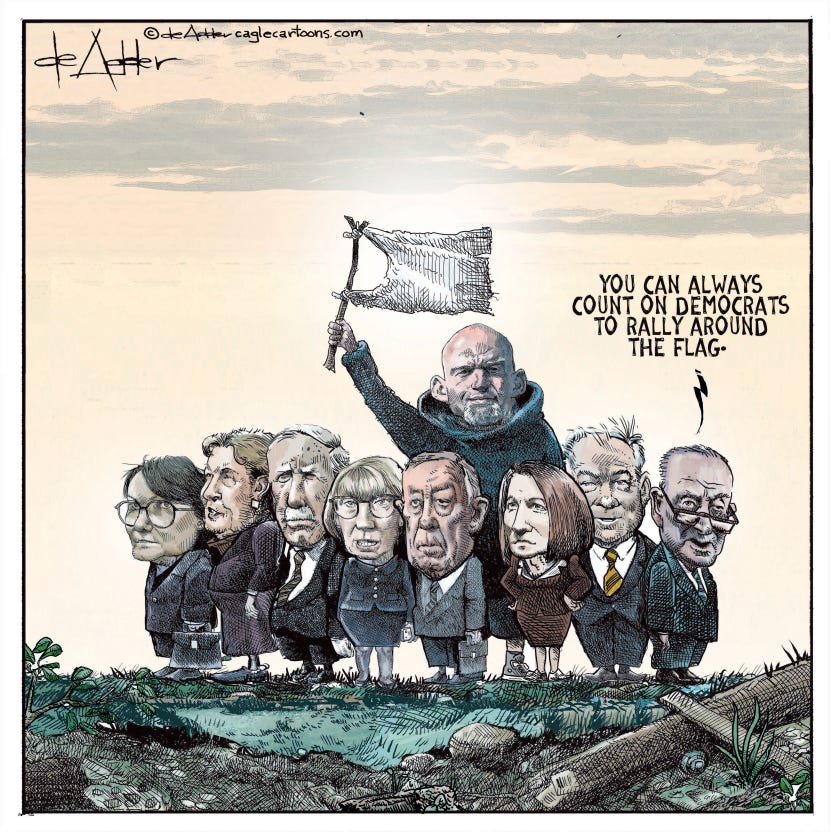
So why did six Democrats (one Independent and whatever the fuck Fetterman is) cave in on the government shutdown? They had just overwhelmingly won elections in New York City, New Jersey, and Virginia last week. The public was correctly blaming Donald Trump and Republicans for the shutdown. Proof of that was Donald Trump’s fight with courts to prevent snap benefits from feeding the hungry. Are Democrats upset over flight delays? Are they afraid Thanksgiving would be ruined? What did they get for rolling over?
Michael De Adder correctly has them surrendering.
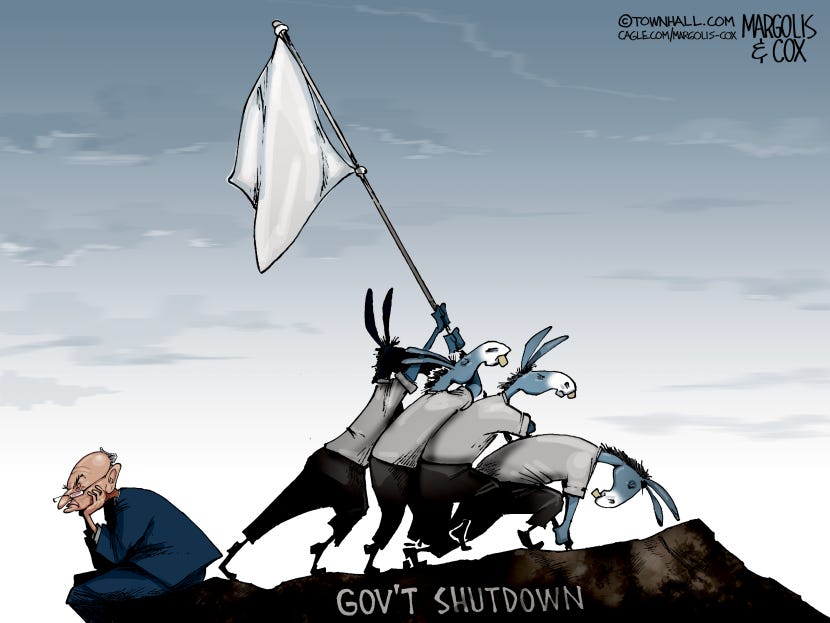
Fake cartoonists Margolis and Cox have them surrendering, too. I can’t tell what’s going on with the person in the left-hand corner because the artwork is so bad. Why didn’t they finish writing “government?” There is plenty of room.
In the new deal, SNAP and WIC will receive additional funding, and there are a few other modest concessions on spending levels elsewhere in the government. Laid-off federal workers will be rehired, and furloughed federal workers will be given back pay. But remember, this entire fight was over subsidies for the Affordable Care Act being suspended. In exchange for rolling over, Democrats got a promise from Republicans that there would be a vote on healthcare subsidies. Basically, Democrats got a promise from Republicans that they’ll think about it.
Ezra Klein, an opinion columnist for The New York Times, wrote,“This, in the end, is the calculation the defecting Senate Democrats are making: They don’t think a longer shutdown will cause Trump to cave. They just think it will cause more damage.”
I understand why Democrats may get that impression. Donald Trump is flying to Asia, playing golf, traveling to me MAGA-Lardo, going to football games for no fucking reason, and ramping up support to name the new stadium in Washington, DC after him, and it’s obvious he doesn’t care about people starving. So what does Trump care if the government shuts down? And what do Republicans care either? They’re all on vacation. Mike Johnson sent Republicans on vacation. They want Democrats to own the shutdown, but they’re not doing anything to end it.
It is especially frustrating because these Democrats have been in Washington, DC long enough to know better than to trust Republicans. I wouldn’t be surprised if Republicans never even hold a vote on the subsidies for the Affordable Care Act. I mean, House Republicans did not make this deal, so they don’t have to hold a vote on the subsidies. Only Senate Republicans have promised to hold a vote.
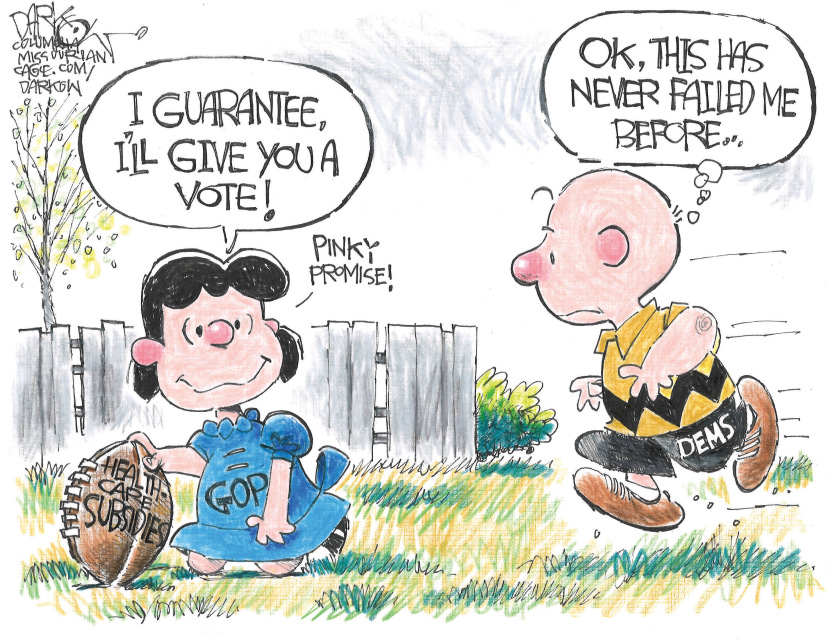
Kicking Lucy’s football is a lazy trope, but John Darkow has it right that Democrats are nothing but a bunch of suckers.
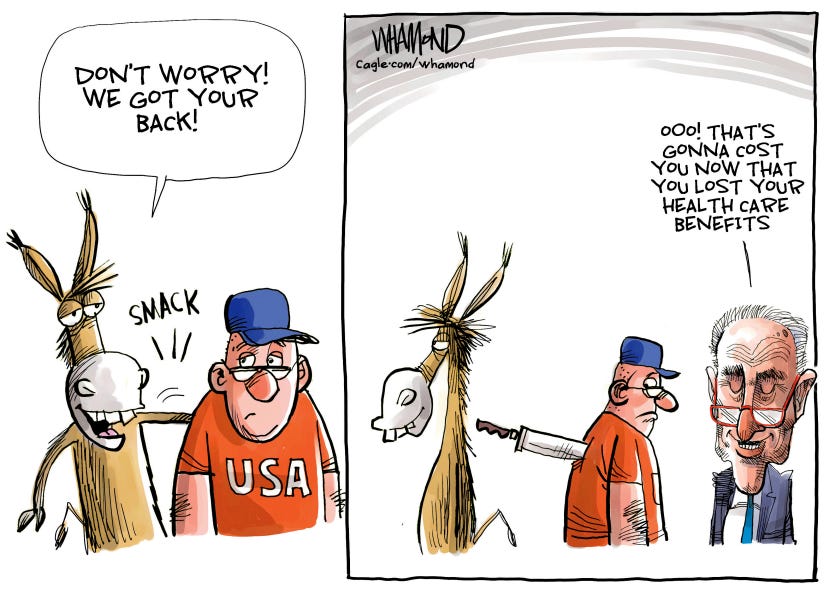
Chuck Schumer did not vote for this plan, but do you blame him as the Democratic Senate leader for it happening, as Dave Whamond has cartooned about here? Personally, whether Schumer deserves part of the blame or not, doesn’t matter in concerning his fate, as he has always been a weak leader.
Democrats have the view that Donald Trump is not caving, thus they’re caving into in without even negotiating. Are you telling me that Donald Trump’s strategy of not giving a fuck is working to sway Democrats?
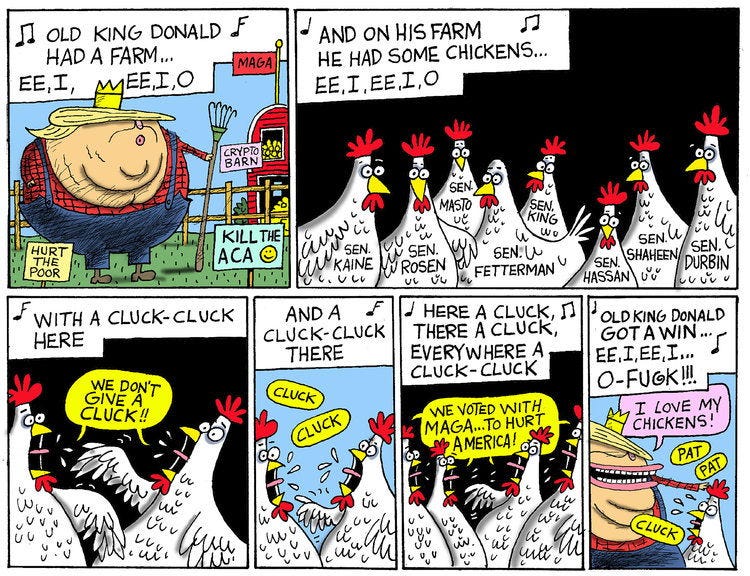
Chris Britt has it right that these eight are nothing but a bunch of chickens.
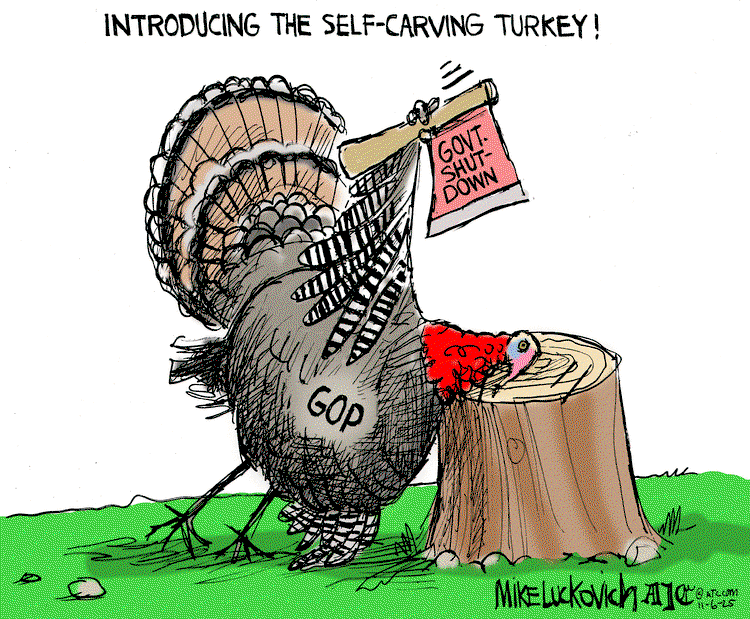
Mike Luckovich sure this cartoon last week or so, but now I believe it’s the Democrats, who are curving themselves up. If nothing else, they’re serving Obamacare up for the slaughter.
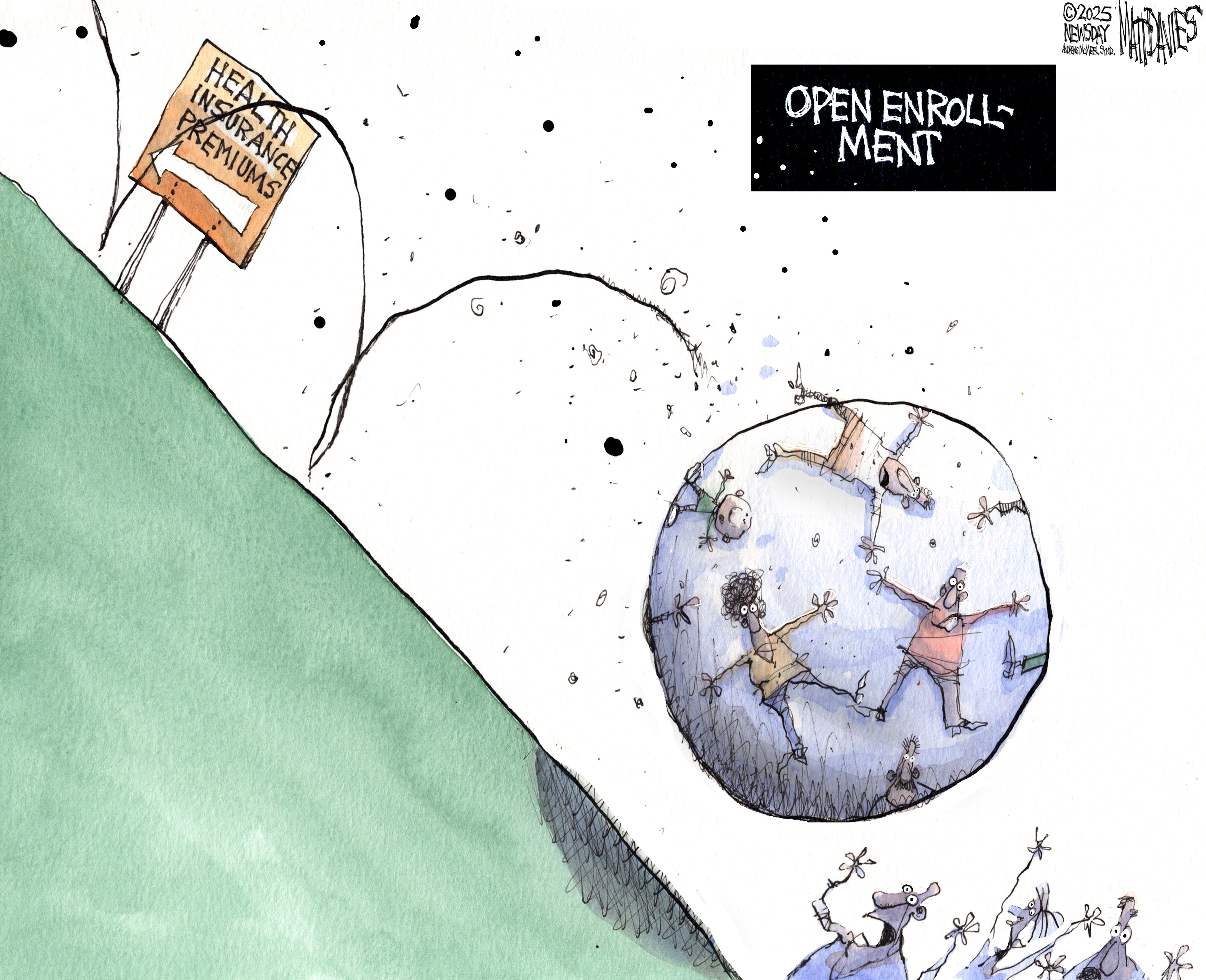
I don’t think anyone has explained the healthcare subsidy situation better than Matt Davies has. As someone who is benefiting from Obamacare and government subsidies, I feel like we’re getting rolled over.
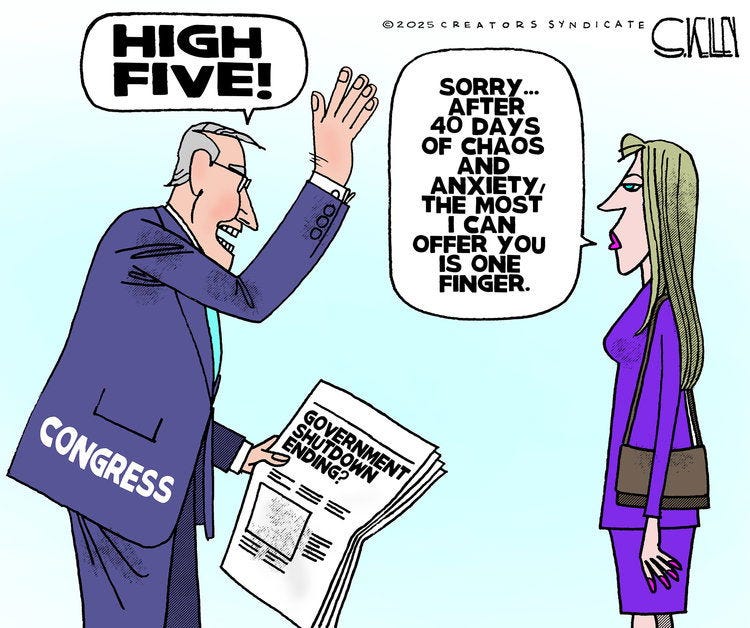
And Steve…
I know you get reprints when you don’t blame anyone specific, but it wasn’t just Congress that was responsible for the shutdown. Maybe someday you’ll be able to cartoon about issues after you understand them.
This was almost as cowardly as…
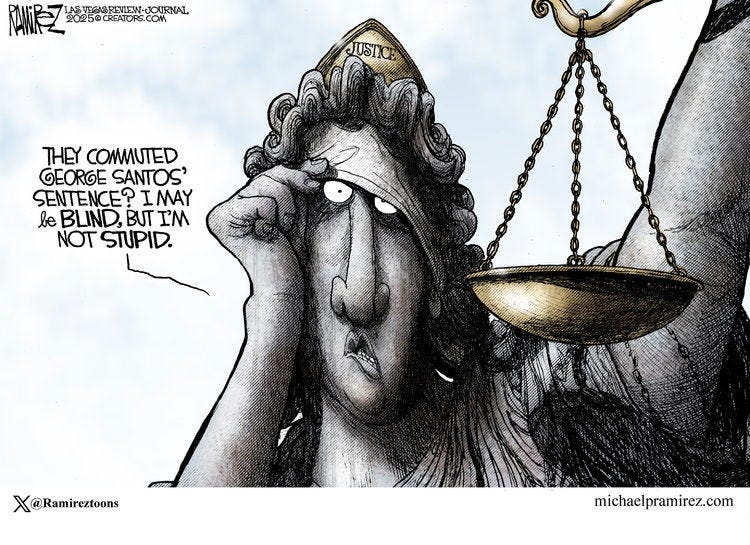
…when Ramirez was afraid to blame Donald Trump for pardoning George Santos. Seriously, Michael… “they” did not pardon George Santos. Only one person could have pardoned George Santos, and I don’t know if you know how the Constitution works, but it doesn’t say that person is “they.”
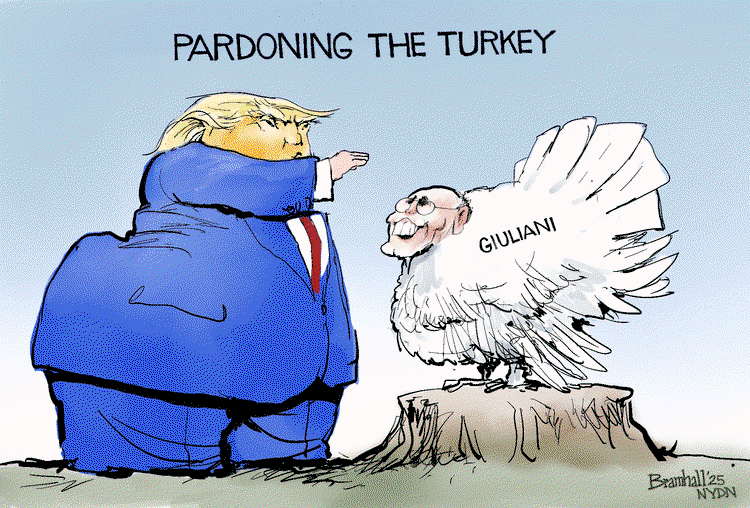
Was Rudy Giuliani guilty of trying to help Trump steal the 2020 election? Donald Trump thinks he is. That’s why he got a pardon this week. This isn’t like Joe Biden giving his son and Dr. Anthony Fauci pardons, Fauci being preemptive, because Donald Trump has proved those were necessary as he has turned the entire Justice Department into his personal attack dog, and is ordering it to go after his political enemies and seek revenge. But nobody was really going after Rudy on criminal charges in federal courts. A pardon does not save Rudy from paying out the civil judgment from the Georgia election workers any more than it stops his farts or black shoe dye from running down his skull.
Bill Bramhall, who was a couple of days after Lucko’s turkey, caught that this pardon was in the right season.
Along with Giuliani, Trump pardoned John Eastman, a corrupt lawyer who advised Trump’s 2020 campaign; Mark Meadows, the former White House chief of staff; Boris Epshteyn, a presidential adviser; and Sidney Powell, an insane lawyer who blamed conspiracy theories for Trump’s defeat to Joe Biden. None of these people has been charged in federal courts, though they have been charged in state courts. Trump’s pardons are only symbolic as they don’t protect his friends from state charges.
This is another example of Trump using the presidency to help himself and his friends and not the American people. This is what happens when a felon gets pardon powers.
I’m sick of the new normal, which includes pandering to a 79-year-old toddler. Part of this new normal is naming shit after Trump. There’s talk of renaming the Kennedy Center after Donald Trump. There’s talk of renaming the metro system in Washington, DC after Trump, the $1000 savings account for newborns is called the Trump account, lawmakers had proposed renaming Dulles International Airport after Trump, and now, Trump is demanding that the new football stadium on the old RFK Stadium site be named after him. Donald Trump didn’t have anything to do with securing the stadium deal any more than he did with ending the war between Hamas and Israel.
As for the Metro, a Republican introduced a bill that threatened to withhold federal funding for Washington’s rail system unless the name was changed to the Trump train. Why? There’s no fucking reason given for this fealty to Trump. Republicans want to hold funding hostage, not for any policies or improvement, but just to name the system after Donald Trump. I seriously doubt Donald Trump has ever taken a ride on the Metro.
As you may know from reading this blog, I love Subway systems. I use the Metro more than any other train system, and it’s one I know very well. I will take it as a personal insult if the name is officially changed to the fucking Trump Train. This will be an insult to the entire city of Washington, and no longtime resident of the city will ever refer to it as the goddamn Trump Train.
I have said it before, and I will say it again. This is some Saddam Hussein-level bullshit. Of course, Republicans don’t care about the optics anymore.
I’m very surprised the Supreme Court refused to revisit gay marriage. You know if zealots Clarence Thomas and Amy Coney Barrett had their way, they would try to overturn it the same way they did with Roe. Precedent doesn’t mean anything to the Supreme Court anymore. Neither does the Constitution nor the law. SCOTUS would rather go by the Old Testament than by the United States Constitution.
Donald Trump is promising tariff payments to middle-income Americans. He said, “We’re going to issue a dividend to our middle-income people and lower-income people of about $2,000. And we’re going to use the remaining tariffs to lower our debt.”
Two things: this contradicts his argument that tariffs are not taxes being paid by American consumers, and his tariffs aren’t bringing in enough revenue to give everyone $2,000. If you make Americans pay these tariff dividends from the budget, then aren’t Americans paying for the dividends just like they’re paying for the tariffs? Donald Trump doesn’t even have any details for this new plan. He thinks it’s magic money that’s going to appear out of thin air.
Donald Trump wants the tariffs to pay off the deficit. American consumers are paying the tariffs. Donald Trump wants to pay American consumers out of the debt for paying for the tariffs. You don’t need to be an economics major to know that this is madness.
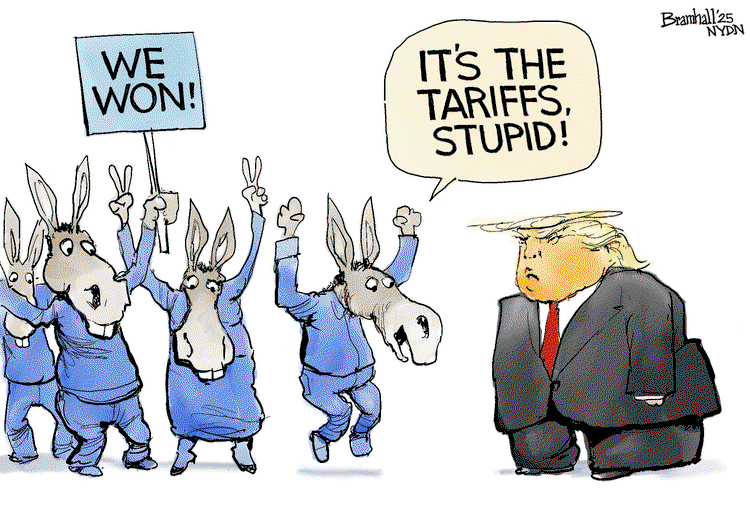
As Bill points out, it’s the tariff, stupid. If Democrats do come out winning over Trump’s tariff policy, I’m sure they will find a way to blow it.
Donald Trump is now demanding that the BBC apologize to him for editing part of a video of his speech before the January 6 attack, and to pay him lots of money, or he will sue them for $1 billion. This sounds like Dr. Evil threatening the BBC.
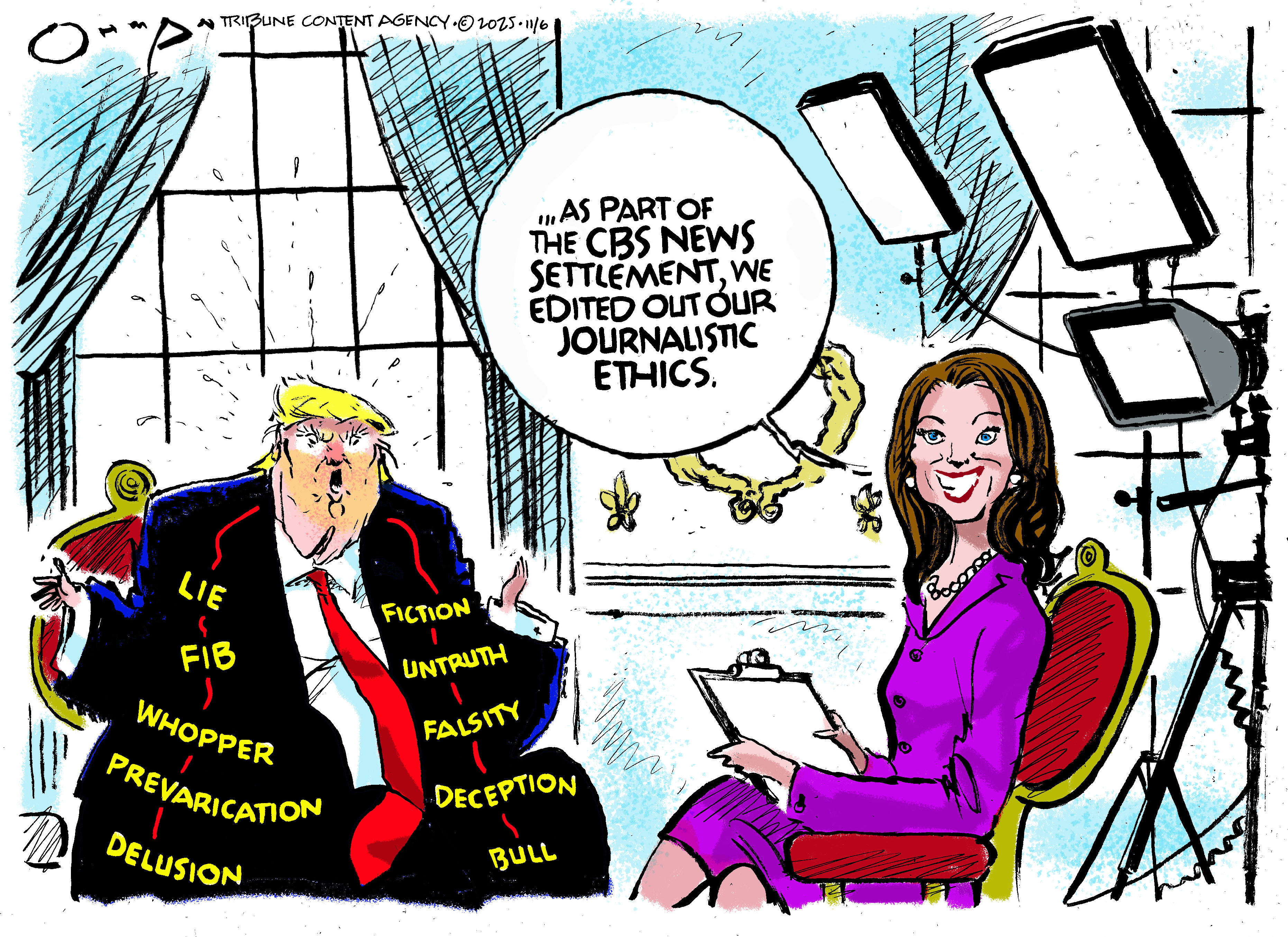
As Jack points out, ethics are lapsing with the American media. Now, when 60 Minutes interviews him (after CBS allowed him to bribe them), it’s about as ethical as when Fox News does not give him follow-up questions.
Trump believes the video made him sound more violent than he really was, ignoring that the attack on January 6 was violent and an attempt to overturn the 2020 election. But as usual, Donald Trump is demanding to be bribed. The American press has failed to stand firm against Donald Trump and his threats, so I hope the British press does not give in. I need to believe in something.
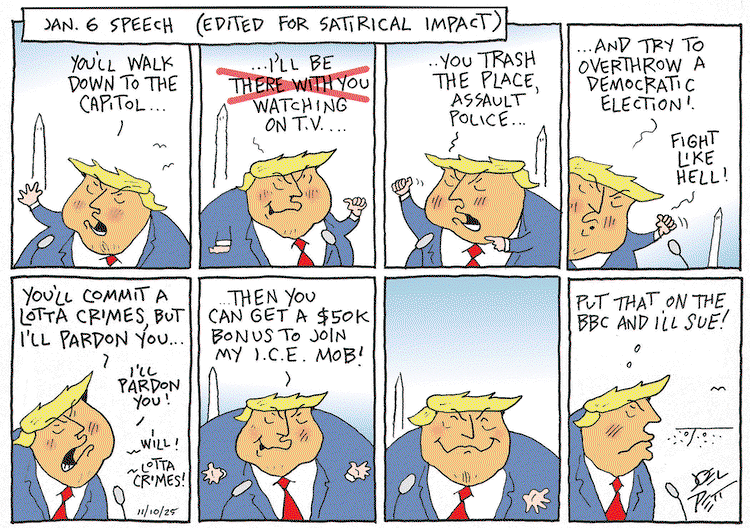
Joel Pett points out what Donald Trump wants edited out.
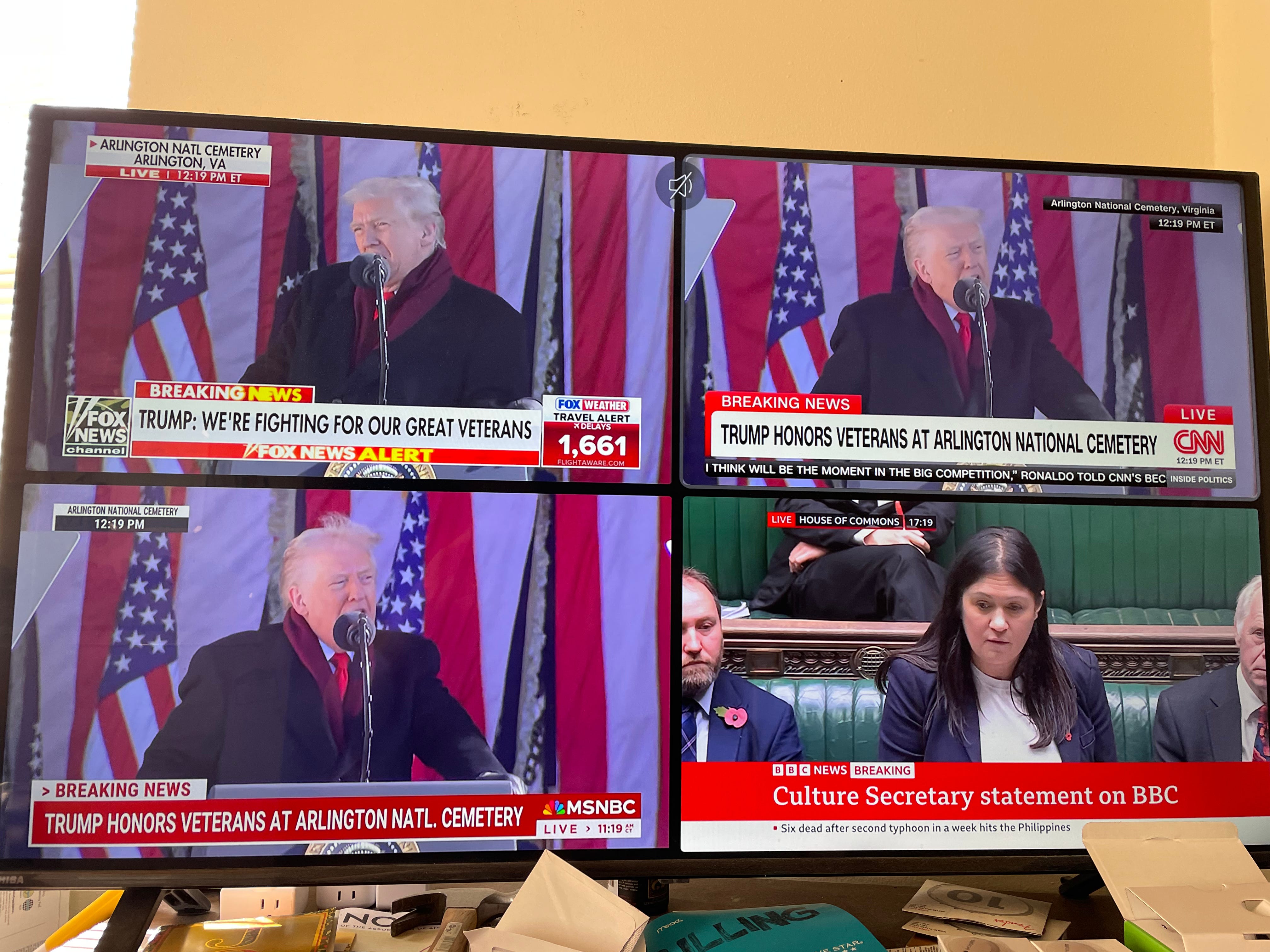
This is one reason why I like to have the BBC as one of the four channels in the multiview feature.
Have you heard of Mar-a-Lago face? Usually, people who have a little work done don’t want to advertise it. Most people lie about it when questioned. But now it seems that they’re all going the Kristi Noem route, and going for the Melania. Having your lips filled and being proud of it is very much a Palm Beach thing, but now it’s extending to Washington, DC. Now there are MAGAts in Washington who are having work done, and they’re proud of it. They want everyone to know, which means their faces look fucking stupid. It seems the facelift of Washington isn’t just going to be in the city. I guess collagen-filled lips are better for kissing Donald Trump’s ass with. Dammit, that’s a political cartoon.
If I see a bunch of Kristie Noems on the “Trump Train,” I’m going to lose my shit. Last June, during Trump’s birthday parade, I did tell some MAGAts on the metro to fuck Trump. A MAGAt’s right to free speech to wear that ugly cap on the Metro also applies to my free speech to tell them to go fuck themselves.
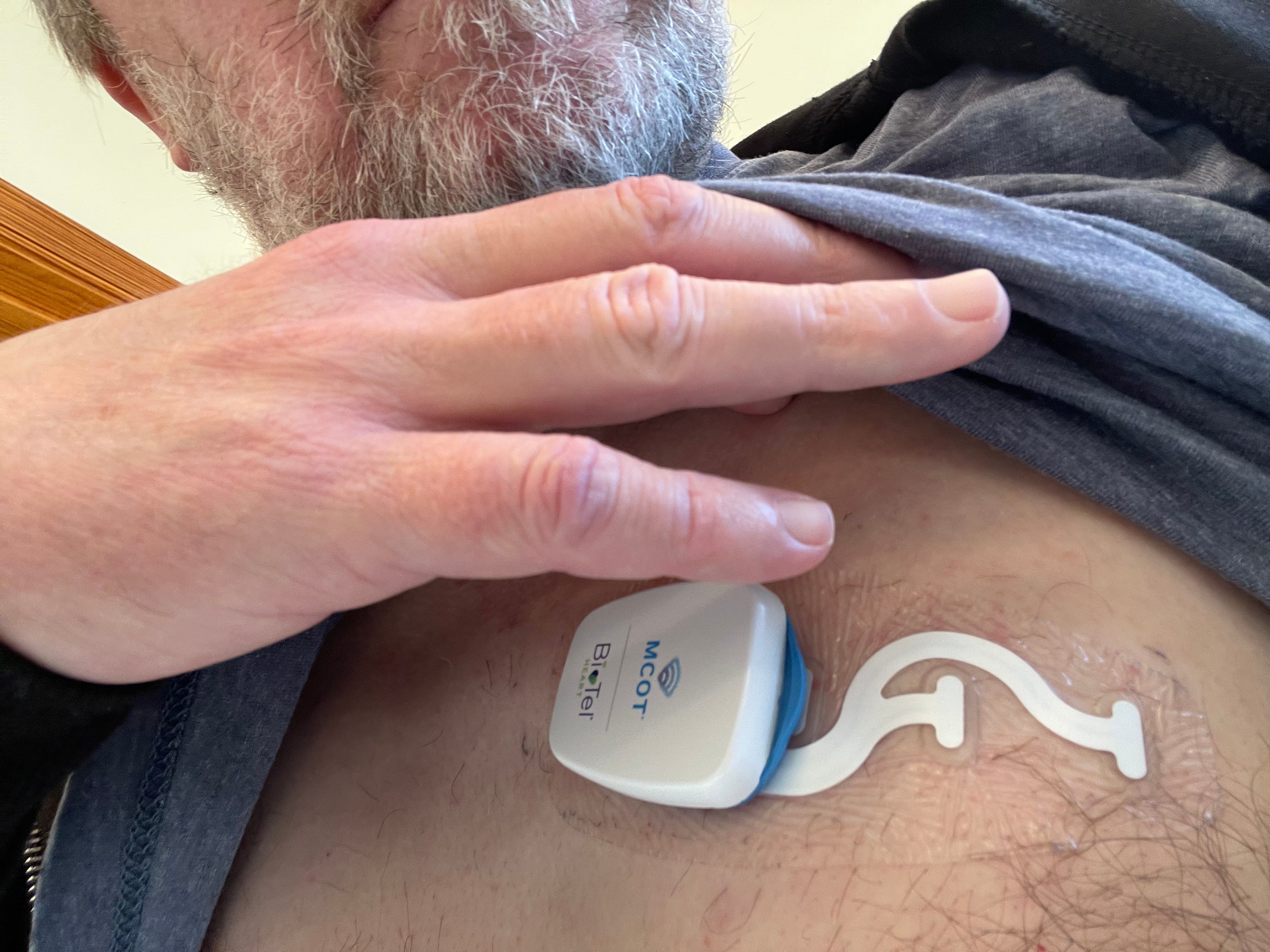
Let’s talk about some stroke stuff. I am currently wearing a temporary heart sensor. I hate it. Since I got out of the hospital, it’s been the bane of my existence.
The shutdown is over.Well, not officially, but it’s over. Seven Democrats and a Dem-caucusing independent caved, providing Republicans with the eight votes necessary to shove through a funding bill that will eventually reopen the government.
Once again, Republicans’ will to do the wrong thing was greater than Democrats’ to do the right thing.
Amazing how often that happens. With Medicare-for-all. With Senate representation for Puerto Rico and D.C. With revamping the U.S. Supreme Court. With simply seating a properly nominated Supreme Court justice.
Every single time, when the fight got hard, there were just enough Democrats willing to tuck tail and run to give Republicans another win. Just enough Democrats willing to believe that this time the GOP Lucys won’t move the football.
It’s coming again, sure as you’re reading this.
There will be no negotiation over Affordable Care Act subsidies—the lone concession that Democrats received for their spineless fold. Anyone with a working brain can see the end of this thing.
Republicans are going to renege. There’s going to be shock and outrage. Republicans and their media partners will not care. They’ll spin it in the dumbest possible way. Four million Americans will lose health care coverage. The costs of insurance premiums will go up substantially for all of us.
It’ll probably end up being Obama’s fault somehow.
Because this is how bad the Democrats are at messaging. Even when every single fact is on their side—and the facts were decidedly on their side—they can’t even get their own caucus to buy in.
I want you to consider what was happening. Take a step back. Consider all of the facts. And behold the breathtaking failure that the Democrats snatched from the jaws of accomplishment.
You have a country that is extremely angry with its current president, because that guy has failed to do anything that he promised he was going to do. (Probably because he lacks both the intelligence and the will to do any of those things.) This guy, whose policies have driven up prices and bankrupted American farmers and businesses, was publicly snatching food from the mouths of hungry children and poor people. At the same time, his party’s disastrous spending bill, which included ridiculous tax breaks for the wealthy and corporations at the expense of health care subsidies for the poor and working class, was in the beginning stage of jacking up monthly premiums from barely affordable to “I guess we’ll just die” rates.
For 41 days, the Democrats told everyone who would listen that they simply could not stand aside and allow this pain to fall upon good Americans. That this was a fight they wouldn’t abandon. That this was a fight they were in until the end.
Or until the airports got real busy.
I mean, people starving because food stamps were cut off was one thing. But long lines and cancelled flights, pfft, what are we, some sort of third-world country?
So, seven of them caved. Like sniveling, pathetic cowards.
Because more wasn’t demanded of them.
I’ve been preaching for some time now about the absolute necessity of researching and voting for the right people. For not simply voting for the party-affiliated candidate. To demand more. To vote for the people who best represent you and who have the best answers to your issues.
For most of you, particularly the working class and poor, that will be a Democrat. It just needs to be the right Democrat. We have to stop electing weak, ineffective, soft candidates, and choose people who will fight with intelligence and grit.
Look, let’s keep in mind the reality here. The things that were at the center of this fight—food stamps, health care subsidies, Medicaid, Medicare, Social Security—none of them would exist without Democrats, without a progressive party that governs based on morals and decency. A party that made sure the poor have food on the table and access to medical care. A party that said senior citizens deserved to live with dignity and some security.
But what happened with the shutdown cave should highlight the fact that it’s not enough to simply elect Democrats. You have to demand more. You have to demand a commitment, a willingness to fight.
Anything less, as we’ve seen, is just a waste of everyone’s time.



 Scottie's Playtime