No one forced these people to read the book. But just having the book there in open view enraged them. How dare this librarian admit that trans kids exist, that they are real. They wouldn’t have an issue with a book on child angels or mythical creatures, but humans that are different from the majority straight cis must be denied and destroyed. Forbidden knowledge seems big in the Christian extremest world. They seem to live for and delight in harming anyone or thing different from the way they want the world to be. They seem to think it fine for them to force their views on others but requiring factual teaching about science, biology, geology, race history is oppressing them. Imposing the idea that some people dress up in costumes to read books to children on them is a violation of their rights, but a kid’s desire to see themselves represented in media they feel they have a right to prevent. Hugs
The cover of the offending book, When Aidan Became a Brother by transgender male author Kyle Lukoff. | Lee & Low Books
Lavonnia Moore, a 45-year-old library manager, had worked at the Pierce County Library in Blackshear, Georgia, for 15 years. She was ultimately let go when a Christian extremist group filed a complaint to the library after Moore approved the display of a children’s book about a transgender boy.
According to Moore, the display (entitled “Color Our World”) included the book When Aidan Became a Brother (by trans male author Kyle Lukoff), a story about a family accepting a trans child named Aiden while also preparing for the birth of Aiden’s sibling. Library volunteers created the display as a part of a regional-wide summer theme featuring books that celebrate diversity.
“I simply supported community involvement, just as I have for other volunteer-led displays. That’s what librarians do — we create space for everybody… I did not tell the parents and children what they could or could not add to the display, just as I do not tell them what they can or cannot read,” she wrote in a statement.
However, the book caught the attention of a group calling themselves the Alliance for Faith and Family (AFF), not to be confused with the anti-LGBTQ+ legal group Alliance Defending Freedom. The AFF had previously been in the public eye for demanding the removal of a mural in the Waycross-Ware County Public Library, which included a Pride theme declaring, “Libraries Are For Everyone.”
The AFF campaigned on Facebook, urging their followers to pray and take a few moments out of their day to email the Three Rivers Library System and Pierce County Commissioners to “put a stop to this and show them the community supports them in taking a stand against promoting transgenderism at our local library,”
In an update post, the group wrote, “The display has been removed, and LaVonnia is no longer the Pierce County Library Manager. Please thank the Pierce County Commissioners and Three Rivers Regional Library System for quickly addressing our concerns.”
Moore and her sister Alicia confirmed that LaVonnia Moore had been fired. A statement to The Blackshear Times from the Three Rivers Library System Director Jeremy Snell explained that the library board leadership decided to move to new leadership for the Pierce County Library. He specifically cited the display of an “inappropriate” book as his reasoning.
“The library holds transparency and community trust in the highest regard,” Snell said.
“Instead of investigating, talking to me or my team, or exploring any kind of fair process, they used the ‘at-will’ clause in my contract to terminate me on the spot. No warning. No meeting. No due diligence. Just the words ‘poor decision making’ on a piece of paper after 15 years of service,” Moore claimed.
“I am just heartbroken,” she said of her dismissal.
According to Moore’s sister Alicia, “She messaged the family group and said ‘I was just fired.’”
“I don’t think she’s doing emotionally good, because imagine having to pack up 15 years in two days,” Alicia Moore told First Coast News.
“She’s heartbroken that a place she gave so much of herself to turned its back on her so quickly. And yes, she’s still in disbelief. She didn’t expect to be punished for doing her job with integrity and love for all patrons — especially children.” the sister explained.
The sisters are currently seeking legal counsel, and Alicia is urging people to reach out to the library board and county commissioners.
“I’m hoping the same method will be useful to get her justice,” Alicia said.
Subscribe to the LGBTQ Nation newsletter and be the first to know about the latest headlines shaping LGBTQ+ communities worldwide.
BREAKING: The three liberal Supreme Court justices release a scathing dissent after the Republican-controlled judges issue an anti-LGBTQ ruling that “ushers in a new reality” that will deny children the “opportunity to practice living in our multicultural society.”
This is only the third time that Sonia Sotomayor has read her dissent from the bench, indicating strong disapproval…
“Exposing students to the ‘message’ that LGBTQ people exist, and that their loved ones may celebrate their marriages and life events, the majority says, is enough to trigger the most demanding form of judicial scrutiny,” Justice Sonia Sotomayor wrote, supported by justices Elena Kagan and Ketanji Brown Jackson.
The ruling was made in favor of a group of parents who want to opt their children out of elementary school lessons that include LGBTQ storybooks. The case will now go back to a lower court for final decision on whether schools must provide such an opt-out option.
Thanks to the Republican justices, school districts must now inform parents in advance of the books being read in class and allow them to pull their children if they choose. For underfunded schools, this additional burden will be too much to bear. It adds administrative costs and distracts teachers who are already struggling to teach overcrowded classrooms. Taken in tandem with the Trump administration’s efforts to completely eliminate the Department of Education, it’s a grim omen of things to come.
Crucially, the decision is a blatant handout to the religious radicals who helped put Donald Trump in power, which in turn tilted the court even more conservative. Such people want to pretend that LGBTQ people don’t even exist.
“Given the great diversity of religious beliefs in this country, countless interactions that occur every day in public schools might expose children to messages that conflict with a parent’s religious beliefs. If that is sufficient to trigger strict scrutiny, then little is not,” Sotomayor continued.
She predicted that the decision will cause “chaos for this Nation’s public schools.”
“Requiring schools to provide advance notice and the chance to opt out of every lesson plan or story time that might implicate a parent’s religious beliefs will impose impossible administrative burdens on schools,” she continued. “The harm will not be borne by educators alone: Children will suffer too. Classroom disruptions and absences may well inflict long-lasting harm on students’ learning and development.”
“Worse yet, the majority closes its eyes to the inevitable chilling effects of its ruling,” she went on. “Many school districts, and particularly the most resource strapped, cannot afford to engage in costly litigation over opt-out rights or to divert resources to tracking and managing student absences. Schools may instead censor their curricula, stripping material that risks generating religious objections.”
“The Court’s ruling, in effect, thus hands a subset of parents the right to veto curricular choices long left to locally elected school boards,” she added. “Because I cannot countenance the Court’s contortion of our precedent and the untold harms that will follow, I dissent.”
The final version of Ohio’s two-year state operating budget retains anti-LGBTQ provisions, requires Governor’s Merit Scholarship recipients pledge to remain in Ohio after graduation, and ties state funding to compliance with a new higher education law.
The budget now heads to Ohio Gov. Mike DeWine’s desk for his signature, which he must sign by June 30. He can line-item veto provisions in the budget.
Anti-LGBTQ provisions
A handful of anti-LGBTQ+ provisions are sprinkled throughout the budget, including a provision that would only recognize two sexes — male and female.
“Do we really have to make a law that says that men are men and women are women?” state Rep. Gary Click, R-Vickery, asked. “Do we really have to define that? We shouldn’t have to, but apparently we do.”
The budget would require public libraries to put books related to sexual orientation or gender identity in an area of the library that is out of sight for minors.
“If moms and dads want their kids to be indoctrinated within that, that’s up to the moms and dads, but we’re not going to put it in children’s faces in the children’s sections of the libraries,” Click said.
Ohio House Minority Leader Dani Isaacsohn, D-Cincinnati, called out the library provision.
“If you are one of the 20% of young people who identify as LGBTQ, you’re not going to be a hero in that story,” he said. “We have to have more books that show you as a leader, as a champion, as a hero.”
The budget would also ban Pride flags from being flown at public buildings and prohibit giving funds to youth homeless shelters that house transgender youth, even if they also serve youth who are not transgender.
“We are not hanging out the welcome mat for people from the LGBTQ community,” said Ohio Senate Minority Leader Nickie Antonio, D-Lakewood. “We should be a place where folks can just be who they are authentically and live and let live.”
Higher education provisions
The Governor’s Merit Scholarship awards the top 5% of each high school graduating class a $5,000 scholarship each year to attend an Ohio college or university.
Under the final version of the budget, scholarship recipients must sign a statement of commitment to live in Ohio for three years immediately after graduation starting in fiscal year 2027.
“If we want our young people to stay in Ohio, to start their careers in Ohio, to start a family in Ohio, we need to put our money where our mouth is, and we are doing that in this budget,” said Ohio House Finance Chair Brian Stewart, R-Ashville.
The Senate’s version of the budget would have required scholarship recipients sign a promissory note, but the final version of the budget instead requires students to sign a statement of commitment to live in Ohio for the first three years after graduating college.
“It was deemed (the promissory note) was a little bit heavy-handed and so we tried to roll that back,” Ohio Senate President Rob McColley, R-Napoleon said.
The budget allocates $47 million for fiscal year 2026 and $70 million in fiscal year 2027 for the Governor’s Merit Scholarship.
The Governor’s Merit Scholarship was enacted through the last state budget two years ago and 76% of the state’s 6,250 eligible students from the class of 2024 accepted the scholarship. Eighty-seven percent of Ohio students accepted the scholarship in its second year and 11 rural counties had a 100% acceptance rate.
The budget ties a portion of the State Share of Instruction to compliance with Senate Bill 1, a new higher education law banning diversity efforts, creates post-tenure reviews and an American civic literacy course, among other things.
The law affects Ohio’s public universities and community colleges and each university must submit a report showing compliance to the House and Senate higher education committees by March 1, according to the budget.
Housing provisions
The budget kept housing provisions the Senate added to the budget — $90 for the Residential Development Revolving Loan Program and $10 million for the Residential Economic Development District.
The Residential Development Revolving Loan Program supports new, single-family residential homes in rural areas of the state.
“If we want to grow our population, we have to have places for folks to live,” Stewart said. “This is going to be directed to small counties. We can’t be growing housing just in the three C’s, we need to be growing housing all across Ohio.”
Riley Gaines, who has turned a fifth place finish against non-trans swimmers into career with MAGA media.
Now let me see if I have this right. Riley Gaines finished 5th in a race with a trans athlete. And, if that trans athlete had NOT been in the race, Riley Gaines would still have finished in 5th place because the two swimmers were TIED for 5th. So, a trans athlete being in the race did not have any effect on Riley Gaines at all
First of all, I would like proof of this man’s “big balls.”
Second, he is a national security disaster. From his Wikipedia page:
His maternal grandfather Valery Martynov was a KGB Lieutenant Colonel executed by the Soviet Union as a double agent. After his execution his widow moved with her children, including Coristine’s mother, to the United States.
Also from Wikipedia:
Bloomberg News reported that Coristine had been fired from his internship at cybersecurity firm Path Network in 2022 for allegedly leaking internal company information to a competitor. Following his dismissal, a large collection of internal Path documents and conversations was leaked online.
The apple may not fall too far from the tree in this instance.
Reuters published a story alleging that Coristine’s online content delivery network DiamondCDN had facilitated the work of the cybercriminal group EGodly. In 2023 Egodly thanked Coristine saying “We extend our gratitude to our valued partners DiamondCDN for generously providing us with their amazing DDoS protection and caching systems, which allow us to securely host and safeguard our website,” Egodly has claimed involvement in a number of crimes including email hacking, theft of cryptocurrency, and the harassment of a former FBI agent.
This guy would never have passed any sort of normal security clearance. That this story isn’t a massive front page scandal is an indictment of the times we live in.
Queer History 745: Patricia Highsmith – The Brilliant Fucking Architect of Queer Hope by Wendy🏳️⚧️🏳️🌈🌈 Read on Substack
In the suffocating landscape of 1950s America, when being queer could land you in a mental institution, prison, or worse, one woman sat down at her typewriter and decided to tell the truth. Patricia Highsmith didn’t just write a fucking love story—she carved out a piece of literary real estate where lesbian love could exist without punishment, where two women could find each other and actually keep each other. In a world determined to erase queer joy, she smuggled hope onto bookshelves disguised as pulp fiction.
But let’s not paint Highsmith as some sanitized literary saint. This woman was complicated as hell, brilliant as fuck, and carried enough psychological baggage to sink a goddamn ship. She was an alcoholic, a recluse, and often cruel to the people who loved her. She was also one of the most important queer voices of the 20th century, whether she wanted that label or not. Her story isn’t just about one woman’s struggle with her sexuality—it’s about the price we all pay when society forces us to live fractured lives, and the revolutionary act of refusing to let that fracture define us.
The Making of a Literary Badass
Mary Patricia Plangman was born in Fort Worth, Texas, on January 19, 1921, into a world that would spend the next several decades trying to convince her that everything she was constituted a crime against nature. Her parents, Jay Bernard Plangman and Mary Coates, divorced before she was born, and her mother married Stanley Highsmith when Patricia was three. The family moved to New York, where young Patricia would grow up surrounded by the kind of suffocating heteronormative expectations that could drive anyone to drink—and eventually did.
From childhood, Highsmith knew she was different, and not in the precious, special-snowflake way that adults like to romanticize. She was different in the way that made her feel like she was constantly walking on broken glass, knowing that one wrong step could cut her to pieces. She was attracted to women in an era when that attraction was classified as a mental illness, when “treatments” ranged from electroshock therapy to lobotomies. The psychological pressure of living with this secret would shape not just her personal relationships but every fucking word she ever wrote.
At Barnard College, Highsmith studied English literature and began to understand that stories could be weapons—tools for survival in a hostile world. She was already writing, already crafting the psychological precision that would make her famous. But she was also falling in love with women, conducting relationships in shadows and whispers, learning the exhausting choreography of the closet that would define her entire adult life.
After graduation, she moved to Greenwich Village, ostensibly to pursue her writing career but really to find some semblance of community among other artists and outcasts. The Village in the 1940s was one of the few places in America where queer people could exist with some measure of freedom, though even there, the threat of police raids and social destruction loomed constant. Highsmith found work writing for comic books, including scripts for Captain America and other superheroes—ironic, considering she was creating stories about characters who could live openly as their authentic selves while she remained trapped behind a mask of heterosexual respectability.
The Birth of Lesbian Literary Revolution
In 1951, while working at Bloomingdale’s during the Christmas rush—because even future literary legends had to pay rent—Highsmith had an encounter that would change queer literature forever. She served a beautiful blonde customer buying a doll for her daughter, and something about the interaction sparked what would become “The Price of Salt.” Later, walking through the city, Highsmith felt what she described as a “strange happiness” and knew she had to write this story.
But let’s be clear about what she was attempting: in 1952, lesbian novels ended one of two ways—with the queer character dying or going insane. Those were the only narratives society would tolerate. Happy queers were not allowed to exist in fiction because they weren’t allowed to exist in real life. Publishers, critics, and readers had been thoroughly conditioned to expect punishment for sexual deviance. A lesbian love story with a happy ending wasn’t just revolutionary—it was practically seditious.
Highsmith wrote “The Price of Salt” under the pseudonym Claire Morgan because she knew that attaching her real name to a lesbian novel would be career suicide. Even with the pseudonym, the book was relegated to the pulp fiction ghetto, sold alongside other “deviant” literature in bus stations and drugstores. The literary establishment wouldn’t touch it with a ten-foot pole, and most critics dismissed it as sensational trash designed to titillate straight male readers.
They were wrong, and they were missing the fucking point entirely.
“The Price of Salt” tells the story of Therese Belivet, a young woman working in a department store who becomes infatuated with Carol Aird, an elegant older woman going through a divorce. What follows is a love story that unfolds with the psychological complexity and emotional honesty that would become Highsmith’s trademark. But more importantly, it’s a love story where both women survive, where love is possible, where the ending doesn’t require sacrifice or punishment.
The novel found its audience despite the literary establishment’s best efforts to ignore it. Queer women passed dog-eared copies between friends, smuggled them in suitcases, hid them between mattresses. For the first time, they could read a story where people like them weren’t doomed, where lesbian love wasn’t portrayed as inherently tragic or destructive. The psychological impact was immeasurable—here was proof that queer happiness was possible, that their desires weren’t automatically poisonous.
The Psychological Architecture of Survival
Understanding Highsmith’s impact on LGBTQIA+ people requires understanding the psychological landscape they were navigating in mid-20th century America. This was an era of institutionalized homophobia so complete and systematic that it’s hard to imagine from our current perspective. Homosexuality was classified as a mental illness. Same-sex relationships were illegal in every state. Queer people were barred from government employment, discharged from the military, subjected to police harassment, and often rejected by their families.
The psychological effects of living under this kind of systematic oppression were devastating. Queer people internalized shame, developed elaborate systems of concealment, and often struggled with depression, anxiety, and suicidal ideation. The absence of positive representation in media and literature reinforced the message that queer love was inherently destructive, that happiness wasn’t possible for people like them.
Into this psychological wasteland, Highsmith dropped a fucking bomb of hope.
“The Price of Salt” didn’t just tell queer women that love was possible—it showed them what that love might look like. Carol and Therese weren’t tragic figures destroyed by their desires; they were complex, flawed, human women who found each other and fought to stay together. The novel’s ending, with Therese choosing Carol over societal expectations, was nothing short of revolutionary.
But Highsmith’s psychological insight went deeper than just providing positive representation. She understood the specific ways that homophobia warped relationships, the paranoia and secrecy that poisoned even the most genuine connections. Carol’s ex-husband uses their daughter as leverage, threatening to take the child away if Carol doesn’t renounce her “perversion.” The constant threat of exposure hangs over every tender moment, every stolen glance, every whispered conversation.
This wasn’t melodrama—this was documentary realism for queer people living in the 1950s. Highsmith captured the specific psychological toll of living in the closet, the way fear could poison love, the exhausting vigilance required to maintain a double life. But she also showed that despite all this, love could survive, relationships could endure, happiness was fucking possible.
The Ripple Effects: How One Book Changed Everything
The immediate impact of “The Price of Salt” was profound but largely invisible. Queer women didn’t write letters to newspapers praising the book—that would have been social suicide. Instead, they quietly bought copies, passed them along to friends, and felt something shift inside themselves when they read about Carol and Therese’s love story.
Dr. Eli Coleman, a sexologist who has studied the impact of literature on LGBTQIA+ identity formation, argues that positive representation in fiction serves a crucial psychological function for marginalized communities. “When people see themselves reflected positively in stories,” Coleman explains, “it validates their experiences and provides a roadmap for possibility. For queer people in the 1950s, who had almost no positive representation anywhere, a novel like ‘The Price of Salt’ could literally be life-saving.”
The psychological impact extended beyond individual readers to the broader cultural conversation about homosexuality. While the book didn’t immediately change mainstream attitudes—that would take decades—it planted seeds that would eventually bloom into the gay rights movement. Young people who read Highsmith’s novel grew up with the revolutionary idea that queer love didn’t have to end in tragedy, that happiness was possible for people like them.
This shift in narrative possibilities had profound philosophical implications. If queer love could be portrayed as beautiful, complex, and worthy of a happy ending, then the entire moral framework that condemned homosexuality began to crack. Highsmith wasn’t just telling a love story—she was challenging the fundamental assumptions that justified queer oppression.
The Complex Psychology of Patricia Highsmith
While Highsmith was creating revolutionary representation for other queer people, her own relationship with her sexuality remained deeply complicated. She never publicly came out, never became an activist, and often seemed uncomfortable with the idea that “The Price of Salt” had become a touchstone for lesbian readers. This wasn’t just garden-variety internalized homophobia—though that was certainly part of it—but a complex psychological response to a lifetime of navigating hostile territory.
Highsmith’s personal relationships were often tumultuous and self-destructive. She drank heavily, maintained emotional distance even from intimate partners, and seemed to prefer the company of her numerous cats to most humans. Friends and lovers described her as brilliant but difficult, generous but cruel, capable of profound empathy and stunning callousness sometimes within the same conversation.
This psychological complexity was both a source of her literary genius and a reflection of the damage caused by a lifetime in the closet. Highsmith had spent so many years concealing her true self that authenticity became nearly impossible. She developed what psychologists call “minority stress”—the chronic psychological tension experienced by stigmatized groups who must constantly monitor and modify their behavior to avoid discrimination.
The effects of minority stress on LGBTQIA+ individuals are well-documented: higher rates of depression and anxiety, difficulty forming intimate relationships, substance abuse, and a persistent sense of alienation from mainstream society. Highsmith exhibited many of these symptoms throughout her life, but she also channeled that psychological complexity into her writing, creating characters whose inner lives were as intricate and contradictory as her own.
Her later novels, including the famous Tom Ripley series, explored themes of identity, deception, and the psychology of outsiders—all subjects she knew intimately from her own experience as a closeted lesbian. While these books weren’t explicitly queer, they were infused with the psychological insights that came from a lifetime of living on society’s margins.
Social Impact: Cracking the Foundations of Heteronormativity
“The Price of Salt” didn’t exist in a vacuum—it was part of a slowly building wave of cultural change that would eventually reshape American attitudes toward sexuality. But Highsmith’s contribution was unique in its subtlety and psychological sophistication. Unlike the explicitly political gay rights literature that would emerge in later decades, her novel worked by stealth, smuggling queer humanity into mainstream consciousness through the back door of popular fiction.
The book’s classification as pulp fiction was actually crucial to its impact. While “serious” literature was consumed primarily by educated elites, pulp novels reached a much broader audience. Working-class people, teenagers, small-town residents—people who might never encounter openly queer individuals in their daily lives—were reading about Carol and Therese’s love story. The seeds of empathy were being planted in unexpected soil.
This demographic reach had significant social implications. When the gay rights movement began to gain momentum in the 1960s and 1970s, it wasn’t starting from scratch. Thanks to novels like “The Price of Salt,” millions of Americans had already been exposed to positive portrayals of queer relationships. The ground had been prepared, even if most people didn’t realize it.
The philosophical implications were equally profound. For centuries, Western society had constructed elaborate theological and pseudo-scientific justifications for condemning homosexuality. These arguments depended on portraying queer love as inherently unnatural, destructive, and incapable of producing genuine happiness. Highsmith’s novel didn’t engage these arguments directly—it simply rendered them irrelevant by showing that none of them were true.
Carol and Therese’s relationship was portrayed as natural, nurturing, and fulfilling. They weren’t predators or victims, sick or sinful—they were simply two women who fell in love. This narrative simplicity was actually a sophisticated philosophical assault on the entire edifice of heteronormative ideology.
The Continuing Revolution: Highsmith’s Legacy in Contemporary LGBTQIA+ Culture
When “The Price of Salt” was reissued in 1990 under Highsmith’s real name with the new title “Carol,” it found a new generation of readers who could appreciate its revolutionary impact. The AIDS crisis had decimated the gay male community, and lesbian feminism was providing crucial leadership in the broader LGBTQIA+ rights movement. Highsmith’s novel was rediscovered as a foundational text, a reminder of how far the community had come and how much further it still needed to go.
The 2015 film adaptation, starring Cate Blanchett and Rooney Mara, introduced Highsmith’s story to an even broader audience and sparked new conversations about queer representation in media. The film’s lush cinematography and devastating emotional honesty brought Carol and Therese’s love story to life for a generation raised on increasing LGBTQIA+ visibility but still fighting for full equality.
For contemporary LGBTQIA+ people, particularly young people struggling with their sexual or gender identity, Highsmith’s work continues to provide crucial psychological support. In an era of increasing political backlash against queer rights, when transgender youth face legislative attacks and gay marriage remains under threat, the simple existence of stories like “Carol” serves as a reminder that queer love has always existed, has always been beautiful, and has always been worth fighting for.
The psychological impact is particularly powerful for young people from conservative backgrounds or regions where LGBTQIA+ visibility remains limited. Reading about Carol and Therese’s love story can be the first time these individuals encounter the revolutionary idea that their desires are valid, that happiness is possible, that they aren’t broken or sinful or destined for tragedy.
The Philosophical Architecture of Queer Joy
Highsmith’s greatest achievement wasn’t just creating positive lesbian representation—it was constructing a philosophical framework for queer joy that transcended the specific circumstances of her characters. “The Price of Salt” argues, through narrative rather than polemic, that love itself is the highest human value, that authentic relationships matter more than social approval, and that individuals have the right to pursue happiness even when that pursuit challenges conventional morality.
This philosophical stance was radical in 1952 and remains challenging today. American society continues to struggle with the tension between individual freedom and social conformity, between traditional values and evolving understanding of human sexuality and gender identity. Highsmith’s novel doesn’t resolve these tensions—it simply insists that love transcends them all.
The book’s ending is particularly significant in this regard. Therese’s choice to pursue a relationship with Carol isn’t portrayed as a rejection of society or a declaration of war against heteronormativity. It’s simply a young woman choosing love over fear, authenticity over approval, joy over safety. The philosophical implications are profound: if individuals have the right to pursue happiness, and if love between consenting adults is inherently valuable, then society’s objections become irrelevant.
This isn’t the angry politics of later gay liberation movements—it’s something more subtle and perhaps more subversive. Highsmith wasn’t arguing that society should accept queer people; she was arguing that queer people didn’t need society’s acceptance to live full, meaningful lives. The audacity of that position, especially in 1952, cannot be overstated.
The Psychological Legacy: How One Story Saves Lives
The most important measure of Highsmith’s impact isn’t literary criticism or sales figures—it’s the immeasurable number of LGBTQIA+ lives that have been saved by her willingness to imagine queer happiness. In a community where suicide rates remain tragically high, where young people continue to face rejection and violence for their sexual or gender identity, stories matter in ways that straight, cisgender people often struggle to understand.
Dr. Ryan Watson, who studies the relationship between media representation and LGBTQIA+ mental health, explains: “For young people questioning their sexuality or gender identity, seeing positive representation in media can literally be the difference between life and death. When you’re told by your family, your school, your church, and your government that you’re fundamentally wrong or broken, finding stories where people like you are happy and loved can provide the hope necessary to survive.”
“The Price of Salt” has been providing that hope for over seventy years. It sits on countless bookshelves, gets passed between friends, appears on recommended reading lists, and continues to whisper the same revolutionary message to each new generation of readers: you are not alone, your love is valid, happiness is possible.
The novel’s impact extends beyond individual readers to the broader cultural conversation about LGBTQIA+ rights and representation. Every positive portrayal of queer relationships in contemporary media owes a debt to Highsmith’s pioneering work. Every time a young person sees themselves reflected positively in a book, movie, or television show, they’re benefiting from the foundation she laid in 1952.
The Ongoing Fight: Highsmith’s Relevance in Contemporary Struggles
As LGBTQIA+ people continue to fight for full equality and acceptance, Highsmith’s work remains remarkably relevant. The psychological insights she provided about the costs of closeting, the importance of authentic relationships, and the possibility of queer joy continue to resonate with contemporary experiences.
Young transgender people facing legislative attacks and social rejection can find solidarity in Therese’s struggle to live authentically despite social pressure. Gay men navigating family rejection might recognize themselves in Carol’s battle to maintain relationships with her loved ones while refusing to deny her true self. Lesbian couples fighting for the right to parent can draw strength from Carol and Therese’s determination to build a life together despite legal and social obstacles.
The philosophical framework Highsmith constructed—that love transcends social convention, that individual happiness matters, that authenticity is worth fighting for—remains a powerful tool for contemporary LGBTQIA+ activism. While the specific battles have evolved, the underlying struggle between individual freedom and social control continues.
Perhaps most importantly, Highsmith’s work reminds us that representation matters, that stories have power, that the simple act of imagining queer happiness can be a revolutionary force. In an era when politicians and pundits continue to debate the “appropriateness” of LGBTQIA+ visibility, her novel stands as proof that queer people have always existed, have always loved, and have always deserved the chance to pursue happiness.
Conclusion: The Fucking Beautiful Truth
Patricia Highsmith died in 1995, long enough to see some of the changes her work helped create but not long enough to witness marriage equality, widespread LGBTQIA+ representation in media, or the growing acceptance of transgender rights. She remained complicated and contradictory until the end—a brilliant writer who struggled with intimacy, a queer pioneer who never fully embraced that role, a woman who gave hope to millions while often seeming to have little hope for herself.
But her legacy isn’t diminished by her personal struggles—if anything, it’s enhanced by them. Highsmith’s psychological complexity, her understanding of the costs of closeting, her ability to create characters who were both strong and vulnerable, all stemmed from her own experiences navigating a hostile world. She transformed her pain into art, her isolation into empathy, her struggle into a story that continues to save lives.
“The Price of Salt” stands as proof that individual acts of courage can have ripple effects that extend far beyond what their creators ever imagine. When Highsmith sat down to write about Carol and Therese’s love story, she probably thought she was just crafting another novel to pay the bills. Instead, she created a piece of revolutionary literature that challenged fundamental assumptions about sexuality, provided hope to countless individuals, and helped lay the groundwork for the LGBTQIA+ rights movement.
In a world that continues to tell queer people that their love is wrong, that their happiness is impossible, that they should be grateful for tolerance rather than demanding full equality, Highsmith’s novel remains a radical document. It insists that queer love is beautiful, that happiness is possible, that authenticity is worth any price society might demand.
That message, delivered with all the psychological sophistication and emotional honesty Highsmith could muster, continues to resonate with each new generation of readers who discover that they are not alone, that their love is valid, and that despite everything society might tell them, happiness is not only possible—it’s their fucking birthright.
The woman who wrote comic book heroes while hiding behind a mask of heterosexual respectability ultimately became a hero herself, not through superhuman powers but through the simple, revolutionary act of telling the truth about love. In doing so, she proved that sometimes the most powerful weapon against oppression isn’t anger or violence—it’s the audacious insistence that joy is possible, that love conquers all the bullshit society tries to pile on top of it, and that everyone deserves the chance to pursue their own beautiful, complicated, fucking magnificent version of happiness.
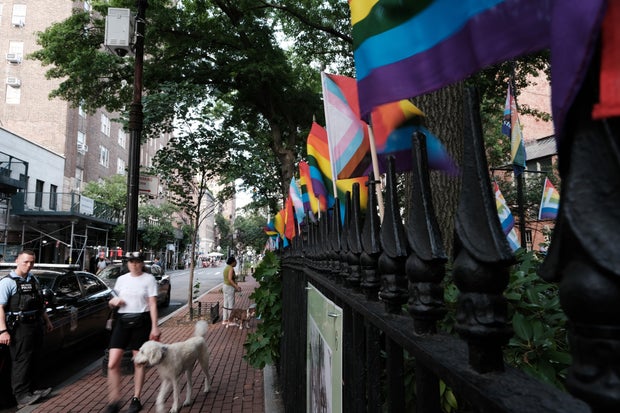
The transgender flags that usually adorn the Stonewall National Monument in New York City during Pride Month were missing this year, so some New Yorkers are taking matters into their own hands.
During June, Pride flags are placed around the park’s fence. They usually include a mixture of rainbow LGBTQ+ flags, transgender flags and progress flags, which have stripes to include communities of color.
Photographer and advocate Steven Love Menendez said he created and won federal approval for the installation nine years ago. Within a few years, the National Park Service was picking up the tab, buying and installing flags, including trans ones.
Pride flags fly in the wind at the Stonewall National Monument in Manhattan’s West Village on June 19, 2023 in New York City.Spencer Platt/Getty Images
This year, however, Menendez said the National Park Service told him to change the protocol.
“I was told … only the traditional rainbow flag would be displayed this year,” he said.
Now, no transgender or progress flags are among the 250 rainbow flags installed around the park.
“It’s a terrible action for them to take,” Menendez said.
“I used to be listed as an LGBTQ activist, and now it says ‘Steven Menendez, LGB activist,'” Menendez said. “They took out the Q and the T.”
“I’m not going to stand by and watch us be erased from our own history”
Many visiting the monument said they are opposed to the change.
“I think it’s absurd. I think it’s petty,” said Willa Kingsford, a tourist from Portland.
“It’s horrible. They’re changing all of our history,” Los Angeles resident Patty Carter said.
Jay Edinin, of Queens, brought his own transgender flag to the monument.
“I’m not going to stand by and watch us be erased from our own history, from our own communities, and from the visibility that we desperately need right now,” he said.
The transgender flags that usually adorn the Stonewall National Monument in New York City during Pride Month were missing this year, so some New Yorkers are taking matters into their own hands.CBS News New York
He is not the only one bringing unauthorized flags to the park. A number of trans flags were seen planted in the soil.
National Park Service workers at the park told CBS News New York they are not authorized to speak on this subject. CBS News New York reached out by phone and email to the National Park Service and has not yet heard back.
Dave Carlin has covered major national news stories and events in the past four decades including Superstorm Sandy and its tri-state impacts, Hurricane Hugo in South Carolina and Iniki on Kauai, Hawaii. He also covered the Space Shuttle Program, 1989 San Francisco Earthquake, numerous Southern California wildfires, the trial and execution of serial killer Ted Bundy in Florida, the 1994 police shooting death of Tyke the eacaped Cirus Elephant on the streets of Honolulu, 2009’s Miracle on the Hudson, the NYC Mayoral administrations of Bloomberg through Adams and more.
My wife and I recently returned from a Danube River cruise — no, it’s not blue, the waltz notwithstanding — and we had a wonderful time.
One of the many pleasures of these relatively small river cruises is all the interesting people you get to meet from around the world. This time around, we spent most of our time with Canadians and Australians, who seemed to enjoy our company once they determined we shared their low opinion of our president.
When one of the Canadians we dined with several times learned that we had signed on for a “Sound of Music” tour of Salzburg, Austria — featuring fountains, mountains, cityscapes, trees, a church and other locations from the movie — he told a nice story about an Austrian who emotionally described to him his love for their traditional folk song, “Edelweiss.”
I had read that the song actually was written just for the movie and had no significance for Austrians, which our guide confirmed the next day. So when our new friend repeated his story at dinner that evening, I politely corrected him, explaining that although some Austrians may have embraced the song — the Edelweiss is their national flower — it was a Rodgers and Hammerstein creation.
I won’t say our friend was crestfallen, but he did seem disappointed. I should add that I have a long tradition of spoiling people’s favorite stories, in part through the urban legend columns I used to write semiregularly.
So here’s the question. Is the truth really that important, if it spoils a good narrative?
After all, we’re in what some people have characterized as the Post-Truth Era, ushered in most recently by Donald Trump, his congressional lapdogs and Fox News but immortalized much earlier by Adolf Hitler and his Nazi regime. Falsehoods abound, not just in the White House but all over social media.
Here’s how the European Center for Populism Studies explained the Big Lie technique.
The big lie is the name of a propaganda technique, originally coined by Adolf Hitler in “Mein Kampf,” who says “The great masses of the people … will more easily fall victim to a big lie than to a small one,” and denotes where a known falsehood is stated and repeated and treated as if it is self-evidently true, in hopes of swaying the course of an argument in a direction that takes the big lie for granted rather than critically questioning it or ignoring it.
Pssst. If that doesn’t sound familiar, wake up.
Hitler used it to blame his country’s problems on his best available scapegoat, Jewish people. Trump and company have broadened this approach to encompass multiple scapegoats — immigrants, foreigners, transgender people, people who are “woke” because they encourage social justice and care about the future health of our planet — and to big lies involving the 2020 election and so many other subjects that we’re numb to it. He lies about everything, and his supporters don’t seem to know or care.
I remember when the idea of act checking first emerged in political coverage. Instead of just quoting politicians who were fudging the truth, the fact-checkers would point out when they were lying or exaggerating, in the case of The Washington Post by assigning up to four Pinocchios for the most egregious falsehoods.
Some politicians would correct themselves in future pronouncements. Others wouldn’t bother.
Trump, the ultimate Pinocchio, is oblivious to Fact Checking. He just plows ahead — “They’re eating the dogs, they’re eating the cats!” — repeating the same misinformation over and over at rallies, news conferences, debates. Facts are irrelevant.
Perhaps most amazingly, his long-since-debunked fraud allegations regarding the 2020 election are being incorporated into Oklahoma’s public-school curriculum. Elsewhere, facts about racial injustice, climate change and our nation’s history have been altered or eliminated from public school curricula to suit the MAGA agenda. Kinglike, Trump even is punishing colleges, states and others who won’t go along with his determination to impose “1984”-style Newspeak.
I think at least some Trump followers — particularly Republican elected leaders — know he is lying. But because it suits their preferred narrative, they go along. That’s frightening enough. Even scarier, though, are the people who are too dim, lazy or Foxcentric to figure out that we’re not being overrun by bloodthirsty killer immigrants or that non-straight men and women aren’t a threat to our military, our children or anything else, not to mention that Trump really lost the 2020 election, that the rioters storming the Capitol weren’t the true victims of Jan. 6, that indiscriminate ICE goon squads aren’t the best solution to illegal immigration and that vaccinating our children continues to be a very good idea.
They don’t just accept the lies. They spread them. That’s why we must be advocates for the truth, correcting and even confronting falsehoods, at rallies, on social media, in conversations. Ignorance is not bliss. It’s fueling our country’s descent into unrecognizable autocratic chaos.
“Eidelweiss” may be trivial. But innocent people being demonized? Trust in our elections destroyed? Our constitutional guarantees shredded? Our planet’s climate threatened? Long-dead diseases given new life?History rewritten?
Speak up. The truth is worth defending.
This is a contributed opinion column. Bill White can be reached at whitebil1974@gmail.com. His Threads handle is whitebil2000. The views expressed in this piece are those of its individual author and should not be interpreted as reflecting the views of this publication. For more details on commentaries, read our guide to guest opinions at themorningcall.com/opinions.
I admit this is long at 44 minutes. I found it worth the watch even though at times Gagnon tries to get technical and uses a circular argument in favor of his predetermined view of homosexuality and the LGBTQ+ spectrum. He is not using the bible to inform him as Reverend Trevors says but instead using it as a weapon for his dislike / hate for anything not superior male inferior female relationships. I find McClellan easy to follow and understand and I like that he leaves his feelings at the door when he tries to understand the texts of that time. He points how Gagnon is using his biases to inform his religion and not his religion forming his biases. The other interesting thing to me is that McClellan seems to have researched the times and cultures of the different passages to see the context they were written in, whereas Gagnon seems to simply impose his modern standards on the words. Hugs
The Senate Judiciary subcommittee held a hearing Wednesday digging into the cognitive abilities of former President Joe Biden and claims of whether his aides helped what they say was a cover up of his alleged mental decline — claims the former president and many on his staff have denied.
The probe didn’t uncover any new information on the former president — with Democratic members of the subcommittee boycotting the hearing.
Democratic senators on the committee walked out of the hearing shortly after it began, with Democratic Sen. Dick Durbin blasting the panel for even holding the hearing, while he says a number of timely investigations should be going on related to President Donald Trump’s current actions.
“So far this year, the Republican majority on this committee has not held a single oversight hearing, despite numerous critical challenges facing the nation that are under our jurisdiction,” Durbin said.
The GOP panel repeatedly accused Democrats — and the media — of concealing the former president’s alleged real health conditions in order to prevent Trump’s 2024 victory.
“Today’s hearing is about competency, corruption and cover up within the Biden administration. Simply put, the last administration was rudderless from one crisis to another. The Biden Administration failed and folded. The partisan media did their best to cover up those failures,” Senate Judiciary Chairman Chuck Grassley claimed.
Former White House Press Secretary Sean Spicer listens to questioning during Senate Committee on the Judiciary hearings on how the Biden Cover-Up Endangered America and Undermined the Constitution in the Dirksen Senate office building in Washington, DC, June 18, 2025.
Mattie Neretin/Sipa USA via AP
Former White House press secretary Sean Spicer, who was among the witnesses, compared his time working under Trump in his first term to his observations of Biden, praising Trump’s energy and mental focus. Spicer never worked for the Biden administration.
Spicer also criticized “legacy media” for questions raised about Trump’s fitness for office in his first term, while he claims they were not questioning Biden the same way.
“Many, rightly so, believe the media in this country is culpable in covering up the obvious decline of the 46th president and leaders of the free world — the president of the United States. The scrutiny that was baselessly directed at President Trump during his first term was wholly absent from the media coverage of the Biden White House,” Spicer claimed.
Republicans on the committee also focused on Trump — saying he is in command and makes skillful decisions.
“The public is counting on us to ensure this never happens again, because we won’t always be fortunate enough to have a leader like President Trump, who is so unmistakably in command,” Republican Sen. Eric Schmitt said.
Joe Biden speaks during a conference of the Advocates, Counselors and Representatives for the Disabled (ACRD) at the Sofitel Hotel in Chicago, Illinois, on April 15, 2025.
Tannen Maury/AFP via Getty Images
In May, Senate Republicans announced their plans to launch the probe into Biden’s mental fitness while in office — including his use of autopen, a mechanical device to automatically add a signature to a document that’s been utilized by several past presidents, including Trump in his first term.
The hearing also comes after Trump earlier this month ordered Attorney General Pam Bondi to investigate whether Biden’s administration sought to conspire to cover up his alleged mental state while in office. The move by the White House represents a significant escalation, as it is a directive to the Justice Department to formally investigate.
Biden responded to the Trump order, saying “Let me be clear: I made the decisions during my presidency.”
“I made the decisions about the pardons, executive orders, legislation, and proclamations. Any suggestion that I didn’t is ridiculous and false,” Biden said in a statement.
In May, House Oversight Chairman James Comer requested Biden’s White House physician, Kevin O’Connor, appear for a transcribed interview as part of an investigation into Biden’s mental fitness and use of a presidential autopen while in office. Comer asked O’Connor to sit for an interview on June 25.
Sean Spicer, Heritage Foundation Visiting Fellow for Law and Technology Theodore Wold, and University of Virginia Law Professor John Harrison testify during a Senate Judiciary Committee hearing on the alleged cover up of former President Joe Biden’s alleged incapacity to serve on Capitol Hill June 18, 2025.
In response to the book’s release, a Biden spokesman said “there is nothing in this book that shows Joe Biden failed to do his job, as the authors have alleged, nor did they prove their allegation that there was a cover up or conspiracy.”
On Wednesday morning, Trump — who often criticizes Biden — lambasted the former president’s use of autopen and claimed that Biden didn’t have control while leading the country.
“All these people, all the scum that was around the Oval, you know, the Oval Office, or around the beautiful Resolute desk, telling this guy here, ‘Do this,’ ‘Do that,’ and not even tell him. They just go over to the autopen and sign whatever the hell they wanted to sign,” he said.
Trump claimed that it was aides who were making decisions for Biden — employing the autopen to carry out an agenda.
“He wasn’t for open borders, he wasn’t for transgender for everybody. He wasn’t for men playing in women’s sports. But he has no idea what the hell — he has no idea,” Trump claimed.

 Arin Waller (She/They)June 24, 2025, 4:00 pm EDT
The cover of the offending book, When Aidan Became a Brother by transgender male author Kyle Lukoff. | Lee & Low Books










 Scottie's Playtime