
Political cartoons / memes / and news I want to share. 7-15-2025


Obama tells democrats to toughen up.
https://www.cnn.com/2025/07/14/politics/obama-democrats-message?cid=ios_app
Best Wishes and Hugs,
Scottie
Funny!
We may have seen this here before, I don’t recall. We’ve each probably seen it somewhere before. It’s still funny! Laughter releases endorphins; those endorphins make us stronger. Enjoy!
Justice Department opens investigation into Minnesota for alleged hiring discrimination
Here is the reason for the post. The Department of Justice announced Thursday that its Civil Rights Division is investigating the state of Minnesota for possible hiring discrimination. What the current US government is trying to roll back all gains by minority groups since the 1960s. They started by making teaching the history of oppression of black people an attack on white people by making CRT a boogie man. Then came woke as the villain and save the children from the gays or anyone with a different lifestyle from the straight cis majority. Now it is DEI. The right has hammered on DEI even though most on the MAGA side couldn’t tell you what it means. The media on the right has tried to say any black person or any woman hired is not qualified and only got the job because they were a quota DEI hire. They see a black pilot and think DEI as in not qualified to fly better get off the plane as Charlie Kirk said on his show. They are trying to make the US a white straight cis ethnostate in the model of Russia with the white males clearly in charge. We must not let them destroy the melting pot mixture of different people and cultures that have made the US such a grand country. Plus the AG Bondi claims DEI is illegal but no law was passed by the congress? tRump seems to think if he says it or if he signs an executive order that makes it law. He is not a dictator yet. Hugs
https://www.politico.com/news/2025/07/10/trump-doj-investigates-minnesota-00447779
The investigation represents one in a series of clashes between the state and Trump’s DOJ.
Minnesota Attorney General Keith Ellison (left) and Minnesota Governor Tim Walz (right) await the arrival of then-Vice President Kamala Harris at the Minneapolis-St. Paul International Airport on March 14, 2024. | Stephen Maturen/AFP via Getty Images
By Jacob Wendler07/10/2025 05:14 PM EDT
The Department of Justice announced Thursday that its Civil Rights Division is investigating the state of Minnesota for possible hiring discrimination, setting up another clash between the Trump administration and the state’s Democratic leadership.
The investigation hinges on a policy issued earlier this month by the Minnesota Department of Human Services mandating that hiring supervisors provide a “hiring justification when seeking to hire a non-underrepresented candidate,” according to a Thursday letter sent to Minnesota Attorney General Keith Ellison from Assistant U.S. Attorney General Harmeet Dhillon, head of the DOJ’s Civil Rights Division.
Attorney General Pam Bondi’s DOJ has pursued an aggressive crackdown on states and universities that engage in affirmative action policies, opening similar investigations into Rhode Island and the University of California.
“Minnesotans deserve to have their state government employees hired based on merit, not based on illegal DEI,” Bondi said in a statement.
The statute specifies that the justifications are required for “nonaffirmative action hires,” the Minnesota Department of Human Services said in a statement defending its policy.
“The Minnesota Department of Human Services follows all state and federal hiring laws,” it said. “Justification of non-affirmative action hires for some vacancies has been required by state law since 1987.”
The White House has repeatedly clashed with Minnesota Gov. Tim Walz, who has sharply criticized the president since running for vice president on the Democratic ticket in 2024. Ellison has also filed multiple lawsuits against the Trump administration seeking to block several of its policies, and the DOJ sued Minnesota last month to stop the state from providing in-state tuition for some undocumented students.
Trump also refused to call Walz after two Minnesota state lawmakers were shot in May, calling the governor “so whacked out.”
Walz’s office did not immediately respond to a request for comment, and Ellison’s office declined to comment.
It’s Bastille Day in France! & More, In Peace & Justice History for 7/14

| July 14, 1789 Bastille Day in France: Parisian revolutionaries and mutinous troops stormed and dismantled the Bastille, a former royal fortress converted to a state prison, that had come to symbolize the tyranny of the Bourbon monarchy. This dramatic action was proof that power no longer resided in the King as God’s representative, but in the people, and signaled the beginning of the French Revolution and the First Republic.  Bastille Day for kids |
| July 14, 1798 A mere 22 years after the Declaration of Independence, Congress passed the Sedition Act, making it a federal crime to “. . . unlawfully combine or conspire together, with intent to oppose any measure or measures of the government of the United States . . . or to excite any unlawful combinations therein, for opposing or resisting any law of the United States, or any act of the President of the United States . . . .” The Declaration: “…whenever any Form of Government becomes destructive of these ends [life, liberty and the pursuit of happiness], it is the Right of the People to alter or to abolish it, and to institute new Government….” “An act for the punishment of certain crimes against the United States” |
| July 14, 1887 Adrian C. “Cap” Anson, both manager and captain of the Chicago Whitestockings (National League), refused to let his baseball team take the field as long as the Newark Little Giants included their starting pitcher, George Stovey, an African-American, in the lineup. “Get that nigger off the field!” Anson was heard to say. Newark refused to allow Anson to dictate the use of their personnel, but the game was ruled a forfeit to Chicago. At the time there were only 20 black players in all of professional baseball. The same day, the directors of the International League (which included Newark) barred any of their teams from hiring black players in the future. By the following year there were only six black players left on all the teams in four leagues. All-black teams were formed, but the last of them, the Acme Colored Giants from Celeron, New York, of the Iron and Oil (I&0) League, stopped playing in 1898. No African-American would play in white organized baseball again until Jackie Robinson nearly 50 years later. |
| July 14, 1955 The Air Pollution Control Act of 1955 became law, the first in a series of laws that ultimately became the Clean Air Act in 1963. This first law simply provided funding to the Public Health Service to conduct research.  History of the Clean Air Act |
July 14, 1958 King Faisal II A group of Iraqi army officers staged a coup in Iraq and overthrew the monarchy of King Faisal II (who had ascended to the throne at age four). The new government, led by Abdul Karim el Qasim, was ousted in 1963 by a coup helped by the CIA and led by the Arab Socialist Ba’ath Party—later dominated by Saddam Hussein. Read more |
And Now, For Something Completely Different!
A Rabbit Rides a Chariot Pulled by Geese in an Ancient Roman Mosaic (2nd century AD)
in Art, History | July 9th, 2025
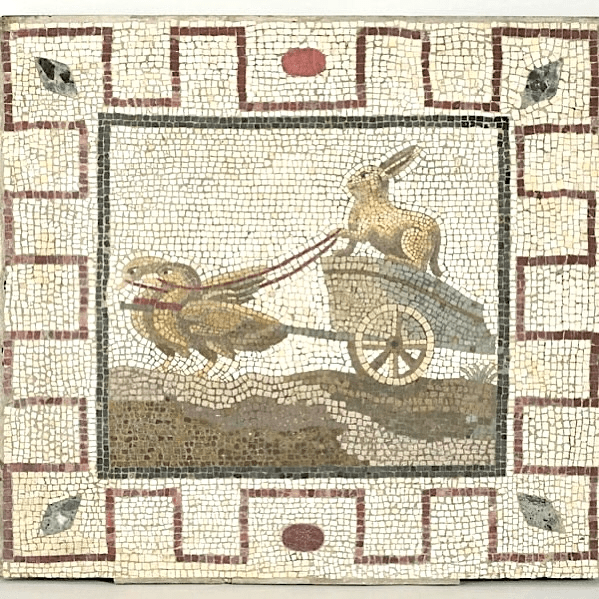
If you head to the Louvre, make sure you visit the Mona Lisa, Venus de Milo, and Liberty Leading the People. But then swing by the Department of Greek, Etruscan, and Roman Antiquities. There you might find (no guarantee!) a Roman mosaic featuring a rabbit riding a chariot pulled by geese. Discovered at Hadrian’s villa in Tivoli, Italy, the mosaic dates back to the 2nd century. About the mosaic, the History Cool Kids writes:
This kind of humorous scene is an example of asária, a type of ancient visual joke where animals behave like humans (anthropomorphism). Such mosaics were popular in Roman domestic decoration, often as floor or wall panels in villas and bathhouses.
This particular mosaic is part of the Louvre’s extensive collection of Greek, Etruscan, and Roman Antiquities. It illustrates how Roman artists loved playful or satirical imagery alongside more serious mythological and realistic scenes. The rabbit, a symbol often associated with fertility and speed, paired with the absurdity of it driving a chariot of geese, reflects both Roman wit and their fondness for decorative exuberance.
Some scholars believe the mosaic plays on a line in Ovid’s Metamorphoses: “Cytherea [Aphrodite] was riding in her dainty chariot, winged by her swans, across the middle air making for Cyprus, when she heard afar Adonis’ dying groans, and thither turned her snowy birds.” But it’s hard to know for sure.
Related Content (snip)
Political cartoons / memes / and news I want to share. 7-14-2025. A small one but my stomach can not stand much more.


Ten Bears also posted this cartoon. If you have not visited his site or subscribed I recommend you do so. Hugs http://homelessonthehighdesert.com/2025/07/11/theyre-all-meth-heads/


DHS Tells Police That Common Protest Activities Are ‘Violent Tactics’
That pesky thing called the US CONSTITUTION says that the people have a right to protest the government. The last ten or more years the federal government has been trying to restrain the rights of the people to protest or have their voices heard. This is another example. Hugs
https://www.wired.com/story/dhs-tells-police-that-common-protest-activities-are-violent-tactics/
DHS is urging law enforcement to treat even skateboarding and livestreaming as signs of violent intent during a protest, turning everyday behavior into a pretext for police action.
The Department of Homeland Security is urging local police to consider a wide range of protest activity as violent tactics, including mundane acts like riding a bike or livestreaming a police encounter, WIRED has learned.
Threat bulletins issued during last month’s “No Kings” protests warn that the US government’s aggressive immigration raids are almost certain to accelerate domestic unrest, with DHS saying there’s a “high likeliness” more Americans will soon turn against the agency, which could trigger confrontations near federal sites.
Blaming intense media coverage and backlash to the US military deployment in Los Angeles, DHS expects the demonstrations to “continue and grow across the nation” as protesters focused on other issues shift to immigration, following a broad “embracement of anti-ICE messaging.”
The bulletins—first obtained by the national security nonprofit Property of the People through public records requests—warn that officers could face assaults with fireworks and improvised weapons: paint-filled fire extinguishers, smoke grenades, and projectiles like bottles and rocks.
At the same time, the guidance urges officers to consider a range of nonviolent behavior and common protest gear—like masks, flashlights, and cameras—as potential precursors to violence, telling officers to prepare “from the point of view of an adversary.”
Protesters on bicycles, skateboards, or even “on foot” are framed as potential “scouts” conducting reconnaissance or searching for “items to be used as weapons.” Livestreaming is listed alongside “doxxing” as a “tactic” for “threatening” police. Online posters are cast as ideological recruiters—or as participants in “surveillance sharing.”
One list of “violent tactics” shared by the Los Angeles–based Joint Regional Intelligence Center—part of a post-9/11 fusion network—includes both protesters’ attempts to avoid identification and efforts to identify police. The memo also alleges that face recognition, normally a tool of law enforcement, was used against officers.
Vera Eidelman, a senior staff attorney with the American Civil Liberties Union, says the government has no business treating constitutionally protected activities—like observing or documenting police—as threats.
DHS did not respond to a request for comment.
“Exercising those rights shouldn’t be justification for adverse action or suspicion by the government,” Eidelman says. Labeling something as harmless as skateboarding at a protest as a violent threat is “disturbing and dangerous,” she adds, and could “easily lead to excessive force against people who are simply exercising their First Amendment rights.”
“The DHS report repeatedly conflates basic protest, organizing, and journalism with terroristic violence, thereby justifying ever more authoritarian measures by law enforcement,” says Ryan Shapiro, executive director of Property of the People. “It should be sobering, if unsurprising, that the Trump regime’s response to mass criticism of its police state tactics is to escalate those tactics.”
Fusion centers like JRIC play a central role in how police understand protest movements. The intelligence they produce is rapidly disseminated and draws heavily on open-source data. It often reflects broad, risk-averse assumptions and includes fragmentary and unverified information. In the absence of concrete threats, bulletins often turn to ideological language and social media activity as evidence of emerging risks, even when tied to lawful expression.
DHS’s risk-based approach reflects a broader shift in US law enforcement shaped by post-9/11 security priorities—one that elevates perceived intent over demonstrable wrongdoing and uses behavior cues, affiliations, and other potentially predictive indicators to justify early intervention and expanded surveillance.
A year ago, DHS warned that immigration-related grievances were driving a spike in threats against judges, migrants, and law enforcement, predicting that new laws and high-profile crackdowns would further radicalize individuals. In February, another fusion center reported renewed calls for violence against police and government officials, citing backlash to perceived federal overreach and identifying then-upcoming protests and court rulings as likely triggers.
At times, the sprawling predictions may appear prescient, echoing real-world flashpoints: In Alvarado, Texas, an alleged coordinated ambush at a detention center this week drew ICE agents out with fireworks before gunfire erupted on July 4, leaving a police officer shot in the neck. (Nearly a dozen arrests have been made, at least 10 on charges of attempted murder.)
In advance of protests, agencies increasingly rely on intelligence forecasting to identify groups seen as ideologically subversive or tactically unpredictable. Demonstrators labeled “transgressive” may be monitored, detained without charges, or met with force.
Social movement scholars widely recognize the introduction of preemptive protest policing as a departure from late-20th century approaches that prioritized de-escalation, communication, and facilitation. In its place, authorities have increasingly emphasized control of demonstrations through early intervention, surveillance, and disruption—monitoring organizers, restricting public space, and responding proactively based on perceived risks rather than actual conduct.
Infrastructure initially designed to combat terrorism now often serves to monitor street-level protests, with virtual investigations units targeting demonstrators for scrutiny based on online expression. Fusion centers, funded through DHS grants, have increasingly issued bulletins flagging protest slogans, references to police brutality, and solidarity events as signs of possible violence—disseminating these assessments to law enforcement absent clear evidence of criminal intent.
Surveillance of protesters has included the construction of dossiers (known as “baseball cards”) with analysts using high-tech tools to compile subjects’ social media posts, affiliations, personal networks, and public statements critical of government policy.
Obtained exclusively by WIRED, a DHS dossier on Mahmoud Khalil, the former Columbia graduate student and anti-war activist, shows that analysts drew information from Canary Mission, a shadowy blacklist that anonymously profiles critics of Israeli military action and supporters of Palestinian rights.
In federal court Wednesday, a senior DHS official acknowledged that material from Canary Mission had been used to compile more than 100 dossiers on students and scholars, despite the site’s ideological slant, mysterious funding, and unverifiable sourcing.
Threat bulletins can also prime officers to anticipate conflict, shaping their posture and decisions on the ground. In the wake of violent 2020 protests, the San Jose Police Department in California cited the “numerous intelligence bulletins” it received from its local regional fusion center, DHS, and the FBI, among others, as central to understanding “the mindset of the officers in the days leading up to and throughout the civil unrest.”
Specific bulletins cited by the SJPD—whose protest response prompted a $620,000 settlement this month—framed the demonstrations as possible cover for “domestic terrorists,” warned of opportunistic attacks on law enforcement and promoted an “unconfirmed report” of U-Haul vans purportedly being used to ferry weapons and explosives.
Subsequent reporting in the wake of BlueLeaks—a 269-gigabyte dump of internal police documents obtained by a source identifying as the hacktivist group Anonymous and published by transparency group Distributed Denial of Secrets—found federal bulletins riddled with unverified claims, vague threat language, and outright misinformation, including alerts about a parody website that supposedly paid protesters and accepted bitcoin to set cars on fire, despite a clear banner labeling the site “FAKE.”
Threat alerts—unclassified and routinely accessible to the press—can help law enforcement shape public perception of protests before they begin, laying the groundwork to legitimize aggressive police responses. Unverified DHS warnings about domestic terrorists infiltrating demonstrations in 2020, publicly echoed by the agency’s acting secretary on Twitter, were widely circulated and amplified in media coverage.
Americans are generally opposed to aggressive protest crackdowns, but when they do support them, fear is often the driving force. Experimental research suggests that support for the use of coercive tactics hinges less on what protesters actually do than on how they’re portrayed—by officials, the media, and through racial and ideological frames.
Dell Cameron is an investigative reporter from Texas covering privacy and national security. He’s the recipient of multiple Society of Professional Journalists awards and is co-recipient of an Edward R. Murrow Award for Investigative Reporting. Previously, he was a senior reporter at Gizmodo and a staff writer for the Daily … Read More

YOU HAVE THE LEGAL AUTHORITY, F*****G USE IT
One voice was yelling he was a US citizen. The conditions are horrible. They get their drinking water from the toilet. Maxwell Frost is a progressive treasure. Hugs
 Scottie's Playtime