So, as I do most evenings, Saturday evening I opened the NewsCow to see what I’d missed about town since Friday evening. Turns out, the Recycling Center had reopened, effective Saturday morning! There is very little info, so I’m including it all underneath, but you can click through to nose about and maybe vote in a poll, or something, if you like. This is follow-up to So Reading the News Yesterday, from July 11th.
…..Sumner Newscow report — Effective Saturday, July 19, 2025, the Wellington Recycling Center will reopen and begin collecting materials again. At this time, the materials will remain the same as before: cardboard, paper products, magazines, tin cans, and aluminum cans. Hours of operation will also remain the same:
Monday, 11 a.m. to 1 p.m. and Saturday, 9 a.m. to noon.
City staff is in discussions with multiple buyers and evaluating the environmental, operational and financial impacts of all of the options available at this time. Information will be provided in the future if any changes at the Center are required. (End; now you know what I know. Oh, except the City’s Recycling Center Page is not yet updated as of Sunday evening. Interesting!)
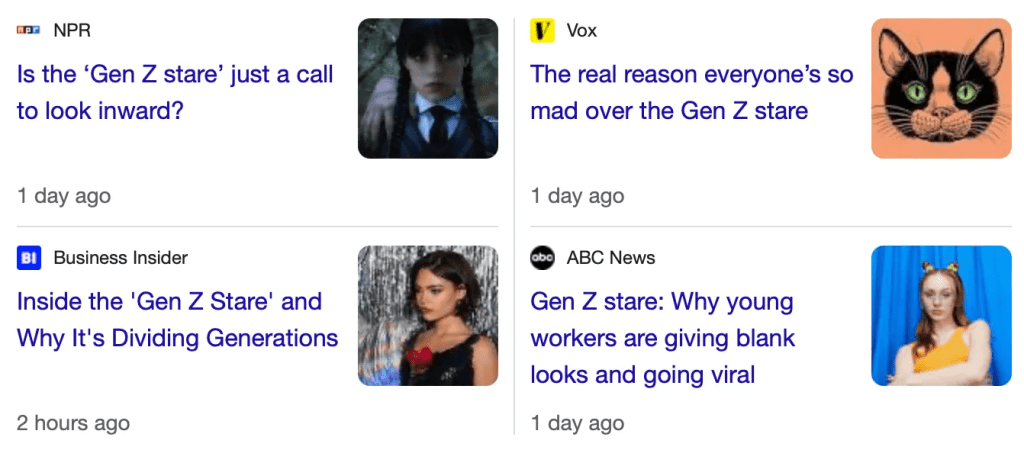
Legacy media is very concerned with the ‘Gen Z Stare’
In the past week, there’s been robust discourse in legacy media about the so-called ‘Gen Z Stare’ and the bursts of generational conflict it reportedly captures.
It’s gotten write-ups by The New York Times, The Washington Post, USA Today, The Boston Globe, NBC News, ABC News, CNBC, Newsweek, Indy100, Axios, Fortune, Vox, Vice, Business Insider, The Independent, Forbes, Buzzfeed, Slate, HuffPost, Glamour, People, and Marie Claire, among others.
As a millennial, I am apparently urged to be concerned about this phenomenon of Gen Z folks supposedly failing to appropriately interact with me through sufficiently pleasant facial expressions, so I thought it might be helpful to offer my thoughts:
The sitting president of the United States is currently covering up a massive sex trafficking operation that targeted children and likely implicates a number of powerful people who are currently out in the world and free to continue preying on children.
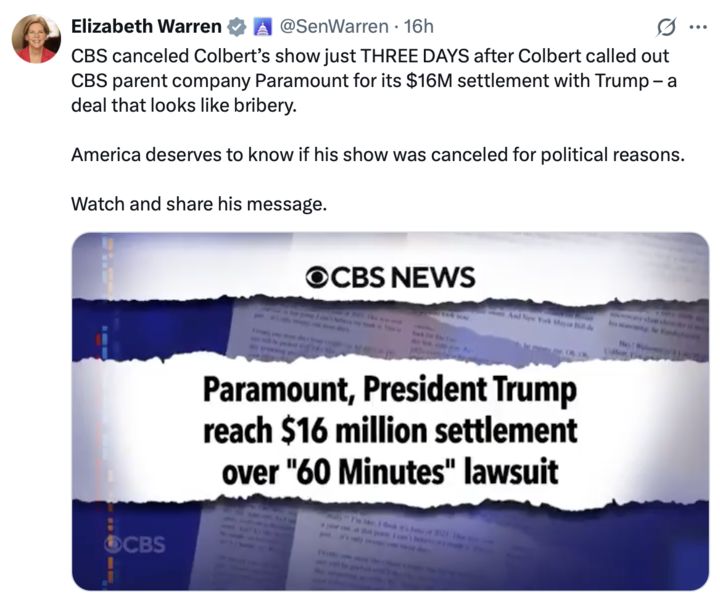
The sitting president of the United States just successfully pressured Paramount and CBS to cancel the #1 late-night talk show on broadcast television as part of what appears to be a blatant bribery deal because the host has been critical of him.
The sitting president of the United States just got the extremist Republican majority in Congress to strip 11 million Americans of health care coverage by the end of 2026 and upwards of 17 million Americans when you account for new federal work requirements. (snip-MORE; it’s succinct and quick, and it’s all good facts for grocery/other places lines, for discussion.)
July 21, 1878 Publication of “Eight Hours,” written by Reverend Jesse H. Jones (music) and I.G. Blanchard (lyrics), the most popular labor song until “Solidarity Forever” was published by the IWW (Industrial Workers of the World) in 1915. “Eight hours for work, Eight hours for rest; Eight hours for what we will.” All the lyrics (The eight-hour was an established concept before the song.)
July 21, 1925 The so-called “Monkey Trial” ended in Dayton, Tennessee, with high school teacher John T. Scopes convicted of violating a state law against teaching Darwin’s theory of evolution. It was considered illegal to contradict the Bible’s description of God’s seven-day creation of the world in Genesis. The trial pitted two of America’s leading advocates as the opposing lawyers: William Jennings Bryan, thrice the Democratic presidential candidate (1896, 1900, 1908) and the state’s prosecutor; Clarence Darrow, a lawyer famous for representing the underdog, at the defense table. Referred to as “the trial of the century” even before it began, it was the first trial ever broadcast (on radio). Bryan became ill and died shortly after the trial’s end; the conviction was later overturned by Tennessee’s Supreme Court. The Defendant John T. Scopes The Attorneys: Darrow & Bryan/ The Verdict: Thou Shall Not Think Interest in the trial by the populace and the media (and the heat in the courtroom) prompted Judge John T. Raulston to move the trial outdoors to the courthouse lawn. Bryan himself was called as a witness on the literal interpretation of scripture. Attorney General Thomas Stewart, in response to Darrow’s questioning, asked, “What is the meaning of this harangue?” “To show up fundamentalism,” shouted Mr. Darrow, “to prevent bigots and ignoramuses from controlling the educational system of the United States.” Mr. Bryan sprang to his feet, his face purple, and shook his fist in Darrow’s face: “To protect the word of God from the greatest atheist and agnostic in the United States.” ACLU History: The Scopes ‘Monkey Trial’ More about the Monkey Trial
July 21, 1954 Major world powers, meeting in Geneva, Switzerland, reached agreement on the terms of a ceasefire for Indochina, ending nearly eight years of war. The war began in 1946 between nationalist forces of the Communist Viet Minh, under leader Ho Chi Minh, and France, the occupying colonial power after the Japanese lost control during World War II. The Geneva conference included France, the United Kingdom, the U.S., the U.S.S.R., People’s Republic of China, Cambodia, Laos, and both Vietnamese governments (North and South). The peace treaty called for independence for Vietnam and a 1956 election to unify the country. However, only France and Ho Chi Minh’s DRV (Democratic Republic of Vietnam (North)) signed the document. The United States did not approve of the agreement. Instead, they backed Emperor Boa Dai and Prime Minister Ngo Dinh Diem’s government in South Vietnam and refused to allow the elections, knowing, in President Eisenhower’s words, that “Ho Chi Minh will win.” The result was the Second Indochina War, more commonly known as the Vietnam War. The treaty is signed
July 21, 1976 Plaza de Mayo mother A military junta under General Jorge Rafael Videla took power in Argentina on March 24, disbanding parliament and taking over all labor unions. The military kidnapped hundreds of people from two villages of Jujuy province in northern Argentina, thirty of whom never returned from a clandestine detention center. Most of those disappeared worked for the Ledesma sugar refinery. Since 1983, on the Thursday closest to July 21, Madres de Plaza de Mayo (an organization of mothers and wives of the missing) are joined by others, and walk the 7 km (4.3 miles) from Calilegua to San Martin, demanding answers about their loved ones. Madres de Plaza de Mayo is supported by Amnesty International and the United Nations Human Rights Commission. Read more
Migrants at Ice jail in Miami made to kneel to eat ‘like dogs’, report alleges
Incident in which migrants were shackled with hands tied of one succession of alleged abuses at jails in Florida
Meiselas: Here's audio of Maria Farmer, one of Epstein's victims, who came forward early on…She speaks about an incident where she was going to Epstein's office building. Trump was in the office building, she says, and Epstein tells Trump, “That one's not for you. Yours is in the other room.”
🚨 #BoycottParamount 🚨Paramount just canceled The Late Show with Stephen Colbert—a move that reeks of political obedience, not business. This isn’t just entertainment—it’s the silencing of satire.📢 As Timothy Snyder warned: “Do not obey in advance.”Refuse the script. Turn off Paramount.
Remember Stephen Colbert, who looked at corruption and called it what it was, right up until they took his microphone away.The show must go on, they say. But sometimes, the show just ends.newrepublic.com/article/1981…
The timing of CBS’s announcement has sparked immediate suspicion among critics and media watchers. Many see the decision as yet another example of corporate media preemptively silencing voices critical of Donald Trump.open.substack.com/pub/beinglib…
Trump’s EPA just fired hundreds of scientists – the ones who make sure our water is safe to drink and our air is safe to breathe, and who study the impacts of wildfire smoke and PFAS on our health.eu.usatoday.com/story/news/p…
“We got a beating for breakfast. We got a beating for lunch. We got a beating for dinner.”The horror stories are already emerging from the Venezuelan deportees' time in El Salvador's notorious CECOT prison. http://www.motherjones.com/politics/202…
It doesn't seem like "prisoner swap" is the correct term for returning people, some of whom seem to be US citizens, who were kidnapped off American streets.
Dramatic changes to the Vaccine Injury Compensation Program could drive drugmakers from the market, threatening access to shots, experts say.“If (Kennedy’s) unstated goal is to basically destroy the vaccine industry, that could do it.”By @sheinvestigates.bsky.social
Good morning! I'm in Uganda to visit family and friends. But depending on your perspective, don't worry or I'm sorry: I'll be back by the end of the month. See you soon, NYC.
Epstein’s "little black book" totals 97 pages, containing 1,571 names and roughly 5,000 phone numbers. At least 38 names are mysteriously circled, including Donald Trump's.“I got my hands on a copy,” writes Leland Nally. “I made close to 2,000 phone calls.” http://www.motherjones.com/politics/202…
I would like people to compare the “tough guy” speech given by the ICE person about removing child molesters and kidnappers, rescuing children from forced labor, the worst criminals, murders, making mom and pop safe with the four crimes they mentioned that of the dozens and dozens arrested were accused of. One guy was charged with fentanyl distribution, one was charged with trespass, a third was charged with driving without a license and refusing to show identification. Wow mom and pop are so much safer now that the worst of the worst are in detention with no due process. Let’s be clear, they are going after legal immigrants, they are going after those following the rules, they are showing up at places where these people are working and looking for work because the goal is to remove all the brown people. It is that simple, it is a white supremacy thing driven by racist like Stephen Miller who hates Spanish speaking people and those with brown skin. They held a US citizen veteran for three days with no due process and no explanation. Take a guess of his skin color? Brown? Great guess and correct. These gang thugs are not trying to make the US safer for anyone, they are determined to make it whiter. At the 5:21 mark ICE thugs abruptly stop their car in the middle of the street and with guns and tasers ready while masked and in no uniform they rush a woman who is a well known activist who has been openly filming them for weeks. This is an attempt to cause fear and stop people from viewing and reporting their actions. This is such a 1930s Hitler’s Germany moment in the US. And Vaush talks about how the nation if flooded with guns and these masked people with no uniforms rushing at people could be shot by people in reasonable fear for their lives as Roger also has been saying. Hugs
If asked to pick one Lady Gaga song to encapsulate who she is and what she stands for, you’d be hard pressed to come up with a better choice than “Born This Way.” Released in 2011, the song is a vibrant, full-body dance anthem that calls on listeners to celebrate who they are. “God makes no mistakes,” she sings in the refrain. “I’m on the right track, baby / I was born this way.” The song was immediately embraced upon release, particularly by the LGBTQ+ community.
As it turns out, this wasn’t the first time a song by that name made that kind of impact. In 1977, Motown Records released the disco anthem “I Was Born This Way,” an upbeat tune featuring a largely unknown Black gospel singer who responds to critics with a refrain that was a head-turner for its time: “I’m happy. I’m carefree. And I’m gay. I was born this way.”
In 2021, Gaga directed people’s attention to that song, saying it was the inspiration for her own hit. And in the new documentary I Was Born This Way, which premiered at the Tribeca Film Festival in June, directors Daniel Junge and Sam Pollard shine a light on its creation and its singer, Carl Bean, an extraordinary individual who spent his life serving his LGBTQ+ community.
Junge and Pollard’s film starts with the story of Bean’s childhood in Baltimore. And many of the main moments are unforgiving: His mother abandons him at birth because she doesn’t feel ready to have a child; his uncle sexually assaults him for years; Bean attempts to kill himself as a teenager after his previously loving adoptive father hits him for being gay.
Bean, who died in 2021 at age 77, faced hardships in his life, many of which the film explores. But none of the horrors of Bean’s life land with the kind of bleakness one might expect. It’s not that the documentarians pull their punches, either. It’s Bean — there’s a persistent lightness to his spirit, the quiet joyfulness of someone who by some miracle is able to see a broader perspective. Those qualities so suffuse the story of his life that no darkness can overcome them.
And that faith sustained him when he moved first to New York City, where he would sing with Harlem’s Christian Tabernacle Choir, and then when he moved to Los Angeles and started writing his own songs. In New York, he worked at Macy’s and became lifelong friends with Cissy Houston, Estelle Brown, and Dionne Warwick; in Los Angeles, he signed a record deal but then discovered they only saw him as a gospel singer. And then, out of nowhere, Motown Records reached out.
The song “I Was Born This Way” has its own interesting history, which Junge and Pollard track. It was originally written years earlier by Bunny Jones, a New York City beautician who was friends with Stevie Wonder and later became a promoter. She wrote the song for one of her acts, a gay performer. But it wasn’t until two years later, when Motown reworked the song for disco and gave it to Bean to sing (with his friend Estelle Brown on backup), that it took off.
“There was such a feeling of freedom and relief and release when you danced to that song,” Minority AIDS Project program director Mike Jones says in the documentary. “All of the things we were trying to say throughout our lives to many of our friends and family that we could not say were in that song.”
While the collapse of disco would see the song fade from people’s memories, the film reveals the ways it continued to quietly live on. Musician and record producer Questlove talks about how often it has been sampled in other work over the decades. Among other places, you can hear it on Debbie Gibson’s “One Step Ahead,” Deee-Lite’s “Good Beat (Turn Up the Radio Mix),” and Rick Wade’s “Free.” The song, he says, “is the music equivalent of the Giving Tree.”
Meanwhile, Bean faced an unexpected fork in the road. Motown offered him the chance to do another big song. But “I Was Born This Way” had changed his perspective on the meaning and purpose of his life. “I had found my niche,” he said. “I knew my gig was to be a change agent in our society.”
And the film recounts how that choice led him down a path he could not have expected. Seeing how little was being offered to people of color when the AIDS pandemic erupted in the early ’80s, Bean started making visits on his own, traveling from person to person he learned about on Los Angeles city buses. Eventually he founded the Minority AIDS Foundation, which provided a hotline for information and to arrange visits.
When he learned from social workers that he would gain greater access to those who were sick if he became clergy, he also got ordained. Unexpectedly, some of those he visited asked for an Easter service. He provided it, not realizing it would be such a positive experience that they would aske him to lead to more services. Eventually, he started his own church, Unity Fellowship, an African American Christian community specifically for LGBTQ+ people.
Bean’s decades of generosity would eventually cost him. In his later years, he found himself unable to move his lower body. “All of those years of racism, of homophobia, all of that death and dying, it had an effect on my mind, my spirit, my being,” he said. “My body shut down.” The revelation is stunning — there’s been no sign over the course of the film that he has been suffering or overwhelmed with grief.
It’s a telling reminder of the sacrifices and generosity of so many queer people like Bean, whose stories are not well known. It’s also a testament to their irrepressible joy: At the end of the film, asked whether he has any last words for the camera, Bean offers a simple thought that pours directly out of the work of his life, including his famous song. “Find the place in you that allows you to love yourself and others,” he says. “It begins with love and ends with love.”
Then, as the film crew starts to pack up, he starts laughing warmly. There’s no reason. He just has so much to give.
July 20, 1967 The first Black Power conference was held in Newark, New Jersey, calling on black people in the U.S. “to unite, to recognize their heritage and to build a sense of community.” Read more
July 20, 1971 The first labor contract in the history of the federal government was signed by postal worker unions and the newly re-organized U.S. Postal Service. This contract was made possible by the postal strike of March 1970, in which 200,000 postal workers walked off the job, defying federal law. Prior to that, postal worker salaries started at $6,200 a year, and many postal workers were eligible for food stamps. The strike was not organized by a national union; it started when rank-and-file workers walked off the job in New York City and it spread to other parts of the country. The strike led to federal legislation that allowed postal unions to negotiate a contract with postal management (previously, postal salaries were set by Congress), with provisions for arbitration if no agreement were reached.Since that time, postal unions have successfully negotiated or arbitrated wages and benefits that provide a secure standard of living for their members. Read about the history of the APWU (American Postal Workers Union)