
Tag: Bigotry
Peace & Justice History for 3/7
| March 7, 1932 The Ford Hunger March began on Detroit’s east side and proceeded 10 miles seeking relief during the Great Depression. Facing hunger and evictions, workers had formed neighborhood Unemployed Councils. Along the route, the marchers were given good wishes from Detroit Mayor Frank Murphy as well as two motorcycle escorts, and thousands joined the marchers along the route.  At the Detroit city limit, the marchers were met by Dearborn police and doused by fire hoses. Despite the cold weather, they continued to the Employment Office of the Ford River Rouge plant, from which there had been massive layoffs. Five workers were killed and nineteen wounded by police and company “security” armed with pistols, rifles and a machine gun.   Dave Moore Dave MooreAccording to Dave Moore, one of the marchers, “That blood was black blood and white blood. One of the photos that was published in the Detroit Times, but never seen since, shows a black woman, Mattie Woodson, wiping the blood off the head of Joe DiBlasio, a white man who lay there dying . . . It’s been 75 years, but when you drive down Miller Road today, your car tires will be moistened with the blood that those five shed.” Grave markers with the words “His Life for the Union” pay tribute to the fallen hunger marchers in Woodmere Cemetery on Detroit’s west side. |
| March 7, 1965 525 civil rights advocates began a 54-mile march on a Sunday morning from Selma, Alabama, to the capital of Montgomery, to promote voting rights for blacks. Just after crossing the Edmund Pettus Bridge on the outskirts of Selma, the marchers were attacked in what became known as Bloody Sunday.  Enforcing an order by Governor George Wallace, the group was broken up by state troopers and volunteer officers of the Dallas County sheriff who used tear gas, nightsticks, bullwhips and rubber tubing wrapped in barbed wire. John Lewis, then head of the Student Nonviolent Coordinating Committee and a leader of the march, suffered a fractured skull.John Lewis was elected a member of Congress from Georgia in 1986 and served till his death in 2020.ABC television interrupted a Nazi war crimes documentary, “Judgment at Nuremberg,” to show footage of the violence in Selma, confusing some viewers about who was beating whom.  Injured in Selma Selma 1965 – Edmund Pettus Bridge, video excerpt from a PBS documentary with Rep. John Lewis and others who were there Read more |
| March 7, 1988 A Federal Court ruled in Atlanta, Georgia, that a peace group must have the same access to students at high school career days as military recruiters.  the anti-recruitment movement today: LEAVE MY CHILD ALONE! |
https://www.peacebuttons.info/E-News/peacehistorymarch.htm#march7
Peace & Justice History for 3/6
More repetition. sigh
| March 6, 1857 The U.S. Supreme Court handed down the Dred Scott decision (Dred Scott v. Sandford) which declared that an escaped slave, Scott, could not sue for his freedom in federal court because he was not a citizen. Those of African descent could never be considered citizens but “as a subordinate and inferior class of beings,” according to the Court.  Dred Scott Dred Scott’s fight for freedom (2 links) Chief Justice Roger Taney stated in his opinion that the “unhappy Black Race. . . had no rights which the white man was bound to respect; and that the negro might justly and lawfully be reduced to slavery for his benefit. He was bought and sold and treated as an ordinary article of merchandise and traffic, whenever profit could be made by it.”  Chief Justice Roger Taney Read the decision |
March 6, 1884 Susan B. Anthony Susan B. Anthony and more than 100 delegates from the National Woman Suffrage Association met with President Chester Alan Arthur concerning women’s right to vote. Anthony asked him, “Ought not women have full equality and political rights?” He responded, “We should probably differ on the details of that question.”  President Chester Alan Arthur |
| March 6, 1957 Ghana became the first black African country to become independent from colonial rule. Dr. Kwame Nkrumah became independent Ghana’s first leader.  Ghana’s flag Read more |
| March 6, 1967 Muhammad Ali was ordered by the Selective Service to be inducted into military service. He refused, citing his religious beliefs that precluded him from killing others.  “I ain’t got no quarrel with those Vietcong.”  Top Black athletes gather to hear Muhammad Ali (formerly Cassius Clay) give his reasons for rejecting the draft, United States, June 4, 1967. |
| March 6, 1982 The University for Peace near San Jose, Costa Rica, was founded. UPeace, the U.N.-mandated graduate school of peace and conflict studies had been chartered by the General Assembly for research and the dissemination of knowledge specifically aimed at training and education for peace. Visit the University for Peace  The monument on campus sculpted by Cuban artist Thelvia Marín in 1987, is the world’s largest peace monument. |
https://www.peacebuttons.info/E-News/peacehistorymarch.htm#march6
J.K. Rowling’s Anti-Trans Crusade Is Hurting All Women
Christopher Titus Armageddon clips
“A Deep Dive Into The Fight Against DEI”,
a couple bits from my Refinery 29 newsletter.
I’m A Black Woman Working In DEI & Here’s What It’s Really Like
Dria James Last Updated February 12, 2025, 10:20 AM
Dria James is a former DEI executive, with over a decade of experience driving diversity, equity, inclusion, and belonging across financial services, management consulting, higher education, and non-profit sectors. Now, she’s the CEO and founder of Black In Diversity, dedicated to empowering Black leaders and allies to thrive while driving systemic change. Here, shetakes us inside what it’s like to work in America’s most contested industry.
As told to Keyaira Kelly.
The emptiness of not-quite belonging followed me like a shadow from a young age. Born in the late ’80s in Paterson, New Jersey, to two young parents, private school education was seen as one of the few lifelines available for Black folks looking to transcend the social, economic, and political firestorm that engulfed Paterson in the 1990s. At the time, the city was marred by rising crime rates, declining businesses, and severe budget cuts to public schools, leaving many families searching for alternatives. In fact, my mother’s high school, Eastside, is featured in Lean On Me, the Black film classic that details the true story of Paterson’s own Principal Joe Clark, an educator who went to extreme lengths to help improve the test scores and livelihoods of Black students at the inner city school.
My parents, both educators, witnessed firsthand the crumbling state of local public school education: overcrowded classrooms, underfunded programs, and a growing sense of despair among students and teachers. So, they made immense sacrifices, often forgoing their own comforts, to ensure I had access to a quality education in a private school life. But that choice carried an unseen cost—a nagging fractured sense of identity that lingered long after I left the classroom.

Courtesy of Dria James, The author, Dria James
In college, I penned a personal statement titled The Struggle of Adaptation, detailing the weight of double-consciousness I carried as a child while wading alone in a sea of white for most of my formal education. On the one hand, I knew I was privileged to attend the schools I did, gaining access to extracurricular opportunities, like playing the violin and traveling, rare opportunities that few Black kids from Paterson could even dream of at the time. But inside those classrooms, as one of the only Black girls in a space where no one looked like me, I often felt small, like my experiences and perspectives were invisible or undervalued. My educational experience was a tightrope walk between two worlds, never quite falling safely into either.
Looking back, my own awkward dance with cultural isolation set the stage for my future career as a corporate human resources executive in diversity, equity, and inclusion (DEI). Perhaps subconsciously, I was driven to resolve my internal conflict by helping other underrepresented communities navigate the challenges of educational and workplace integration with less angst. But DEI work extends far beyond my personal story, it is deeply woven into this country’s history. The earliest forms of this work trace back to the Civil Rights Act of 1964, which guaranteed equal employment rights to Americans regardless of race, age, sex, religion, or national origin. With that storied history on my shoulders, I enrolled at Cornell University, determined to make a tangible impact. My first step? A DEI internship at a major financial institution, where I arrived with the enthusiasm of a true changemaker, eager to reshape the narrative.
As an intern, I was involved in diversity recruiting efforts on college campuses. As a bright-eyed, bushy-tailed college junior, I put together a list of schools to visit, including Historically Black Colleges and Universities (HBCUs), determined to bring diverse, qualified Black talent into the Wall Street pipeline. But I was quickly hit with my first strip of DEI yellow caution tape — I was told those schools were too small to justify a campus visit from a budget perspective and was instead directed to focus on institutions with larger enrollment numbers.
That early career disappointment was a wake-up call. As much as I wanted my work to be heart-centered and passion-driven, I realized that passion alone wasn’t enough in the corporate world. Everything had to have a clear return on investment (ROI). That’s why the current narrative that DEI is a shell-tactic to simply give a handout to undeserving folks is so wildly misleading. Companies wouldn’t invest in these policies if they weren’t economically advantageous to their bottom line. (snip-there is MORE; not tl,dr.)
=====
In War On DEI, Law Is Being Used As A Weapon — These Leaders Are Fighting Back
Brea Baker Last Updated February 3, 2025, 9:25 AM
“Nothing that you are seeing right now is normal,” says Gabrielle Perry, a political commentator, nonprofit founder, and organizer. “We are seeing the Latino community buying groceries in bulk so that they do not have to leave their homes frequently. We are seeing Native American people’s citizenship being called into question. We are seeing Black people in mass being laid off from their jobs at the federal level.” In each of these situations, the law is being weaponized as a tool of fear and anxiety, but it’s the latter threat — the legal war against diversity, equity, and inclusions in workplaces — that hits home for Perry. “DEI has now become synonymous with Black people and that’s not an accident,” says Perry, who is the founder and executive director of The Thurman Perry Foundation, a nonprofit organization that lost a $35,000 grant that they normally receive annually. “White people, particularly white men, are suing nonprofits and universities for awarding any aid to anyone on the basis of race or gender,” she tweeted out afterwards. Though Perry’s organization wasn’t sued, her funders are responding to this moment with an abundance of caution which means pulling “risky” investments. And after Trump’s executive order urging the roll back of DEI at the federal level, everyone else seems to be falling in line and investing in anything Black is deemed a “risk”.
Fear is a powerful motivator and the threat of having the full force of the American legal system against you is enough to make anyone cower. For example, even when Latine Americans do have citizenship, there is a fear of being rounded up anyway with no clear path to resistance. And even when there is no legal grounds to strip employees of their right to equity and inclusion, Trump’s grandstanding has stoked enough uncertainty that his rhetoric is working. Multiple brands have announced they are either ending or curtailing their DEI efforts in what seems to be a pre-emptive show of compliance to the Trump administration. That’s exactly what makes these shifts so dangerous; conservatives don’t even need to have constitutional cover for their onslaught. Republicans only need to make the average American fear their proposed policies enough to shift their behavior proactively.
These attacks are not new. Over the past few years, Republicans have come after “woke culture,” critical race theory, affirmative action, and now DEI. Trump has positioned DEI as standing in the way of others’ freedoms, a falsehood that his base has run with in recent years. “The distortion of our words and work is right out of the playbook for opponents of freedom for all people,” says Susan Taylor Batten, President and CEO of ABFE. She encourages people to refocus the conversation around the true history of this country and Black organizations’ consistent investment in fighting for all people regardless of race, ethnicity, gender, ability, and more. Similarly, Dr. Alvin Tillery believes we need to shift our strategy for how we communicate what is happening. Tillery is a tenured professor at Northwestern University and founder of The Alliance for Black Equality. “I see so many beautiful Black kids on social media posting things like, ‘Donald Trump is a DEI hire.’ No, he’s not,” Tillery corrected. “DEI hires are qualified and legitimate. Donald Trump is a white supremacy hire.” When conservatives co-opt progressive messaging, the answer isn’t to fall in line with their revisionism. “We don’t need to respond to racism by saying we’re excellent,” Tillery warns. “Rebranding our work won’t protect us or these programs because this fight isn’t rational. We have to fight back.”
Perry also expanded on this moment and how these attacks are bleeding into all facets of American life — not just Black communities. “People began to see this coming to a head on a national lens last February when the Fearless Fund venture capital lawsuit hit national headlines,” Perry expounded. The Fearless Fund previously extended grants to small businesses led by women of color and was sued by Edward Blum and his conservative organization, the American Alliance for Equal Rights. The claim was essentially one of reverse-racism; that by only opening their grant program to Black women, Fearless Fund was discriminating against others in violation of the Civil Rights Act of 1866. “At the time,” Perry said, “I knew it was horrible what was happening to her but I had no idea that was going to trickle down to my little organization in Louisiana. [Arian Simone] made the absolutely selfless decision to settle and to close her doors because she knew that if she took it to the Supreme Court, so much would be stacked against her, and that it would affect all of us.” Blum and the AAER claimed victory, labeling the Fearless Fund’s work as “divisive and illegal” and painted the founders — working to resource the most marginalized among us — as exclusionary (Unbothered has reached out to Blum and the AAER and they have yet to respond). Unfortunately, the decision has hurt Black founders anyway as funders pull resources in fear of litigation and as the federal government remains on the attack. Litigation is expensive and sets precedence which can completely shift the landscape facing Black-led organizations. It takes deep coffers to go up against a high-powered law team and, if you lose, a single legal decision can hurt thousands of organizations. For many, it’s easier to avoid lawsuits altogether.
“The cruelty is the point,” Gabrielle Perry reiterated. “Trump is testing what will hold and what won’t. Who’s going to push back and who won’t.” Perry urges that there needs to be a strong and unrelenting response to these attacks, something Democrats haven’t been doing with nearly enough force. Tillery agrees and brought up some important historical context to emphasize how much more could be done right now. “We have more power in 2025 than Dr. King and Fannie Lou Hamer and Rosa Parks and Ralph Abernathy had in 1964 when the Civil Rights Act passed,” Tillery called out. “There were three Black members of Congress, then, and it was a segregated institution. Today there are over 60 Black members of Congress including five Black senators who have the ability to filibuster. Why aren’t we putting pressure on them right now to step up?” (snip-MORE; again, not tl,dr.)
TizzyEnt clips
Peace & Justice History for 3/1
| March 1, 1943 A huge rally in New York City’s Madison Square called on the U.S. government to reconsider its refusal to offer sanctuary to Jewish refugees of Nazi Germany. |
| March 1, 1954 Nuclear Free and Independent Pacific Day, or Bikini Day, marks the anniversary of the explosion of the largest-ever U.S. nuclear weapon which contaminated major parts of the Marshall Islands [see February 28, 1954].  The land and people of the south Pacific have been exposed to numerous nuclear bomb tests and their radioactive aftermath. In addition to the 67 atmospheric U.S. tests at Bikini and Eniwetok Atolls, France tested 193 weapons in French Polynesia, 46 in theatmosphere. The U.K. exploded 34 devices on Malden and Christmas Islands.The day is also intended to call attention to the potential danger of the increasing trans-oceanic shipment of hazardous nuclear materials, and the need of nuclear and shipping nations to consider the rights and health of the indigenous peoples of the region. The proposed South Pacific Nuclear-Free Zone Treaty |
| March 1, 1956 The University of Alabama permanently expelled Autherine Lucy, the first African-American person ever admitted to the University (following a federal court’s ordering her admission).She was met with rioting by thousands of students (none of whom were disciplined) and others. She charged in court that University officials had been complicit in allowing the disorder, as a means of avoiding compliance with the court order. The trustees expelled her for making such “ baseless, outrageous and unfounded charges of misconduct on the part of the university officials.”  Burning desegregation litgerature at the University of Alabama. Students, adults and even groups from outside of Alabama shouted racial epithets, threw eggs, sticks and rocks, and generally attempted to block her way.  Autherine Lucy Foster receives her master’s degree from University of Alabama in 1992. Autherine Lucy Foster ultimately received her master’s degree from the University of Alabama in library science in 1991, the same year her daughter, Grazia, earned her undergraduate degree. The University now grants an endowed scholarship annually in Lucy Foster’s name. |
March 1, 1961 President John F. Kennedy issued Executive Order 10924 establishing the Peace Corps as a new agency within the Department of State. The same day, he sent a message to Congress asking for permanent funding for the agency, which would send trained American men and women to foreign nations to assist in development efforts. The Peace Corps captured the imagination of the U.S. public, and during the week following its creation, thousands of letters poured into Washington from young Americans hoping to volunteer. What is the Peace Corps today? (A happy surprise; the website is still up and functioning at 7:54 PM 2/28/25. -A) |
| March 1, 1974 Former top Nixon White House aides H.R. Haldeman and John D. Ehrlichman, and former Attorney General John Mitchell, were indicted on obstruction of justice charges related to the Watergate break-in. |
| March 1, 1981 Irish Republican Army member Bobby Sands began a hunger strike at the Maze Prison in Northern Ireland; he died 65 days later. He had dedicated his life to freeing Northern Ireland from British rule.  Read more “Hunger,” a film about Bobby Sands by director Steve McQueen (“Shame”) with Michael Fassbender Watch the trailer |
https://www.peacebuttons.info/E-News/peacehistorymarch.htm#march1
Is The Left Assaulting The Religion Of The Right?
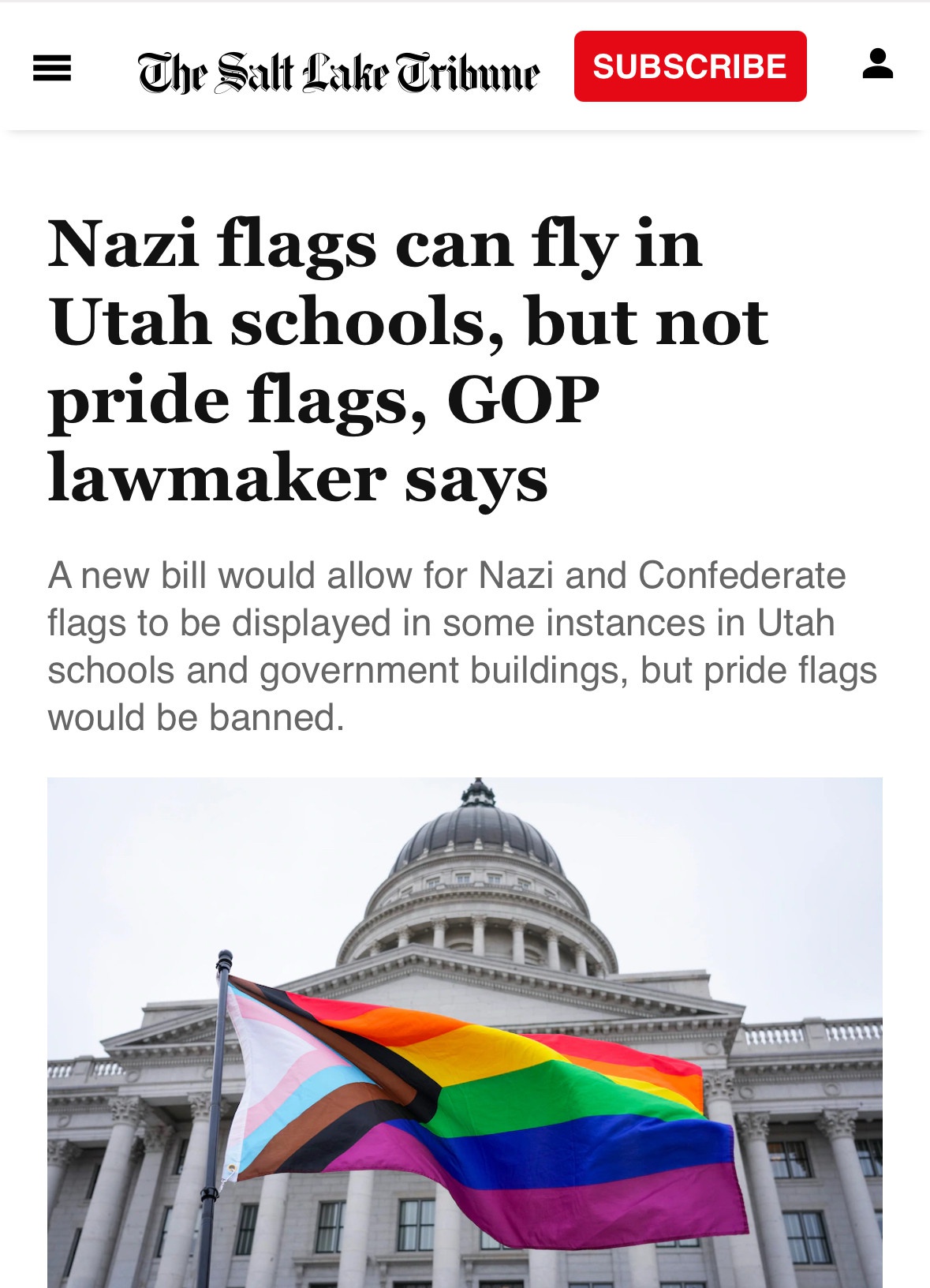
Utah GOP Bill: Ban Pride Flags, But Allow Nazi Flags
Sorry this is both old and I can’t remember if I already posted it. But the GOP is not even trying to hide it anymore. They are Nazi wannabees. Hugs
++++++++++++++++++++++++++++++++++++++++++++++++++++++++++++++++
The Salt Lake Tribune reports:
An ongoing fight in Utah to ban pride flags in schools entered new territory Thursday after Rep. Trevor Lee proposed new legislation to ban the flags not just in public schools, but in any government building or on any government property. The bill, HB0077, originally applied only to schools. But an update to the bill released ahead of Thursday’s House Education Committee hearing expands the ban to all government buildings or property.
Approved flags for display in government buildings and schools would include the Utah state and U.S. flags, military flags, flags for other countries, flags for Native American tribes and official flags for colleges and universities. The bill also allows for the flying of a “historic version of a flag … that is temporarily displayed for educational purposes,” which Lee, R-Layton, said would include the Confederate and Nazi flags.
Read the full article. In his floor speech, Lee said, “You may have a Nazi flag. You may have a Confederate flag, and so you are allowed to display those flags as part of the curriculum, and that is okay.” An attempt to ban Pride flags failed in 9-20 Utah Senate vote last year. As you’ll see in the video report below, Lee has a history. His X feed is mostly retweets of prominent cultists and extremists. He’s also attacking the “dumb” report linked above.


 Scottie's Playtime