These hateful Christian bigots think any mention or media showing that LGBTQ+ people exist is pornography. It isn’t and makes a mockery of protecting kids from real porn. But they use these words and equate any mention or sign of LGBTQ+ with porn to make it seem as harmful and dangerous as showing hardcore rape porn to children. See the quote below. Their goal is again to wipe any mention of the LGBTQ+ from society and public view. They learned from Putin who used the same protect the children tactic. Think of this if this bill passes how do they justify the Bible in libraries and schools? But these people want a straight cis white male dominated society where they get to force their church doctrines on the public. However these same people scream parental rights or religous freedoom if you ask them to give others respect and equality. They want to oppress everyone else but any attempt to get them to give the same respect they demand for their ideas to others who have different beliefs is persecuting them. Hugs
On the full House floor, sponsor Rep. Doug Bankson called HB 1119 a “commonsense policy that answers a simple question: Should pornography be available to minors in our schools?”
‘Our focus right now is on making legislators aware of the bill’s constitutional problems.’
The Foundation for Individual Rights and Expression (FIRE) is urging the Senate to kill a bill passed by the House that First Amendment advocates fear will increase book banning in Florida schools.
“Library book removals can raise serious First Amendment issues,” FIRE’s Public Advocacy Director Aaron Terr wrote in a letter last week to Senate President Ben Albritton. “The bill creates a powerful incentive for individuals to object to any book they dislike or consider inappropriate, knowing it will be immediately pulled from circulation for all readers.”
The House passed HB 1119 via a 84-28 vote following a partisan debate. An identical Senate bill (SB 1692) has not moved in the upper chamber since it was filed last month.
HB 1119 would block schools from considering the literary, artistic, political or scientific value of books if the material is deemed otherwise harmful for minors.
On the full House floor, sponsor Rep. Doug Bankson called HB 1119 a “commonsense policy that answers a simple question: Should pornography be available to minors in our schools?”
“The answer is an emphatic no,” he told lawmakers.
Bankson and other Republicans argued some inappropriate books still exist on the shelves because of a loophole from the application of the Miller Test, which is a Supreme Court decision dealing with adult material.
The Apopka Republican filed similar legislation last year that advanced in the House but died in the Senate.
FIRE argues that HB 1119 goes too far.
“To be clear, not every book is appropriate for every student,” the Philadelphia-based First Amendment advocacy nonprofit wrote in the letter.
“Again, FIRE recognizes that school districts have a responsibility to assess whether library materials are appropriate for students of different ages. But any such assessment must be carefully crafted to ensure that students are not broadly denied the opportunity to read age-appropriate works that speak to their particular interests.”
The bill wouldn’t allow school officials to take into account the full content of the book or if the work has serious literary, artistic, political, or scientific value for minors of any age since it doesn’t consider grade levels, FIRE said.
“These elements of the Miller test are critical to preventing censorship of literature, art, medical textbooks, history texts, and other speech that depicts or alludes to sex simply because someone finds them offensive,” FIRE said.
“In other words, older students’ access cannot be restricted based on what may be unsuitable for younger children. But HB 1119 disregards this commonsense principle. It requires districts to ‘discontinue use of the material’ if they determine it is ‘harmful to minors,’ without regard to age or grade level.”
Florida passed a 2023 law that allows people to challenge book titles they find offensive for young people in schools.
“Under the current statute, Florida school districts have removed hundreds of books from libraries, including titles that are by no stretch of the imagination ‘pornography’ and come nowhere close to the legal definition of obscenity,” FIRE said in the letter.
“The Florida Department of Education’s own report shows that during the last school year, literary classics and widely acclaimed modern works — including ‘One Hundred Years of Solitude,’ ‘A Clockwork Orange,’ ‘The Human Stain,’ ‘The Kite Runner,’ and ‘Life of Pi’ — were removed even from libraries serving students in grades 9-12. If enacted, HB 1119 will only accelerate this trend and further narrow the range of ideas on school library shelves.”
When asked by Florida Politics whether FIRE would sue if the Legislature passes the bill, the organization did not answer.
“Our focus right now is on making legislators aware of the bill’s constitutional problems,” FIRE spokesman Jack Whitten said. “That’s a decision that would require internal discussion and depend on various factors.”
Gabrielle Russon
Gabrielle Russon is an award-winning journalist based in Orlando. She covered the business of theme parks for the Orlando Sentinel. Her previous newspaper stops include the Sarasota Herald-Tribune, Toledo Blade, Kalamazoo Gazette and Elkhart Truth as well as an internship covering the nation’s capital for the Chicago Tribune. For fun, she runs marathons. She gets her training from chasing a toddler around. Contact her at gabriellerusson@gmail.com or on Twitter @GabrielleRusson .
It’s a blog entry by Jenny Lawson, about one of her books. I haven’t been able to open her WP blog for a few weeks, now; I get the page that says it’s an unsafe connection. I either don’t know how, or can’t get a whole post in the WP Reader, but I did get this whole post in email, so I’ll copy & paste it here. Jenny is funny, but this is not good news about Texas and literacy.
This is not what I wanted to write. I wanted to write about how I’m about to go on book tour for my new book in a few days. Instead I am writing about the fact that I was just informed that my first book Let’s Pretend This Never Happened was banned from the high school library of a nearby town I love and visit often.
Honestly, I’m not that upset about my book being banned. I’ve had so many letters from young people who felt they’d been helped by my books but it does have some profanity and so I can understand the reasoning even if I disagree with it. What I am upset about is the stories about how New Braunfels ISD has pulled more that 1,500 books from their school library shelves after the Texas’ Republican-backed book banning law (senate bill 13) passed. The bill ordered all public school libraries to review books for “profane” and “indecent” content and I guess Let’s Pretend This Never Happened was deemed too dangerous for high schoolers.
Weirdly, my book was not on the original list of the 1,500 books triggered for review on March 13 but a week ago it was added to the New Braunfels ISD website as being removed for being “non-compliant”. (I’ve been called worse.) I guess 1,500 books weren’t enough. But then, it’s never enough for book banners.This is going to happen more and more. It used to be a rarer thing…almost a badge of courage to have a book banned. Now? It’s everywhere…this war against books and ideas and people. Reading is how you fall in love with people different from you, and how you develop compassion for them…because if you love them, you want to protect them. But there are some people who don’t want you to love others. They need you to fear them.
Books save lives. They have saved mine. Books are safety nets for so many of us, and right now those nets are being cut.The list of banned books is incredible in length and includes so many that I adore. Equally upsetting is the fact that so many classics that shaped me have been pulled from the shelves and placed into restricted sections where they can only be accessed by students enrolled in Advanced Placement Literature, because God forbid a normal high school student would want to read the works of dangerous writers like *checks the list* Jane Austen and Emily Brontë (whose name they misspelled).
Sometimes it feels like we’re living in A Brave New World (restricted) and that the book burning of Fahrenheit 451 (restricted) is closer than ever, with no Sense and Sensibility (restricted) about what this will cost. It feels like we’re going through The Crucible (restricted) and are caught in a Catch-22 (restricted) where we can’t convince people how terrible it is to ban books because they either don’t know the power of books or they absolutely know it and fear it. It’s An Absolutely Remarkable Thing (banned) how book banners go out on some kind of A Discovery of Witches (banned) and fight against Acceptance (banned) and of diversity, while we are losing All The Beauty in the World (banned). America is a Beautiful Country (banned) in so many ways, but we will lose so much of that beauty if we don’t make Changes (banned) to cherish and embrace and grow what makes us Educated (banned) and compassionate. The diversity of voices is necessary…it is a reflection of who we are and who we want to be. A plethora of ideas and voices and experiences…This Is What America Looks Like (banned). We can’t just pretend that Everything’s Fine (banned) and that this is just an overreaction of Anxious People (banned). Do you think this is what the founding fathers like Alexander Hamilton (banned) envisioned? I’m going to stop here because I’m sure you can see that this dumb paragraph is WAY TOO EASY TO WRITE because there are so many books they have issues with and you probably get the picture already but y’all….Jane Eyre? The Color Purple? The Odyssey? Crime and Punishment?? THIS IS WHAT WE’RE SAVING TEENAGERS FROM?
So what can you do? You can buy books that are being targeted, especially those written by the LGBTQ+ authors or authors of color because they are being targeted the most. Supporting those authors tells publishing to keep producing those books because they are needed. Publishers will lose money if libraries become afraid to purchase books and so we need to make sure that they know the audience is there and greedy for diverse voices. Get a library card and start checking out those books and more, to prove to the government that libraries need funding and that people care about reading. Read to your children. Read in front of your children. Talk online about the books that you love so that your passion ignites others. If you’re a parent you can get involved with your school to make sure this doesn’t happen in your school and you can protest it if it happens. You can vote out the people who seem to be obsessed with freedom, but mainly when it’s their freedom to take away yours and your children’s. You can run against school board members who are book banners and show up at the meetings. You can keep updated by following organizations like PEN AMERICA, or the Texas Freedom to Read Project or Authors Against Book Bans.
*deep breath*
This is probably filled with typos and is not really the sort of thing that I should be writing the day before I leave to start my book tour but it’s important. When books and thoughts and people are suppressed, we all lose. Keep fighting the good fight, friends. It’s worth it.
Again all this is about is a Christian nationalist desire to mimic Russia and remove all LGBTQ+ representation from the public view in the name of “protecting children from porn” as if just being or media representing LGBTQ+ people is pornographic and sexual. These people feel anything not straight and cis is sexualizing and abusing children simply because they do not want the LGBTQ+ people to exist. Hugs
Side note. Ron got home last night 3-2-2026 about 6 pm. I made him a supper of a salad and two hamburgers with the fixings. He was so happy. I was happy. We went to bed and snuggled which made Tupac who has snuggled me every night a bit unhappy but he pressed in from the other side. All day Ron and I have been together, unloading the car, doing laundry, Ron started on the floors in the kitchen, and we are making a pork tenderloin, potatoes, brown gravy, carrots, and greenbeans for supper. It is so good to have my husband home. I understood why he had been gone for the better part of three months but it sure is grand to have him home. I feel better, anxieties lower, and happy feeling up. Also for those worried I was not eating which I was not, I ate like a pig at a trough tonight, having a first heaping plate of everything and then going back for a second heaping plate. The end of the second one was a bit challenging to finish but I did. I offered to pick up the last bits of left overs but ron said he would do it. I think he noticed I was trying to hide that I was swaying and wobbleing when I walked due to my pain levels. Hugs
Discussion of gender is not sexualization. Making books available to students that represent the diversity of their experiences and showcase the numerous ways to be a person in the world is not sexualizing them. Such an interpretation says far more about the adults and the perspectives they’re applying to books than it does about the books or their intended audiences.
Following this week’s State of the Union Address, House Republicans worked quickly to advance legislation to ban books from public schools nationwide. House Resolution 7661 (H.R. 7661), also known as the “Stop the Sexualization of Children Act” would modify the Elementary and Secondary Education Act of 1965 by prohibiting use of funds under the act “to develop, implement, facilitate, host, or promote any program or activity for, or to provide or promote literature or other materials to, children under the age of 18 that includes sexually oriented material, and for other purposes.”
The bill was introduced by House Representative Mary Miller (Republican, Illinois). 17 additional Representatives cosigned it.
H.R. 7661 is an anti-trans bill, and tucked within its provisions are those that ban books for those under 18 that “include sexually oriented material.” This is the same vague language used in numerous states across the U.S. to ban books from public schools and public libraries. This bill includes “lewd” and “lascivious” dancing as prohibited topics or themes. No such books for young readers exist, but facts don’t matter to a regime seeking total and complete control.
The bill goes on to further define “sexually oriented material” as anything broaching the topics of “gender dysphoria or transgenderism.” The latter is an intentionally harmful word used as a cudgel to harm trans people. Such a broad definition also ensures that this kind of bill could be applicable in any situation where it would benefit the banners. It isn’t a stretch to see a bill like this used to outright ban all books by or about LGBTQ+ people under the guise of it being “sexually oriented.”
Though this legislation would apply to institutions using funds from the Elementary and Secondary Education Act of 1965, there’s little question that it would expand to include all public libraries, not just those in public schools. We’ve already seen this very thing play out across the country.
These local-level policies, alongside state-level policies like Iowa’s Senate File 496 and Idaho’s House Bill 710–both still working their way through numerous lawsuits–provided the roadmap for the proposal of federal-level book ban legislation. It was only a matter of time, and the ongoing onslaught of anti-trans legislation and rhetoric that has grown exponentially under the Trump-Vance regime made this the prime moment.
Discussion of gender is not sexualization. Making books available to students that represent the diversity of their experiences and showcase the numerous ways to be a person in the world is not sexualizing them. Such an interpretation says far more about the adults and the perspectives they’re applying to books than it does about the books or their intended audiences.
You can read the full text of H.R. 7661 here, including its list of cosponsors. Right now, your best way to have your voice heard about this hateful and discriminatory bill is to call your House representatives and urge them to veto this bill at every opportunity. There are years’ worth of resources from which you can pull about where and how all of these bills are calculated and targeted, and you can pull from the numerous ongoing lawsuits challenging similar bills and policies at the local and state level. Let your lawmakers know that you’re watching them and their voting records, especially if they’re among the roster of those proposing the legislation.
These bills aren’t about removing books; books are just one of the tools. These bills are about the complete and total erasure and removal of queer people from American life.
Don't be fooled by this bill's name– this is a book banning bill that will exclude LGBTQ books from all public schools NATIONWIDE.Call your congresspeople and tell them to VOTE NO on this nakedly bigoted book banning bullshit. http://www.congress.gov/bill/119th-c…
The conflation of porn and LGBTQ (but specifically trans) issues is purposeful. It's part of the Project 2025 plan to criminalize LGBTQ+ ppl.It starts with books. It moves to bathrooms. Then it moves to govt IDs. We're in it already.You don't need to be an expert to see where this goes next.
Nazi Republican Mary Miller who has quoted Hitler in the past now wants to ban strippers in public schools…and she's all in with banning any book that dares mention LGBTQ+ issues…www.lgbtqnation.com/2026/02/gop-…
This is simply a push by religious groups to force their church doctrines on the rest of the public. I also they think if kids don’t see representations of LGBTQ+ kids people in media they won’t become LGBTQ+ or accept others who are. They are incorrect. It is about a small group of people trying to force the majority of people to be at like them. These people don’t like letting other people be themselves, they demand the right to run other people’s lives and to manage other people’s kids. As the report says this is pushed hard by Christian nationalists who demand the right to enshrine their church doctrines into civil laws and force their religious views on the entire nation. Hugs
Texas A&M University, earlier this month, banned a philosophy professor from teaching about Plato’s Symposium because it’s too gay (well, in their words, for discussing “gender ideology”), and, while obviously philosophy classes should be allowed to teach about Plato and state lawmakers and administrators shouldn’t be interfering in curricula… they are right that the specific texts that they banned are pretty gay.
If the legislators’ and administrators’ goal is to make LGBTQ+ people feel more isolated and alone as a way of getting them to conform and pretend to be cisgender and heterosexual, this won’t be enough to accomplish that goal — however, it’s a necessary step towards that goal.
I grew up in the ’90s in a conservative part of central Indiana, and I went to college on the other side of the country, determined to get away from everyone I knew and to live my life as I wanted. One of the classes I had to take in my first semester at college as an 18-year-old freshman was a survey of Western civilization-type class that included Symposium as one of its readings.
I still remember the professor warning us in the class prior to reading Symposium that the text was about “love” and that, for Plato, that very much included love between two men. This was 2001, pre-September 11, just a couple of years after Ellen DeGeneres came out, and at a time when homosexuality was illegal in many states, so, yes, we got a “trigger warning,” and the potential trigger was a discussion of homosexuality.
It’s hard to say what impact that book had on me. Pretty much the only mentions of homosexuality in grade school that I remember from Indiana were the slurs kids would throw around every other sentence, the jokes and insults that were never any deeper than calling someone gay, the Christians randomly arguing (against no one!) that homosexuality was sinful, the casual discussions of violence against gay people (I grew up in the days when fantasizing putting all gay men on an island and dropping a bombshell on them was just a normal thing for people to talk about, like the weather)… and here I was — a freshly minted adult among other adults — talking about Plato, the famous philosopher who (pretty much every adult my whole life had said) was an important historical figure. And Plato was gay. Maybe not “gay” in the modern sense, but he was writing books about loving men, and that was close enough for me.
[This] is why MAGA wants to end liberalism itself. To them, people are workers, soldiers, baby-producing machines, not human…. It’s a cold and sad way of looking at the world.
One of the passages that Texas A&M University had an issue with was Aristophanes’ speech about the origin of love. The short version is that, in the distant past, humans rolled around like balls with four arms and four legs and two faces. Some people were all male, some all female, and some a mix. They were powerful and a threat to the gods, so Zeus cut them all in half. Now they (we) spend our lives looking for our other half and holding on when we find them.
While the point of the story isn’t an explanation of why some people are gay and others are straight, it’s baked in, and modern readers are going to notice that Aristophanes is saying that same-sex love has the same origin as opposite-sex love. They’re all just normal variants of human sexuality, and it’s not something that anyone else in the book even comments on. That is, same-sex love is just another legitimate expression of love that comes from the same place, at least for Aristophanes. Others in the book have different opinions about male same-sex love, but none are disapproving.
I wasn’t the only one to take that message from that story. I have heard it mentioned by other queer people throughout my adult life. It featured prominently in the late-90s musical (and later film) Hedwig and the Angry Inch. It’s a part of the queer lexicon.
“The ‘gender ideology’ of this tale comes to us from the fourth century BC,” writes Guardian columnist Osita Nwanevu. “And philosophers in the many centuries since have examined it not only for what it tells us about the Greeks in Plato’s day but for what it might tell us, as far removed as we might be from ancient Athens, about sex, love, and longing. It is a tale about universal aspects of the human experience philosophers have examined in the service of understanding what it means to be a human being.”
Nwanevu’s larger point is that the underlying ideology of the presidential administration — as shown in Stephen Miller’s claim that the world is “governed by strength” and Vice President J.D. Vance’s statement that America is nothing more than a “homeland” for “people with a shared history and a common future” — is really selling people short. What it means to be human is much more than mere strength and domination, and America is supposed to be an idea and an ideal, not just a piece of land where we live.
LGBTQ+ rights flourished in the post-war world, as did other human rights protections; ending the constant spats over pieces of land inspired people to understand that there’s a lot more to being human…
That is, America is supposed to be about all people’s inherent value and right to “Life, Liberty and the pursuit of Happiness,” not Miller’s “iron laws of the world” — those of “might makes right” — that Nwanevu rightly calls “the laws of animals.”
This is fundamental to how the global neo-fascist movement sees the world: For them, everything is about domination and resource-hoarding. All other considerations are secondary.
It can be seen in the attacks on LGBTQ+ rights that are often justified by pointing to a decline in the birthrate, or in the attacks on humanities and social sciences at universities, degrees that many claim (often incorrectly) don’t pay well. This can be seen in the complaints that schools shouldn’t teach kids to be more tolerant of diverse people — a necessary skill in a multicultural world where we all get along — and should instead teach them the bare minimum of reading, writing, and arithmetic (and, since it’s the 21st century, how to code). It can be felt in the right-wing mockery of art and arts funding when they never have complaints about spending money on military equipment that will never (and should never) see combat.
And it’s in this horrifying Greenland business, which is what Miller was talking about when he was discussing “the iron laws of the world.”
| Shutterstock
On the one hand, invading Greenland would end NATO, end all sorts of ties between the U.S. and Europe, and end the peaceful world created in the latter half of the 20th century that led to prosperity in the West and an end to the wars for territorial expansion that defined Europe for millennia.
On the other hand, Greenland looks kinda big on Mercator-projection maps, and adding a big splotch to the part of the world labeled “United States” would make the president feel like he actually accomplished something of value in his life.
It shouldn’t be surprising that LGBTQ+ rights flourished in the post-war world, as did other human rights protections; ending the constant spats over pieces of land inspired people to understand that there’s a lot more to being human, to be concerned with their own and other people’s happiness, and to try to live up to the ideals laid out in previous centuries.
Which is why MAGA wants to end liberalism itself. To them, people are workers, soldiers, baby-producing machines, not human. Our worth is measured in terms of how much stuff we can produce, how much we can contribute to our nation’s domination over other nations. Individuals’ fulfillment and happiness are secondary. It’s a cold and sad way of looking at the world.
So Plato, of all people, is taking a beating in Texas. Learning about philosophy opened my mind when I was young and taught me to ask questions about what life could offer. (The part of Symposium about how homosexuality results in intellectual reproduction instead of biological reproduction like heterosexuality wasn’t even on the syllabus at Texas A&M, but I still haven’t forgotten about it.)
In the war on human-ness itself, LGBTQ+ identities will always be one of the first victims. That’s why they don’t want us learning about ourselves.
Subscribe to the LGBTQ Nation newsletter and be the first to know about the latest headlines shaping LGBTQ+ communities worldwide.
I can’t understand living just to hate and harm others who are not doing anything that harms you. To carry that bitterness and to work so hard to deny to others what you demand for yourself seems like poisoning one’s self. With so much to enjoy in diversity and inclusion why work so hard to create a homogeny of everyone being the same. Hugs
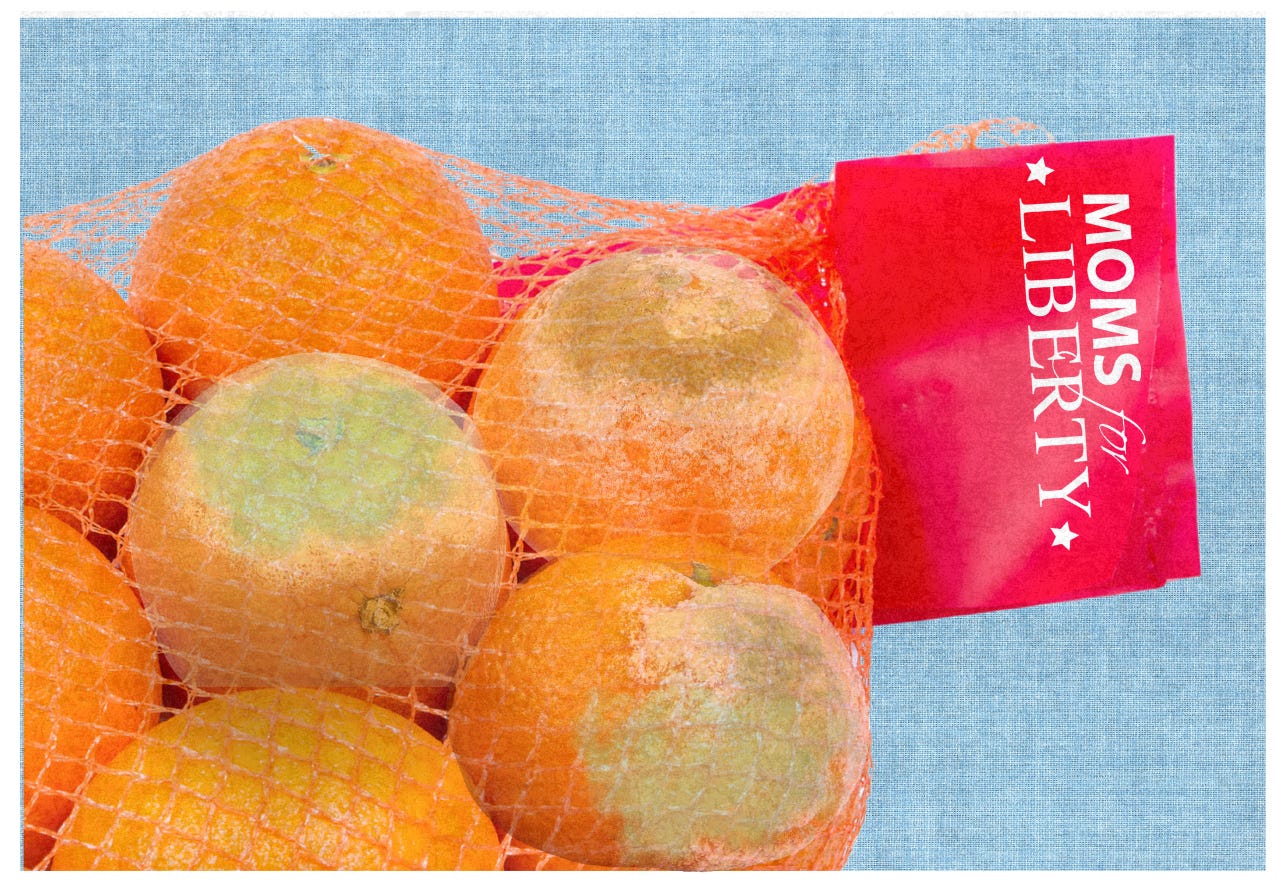
As the M4L annual summit kicks off this weekend, here’s how one of the group’s original chapters is sowing chaos and pushing anti-LGBTQ policies in Indian River County.
Mink Tyner says some people call her a “helicopter parent” because of how protective she is over her kids. Despite this, she wasn’t concerned about bringing her daughter, then 14, to the Indian River County, Florida, school board meeting in August 2023, where they were discussing changes to the state’s curriculum relating to race and slavery.
That’s why she was shocked when she saw community members at the podium reading excerpts of sexual content from books.
“I hate lights out now because my D has a mind of its own,” one woman read. Then a man came up and read, “When Doris had just turned 11, her current stepfather started having sex with her.” And a third person read, “He took a long long time peeling off my jeans and T-shirt, pink bra and panties, and a longer time stroking and kissing me.”
The meeting had turned into more of a stunt led by protestors affiliated with the local chapter of Moms for Liberty (M4L), a Southern Poverty Law Center-designated far-right extremist group.
“I’m not gonna have my kid in here listening to these adults doing this shit,” Tyner remembers thinking.
She took her daughter out of the room and pleaded with security to intervene, but they refused. So she spoke up to disrupt the meeting herself, only for security from the Sheriff’s office—who told Uncloseted Media their deputies responded “appropriately and in accordance with established procedures”—to escort her out.
As she was leaving, conservative pastor John Amanchukwu, who had attended the meeting with M4L, confronted her while recording a video that he would later post to X calling her “demonic” and lashing out about her being pro-LGBTQ: “You’re okay with DEI. … You’re okay with Pride Month. You’re okay with the rainbow flag. You’re okay with all that junk,” he yelled. Tyner responded by calling him a “fucking weirdo” and walked out.
That video opened a floodgate of harassment that tormented Tyner and her family for years: She received insults, accusations of pedophilia, and persistent threats of violence from a Facebook account displaying the name CURTIS COUSINS who called her a “fent-using fat fucking dyke” and told her she deserved to have “a potato peeler peel her clit right off to the bone.”
“I never know if this week or 10 years from now somebody’s gonna show up [to my business] based on some kind of misinformation that Moms for Liberty started about me [or] want to harm me and my family,” Tyner, who owns a tattoo shop, told Uncloseted Media.
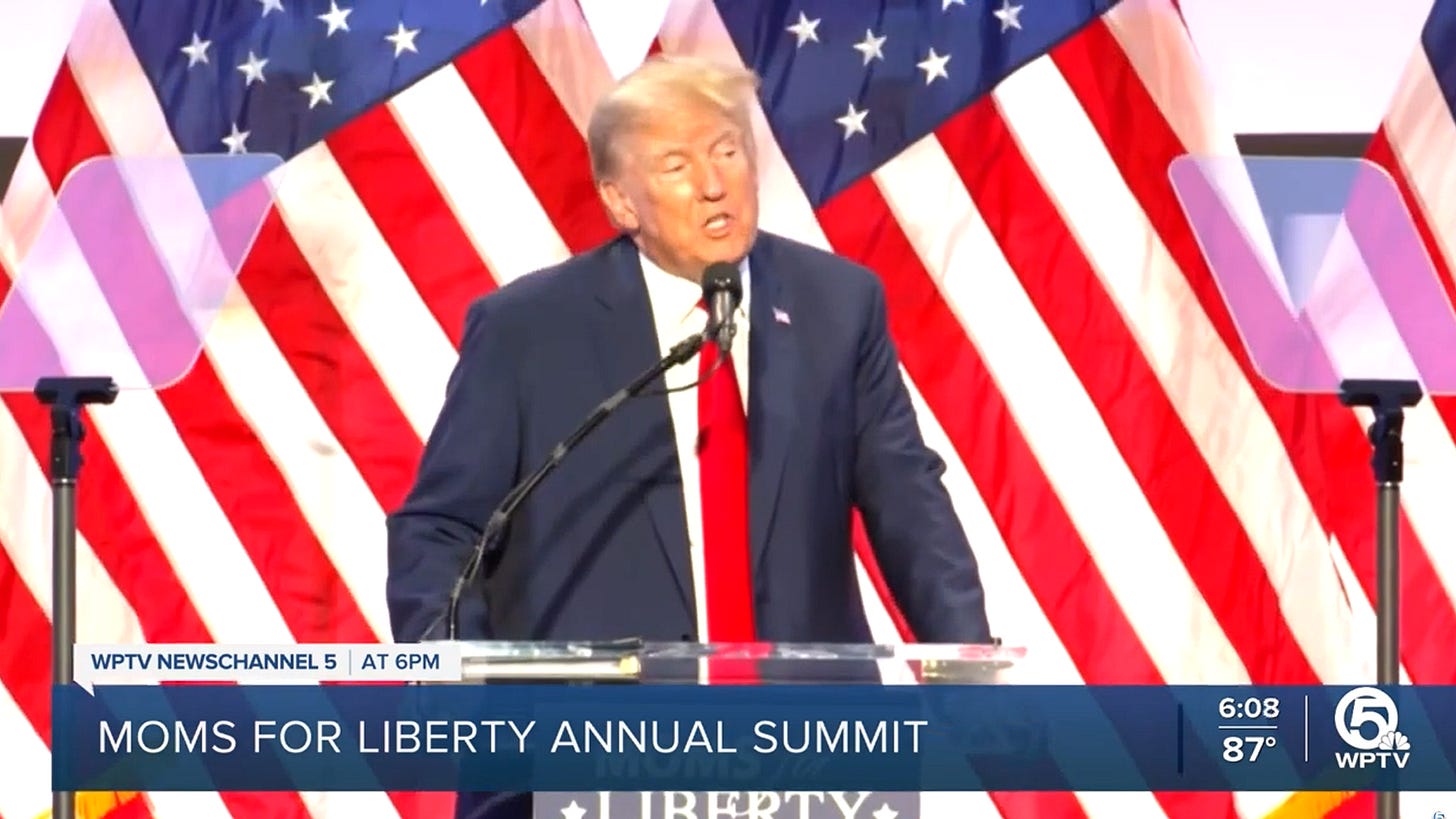
Indian River County is home to one of the first of M4L’s 320 chapters nationwide. The group’s annual summit is this weekend and will feature a variety of politicians with anti-LGBTQ track records, including Oklahoma’s former state superintendent Ryan Walters, who made headlines for making anti-trans comments after the death of 16-year-old trans teen Nex Benedict. Last year, conservative heavyweights spoke at the event, including President Trump, Tulsi Gabbard and Sebastian Gorka.
Over the last four years, M4L have built a reputation for chaos and controversy. Members have made the news for quoting Hitler, stripping at a school board meeting and offering bounties to report teachers who teach about “critical race theory.”
At one point in Indian River County, close allies of M4L made up a majority of the school board where they pressured the district to ban scores of books, many of which contain LGBTQ themes, and reverse a racial equity policy—all while harassing, doxing and defaming their adversaries.
Maurice Cunningham, a retired professor of political science from the University of Massachusetts, says what’s playing out in Indian River County is a microcosm for so many other chapters across the country.
“[The media are] falling like suckers for this story that they’re a grassroots moms organization. They are not, they are connected to … the far right establishment,” he says. “And that’s become … more and more apparent. So this whole grassroots thing is hogwash.”
Beginnings
Moms for Liberty was founded in Florida in 2021 by three current and former school board members: Tiffany Justice, Tina Descovich and Bridget Ziegler, the latter of whom has since left the group after being involved in a sex scandal wherein her husband allegedly prowled local bars to solicit women for threesomes.
Shortly after M4L launched, Justice tapped Jennifer Pippin, who had made a name for herself for leading activism against COVID-19 restrictions, to lead the chapter for her home county, Indian River.
While the anti-mask circles that would later be folded into M4L always had a conservative lean, multiple county residents told Uncloseted Media that the group’s discriminatory views were not initially apparent.
Tyner, a lesbian who identifies as politically independent, actually felt welcomed by the group when she worked with them on their anti-mask mandate advocacy. However, that changed as M4L’s focus turned towards opposing LGBTQ inclusion measures in schools.
“Once they organized and got the appearance of a grassroots start … and many people in the community that were siding with them, it’s like they took the steering wheel and they just steered another direction,” she says.
When Tyner began speaking up against this rhetoric, she says she was blocked from the group’s Facebook pages. But as she continued to oppose them publicly, Justice offered to meet with her to address her concerns.
Over breakfast at a local cafe, Tyner says Justice gave her a “scripted” response in the hopes of winning back her support. She even invited Tyner to an M4L chapter meeting. However, Tyner declined as the meeting was allegedly to be hosted by a community member who had made an online post suggesting necrophilia and pedophilia are part of the LGBTQ umbrella.
“I was like, ‘Alright, this is not a good or a safe movement,” says Tyner.
Justice did not respond to a request for comment. In an email, Pippin told Uncloseted Media that M4L have “members and members children that are LGB in [their] chapter and across the country.”
Another local parent, who requested anonymity due to concerns about his job security, says while he’d initially been on board with M4L’s parental rights advocacy, he ran into conflict with the group when they started opposing the school district’s racial equity policies and tried to ban books with antiracist themes, including Ibram X. Kendi’s “Antiracist Baby”and “Stamped: Racism, Antiracism, and You.” Like Tyner, he says he was approached by Justice and Pippin to win him over again but was ultimately unconvinced.
After he split from M4L, he began publicly criticizing the group’s book bans. In retaliation, some M4L members accused him of supporting pedophiles.
When he reached out to Pippin to ask for the people making such accusations against him to be held accountable, he says she waved him off—all while blocking him on social media and accusing him of “bullying.” He also says that she doxed him after another dispute—a major factor in his decision to remain anonymous.
“Her response to me basically was ‘free speech,’ ‘we don’t control what our members say.’ And I’m like, ‘But Jennifer, you know me, and you know I’m not a pedophile, and this is unacceptable,’” he told Uncloseted Media.
Building Political Power
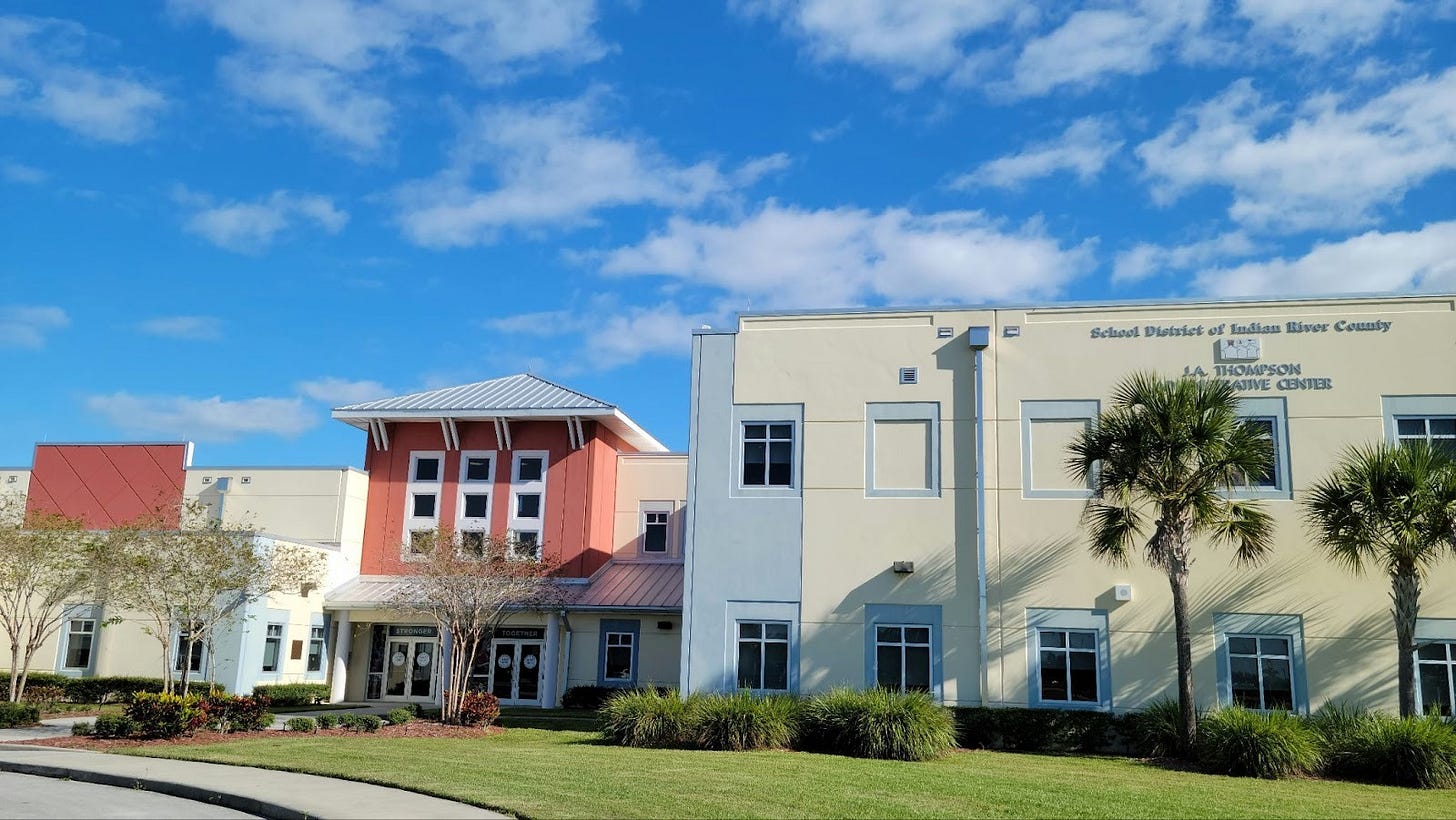
The Indian River County School District’s J.A. Thompson Administrative Center. Photo by Kiran891.
Efforts to ban LGBTQ and racial justice-related books in schools are part of M4L’s national ammo that helped them quickly explode in popularity.
Cunningham says M4L were boosted by high-profile connections on the right. Ziegler and Descovich both served as presidents of the Florida Coalition of School Board Members, a group billed as a conservative alternative to the Florida School Board Association. Ziegler’s husband, Christian, was vice chairman of Florida’s Republican Party at the time and worked as a media surrogate for the Trump campaign in 2016.
Since their launch, M4L have had their conferences and events sponsored by the Heritage Foundation and the Leadership Institute; were directly advised by Leadership Institute founder Morton Blackwell; and were a part of Project 2025’s advisory board. And this summer, Justice was hired as executive vice president of Heritage Action.
In 2022, the Indian River County chapter leveraged this influence to carve out power in local government: They got two close allies, Jacqueline Rosario and Dr. Gene Posca, elected to the school board, and they developed closerelationships with the Ron DeSantis-backed county sheriff Eric Flowers. Pippin was even appointed by Florida’s Department of Education to a statewide workgroup to develop compliance training for Florida’s classroom censorship policies, including the infamous “Don’t Say Gay” law.
As M4L became notorious for pushing exclusionary measures in schools, some officials—including school board member Peggy Jones—criticized the group. In retaliation, Jones reportedly received so many death threats that the district had to increase security detail at all school events where she was present.
In the midst of increasing chaos surrounding M4L, the group mounted a campaign of hundreds of requests to ban books containing “sexual content.”
While some librarians continued to hold the majority of books where bans were unsuccessful, M4L convinced Flowers to investigate one school library, alleging that keeping the books on the shelf could constitute a sex crime. While the investigation found that no crime had been committed, Flowers concluded that “we do not feel that this content is appropriate for young children,” putting even further pressure on local librarians.
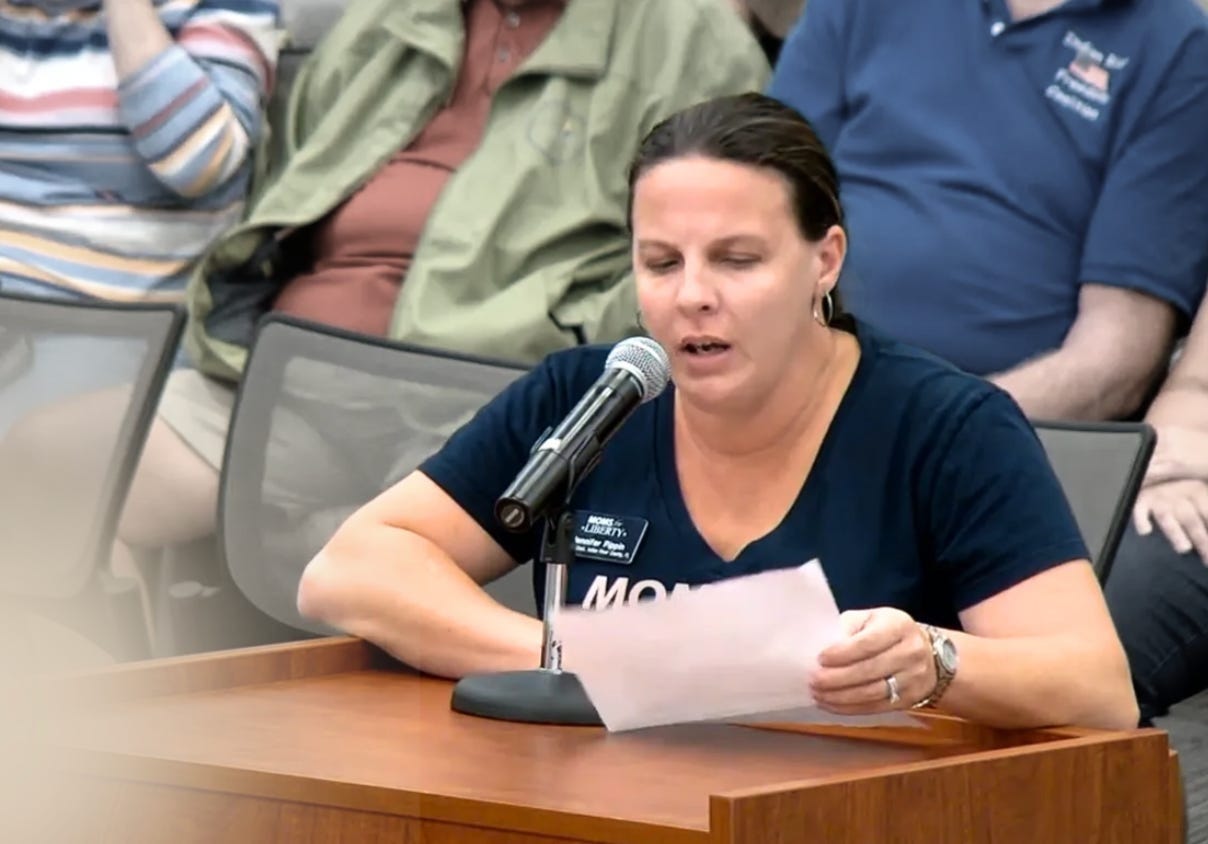
Pippin at the school board meeting in August 2023. Photo via YouTube.
This kind of direct action proved very effective. Even the reading protest where Tyner was escorted out won them 34 additional book bans from a unanimous board vote.
“You can’t deny that the kind of tactics that they have have been useful,” Cunningham says. “Some of the places they’ve taken over, [including] Sarasota County, where Bridget Ziegler was on the board, became much more conservative over the past few years.”
Silencing Opposition
In addition to school board meetings, the group has a track record of trolling progressive events. Tyner and the anonymous parent remember an incident where a group of M4L members showed up to a local National Association for the Advancement of Colored People (NAACP) meeting that had been organized to discuss plans for opposition against new state regulations that required classes to portray slavery in a more positive light.Tyner says white M4L members attempted to shout down NAACP speakers, with one member allegedly using the n-word. Thomas Kenny, a M4L member who was at the event, said this “did not happen” and that one of their members using the n-word is “an absolute lie.”
Cunningham says these disruptions are part of M4L’s playbook. He pointed to the example of Jennifer Jenkins, the liberal school board member who unseated Tina Descovich in neighboring Brevard County, who says protestors spurred by M4L have turned up outside her home calling her a pedophile and burning “FU” in her lawn.
“They [use the] same kind of tactics … over and over again,” says Cunningham.
Pippin
Chapter leader Jennifer Pippin has mastered those tactics, becoming widely known as one of the most influential book banners in the country. She’s also made headlines for filing a complaint against the Kilted Mermaid, a Vero Beach wine bar, alleging that they had hosted an all-ages drag event with sexual content, which the bar owner denies. M4L rallied against the bar online, spamming the posts of one of the bar’s drag performers, telling the queen to “stay away from children.” This stunt caught the attention of Florida’s Attorney General James Uthmeier, who launched an investigation and issued subpoenas for video recordings of the bar on the day of the event as well as identifying documents for employees and performers.
Pippin has also claimed to be a nurse, despite no public records showing that she has a license, and appeared on the antisemitic and homophobic far-right news website TruNews, where she claimed, without evidence, that anti-M4L activists have been killing pets and livestock owned by the group’s members.
Fear
Tyner and the other anonymous parent both say that they’ve had to take a step back from the school board and local activism because of the toxic environment M4L have created.
“It’s been turned into such a circus,” Tyner says.
In the meantime, things have gotten worse for the LGBTQ community in Indian River County, and in Florida overall, between the “Don’t Say Gay” law and anti-LGBTQ legislation that requires teachers to deadname trans students unless they have signed parental permission slips. The anonymous parent says he’s watched many of the LGBTQ people in his life, including one of his own children, who is a teacher, leave the state due to the hostile environment.
“It’s not safe for a lot of people,” he says.
Greener Pastures?
Despite all of this, a sea change may be on the horizon. A 2024 Brookings report found that the success rates of M4L-endorsed candidates were on the decline, and in Indian River County’s elections last year, both of M4L’s school board candidates lost. With the continued controversies of the Trump administration and the growing popularity of groups that oppose M4L’s ideology, Cunningham feels the tide may be turning for M4L’s influence in Indian River County and across America.
“In school board races, the Moms for Liberty label is toxic, so try to not get attached to that,” he says. “They’ve had quite an impact … I don’t wanna downplay that. But in terms of popular appeal and growth, I think it’s much more limited than it is portrayed.”
Editor’s Note: In an email, Jennifer Pippin responded to the allegations made about her in this story. You can read them here.
If objective, nonpartisan, rigorous, LGBTQ-focused journalism is important to you, please consider making a tax-deductible donation through our fiscal sponsor, Resource Impact, by clicking this button:
What amazes me is how frightened straight cis hegemony is over anything that is different from how they live / perceive the world. They can’t seem to be able to live in a society with people who are different from them or how they live. It scares them to their core and makes them think the world is ending. They reject anything that moves from their past comfort zones. The idea of coexistence with others is emotionally shattering to them. They are so fragile. So small in their thinking. They need to make sure anything different is not seen as if removing all evidence of it makes it not exist anymore. That is so stupid I shouldn’t have to address it. But OK let me explain, in the 1950s the only representation of homosexuality was negative and strongly biased toward hating, yet gay kids were born to straight parents, the entire LGBTQ+ had no representation yet all existed. Hugs
Lawmakers in Kazakhstan are following the lead of Russian President Vladimir Putin with a bill to ban so-called “LGBTQ propaganda” in the former Soviet republic.
The lower house of Kazakhstan’s parliament on Wednesday approved the measure outlawing “LGBT propaganda” online and in the media, with fines mandated for violators, and up to 10 days in jail for repeat offenders, Reuters reports.
The legislation now moves to the Kazakh senate, where it’s likely to pass.
President Kassym-Jomart Tokayev has expressed support for the anti-LGBTQ+ bill, which, like similar laws passed in Russia, Georgia and, Hungary, has been promoted as a bulwark against “degenerate” values imported from the West.
“Children and teenagers are exposed to information online every day that can negatively impact their ideas about family, morality, and the future,” Kazakh Education Minister Gani Beisembayev told lawmakers before the vote.
Deputy Irina Smirnova cited library books and cartoons featuring same-sex relationships as examples of the “propaganda” addressed by the bill.
“I saw books in the library that promote LGBT, where a prince falls in love with a prince, two boys,” she told lawmakers. “There are cartoons that allow this to be shown, there are magazines and comics where all this is promoted.”
For months, President Tokayev has lobbied hard for passage of the bill — which is essentially copycat legislation of Russia’s own “anti-LGBTQ propaganda” measure — stressing the need to uphold what he and Putin call their countries’ “traditional values”.
Parties loyal to Tokayev dominate the lower house and voted unanimously in favor of the ban.
With the fall of the Soviet Union in the 1990s, Kazakhstan legalized homosexuality as it drew politically closer to Europe and the West.
But while the Muslim-majority nation is officially secular, it remains deeply conservative when it comes to social issues. With Putin‘s prodding, far-right politicians have exploited those social fissures to push the country back into Russia’s sphere of influence.
“We live in an independent and sovereign republic. Or are we already a colony of the Russian Federation?” Zhanar Sekerbayeva, co-founder of the feminist initiative, Feminita, asked at a recent LGBTQ+ rights roundtable in the country.
Arj Tursynkan, an activist with the NGO Education Community, explained that language in the legislation was sweeping.
“Because of these amendments, people can be punished for anything – jokes, drawings, hugs,” he said.
The activist argued that the legislation is not just a legal text, but a test of Kazakhstan’s commitment to international norms of dignity and freedom.
Ahead of the vote, Belgium-based group International Partnership for Human Rights condemned the measure, saying it would “blatantly violate Kazakhstan’s international human rights commitments.”
Subscribe to the LGBTQ Nation newsletter and be the first to know about the latest headlines shaping LGBTQ+ communities worldwide.
Whistleblower Rutherford County Library Systems Director Luanne James claims the RCLS Board Chair, Cody York, instructed her to remove multiple books from the public library system without following the rules to do so.
James claimed York had checked out books he wanted banned and kept the books for so long they were marked as lost and then removed from the system. James also said York asked her to gather a list of library patrons’ personal information, including which books they checked out.
“Names of the patrons, their addresses, their ZIP codes, their barcodes, how many children and how many adults were in each household and what they were checking out,” James told the RCLS Board Monday night.
According to RCLS, James was appointed as the new Library Director, which went into effect on July 28. James claimed she was at her job for only two days before she was instructed to remove books.
During Monday’s meeting, York denied all James’ allegations and denied any wrongdoing, saying he requested patrons’ ZIP codes to see which patrons lived outside the county so they could pay an additional $25 fee to hold a library card. With regard to the missing books, York shifted the blame back to James.
“Does policy allow one board member or the chair to remove books?” York asked James during the board meeting.
“No,” James replied.
“So why did you do it [remove books]?” York said. “…I’m not denying that I told you these books should not be in the library, but I can’t make a decision to remove them — that’s your decision.”
A local advocacy group called the Rutherford County Library Alliance believes the following books listed are missing and had been removed from the library:
“Forever” by Judy Blume
“Over the River and Through the Wood: A Holiday Adventure” by Lisa Marie Francis Child
“The Antiracist Kid” by Tiffany Jewel
“Making a Baby” by Rachel Greener
News 2 hasn’t been able to independently confirm these specific titles are missing.
“If a librarian has put a book in our library, it’s because our community needs it, so by bypassing all of the professionals and saying, ‘Well, I don’t like it, so it should go because I don’t want my kid reading it,’ that goes against the First Amendment,” Keri Lambert, Vice President of the Rutherford County Library Alliance, told News 2.
“I believe it’s all driven by one motive only: to basically eliminate a certain class of people from the library collection as if they didn’t exist … To figuratively put them back in the closet, if you will,” Frank Lambert, a Library and Information Science Associate Professor at Middle Tennessee State University, told News 2.
News 2 reached out to Chair York, who responded with a statement:
“I categorically deny the allegations made against me last night.
The Rutherford County Library System has only two approved methods by which a title may be removed from the collection under our policies. Library staff may remove a title if it no longer meets the collection standard, such as relevance, condition, accuracy, or other established criteria, through the normal weeding process. A title may be removed by a vote of the Library Board, but only after the formal reconsideration process is completed. This process includes a written request, staff review, and a vote in an open public meeting.
Those are the only mechanisms permitted. No board member can direct the Executive Director to bypass either process. Raising questions about whether books in the collection meet our collection standards is not inappropriate.”
When News 2 reached out to the whistleblower, Luanne James, we received an Out of Office email, indicating she may still be employed by the library system.
Hey if these people can outright lie about the LGBTQ+ community, willing to let LGBTQ+ kids die or be pushed via violence into the closet hiding who they really were, what is faking your expertise. I already posted about a sexologist who had no experience with trans kids testifying to red state legislatures enabling his bigotry to further the harm to trans kids by giving an excuse for theirs. These people are on a mission that is far from pure but one driven by hate and bigotry to make all kids pretend to be straight and cis in the hope that they can force all adults to pretend to be straight and cis also. If they can’t force the adults to pretend to be straight or cis at least they can stop the trans adults from looking like the gender they identify with in hopes of stopping those that are passing as the gender they identify as. This they hope will mark those people in ways that make their life harder. Again their lies are OK for them because either they think their god approves or their hate is that great so nothing but the mission matters. Hugs
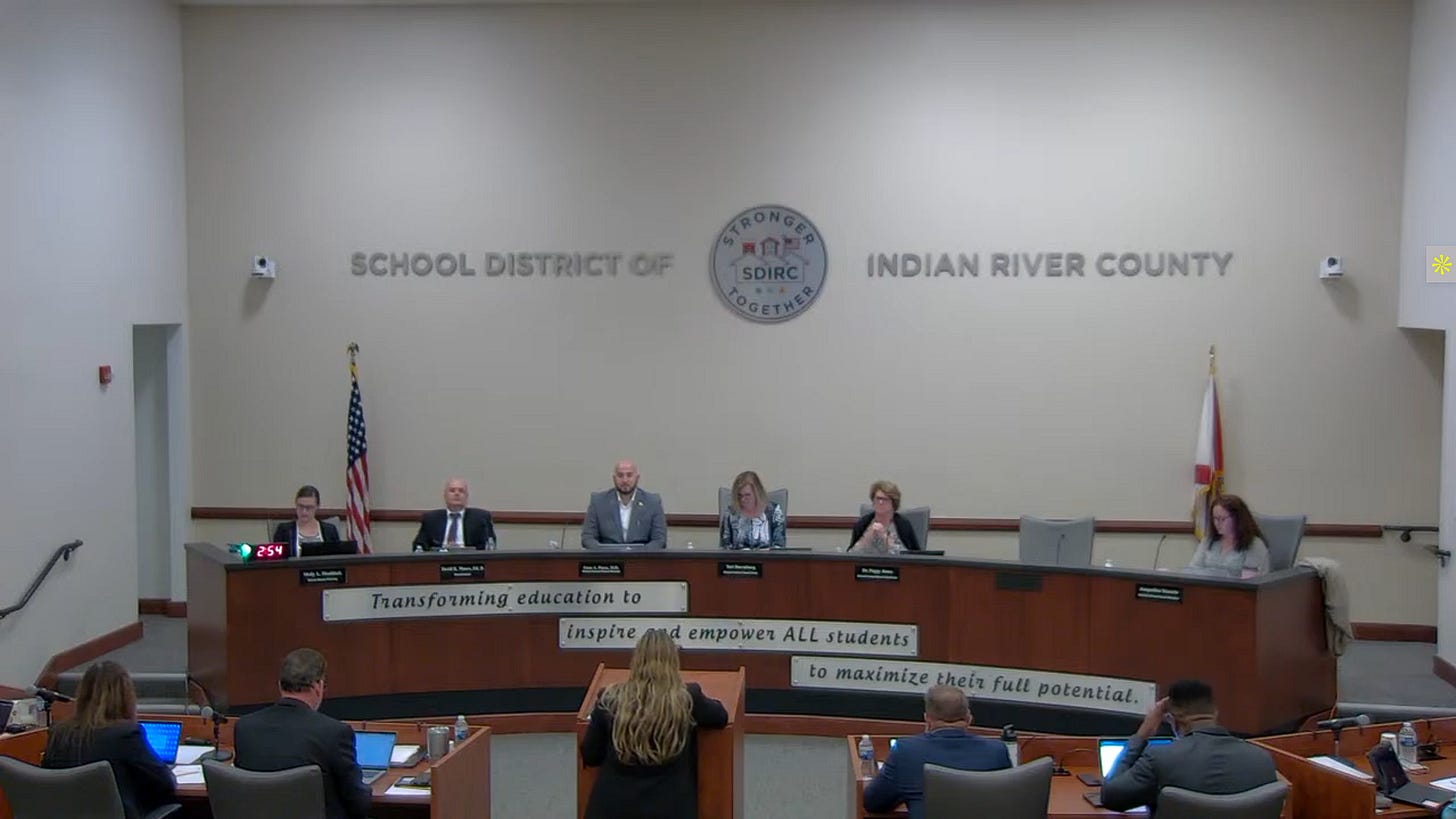
Pippin testifying in favor of book bans at a school board meeting in 2023 (screenshot / YouTube).
Subscribe
Jennifer Pippin has repeatedly claimed to be an operating room nurse. USA TODAY, the New York Times, TC Palm and other publications have cited her as such. In 2020, Pippin argued that wearing masks to prevent the spread of COVID-19 was unnecessary, citing her professional expertise.
“As a registered nurse, I’ve learned a bit. I’ve learned a whole lot more though that they won’t tell you in nursing school,” she wrote in a 2020 Facebook post. “Not wearing a mask is NOT A RISK. Not to me and not to anyone else.”
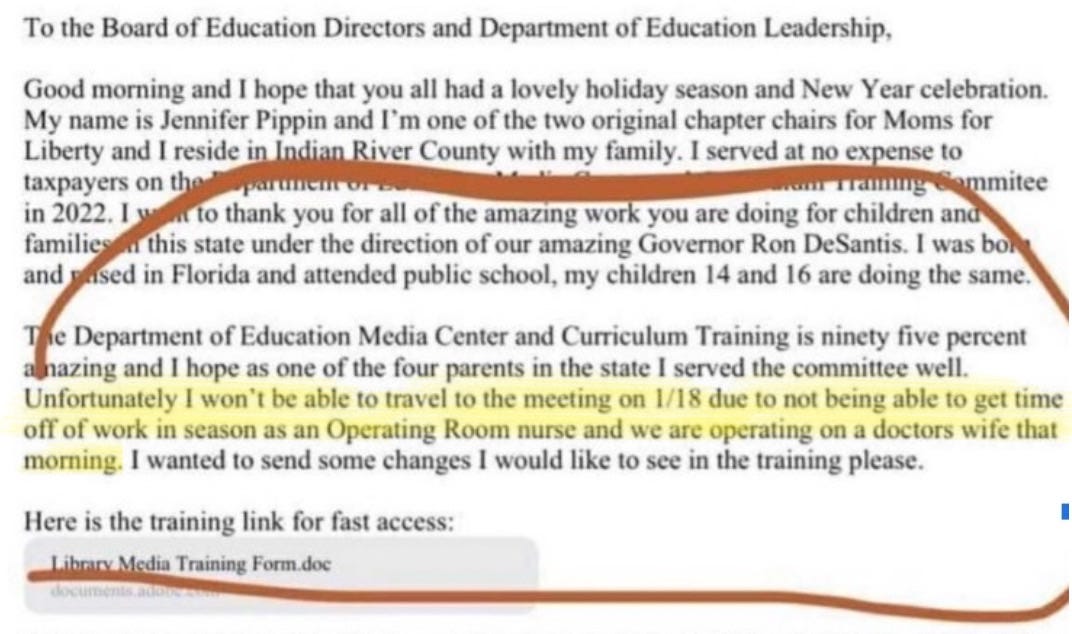
Pippin, now the chair of one of Moms for Liberty’s (M4L) first chapters in Indian River County, Florida, has also mentioned having “medical licenses” while speaking about the group’s accomplishments at a school board meeting. And in an email chain with Florida’s Department of Education, she wrote that she couldn’t make it to a meeting because she was “operating on a doctors wife.”
(Screenshot received from The Florida Fruit Loop, highlight added).
However, allegations have surfaced that these statements might not be true, and the community is growing frustrated. On Facebook, one user decried “the utter misinformation that has spewed out of [Pippin’s] mouth any time she’s shared her thoughts about public health issues.” Another sarcastically wrote that they were “shocked … to find out Jenny is a liar!!”
“We reported this years ago, but because [M4L] were so powerful politically here in Florida with Ron DeSantis, we had no voice, nobody cared,” Cindy Gibbs, a local parent and former school board candidate, told Uncloseted Media.
Subscribe for LGBTQ focused, accountability journalism.
Subscribe
Is She Really a Nurse?
Despite Pippin’s claims of being a nurse, there is a stack of evidence suggesting otherwise. One individual shared screenshots of emails they received from a Florida Department of Health (DOH) official in 2024 after they filed a complaint against Pippin when they noticed her license wasn’t turning up in database searches. In one email, the DOH official states that Pippin had been under investigation since April 1, 2024, for potentially misrepresenting herself as a nurse and that no license had been found.
Uncloseted Media also filed a public records request with the DOH for the license. In an email, they said they were “unable to find anyone licensed by the department matching the information … provided.” The department did not respond to a request for further comment.
In addition, Uncloseted Media was unable to find any license associated with Pippin in the Florida Department of Health’s medical license database or the NURSYS database, which records multi-state licensees. We also checked the certification database for the Competency and Credentialing Institute, which certifies certain specialized nurses including operating room specialists, and found nothing.
While records do exist for Jennifer Hughes Pippin, a nutritionist and dietician at Florida State College in Jacksonville, her listed address and social media profiles do not match the Pippin from Indian River County.
The Florida Nurses Association also did not find any record of Pippin’s membership.
Multiple sources and news articles say Pippin was formerly employed by the Cleveland Clinic Indian River Hospital. Despite this, Uncloseted Media was unable to confirm she held a position there. The hospital declined to comment on the status of current or former employees as a matter of policy.
The only employment information we found listed for Pippin later than 2021 was in a Sebastian City Council meeting agenda from 2023, where she says she is “self employed” working for Organize Me!, a gig-based home cleaning service.
Why It Matters
Falsely presenting as a nurse is a phenomenon that has been on the rise since the start of the COVID-19 pandemic.
Pippin’s case, though, is of particular interest because she is often cited as an influential figure in Florida politics. In her role with M4L, Pippin has filed hundreds of requests to ban books—many of which include LGBTQ or racial justice themes—from school libraries. Some of the books she’s requested to ban include a graphic novel adaptation of “The Diary of Anne Frank” and “All Boys Aren’t Blue,” a memoir about growing up Black and queer.
In 2022, Pippin was also appointed by the Florida Department of Education to a workgroup of parents tasked with developing a training for state educators to comply with the classroom censorship laws signed by Governor Ron DeSantis, who has spoken at a M4L summit. One of these laws is the notorious “Don’t Say Gay” law, which prohibits educators from teaching about sexual orientation or gender identity.
And earlier this summer, she filed a complaint against a Vero Beach wine bar for hosting an all-
ages drag event, which she alleges contained performances with sexual themes. The bar’s owner, who is also a city official, denies the allegations.
This is not M4L’s first brush with controversy. The group’s co-founder, Bridget Ziegler, allegedly assisted her husband in sexually assaulting another woman. An Indiana chapter came under fire for quoting Adolf Hitler in a 2023 newsletter. And the group has hosted speakers who’ve spread medical misinformation on multiple occasions, claiming that doctors are “sterilizing and mutilating [trans] children” and that gender-affirming health care is “snake oil.”
Subscribe
Pippin’s Response
When presented with these allegations, Pippin did not provide any evidence of a nursing license. In an email, she told Uncloseted Media that she was “surprised to see these allegations being raised again — especially considering they were addressed over a year ago.” She pointed to a prior case involving stalking and said the answers about whether she is a licensed nurse can be found via that case. However, the case and its associated documents are not available online.
Pippin testifying before the Indian River County School Board (screenshot/YouTube).
Pippin has previously stated that the reason her license is not publicly accessible is because she was ordered to “hide [it] from the public for five years” after filing a fraud suit in 2020 against someone who she says had used her license to file for unemployment. In emails with Uncloseted Media, she reaffirmed this story.
While Uncloseted Media was unable to verify the existence of this fraud case, experts say that such a decision from the court would be “unusual.”
“We have fought to make nurses licenses private and have been unable to do so even in at-risk areas,” says Willa Fuller, executive director of the Florida Nurses Association.
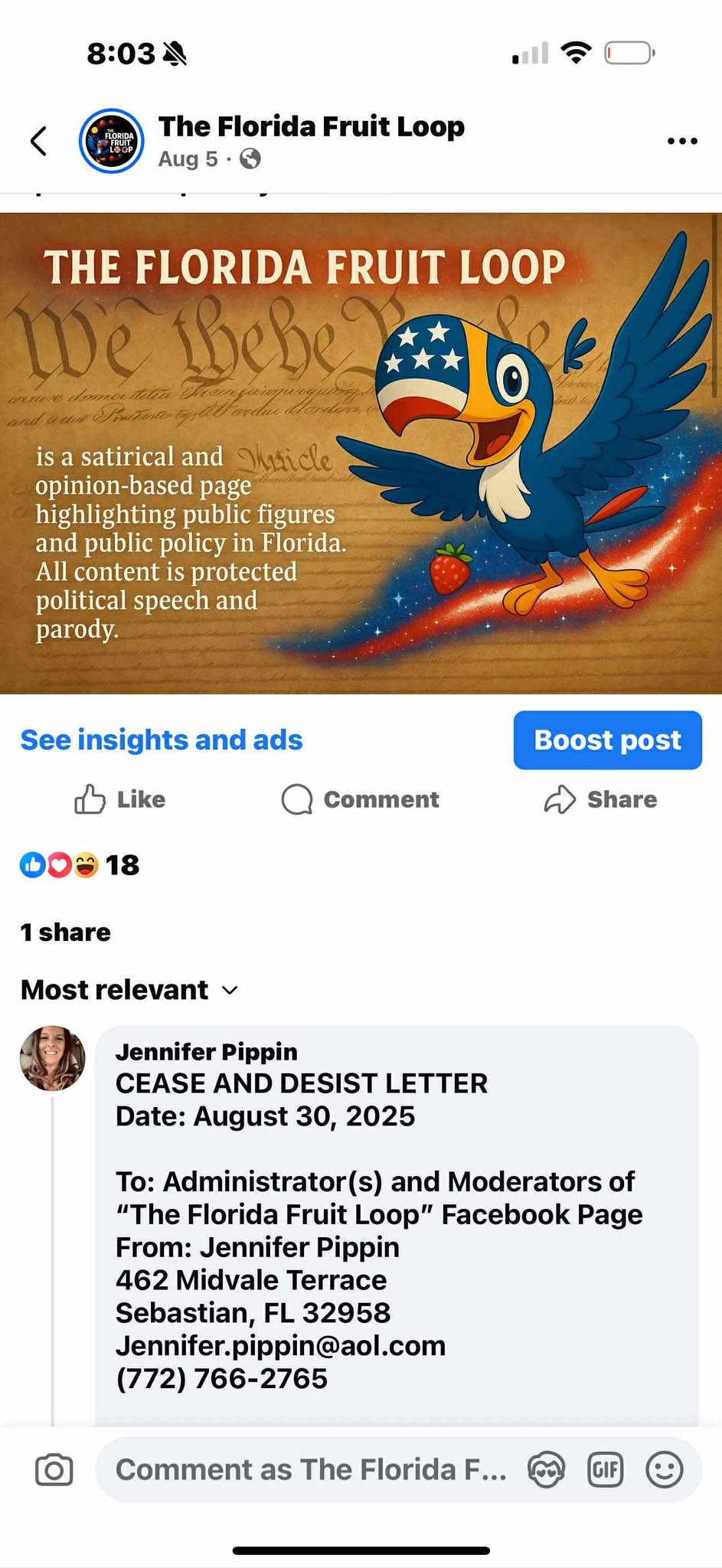
Multiple people in Indian River County say that Pippin’s questionable nursing status has been an open secret for years, but the issue didn’t start attracting wider attention until it was covered by The Florida Fruit Loop, a local Facebook page that promises to provide “a daily dose of MAGA butthurt.” Last weekend, Pippin left a note in the page’s comments titled “CEASE AND DESIST LETTER,” where she called multiple statements made by the page defamatory. However, the notice does not mention or dispute any allegations made about her nursing license.
The intro to Pippin’s comment (screenshot received from The Florida Fruit Loop).
The Implications
Falsely presenting as a nurse is a crime in Florida under certain circumstances, with one woman being arrested in the state for this just last month. However, in emails reviewed by Uncloseted Media, a DOH official cautioned that the laws only apply in specific cases.
“For those statutes where an unlicensed person is allegedly holding themselves out as a licensed healthcare provider to apply, the Subject would need to hold themselves out / lead the public to believe they are a current and active licensee,” the official wrote.
While the full results of Pippin’s investigation have not yet been released, the individual who corresponded with the DOH says the department later informed them that their complaint “lacked … a criminal finding.”
The DOH official did note, though, that the video of Pippin’s testimony before the school district could be considered a violation. Pippin has also publicly used the formal title “registered nurse” on multiple occasions, including in a rant against masking posted to the Republican Club of Indian River’s Facebook page in 2020; in a Department of Education report; and in Vero News.
“She has been out here presenting herself as an authority on things in the world of health care and education,” says Cindy Gibbs. “And the groups of people that she associates herself with … just keep generating and regenerating the same stuff: ‘oh, Jennifer knows things because she’s a registered nurse.’”
If objective, nonpartisan, rigorous, LGBTQ-focused journalism is important to you, please consider making a tax-deductible donation through our fiscal sponsor, Resource Impact, by clicking this button:

Gabrielle RussonFebruary 23, 2026
‘Our focus right now is on making legislators aware of the bill’s constitutional problems.’

 By thebloggess on March 25, 2026
 Shutterstock

 Russian President Vladimir Putin | Shutterstock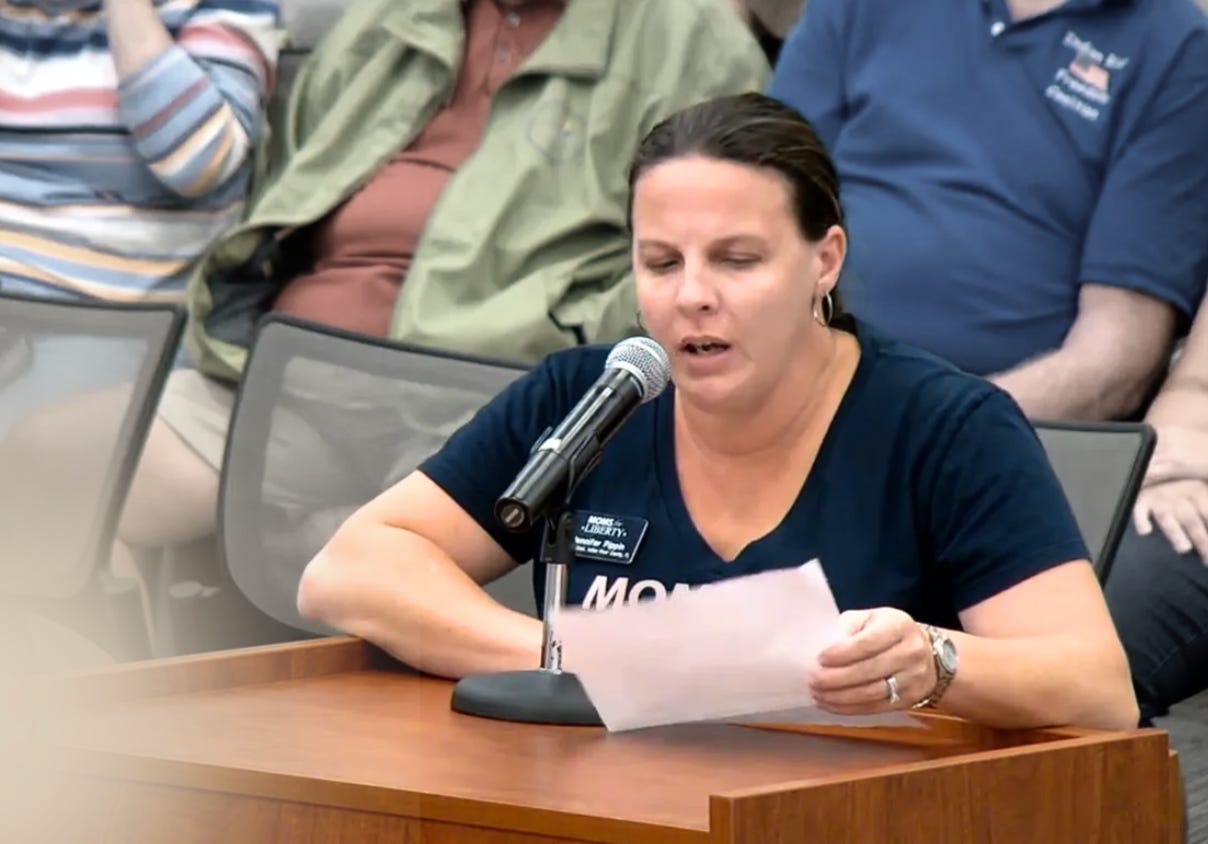
 Scottie's Playtime
