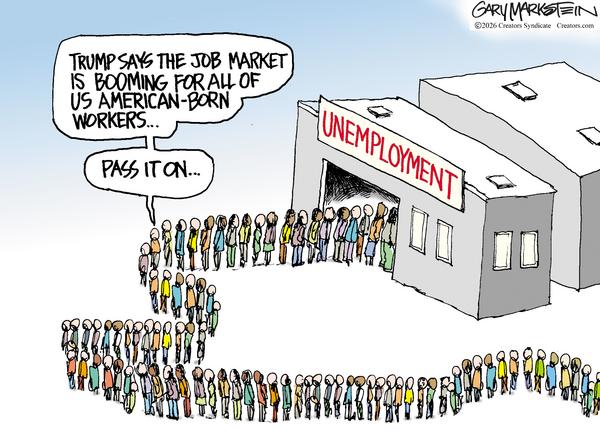
tRump has never purchased anything personally like normal people. He doesn’t go to stores and shop. He has always been a pampered rich boy even in bankruptcy. I don’t know about anyone else but Ron and I have to stretch our first half of the month income to be able to afford groceries and medications. We ended last month with $30 in the checking account. This month is always bad for us. So I want to know where this lowering of costs are. Ron wears me and the car outgoing from store to store to get the best deals. We suffer in too cold or too warm a house to keep the electric bill down. But yes Florida is a high cost of living state, would love to move, but … yup we can’t afford it. Hugs.
Donald Trump’s claims about bringing down prices comes just weeks after he told families to limit the number of presents that they buy for their children
like 75% of dem messaging right now should be “the party led by epsteins best friend is breaking into pre-k childcare centers so they can record your toddlers and put the videos on internet”
One of the reasons given by people that voted for tRump, that he would lower prices of stuff. Yup that was dumb. They also claim that he speaks like they do so they understand him. I ask why do you speak as hateful as him? They also think he cares about them, a man who was a born millionaire and who lives in golden penthouses is just a man of the people? A man who thinks money is the most important thing in life doesn’t care if poor people live or die. Hugs
As President-elect Donald Trump readies to return to the Oval Office, U.S. retailers that depend on foreign suppliers are prepared to pass along the cost of his proposed import tariffs to consumers, potentially leading to higher prices for a range of products.
Americans stand to lose between $46 billion and $78 billion in spending power each year on products including apparel, toys, furniture, household appliances, footwear and travel goods due to the new tariffs, the National Retail Federation stated in findings released Monday.
“Retailers rely heavily on imported products and manufacturing components so that they can offer their customers a variety of products at affordable prices,” NRF Vice President of Supply Chain and Customs Policy Jonathan Gold said in a statement. “A tariff is a tax paid by the U.S. importer, not a foreign country or the exporter. This tax ultimately comes out of consumers’ pockets through higher prices.”
For example, a $40 toaster oven would retail for $48 to $52 after the tariffs, while a $50 pair of running shoes would jump to to $59 to $64, according to the industry trade group. A $2,000 mattress and box spring set would cost $2,128 to $2,190, the NRF said.
During President-elect Trump’s first term in office, his administration imposed tariffs of up to 25% on more than $360 billion in products from China. President Joe Biden’s White House kept most of those tariffs and added more onto goods including Chinese electric cars and microchips.
Now, Trump has said he plans to impose a 60% tax on goods from China and a 10% to 20% levy on all of the $3 trillion in foreign goods the U.S. imports annually. Such sweeping tariffs would reignite inflation, as they would mostly be paid by U.S. consumers, Treasury Secretary Janet Yellen has warned, offering a general view widely shared by other economists on both sides of the political aisle.
“A consistent theoretical and empirical finding in economics is that domestic consumers and domestic firms bear the burden of a tariff, not the foreign country,” the nonpartisan Budget Lab at Yale University stated in an analysis published in mid-October.
Trump has repeatedly contended that foreign companies would foot the bill, telling a gathering last month at the Economic Club of Chicago that “the countries will pay” the tariffs. In reality, American importers pay the tariffs to the U.S. Customs and Border Protection agency when their goods cross the border.
“These policy steps would amount to regressive tax cuts, only partially paid for by regressive tax increases,” and cost a typical middle-income household about $1,700 in increased taxes a year,” according to economists at the Peterson Institute for International Economics. The proposed tariffs would shift tax burdens from the well-off to lower-income Americans, the nonprofit also stated in a policy brief published in August.
For now, it is unclear when the new Trump regime could seek to stiffen tariffs. The process to complete legislation required to raise the levies could take nearly a year, so any adverse impact might not be felt until 2026, according to Oxford Economics.
Harvard University professor and former U.S. Treasury Secretary Lawrence Summers questioned the wisdom of taxing imports, noting the potential impact on prices. “For parents, we’re coming up on the holiday season and most of our toys are imported from China,” Summers tweeted on Thanksgiving Day.
Trump has argued that tariffs compel American companies to make goods on U.S. soil rather than purchasing from foreign suppliers.
But some companies have other plans.
“If we get tariffs, we will pass those tariff costs back to the consumer,” Philip Daniele, CEO of vehicle parts supplier AutoZone, told Wall Street analysts in an earnings call in late September. “We’ll generally raise prices ahead of — we know what the tariffs will be — we generally raise prices ahead of that,” Daniele said.
Major suppliers to AutoZone include companies based in China, India and Germany, according to the company.
Stanley Black & Decker CEO Donald Allan Jr. said last week his tool-producing company has been planning for the possibility of additional tariffs on imports since the spring. “Obviously, coming out of the gate, there would be price increases associated with tariffs that we [would] put into the market.”
Allan downplayed the idea of moving manufacturing back to the U.S., saying it would not be cost-effective. The company’s options could include “moving production and aspects of the supply chain to different parts of the world,” including from China to other parts of Asia and possibly Mexico, the executive said.
Such a shift has already been made by Shelton, Connecticut-based Acme United, which now has its Westcott brand products like rulers made in Thailand and the Philippines, avoiding the tariffs targeting China, CEO Walter Johnsen said in an October earnings call.
Acme has switched production of certain medical products to India, Egypt and U.S. plants in Florida, North Carolina and Washington state, the executive said.
Businesses have also stocked up, placing bigger-than-usual import orders ahead of new tariffs taking hold, as the U.S. imported 11% more Chinese products in July and August than they did during the same two-month period a year ago, according to the Census Bureau.
As Donald Trump readies to return to the Oval Office, U.S. retailers that depend on foreign suppliers are prepared to pass along the cost of his proposed import tariffs to consumers, potentially leading to higher prices for a range of products. https://t.co/FnazDzizgT



















 Scottie's Playtime