The presidential election has turned into a contest between a capable, smart woman who emphasizes what Americans can achieve when they work together for the common good, and a sundowning old racist creep who would be pathetic if he weren’t so dangerously close to returning to power.
In case you’re wondering what the difference looks like, compare the hate and division the old racist creep is spreading with some recent announcements from President Joe Biden’s administration, nearly all of them about programs funded by one or another of Biden’s big legislative packages. Just a little reminder of why elections matter, and of the legacy that Kamala Harris is committed to building on. For, y’know, the people.
Telling tourists on the Great Barrier Reef about climate change doesn’t negatively affect their trip, according to a new study.
Instead, finds the research, it could be a good avenue to promote climate action for people who wouldn’t otherwise be engaged.
The study, done by a team of Queensland researchers, is published in People and Nature.
“Tourism operators are getting more engaged in learning how they can spread more awareness, given the state of the Reef and how urgent it’s getting,” says lead author Dr Yolanda Waters, an environmental social scientist at the University of Queensland.
“But they still have these concerns – what if it ruins people’s day? People pay a lot of money to go to the Reef.”
The team tested this concern by surveying 656 visitors on a variety of Reef tours that either did or didn’t mention climate change.
Waters tells Cosmos that her background working in Great Barrier Reef tourism provided the stimulus for the research.
“I used to work on the boats out of Cairns, and I went through these experiences of tourists asking questions and not really feeling equipped to answer them,” she says.
“There is this real feeling: how do we talk about this in a way that doesn’t negatively affect the industry?”
Dr Yolanda Waters (right) on the Great Barrier Reef. Credit: Yolanda Waters
The researchers joined forces with 5 Reef tour operators in north Queensland to set up the experiment.
“We tried to get a range of different operators out of Cairns and Townsville, because we were also testing if it depends on the type of experience, the type of boat, if it’s 300 people or a smaller trip,” says Waters.
The researchers and tour staff developed control and experimental climate trips for each tour.
“It really depended on the boat and the type of trip,” says Waters.
“The operators let us work with their staff and design one trip that had no information about climate change specifically – they still had their regular information about marine life and regular day-to-day operations.
“And on other trips, they let us work with the staff to make sure climate change was very clearly incorporated throughout the day.”
This might include marine biologists’ presentations addressing climate change, videos, and posters.
“On the trip back, I went around and surveyed as many tourists as I could,” says Waters.
Visitors were asked to complete a 5-minute paper survey asking about their experience of the trip, and their engagement with climate change.
The researchers found that trips mentioning climate didn’t have a significant effect on visitors’ experiences.
“There was no overall effect on satisfaction,” says Waters.
Credit: Yolanda Waters
People on both trips were interested in learning more about climate change.
“A lot of them wanted to have a chat about it, especially on days where there was no climate information on the boat – people noticed,” says Waters.
But people on trips with climate information weren’t any more likely to be spurred to action on climate change.
“We found that the climate information did increase people’s awareness about the threat, that information did get across to people, but we found that didn’t really translate to people’s willingness to do something when they went home,” says Waters.
This means that the information about climate change could be tweaked to be more solutions-focussed, according to the researchers.
“Our conclusion out of this, which aligns with some of the other research we’ve been doing, is that if tourism is to be this beacon of engaging people with climate change, it can’t just be talking about threats – people really want to know about solutions,” says Waters.
“Most people have no idea how they can help stop the ocean boiling. So that was the opportunity we identified.”
Credit: Yolanda Waters
The research comes shortly after the release of the 2024 Great Barrier Reef Outlook report by the Great Barrier Reef Marine Park Authority, which is compiled every 5 years.
The report found that, while parts of the Reef had declined and parts had improved, the overall state of the Reef remained “poor” and climate change was rapidly closing the window to preserve its health.
The researchers say in their paper that the tourism industry has an opportunity to promote action on climate change, provided it uses the right strategies.
“Two million people visit the Reef every year,” points out Waters. She adds that tourists often place a high amount of trust in the information given to them by guides.
“This is the right place and time to do it, but if tourism wants to really embrace the role, they need to start tailoring those talks and those education materials around solutions and actions that people can take home with them.”
Waters says the tourism operators the team worked with were “very receptive” to the study.
“I think tourism really does want to be on board,” she says.
“Tourism has to change, no matter what happens. And I think they’re starting to really recognise that.”
Biologists have studied an extreme gymnast of the animal kingdom, watching as it moves so quickly it appears to all but vanish.
The globular springtail (Dicyrtomina minuta) is a small but mighty bug that can backflip more than 60 times higher and 100 times longer than its own body length.
This tiny bug grows to only a couple of millimetres and can’t sting, bite, or fly its way out of danger. Instead, its preferred method of avoiding predators is to flip out so forcefully it seems to disappear! (snip-More on the page, with photos)
A study has found promising antibiotic candidates inside bacteria harvested from the deep Arctic Sea.
The research, by Finnish and Norwegian researchers, is published in Frontiers in Microbiology.
Antibiotic discovery has slowed in recent decades, which has exacerbated the risks of antibiotic resistance.
Most licensed antibiotics – about 70% – have been derived from a type of soil-dwelling bacteria called actinobacteria.
“For example, members of the Streptomyces genus produce several secondary metabolites, including clinically useful antibiotics such as tetracyclines, aminoglycocides and macrolides,” says corresponding author Dr Päivi Tammela, a professor at the University of Helsinki, Finland.
But soil isn’t the only place these bacteria can be found.
“Marine actinobacteria found in the sea, on the seafloor, or within the microbiome of marine organisms, have received far less attention as possible sources of antibiotics,” says Tammela. (snip-More on the page)
Countries in the Asia-Pacific region account for 76% of the world’s thermal coal power generation, and many of these plants will need to retire early to meet global emissions targets.
But according to a new analysis, it’s possible to phase these coal plants out and transition to renewable energy while investors still make money.
The study, done by Australian, Singaporean and Chinese researchers, is published in Energy Policy.
“There is a drive and interest from a number of different investors like the Asian Development Bank, but also private sector investors, to finance the early retirement coal fired power plants,” lead author Professor Christoph Nedopil Wang, director of Griffith University’s Asia Institute, tells Cosmos.
Nedopil and colleagues looked specifically at 6 Chinese-sponsored coal-fired power plants in Vietnam and Pakistan.
“With investors wanting to invest in, and ideally also providing lower cost financing for, green projects, refinancing of these coal fired power plants becomes possible at a lower cost,” says Nedopil.
The researchers modelled the future performance of these stations under a variety of financing and geoeconomic scenarios.
“That brought us to the conclusion that, depending on the age of the coal-fired power plant, we can retire these plants earlier than currently envisaged, while reducing the financing cost and therefore increasing enterprise value,” says Nedopil. (snip-More on the page)
The Inflation Reduction Act has sparked a manufacturing boom across the U.S., mobilizing tens of billions of dollars of investment, particularly in rural communities in need of economic development.
The future of those investments could hinge on the outcome of the U.S. presidential election. The prospect of a Republican victory has shaken the confidence of some investors who worry the IRA could be weakened or in a worst-case scenario repealed.
Actual manufacturing investment has totaled $89 billion, an increase of 305% compared to the two years prior to the IRA, according to MIT and Rhodium. Overall, the IRA has leveraged half a trillion dollars of investment across the manufacturing, energy and retail sectors, according to the data.
“It is having a transformative effect within the manufacturing sector,” said Trevor Houser, a partner with the Rhodium Group. “The amount of new manufacturing activity that we’re seeing right now is unprecedented in recent history, and is in large part due to new clean energy manufacturing facilities.”
Some 271 manufacturing projects for clean energy tech and electric vehicles have been announced since the IRA passed, which will create more than 100,000 jobs if they are all completed, according to the advocacy group E2, a partner of the National Resources Defense Council. The investments sparked by the IRA have been a boon for rural communities in particular, Houser said.
“Unlike investment in AI and tech and finance, which is clustered in big cities, clean energy investment really is concentrated in rural communities, and is one of the brightest sources of new investment in those areas,” Houser said.
The IRA has also accelerated the deployment of renewable energy, with $108 billion in invested in utility-scale solar and battery storage projects. Investments in solar and battery storage have surged 56% and 130%, respectively, over the past two years, according to the Rhodium data.
“The more mature technologies, so like wind and solar generation, electric vehicles, those have achieved escape velocity,” Houser said. “They will continue to grow no matter what. It’s a question of speed.”
Trump threats to IRA
But the “manufacturing renaissance” is still in its early stages and remains fragile, Houser said. Without the IRA, the resurgence of new factories would not have taken off, said Chris Seiple, vice chairman of Wood Mackenzie’s power and renewables group.
Former President Donald Trump has threatened to dismantle the law as he advocates for more oil, gas and coal production.
“Upon taking office, I will impose an immediate moratorium on all new spending grants and giveaways under the Joe Biden mammoth socialist bills like the so-called Inflation Reduction Act,” Trump told supporters at a May rally in Wisconsin.
“We’re going to terminate his green new scam,” he said. “And we’re going to end this war on American energy — we’re going to drill, baby, drill.”
Thirty years ago, when Michael Goldberg would dive in the glimmering blue water of the British Virgin Islands, the reefs were teeming with life. “The expanse of these reefs was astounding,” says Goldberg, a cofounder of I.CARE, a Florida-based reef restoration organization. “The corals were so thick and lush.”
Today those reefs are dying. In much of the Atlantic Ocean, including the Florida Keys, where the 61-year-old Goldberg lives, roughly 70-95 percent of the coral is gone, devastated by disease, rising sea temperatures, and other existential threats.
By 2015, as the reefs declined, Goldberg faced a decision. He would either leave the scuba industry — since 2004, he has owned Key Dives, which provides diving and snorkeling on the Keys’ Islamorada reefs — or take action to restore the coral. Fortunately for Florida, the ocean, and humanity, he chose the latter.
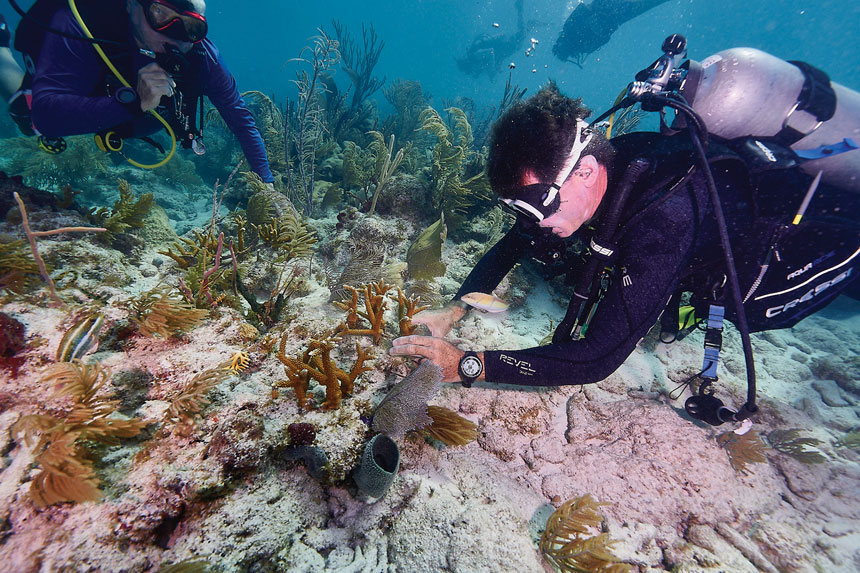
In 2019, Goldberg cofounded I.CARE (Islamorada Conservation and Restoration Education). The mission: To restore and maintain Islamorada’s reefs by teaming with local businesses, residents, and visitors, including local dive shops and recreational divers. Activities range from underwater trash clean-ups — since 2021, divers have lugged 20,000 pounds of debris to the surface — to coral transplants. Over the past three years, I.CARE has planted over 15,000 corals on six different reefs.
The need is urgent. Coral reefs provide food and shelter to thousands of organisms — crustaceans, fish, anemones, sponges — and protect shorelines from storms and erosion. The reefs’ economic benefits include tourism and commercial and recreational fishing. Coral has even been used in medical technologies such as “bone grafting techniques and possible treatments for diseases including Alzheimer’s and cancer,” I.CARE notes.
“I love educating people about the importance of this, but the most gratifying thing for me is seeing the coral grow,” Goldberg says. “I love seeing little baby corals thrive in a harsher environment than I ever imagined, and knowing that despite all the challenges, we’re seeing success.”
Goldberg’s career initially focused on money management rather than ocean management. His love of the water began when he was a boy in Los Angeles, but his family moved to Chicago when he was 10, and he later studied finance at Northern Illinois University. On a summer trip to Acapulco, he dove for the first time, purely, he says, “as a lark.”
“Someone got me some gear, and I wasn’t certified, and I didn’t know what I was doing,” he says. Acapulco is not known for stellar diving experiences, but he loved it: “I was just so enamored with being underwater.”
After that, he was hooked. He earned his diving certification and then moved back to one of L.A.’s beach communities and became an instructor. Before long, he and his wife decided to move to the British Virgin Islands. Eight years later, the couple returned to the United States and opened Key Dives in Islamorada.
Hope and water: “If I wasn’t optimistic, I wouldn’t keep doing this,” says I.CARE cofounder Michael Goldberg. (Photo courtesy Michael Goldberg)
Goldberg has made over 10,000 dives, swimming not only with dolphins and schooling sharks, but within 15 feet of a humpback whale as it breached. And yet the vast coral reefs have always intrigued him most, whether diving alone or taking clients off the island of Virgin Gorda in the British Virgin Islands.
“There was this one unique piece of coral that I would swim underneath — it was like a tree,” he says. “Most people want to see fish, but to me, that coral was always the highlight of the dive.”
In 2017, Goldberg met Kylie Smith, who was working on her Ph.D. at Clemson University and studying coral in the Florida Keys. Smith would fill her tank at Key Dives, and Goldberg, who was “already shifting my business toward conservation,” would tap into her aquatic expertise.
“When I met Dr. Smith, I would pepper her with questions — she couldn’t walk in my store and leave in quick fashion,” Goldberg says. Their discussions eventually moved from the dive shop to a beer garden at The Florida Keys Brewing Company. “We would sit and chat, and I kept saying to her, I’ve got an idea to empower recreational divers so that they can become citizen scientists — not only because they want to be part of the solution, but because they need to be a part of the solution. That’s the largest potential boots-on-the-ground army that can enact so much of what we do.”
Those discussions led them to co-launch I.CARE. By January 2021, volunteer divers had transplanted I.CARE’s first corals.
For the coral restoration, divers use coral raised in nurseries. Once it’s planted on the reefs, the coral will, hopefully, reproduce into a coral colony — but the process is slow. It can take 20-50 years for coral to grow large enough to spawn.
To speed up reproduction, I.CARE uses a process called micro-fragmentation. Larger corals are cut into thumbnail-size pieces and grown in a nursery. When those pieces grow to about the size of a 50-cent piece, they are planted edge to edge on a living coral structure. After a few years, the coral fuse to become one larger coral, and they’ll start to spawn in about 7 to 10 years.
For the micro-fragmentation work, I.CARE rescues coral that has broken free from the main reef structure due to storms and substrate erosion.
“What is cool about these corals is that these are the survivors. They are the most resilient, the ones that have persisted despite all the disease and heat,” says Goldberg. “It’s survival of the fittest in the truest sense, and the ones we are using to rebuild our precious reefs.”
Despite the advances, the challenges are huge, both for I.CARE and the planet. During the intense heat of summer 2023, most of I.CARE’s seemingly healthy coral fragments died at one of Goldberg’s favorite reefs. “I cried underwater,” he admits. But he prefers to focus on the organization’s victories. Seventy-seven of the fragments survived and are thriving.
“If I wasn’t optimistic, I wouldn’t keep doing this,” he says. “We’ve had successes, and we can build on those successes.”
When it comes to restoring the reefs for future generations, he offers a simple vow: “We’re not gonna give up.”
Ken Budd has written for The Washington Post, The Atlantic, The New York Times, National Geographic Traveler, and many more. He is the author of an award-winning memoir, The Voluntourist.
This article is featured in the July/August 2024 issue of The Saturday Evening Post.
Australian researchers have equipped sea lions with underwater cameras to map previously unexplored areas of the ocean floor.
In Australia – and the world – ocean seabeds and the surrounding benthic habitats remain shrouded in mystery. Remotely operated robots can gather ocean floor data, but they are expensive, require certain weather conditions and are difficult to operate in remote, offshore areas.
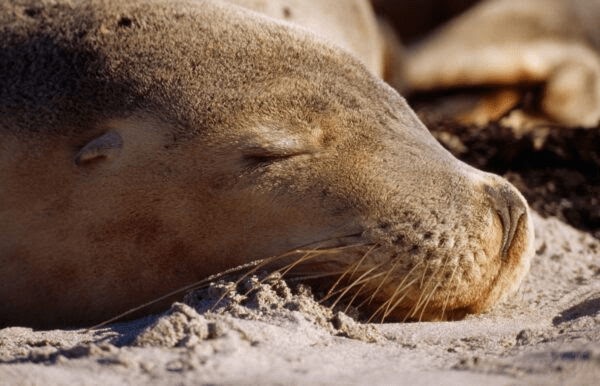
To overcome these challenges, the research team glued GPS units and lightweight cameras on Australian sea lions (Neophoca cinerea). These fast-swimming predators forage in several different benthic habitats, allowing the researchers to model over 5,000 square kilometres of ocean floor.
The results are published in Frontiers of Marine Science.
The eight enlisted sea lions came from the Olive Island and Seal Bay colonies on the coast of South Australia.
“We deployed the instruments on adult females so we could recover the equipment a few days later when they returned to land to nurse their pups,” explains first author Nathan Angelakis, a PhD student with The University of Adelaide and the South Australian Research and Development Institute.
The sea lions collected 89 hours of recordings in total, from which the researchers identified six distinct benthic habitats: macroalgae reef, macroalgae meadow, bare sand, sponge/sand, invertebrate reefs and invertebrate boulder.
The researchers then used machine learning models to predict the habitat type in nearby areas of continental shelf.
“The sea lions from both locations covered quite broad areas around the colonies. In our calculations, we kept the area in which we predicted habitats small to maximize the precision of our predictions,” said Angelakis. “This allowed us to model benthic habitats across more than 5,000 square km of the continental shelf.”
The findings have conservation implications for the endangered sea lion and for other benthic species that rely on these habitats.
“These data are useful both for mapping critical habitats for an endangered species such as the Australian sea lion, and more broadly, for mapping unexplored areas of the seabed,” said Angelakis.
In an episode of The Twilight Zone called “The Midnight Sun,” first broadcast in November 1961, the apocalyptic temperature of an Earth getting ever closer to the Sun is represented by a thermometer bursting at…130°F. On July 5, 2024, Palm Springs, California, reached 124°F, while the next day, Death Valley hit 128°F, amidst a shattering of triple-digit temperature records across the American West.
Benchmarks have shifted. In 1961, the amount of carbon dioxide (CO2) in the atmosphere was 318 parts per million by volume (ppmv). CO2 is a greenhouse gas, acting as atmospheric insulation, preventing heat radiation from dissipating into space. Last year, 2023, the amount of CO2 in the atmosphere was 421 ppmv. It continues to increase, not least as we battle the resulting heat by burning fossil fuels to stay cool. We’re in a global greenhouse, and the doors seem to be locked as we paradoxically produce more CO2 to stay cool in the face of heating caused by the production of more CO2.
Humans have long worked to beat the heat, especially in the tropics and in deserts. Their perfectly rational strategies—stay out of the midday sun, live underground, cover up completely—may once have been criticized by those from temperate zones, sometimes in racist terms, but more and more parts of the world are having to learn the lesson of those strategies.
A sign outside an air-conditioned American restaurant points to the “White Rest Rooms,” in a clear indication of racial segregation, circa 1960. Getty
What, after all, would it be like without air conditioning? Take a look at this Before Air-Conditioning piece in Scientific American’s “Hints for Keeping Cool.” Published in July 1858, the piece begins with a dietary suggestion: eat “fruits, vegetables, and farinaceous food, and the lighter kinds of meat.” In 1858, the amount of CO2 in the atmosphere was 286 ppmv. Seven years earlier, Dr. John Gorrie, striving to cool down his malaria and yellow fever patients in Florida, patented the first ice-making machine (1851, 285 ppmv).
The first modern, electrical air condition system dates to 1902 (297 ppmv), when inventor Willis Carrier cooled and dehumidified the Sackett-Wilhelms Lithographic & Publishing Company in Brooklyn, New York. The publishing company was most concerned about humidity warping their paper supplies. Carrier is still a going concern.
A little over a century after Scientific American’s helpful hints, The Science News-Letter’s “Keeping Cool in Summer Heat” (1961: 318 ppmv) wasn’t so very different.
“If you suffer from heat frustration when the mercury hits the 90’s, a little scientific knowledge of summer heat can help your body temperature and state of mind remain well within the comfort zone,” the editors claim.
These hints were essential for those without air conditioning, that wonder of the twentieth century. Try to imagine cars, theaters, restaurants, the suburbs, office towers, apartment blocks, malls, et cetera, without A/C. The post-World War II population growth across the Sun Belt, stretching from Southern California to North Carolina, would most likely not have been possible without it.
“I hate air conditioning,” the woman confirmed. “It’s a damnfool invention of the Yankees. If they don’t like it hot, they can move back up North where they belong.”
But most people—in the South and elsewhere—welcomed A/C with a passion. Arsenault notes that historians tended to shy away from writing about the transformative power of air-conditioning on the South because they were leery of falling into an old climate-is-destiny paradigm. In the first three decades of the twentieth century, the South’s climate was held responsible for everything from the Southern drawl to plantation slavery. Climate determinism faded by mid-century (1950: 311 ppmv), as the “long hot summers” of the Civil Rights years transitioned into the “New South,” supposedly post-racial but definitely all indoor-cooled.




 Scottie's Playtime