First you know this man was threatened all the way back to the US that his family would be rounded up and tortured if he told of what happened to him in that prison. I wonder if they had to wait until injuries healed before they could let the public see him? Ron says they maybe starved him and had to feed him again to build up his weight and looks. Poor man I hope he is able to safely get his story out. It is clear the charges against him are fraudulent and made up. Just like the government kept saying he was an MS 13 gang member which two courts found he was not. Also he was living in Maryland and his court case is being heard in DC so why is the Justice department trying his new charges in Tennessee? Why not add the charges to the case being heard now in DC. Clearly they hope to get a much more conservative and racist court there than they would in the northern states. I am surprised they did not charge him in Texas. Hugs.
Mistakenly deported Salvadoran native Kilmar Abrego Garcia appeared in a Tennessee courtroom Friday, hours after he was brought back to the United States to face criminal charges for allegedly transporting undocumented migrants within the U.S.
More than two months after the Trump administration admitted it mistakenly deported Abrego Garcia from Maryland to his native El Salvador, a two-count indictment unsealed Friday alleges that he participated in a years long conspiracy to haul undocumented migrants from Texas to the interior of the country.
The return of Abrego Garcia from his native El Salvador follows a series of court battles in which the Trump administration repeatedly said it was unable to bring him back, drawing the country toward the brink of a constitutional crisis when the administration failed to heed the Supreme Court’s order to facilitate his return.
MORE: Justice Department investigating 2022 Abrego Garcia traffic stop: Sources
He made his initial court appearance Friday evening in the Middle District of Tennessee, answering “Yes, I understand” in Spanish when U.S. Magistrate Judge Barbara Holmes asked him if he understood the charges against him.
Judge Homes set a hearing for June 13, where Abrego Garcia will be arraigned on charges and the judge will take up the government’s motion to hold him in pre-trial detention on the grounds that he “poses a danger to the community and a serious risk of flight” He will remain in federal custody in Tennessee pending next week’s hearing.
“If convicted at trial, the defendant faces a maximum punishment of 10 years’ imprisonment for ‘each alien’ he transported,” said the government’s motion for detention, which also contained an allegation — not included in the indictment — that one of Abrego Garcia’s co-conspirators told authorities that Abrego Garcia participated in the murder of a rival gang member’s mother in El Salvador.
Abrego Garcia’s attorney, in an online press briefing, called the charges against his client “an abuse of power.”
Kilmar Abrego Garcia is placed in the back seat of a truck by ICE agents after arriving in Nashville, Tenn., June 6, 2025.
ABC News
“They’ll stop at nothing at all — even some of the most preposterous charges imaginable — just to avoid admitting that they made a mistake, which is what everyone knows happened in this case,” said attorney Simon Sandoval-Moshenberg.
“Mr. Garcia is going to be vigorously defending the charges against him,” the attorney said.
The decision to pursue the indictment against Abrego Garcia led to the abrupt departure of Ben Schrader, a high-ranking federal prosecutor in Tennessee, sources briefed on Schrader’s decision told ABC News. Schrader’s resignation was prompted by concerns that the case was being pursued for political reasons, the sources said.
Schrader, who spent 15 years in the U.S. Attorney’s Office in Nashville and was most recently the chief of the criminal division, declined to comment when contacted by ABC News.
The alleged conspiracy spanned nearly a decade and involved the domestic transport of thousands of noncitizens from Mexico and Central America, including some children, in exchange for thousands of dollars, according to the indictment.
Abrego Garcia is alleged to have participated in more than 100 such trips, according to the indictment. Among those allegedly transported were members of the Salvadoran gang MS-13, sources familiar with the investigation said.
MORE: Timeline: Wrongful deportation of Kilmar Abrego Garcia to El Salvador
Abrego Garcia is the only member of the alleged conspiracy charged in the indictment.
Attorney General Pam Bondi, at a Friday afternoon press conference, thanked Salvadoran President Nayib Bukele for “agreeing to return Abrego Garcia to the United States.”
“Our government presented El Salvador with an arrest warrant and they agreed to return him to our country,” Bondi said.
Bondi said that if Abrego Garcia is convicted of the charges, upon the completion of his sentence he will be deported back to his home country of El Salvador.
“The grand jury found that over the past nine years, Abrego Garcia has played a significant role in an alien smuggling ring,” Bondi said. “They found this was his full time job, not a contractor. He was a smuggler of humans and children and women. He made over 100 trips, the grand jury found, smuggling people throughout our country.”
Attorney General Pam Bondi speaks as Deputy Attorney General Todd Blanche listens during a news conference about Kilmar Abrego Garcia at the Justice Department, June 6, 2025, in Washington.
Julia Demaree Nikhinson/AP
In a statement to ABC News, Abrego Garcia’s attorney said that he’s going to keep fighting to ensure Abrego Garcia receives a fair trial.
“From the beginning, this case has made one thing painfully clear: The government had the power to bring him back at any time. Instead, they chose to play games with the court and with a man’s life,” Sandoval-Moshenberg said. “We’re not just fighting for Kilmar — we’re fighting to ensure due process rights are protected for everyone. Because tomorrow, this could be any one of us — if we let power go unchecked, if we ignore our Constitution.”
Abrego Garcia, a Salvadoran native who had been living with his wife and children in Maryland, was deported in March to El Salvador’s CECOT mega-prison — despite a 2019 court order barring his deportation to that country due to fear of persecution — after the Trump administration claimed he was a member of the criminal gang MS-13. His wife and attorneys deny that he is an MS-13 member.
The Trump administration has acknowledged in court filings that Abrego Garcia’s removal to El Salvador in March was in error, because it violated a U.S. immigration court order in 2019 that shielded Abrego Garcia from deportation to his native country, according to immigration court records. An immigration judge had determined that Abrego Garcia would likely face persecution there by local gangs that had allegedly terrorized him and his family.
The administration argued, however, that Abrego Garcia should not be returned to the U.S. because he is a member of the transnational Salvadoran gang MS-13, a claim his family and attorneys have denied. In recent weeks, Trump administration officials have been publicizing Abrego Garcia’s interactions with police over the years, despite a lack of corresponding criminal charges.
After Abrego Garcia’s family filed a lawsuit over his deportation, U.S. District Judge Paula Xinis in Maryland ordered the Trump administration to facilitate his return to the United States. The U.S. Supreme Court affirmed that ruling on April 10.
Abrego Garcia was initially sent to El Salvador’s notorious CECOT prison but was believed to have later been transferred to a different facility in the country.
The criminal investigation that led to the charges was launched in April as federal authorities began scrutinizing the circumstances of a 2022 traffic stop of Abrego Garcia by the Tennessee Highway Patrol, according to the sources. Abrego Garcia was pulled over for speeding in a vehicle with eight passengers and told police they had been working construction in Missouri.
According to body camera footage of the 2022 traffic stop, the Tennessee troopers — after questioning Abrego Garcia — discussed among themselves their suspicions that Abrego Garcia might be transporting people for money because nine people were traveling without luggage, but Abrego Garcia was not ticketed or charged.
The officers ultimately allowed Abrego Garcia to drive on with just a warning about an expired driver’s license, according to a report about the stop released last month by the U.S. Department of Homeland Security.
Asked what circumstances have changed since Abrego Garcia was not taken in custody during that traffic stop in Tennessee, Bondi replied, “What has changed is Donald Trump is now president of the United States, and our borders are again secure, and thanks to the bright light that has been shined on Abrego Garcia — this investigation continued with actually amazing police work, and we were able to track this case and stop this international smuggling ring from continuing.”
Asked by ABC News’ Pierre Thomas asked whether this should be seen as resolving the separate civil case in Maryland in which a federal judge ordered the government to facilitate Abrego Garcia’s return, Deputy Attorney General Todd Blanche said, “There’s a big difference between what the state of play was before the indictment and after the indictment. And so the reason why he is back and was returned was because an arrest warrant which was presented to the government and in El Salvador. So there’s, there’s a big difference there as far as whether it makes the ongoing litigation in Maryland moot. I would think so, but we don’t know about this. He just landed today.”
As ABC News first reported last month, the Justice Department had been quietly investigating the Tenessee traffic stop. As part of the probe, federal agents in late April visited a federal prison in Talladega, Alabama to question Jose Ramon Hernandez-Reyes, a convicted felon who was the registered owner of the vehicle Abrego Garcia was driving when stopped on Interstate 40 east of Nashville, sources previously told ABC News. Hernandez-Reyes was not present at the traffic stop.
MORE: Newly released video shows Abrego Garcia’s 2022 Tennessee traffic stop
Hernandez-Reyes, 38, is currently serving a 30-month sentence for illegally re-entering the U.S. after a prior felony conviction for illegal transportation of aliens.
After being granted limited immunity, Hernandez-Reyes allegedly told investigators that he previously operated a “taxi service” based in Baltimore. He claimed to have met Abrego Garcia around 2015 and claimed to have hired him on multiple occasions to transport undocumented migrants from Texas to various locations in the United States, sources told ABC News.
When details of the Tennessee traffic stop were first publicized, Abrego Garcia’s wife said her husband sometimes transported groups of fellow construction workers between job sites.
“Unfortunately, Kilmar is currently imprisoned without contact with the outside world, which means he cannot respond to the claims,” Jennifer Vasquez Sura said in mid-April.
Sen. Chris Van Hollen of Maryland, who flew to El Salvador and met with Abrego Garcia shortly after his deportation, said Friday that the Trump administration had “relented” regarding his return.
“After months of ignoring our Constitution, it seems the Trump Admin has relented to our demands for compliance with court orders and due process for Kilmar Abrego Garcia,” Van Hollen posted on X. “This has never been about the man — it’s about his constitutional rights & the rights of all.”
Abrego Garcia entered the U.S. illegally as a teenager in 2012, according to court records. He had been living in Maryland for the past 13 years, and married Vasquez Sura, a U.S. citizen, in 2019. The couple has one child together.
ABC News’ Laura Romero contributed to this report.
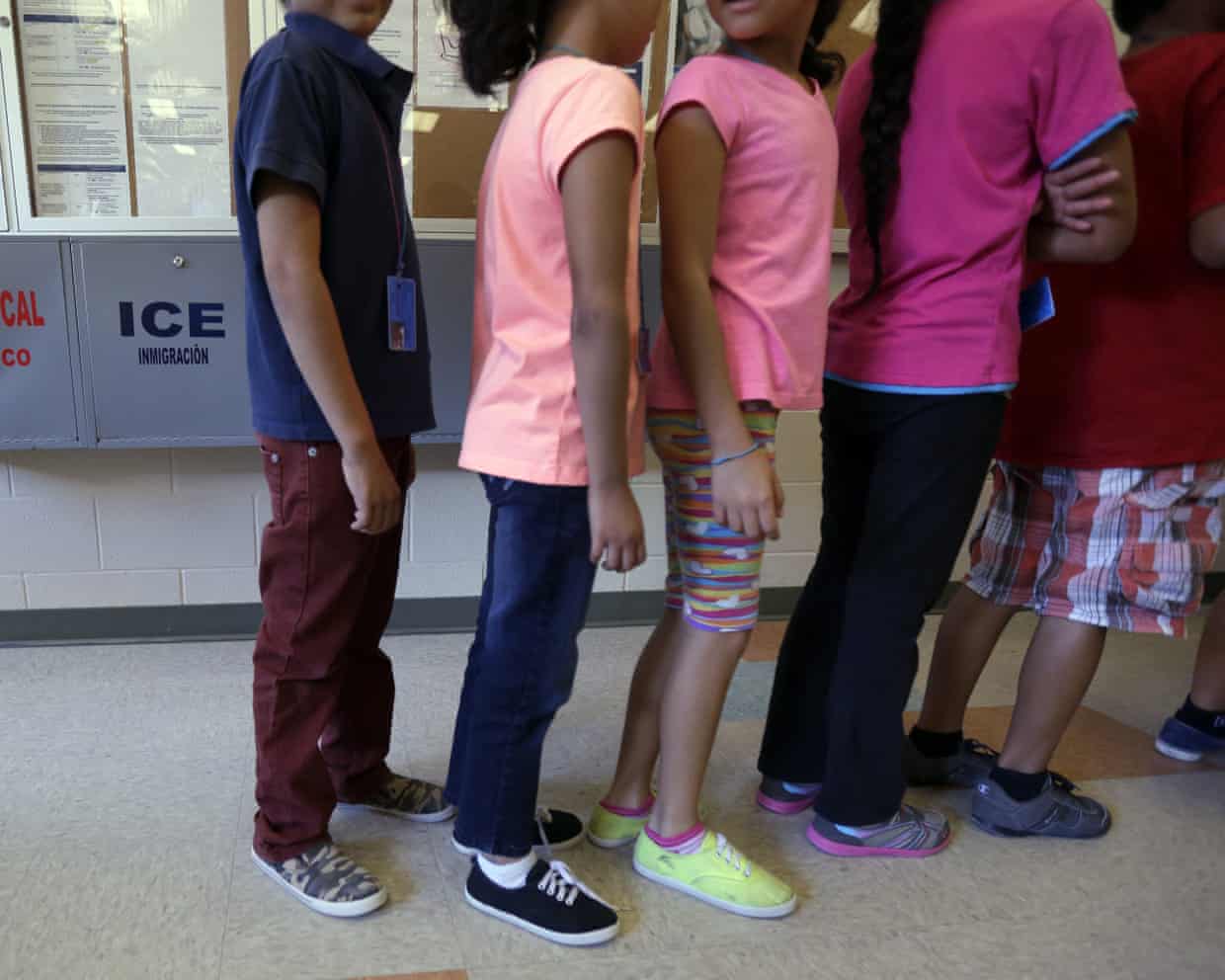
Detained children line up in the cafeteria at the Karnes County Residential Center in Karnes City, Texas, on 10 September 2014. Photograph: Eric Gay/AP
The Trump administration is trying to end a cornerstone immigration policy that requires the government to provide basic rights and protections to child immigrants in its custody.
The protections, which are drawn from a 1997 consent decree known as the Flores Settlement Agreement, limit the amount of time children can be detained by immigration officials. It also requires the government to provide children in its custody with adequate food, water and clean clothes.
The administration’s move to terminate the Flores agreement was long anticipated. In a court motion filed Thursday, the justice department argued that the Flores agreement should be “completely” terminated, claiming it has incentivized unauthorized border crossings and “prevented the federal government from effectively detaining and removing families”.
Donald Trump also tried to end these protections during his first term, making very similar arguments.
Ice arrests at immigration courts across the US stirring panic: ‘It’s terrifying’
Read more
The move to end protections follows a slew of actions by the Trump administration that target children, including restarting the practice of locking up children along with their parents in family detention. Immigration advocacy groups have alleged in a class-action lawsuit filed earlier this month that unaccompanied children are languishing in government facilities after the administration unveiled policies making it exceedingly difficult for family members in the US to take custody of them. The president and lawmakers have also sought to cut off unaccompanied children’s access to legal services and make it harder for families in detention to seek legal aid.
“Eviscerating the rudimentary protections that these children have is unconscionable,” said Mishan Wroe, senior attorney at the National Center for Youth Law. “At this very moment, babies and toddlers are being detained in family detention, and children all over the country are being detained and separated from their families unnecessarily.”
The effort to suspend the Flores agreement “bears the Trump administration’s hallmark disregard for the rule of law – and for the wellbeing of toddlers who have done no wrong”, said Faisal al-Juburi of the Texas-based legal non-profit Raices. “This administration would rather enrich private prison contractors with the $45bn earmarked for immigrant detention facilities in the House’s depraved spending bill than to uphold basic humanitarian protections for babies.”
The Trump administration in 2019 asked a judge to dissolve the Flores Settlement Agreement, but its motion was struck down. During the Biden administration, a federal judge agreed to partially lift oversight protections at the Department of Health and Human Services, but the agreement is still in place at the US Customs and Border Protection (CBP) and US Immigration and Customs Enforcement agencies.
“Children who seek refuge in our country should be met with open arms – not imprisonment, deprivation and abuse,” said Sergio Perez, executive director of the Center for Human Rights and Constitutional Law.
The settlement is named for Jenny Flores, a 15-year-old girl who fled civil war in El Salvador and was part of a class-action lawsuit alleging widespread mistreatment of children in custody in the 1980s.
Since the settlement agreement was reached in 1997, lawyers and advocates have successfully sued the government several times to end the mistreatment of immigrant children. In 2018, attorneys sued after discovering unaccompanied children had been administered psychotropic medication without informed consent.
In 2024, a court found that CBP had breached the agreement when it detained children and families at open-air detention sites at the US southern border without adequate access to sanitation, medical care, food, water or blankets. In some cases, children were forced to seek refuge in portable toilets from the searing heat and bitter cold.



 Scottie's Playtime