Teaching tolerance isn’t indoctrination. It’s protection

https://www.advocate.com/voices/mahmoud-v-taylor

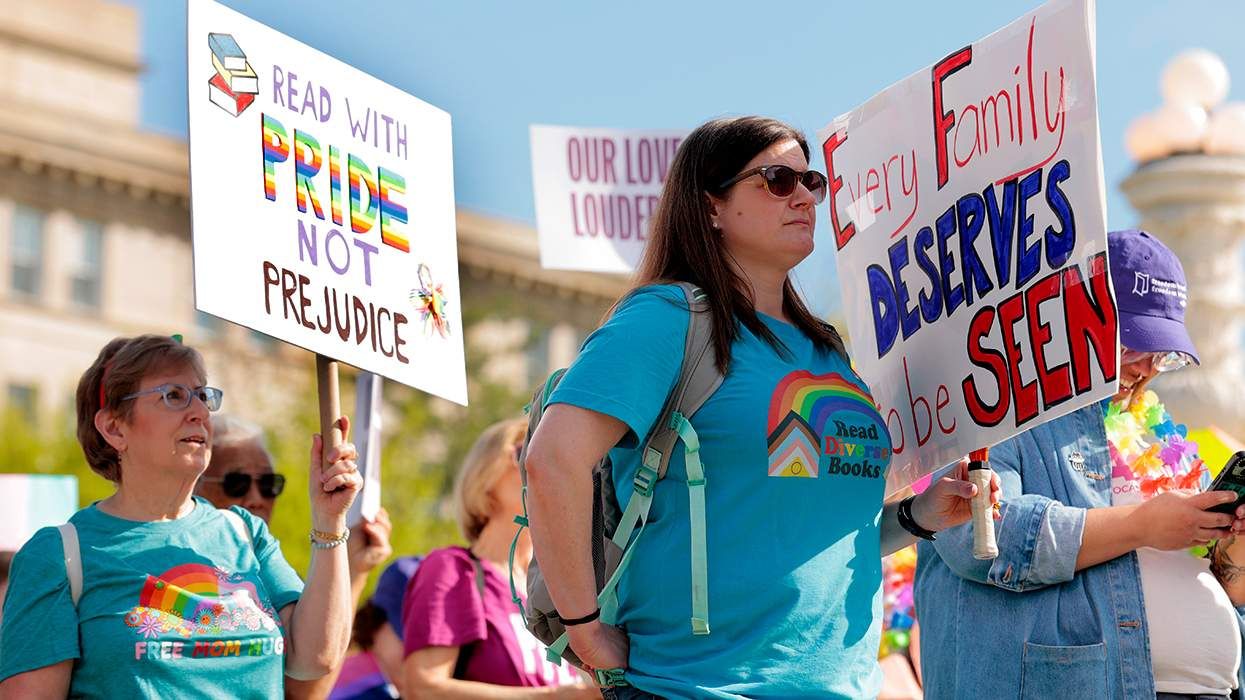
Mahmoud v Taylor LGBTQ rights protesters with signs outside US Supreme Court building washington DC April 2025

Anna Moneymaker/Getty Images

Protesters in support of LGBTQ+ rights and against book bans demonstrate outside of the U.S. Supreme Court Building while the justices heard arguments for the case of Mahmoud v. Taylor in Washington, DC., April 2025

Opinion: In Mahmoud v. Taylor, the justices gave bigotry a permission slip and ruled that parents can “opt out” of LGBTQ-inclusive lessons, further diminishing lessons and practices on inclusivity in civic society, argues Darek M. Ciszek.

The U.S. Supreme Court made a decision earlier this summer that has a significant impact on classrooms nationwide. In their 6-3 decision in Mahmoud v. Taylor, the majority completely missed the point as to why LGBTQ-inclusive education matters. By giving parents the option to pull their kids out of lessons that include LGBTQ+ characters or content, the Court prioritized personal religious objections over creating schools where students can learn without feeling invisible.

Justice Alito‘s majority opinion is especially troubling. He treats LGBTQ-inclusive education as if it were some optional “add-on” that schools can easily work around. As a former teacher, I can confidently say that is not how education works, especially when it comes to curriculum and lesson planning. And while Justice Thomas calls LGBTQ-inclusive education “ideological conformity,” he fails to see that most LGBTQ+ adults today grew up in a school system that forced us to conform to a cisgender and straight worldview. Ironically, I’d consider the Court’s narrow view of public education to be ideologically driven.


Let’s be clear about what LGBTQ-inclusive education is and isn’t. When teachers include books like Uncle Bobby’s Wedding in their curriculum, they are not trying to convert anyone’s child or attack anyone’s faith. They are trying to show students that families come in all colors, shapes, and sizes, reflecting our diverse society.

LGBTQ+ people are also part of every community. We have always been a part of human history, and we deserve to be represented in our nation’s schools. The goal is not to change what students believe at home; it is to teach them how to be respectful in a democratic and diverse world. Luckily, in her dissent, Justice Sotomayor got it right when she said that LGBTQ-inclusive education is “designed to foster mutual civility and respect.”

I could not agree more.


But here’s what the Court’s majority really got wrong: they ignored the anti-bullying efforts that motivate many LGBTQ+ inclusive education programs in the first place. According to the latest National School Climate Survey from GLSEN, 68% of American students reported feeling unsafe in school due to their SOGIE (sexual orientation, gender identity, and/or gender expression) characteristics.

That is two out of three LGBTQ+ youth.

These aren’t just statistics. These are real children trying to learn while dealing with a school environment that tells them, whether implicitly or explicitly, that their identities or families are somehow wrong or shameful.

When schools include diverse families in their lessons, they are not pushing an agenda. They are teaching kids that being different does not mean bad. They are giving LGBTQ+ students a chance to see themselves reflected in their education and helping other students see and understand those who are different from them.


Research shows inclusive education works. Studies have found that an LGBTQ-inclusive curriculum can improve the social and emotional well-being of LGBTQ+ youth. When kids learn about different types of families early on, they are more likely to treat their classmates with kindness instead of cruelty. In other words, when implemented correctly, LGBTQ-inclusive education can be an essential anti-bullying and student well-being strategy.


For instance, as a result of my doctoral research, I have learned that some schools around the world are starting to address LGBTQ+ bullying head-on, and, not surprisingly, it’s through curriculum and instruction. In Scotland, LGBTQ-inclusive education became required in 2021 across both primary and secondary, and most major subject areas. When I interviewed government staff about their experience implementing the new policy, I learned that they even worked with religious groups to inform the effort. Faith communities could agree that inclusion was important for reducing homophobic bullying, even if they had some religious concerns. Scottish students now learn how homophobic language hurts people and develop the social-emotional skills needed for creating safer schools. It’s not ideological instruction; it’s teaching kids critical peer relationship skills.

Similar to the Scottish experience, the U.S. Supreme Court could have left the door open for education authorities to find a balance that respects both religious families and vulnerable LGBTQ+ kids. Real inclusion programs do not ask anyone to abandon their faith. They ask people to treat others with respect and dignity, a lesson I believe everyone should support in class. Kids can learn that some families have two moms without being told their family is wrong. They can remember that using “gay” as an insult hurts people without abandoning their religious beliefs. Getting to know your neighbor does not go against faith.


Unfortunately for the U.S., the impact of the Court’s decision may be severe and widespread, especially in ideologically conservative states. Instead of dealing with complicated opt-out policies, I fear many school districts will probably remove LGBTQ+ inclusive materials entirely. Unfortunately, it can be easier to bow to political pressures than to fight, especially when faced with potential lawsuits or a loss of school funding. This means LGBTQ+ kids lose representation, and all students miss out on critical lessons in diversity and inclusion.

The Court’s decision also has broader implications beyond the LGBTQ+ community. By way of a new precedent, the case approves a heckler’s veto, allowing parents to claim a religious objection to any educational content they may not align with at home. This is because the majority opinion wasn’t apparent on how opting out of inclusive education would work in practice, or what would even qualify as a personal religious objection. We might start seeing opt-out forms for instruction on topics like human evolution, women’s rights, or civil rights history. Thanks to the Court, there is no line in the sand.


When we remove students from lessons about diverse communities, we fail everyone. But the call for truly inclusive education is not going anywhere. Our kids—all of our kids—deserve better.

Darek M. Ciszek is a PhD Candidate in Education at UCLA with a research focus on curriculum, learning, and social development.

Voices is dedicated to featuring a wide range of inspiring personal stories and impactful opinions from the LGBTQ+ community and its allies. Visit Advocate.com/submit to learn more about submission guidelines. Views expressed in Voices stories are those of the guest writers, columnists, and editors, and do not directly represent the views of The Advocate or our parent company, equalpride.

Alabama charter school keeps contract after removing rainbow murals, LGBTQ references

Even though the school was started as a LGBTQ+ safe space they had to remove anything affirming the LGBTQ+ people.  The goal of the republican right is to erase LGBTQ+ people from the public society.  They don’t want us seen, they do not want us talked about.  They especially don’t want kids to understand they can be themselves if they are not straight or cis.  They want kids to feel they must fit the mold of straight and cis only.   If you feel differently you must hide it and live miserably to make the snowflake Christian nationalist right feel comfortable.  This will backfire on them.   Just as the LGBTQ+ overcame the full force of the right’s bigotry once we can do it again.   We have moved far too toward equality to let them push us from society again.  The young people will not accept it nor tolerate the regression of freedoms to make a few bigots feel comfortable with the world around them.  They also know that intolerant maga driven my the cult of tRump won’t last forever.  Hugs

“We have had rainbows in our building because we are affirming to all people, and at some point our mission statement included a segment that said ‘We are affirming to LGBTQ people,’ but we have taken that out.”

Before the vote Wednesday, she said the school painted over rainbow colors and designs and replaced maps with ones that had a “Gulf of America” label. They revised the logo and reviewed textbooks and other documents.


https://www.al.com/educationlab/2025/10/alabama-charter-school-keeps-contract-after-removing-rainbow-murals-lgbtq-references.html

Magic City Acceptance Academy graduation
Magic City Acceptance Academy held its first graduation ceremony May 27, 2022, in Birmingham, Alabama. Trisha Powell Crain/AL.com
By

Months after its contract was threatened over a rainbow mural and a map labeling the Gulf of Mexico, an Alabama charter school will stay open.

The state charter commission voted Wednesday to renew Magic City Acceptance Academy’s contract, allowing the school to operate for five more years. The school and its leaders came under fire this spring for allegedly violating aspects of Alabama’s new anti-DEI law, which prohibits so-called “divisive concepts” and other diversity and inclusion programming in public schools and colleges.

“I’ll say the thing that we’re all thinking,” said Karen Musgrove, the school’s CEO, after being pressed by one commissioner to address the “monster in the room.”

“We have had rainbows in our building because we are affirming to all people, and at some point our mission statement included a segment that said ‘We are affirming to LGBTQ people,’ but we have taken that out.”

“We’re affirming to all people. We’re affirming to our Black students. We’re affirming to our Hispanic students. We’re affirming to our LGBTQ students, which are in every school in the state.”

Magic City Acceptance Academy opened in 2021 in an effort to provide a supportive learning environment for LGBTQ students and other at-risk populations. Students and staff say they built a welcoming community in the Birmingham-area school, despite a firestorm of political backlash over the years.

In a plea to commissioners, one parent said “everything changed” for her son after enrolling at MCAA. He stopped skipping class, vaping and fighting, and he’s now excelling in college-level courses.

“Renewing Magic City’s charter means continuing to change lives like my son’s,” she said. “It means giving more kids the chance to discover their potential and their purpose.”

After a brief debate, the commission ultimately renewed the charter – on the condition that it agreed to maintain “strict adherence throughout its shorter term to Alabama laws, specifically including, without limitation, Alabama Code 41190,” the state’s “divisive concepts” law. If it fails to comply, Magic City could be subject to sanctions, said Lane Knight, the commission’s lawyer.

“They’ve got the financial support, they’ve got a good program, they’ve got the leadership,” said commission member Charles Knight. “And again, we all agree that we’re trying to create environments where students are educated, and obviously they’re doing a good job of that.”

Recent changes

According to emails obtained by AL.com, school officials contacted the charter commission in early 2025, just days after 1819 News ran an article claiming the school was violating the law by hosting a “radical LGBTQ+ anti-America author” and promoting diversity, equity and inclusion in its handbook.

Musgrove reached out to the commission’s director, Logan Searcy, for advice on January 24. She sent Searcy changes to the school’s mission statement a week later.

Between February and March, 1819 published a handful of articles about the school. Republican lawmakers threatened its funding and called for a state investigation.

In early February, the commission paid the school another visit.

“The goal here is to report our diligence in monitoring the school to hopefully alleviate concerns at renewal time,” the commission’s financial specialist, Douglas Riley, wrote to Principal Patton Furman on Feb. 4. “I suspect you will see much more attention from the Commission this spring with that goal in mind. Please understand the spirit in which these efforts are intended, we want to identify and fix problems before they grow into something serious.”

He wrote to school leaders again after the visit: “Y’all are making some strong moves and I hope we can put the recent press behind us and have a smooth renewal process later this year.”

That same day, the commission sent the school a letter, noting that it had received “various reports” that the school’s curricula and programming violated the new law.

Searcy visited the school, along with commission member Cynthia McCarty, on Feb. 20, according to emails.

On March 6, Musgrove issued a lengthy response to the commission’s letter, claiming that leaders had already taken steps to make changes to decor and programming, and that they had not received any negative feedback after members’ visits to the school.

Before the vote Wednesday, she said the school painted over rainbow colors and designs and replaced maps with ones that had a “Gulf of America” label. They revised the logo and reviewed textbooks and other documents.

“We don’t see ourselves as being divisive,” she said. “Because we did exactly what was asked of us.”

A new outlook

It is rare for an Alabama charter school to close down after its initial contract is granted. If the commission has any concerns about a school’s viability, they may issue a shortened two- or three-year contract.

The commission originally suggested a three-year contract for Magic City, but voted to approve a standard five-year one after some pushback.

With the greenlight from the commission, school officials plan to start work immediately on a new building, which will feature a large theater, band room and expanded mental health resources.

It plans to eventually serve up to 500 students.

“We are going to make you proud,” Musgrove told the commission. “We’re doing amazing things, and we want you to be a part of that relationship.”

The commission also approved a five-year extension for LEAD Academy in Montgomery and a three-year extension for Breakthrough Academy in Perry County.

—————————————————————————————————————–
Rebecca Griesbach

Rebecca Griesbach is a data reporter at AL.com, covering education and other issues across the state. She joined the newsroom in 2021 as a founding member of the Alabama Education Lab and a Report for America… more

Bari Weiss: Last Week Tonight with John Oliver (HBO)

This is the same Bari Weiss that is rabidly anti-trans and a religious racist bigot.   She is often used as a warrior to get the crimes against trans kids out, and Teldeb that used to come here and spew Weiss’s lies.   No matter who many times I debunked and showed that everything Weiss had reported was lies and misinformation rabid trans haters like Teldeb kept pushing her lies.  Because the truth doesn’t matter to them, making sure no child can be who they really are or fit the mold they demand children fit in.  Now it is trans kids but as we have seen in the US they are coming for every not straight cis kid demanding they fit into the regressive world they demand everyone live in.  Weiss is also a Jewish person who is an Islamophobe.   She supports the genocide in Gaza. Hugs

Teachers on the Frontlines of LGBTQ Erasure [WATCH]

https://www.unclosetedmedia.com/p/teachers-on-the-frontlines-of-lgbtq

Six LGBTQ and ally teachers from red and blue states speak with Uncloseted Media Founder Spencer Macnaughton about teaching in America in 2025.


As back-to-school season is in full swing, many teachers are on edge. There were 277 anti-LGBTQ bills introduced in 2025 that were meant to restrict student and educator rights. These include trans-exclusionary pronoun laws and so-called “Don’t Say Gay” laws, which disallow teachers from educating students about sexual orientation or gender identity. And in June, the Supreme Court ruled in favor of parents who wanted to opt their children out of classes that featured books with LGBTQ characters.

In addition, there have been numerous false claims that teachers are grooming their students by discussing LGBTQ issues in the classroom. Vice President JD Vance has said that childless teachers are “trying to brainwash the minds of our children,” and President Donald Trump has repeatedly made the false claim that children are undergoing transgender surgery at school.

We wanted to understand how queer and ally teachers are navigating the political climate. So we called up six of them from various red and blue states to get their take on teaching in America in 2025.

Watch the video or read the transcript below.

Spencer Macnaughton: Hi everyone, I’m Spencer Macnaughton. Today I am here with a set of teachers from across the United States, LGBTQ teachers and allies alike, and we want to get their perspective on what it’s like to be a teacher in America, as we’re in the throes of back-to-school season. Everyone, thanks so much for speaking with me and Uncloseted Media today.

Daniel Greenspan: Great to be here.

SM: So I feel like I’d be remiss if I didn’t start right away with the events that happened last week with the assassination of Charlie Kirk. How do you approach a subject like this that is so complicated for adults to discuss with your students, if at all?

DG: I’m in a much more rural area and I definitely got asked about it. I’m kind of on edge about the whole topic because several teachers in my district have been fired just over the last week. I try not to discuss it if possible. It’s a shame that we can’t discuss controversial topics, but you know, they are kids and they’re prone to misinterpret things, and the second a parent gets wind of it, you’ll be very quickly removed.

SM: I feel like if I had kids, I’d want my kids to be learning about tough topics from their teachers, but you’re saying that you’re worried that you could get fired if you talked about that. Is that a sentiment that’s felt across the board here?

Mardy Burleson: Absolutely. Absolutely.

SM: Mardy, tell us more about that.

MB: Well, I have been on the receiving end of a group of parents, community members, for just being an ally. And it’s been pretty horrific, and to the point where it’s now a lawsuit that I initiated because it got so threatening that I had no choice.

SM: And Mardy, just for folks and people listening who don’t know your story, you essentially gave a worksheet to your students that asked them what their pronouns were, and that got out to some of the parents in your class, and you were subsequently doxed, called a groomer, and really harassed online for many, many months to the point where you were afraid to walk down aisles in the grocery store. Is that all accurate?

MB: That is accurate. Yes, that is accurate. I was on paid admin leave for my own safety. I mean all the teachers in here knows what they are, they’re just get-to-know you questionnaires at the beginning of the year and there was an optional question on there: What are your preferred pronouns? And, it got crazy online, it was like threats [on] my life.

SM: When you go through that at school, getting doxed by parents in the community because you’re trying to teach about pronouns, tell me what that does to you personally from a mental health perspective.

MB: Well, I mean, it’s exhausting. It’s exhausting, the amount of weight of the worry, of the guilt, the shame, and you know, to be honest, the biggest toll aside from my family that it took out on them having to deal with the backlash of me being an ally, was my kids that I teach. At that point, I was teaching middle school, and they pulled me out the very next day after this story was written about me. They, the district, pulled me out, put me on paid admin leave immediately. And there were at least two kids that were gender neutral in a different class than this one, where this parent was. One of them, every day—I wasn’t allowed to communicate with them at all—none of my students previously—and every day she would go to my bestie’s room and be like, “Ms. King, is Ms. B coming back?” Every single day. My friend would be like, “I’m sorry, I can’t talk about it.”

SM: It’s such a balance too that the LGBTQ community has become so politicized and, you know, there’s been dozens and dozens of anti-LGBTQ bills from book bans, to don’t say gay laws, to so many rules about can you use pronouns? Can you not use this? Particularly in red states. I’m curious as allies or as queer teachers, how has it inhibited you or stifled your ability to teach what you want as it relates to LGBTQ studies?

AJ Pound: Something that really sticks out to me is that at my first—at the suburban school that I was subsequently bullied out of by a series of parents and then a new principal who just didn’t want to take the flak, I guess. We did like a poem-a-day type of thing. And one poem, one of them, was by a non-binary poet. I mentioned it in class, and a parent sent me a nasty email. That kind of thing really, especially when you’re a new teacher, sticks with you, and it just makes you afraid to touch, to even get close. That was a total non-invasive way, I think, of just bringing in a queer voice, and the response from just that attempt really put me off. It’s one of those things, though, where you just have to accept that at school, unfortunately, you have to be on and performing 100% of the time already. So it’s just adding that little extra bit of hiding.

J. Everett Irwin: I had had over a decade into the district that I was teaching at when I started using gender neutral names and they/them pronouns in story problems for math. I thought I was in a safe position, and it came back again.

DG: There’s definitely a degree of detraction from the lessons. I couldn’t read something by James Baldwin and not mention how his sexuality influenced the work. That’s incredibly disrespectful. There’s a degree of shame almost in not standing up for this stuff. To think this stuff doesn’t trickle down to the kids is naive.

SM: You said a word there that I thought was striking is “shame.” You feel shame, some shame when you can’t teach that.

DG: You know, why are we doing this? Why are we doing this job? It’s to help kids grow and become better human beings. Everyone’s so quick to jump on, we have an agenda, but really my only agenda is helping kids out. There are easier and better ways to make money if I wanted. I want to be able to teach this stuff and it feels shameful not to allow myself to kind of live in that fearful state.

AP: As a young teacher, I came out when I was student teaching. My first day at this school, as a brand new first-year teacher, was my first classroom. I was so excited. I had my rainbow planner sitting on my desk. After school that day, my principal told me that a parent called in and was crying in tears on the phone, worried about her daughter and how I was going to corrupt her daughter because of my rainbow planner. So there were too many things going on at once where it was like, I felt shamed that I had upset a parent, that this indicated that I was bad at my job or I wasn’t a safe teacher. I felt shamed that people were threatened by my identity. I felt shamed that a student in my classroom was upset. Then I also felt shame that I was shamed because I was like, wait, no, I’m proud, I’m out, right? I’m over this. But I think there’s something that happens when you’re raised in a society that tells you constantly to [be] quiet and squash it down. There are kids in my classroom right now who feel the way I do or feel worse than I do because the world they’re entering is not safe for them.

Kaitlynn Pelletier: My first three years of teaching were in Maine, and I was teaching in a really tiny, tiny, tiny small town. A student, a transgender student, came up to me and asked me to start a [Gay-Straight Alliance] GSA. And I was like, yeah, I’m down. Then I went forward with the principal, trying to see if I could do that. He kind of made it impossible to do. He was telling me it couldn’t be anything to do with rainbows, the name had to be something completely not related to pride. Anytime a student came out, I would have to report that to the parents. I feel like he just kept putting things in my way to get it so that I couldn’t ever start this, and then COVID happened, and then I couldn’t anyways. So I feel so bad for that student because I know she was very much bullied there.

Alyssa Hamilton: For me, I’m very grateful that I work in a building that, I think our administrators, as well as a majority of the staff, we understand that when we’re building a curriculum, a curriculum should look like a mirror to our students and not necessarily them looking through a window. We try to incorporate all of our students’ lived experiences to make our pedagogy culturally relevant and responsive. We’re really lucky to work in school districts in New York City that allow us to have that kind of onus in our curriculum. Because I think if I was in another school district where I felt like any of my students’ voices were being stifled or their lived experience wasn’t being shown within the classroom, just from the curriculum standpoint, you start to see lack of engagement. If I’m a student who I totally cannot relate to what you’re presenting to me and you don’t try in any way to make it relatable, then there is no context. If there’s no context, then there’s no question that I’m going to want to answer. I want the creativity and the experiences and the cultures, the socioeconomics, the gender identities, the sexualities of my students to be present within what I’m doing in the classroom so that they feel like even though we might be reading Chaucer, there’s some point in the lesson where they can identify as themselves within that piece of the curriculum. That all happens when you have the classroom community and culture built in from day one of the school year.

SM: That’s awesome.

MB: Wow! Just wow.

SM: Mardy, how is what Alyssa described to you that she’s up to in New York City differ from what you’re up to in South Carolina?

MB: It is the polar opposite. I am not allowed to incorporate other voices. So I’m teaching entrepreneurship right now, and even as we’re going through entrepreneurial traits and then the behaviors of entrepreneurs and stuff, there’s major traits in there, of a true entrepreneur, include compassion and understanding world cultures and all of this. And I had to water all my stuff down intentionally, including different faces and different pronouns, and I had to go back and well, I don’t want to say whitewash, but in South Carolina, that’s exactly what it is. Our department, our superintendent, has adapted the Prager University as a statewide acceptable curriculum base.

SM: And PragerU, for those listening, is a designated anti-LGBTQ hate group by many civil rights groups and extremely far right in its ideology and has been, to Mardy’s point, adopted in many school districts across the U.S. Sorry, go ahead.

DG: It’s unbelievable.

MB: Yeah, the whole state of South Carolina. It’s not even an LGBTQ plus, it’s brown and black skinned people and kids. It is… I mean, we’re the home of Nancy Mace.

AP: It’s awful. I definitely struggle with anxiety and depression. It feels like everything I do in the classroom is under a microscope lens. I was the emotional support teacher, they literally called me that, for this group of kids in my middle school. These are real children who really needed an adult who would listen to them. Just listen. That’s all I did. They came into my classroom while I was grading things at the end of the day, and then they left when they were comfortable leaving. That was it. But that’s exactly where those parents that didn’t like me, that principal that didn’t like me, wanted to take it. They were like, well, that’s suspicious, or what have you.

SM: Playing into the conspiracy that queer teachers are pedophiles.

AP: Correct. When you’re a queer teacher, you have to be perfect. Any mistake that you make becomes blown up. Whereas somebody who isn’t in the minority group gets the benefit of the doubt, that doesn’t exist when you’re queer as a teacher. It just gets stripped from you so fast. Every conversation about queer teachers has this weird undertone of, well, you’re in it for the wrong reasons. I just want to help kids. Like that’s the most innocent and most like, I don’t know, most moral—in my opinion anyways—most moral possible motivations in the world is I want to help the next generation have a better time than I did. I want kids, like me, who suffered in school, like me, to not have to suffer. So then the mental health piece of that is that you have to carry the weight of that constantly. It’s not something you can put down. It’s not like I come home and I’m like, wow, I don’t have to worry about my gay kids anymore. They’re not fine. Now they’re in worse places. Cause at least when they’re in my classroom, I know they’re safe. I know for a fact, some of them aren’t safe when they go home, and I can’t do anything about that.

SM: I’m so sorry you had to go through that. I wanna go back to PragerU. Just for the people watching this who don’t know, PragerU’s videos and lesson plans are approved as supplemental educational resources in at least eight states. Some key points about what they’ve done with LGBTQ issues: They released a 21-minute film called Detrans, which promotes the idea that gender-affirming care is dangerous, and the film and the campaign faced strong criticism from LGBTQ advocacy groups. The human rights campaign called the content “hate-filled propaganda.” You, Daniel, said that it was unbelievable when we mentioned PragerU in some of the schools. Tell us more about why you said that.

DG: I’m just astonished. I’ve never ever seen that. They’re not a university. They call themselves Prager University. They’re not, it’s a YouTube channel. And a lot of it’s inaccurate, historically or otherwise. I can’t believe that they would allow that.

SM: How frustrating is it for you as a teacher when you’re like, this is historically inaccurate, this is coming after marginalized groups, and now it’s being implemented in many states where I’m expected or encouraged to teach this?

AH: I’m in a very, very lucky position to be in New York City, while all of the things are happening in the world. Like I know that our chancellor’s regulations in New York City, they supersede whatever’s happening federally. It’s heartbreaking to hear that there’s like stifling that’s happening with that because at the core of a teacher, we’re there to help children. In my building, we have a Christian club that the kids go to. We also have, you know, a Muslim club where the kids who are Muslim, they get to go and speak and be heard and they’re around like-minded children and teachers who share the same values. We have our GSA. We have a African-American studies club. There’s so much diversity within the building. I think a lot of times people speak about teachers, and they think teachers have the ability to indoctrinate children with whatever their stance is. I think that if non-educators took a step into the classroom, they’d realize that teachers are not actually indoctrinating kids with any type of view. In fact, we’re there to teach them how to have, at least in my school, how to have conversations and discussions where you might not agree with a person, but you have to respect where they come from. We’re there to teach respect. We’re there to teach diversity.

SM: And, Alyssa, I know you obviously. I know you’re yourself a devout Christian, right? How do you think the government and school districts are weaponizing Christianity as it relates to curriculums in schools?

AH: My students don’t know my religious beliefs. My students don’t know my political beliefs. That’s not my place. It’s not my place to say—as the role model in the room—it’s not my place to say, “Oh, well I’m a Christian and you guys should be praying every night.” No, now there are discussions where race or sexuality or religion come into play. I allow my students to lead those conversations and those discussions with each other under parameters, like I said, of respect and rapport, and there are going to be different religions in the room. I tell our kids the very first day, implicit bias and explicit bias stops at this door. When you come in and you’re working with your peers, my expectation to you as my students is that you’re able to articulate yourself respectfully. You’re going to have a rapport in this classroom community with people who are different than you are and that is okay. I feel like our world would be a lot better if people kind of stood in the, it’s okay, let them be. Let people be. Let people be Christian, let people be Muslim, let people be gay, let people be straight, let people identify how they want, let them be. The more we understand the concept of “let them be” in this world, I feel the less division there will be.

SM: That was really nice. I do want to talk about our president, Donald Trump. Trump has attacked many different groups, but also teachers. He said that promoting woke gender ideology, which he says teachers are doing in many cases, is nothing less than child abuse. He has said that schools are now almost exclusively teaching kids how to be transgender. When you have a president who’s setting the tone for the country, supposedly, saying rhetoric like this about teachers, what is the effect for you guys on the ground there?

AH: There’s so much division because of the rhetoric that’s coming directly from politicians, and it’s trickling into the classroom. It is heartbreaking to see or have children leave anybody’s classroom for me. The kids are walking out, and you see rejection written on their faces. You see sadness, you see kids who don’t—I’m getting goosebumps. You have kids who are afraid to say something because they don’t want the teacher to get in trouble because they’re afraid of retaliation. That is what you’re seeing.

KP: That’s what I always echo back to my students, is that at this school we’re all important, we’re all valid. So it wouldn’t be nice to exclude somebody because what if it was you?

AP: Everything that we’re trying to do that is good doesn’t matter because it has this perception from this very large crowd, this very loud crowd, of being dangerous. No matter of facts, no matter of truth can get through to them, because they’ve picked their own version of reality that they wish to impose upon all of the rest of us, regardless of what real damage it does.

JEI: It’s wild to me how the “facts don’t care about your feelings” crowd absolutely care about how their feelings might or might not be affected by that.

SM: This has been obviously a heavy conversation in many ways. I want to know though, from you guys as teachers, what’s giving you hope with the next generation?

DG: We were having just a quick conversation about what a stereotype was. One kid started talking about his gay brother, and a girl, you know, she didn’t know what she was saying, but she used a slur by accident. The reaction from the class was pretty overwhelmingly, “Hey, you can’t say that.” I was kind of ready to shut it down and we moved on after that, but I didn’t really need to correct them, I didn’t need to do anything myself. That made me really proud.

KP: I really love students’ rejection of authority. Which also, it makes my life miserable a lot, it makes classroom management very difficult. But I love that they don’t just follow whoever the most powerful person in the room. I love that they question everything. I think that’s really important, and I think they’re so strong-willed, and I think that’s exactly what we need from the next generation.

MB: Of all these community members that we have, I’ve taught more than one of their kids now. And there are a few that are still, not still, but they’ve been indoctrinated at home for hate. And there’s a few of them. But what I’ve seen more overwhelmingly is a lot of colorblind, a lot of gender blind, it’s like no big deal to them.

SM: Just to underscore for the audience, you’re essentially in the Bible belt, where you’re saying that it’s overwhelmingly no big deal. I mean, that’s another major marker to me of progress.

MB: Yeah, it’s crazy to see the evidence of it. I have a lot of hope.

SM: I do think there’s a lot of parents who might be misinformed about LGBTQ issues and maybe not inherently hateful, but just afraid for their kids. What would your message to those parents be?

AP: If you would just sit in a room with me, and we could have a cup of coffee, and we could get to know each other a little bit, I’m not trying to harm anyone. I get fear. Like fear is real. It’s something that you have to combat. But it’s hard and so like, if you need somebody to hold your hands, I’ll hold your hand. I’m totally here for that. I just wish that when your hand was reaching out, it would not sharpen your claws, right? Put those away. So if, you know, if you come to me and you have an honest question, I’ll hear any kind of… The phrasing doesn’t matter to me. It can be as offensive-sounding. As long as I know that your intention is good, I don’t care if you use the right terms. I want you to know that your child is safe with me and I want you to know that every child in my classroom is safe with me, regardless of what parentage they’re coming from. Regardless of what situation they’re in. When I say my classroom is a safe space, I don’t mean it’s safe just for queer people. I mean that it’s safe for everyone, and that’s what I want those parents to know.

AH: If parents understood that by understanding each other’s identities, we end up building stronger connections, it creates trust within the household, and it builds that bridge between school and home so that we’re supporting every single student in a meaningful way. Not looking at it as we’re standing across from each other, but like we all want the best for your child. So, let’s stand side by side so that we can make sure that that learner, that little light, can actually shine.

JEI: As the parent of four adult children, my youngest turns 18 in a couple of months. They have all become their own unique people. If you have children and you’re sending them to me or anywhere else, they’re going to be who they’re going to be. You can either try to change that and possibly do incredible damage, or you can be supportive and help them figure out how to be safe through that.

SM: I love it.

JEI: And that’s what I’m here for.

SM: Thank you, I think that’s a wonderful place to end. You guys are absolutely fantastic and saints of society to educate the next generation. Caitlin, Daniel, Everett, AJ, Mardy and Alyssa, thank you all so much for speaking with me and Uncloseted today. We learned a lot.

Additional reporting by Hope Pisoni

Editor’s note: In the video, Mardy Burleson’s name is misspelled. Her first name is spelled M-A-R-D-Y, and Kaitlynn is spelled K-A-I-T-L-Y-N-N.


If objective, nonpartisan, rigorous, LGBTQ-focused journalism is important to you, please consider making a tax-deductible donation through our fiscal sponsor, Resource Impact, by clicking this button:

Donate to Uncloseted Media

Charlie Kirk was a hate monger who vilified and called for the violent erasure of anyone not a white cis straight Christian males.

A Moms for Liberty Leader Claims To Be a Nurse. Is She?

Hey if these people can outright lie about the LGBTQ+ community, willing to let LGBTQ+ kids die or be pushed via violence into the closet hiding who they really were, what is faking your expertise.  I already posted about a sexologist who had no experience with trans kids testifying to red state legislatures enabling his bigotry to further the harm to trans kids by giving an excuse for theirs.   These people are on a mission that is far from pure but one driven by hate and bigotry to make all kids pretend to be straight and cis in the hope that they can force all adults to pretend to be straight and cis also.  If they can’t force the adults to pretend to be straight or cis at least they can stop the trans adults from looking like the gender they identify with in hopes of stopping those that are passing as the gender they identify as.   This they hope will mark those people in ways that make their life harder.   Again their lies are OK for them because either they think their god approves or their hate is that great so nothing but the mission matters.   Hugs


https://www.unclosetedmedia.com/p/a-moms-for-liberty-leader-claims

Uncloseted Media has obtained documents that suggest a prominent member of Moms for Liberty may be falsely presenting as a nurse.

Google Sends Parents of LGBTQ Kids to Conversion Therapy Websites. Why?

https://www.unclosetedmedia.com/p/google-sends-parents-of-lgbtq-kids

We asked Americans to Google five queries looking for resources for LGBTQ people who are struggling. Far-right religious groups dominated the results.

Asking the right wing religious bought members of the SCOTUS to allow the banning of torture of LGBTQ+ kids

Sarasota Republicans call for Tom Edwards’ resignation, but he brushes that off as a distraction

This is more of the rights push to erase the LGBTQ+ from society.  They are trying to return to the past when people could be fired simply for being gay.   These people really carve the society of the 1950s when the LGBTQ+ were not in public society and the normal was considered straight and cis with any divergence considered an illness.   I think it is because they can’t imagine something if they don’t feel it or understand it.   They are straight so straight should be what everyone feels, to feel differently is weird and yucky to them.   They view same sex acts as yucky because it doesn’t appeal to them, but they don’t stop to think that is how gay people feel about mixed sex relationships.   Hugs

——————————————————————————————————————–

Jacob OglesAugust 13, 20258min

The 2-term School Board member just took over as Executive Director of Project Pride SRQ.

Sarasota County School Board member Tom Edwards just joined a nonprofit promoting diversity programs. Now, local Republicans say he should resign his public office, but the incumbent brushed that off as a desperate attempt to distract from other bad news for the GOP.

Project Pride SRQ last week announced that Edwards, a second-term School Board member, had taken over as Executive Director of the Sarasota organization.

“Project Pride envisions a silo-free community that is proud, resilient, and unified by shared values, not tribal policies,” Edwards said last week. “I am so excited that Project Pride has given me this platform to do this important work.”

But the Republican Party of Sarasota (RPOS) immediately called out Edwards’ new job as a conflict.

“In his new role, Tom Edwards will have overt conflicts of interest. The press release announcing this new job said Edwards will work to establish multiple programs in the schools and after school to further this radical ideology rejected by the vast majority of Americans,” reads a statement from the party.


“Tom Edwards can do whatever that he wants in his private life. But this position leverages him as a School Board member to push programs in the public, taxpayer-funded schools of which he has enormous influence. He cannot hold this position and look out for the well-being of all students. He clearly is incentivized to prioritize a small minority.”

Edwards made clear he has no intention of stepping away from his new work.

“Mr. Brill, is this a  political ploy created as another distraction from the (Jeffrey) Epstein files? Or perhaps, with the upcoming School Board elections, you are concerned about two of your previously-endorsed School Board members’ reputations spoiling the chances of election for their replacements? If that’s the case, is it the one who was embroiled in the ‘Throuplegate’ scandal along with her husband, who was terminated as the State Republican Party chair because of rape allegations? Or is it the one who behaved like a spoiled child, refusing to return to her post and complete her term after losing her election? I must have missed it when you called for their resignations,” Edwards said in a statement.

“Only you can answer what keeps you up at night. In the meantime, I will continue to do the good School Board work that the community – from both sides of the aisle – overwhelmingly reelected me to do. Additionally, I will use my new position at Project Pride SRQ to build a stronger, kinder, more resilient community that can respond to the bullying tactics frequently deployed on members of the LGTBQ+ community. I remain steadfast in building coalitions that foster inclusivity and stand against the elimination of human rights for any element of the population.”

Edwards, who is openly gay, has faced criticism since his election to the School Board in 2020, when he defeated incumbent School Board member Eric Robinson. Gov. Ron DeSantis listed the School Board member as a top target in the last election cycle, but Edwards won re-election regardless.


Edwards walked out of a School Board meeting in 2023 after members of the public hurled homophobic slurs at him. A few months later, he was among those members calling for fellow School Board member Bridget Ziegler to resign amid her own sex scandal; she remains on the board.

Now, Republicans want Edwards to step down, and labeled his agenda as extreme.

“School Board Member Tom Edwards is a supporter of radical LGBTQ beliefs and has pushed them as a School Board member — completely out of touch with what the Sarasota County community of parents want,” reads a statement sent out by RPOS Chair Jack Brill. “But now he has been named Executive Director of Project Pride SRQ, which consistently pushes ideas far outside the mainstream.”

Project Pride SRQ leaders had a different take on Edwards’ record.

“We’re thrilled to welcome Tom as our new executive director,” said Justyn Hunter-Ceruti, Project Pride SRQ Board President. “His leadership, experience, and deep ties to the community will be invaluable as we step into this next chapter. I look forward to working with Tom to advance our mission and ensure that Project Pride continues to be a powerful force for inclusion, connection, and resilience in Sarasota and beyond.”

Added Harry Cicchetti, Vice President of the organization’s board: “Tom brings a passion for our mission, a wealth of experience, and a dedication to advancing equity, justice and inclusion not only for LGBTQ+ people but for all who face barriers, which our organization is committed to addressing at this pivotal time in our culture. The board looks forward to working with Tom as he leads our organization into our next chapter of growth and impact.”

Regardless, the fact that the organization also said Edwards will work on issues like a peer-to-peer Support Squad of students to identify bullying and mobilize around victims has GOP leaders concerned.

“We call on Tom Edwards to resign his School Board seat if he wants to be Executive Director of this organization,” reads the RPOS statement. “Holding both positions is antithetical to ethical behavior and harmful to public school students.”

Jacob Ogles

Jacob Ogles has covered politics in Florida since 2000 for regional outlets including SRQ Magazine in Sarasota, The News-Press in Fort Myers and The Daily Commercial in Leesburg. His work has appeared nationally in The Advocate, Wired and other publications. Events like SRQ’s Where The Votes Are workshops made Ogles one of Southwest Florida’s most respected political analysts, and outlets like WWSB ABC 7 and WSRQ Sarasota have featured his insights. He can be reached at jacobogles@hotmail.com.

We decide if homosexuality is a sin