Israeli ministers said the settler outpost at Homesh will be retrospectively legalised (file photo from May 2023)
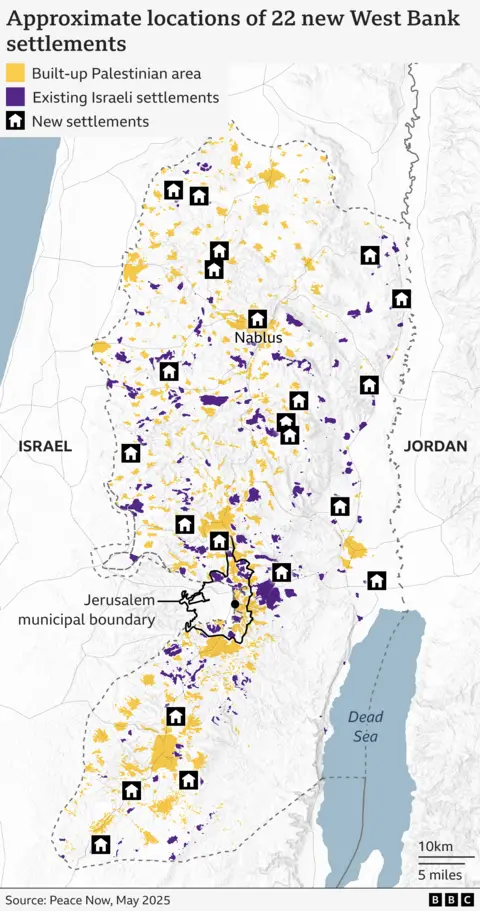
Israeli ministers say 22 new Jewish settlements have been approved in the occupied West Bank – the biggest expansion in decades.
Several already exist as outposts, built without government authorisation, but will now be made legal under Israeli law. Others are completely new, according to Defence Minister Israel Katz and Finance Minister Bezalel Smotrich.
Settlements – which are widely seen as illegal under international law, though Israel disputes this – are one of the most contentious issues between Israel and the Palestinians.
Katz said the move “prevents the establishment of a Palestinian state that would endanger Israel”, while the Palestinian presidency called it a “dangerous escalation”.
The Israeli anti-settlement watchdog Peace Now called it “the most extensive move of its kind” in more than 30 years and warned that it would “dramatically reshape the West Bank and entrench the occupation even further”.
BBC team’s tense encounter with sanctioned Israeli settler while filming in West Bank
Israeli settlers are seizing Palestinian land under cover of war – they hope permanently
Israel has built about 160 settlements housing some 700,000 Jews since it occupied the West Bank and East Jerusalem – land Palestinians want, along with Gaza, for their hoped-for future state – in the 1967 Middle East war. An estimated 3.3 million Palestinians live alongside them.
Successive Israeli governments have allowed settlements to grow. However, expansion has risen sharply since Prime Minister Benjamin Netanyahu returned to power in late 2022 at the head of a right-wing, pro-settler coalition, as well as the start of the Gaza war, triggered by Hamas’s 7 October 2023 attack on Israel.
On Thursday, Israel Katz and Bezalel Smotrich – an ultranationalist leader and settler who has control over planning in the West Bank – officially confirmed a decision that is believed to have been taken by the government two weeks ago.
A statement said they had approved 22 new settlements, the “renewal of settlement in northern Samaria [northern West Bank], and reinforcement of the eastern axis of the State of Israel”.
It did not include information about the exact location of the new settlements, but maps being circulated suggest they will be across the length and width of the West Bank.
Katz and Smotrich did highlight what they described as the “historic return” to Homesh and Sa-Nur, two settlements deep in the northern West Bank which were evacuated at the same time as Israel withdrew its troops and settlers from Gaza in 2005.
Nine of the settlements would be completely new, according to the watchdog. They include Mount Ebal, just to the south of Homesh and near the city of Nablus, and Beit Horon North, west of Ramallah, where it said construction had already begun in recent days.
The last of the settlements, Nofei Prat, was currently officially considered a “neighbourhood” of another settlement near East Jerusalem, Kfar Adumim, and would now be recognised as independent, Peace Now added.
Katz said the decision was a “strategic move that prevents the establishment of a Palestinian state that would endanger Israel, and serves as a buffer against our enemies.”
“This is a Zionist, security, and national response – and a clear decision on the future of the country,” he added.
Smotrich called it a “once-in-a-generation decision” and declared: “Next step sovereignty!”
But a spokesperson for Palestinian Authority President Mahmoud Abbas – who governs parts of the West Bank not under full Israeli control – called it a “dangerous escalation” and accused Israel of continuing to drag the region into a “cycle of violence and instability”.
“This extremist Israeli government is trying by all means to prevent the establishment of an independent Palestinian state,” Nabil Abu Rudeineh told Reuters news agency.
Lior Amihai, director of Peace Now, said: “The Israeli government no longer pretends otherwise: the annexation of the occupied territories and expansion of settlements is its central goal.”
Elisha Ben Kimon, an Israeli journalist with the popular Ynet news site who covers the West Bank and settlements, told the BBC’s Newshour programme that 70% to 80% of ministers wanted to declare the formal annexation of the West Bank.
“I think that Israel is a few steps from declaring this area as Israeli territory. They believe that this period will never be coming back, this is one opportunity that they don’t want to slip from their hands – that’s why they’re doing this now,” Mr Ben Kimon told the BBC’s Newshour programme.
Israel effectively annexed East Jerusalem in 1980, in a move not recognised by the vast majority of the international community.
AFP
Israeli soldiers accompanied settlers establishing the Homesh outpost in May 2023
This latest step is a blow to renewed efforts to revive momentum on a two-state solution to the decades-old Israel-Palestinian conflict – the internationally approved formula for peace that would see the creation of an independent Palestinian state alongside Israel – with a French-Saudi summit planned at the UN’s headquarters in New York next month.
Jordan’s foreign ministry condemned what it called a “flagrant violation of international law” that “undermines prospects for peace by entrenching the occupation”.
UK Foreign Office Minister Hamish Falconer said the move was “a deliberate obstacle to Palestinian statehood”.
Since taking office, the current Israeli government has decided to establish a total of 49 new settlements and begun the legalisation process for seven unauthorised outposts which will be recognised as “neighbourhoods” of existing settlements, according to Peace Now.
Last year, the UN’s top court issued an advisory opinion that said “Israel’s continued presence in the Occupied Palestinian Territory is unlawful”. The International Court of Justice (ICJ) also said Israeli settlements “have been established and are being maintained in violation of international law”, and that Israel should “evacuate all settlers”.
Netanyahu said at the time that the court had made a “decision of lies” and insisted that “the Jewish people are not occupiers in their own land”.
The billionaire helped fund an effort to gin up fraud claims against the Democratic donation platform.
Trump’s claim that he can order the Justice Department to investigate a fundraising platform used by his political foes based on vague allegations is part of his ongoingeffort to use the government’s powers to target political enemies. It’s not a particularly realistic accusation—the fact sheet claims it’s targeting “straw donor” schemes, in which one person donates on behalf of another. Given the fairly strict limitations on campaign contributions, any straw donor scheme that wants to inject any noticeable amount of money into an electoral system that had $15.5 billion run through it is a great deal of tedious, high-risk work for a scammer.
On the other hand, in the post-Citizens United era, there are plenty of ways to inject unaccounted-for money—even, theoretically, foreign money—into the election. Super-PACs can accept unlimited donations from fairly easy-to-obscure sources, for instance, which makes the idea of anyone using a small-dollar conduit like ActBlue (or the GOP equivalent WinRed) fairly silly.
And notably, the funding for some of Trump’s “data” on an alleged ActBlue “fraud” seems to have come from just such a source: a super-PAC bankrolled by Elon Musk.
Last year, an opaque group called the Fair Election Fund began promising to pay “whistleblowers” who cited election fraud “with payment from our $5 million fund.” That never panned out, but the same organization found more success with a claim that 60,000 people who were named as small-dollar donors in the Biden-Harris campaign’s July Federal Election Commission report did not recall making the contribution when contacted by the Fair Election Fund.
As Mother Jonesreported last year, the Fair Election Fund appears to have generated this finding by blasting out ominous-sounding texts and emails telling ActBlue donors that their donations had been “flagged,” then tallying people who responded—accurately or not—by checking a box saying they did not recall making the contribution.
More at the link above
Israel carrying out ‘live-streamed genocide’ in Gaza, Amnesty says
Amnesty accuses US President Donald Trump of committing a ‘multiplicity of assaults’ on human rights.
Israel is perpetrating a “live-streamed genocide” in Gaza, committing illegal acts with the “specific intent” of wiping out Palestinians, Amnesty International has said.
Israeli forces in Gaza have violated the United Nations Genocide Convention with acts that include “causing serious bodily or mental harm to civilians” and “deliberately inflicting conditions of life calculated to bring about their physical destruction”, the human rights organisation said in its annual report released on Monday.
Israeli air strikes have also frequently hit civilians who were following evacuation orders, while its forces continued to “arbitrarily detain and, in some cases, forcibly disappear Palestinians”, the rights group said.
DOGE has made a big impact on Washington. But government spending is up.
Elon Musk and his shadowy “tech support” team have ripped through Washington, reshaping the government and culling the federal workforce with astonishing speed and scope.
Nearly a quarter of a million workers have or are expected to leave their federal jobs. That includes more than 112,000 federal workers who have opted into the deferred resignation program, according to a POLITICO analysis of previous reporting and conversations with administration officials. It also includes some 121,000 workers across agencies who have been fired, according to a CNN analysis.
DOGE has hollowed out or shut down 11 federal agencies and says it has terminated more than 8,500 contracts and 10,000 grants. It has wiped out foreign aid and volunteerism in the U.S., slashed education spending and made sweeping changes to the way the government makes procurements, hires contractors and shares data.
DOGE, after promising $2 trillion in savings, now says it has saved the government $160 billion. But even these reported savings, so far, have not led to any meaningful decline in total government spending this year, according to the nonpartisan Penn Wharton Budget Model, which tracks weekly Treasury data.
In fact, the government has actually been spending more compared to this time last year, the model found.
Total spending rose by 6.3 percent, or $156 billion since Trump took office, compared to the first four months of 2024, said Kent Smetters, a Wharton professor who directs the model. Even when accounting for inflation, the federal government has still added $81.2 billion more spending to its books compared to the same period last year, he added.

AFP
Israeli ministers said the settler outpost at Homesh will be retrospectively legalised (file photo from May 2023)AFP
 Scottie's Playtime