October 20, 1947 The House Un-American Activities Committee (HUAC) opened public hearings into alleged Communist influence in Hollywood. To counter what they claimed were reckless attacks by HUAC, a group of motion picture industry luminaries, led by actor Humphrey Bogart and his wife, Lauren Bacall, John Huston, William Wyler, Gene Kelly and others, established the Committee for the First Amendment (CFA). Read more
October 20, 1962 A folk music album, “Peter, Paul and Mary,” hit No. 1 on U.S. record sales charts. The group’s music addressed real issues – war, civil rights, poverty – and became popular across the United States. The trio’s version of “If I Had A Hammer” (originally recorded by The Weavers, which included the song’s composers, Pete Seeger and Lee Hays) was not only a popular single, but was also embraced as an anthem by the civil rights movement. About Peter, Paul and Mary
October 20, 1967 The biggest demonstration to date against American involvement in the Vietnamese War took place in Oakland, California. An estimated 5,000-10,000 people poured onto the streets to demonstrate in a fifth day of massive protests against the conscription of soldiers to serve in the war. [see October 16, 1967] Read more
October 20, 1973 In what was immediately called the “Saturday Night Massacre,” President Richard Nixon’s Press Secretary, Ron Ziegler, announced that Special Watergate Prosecutor Archibald Cox had been dismissed. Cox had been investigating Nixon, his administration and re-election campaign. Nixon had demanded that he rescind his subpoena for White House recordings. Archibald Cox Richard Nixon Earlier in the day, Attorney General Elliot Richardson had resigned, and Deputy Attorney General William Ruckelshaus had been fired, both for refusing to dismiss Cox. Solicitor General Robert Bork, filling the vacuum left by the departure of his two Justice Department superiors, fired Cox at the president’s direction.
Ann Arbor (Informed Comment) – In the 1820s Greece waged a successful war of independence against an authoritarian king, the Ottoman Emperor Mahmoud II. The American public, enthralled with this saga of a quest for liberty, idolized the revolutionaries, who were led for a few years by Demetrios Ypsilantis. They took his name for the name of their town, Ypsilanti. The people here therefore have a very long history of despising tyrants, and they demonstrated it again on Saturday.
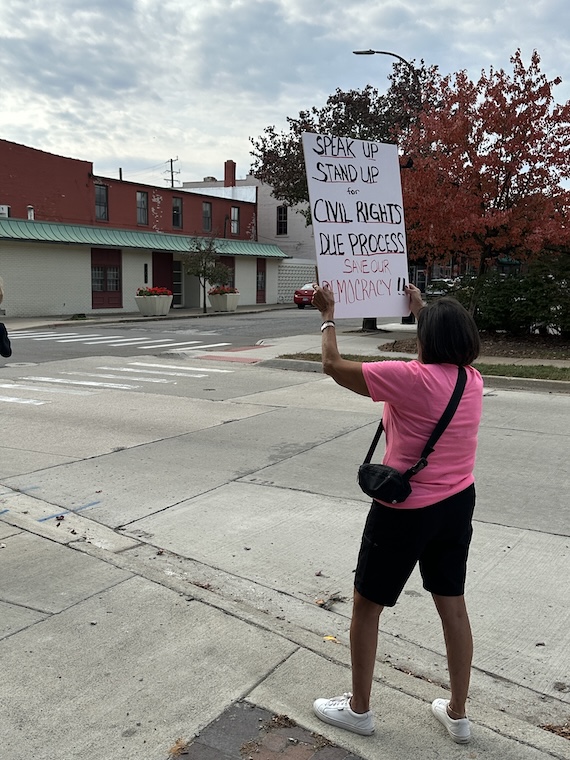
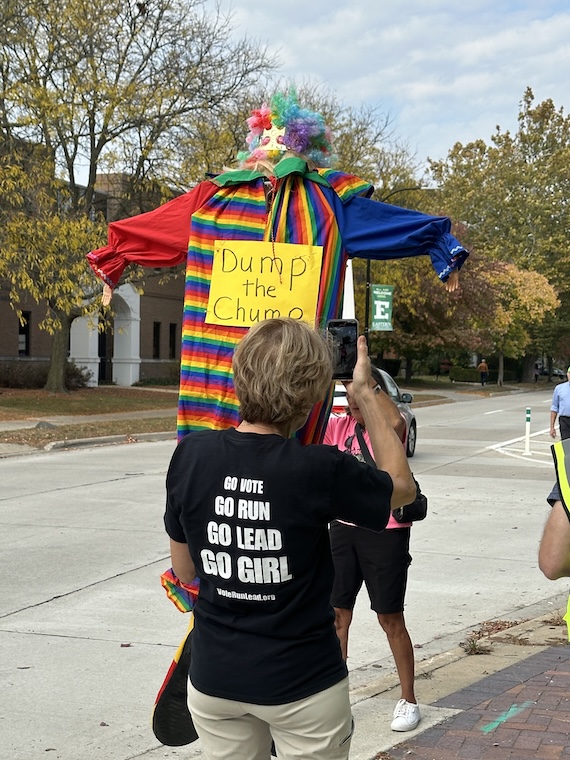
Some 3,500 demonstrators came out for a march against Trump policies on No Kings Day, October 18 in Ypsilanti, Michigan, according to Lilly Kujawski. People chanted “What does democracy look like? This is what democracy looks like!” and “Hey, hey, ho, ho, Donald Trump has got to go.”
Ypsilanti is a majority white, predominantly Democratic town of about 20,000 residents in the southeast corner of the state, with several factories (including the Rawsonville Ford plant) and Eastern Michigan University, with its WEMU NPR jazz station.
As a blue collar town, it shows that the slight swing to Trump among working class families nationally did not happen everywhere. Trump’s workers often don’t have a high school degree or are evangelicals. In 2024, he “lost majorities of blue-collar blacks, Latinos, and non-evangelical whites,” according to Brookings. The roughly one quarter of the residents in the town who are of African-American heritage suffer from the openly racist discrimination of Trump’s minions.
Trump policies favoring the rich fat cats and harming blue collar workers hurt Ypsilanti residents. His tariffs will raise the cost of the things they buy. His attack on their health care will put up their doctor and hospital costs. For those between jobs, the cuts to SNAP, medicaid and other benefits hurt.
When Demetrios Ypsilantis mounted his rebellion against the Ottoman Empire, among his goals were a rule of law and a constitutional order. The Ottoman Empire was an absolute monarchy that in the 1820s had no constitution, no legislature, and the judges in which were Muslim clerics appointed by and paid by the state, so that they had no independence of the sultan.
The French political philosopher Montesquieu (d. 1755) had laid out the problem in his Spirit of the Laws, which deeply influenced the American Founding Fathers. He wrote,
“There would be an end of everything, were the same man or the same body, whether of the nobles or of the people, to exercise those three powers, that of enacting laws, that of executing the public resolutions, and of trying the causes of individuals.
Most kingdoms in Europe enjoy a moderate government because the prince who is invested with the two first powers leaves the third to his subjects. In Turkey, where these three powers are united in the Sultan’s person, the subjects groan under the most dreadful oppression.”
As usual, that is omitted, then people believe it when other people say Dems do nothing. Elected Dems are doing all they can. Sen. Rand Paul is also involved, as Libertarians will be in matters of war.
Amid a wave of U.S. military strikes in the Caribbean and plans for covert operations in Venezuela, Sen. Tim Kaine, D-Va., is leading a bipartisan effort to force a vote to stop President Trump from unilaterally declaring war on the South American nation.
Kaine, a longtime proponent of Congress’ powers to declare war, filed the resolution late Thursday, a move that will force the Senate to take up the legislation after a 10-day waiting period. Sens. Adam Schiff, D-Calif., and Rand Paul, R-Ky., co-sponsored the plan.
Kaine said concerns about war in the Latin American region are growing.
“The pace of the announcements, the authorization of covert activities and the military planning makes me think there’s some chance this could be imminent,” Kaine told reporters.
Sen. Tim Kaine, D-Va., speaks to reporters outside the Senate chamber on Oct. 1. Kaine is hoping to prevent President Trump from unilaterally waging war on Venezuela without approval from Congress.Anna Moneymaker/Getty Images
This week, Trump said the U.S. had conducted another military strike on an alleged drug boat in the Caribbean and announced that he had authorized CIA operations in Venezuela. He also said he was considering land operations in the country.
“We’ve almost totally stopped it by sea. Now we’ll stop it by land,” Trump said from the Oval Office on Wednesday about alleged drug smuggling.
Last week, Kaine and Schiff forced a Senate vote to limit Trump’s war powers in the Caribbean. While that vote failed 48-51, two Republicans, Paul and Sen. Lisa Murkowski of Alaska, joined Democrats in support.
Paul has been a vocal critic of the new military strikes, saying they set a precedent for the U.S. to shoot first without asking questions.
“The American people do not want to be dragged into endless war with Venezuela without public debate or a vote,” Paul said in a statement. “We ought to defend what the Constitution demands: deliberation before war.”
Kaine, Paul and Schiff are hoping more Republican members will vote in favor of the new limits. Several Republicans have voted for other war powers and use of military force resolutions led by Kaine in the past.
“I think it’s probably 10 or so [Republicans] who voted yes on at least one of them,” he said. “So we’ll start to work that.”
It remains unclear whether there are enough Republican votes for the measure to succeed.
Kaine said Congress continues to face a “black hole” of information related to action against Venezuela. Lawmakers say the administration still has not shared evidence to justify the boat strikes, which Kaine and others believe are illegal and unconstitutional.
Since September, Trump has ordered at least five U.S. military strikes on boats that the administration has claimed were smuggling illegal drugs. So far, at least 27 people have been reported killed, but their identities have yet to be shared.
October 18, 1648 I. Marc Carlson The Shoemakers Guild of Boston became the first labor union in the American colonies. Labor organization in colonial times —————————————————– October 18, 1929 The Persons Case, a legal milestone in Canada, was decided. Five women from Alberta, later known as the Famous Five, asked the Supreme Court of Canada to rule on the legal status of women. Some decisions of Magistrate Emily Murphy had been challenged on the basis that she was not a legal person, and she was a candidate for appointment to the Canadian Senate. After the Supreme Court ruled against them, they appealed to the British Privy Council.The Privy Council found for the women on this day (eight years after the case began and eleven years after women received the federal vote), declaring that women were persons under the law. October 18 has since been celebrated as Persons Day in Canada, and October as Women’s History Month.
Sculpture by Barbara Paterson of the Famous Five in Ottawa, first on Parliament Hill to honor women The other women activists in the Famous Five: Henrietta Muir Edwards, Nellie McClung, Louise McKinney, and Irene Parlby. The Persons Case
Despite repeatedly promising not to cut Social Security, the Trump Administration is reportedly preparing a proposed rule that could reduce the share of applicants who qualify for Social Security Disability Insurance (SSDI) by up to 20 percent, according to an Urban Institute report that cites writing by a former Trump Administration official and interviews with former staff at the Social Security Administration (SSA). This would be the largest cut in SSDI history.
SSDI is an integral part of Social Security. It provides essential benefits to workers who cannot support themselves through earnings due to severe and long-lasting disabilities that significantly impede their ability to work, and it helps to prevent beneficiaries and their families from experiencing poverty.
The rule would make it much more difficult to qualify for both SSDI and Supplemental Security Income (SSI). Because it would dramatically change the eligibility criteria for older applicants, the losses among people over age 50 would be much deeper.
The rule is likely to be the largest-ever cut to Social Security Disability Insurance. A 20 percent cut in the share of applicants who qualify for SSDI would be larger than any previous change to the program. It would be even larger than the Reagan-era disability cuts, which the Reagan Administration was forced to reverse amid fierce opposition from governors, courts, beneficiaries, and advocates. According to an Urban Institute analysis, even a cut half the size of what the Trump Administration is considering would mean 750,000 fewer people would receive SSDI benefits within ten years. In addition to reducing the share of applicants who receive benefits, some current beneficiaries could see their benefits taken away when their eligibility is reviewed.
The rule would particularly hurt older workers. Like the rest of Social Security, SSDI serves largely older people; nearly 80 percent of disabled workers are aged 50 or older. SSDI benefits provide vital support to people whose careers are cut short by severe medical impairments. The rule is expected to target older applicants already determined to have significant medical impairments by discounting the barriers they face due to their age in continuing to do substantial work — despite the law’s requirement that the Social Security Administration (SSA) consider how age, education, and skills might make working harder, in addition to considering health conditions.
It’s already difficult at any age to qualify for disability benefits, given their stringent rules. Research shows applicants whose impairments are not severe enough to qualify for SSDI fare poorly in their attempts to return to work — especially if they’re older. Rejecting more older applicants will cause more hardship for people who would be eligible for benefits under the existing rules.
The rule will likely cause disproportionate harm to people living in the South and Appalachia. Some states have a higher share of people receiving disability benefits, particularly those with more older workers with fewer years of formal education, and who are more likely to have worked in physical jobs like manufacturing or mining. That is true of many Southern and Appalachian states, as well as Maine and the Rust Belt states of Michigan, Ohio, and Pennsylvania. The proposed rule drafted during the first Trump Administration would reportedly change the way SSA considers education as well as age, and because residents of these states are on average older and less educated, these changes will hit them doubly hard.
In addition to cutting Social Security and SSI, the rule would threaten retirement security, access to health care, and other supports. Workers who become disabled and qualify for SSDI are significantly worse off in retirement: they are poorer, experience more hardship, and have lower savings. Disabled workers will fare even worse in retirement if their eligibility for disability benefits is stripped. They would be forced to spend any retirement savings faster and claim their Social Security retirement benefits at a younger age, permanently reducing their — and possibly their family’s — monthly Social Security retirement benefits by up to 30 percent. For hundreds of thousands of older people, this rule would create long-term financial insecurity as they age.
In addition, applicants who do not qualify for disability benefits may face significant challenges accessing health care. SSDI recipients typically receive Medicare 24 months after they begin to receive benefits; if someone no longer qualifies for these benefits, they won’t be able to get Medicare until they turn 65. And, SSI recipients receive Medicaid, so those who lose SSI benefits may also lose Medicaid (particularly in states that have not adopted the Medicaid expansion). Most rejected applicants under the new standard will have very significant medical impairments, and many will struggle to access health care without those benefits — particularly after the steep Medicaid cuts in the Republican megabill.
Finally, restricting eligibility for disability benefits will make it more difficult for rejected applicants to access other key supports, such as food assistance, which has increasingly strict time limits for most non-elderly individuals without younger children who are not receiving disability benefits. New Medicaid work requirements could also pose significant impediments to people who lose disability benefits.
This rule is the latest in a series of harmful actions by the Trump Administration that threaten access to Social Security. This year, the Administration has forced SSA through a radical downsizing that has disrupted services for the largely older and severely disabled people who rely most on the agency, indiscriminately pushing out 7,000 workers in the largest staff cut in SSA’s history. This realignment has resulted in fewer staff serving Social Security applicants and beneficiaries, and huge cuts to staff supporting the agency’s customer service mission. These cuts have been coupled with inexplicable new restrictions — some of which have already been partially rolled back — for how the public can engage with SSA for assistance, creating additional access barriers.
At the same time, the Administration is working to advance changes that would make it harder for hundreds of thousands of eligible people to receive or continue receiving SSI, creating additional red tape for beneficiaries and more work for depleted and overburdened SSA staff.
I am not trans even though I have been asked because of my super strong support of trans people. I have lost friends who wouldn’t accept trans people using a public bathroom with them even though all private functions happen in enclosed little stalls. I do have distant family members who are trans and fully supported by family. More important I can clearly see the same negative vile things said about trans people are the same things pushed against gay people when I was a struggling gay teen being pushed by the same groups on the same ideas of victimhood. They were mostly driven by hyper Christian Nationalist religious groups and those who demanded that traditions along with society never change from when they were young and happy. These same groups and feelings are in play against trans people. They are simply the homosexual aids scare of the 1980s. Just as I as a young gay person needed allies and support so do trans people today. Please give as much vocal and upfront support for trans people you can. It is easier to make progress as a society if we don’t have to undo hateful laws outlawing our very existence. Hugs
is today in Peace & Justice History. Feeding people is my main “thing,” so I’m featuring it today. There is so very much that has happened on October 16, and it can all be seen on this page.
October 16th every year
United Nations’ World Food Day is recognized every year.
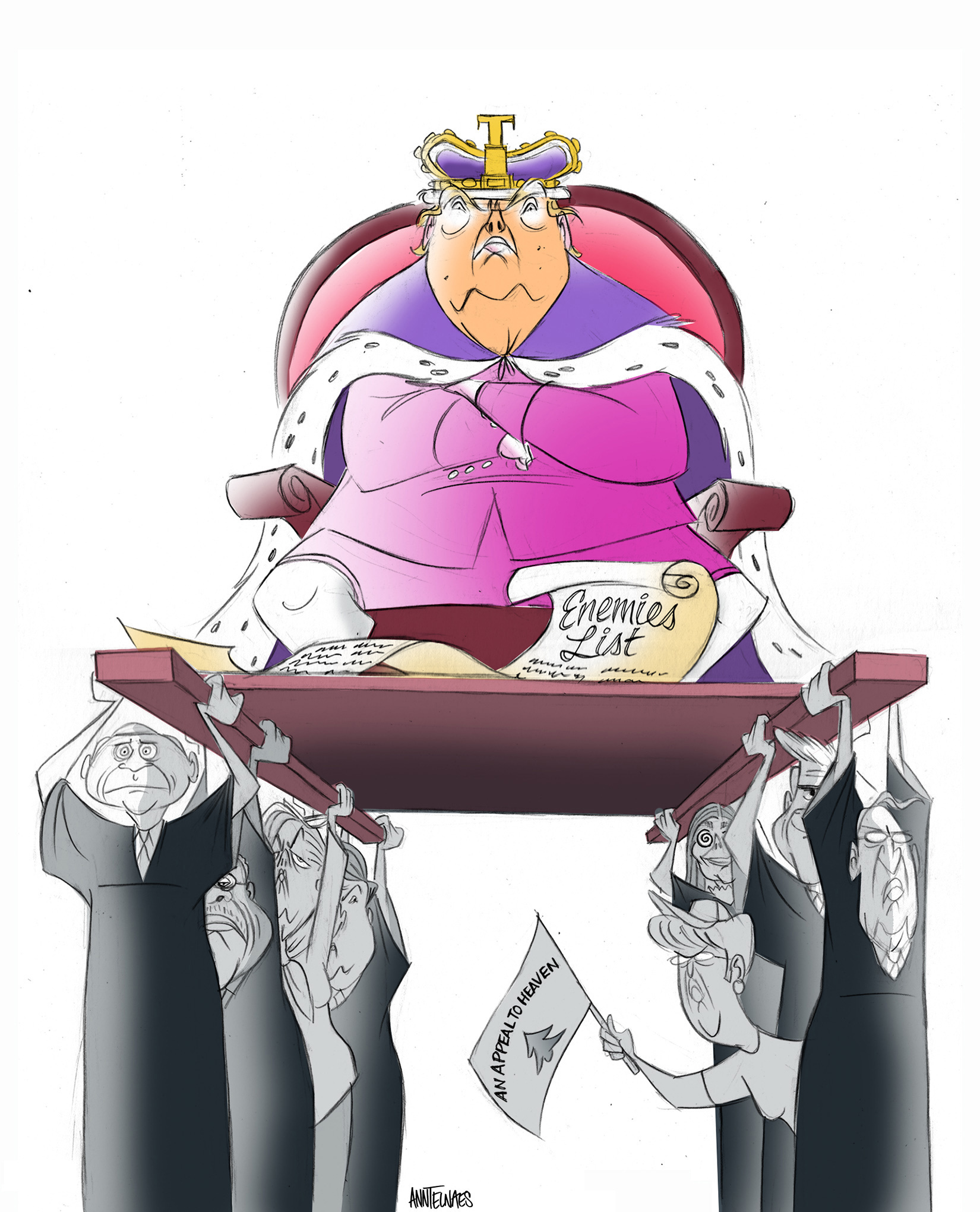
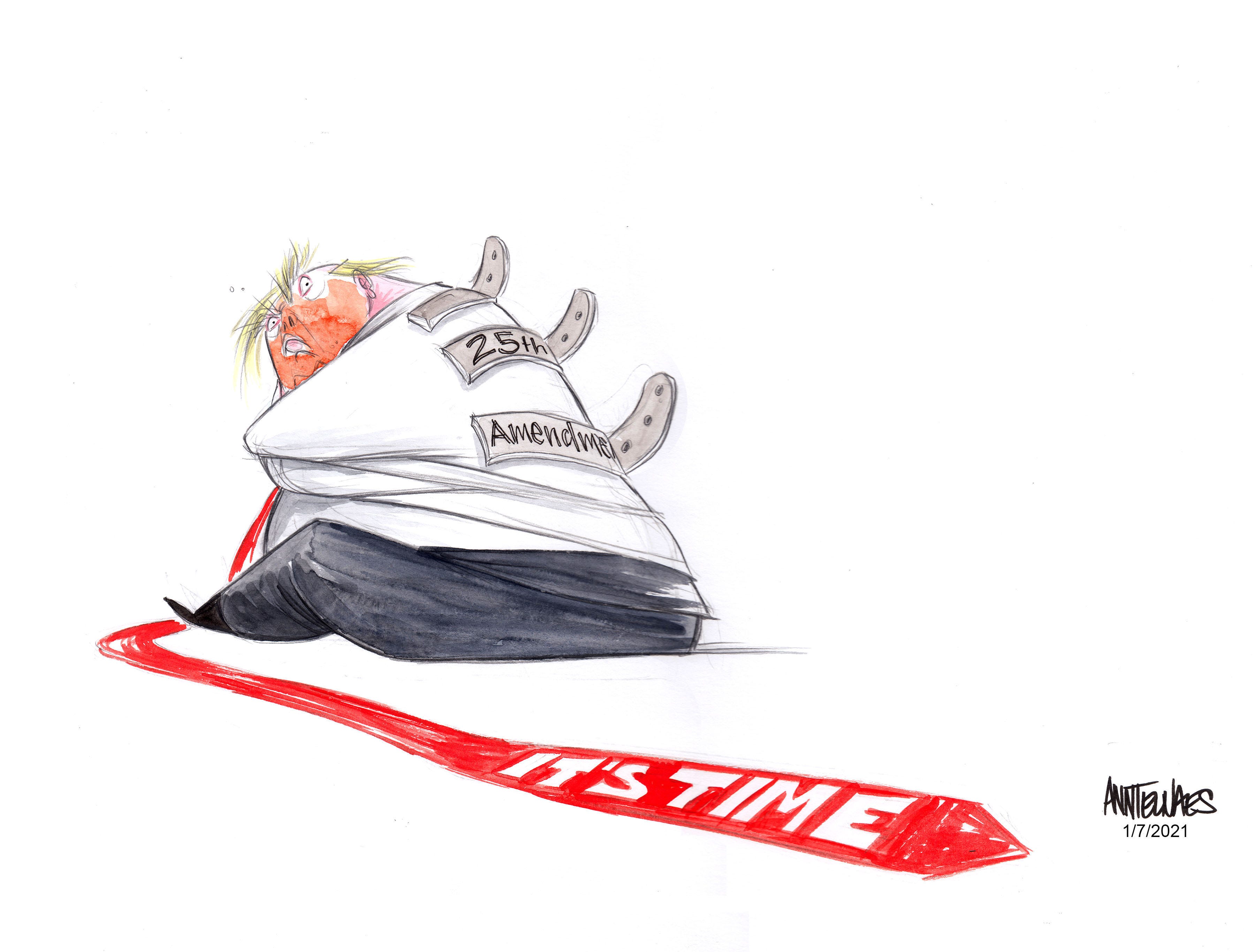
As I’ve said before, please feel free to use my cartoons for your posters (just no altering text or images, please). Contact me either in the comments or email for the hi-res file (atelnaes@anntelnaes.com) . Here’s also a few suggestions from my archives if you don’t have a particular one in mind.
Stay safe and be loud with your First Amendment Rights.
UPDATE: Thank you for all your requests and my apologies for not being able to respond to your added kind messages. Even if you’re only getting the attached file, I’ve read and appreciated them all.
***Liza Donnelly and Steve Brodner are both offering their excellent editorial cartoons to download for posters.
There is a brutal video at the link that shows her detainment / arrest. She was peacefully protesting. At one point ICE agents rushed out of the gates, jumped the woman who was just playing her clarinet. She was not doing anything wrong. She was in a public space exercising her 1st amendment rights. Then ICE took her across state lines and put her in a jail with no charges and no bail. She is being held incommunicado not allowed to talk to anyone which means no lawyer. The video reporter says that the peaceful protestors were hit with pepper balls. The US is being run by a mob boss wannabee racist white nationalist authoritarian who doesn’t want any rights for anyone not white and wealthy. The people of this country have lost all civil rights. One of the people arrested was white so it doesn’t matter race. Please watch the video. We are at a point where any protest against the government can get you disappeared Russia style. Hugs
A clarinet player is apparently being held without bail on no specific charges at the Clark County Jail in Vancouver after her husband said she was arrested Sunday during a protest across the street from the ICE facility in South Portland. The woman’s husband — who asked KOIN 6 News not to identify either of them for safety reasons — said his wife was tackled by federal agents while she was playing her clarinet around 5 p.m.
“It is a beautiful party atmosphere. Everybody’s really excited. Then the band hits into ‘Ghostbusters’, and then at ‘Ghostbusters’, that’s when ICE start storming in,” the husband said. “Why are they targeting a clarinet player? A clarinet player standing on the sidewalk far away from the street, following instructions.” Video of the arrest obtained by KOIN 6 News shows the woman face down in the mud with her clarinet on the ground next to her.
Following public outcry, the Department of Education has reversed its decision to cut funding for students who have both hearing and vision loss, opting instead to reroute grants to an organization that will provide funding to these students.
Following public outcry, the U.S. Department of Education has restored funding for students who have both hearing and vision loss, about a month after cutting it.
But rather than sending the money directly to the four programs that are part of a national network helping students who are deaf and blind, a condition known as deafblindness, the department has instead rerouted the grants to a different organization that will provide funding for those vulnerable students.
The Trump administration targeted the programs in its attacks on diversity, equity and inclusion; a department spokesperson had cited concerns about “divisive concepts” and “fairness” in explaining the decision to withhold the funding.
ProPublica and other news organizations reported last month on the canceled grants to agencies that serve these students in Oregon, Washington and Wisconsin, as well as in five states that are part of a New England consortium.
Programs then appealed to the Education Department to retain their funding, but the appeals were denied. Last week, the National Center on Deafblindness, the parent organization of the agencies that were denied, told the four programs that the Education Department had provided it with additional grant money and the center was passing it on to them.
“This will enable families, schools, and early intervention programs to continue to … meet the unique needs of children who are deafblind,” according to the letter from the organization to the agencies, which was provided to ProPublica. Education Department officials did not respond to questions from ProPublica; automatic email replies cited the government shutdown. (snip-MORE)









 Scottie's Playtime