| FETCH THIS PRINT |
| “There is hope in the resilience of nature.”Jane Goodall |

| FETCH THIS PRINT |
| “There is hope in the resilience of nature.”Jane Goodall |
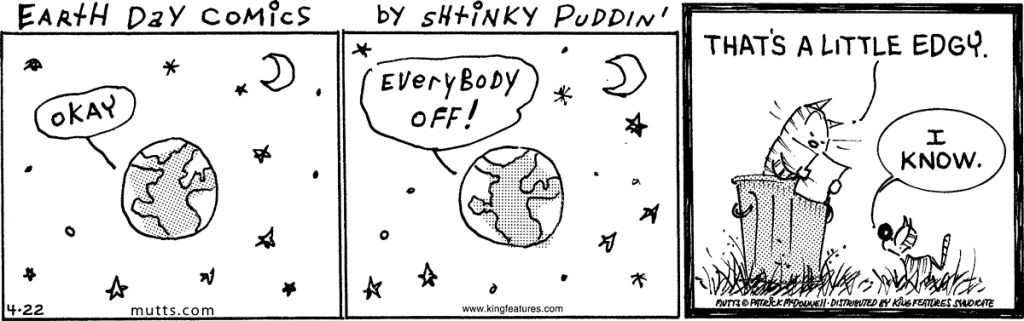
Ollie has endeared himself to some house finches who come here to eat. He’s done this by chasing the squirrel off the feeder they prefer. He doesn’t realize he’s doing favors for the birds; he wants to play with the squirrel, especially zoomies. But, for 2 days in a row, I’ve watched house finches, in pairs, chase a squirrel back in Ollie’s direction by swooping the squirrel. They also are, so far, the only birds who don’t fly up away from this feeder when Ollie goes outside. Even the crows tend to fly into the trees until he comes back inside. So the house finches fascinate me this year. Anyway, here are these about more birds, and a bat, too.
Also Known As

The Yellow-winged Blackbird is a conspicuous species of the Southern Cone of South America, congregating in colonies in marshes during the breeding season, and forming larger flocks in wetlands, grasslands, and agricultural fields the rest of the year. These birds are also extremely vocal, giving a startling variety of calls, including sharp and percussive sounds, clear and musical whistles, and a range of other rattling, chirping, whining, whirring, and gargling vocalizations. Their song in particular makes use of virtuosic trills, robotic whistles, and mechanical whirring or buzzing sounds, coming across as half bird, half sci-fi robot. This iconic song is also the source of one of the Yellow-winged Blackbird’s nicknames, “trile,” and some authors propose it may also be the origin of the name of the country Chile! As if to make the most of their raucous acoustic capacity, the males of an entire colony will sometimes sing together in one big, cacophonous chorus.
In addition to nesting together in the same space, Yellow-winged Blackbirds also synchronize their nesting in time. Most of the females in a colony will lay within several days of each other. As a result, most of the nests in the colony will be on the same timeline, with eggs and nestlings developing at about the same time across the marsh. (snip)
Historic Oregon Bill Generating Conservation Funding Is Signed Into Law
Oregon will soon have a new, dedicated source of conservation funding to support the recovery of struggling bird and wildlife species across the state. House Bill 4134, dubbed 1.25% for Wildlife Bill, passed the Oregon State Senate in February and has now been signed into law by Governor Tina Kotek. American Bird Conservancy (ABC) strongly supported the 1.25% for Wildlife Bill, a proactive measure expected to raise up to $30 million annually for wildlife conservation in the state.
“This is monumental: Oregon has chosen to invest in its wildlife and its future with the passage of this historic law. Habitat restoration, recovery programs, and anti-poaching efforts are just a few of the programs that will be funded by this landmark legislation,” said Hardy Kern, ABC’s Director of Government Relations.
The Act will create a sustainable funding source dedicated to conserving imperiled species like the Marbled Murrelet, a seabird that nests in mature and old-growth forests in the state. Nest predation by jays and ravens contributes to the species’ declining population. Actions that could boost nesting success, such as campground cleanup efforts to reduce jay and raven numbers near sensitive nesting sites, are currently unfunded, but could benefit from the revenue generated by the newly signed law. (snip-MORE)
| April, 16, 1971 The Internal Revenue Service (IRS) estimated over 2,000 people openly refused to pay part or all of their income tax. “If a thousand [people] were not to pay their tax bills this year, that would not be a violent and bloody measure, as it would be to pay them and enable the state to commit violence and shed innocent blood.” – Henry David Thoreau on the Mexican War  National War Tax Resistance Coordinating Committee |
| April 16, 2000 Between 10,000 and 20,000 activists blockaded meetings of the World Bank and International Monetary Fund in Washington, D.C. Sitting down at intersections and locking arms to form human chains, the protesters were opposed to Bank and IMF policies that increased third-world indebtedness and did little to directly benefit the poor in those countries. “The World Bank is subjugating our economic and social independence,” Vineeta Gupta, a doctor from the Punjab in India, said in a letter he delivered to World Bank President James Wolfensohn at his home. “It is time that we shut the bank down, and this boycott is a great start.” |
More from National War Tax Resistance Coordinating Committee:
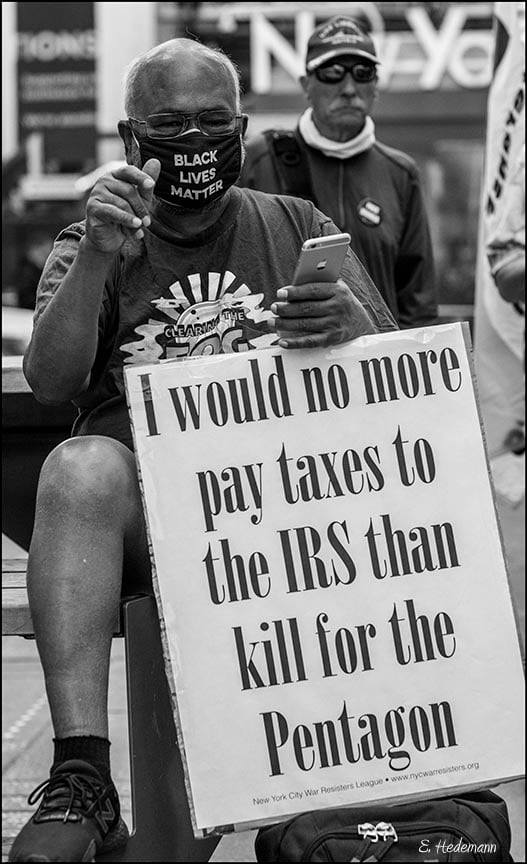
War tax resistance means refusing to pay some or all of the federal taxes that pay for war. While you can refuse income tax legally by lowering your taxable income, for many people war tax resistance involves civil disobedience.
In the U.S. war tax resisters refuse to pay some or all of their federal income tax and/or other taxes, like the federal excise tax on local telephone service. Income taxes and excise taxes are destined for the government’s general fund and about half of that money goes for military spending, including weapons of war and weapons of mass destruction.
People take many roads to war tax resistance. Most are motivated by a combination of reasons and actively work for peace in many other ways too. If you consider your motivations this will help you determine your method of resistance.
Refusing to pay federal income taxes is an act of civil disobedience with a long history in the U.S. America’s most well-known war tax resister was Henry David Thoreau, whose refusal to pay his poll tax because of the Mexican-American War earned him an night in jail and the experience that led him to write his influential essay, Civil Disobedience. While those of us who refuse to pay war taxes believe our refusal is just and imperative — and some of us cite international law to back up this belief — the government considers the refusal to pay these taxes to be illegal, and there are potential repercussions through the IRS collection system. For most of us who resist, the dire consequences of voluntarily paying for war are far worse that what the IRS and government can do to us. (snip-MORE)
| April 17, 1959 22 were arrested in New York City for refusing to take shelter during a civil defense drill. |
| April 17, 1960 Inspired by the Greensboro sit-in of four black college students at an all-white lunch counter, nearly 150 black students from nine states formed the Student Nonviolent Coordinating Committee (SNCC). Meeting in Raleigh, North Carolina, with Ella Baker, James Lawson and Martin Luther King, Jr., the founders set SNCC’s initial goals as overturning segregation in the South.   They also considered it important to give young blacks a stronger voice in the civil rights movement, as many had participated in sit-ins that had proliferated to dozens of cities over the previous three months. At the Raleigh conference Guy Carawan sang a new version of “We Shall Overcome,” an adaptation of an old labor song. This song would become the national anthem of the civil rights movement.People joined hands and gently swayed in time singing “black and white together,” repeating over and over, “Deep in my heart, I do believe, we shall overcome some day.” What SNCC did to make change happen |
April 17, 1961 Cuban leader Fidel Castro during the Bay of Pigs invasion. An army of 1500 anti-Castro Cuban exiles, mercenaries equipped and trained at a secret Guatemala base by the CIA, landed at Bahia de Cochinos (Bay of Pigs) in an attempt to “liberate” Cuba from Communist rule. Within three days, the invasion proved disastrous with nearly 1200 members of Brigade 2506 (who had been trained in the U.S.) taken prisoner. Known as Operation Zapata, it was conceived by Vice President Nixon, planned and approved by the Eisenhower administration, and executed shortly after President John Kennedy’s inauguration.  President Kennedy receives the Brigade 2506 flag in Miami in 1962 and declares: “I promise to return this flag in a free Havana.” Soviet General Secretary Nikita Kruschev sent a telegram to President Kennedy: “Mr. President, I send you this message in an hour of alarm, fraught with danger for the peace of the whole world. Armed aggression has begun against Cuba. It is a secret to no one that the armed bands invading this country were trained, equipped and armed in the United States of America. The planes which are bombing Cuban cities belong to the United States of America, the bombs they are dropping are being supplied by the American Government . . . .” What actually happened |
April 17, 1965 The first national demonstration against the Vietnam War took place in the nation’s capital. Students for a Democratic Society (SDS), the organizers, had expected about 2000 marchers; the actual count was 15,000–25,000. This was the largest anti-war protest ever to have been held in Washington, D.C. up to that time. The number of marchers approximately equaled the number of U.S. soldiers in Vietnam. Several hundred students in the protest broke away from the main march and conducted a brief sit-in at the U.S. Capitol’s door. An exam prepared by SDS about the Vietnam War (answers available) |
April 17, 1965 Gay rights advocate Jack Nichols The first demonstration promoting equal treatment of homosexuals, Jack Nichols, Barbara Gittings and others picketed in front of the White House. There were no media present. Read more (Go-it’s interesting!) |
| April 17, 1986 Reverend Jesse Jackson, future congresswoman Maxine Waters and others co-founded the Rainbow Coalition, initially intended as a progressive public-policy think tank within the Democratic Party.  Representative Maxine Waters, Harry Belafonte, John Sweeney, President of the AFL-CIO, Reverend Jesse Jackson, and Willie Nelson August 6, 2005-Atlanta, Georgia. Brief history of Rainbow Push Coalition |
| April 17, 1992 On Good Friday morning, about 50 people accompanied Fr. Carl Kabat and Carol Carson to Missile Silo Site N5 at Whiteman Air Force Base in Missouri, the same silo that Carl and other members of the Silo Pruning Hooks (see below) disarmed in 1984. They cut through a fence and, once inside, Carol used a sledgehammer on the concrete lid of the silo while Carl performed a rite of exorcism. Eventually, the police arrived and arrested Carl and Carol. They were jailed and held until their court appearance. At that time, they made a preliminary agreement with federal prosecutors wherein they would plead “no contest” to trespass in exchange for the property destruction charge being dropped; they were sentenced to six and three months, respectively, in a halfway house.  Carl Kabat Carl KabatA History of Direct Disarmament Actions About the Silo Pruning Hooks action |
Not before free public restrooms, but still. Maybe service organizations or churches can help out with space, etc. Anyway, enjoy simply reading about a nice thing.
KJZZ | By Sam Dingman
Published April 9, 2026 at 12:43 PM MST

The “wind phone” set up at New Vision Center for Spiritual Living in Phoenix.
Back in 2020, a woman named Amy Dawson lost her 25-year-old daughter, Emily.
In the midst of her grief, she discovered a monument in Japan, built by a man named Itaru Sasaki: a small white phone booth on a hill overlooking the Pacific Ocean, in the town of Otsuchi. Sasaki, who’d suffered a loss of his own several years earlier. He called it a “wind phone,” and the idea was simple: step into the booth, pick up the receiver and speak to those you can no longer reach on a regular phone.
Dawson fell in love with the idea as a way of communicating with Emily, and set up a wind phone of her own. And Dawson set up a website encouraging others to set up or find their own wind phones.
Here in Phoenix, the idea connected with a member of the congregation at the New Vision Center for Spiritual Living, who told Rev. Karin Einhaus about it.
Einhaus was moved by the story, and resolved to set up a wind phone that’s open to the public on the center’s campus.
And not long after, she got a call from another member of the congregation. (snip-go read it! It’s not at all long.)
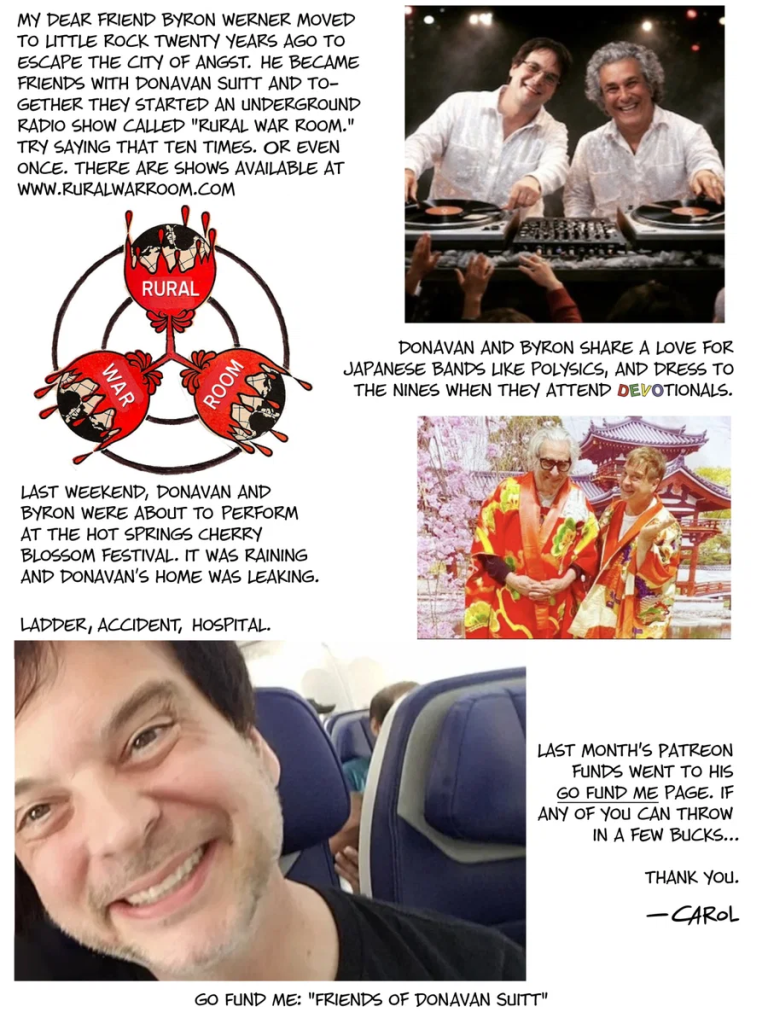
is a fundraiser for a friend of the cartoonist. I’m posting it not so much to try to help, but because I promised I’d post this every week. There is, as always, great art here!
(A comic, and some shorts. I thought I had more comics!) Some current event related, some simple humor, some both. And dancing!
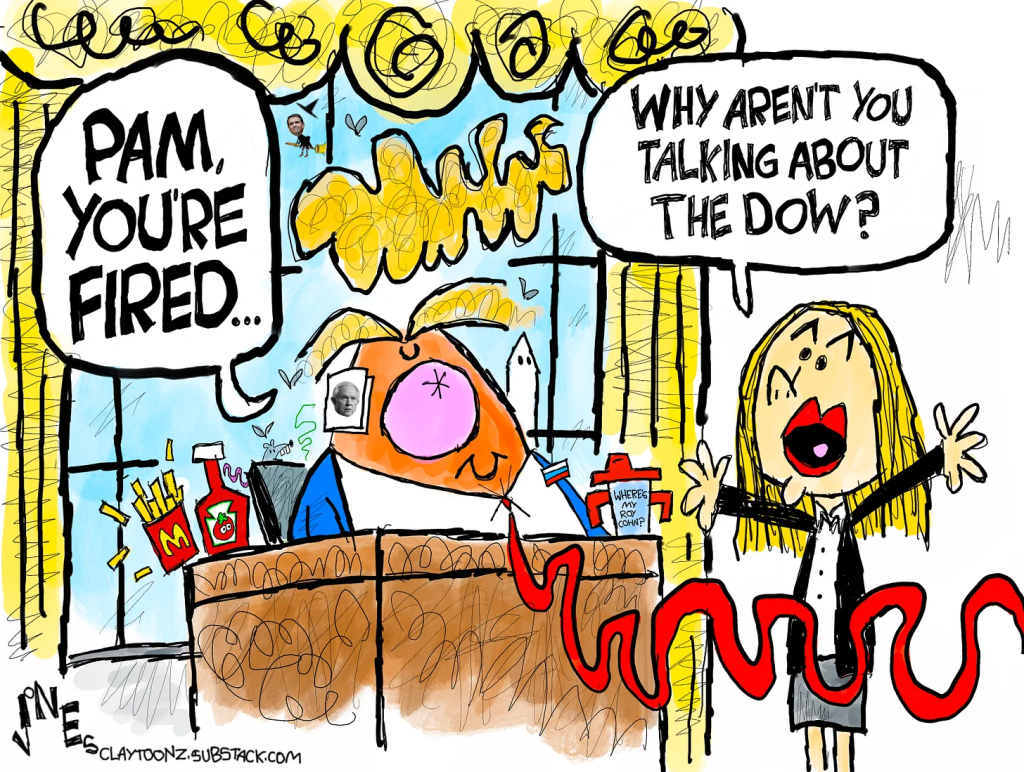
There were a lot of reasons to fire Pam Bondi as United States Attorney General, but Donald Trump picked a bad one.
Bondi was never qualified for the job, which was the second choice after Matt Gaetz, who would have been another ridiculous choice. Bondi made it clear after the 2020 election that she didn’t need evidence to make legal claims, as she declared that Donald Trump was cheated out of that race. She had been in his pocket ever since he bribed her in the 2000s not to investigate Trump University in Florida, when she was the state’s Attorney General.
After Bondi misled the country about her initial disclosures in the Jeffrey Epstein case, Congress responded by passing a law forcing the Justice Department to release its files on the pedophile and his allies. (snip-MORE; click on the title above)
They’re greedy and they’re dummies
Drumpf’s face looks like a mummy’s
The opposite of yummy
The Drumpfy Family
Don Junior loves his cocaine
And Eric is a no-brain
They’re syphillitic, insane
The Drumpfy Family
Chum
Numb
And dumb
So hide beneath the covers
And find yourself a lover
Don’t be a MAGA sucker
The Drumpfy Family!
(snip)
There are links here so you can go vote. Vote Josh!! 😄

Hi Friends, I have been nominated for @TheWebbyAwards and you can vote if you want me to win. https://vote.webbyawards.com/PublicVo… . I’ll also be hosting the awards this year which is truly wild. Thank you all so much for getting me here ❤️
http://youtube.com/post/Ugkx__HG-YmAkQTa7nviWbuaUqd05QWyZ1x8?si=C7rai-VAr9tNrk-u
https://youtube.com/shorts/Kcol2OLmmko?si=2OFQPUVfmJyLrf6E
(Which is your favorite failed Donald Trump business? It’s hilarious! Go watch it-very brief!)
It’s a cat paradise.

An amazing retirement village is accepting guests in Shropshire, England—but instead of catering to elderly people, it’s designed for elderly cats. Shropshire Cat Rescue has been rescuing elderly cats set to be euthanized and providing them with top-notch elder care for over 21 years. Thanks to donations and sponsorship, the retirement village was built in 2009 to create comfortable homes within the rescue for senior and super senior kitties.
The owner and co-founder of the rescue, Marion Micklewright, was tired of seeing older cats get passed over for adoption and subsequently put to sleep simply because they were old. So she decided to do something about it. Shropshire was created in 1991 and moved to Micklewright and her husband Richard’s current home address in 1998. Today there are cats wandering the retirement village who are over 20 years old. One cat, lovingly named Cat, loves to hang out in the little “store” in the tiny cat town, while others lounge in cat condos. (snip-MORE)
We’ve got a tornado watch with storms on their way, so I don’t know how active I’ll be online tonight. However, I want to finish off the day nicely, since nothing is happening right now. Enjoy! TTYL, or tomorrow. 🙂
“‘My faculties have been exhausted by perpetual toil’ goes hard.”
By Evan Porter
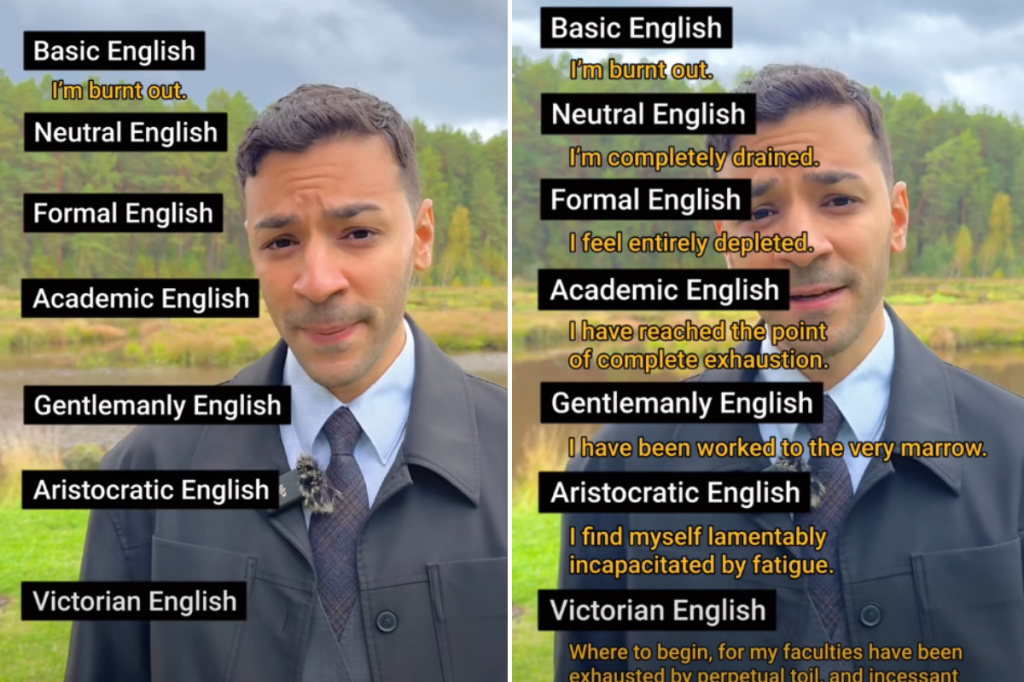
A British teacher is showing how to speak in Victorian English, and people are loving it. – Photo credit: Abram Elenin/Facebook
It’s hard to believe now, but communicating via the written word used to be a gigantic deal. Long before texting, social media, quick emails, or even short postcards, one of the only ways people could communicate across space and time was by writing long letters.
The 18th century is considered by some to be the peak of the Golden Age of letter writing. It was a key element of education for people wealthy enough to receive one, and it was incredibly important: business was conducted via handwritten letters, love was declared, and new introductions were made.
It was crucial, then, to choose your words extremely carefully. This was especially true in and around the Victorian Era in England, roughly between 1820 and 1914.
An English teacher from the United Kingdom has been delighting followers with Victorian-era translations of everyday sayings.
Abram Elenin runs Berber English, where he says, “I help professionals master British English… and communicate more effectively.”
He also likes to have a little fun with his work as a linguistics expert and accent coach. In a wildly popular series of Instagram Reels, he performs “tiered” translations of common phrases, transforming them into increasingly formal variations. Victorian English is usually the final resting point and comedic punchline.
In one popular video, “I’m burnt out” becomes “I’m entirely depleted” in formal English, and “I have been worked to the very marrow” in gentlemanly English.
But Victorian English, the age of beautiful if long-winded novels like Great Expectations and Jane Eyre, takes the cake: “Where to begin, for my faculties have been exhausted by perpetual toil, and incessant application has so stripped me of vitality that I am scarcely able to summon the strength requisite for the smallest effort.”
(The Instagram post, below. You don’t have to log in to see/hear.)
In another Reel, “I’m poor” becomes “I find myself in a precarious financial position,” and finally:
“It is with no small measure of affliction that I acknowledge my fortunes to be sadly diminished, my purse exhausted, and my station reduced to one of grievous penury, such that I find myself abandoned to the stern tutelage of want, the harshest master to which mankind is ever subject.”
It just sounds so much better that way. Can’t you just hear Moira Rose from Schitt’s Creek saying that? (snip-a little MORE, with another little video)

