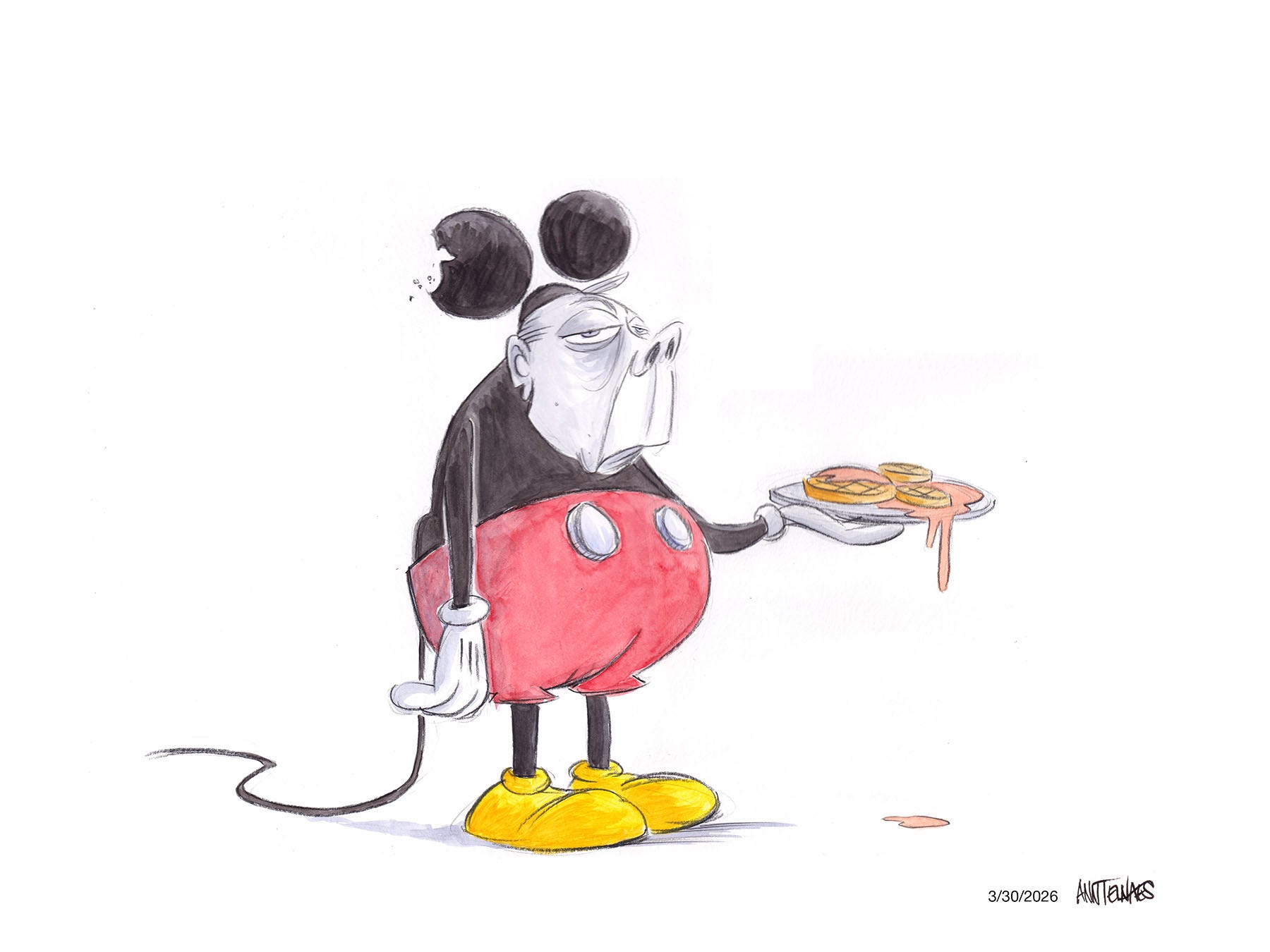
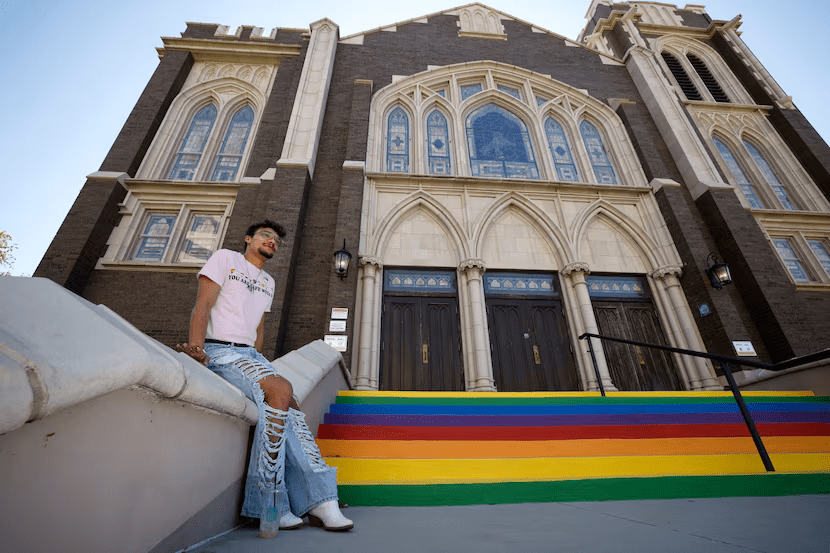
In the days after federal agents killed ICU nurse Alex Pretti (only days after other federal agents killed Renee Good), I saw a video of a haggard Minneapolis restaurant owner saying that he was going to give food away until the federal government’s occupation of Minnesota ends. His restaurant, Modern Times Cafe, was going to be 100% free… for everyone. It wasn’t just going to be free for people who proved they needed free food or for folks who asked for free food. It was going to be FREE. FOR. EVERYONE. Dylan Alverson, owner of the now-renamed Post Modern Times Cafe, was mad as hell, and he was not going to charge for pancakes anymore!
(Full Instagram bit on the page; above is a photo)
Actor and singer Mandy Patinkin’s son Gideon had shared Dylan’s video with me. Gideon runs Mandy’s verified Instagram account. The Patinkins’ IG page is filled with hopeful political messages, righteous leftist anger, and—most importantly—ways to help. At some point our Internet paths crossed, and we have tagged each other in posts ever since. Seeing Dylan’s video was yet another battery in my back that gave me the juice to go to Minneapolis. I saw the video on Monday, January 26, and by that Thursday, January 29 I was on a Zoom with the McKnight Foundation to figure out how we could work together to get me to the Twin Cities. Once we decided that I would go, I quickly put a visit to Post Modern Times on the agenda. I didn’t go there for McKnight. I went there for me. I really wanted to meet Dylan. He reminded me of people I met in Berkeley, back in the day. True believers who are more than excited to go against the grain. Luckily, Dylan was down to talk. As we discuss in the episode, he is not one for attention. He just wants to help his neighbors. I also found out that since he shared that initial video, he has decided that having a free restaurant feels so good that he wants to keep Post Modern Times Cafe free, even after Trump’s government leaves (which they finally announced they are going to do). (Snip)
Dylan plans to turn his restaurant into a nonprofit organization. This just shows, yet again, that the effect this occupation has had on Minnesota is permanent. It doesn’t matter if the feds leave today, they have:
killed two people,
shot at least one more,
made schoolchildren afraid to go to school,
made some people (especially Latino restaurant workers) afraid to go to work,
hurt local business across Minnesota, because consumers are afraid to shop (or are too broke shop because they aren’t working), and
generally traumatized the state.
None of that gets erased, fixed, or healed just because the goons get gone. I truly hope that more people are able to sue the federal government like the teachers union, Education Minnesota, did. The only thing that has stopped the people of the Twin Cities and beyond from folding completely is that there are many, many, MANY people like Dylan Alverson who are committed to community. Like Dylan, they are committed above and beyond their own self-interest… or even their own commonsense.
While Dylan’s free restaurant may seem like a gimmick or a naive idea, Dylan sees it as part of a larger way to fight back against our authoritarian government. Dylan put it best in our interview:
“The world is watching, and they should. This could be the start of a revolution. We don’t know. But to me, it feels like it. And I’m willing to go as far as I need to if I can make that happen.”
Post Modern Times will only be able to keep up its anti-capitalistic “gamble” (gamble is Dylan’s word for what they are doing) if they also have community support. If you can, donate or spread the word about Post Modern Times Cafe’s bold plan.
(snip-MORE, including a podcast with Mandy Patinkin & Katherine Grody, helping MN teachers, and yet more!)
Duolingo saw a sharp rise in Spanish learners following Bad Bunny’s Super Bowl Halftime Show, according to a post shared by the language-learning app on social media.
“Duolingo saw a 35 percent increase in Spanish learners last night. Better late than never,” the company wrote on Threads on February 9, under its official account, @duolingo. The post, which included a graph showing a clear spike in Spanish lessons, has been liked more than 7,500 times to date.
The surge followed Bad Bunny’s history‑making performance at the Super Bowl Halftime Show, where he became the first artist to sing primarily in Spanish during the most-watched sporting event in the U.S. Duolingo’s official Threads account shared the data shortly after the night ended, highlighting the immediate impact the performance appeared to have on language learning behavior.
Bad Bunny’s Super Bowl appearance came months after he used a Spanish-language monologue on Saturday Night Live (SNL) to tell audiences they had “four months to learn” Spanish ahead of the game. Despite online backlash from some commentators at the time, the data shared by Duolingo suggests many viewers embraced the message, with interest in learning Spanish rising sharply during the Halftime Show.
In November 1973, 10 Black models helped put American fashion on the map in an epic runway face-off with well-known French designers. In honor of the start of New York Fashion Week, here’s their story!
Models dressed in midriff-bearing tops and oversized bottoms of solids, stripes and plaids worn with headresses during the fashion show to benefit the restoration of the Chateau of Versailles, five American designers matching talents with five French couturiers at the Versailles Palace on November 28, 1973 in Versailles, France…Article title:’One night and pouf! It’s gone! (Photo by Fairchild Archive/Penske Media via Getty Images)
We know that for most people, February is all about the Super Bowl, Valentine’s Day and Black History Month. But if you love style, you know it’s also about New York Fashion Week – a time for some of the hottest designers to showcase the latest trends — kicking off Wednesday (Feb. 11).
While we’re going to be all over covering what’s new from Sergio Hudson and Public School, we thought this week was also a perfect time to show some love to the Black designers and models who paved the way for future generations.
We’re kicking things off with the story of 1973’s Battle of Versailles fashion show –an epic stand-off between French and American designers in Paris. The highly-hyped event not only put American fashion designers on the map, but it also put a spotlight on a group of 10 Black models who shut down the red carpet and showed the rest of the world the beauty in having a diverse runway that looked more like the rest of the world.
A Palace in Need of Repair
Fragment of golden entrance gates to the Versailles Palace (Chāteau de Versailles) on a sunny summer day. The Versailles is a Royal Palace in Versailles which is a suburb of Paris, some 20 kilometres southwest of the French capital.
The Palace of Versailles is an iconic French landmark. The stunning estate became the official royal residence in 1682. But while it has been a tourist destination for quite some time, in the early 1970s, the 17th century palace was in desperate need of a $60 million glow-up to repair years of damage.
A Fabulous Fundraiser
American Fashion co-ordinator, Miss Eleanor Lambert (Mrs Berkson) who arrived by Qantas today to finalise arrangements for a major all-American fashion show in Sydney and Melbourne later this year. May 25, 1967. (Photo by Trevor James Robert Dallen/Fairfax Media via Getty Images).
American fashion publicist Eleanor Lambert knew $60 million dollars wasn’t small change, so she proposed the idea of a fashion show to raise money for the Versailles repair project. Working with the palace curator, Gerald Van der Kemp, she wanted to invite some of the wealthiest elites from around the world to view collections from fashion designers from France and the United States. Lambert believed the ticket sales would help bring in much-needed funds for the palace project and give American designers a chance to prove their talent on the world stage.
The French Designers
Fashion designer Pierre Cardin stands in his studio surrounded by models. (Photo by Pierre Vauthey/Sygma/Sygma via Getty Images)
Lambert’s idea got the green light, and the date was set for Nov. 28, 1973. The French assembled an all-star lineup of designers, including Hubert de Givenchy, Yves Saint Laurent, Pierre Cardin, Marc Bohan (Creative Director for Christian Dior) and Emmanuel Ungaro. Ready to show the international audience that Paris was the fashion capital of the world, they planned more than an ordinary runway show, but a production that featured live music, dance and an extraordinary set.
The American Designers
NEW YORK, NY – JANUARY 24: Designer Stephen Burrows attends the Tribute To The Models Of Versailles 1973 at The Metropolitan Museum Of Art on January 24, 2011 in New York City. (Photo by Stephen Lovekin/Getty Images)
The American team accepted the challenge and built a roster that included designers Oscar de la Renta, Halston and Bill Blass. Unlike the French, Team USA brought a little more diversity to the event, with the only woman designer, Anne Klein, and Stephen Burrows, a Black graduate of New York’s Fashion Institute of Technology, who made a name for himself with his colorful, lightweight knit designs and signature lettuce hem.
News of the show got lots of press in both the United States and France. John Fairchild, who was the editor of Women’s Wear Daily at the time, helped add to the hype, billing the event “The Battle of Versailles.”
Choosing Models
Norma Jean Darden, Bethann Hardison, Billie Blair (Getty Images)
The budget for the event was tight, causing some of the more well-known models of the time — like Jerry Hall and Lauren Hutton — to turn down the $300 job. But their decision left the door open for a group of talented and beautiful Black models who were happy to step in and help bring the designer’s clothing to life. In the end, the American show featured 10 Black models – Billie Blair, Bethann Hardison, Pat Cleveland, Amina Warsuma, Charlene Dash, Ramona Saunders, Norma Jean Darden, Barbara Jackson, Alva Chinn and Jennifer Brice – making it one of the most diverse runways the fashion industry had ever seen at a major show.
Americans in Paris
Models Bethann Hardison and Armina Warsuma arrive in Marseille, Paris. (Photo by Michel Maurou/Reginald Gray/WWD/Penske Media via Getty Images)
Although they weren’t paid much for the gig, many of the Black American models chosen for the show jumped at the chance to participate in a high-profile international event. Pat Cleveland remembers how excited many of the models were when they first set foot on French soil.
“They got out of the bus and kissed the ground, they were so happy,” she said.
A Not-So-Warm Welcome
Model Pat Cleveland eats a sandwich backstage during the Battle of Versailles fashion show to benefit the restoration of the Chateau of Versailles on November 28, 1973. The Battle of Versailles featured the top five American designers matching their talents with five French couturiers. The Americans triumphed. (Photo by Reginald Gray/WWD/Penske Media via Getty Images)
Although the city of lights was beautiful, the American designers and models did not feel the love in France. Designer Stephen Burrows confirmed that their accommodations were far from five-star.
“There was no toilet paper in the bathroom. It was terrible,” Burrows said. “They had the girls there working all day long and didn’t feed them.”
Rehearsal Drama
Oscar de la Renta watches American team model Billie Blair practicing in a breakout rehearsal space within the palace complex. (Photo by Michel Maurou/WWD/Penske Media via Getty Images)
The French weren’t any more gracious when it came to the rehearsal time, using up most of the days leading up to the show to run through their performance –leaving the American team to make the most of the middle of the night.
A Star-Studded Guest List
Marisa Berenson, Roy Halston, Liza Minnelli and friends attend the fashion show to benefit the restoration of the Chateau of Versailles, five American designers matching talents with five French couturiers at the Versailles Palace on November 28, 1973 in Versailles, France. (Photo by Fairchild Archive/Penske Media via Getty Images)
The idea of a showcase featuring some of the best in American and French fashion attracted a who’s who of high-profile stars, including Elizabeth Taylor, Liza Minelli (who took the stage during the American show) and Andy Warhol.
The French Performance Was a Production
American born-French entertainer Josephine Baker in costume rehearses on stage before her performance during the “Battle of Versailles” fashion competition in Paris on November 29, 1973. (Photo by Reginald Gray/WWD/Penske Media via Getty Images)
On the night of the show, the French took the stage first, with a 40-piece orchestra, more than $30,000 worth of props and performances from well-known Soviet ballet dancer Rudolf Nureyev and legendary performer Josephine Baker along with their designer’s collections. American model Bethann Hardison remembered the French designer’s elaborate presentation that lasted for more than 2.5 hours.
“They had everything. You just couldn’t believe all the entertainment they had,” she said. “It was like a circus. The only thing they didn’t do was shoot a man out of a cannon.”
The Americans Met the Moment
After the French showcase, it was Team USA’s turn to take the stage. Although they walked to music on a cassette tape instead of a live orchestra, they met the moment, with the Black models showing off their rhythm as they floated down the runway. Although their show was only 35 minutes, they left the audience – who gave them a standing ovation – wanting more.
Making Fashion Ready-to-Wear
Battle of Versailles (Photo by Reginald Gray/WWD/Penske Media via Getty Images)
While the French showcased classically tailored clothing conceived with a wealthy client in mind, the American designers were looking toward the future and embracing a growing shift towards ready-to-wear pieces that were accessible to a wider audience. The designers weren’t afraid to add color and pattern to a collection that was made for time.
The Power of Diversity
Models dressed in gowns take the stage during the fashion show to benefit the restoration of the Chateau of Versailles, five American designers matching talents with five French couturiers at the Versailles Palace on November 28, 1973 in Versailles, France…Article title: ‘One night and pouf! It’s gone! (Photo by Fairchild Archive/Penske Media via Getty Images)
Filmmaker Deborah Riley Draper captured the magic of the Battle of Versailles in the documentary, “Versailles ’73: American Runway Revolution.” In an interview with CBS, she emphasized the importance of this groundbreaking moment in fashion history.
“What America was able to do was to demonstrate that diversity and inclusion on the stage was the most powerful weapon they could have,” she told CBS in an interview.
Will your character be an avatar of yourself? A plucky young heroine? A grizzled space pirate? A robot with feelings? Design your character with simple shapes that can easily be repeated from panel to panel. Put them in different poses, draw them far away and up close, from various views. Once the character starts moving on their own, you have the start of a story.
2. Journey from panel to panel
Draw the action from left to right, top to bottom across the page. The space between panels is called the gutter. In the gutter, time passes. This amount of time can be a millisecond (a character blinks) or an eon (a star collapses). Use small changes in expression and pose to show what the character is thinking and feeling. Add thought balloons and text bubbles for dialogue.
3. Create new characters
Make each character distinct in shape and personality. Let their form dictate their behavior and action. How do they complement or oppose the main character? What new direction can they take the story?
4. How does it end?
(Snip-this is a pretty long post with the art, so I’m snipping here. I wanted to leave the art big enough to be seen fairly clearly. We will know how our own toons end! Also, though I don’t recall thinking about it when I found this substack, no doubt there was subconscious inspiration from Michael Seidel’s blog. I read it over lunch.)
This week I needed a quiet place to escape from my own head so I made one:
And then I added another swing because maybe you need a quiet place to be as well. We’re all in this together.
In slightly related news, I follow a lot of artists on instagram who share tips and tutorials and this tree idea came from Cathflo.art who I adore. Her tutorials aren’t in English but art is universal in any language. Also universal? Hope. Love. Joy. Kindness. Compassion.
Since I started reading here at Scottie’s, I’ve thought especially of Bayard Rustin during Black History month. I learned of him (aside from him being at the side of Rev. MLK Jr.) from The Nation magazine back in the early 1990s. Mr. Rustin finally got a movie in 2023, and I’ve wondered about other representation within. There is a veritable trove of information, so here is some of that. Enjoy with your favorite beverage. -A.
=====
Voice of the day
God does not require us to achieve any of the good tasks that humanity must pursue. What God requires of us is that we not stop trying. – Bayard Rustin
it’s important to note the amount of BIPOC Queer History that has been an integral part of American history but has unfortunately been largely erased. Queer history surrounding people of color is deeply interwoven with American history, revealing critical insights into the nation’s progress in civil rights, social justice, and cultural evolution. To understand American history fully, it’s essential to acknowledge how Black queer individuals have shaped and influenced pivotal movements, art, and thought in the U.S. Despite facing intersectional challenges related to both race and sexual orientation, Black queer Americans have persistently fought for visibility, acceptance, and equality, contributing a legacy that has strengthened America’s commitment to inclusion and diversity.
Black queer history includes significant contributions to American arts and culture. From the Harlem Renaissance to contemporary music and fashion, Black queer individuals have played central roles in defining American aesthetics and storytelling. The Harlem Renaissance of the 1920s, for example, was driven by several Black queer artists, including poets like Langston Hughes and novelists like Richard Bruce Nugent, whose works celebrated Black identity while also subtly addressing queer themes. These artists expanded narratives around Black life in America, blending the experiences of race and sexuality into a singular, expressive voice.
The contributions of Black queer Americans to political activism are also inseparable from American history, especially when considering the origins of LGBTQ+ advocacy. These activists confronted police harassment and societal prejudice, laying the groundwork for the LGBTQ+ rights movement in the U.S. (snip-click through to see the stories)
African American literary critic and professor Henry Louis Gates once reflected that the Harlem Renaissance was “surely as gay as it was Black, not that it was exclusively either of these.” Gates’s comments point to the often-overlooked place of the Harlem Renaissance within queer history.
The Harlem Renaissance, a literary and cultural flowering centered in New York City’s Harlem neighborhood that lasted from roughly the early 1920s through the mid-1930s, marked a turning point in African American culture. Developments from Zora Neale Hurston’s folklore-influenced fiction to Duke Ellington’s colorful orchestrations reflected an assertive and forward-thinking Black identity that philosopher Alain Locke dubbed “The New Negro.”
Black queer artists and intellectuals were among the most influential contributors to this cultural movement. Like other queer people in early twentieth century America, they were usually forced to conceal their sexualities and gender identities. Many leading figures of the period, including Countee Cullen, Bessie Smith, and Alain Locke, are believed to have pursued same-sex relationships in their private lives, even as they maintained public personas that were more acceptable to mainstream audiences. From a modern vantage point, the work of these artists and their peers is part of the foundation of modern Black LGBTQ art.
Top row l to r: Gladys Bentley, ca. 1940. 2013.46.25.82; Countee Cullen by Carl Van Vechten, 1941. Courtesy Library of Congress, Prints and Photographs Division; Alain Locke by Winold Reiss, 1925. National Portrait Gallery, Smithsonian Institution. Ethel Waters as Carmen by Carl Van Vechten, 1934. 2010.42.4 Bottom row l to r: Bessie Smith from Delegate magazine, 1975. Gift of Anne B. Patrick and the family of Hilda E. Stokely. 2012.167.9; Jimmie Daniels, early 1930s. Gift of Paul Bodden in memory of Thad McGar and James “Jimmie” Daniels. TA2020.19.3.1; Alberta Hunter, date unknown. Gift of Paul Bodden in memory of Thad McGar and James “Jimmie” Daniels. A2020.19.1.2
(snip-do click through to see. There is a wealth of history: writers, blueswomen, entertainers. There is even a video they cannot play due to restrictions, and then yet more historical information.)
Throughout February, in honor of Black History Month, we’ve been busy on Stonewall’s Instagram highlighting some of the lesser-known figures in queer Black history. These bold individuals lead with bravery and authenticity, moved the needle on LGBTQ liberation and racial justice, and paved the way for future generations. Each one of these icons should be a household name! Read on to learn some of the hidden history of our intertwining and ongoing struggles for equality.
Frances Thompson – Trans Rights Pioneer
Believed to be the first transgender woman to testify before the United States Congress, Frances Thompson was born into slavery in 1840. Living as a free woman by the age of 26, Thompson was an advocate for bodily autonomy, an anti-rape activist, and she played a pivotal role in getting the US government to enact legislation protecting the civil rights of newly emancipated Black people.
Thompson’s bold legacy lives on today as we continue fighting for self-determination, dignity, and justice for queer and trans people. Her story serves as a reminder that queer and trans people have always been here, and we always will be. Always.
One of the most pivotal – yet often forgotten – figures of the Civil Rights Movement, Pauli Murray was a Black, queer, feminist lawyer who dedicated a lifetime to challenging preconceived notions of race, gender, sexuality, and religion. Murray pioneered many of the non-violent protest tactics of the Jim Crow era, and authored legal arguments that played a pivotal role in outlawing systemic racism and sexism.
Many of Murray’s contributions to the Civil Rights Movement were erased from the broader narrative as same-gender relationships and gender nonconformity disrupted the respectability expectations of the era. Many historians believe that if the language existed at the time, Murray may have identified as a trans man.
Later in life, Murray became an Episcopal priest, and was eventually canonized as a saint – a queer saint!
After the death of his father in 1927, Norris B. Herndon assumed the role of president of Atlanta Life Insurance, turning the company into one of the most successful Black-owned business in the US. Using his wealth and influence to support the Civil Rights Movement, Herndon was a critical funder of Civil Rights efforts, and regularly gave generously to support MLK, Jr., HBCUs, the NAACP, and more. He even allowed key Civil Rights activist to use his offices for training purposes.
While he never publicly identified as gay or bi, many in his inner circle were aware of his relationships with men throughout his life.
Herndon’s legacy serves as a reminder of the important role that Black queer individuals have played in shaping American history.
Ma Rainey, also known as the “Mother of the Blues,” was a pioneering blues singer and one of the first openly bisexual performers in the early 20th century. Her music often expressed themes of sexual freedom and gender identity that challenged prevailing attitudes of her time.
Rainey’s songs such as “Prove It on Me Blues” and “Sissy Blues” were widely considered to be bold and unapologetic expressions of her bisexuality, and her performances often featured drag queens and other gender-nonconforming artists.
Rainey’s visibility and outspokenness about her sexuality, at a time when queerness was widely stigmatized, helped pave the way for later LGBTQ performers and activists. Today, she is celebrated as an icon of queer representation in music history.
Marlon Riggs was a pioneering filmmaker and activist whose work focused on issues of race, sexuality, and identity, seeking to challenge and subvert stereotypes of LGBTQ and Black people.
In the early 1990s, Riggs’ films, including “Tongues Untied” and “Color Adjustment,” explored the experiences of Black gay men and the intersectionality of race and sexuality. His work helped to broaden mainstream awareness and understanding of LGBTQ and Black lives, and his films were highly influential in advancing Black and queer representation in media. Riggs also worked with organizations like the National LGBTQ Task Force and ACT UP to fight for the rights of LGBTQ people and folks living with HIV/AIDS.
Riggs’ legacy continues to inspire and inform the ongoing struggle for LGBTQ liberation and racial justice.
American history of resistance is a history of Black LGBTQ+ people. Advancements in civil rights and greater visibility of the LGBTQ+ community overall can be attributed to the efforts of Black LGBTQ+ folks; so much of what is popular and beloved in music, fashion, culture, and even language is because of the innovations and traditions of the Black queer diaspora. All of this is born out of the need to survive oppressive and violent conditions, distinguish themselves from their white LGBTQ+ counterparts who often enjoyed greater privilege.
When there are efforts to censor Black queer history in classrooms, to prevent trans folks from changing their gender markers or using the bathrooms they prefer, we must resist. Resistance of erasure is resistance to oppression.
This Black History Month, take a moment to learn about and honor the Black LGBTQ+ movements and people who have resisted throughout history.
The Cakewalk
What we know as the art of drag and ballroom today is born out of Black queer resistance to enslavement. The cakewalk, a dance performed by enslaved people, was meant to secretly mock plantation owners who frequently galavanted and gloated their expensive clothes. Their enslavers awarded the dancers cakes, unaware they were being blankly parodied. Later during the abolition period, “cakewalks” organized by the formerly enslaved served as a celebration of freedom and continued mockery of the enslavers, featuring attendees in extravagant costumes.
There is one particular person we can thank for the art of drag, and that is William Dorsey Swann, known now as the first drag queen. Swann, who was born into enslavement and survived to emancipation, was inspired by the “queens” of Washington D.C.’s Emancipation Day parades. He developed a form of dance for “glad rags,” also known as masquerade balls, and hosted cross-dressing balls for the community, many of which were raided by police.
This combination of dance performance and visual expression as a form of resistance survives in modern-day ballroom culture, famously depicted in the documentary film “Paris Is Burning.” Categories like “Executive Realness” serve as an opportunity for young Black queer folks — often denied positions of prominence in white society — to both mock the practices of the privileged and pretend to enjoy those privileges.
In the film, artist Dorian Corey notes: “Black people have a hard time getting anywhere. And those that do are usually straight. In a ballroom, you can be anything you want. You’re not really an executive, but you’re looking like an executive. And therefore you’re showing the straight world that ‘I can be an executive. If I had the opportunity, I could be one because I can look like one.’”
Bayard Rustin and the Civil Rights Movement
Many of us know about the work of Dr. Martin Luther King Jr., but not as many know about Bayard Rustin, an “angelic troublemaker,” his mentor and collaborator during the civil rights movement of the 50s and 60s. Rustin was in fact the primary organizer of the historic March on Washington in 1936, perhaps the most famous civil rights protest of all time. Rustin was also openly gay, and spent much of his life dealing with political and legal persecution because of it (recently depicted in the 2023 film “Rustin”).
UNITED STATES – CIRCA 1969: Photo of Fifth Dimension, c.1969, California, Los Angeles, Fifth DimensionL-R: Ron Townson, Florence LaRueBilly Davis, Jr., Lamonte McLemore, Marilyn McCoo. (Photo by Michael Ochs Archives/Getty Images)
We’re not going to lie, 2025 was a tough year, as we lost many of the Black legends we knew and loved. Now, as 2026 gets underway, we must say goodbye to even more of those who had such a tremendous impact on the culture. Although they are gone, they will never be forgotten.
(snip-brief celebratory obits/photos on the page. A few of them have been posted here, lat year. While you peruse our losses, enjoy this next one from The Root, too! I would listen to Luther Vandross sing the phone book.)
LOS ANGELES – 1995: Singer Luther Vandross poses for a portrait in 1995 in Los Angeles, California. (Photo by Harry Langdon/Getty Images)
Although Kendrick Lamar and SZA walked away with the 2026 Grammy for Record of the Year for their song “luther”—which sampled the 1982 Luther Vandross hit “If This World Were Mine”—the late iconic singer still somehow became one of the hottest topics of the night.
This was thanks in large part to Cher’s hilarious and accidental flub, announcing Vandross as the winner instead Lamar. But still it made for a good reason to talk about the legendary singer and his musical contributions. It also got us thinking about our favorite Luther Vandross songs and so we’d figure what better way to wax poetic about them than by putting together our top favorite tracks of his for the best of the best playlist!
Fair warning though: this list will make you move and groove so make room wherever you are!
Amid the Trump administration’s ongoing attempts to erase queer and trans history, a University of California Berkeley professor’s students are working to right these wrongs — through Wikipedia edits.
Over the past decade, students in ethnic studies, gender and women’s studies, and performance studies professor María Rodríguez’s courses have edited and even created Wikipedia articles about LGBTQ+ history, with an emphasis on queer and trans people of color. The assignment currently replaces a final paper in three of her classes: “Documenting Marginal Lives,” “Queer of Color Cultural Production,” and “Queer of Color Critique.”
Rodríguez’s Wikipedia assignments take place in partnership with Wiki Education, a nonprofit that works with university professors in the United States and Canada. The professors’ students add content to course-related Wikipedia articles, which, according to the organization’s website, helps them gain skills like “media literacy, writing and research development, and critical thinking,” while simultaneously filling Wikipedia “content gaps.”
“Wikipedia is a public-facing project — it’s the largest encyclopedia in the world,” Rodríguez told UC Berkeley News in a December interview. “In a political moment where these histories are actively being erased from public view, having students work on a platform like Wikipedia becomes even more important.”
According to The Daily Californian, as of January 26, Rodríguez’s students have contributed over 300,000 edits and 3,000 citations to Wikipedia. At the time of writing, their work has garnered a whopping 96 million-plus views. Her students’ topics run the gamut, touching upon local history like the resonance of queer life in San Francisco’s Chinatown, as well as more international focus areas (for instance: worldwide sex worker movements).
As Rodríguez explained to UC Berkeley News, her students’ edits often help address the disparities between the amount of Wikipedia information about white, Anglo LGBTQ+ populations versus LGBTQ+ populations of color.
“It becomes particularly important to document these subcultures within these communities,” she said. “Because it’s not just queer Latinas — it’s queer goth Latinas, it’s queer comics of color, it’s African American slaying, right? It’s very specific topics that might really vary by region, by historical moment, and of course at different places around the world. Those topics, in Wikipedia and in real life, remain really under-studied and really under-researched.”
These contributions carry a newfound weight during the second Trump administration, in which officials have repeatedly attempted to erase references to queer and trans history. In February 2025, National Park Service websites removed the word “transgender” from multiple pages for historical programs and monuments, as well as references to trans figures such as Marsha P. Johnson. Meanwhile, in June, an unnamed Defense Department official told Military.com that Trump timed an order to remove LGBTQ+ icon Harvey Milk’s name from a military ship to coincide with Pride Month.
“Right now, the Trump administration is trying to erase the very existence of transgender people, so having information about those histories, as well as present challenges facing queer and trans communities, is particularly urgent,” Rodríguez told The Daily Californian via email. “Queer and trans people have always been here, and adding that information to the world’s largest open access encyclopedia is one way to make sure that these stories remain available.”
A bit ago, Scottie – you put out a post titled “I have struggled all day”. In that post, you included two songs, and for those who have been on this blog for a while we do recognize Terry Jacks. Music is a huge part of my life. I sing like a water buffalo with laryngitis, but I love music. It works to lift me up when I’m down, it reminds me of special people and special times in my life, it brings me peace, and sometimes it allows me to be angry. Music can sing to a person’t soul, lighten one’s load. It allows me to cry when I need to cry, to hope when hope seems gone. It reminds me that I’m not alone. So, I have three songs here. Two are just a bit tongue-in-cheek, but the last is very special to me. I sent you this song, Scottie, a long time ago. It is my favorite cover of that song. My challenge and my ask to everyone is to please add in the comments the songs that you love, that feed your heart and soul. Songs that make you smile, make you cry, make you dance or sing in a crowded grocery store because you just can’t not sing or dance when you hear it. Because like the last song says so clearly: we are all in this together, whether we want to be or not. 🙂
I love you, my brother! Randy
Careful. That one gets in your ear and you can’t get it out.
That one for my big brother, who I do my best to irritate – as all brothers should.
And finally, this one, to remind to remind my very wonderful brother and all of us that no matter how much we may feel alone, we are not. We are loved – first we need to remember that we have to love ourselves no matter how we are feeling (easier said, I know). But, we also have to remember that there are people who rely on us, who hope in us, who see our mangled spirit and troubled mind as a life-line in cold dark seas and really think we are something grand even when we don’t.
So, Again Everyone… please let me know the songs that are special to you, and perhaps even why they are special. Music is the magic. Randy