Professor of immigration and citizenship law at the University of Virginia, Amanda Frost joins the show to discuss her book You Are Not American: Citizen Stripping from Dred Scott to the Dreamers. Live-streamed on September 22, 2025.
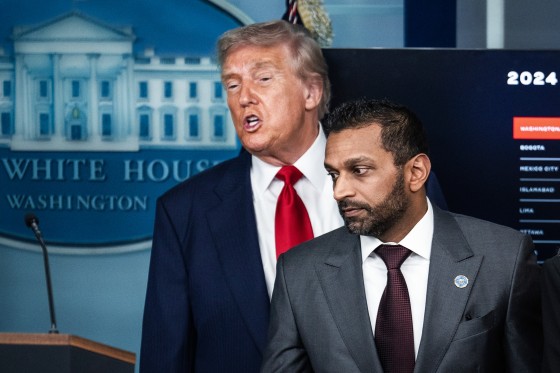
FBI Director Kash Patel on Wednesday fired an agent in training for displaying a gay pride flag on his desk while appointed to a field office in California last year, according to three people familiar with the matter.
The trainee, who previously worked as an FBI support specialist in Los Angeles, received a letter — dated Oct. 1 and signed by Patel — claiming he had displayed an improper “political” message in the workplace during his assignment in California under President Joe Biden, according to a copy of the letter shared with MSNBC.
The letter cited President Donald Trump’s Article II powers under the Constitution to dismiss federal agency career personnel, a justification used in several recent firings at the Department of Justice and FBI. The terminations are currently being challenged in several lawsuits.
“After reviewing the facts and circumstances and considering your probationary status, I have determined that you exercised poor judgment with an inappropriate display of political signage in your work area during your previous assignment in the Los Angeles Field Office.”
FBI DIRECTOR KASH PATEL
“You are being summarily dismissed from your position as a New Agent Trainee at the FBI Academy in Quantico, Virginia, and removed from the federal service,” read the letter, which was sent on the first day of a nationwide government shutdown that created job uncertainty throughout the federal workforce.
“After reviewing the facts and circumstances and considering your probationary status, I have determined that you exercised poor judgment with an inappropriate display of political signage in your work area during your previous assignment in the Los Angeles Field Office,” Patel wrote, without referencing a flag.
The FBI did not immediately respond to a request for comment about this story. MSNBC was unable to reach the fired trainee for comment and, therefore, is not identifying him. The termination over the pride flag was first reported by CNN.
Wednesday’s dismissal comes after Trump and Russell Vought, the White House director of the Office of Management and Budget, threatened widespread firings of federal employees in the event of a government shutdown.
The agent trainee, who had most recently been assigned to the FBI Academy in Quantico, won an Attorney General’s Award in 2022 in recognition of his work, according to a Justice Department news release.
News of the trainee’s firing spurred some agents in the FBI’s Washington field office to scour their work stations and social media accounts for signs or comments — anything that could be viewed as offensive to Trump, his top appointees and MAGA supporters, according to one person familiar with the reaction within the government.
FBI agents and Justice Department prosecutors warned one another, ahead of Trump’s inauguration, to be careful about displaying information revealing their sexual orientation or support for LGBTQ rights.
When Trump was weeks away from inauguration in January, FBI agents and Justice Department prosecutors were warning one another to be careful about displaying information revealing their own sexual orientation or support for lesbian, gay, bisexual or transgender rights. After the inauguration, one person said, FBI agents warned colleagues that they heard new pro-Trump appointees installed at the FBI were combing through internal employee files to find lists that identified employees as LGBTQ.
DOJ Pride, an LGBTQ employee resource group at the Department of Justice, shut down in late January, less than 10 days after Trump signed an executive order seeking to root out all diversity, equity and inclusion measures from the federal government.
The group “ceased to operate effective immediately,” DOJ Pride’s board wrote in an email sent to members at the time.
“In this time of uncertainty and concern, we have taken the extraordinary measure of ceasing operations of DOJ Pride,” the message said. “We have made this decision in the interest and for the protection of all members.”
The email, which was shared then with NBC News by two DOJ staffers, thanked members for their “understanding during this time” and expressed hope that the group could “rebuild in the future.”
The FBI’s firing of a trainee for displaying a gay pride flag on his desk last year came as more than a dozen federal agency websites trumpeted that the “radical left” had caused the government shutdown.
An ICE agent’s lies were exposed in the fatal shooting of 38-year-old Silverio Villegas González. Dr. Rashad Richey and Jamie Lowe discuss on Indisputable. Tell us what you think in the comments below.
“The fatal shooting of a Mexican immigrant by an Immigration and Customs Enforcement officer has left a community “shaken” and in need of transparency, Illinois Gov. JB Pritzker said on Monday, after police bodycam videos of the incident emerged. “Two weeks ago, a man was shot and killed by ICE in Franklin Park, Illinois. Shortly after, ICE issued a statement justifying the killing, saying the federal agent was ‘seriously injured,’’’ Pritzker said, referring to a statement from the Department of Homeland Security.”
Broadview village officials sent a strong message to the feds this week. They do not want U.S. Immigration and Customs Enforcement operating its detention center in their town. On Thursday, Broadview Police Chief Thomas Mills said ICE agents are draining the resources of his department and the community by making false 911 calls.
“Dozens of federal agents raiding an entire apartment building with kids in it just to see what they can find. It’s the most egregious abuse of our basic rights as Americans I’ve seen in a long time, maybe in my lifetime,” says Chris Hayes
A senior White House official accidentally disclosed that the Trump administration was considering deploying an elite army strike force into Portland by using Signal in a public place.
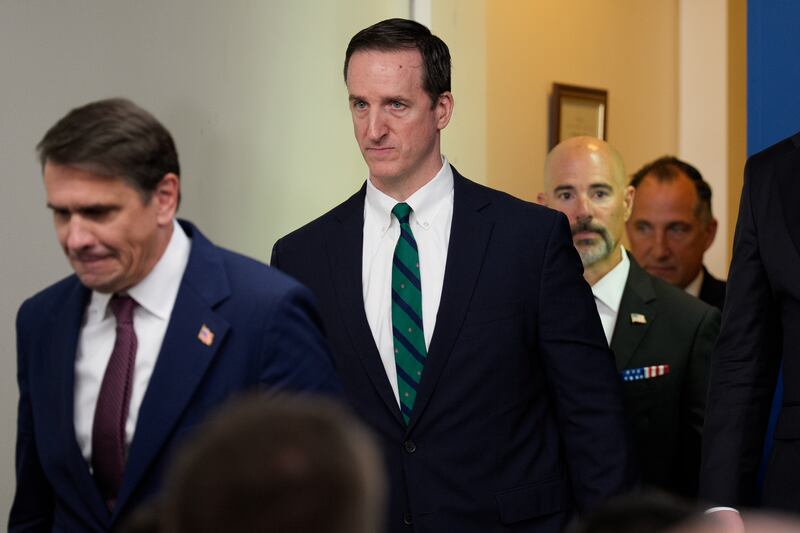
The Minnesota Star Tribune reported Friday that Anthony Salisbury, one of Stephen Miller’s top deputies, was observed discussing the plans via Signal in view of members of the public while traveling in Minnesota. The newspaper was then contacted by one member of the public who was troubled to see sensitive military plans discussed so openly.
In the messages, senior White House officials discussed the potential deployment of the Army’s 82nd Airborne Division, an elite unit that specializes in parachuting into hostile territory. The division has been deployed in both world wars, including the Battle of the Bulge, as well as Vietnam and Afghanistan.
Anthony Salisbury, one of Stephen Miller’s top deputies, discussed plans for military intervention in Portland in full view of members of the public.Andrew Harnik/Getty Images
Across several conversations, the Star Tribune reports, Salisbury spoke about a range of matters with Pete Hegseth adviser Patrick Weaver as well as other officials.
In one of the messages, Weaver revealed that Hegseth wanted Trump to explicitly instruct him to send soldiers to Portland.
“Between you and I, I think Pete just wants the top cover from the boss if anything goes sideways with the troops there,” Weaver reportedly said.
Noting the potentially disastrous optics around sending an elite division into an American city, Weaver told Salisbury, “82nd is like our top tier [quick reaction force] for abroad. So it will cause a lot of headlines. Probably why he wants potus to tell him to do it.”
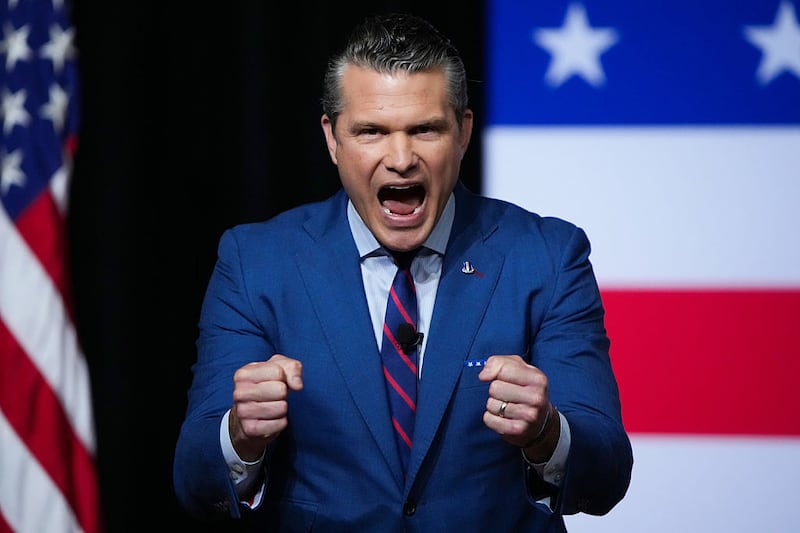
In March 2025, Defense Secretary Pete Hegseth leaked confidential battle plans on Signal.Andrew Harnik/Getty Images
Abigail Jackson, a spokesperson for the White House, told the Daily Beast, “Tony recently traveled to Minnesota to serve as a pallbearer in his uncle’s funeral who passed away from cancer. Despite dealing with grief from the loss of a family member, Tony continued his important work on behalf of the American people.“
“Nothing in these private conversations, that are shamefully being reported on by morally bankrupt reporters, is new or classified information,” Jackson continued. “Frankly, this story just shows the entire Trump Administration is working around the clock—and even through funerals—to make America safe again.”
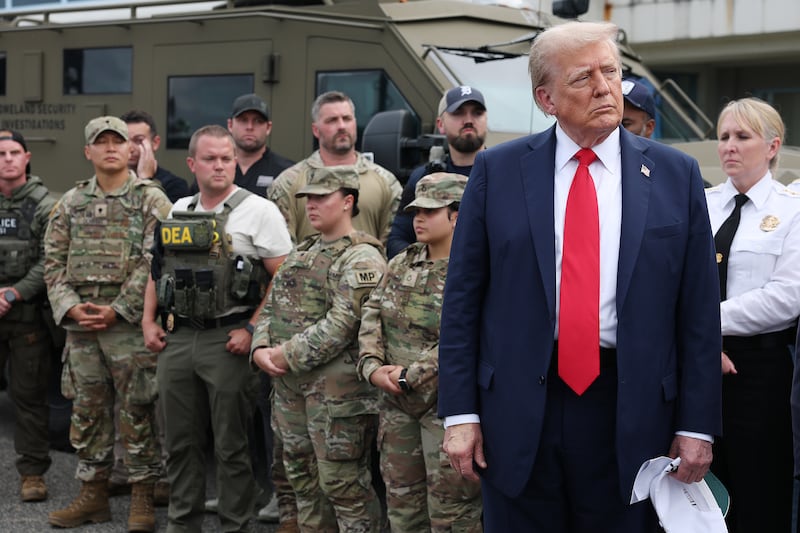
President Donald Trump on Tuesday told top generals that dangerous U.S. cities should be used as military training grounds.Anna Moneymaker/Getty Images
The incident marks the second time in six months that the Trump administration has experienced issues as a result of insecure lines of communication.
Earlier this year, editor-in-chief of The Atlantic Jeffrey Goldberg was accidentally added to a Signal chat where several high-ranking government officials discussed the logistics of a strike on Yemen’s Houthis.
The fiasco was quickly dubbed “Signalgate” and ultimately led to national security adviser Mike Waltz, who was responsible for adding Goldberg to the chat, leaving his role at the National Security Council. President Trump later appointed him Ambassador to the United Nations.
National security adviser Mike Waltz left his role at the National Security Council after accidentally adding a journalist to a Signal chat.Kayla Bartkowski/Getty Images
Trump has consistently asserted that sending soldiers into cities is the only way to address rampant crime. Meanwhile, the White House has admitted to “reconfiguring” crime statistics to suit Trump’s agenda after claiming that other official statistics are “phony.”
The president’s crime crackdown, which has been concentrated entirely on blue cities, is proving more and more unpopular with the American public. After looking at recent polling on Monday, CNN data guru Harry Enten told viewers, “If Donald Trump thinks that potentially sending in the National Guard into cities like Portland is a winning political issue, the polling says you’re wrong, Mr. President!”
Trump also faced a significant blow after a federal judge ruled that his deployment of the National Guard in Los Angeles was illegal, with Judge Charles Breyer finding that the president had violated the Posse Comitatus Act by requiring armed soldiers to carry out domestic law enforcement activities.
Maybe we all live in red states, and this won’t be a thing with which we deal (just maybe.) But, just in case, here is a pointer for coping. Pass it along!
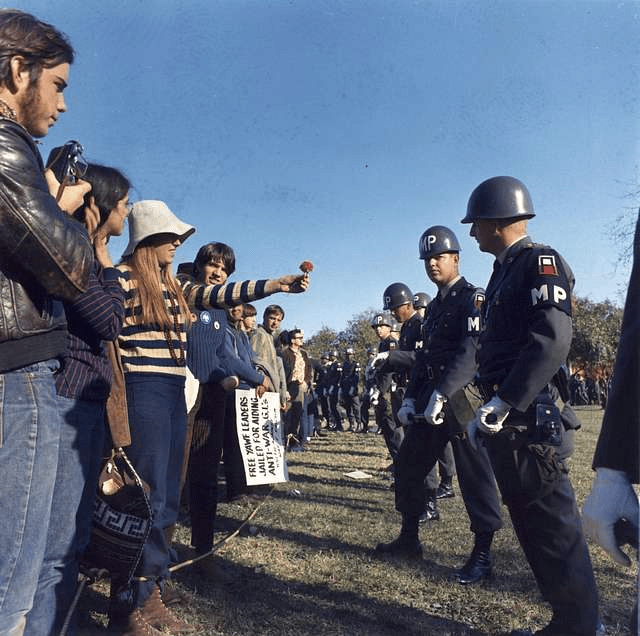
An anti-Vietnam demonstration. Arlington, Virginia, USA. By S.Sgt. Albert R. Simpson. Department of Defense. Department of the Army. Office of the Deputy Chief of Staff for Operations. U.S. Army Audiovisual Center. – This media is available in the holdings of the National Archives and Records Administration, cataloged under the National Archives Identifier (NAID) 594360. Public Domain. Via Picryl.
Tiffin, Ohio (Special to Informed Comment; Feature) – During some of the large anti-war demonstrations during the 1960’s some of the protesters gave flowers to the troops faced off against them. In the 1967 March on the Pentagon it was the 503rd Military Police Battalion, and elsewhere the National Guard was deployed. An iconic photo from 1967 shows a young man placing a flower into a soldier’s gun barrel during the protest. Let’s bring that custom back when the US military occupies your town in 2025, but this time let’s include a note along with the flower.
Allow me to explain.
The demonstrators of the 1960’s understood that the soldiers faced off against him were not the enemy. Nearly all of the soldiers were young and patriotic and trying to do the right thing. Many of them were under economic hardship and wanted help paying for their education. The flower symbolized the protesters’ belief that the soldiers were not their enemies, and they did not wish to be theirs. And in fact, as the almost entirely peaceful protests grew, many soldiers came to sympathize and began to actively oppose the war as well.
Now we have federalized Guard troops being called out by President Trump in Washington, DC, Los Angeles, Portland with other cities soon to follow. Chicago is likely next. The authority for this is said to be Title Ten of the US Code which says that the president may federalize the National Guard if the US “is invaded or is in danger of invasion by a foreign nation; there is a rebellion or danger of a rebellion . . or the president is unable with the regular forces to execute the laws of the United States.”
Legitimate grounds for a US military or National Guard deployment do not exist. The claim that crime is spiraling out of control is false, and those pushing for the deployments know it. There is zero credible proof that crime is increasing. According to a recent FBI report (August, 2025) robbery, assault, rape and murder all continued a decline that began post-covid. We are not being invaded, there is no rebellion, and the laws are being enforced about as well as ever.
A second reason against deploying the military on our streets is that the Posse Comitatus act of 1878 forbids the use of US military forces within the country for active law enforcement except in exceptional circumstances such as insurrection, and explicitly approved by Congress. The military is forbidden from making arrests, conducting searches, issuing warrants, or interfering with local law enforcement. The law also applies to National Guard forces unless approved by state governors. No governors this year have made any requests for federalized National Guard troops.
And it is worth noting that Trump’s military forays into cities are only being used in areas run by Democratic officials. High crime in red state cities is ignored. And the Trump administration refuses to realize the obvious danger of political violence and threats from MAGA and the American right which are much higher than those from the left, according to the Anti-Defamation League (ADL), the Center for Strategic and International Studies (CSIS) and others. Antifa is officially (and improperly) designated as domestic terrorists while violent right wing groups get a pass from the administration.
The President’s rhetoric seems aimed at inflaming and dividing. The “enemy from within”, “full force”, “thugs”, “vermin”, and much more. And there is hardly a peep of protest from the Republican party.
So this time around, how about if we give the troops a note along with the flower? You could use wording such as this:
Dear US soldier –
Your service oath included a pledge to uphold the US constitution, and your training taught you to disobey illegal orders.The orders sending you here (insert name of your city or town) are unlawful and unjust. You have a legal obligation to disobey.
We encourage you to go home, and we will support you in that decision.
About the Author
Arnold Oliver is an emeritus professor of political science at Heidelberg University in Tiffin, Ohio. A Vietnam veteran, he belongs to Veterans For Peace, and can be reached at soliver@heidelberg.edu.
(Needless to say, state Republican legislators, with their supermajority here, are working to gerrymander her district to oblivion before the midterm filing deadline.)
The letter includes links for answers and help regarding the shutdown, seen below. If you click, those links will help all; Rep. Davids is a U.S. Rep and these are U.S. resources.
My actual rep did not send anything today. Over the weekend he referred to the “Schumer Shutdown” as if it was an inevitability; I’m sure he saw it that way as he’s all in on this administration’s actions (yep, Republican.) Anyway, here is this:
I know many people are worried and upset about this government shutdown. I am doing everything I can to push for a bipartisan solution to end this crisis as quickly as possible. I understand Kansans are frustrated with Washington and are demanding solutions instead of more partisanship.
Right now, many government agencies unfortunately may be operating with limited staff. This will impact a variety of crucial services people depend on. My team created this web page to help answer questions, connect people with assistance, and to ask for your thoughts.
This is an evolving situation, so my team will continue to update this page as events warrant. Please know that we’re here to help however we possibly can. You can find the below menu to get answers to your questions. Please also feel free to call my office at (913) 621-0832.