They’re calling her an influencer. She’s calling it campaign strategy.

18,000 individual donors, Instagram and TikTok views have kept Deja Foxx — a once long-shot Gen Z candidate — competitive in the race for a congressional seat in Arizona.

This story was originally reported by Jessica Kutz of The 19th. Meet Jessica and read more of her reporting on gender, politics and policy.

TUCSON, ARIZ. — On a Saturday afternoon, Deja Foxx is staging a TikTok Live in her living room. A phone tripod is set up in front of her kitchen table. The frame is centered on a slouchy sofa against an adobe wall, where a chile ristra hangs on one side. 

“All right, everybody, take your seats,” she tells the mix of young volunteers, family members and campaign staff who are gathered to help her. “You have some really great mail to open, and I’m so excited because usually it’s just me and my mom that do this.” 

She goes live and takes a seat next to her mom on the couch. 

One volunteer reads a letter from a 19-year-old named Henry from California: “Even though I can’t vote for you, I adore your campaign,” he wrote. “We need more young leaders and new, fresh ideas from us, Gen Z. As someone who grew up on MediCal, and free public school lunch, who currently is uninsured, I enjoy your background and fighting for us.” 

Another volunteer read a note from 20-year-old Julie, who wrote that while she’s been frustrated and overwhelmed by the state of politics, following Foxx’s campaign gave her hope. “I’ve been writing to my officials, but wanted to write something positive for a change. Keep doing what you’re doing.” 

Other letter writers included a 22-year-old activist who started organizing after the Parkland shooting, a college student in Phoenix who offered to work for Foxx’s political office in the future, a 23-year-old from Chicago who started following her social media years ago, a North Carolina dad of a daughter moving to Arizona, and a Kentucky woman worried about Medicaid coverage. Volunteers spent 30 minutes reading that day’s mail. During the weekly segment, the audience is usually in the thousands.  
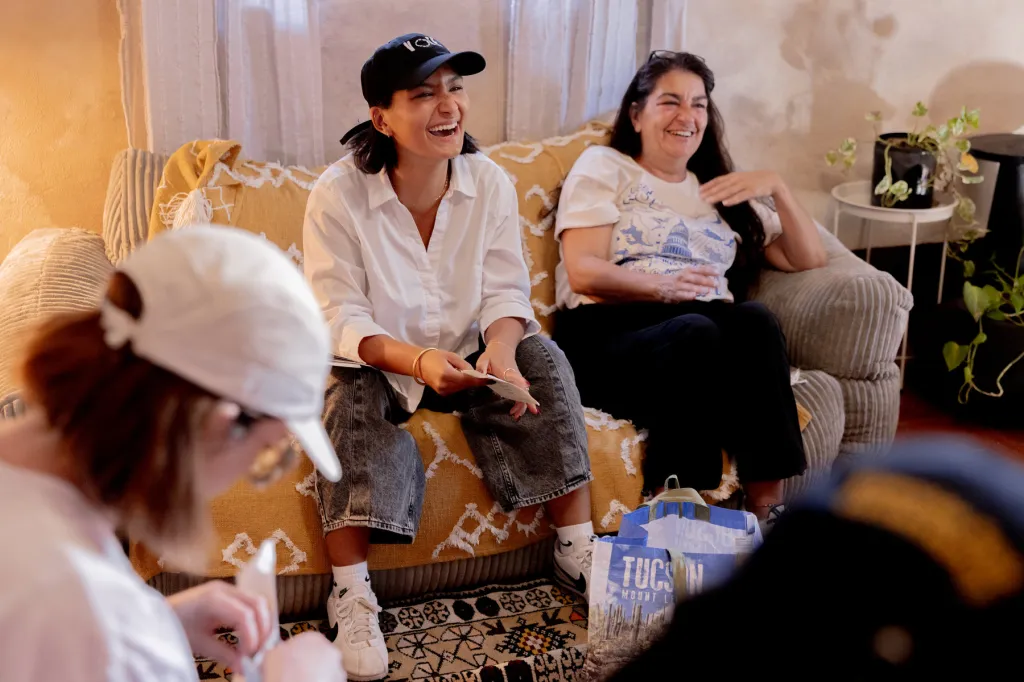
Deja Foxx opens mail from her campaign post office box during a TikTok LIVE with her mother, Lisa Foxx, and close friends at her home.
Deja Foxx opens mail from her campaign post office box during a TikTok LIVE with her mother, Lisa Foxx, and close friends at her home in Tucson, Arizona. (Courtney Pedroza for The 19th)

Most of the notes included a donation, with the amounts ranging from $20 to $2,000. By the end of the read out Foxx had raised $4,000, mostly from people located outside Arizona. Just two days before, she announced she hit $500,000 in campaign donations, raised through 18,000 individual donors. 

Just two months ago, Foxx wrote on Substack about the difficulties of running her campaign for Congress as a Gen Z candidate. She made a plea directly to her online followers: “Our biggest challenge and the only one that really matters: You haven’t invested in us yet.” 

At the time, a slow trickle of donations was keeping afloat her campaign to fill the seat left by U.S. Rep Raúl Grijalva, who represented the southern Arizona district for over 20 years. 

Shortly after the lawmaker’s death in March, his daughter Adelita Grijalva — who has served for decades in local politics on Tucson’s school board and more recently on the Pima County Board of Supervisors — tossed her hat in the ring for the Democratic primary. Then came the endorsements: Arizona U.S. Sens. Mark Kelly and Ruben Gallego, and progressive politicians like Bernie Sanders and Alexandria Ocasio-Cortez. The winner of that primary, which takes place July 15 and includes former state Rep. Daniel Hernandez, will almost certainly go on to win the September special election in this solidly Democratic district. 

Foxx announced that she would take on Grijalva in early April. Most of her short political life — at 25, she would be the youngest woman elected to Congress — has focused on reproductive rights. She served on the board of Planned Parenthood in Arizona at age 17, worked in Tucson health clinics as a sex educator in high school, and more recently worked on the Prop 139 Ballot Initiative campaign in 2024, which enshrined the right to abortion in the state’s constitution. 

If we want to win in 2028, I promise you that it is going to require electing leaders in this party who can be effective messengers.”Deja Foxx
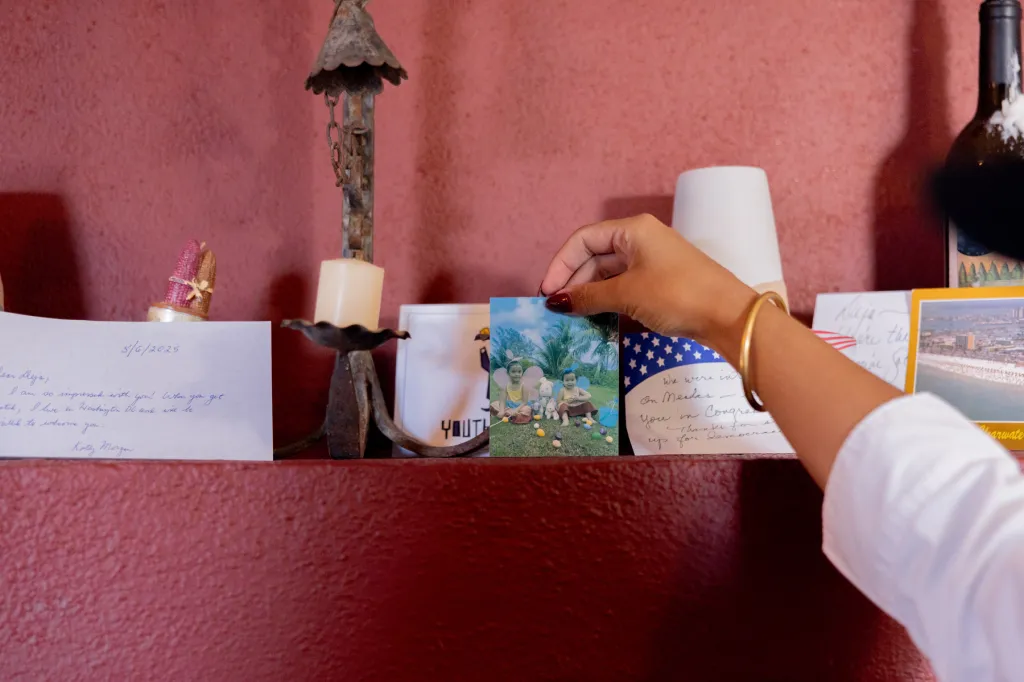
Deja Foxx reaches for mail she received from her campaign post office box.
Deja Foxx reaches for mail she received from her campaign post office box on Saturday, June 21, 2025, at her home in Tucson, Arizona. (Courtney Pedroza for The 19th)

But while Foxx doesn’t have the backing of “the establishment,” as she refers to it, or the name recognition of Grijalva, she’s created her own buzz by using her social media platforms to speak directly to her generation. Over the past month, her stories have been viewed almost 30 million times on TikTok, Facebook and Instagram. She also has thousands of followers on Substack. That support and the donations that followed afforded her television advertisements, something that was out of reach when she started.

Her social media savvy has allowed her to bypass the need for big donors, build her own following, and capitalize on national support that’s percolated from the ground up. Along the way she’s making the argument that her social media skills aren’t just part of a campaign strategy, but necessary to communicate the politics of the party as the electorate grows younger and more disillusioned.

“We saw people in the party, in the traditional media, wringing their hands, ‘How did we lose young people in this last election? Why did they move toward apathy and the other side? … And it’s because we’re failing to compete in social media and new media spaces,” Foxx said. “If we want to win in 2028, I promise you that it is going to require electing leaders in this party who can be effective messengers.” 


Foxx learned the power of a viral moment when she was a 16-year-old activist for Planned Parenthood. At a town hall in 2017, she asked former Arizona Sen. Jeff Flake (R) why he would deny her the American dream by voting against funding that made birth control accessible to people who grew up in poverty. Foxx, who was insured through Medicaid at the time, got her birth control from Planned Parenthood.

A clip of the exchange went viral. “I woke up the next day and millions had seen the video,” she said. It’s a moment that changed how she thought about activism. The fact that millions of people watched her on their phones and computers put her on equal footing in public discourse with the United States senator, she said. “As a 16-year-old girl working at a gas station … that is remarkable.” 

In the nine years since, the political world has grown to recognize the necessity of social media in campaigns, and politicians have turned to Foxx for her expertise. At the same time she was becoming a prominent reproductive rights activist, she used Instagram to build community among her peers through her organization Gen Z Girl Gang. She worked as an influencer and digital strategist for the Kamala Harris campaign in 2019 and later as a social media director at a political action committee. In 2024, she was invited to speak at the Democratic National Convention in support of Harris as an activist and content creator. 

But it’s in her own run for Congress where she has been able to test these communication strategies herself. On her TikTok and Instagram accounts, soundbites from her debates have racked up millions of views. More personal reels, like when she surprised her mom with her first batch of campaign literature, have gone viral. She’s embraced being interviewed by independent journalists with followings on places like Substack and YouTube. 

She’s using communication styles and platforms that are meeting people where they’re at.”Jessica Maddox

“She’s using communication styles and platforms that are meeting people where they’re at. That style may turn off some older voters, but it’s going to excite younger voters who are particularly disaffected or disenfranchised or disheartened by American politics and even the Democratic party,” said Jessica Maddox, an associate professor of digital media at the University of Alabama. “I’ve been particularly impressed with her TikTok presence, because it feels very authentic.” 

That authenticity is the main ingredient in connecting with young voters online, experts say. Maddox and others pointed to the success of Zohran Mamdani’s mayoral campaign in New York as an example of how young politicians are tapping into social media to drum up real support at the polls. Both candidates utilized platforms to engage with people, like Gen Z, who are likely to sit out primaries where voters tend to be older. 

The strategy puts lesser known candidates on a more equal playing field, allowing them to subvert the traditional hierarchies that fuel campaigns. “There’s always been a tight relationship between legacy media and politics, and social media kind of upends that,” Maddox said. “[Foxx] can kind of bypass more traditional outlets and get the message out herself.” 

Social media has also turned a local race into a national fundraiser, which has helped her stay competitive. Candidates like Grijalva and Hernandez have benefited from deeper donor pockets, and outside support from political action committees. By early May, both candidates had already raised hundreds of thousands of dollars, according to the Arizona Republic. Their latest campaign finance numbers are expected to be released soon. Foxx announced she had hit $600,000 in donations at the end of June. 

“It’s an interesting social media element that someone these days could have supporters kind of all over the country, even though they’re running for a very specific seat,” said Kathryn Coduto, a professor of media science at Boston University. 

While there is a scarcity of polls in the race, a recent one commissioned by Foxx’s campaign shows her name recognition has risen significantly since May, when half of likely voters hadn’t heard of her. And, on Wednesday, David Hogg’s political action committee announced it would be endorsing her in the race. Hogg, who became famous for his activism after the Parkland mass shooting, now runs a political organization called Leaders We Deserve, aimed at building generational change for Democrats. 

“If we replace one of the oldest members of Congress with the youngest — Deja is just 25 years old — we could send an incredibly strong message about which direction the Democratic Party is heading in, and show people how we are dramatically changing to meet this moment,” Hogg said in an Instagram Reel. 

While Foxx has worked as an influencer in the past, now that she’s running for office that label has been used to undercut her years of political work and activism. At her first debate, Foxx also pointed out that some of her opponents have belittled her influencer experience. In recent news articles, people associated with Grijalva’s campaign have questioned whether Foxx’s national reach is the same as in-district community support. 

The label “influencer” carries a lot of baggage, experts say. It’s still seen as superficial or trivial despite its power in activism and politics. It’s also another way of writing off young people, particularly women, as unserious. 

“It’s seen as like little girls playing instead of actually utilizing this tool to accomplish something and talk to constituents,” Coduto said. 

Deja Foxx poses for a portrait on at her home in Tucson, Arizona.
Deja Foxx poses for a portrait on at her home in Tucson, Arizona. (Courtney Pedroza for The 19th)

Jade Larson, who wrote her doctoral dissertation on political fandom and social media, said it’s also not surprising that there is such a stigma around being a politician-influencer. 

“Every time media is used in a new way in politics, it’s this scandalous thing,” she said. “You can track it all the way back to Bill Clinton going on the ‘Late Night Show’ and playing saxophone, to Obama starting POTUS on Twitter, to Trump making his own social media [network]. It’s always something that’s scandalous, and people push back against it until it kind of becomes the mainstream and the norm.” 

Arguably it is the mainstream now. The power of social media that Foxx tapped into nearly a decade ago has only grown more influential in politics and the media — two industries that are closely intertwined. A report from Pew Research Center found that over half of U.S. adults get some of their news from social media, with women and Democrats making up greater regular news consumers on apps like TikTok and Instagram. These users also skew younger, with those between the ages of 18 to 40 making up the bulk of social media news consumers. In a separate poll by Pew Research, 48 percent of TikTok users ages 18 to 29 say keeping up with politics is one of the reasons they are on the platform. 

“A whole lot of congresspeople can give a very solid MSNBC interview,” Foxx said. But as someone who interviewed them as a content creator at the State of the Union, “I’m telling you that when they are put in front of an iPhone, there are so many members that fail to communicate. They don’t think the way that our generation thinks. They fail to understand sound bites and algorithms, and youth or even meme culture.” 

At the same time that these social media strategies are taking off, voting power is also starting to shift to the very people that use them. Soon, Gen Z and Millennials will have just as much political sway as Gen X and the Baby Boomersif they go out and vote, Coduto said. 

“If you can cultivate enough excitement and you can find a way to really break through and get people to the polls by using social media, then I think it’s going to be an unstoppable strategy.”

Feeling overwhelmed by the news? The 19th is considering new ways to keep you informed. But we need your input. Fill out this quick survey to share your thoughts.

Niagara Movement, Dr. Spock, & More, In Peace & Justice History for 7/11

July 11, 1905
The Niagara Movement, precursor of the National Association for the Advancement of Colored People (NAACP), was formed in Buffalo, New York. Meeting at the home of Mary Burnett Talbert were W.E.B. DuBois, John Hope and 30 others who rejected the accommodationist approach of Booker T. Washington (“The wisest among my race understand that the agitation of questions of social equality is the extremest folly . . . .”)

Founders of The Niagara Movement at Niagara Falls
The Niagara Movement’s manifesto was, in the words of DuBois, “We want full manhood suffrage and we want it now . . . We are men! We want to be treated as men. And we shall win.
The Niagara Movement and its founding principles 
July 11, 1968
The American Indian Movement (AIM) was founded in Minneapolis, Minnesota, by George Mitchell, Dennis Banks, Clyde Bellecourt and 200 others.
They gathered to organize in order to deal with widespread and persistent poverty among native Americans, and unjust treatment from all levels of government.


American Indian Movement background 
July 11, 1969

The federal appeals court in Boston reversed the convictions of Dr. Benjamin Spock and Michael Ferber who had been found guilty of conspiring to counsel evasion of the military draft in 1968. The judges considered their activities opposing the Vietnam War covered under the 1st Amendment right to free speech.

Dr. Benjamin Spock and Dr. Martin Luther King Jr.
Read “A Call to Resist Illegitimate Authority” co-authored by Dr. Spock (1967) 

https://www.peacebuttons.info/E-News/peacehistoryjuly.htm#july11

Overturning gay marriage ban and adding LGBTQ protections just got harder. Find out why.

https://www.cincinnati.com/story/news/politics/2025/07/09/gop-splits-issue-to-ax-ohio-same-sex-marriage-ban-add-lgbtq-protections/84504795007/

Portrait of Jessie BalmertJessie Balmert

Cincinnati Enquirer
  • Ohio Republicans split the Ohio Equal Rights Amendment into two separate ballot issues.
  • One issue addresses overturning Ohio’s same-sex marriage ban, while the other expands anti-discrimination protections for LGBTQ+ individuals.
  • This move requires proponents to collect double the signatures or sue the Ohio Ballot Board.

Ohio Republicans added another hurdle for proponents of a measure to overturn Ohio’s dormant ban on same-sex marriage and expand anti-discrimination protections for LGBTQ residents.

In a party-line vote, Ohio Ballot Board divided the Ohio Equal Rights Amendment into two issues: one to overturn a 2004 vote that defined marriage as between one man and one woman and another that would prohibit state and local government from discriminating against more than a dozen protected groups, including transgender Ohioans.

To make the ballot, proponents will either have to collect double the number of signatures to get both proposals approved or sue the Ohio Ballot Board to overturn its decision. Backers are eyeing the 2026 ballot at the earliest, said Lis Regula, a member of Ohio Equal Rights’ leadership committee.

During the July 9 meeting, the ballot campaign’s attorney Corey Colombo argued that the proposed constitutional amendment was one issue because it encompassed equal rights for all Ohioans.

People gather for the 52nd Cincinnati Pride Parade, Saturday, June 28, 2025, in Downtown Cincinnati.

People gather for the 52nd Cincinnati Pride Parade, Saturday, June 28, 2025, in Downtown Cincinnati.

But Republicans contended that transgender issues and marriage equality are two different things with two different levels of support from voters.

While Ohioans might support marriage between any two people in the Ohio Constitution, “they may not want to support creating 12 new protected classes under a bunch of different circumstances,” said Ohio Secretary of State Frank LaRose, a Republican who leads the Ohio Ballot Board.

Rep. Terrence Upchurch, D-Cleveland, said Republicans divided the measure because of politics. “It’s one issue. It’s cut and dry.”

“There’s definitely political will for using trans people to divide Ohioans,” Regula said. “The hopeful side of me appreciates that they are recognizing the support for same-sex marriage. That’s great. We’ve made progress. We still have progress to make.”

What is the Ohio Equal Rights Amendment?

If approved by voters, the Ohio Equal Rights Amendment would prohibit state and local government from discriminating based on: “race, color, creed or religion, sex, sexual orientation, gender identity or expression regardless of sex assigned at birth, pregnancy status, genetic information, disease status, age, disability, recovery status, familial status, ancestry, national origin or military and veteran status.”

The sweeping measure would expand the list of protected individuals far beyond the national Equal Rights Amendment, which aims to prohibit discrimination based on sex. Ohio ratified that amendment in 1974, but it has not been recognized as part of the U.S. Constitution because of missed deadlines and other disputes.

The proposal would also overturn a 2004 vote that defined marriage as between one man and one woman.

This language has been dormant since a 2015 U.S. Supreme Court decision led by Ohioan Jim Obergefell legalized gay marriage in America. As of 2023, Ohio had 22,400 same-sex married couples, according to the most recent federal census data.

“Marriage equality has been going strong now for 10 years, and the sky hasn’t fallen. Society hasn’t collapsed,” said Senate Minority Leader Nickie Antonio, D-Lakewood. “What happened is you have families who have standing, whose children can feel good and talk about their families just like every other kid at school, no matter what the configuration of their family is.”

But proponents of marriage equality worry that the Obergefell decision could be overturned by an unfriendly U.S. Supreme Court. “I think it is reasonable to believe that it is under threat,” said Regula, citing the language used in the decision overturning Roe v. Wade.

What are the arguments for and against this measure?

Supporters of the proposed constitutional amendment want to overturn Ohio laws that penalize people with HIV for donating blood or having sex without disclosing their HIV status. More recently, Republican lawmakers banned transgender students from using school bathrooms that match their gender identity and banned gender-affirming care for transgender minors. 

“Those discriminatory laws make Ohio less of a welcoming place and make it a place where fewer people are interested in coming,” Regula said.

Opponents say these are losing issues at the ballot box.

“To bring such an unpopular constitutional amendment like this forward is one, shockingly appalling, but also really dumb after Sherrod Brown just lost his Senate seat over these issues,” said Aaron Baer, president of the Center for Christian Virtues.

Republicans crafted attack ads against Brown for voting against amendments that would have stripped funding from schools and colleges that allowed transgender girls to play in women’s sports.

“I have a hard time seeing them get a lot of traction with this,” Baer said. CCV was a driving force behind the 2004 constitutional amendment to ban same sex marriage in Ohio.

What happens next?

The group looking to put the Ohio ERA before voters faces a tall task. If they want voters to approve both measures, they must collect an additional 1,000 valid signatures for each proposal, go before Ohio Attorney General Dave Yost for initial approval and return to the ballot board.

Then, proponents would have to collect at least 413,487 valid signatures, or 10% of votes cast in the most recent governor’s race, for each measure or 826,974 in total. Those signatures must meet a minimum threshold in half of Ohio’s 88 counties.

“While I applaud the spirit of the work that they are trying to do, I just think it’s a real uphill battle that they’re going to be faced with,” said Antonio, the state’s first and currently only openly gay lawmaker.

For more than a decade, Antonio has repeatedly introduced the Ohio Fairness Act to prohibit discrimination based on sexual orientation or gender identity. The GOP-controlled Legislature has not moved forward on the fairness act.

Antonio said a legislative fix is still the right path for protections against LGBTQ discrimination.

“I struggle with asking the majority of people, the majority of the population, to grant equality by a vote to a marginalized group,” Antonio said. “I will continue to fight for the Ohio Fairness Act, because I think it’s the right thing to do.”

Reporter Laura A. Bischoff contributed to this article.

State government reporter Jessie Balmert can be reached at jbalmert@gannett.com or @jbalmert on X.

But It’s Not Funny, And Causes Far-Reaching Damages

It isn’t timidity. It’s a complete reconstruction of what is acceptable rhetoric, and it makes gentler more collegial conversation and work impossible.

How does the right tear down progressive societies? It starts with a joke

George Monbiot

Whether it’s bloodshed at Glastonbury or starving people on benefits, their ‘irony poisoning’ seeps obscene ideas into the range of the possible

illustration by Nate Kitch

Illustration: Nate Kitch/The Guardian

Imagine the furore if a Guardian columnist suggested bombing, say, the Conservative party conference and the Tory stronghold of Arundel in Sussex. It would dominate public discussion for weeks. Despite protesting they were “only joking”, that person would never work in journalism again. Their editor would certainly be sacked. The police would probably come knocking. But when the Spectator columnist Rod Liddle speculates about bombing Glastonbury festival and Brighton, complaints are met with, “Calm down dear, can’t you take a joke?” The journalist keeps his job, as does his editor, the former justice secretary Michael Gove. There’s one rule for the left and another for the right.

The same applies to the recent comments on GB News by its regular guest Lewis Schaffer. He proposed that, to reduce the number of disabled people claiming benefits, he would “just starve them. I mean, that’s what people have to do, that’s what you’ve got to do to people, you just can’t give people money … What else can you do? Shoot them? I mean, I suggest that, but I think that’s maybe a bit strong.” The presenter, Patrick Christys replied, “Yeah, it’s just not allowed these days.”

You could call these jokes, if you think killing people is funny. Or you could call them thought experiments. Liddle suggested as much in his column: “I am merely hypothesising, in a slightly wistful kinda way.” This “humour” permits obscene ideas to seep into the range of the possible.

Academic researchers see the use of jokes to break taboos and reduce the thresholds of hate speech as a form of “strategic mainstreaming”. Far-right influencers use humour, irony and memes to inject ideas into public life that would otherwise be unacceptable. In doing so, they desensitise their audience and normalise extremism. A study of German Telegram channels found that far-right content presented seriously achieved limited reach, as did non-political humour. But when far-right extremism was presented humorously, it took off. (snip-MORE)

Democrats and climate groups ‘too polite’ in fight against ‘malevolent’ fossil fuel giants, says key senator

Sheldon Whitehouse of Rhode Island gives 300th climate speech on the US Senate floor

a man in a suit speaks

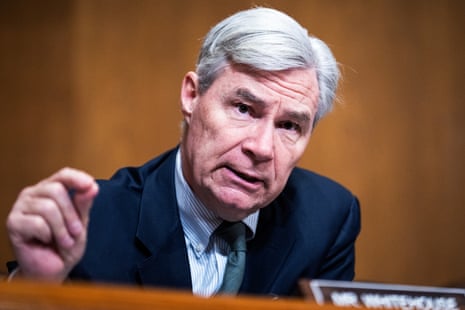
Sheldon Whitehouse at a Senate confirmation hearing on 6 February 2025. Photograph: Tom Williams/CQ-Roll Call via Getty Images

The Democratic party and the climate movement have been “too cautious and polite” and should instead be denouncing the fossil fuel industry’s “huge denial operation”, the US senator Sheldon Whitehouse said.

“The fossil fuel industry has run the biggest and most malevolent propaganda operation the country has ever seen,” the Rhode Island Democrat said in an interview Monday with the global media collaboration Covering Climate Now. “It is defending a $700-plus billion [annual] subsidy” of not being charged for the health and environmental damages caused by burning fossil fuels. “I think the more people understand that, the more they’ll be irate [that] they’ve been lied to.” But, he added, “Democrats have not done a good job of calling that out.”

Whitehouse is among the most outspoken climate champions on Capitol Hill, and on Wednesday evening, he delivered his 300th Time to Wake Up climate speech on the floor of the Senate.

He began giving these speeches in 2012, when Barack Obama was in his first term, and has consistently criticized both political parties for their lackluster response to the climate emergency. The Obama White House, he complained, for years would not even “use the word ‘climate’ and ‘change’ in the same paragraph”.

While Whitehouse slams his fellow Democrats for timidity, he blasts Republicans for being in the pocket of the fossil fuel industry, an entity whose behavior “has been downright evil”, he said. “To deliberately ignore [the laws of physics] for short-term profits that set up people for huge, really bad impacts – if that’s not a good definition of evil, I don’t know what is.” (snip-MORE)

Maga Pastor ADMITS What They’re Really Fighting For

Clay Jones

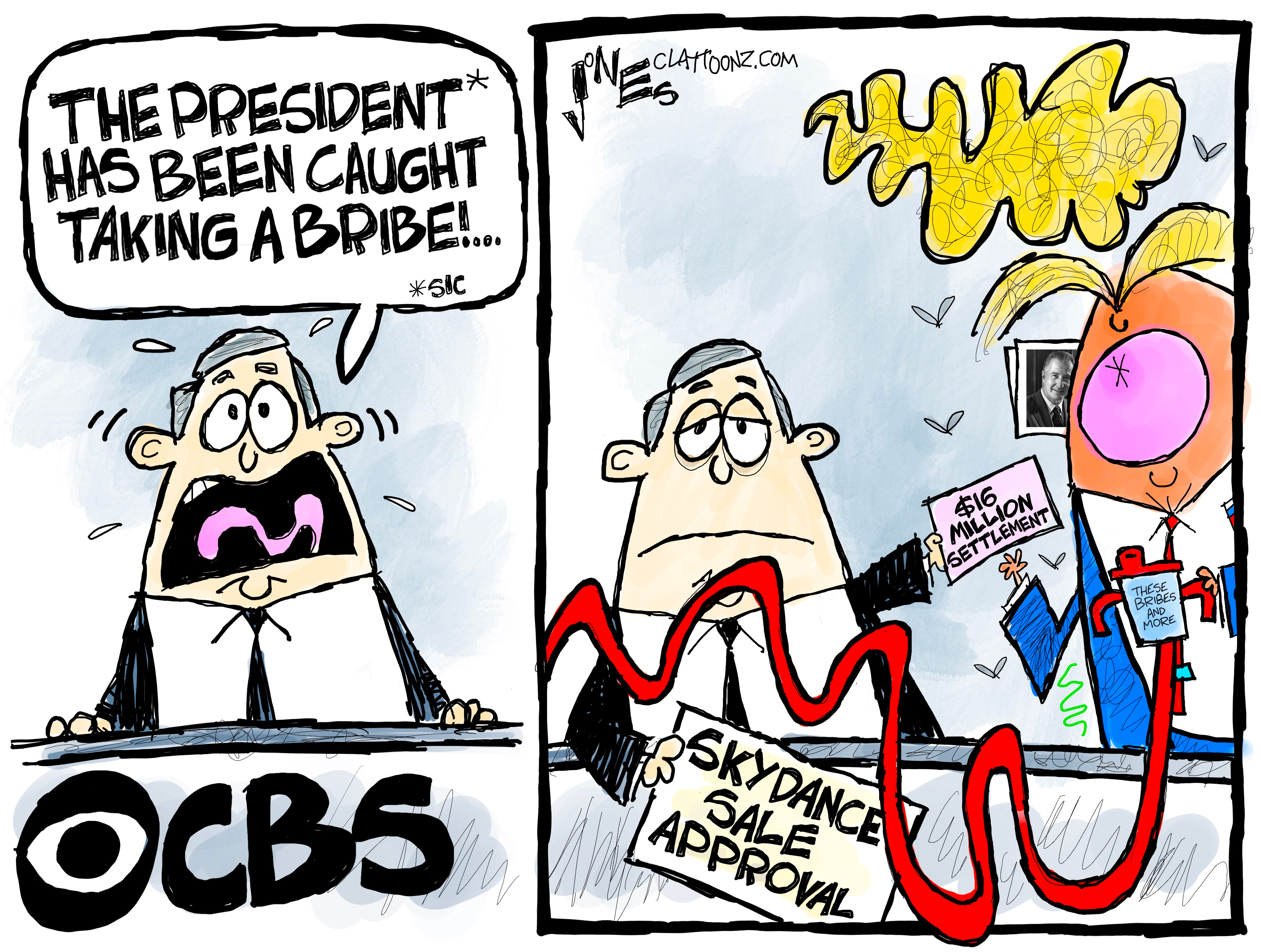
Bribed In 60 Minutes by Clay Jones

News outlets are supposed to expose corruption, not engage in it Read on Substack

The headline at Fox News blasted, “Paramount, CBS forced to pay eight figures, change editorial policy in settlement with President Trump.” Forced? Would Fox News use the word “forced” when they settled a lawsuit with Dominion for over $787 million? You may feel forced, but a settlement is a choice. It’s a choice not to go any further into a trial and shut that shit down, for whatever reasons. And yes, CBS has changed its editorial policy, which is that anytime Trump comes for a bribe, you pay it.

Usually, when someone settles a lawsuit, they’re trying to get off cheaper as they fear the result of the trial will cost them more. In Fox News’ case with Dominion, they were afraid the verdict in a trial would bankrupt them. They were guilty of spreading misinformation that they knew were lies. It’s why Tucker’s no longer on their payroll.

When CNN and the Washington Post settled with teenage Trumper Nicholas Sandmann, one of those smirky, obnoxious, entitled white privileged Catholic Covington kids who was in the center of a viral video controversy with an elderly Native American, they didn’t settle because they were guilty. They settled for what legal experts estimate to be a small portion of the $275 million they were sued for, in order to save on lawyer fees. They weren’t afraid of losing the trial because it had already been dismissed once, but felt they’d pay more to their lawyers than to the little asshole whose feelings got hurt. I hope the ugly little entitled priviliged fuck isn’t feeling too litigious today.

When Disney settled a lawsuit with Trump earlier last December, who sued because ABC news anchor George Stephanopoulos said Trump was “liable for rape,” it wasn’t because they were guilty of anything other than hurting TACO’s feelings because Stephanopoulos was technically correct. Disney, ABC’s parent company, settled because the judge was scary and said in her denial to dismiss that “a reasonable jury could interpret Stephanopoulos’s statements as defamatory,” despite the fact that Donald Trump is a rapist who also liked to pal around with rapists while also endorsing pedophiles for the United States Senate. Also, Trump put Alexander Acosta in his first cabinet. He was the prosecutor who saved Epstein from a criminal trial.

When Meta settled a lawsuit with Trump in January, it was to bribe Trump. Trump sued Meta for banning him from its platforms, Facebook and Instagram, in 2020 after his election denial and white nationalist terrorist insurrection attempt. Trump told Mark Zuckerberg that he would have to settle the lawsuit before he could be “brought into the tent.” I don’t think he’s talking the kind of tent migrants will be forced to sleep in at Alligator Alcatraz, but the MAGA tent. The settlement was for $25 million, and it was a bribe.

Even Elon settled a lawsuit with Trump, and was also to bribe Trump. As if the $275 million Elon paid to elect him wasn’t enough. Like with Meta, Trump sued Twitter for banning him, citing that his First Amendment rights were violated. A federal court in California tossed the case, saying only the government can deny First Amendment rights, not corporations. But Trump’s team took it to an appeals court, which was skeptical. Elon settled with Trump for $10 million. Why would you settle when you already won? Because it’s a bribe.

Also, do you like the irony of Trump claiming his First Amendment rights were violated, and now he’s trying to deport people for protesting? (snip-MORE)

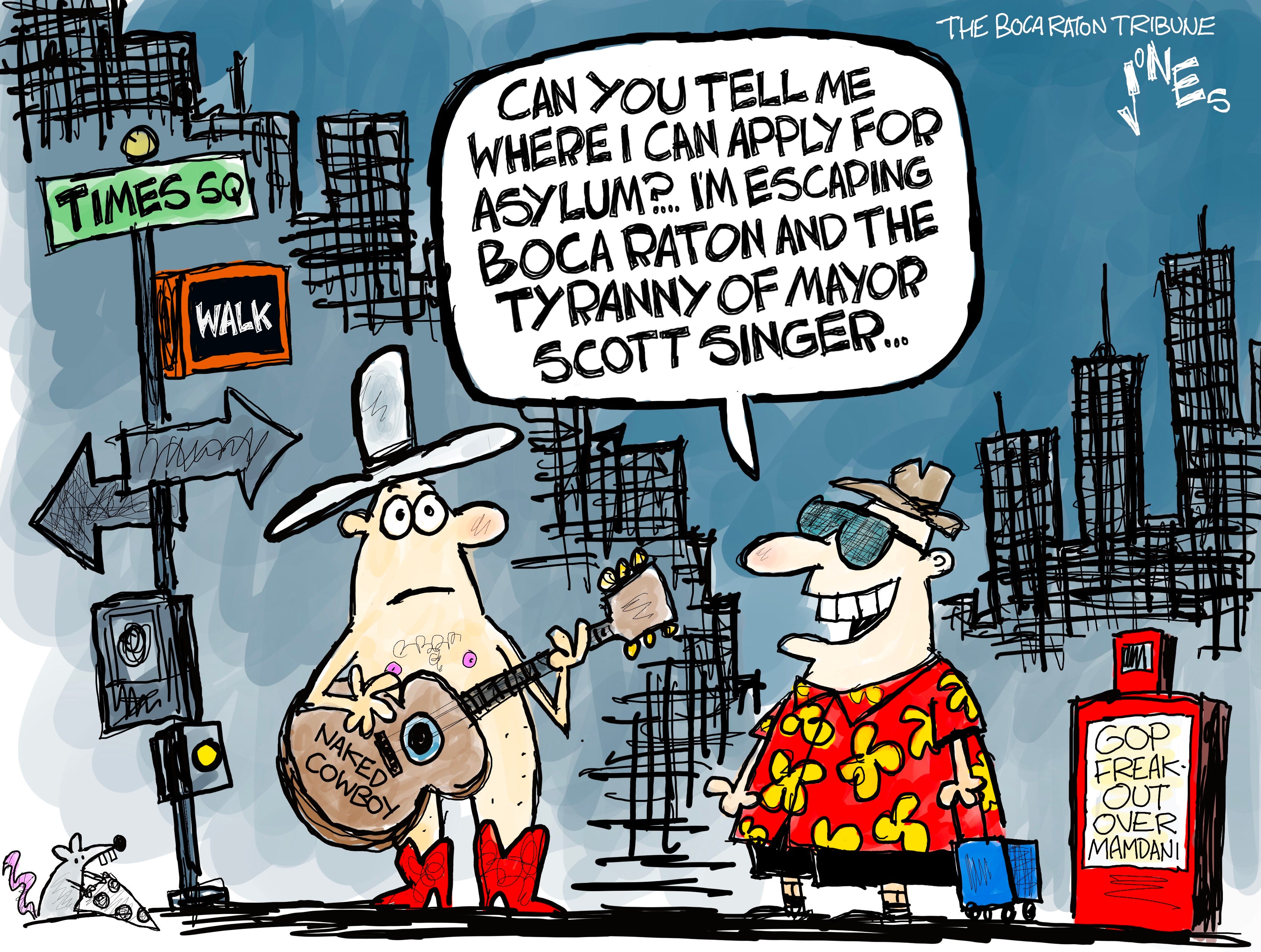
Boca Refugee by Clay Jones

A cartoon for the Boca Raton Tribune Read on Substack

This cartoon was drawn for The Boca Raton Tribune, whose mayor went on Fox News and offered New Yorkers an escape from “socialist” New York City if Zohran Mamdani wins the mayoral race in November.

The mayor, Scott Singer, has aspirations for higher office, and to do that as a Republican, you have to be a vile piece of shit. This is the kind of stuff MAGAts find amusing, like throwing migrants to alligators.

Being the mayor of a city in Florida, Singer should focus on being the mayor of his city in Florida. That’s the job he was elected to do, and not worry about who’s the mayor of New York City. Right now, Republicans are using Mamdani as red meat for their base, without even understanding what they’re talking about.

Sometimes, I think I should move to Florida just for the issues, and syndicate cartoons about them to Florida newspapers. But then, I’d be living in Florida. (snip-MORE)

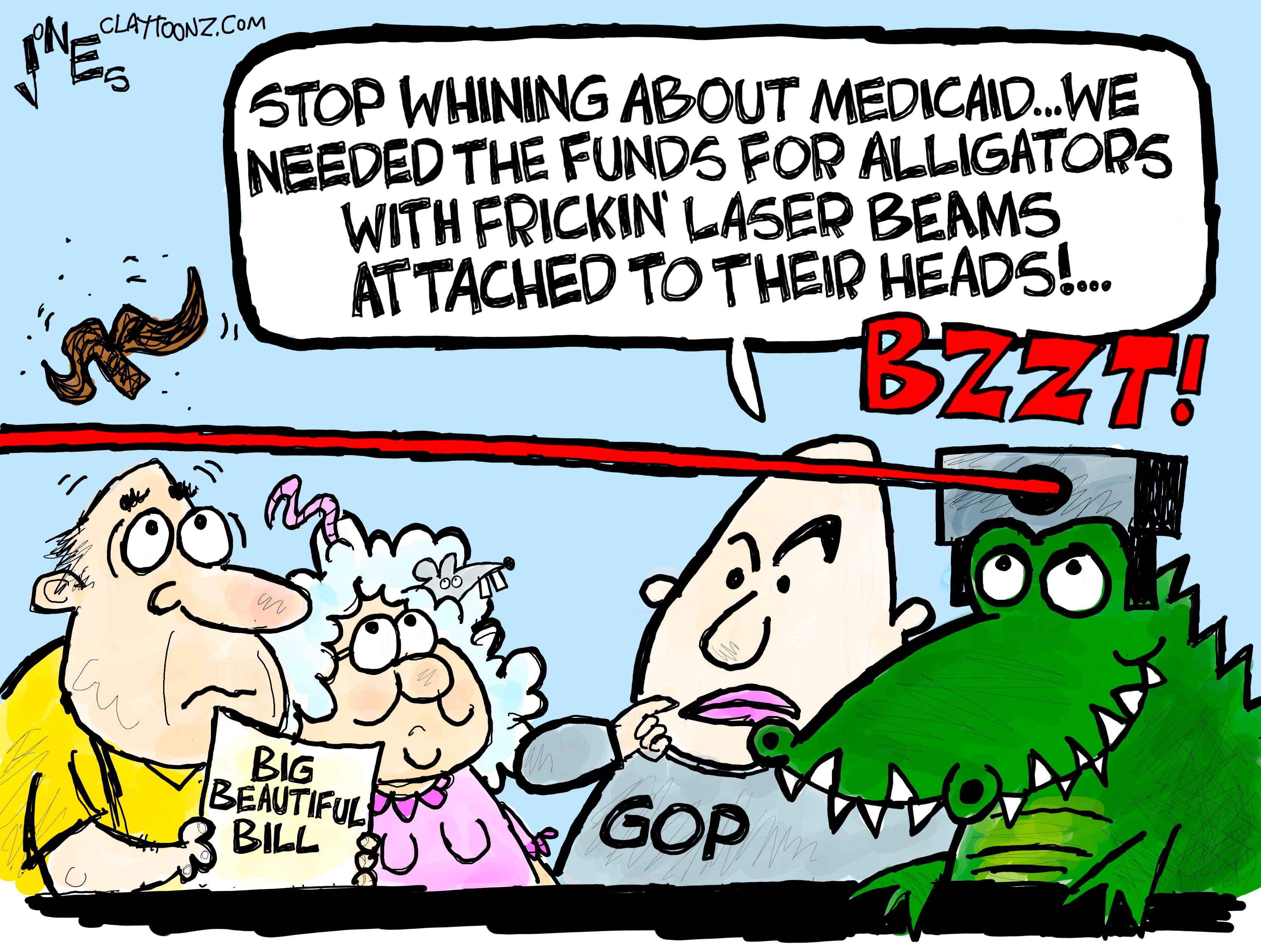
Frickin’ With Medicaid by Clay Jones

The Big Beautiful Bill is evil Read on Substack

Trump’s $4 trillion (at least) “big beautiful bill” is giving seniors a tax credit of $6,000, which is great because they’re gonna need it.

The bill makes deep cuts to Medicaid, the government health insurer for the poor, which covers more than 60 percent of the nation’s nursing home residents.

The nonpartisan Congressional Budget Office (CBO) estimated that the BBB will cut federal spending on Medicaid and Children’s Health Insurance Program (CHIP) benefits by $1.02 trillion, due in part to eliminating at least 10.5 million people from the programs by 2034.

This will lead to benefit losses, increased paperwork requirements, and rural hospital closures that will hurt Americans, especially those with disabilities. It will also make nursing homes scramble to find resources for services they’re currently providing, or simply eliminate services.

Republicans like to say, or lie, that people who receive Medicaid aren’t going to notice any changes. But you can’t find one of the shitweasels who can explain how you don’t lose any services after cutting out over a trillion dollars. Find me one Republican, just one, who can explain that shit.

This will hit rural communities harder. Do you know which party rural communities mostly vote for? The one that just cut their Medicaid. Republican voters are stupid. Red states need the most federal support. Red states need the most welfare, which they also cut. (snip-MORE)

Reasons to Leave Christianity* in 2025

I have long liked this young YouTuber.  I started following him when he was more into debunking stuff while also producing atheist content.  I felt he understood what a lot of people were going through in that he was trying hard to hide being an atheist from his parents and family which gave him an idea what many in the LGBTQ+ community were going through with their families.  He himself noted that similarity.  One of the things I like about him is his calm quiet fact filled delivery.  If others have not noticed I don’t like aggressive angry yelling videos, they are too close to what I grew up with and suffered in my childhood.  Drew is not a fervent anti-Christian like so many atheists are.  Instead he simply is against the bad stuff some people do in the name of religion  / Christianity.   I like that.  At the end of this video he again says if you are getting something good from your faith, don’t leave it, just change it to make it better.  I agree.  He explains how Christianity was abused by corporations and wealthy people to get people to do things against their own interest they otherwise wouldn’t do.  In the name of god work more at a lower cost to make money for your employer type stuff.    Hugs

Republican Crimes Against The U.S.

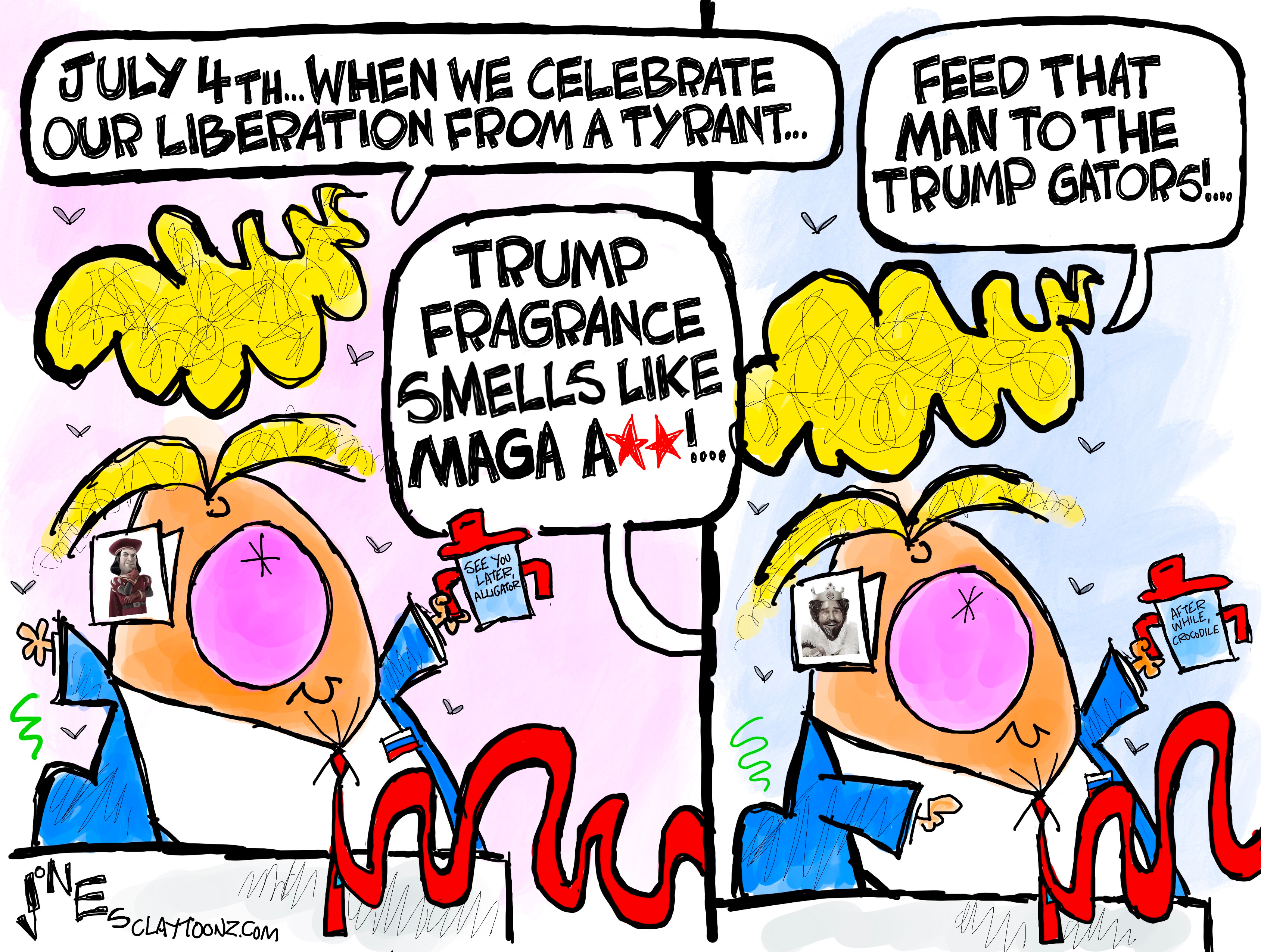
King Stinks-A-Lot by Clay Jones

No room for tyrants Read on Substack

Tomorrow, we’re celebrating the anniversary of our independence from a monarchy. Yet, the guy in the White House envisions himself as a monarch.

He wants to ban protests, which is a First Amendment right. He didn’t send the military to California to stop riots. He sent them to stop the protests. Ice has arrested legal residents, without charges, but citing their protests. The regime is bullying colleges to stop protests against the war in Gaza. This is not freedom. This is not independence.

Trump asked the courts for immunity from criminal charges. Every court said no until it got to the Supreme Court. One man has been ruled to be above the rest of us, and he has immunity.

The Supreme Court allowed Trump to stay on the ballots despite his waging war against this nation.

Trump waged war against this nation to remain in office. He led a white nationalist coup attempt against our country. He attacked Congress to prevent it from doing its constitutional duty of certifying the 2020 election.

Now, Congress is in Trump’s pocket and failing to work as one of the three branches.

The Supreme Court has now ruled that lower courts shouldn’t make rulings against Trump that apply nationally.

The Supreme Court failed to address Birthright Citizenship, allowing Trump to violate a Constitutional amendment. Until SCOTUS acts on this, Trump will go unchallenged.

He is building concentration camps.

He’s ordering the Department of Defense to go after his enemies.

He’s violating the Emoluments Clause, using the White House to enrich himself.

He’s talking about running for a third term, but this would just be another violation of the Constitution. If he’s talking about running for a third term, then he will be running for a third term.

Trump will not allow another election to be fair.

He’s attacking the media, and soon, the only media that will be allowed to continue to exist will be Trump media.

I left a lot out, so go ahead and fill in the blanks in the comments.

(snip-MORE)

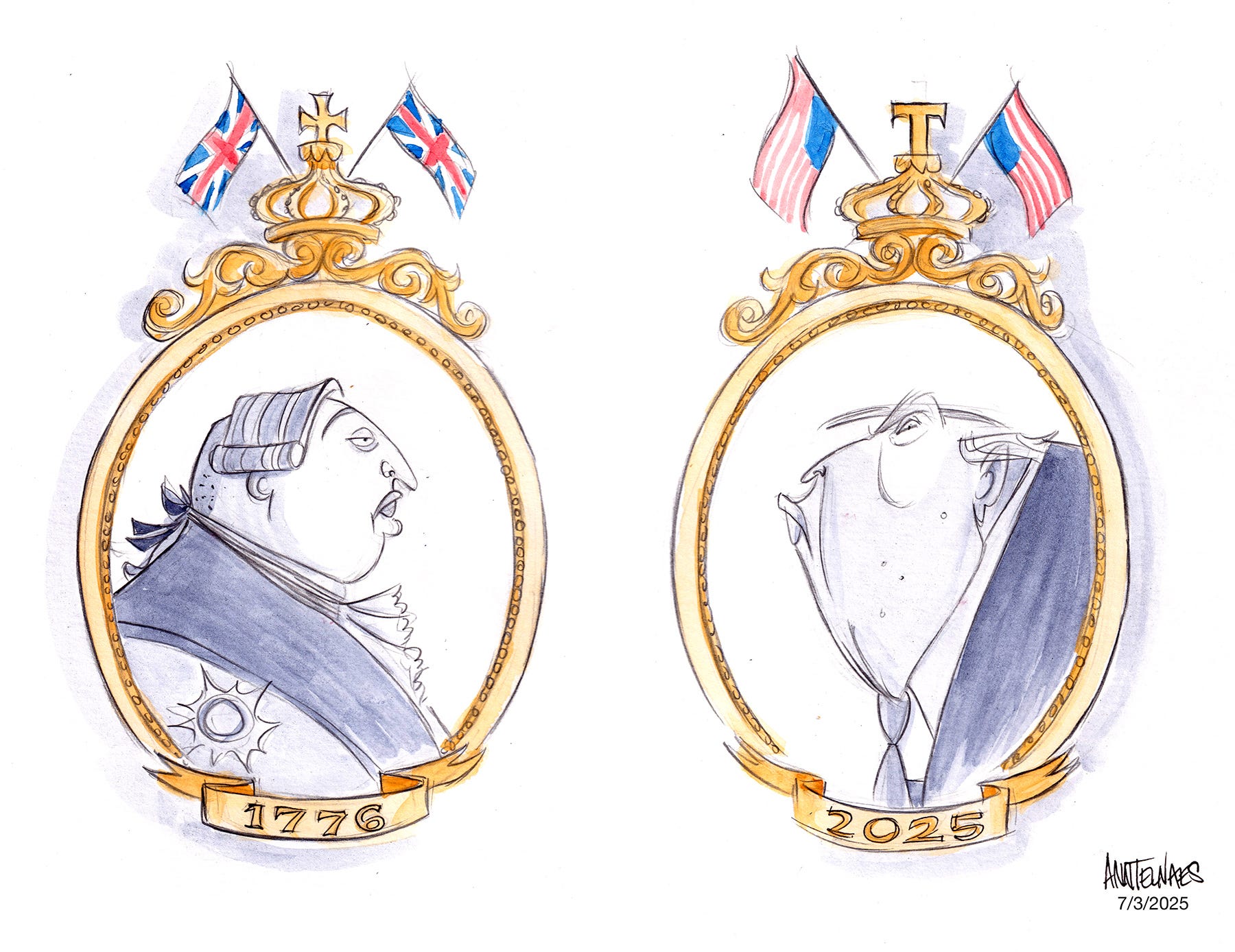
In 1776 we rejected a monarchy by Ann Telnaes

You can thank the oath breaking Republicans for where we are Read on Substack

“He has refused his Assent to Laws, the most wholesome and necessary for the public good.”

Dems fear a gop legal blitz

NJ, VT Get With The Program Again, & More, in Peace & Justice History for 7/2

July 2, 1776
New Jersey became the first British colony in America to grant partial women’s suffrage. The new constitution (temporary if there were a reconciliation with Great Britain) granted the vote to all those “of full age, who are worth fifty pounds proclamation money,” including non-whites and widows; married women were not able to own property under common law.
July 2, 1777
Vermont became the first of the United States to abolish slavery.
July 2, 1809
Alarmed by the growing encroachment of whites squatting on Native American lands, the Shawnee Chief Tecumseh called on all Indians to unite and resist. By 1810, he had organized the Ohio Valley Confederacy, which united Indians from the Shawnee, Potawatomi, Kickapoo, Winnebago, Menominee, Ottawa, and Wyandotte nations.
For several years, Tecumseh’s Indian Confederacy successfully delayed further white settlement in the region.


Chief Tecumseh
Tecumseh’s efforts 
July 2, 1839

Slave ship
Early in the morning, captive Africans on the Cuban slave ship Amistad, led by Joseph Cinquè (a Mende from what is now Sierra Leone), mutinied against their captors, killing the captain and the cook, and seized control of the schooner. Jose Ruiz, a Spaniard and planter from Puerto Principe, Cuba, had bought the 49 adult males on the ship, paying $450 each, as slaves for his sugar plantation.
 More about Amistad
  
Joseph Cinquè
July 2, 1964

Jobs and Freedom march April 28, 1963, Washington DC
U.S. President Lyndon B. Johnson signed the Civil Rights Act of 1964 into law, thus barring discrimination in public accommodations (restaurants, stores, theatres, etc.), employment, and voting.
The law had survived an 83-day filibuster in the U.S. Senate by 21 members from southern states.


“I think we just delivered the South to the Republican party for a long time to come,” said President Johnson to his press secretary,
Bill Moyers later that day.
He anticipated a shift in white southern voting from the Democratic to the Republican party in response to the law.

Massive demonstrations a year earlier ensured passage of the Act.
July 2, 1992
President George H.W. Bush (the elder) announced that the United States had completed the worldwide withdrawals of all its ground- and sea-launched tactical nuclear weapons [see September 27, 1991].

https://www.peacebuttons.info/E-News/peacehistoryjuly.htm#july2