Useful Info & Resource

Understanding the Legal Framework Governing a Shutdown

September 17, 2025 | By Sam Berger

The government funding deadline is fast approaching. With the Trump Administration’s continued efforts to impound and rescind funding, complicating Congress’s ability to reach an agreement on funding bills for the upcoming year, it is important to keep in mind the legal framework that governs a shutdown, and the limits a shutdown places on the executive branch.

This primer focuses on the activities that can (and cannot) legally continue during a shutdown; it does not address the impacts of a shutdown on government programs or the people who use them.

Critically, while the executive branch has some discretion as to what activities continue during a shutdown — and it is impossible to predict whether the Administration will take unlawful actions under the pretext of a shutdown[1] — a government shutdown does not provide the Administration any additional legal authority to fire federal employees, limit review of its actions by federal courts, or freeze funding once full-year appropriations are provided.

Activities That Can Continue During a Government Shutdown

Under the Antideficiency Act, agencies can neither spend, nor make commitments to spend, money without appropriations from Congress.[2]

Some activities continue during a shutdown because they are separately or already funded. For example, activities funded by multi-year or indefinite funding, such as disaster relief, continue, with payments made as normal. Likewise, if some appropriations bills have been enacted prior to a shutdown, activities funded by those enacted appropriations also continue (a scenario sometimes described as a “partial” government shutdown). The Administration has no legal authority to impound or freeze these funds.

Based on long-standing Department of Justice (DOJ) guidance, there are also a limited set of activities for which the federal government can make commitments to pay — though it still cannot make payments — during a shutdown[3]:

  • Activities expressly provided for in law to continue during a shutdown. Some laws expressly provide that certain activities can continue in the absence of appropriations, such as the Department of Defense’s “feed and forage” authority allowing it to obtain certain types of necessary supplies for military personnel.
  • Activities to protect against imminent threats to life or property. This includes activities related to law enforcement, national security, air traffic control, and federal prisons, among others.
  • Activities that are necessary to prevent significant damage to a funded program. For example, activities necessary to ensure Social Security payments (which themselves are funded under law) are made in a timely way can continue during a shutdown even if those activities themselves do not have funding.
  • Activities necessary to discharge the President’s constitutional duties. This includes, for example, the President’s Commander-in-Chief responsibilities.

Different administrations have interpreted these exceptions to apply more or less narrowly, meaning that the activities that continue during a shutdown have differed to some extent from administration to administration. The first Trump Administration took a more expansive view of the public services that should continue.[4] However, to date, a core set of services — such as defense, law enforcement, transportation safety, Social Security, and Medicare — have continued during every shutdown.

Executive Branch Restrictions During a Government Shutdown

While the executive branch has some latitude in what activities it continues during a government shutdown, there are clear limits on its actions.

If an activity is not funded, no actual payments can be made during a shutdown.

Even for activities that continue during a shutdown because they are subject to one of the exceptions described above, funding to pay for them cannot be provided without appropriations. The federal personnel required to work — including law enforcement, prison guards, and the staff that process Social Security benefits — only receive IOUs that will be paid when appropriations are enacted. Federal contractors required to work or provide services also go unpaid during the shutdown.

Under current law, when the shutdown ends all federal employees receive backpay for the time the government was shut down regardless of whether they were working on an activity that could continue during a shutdown or were forced to stop work until the shutdown ended. However, federal contractors do not receive pay for this time period except for any work they were required to perform during it.

Each branch of government determines which of its activities can legally continue during a shutdown.

Congress and the judiciary make their own independent determinations about what activities continue during a lapse. The executive branch is not involved in those determinations.

In prior shutdowns, the judiciary has had sufficient funding in the absence of new appropriations to continue normal operations for the duration of the shutdown. Courts have said in previous shutdowns that in the event they ran out of funding during a shutdown, they would continue to hear cases and otherwise fulfill their constitutional responsibilities.[5] Thus, litigants who are suing in federal court would be able to bring suits against the Administration during a shutdown.

When DOJ does not have funding during a shutdown, its lawyers may request extensions from courts for filing deadlines and other procedural steps. Individual courts have the discretion to determine whether to provide such extensions, and courts have both granted and denied such requests depending on the circumstances.

A shutdown would not provide the Administration with any additional legal authority to engage in widespread firing of federal employees.

A temporary lapse in funding does not provide grounds for an agency to fire employees. In addition, during a shutdown most agencies will not be able to legally conduct personnel actions unrelated to the shutdown itself because their HR departments will not be funded and these types of actions do not fall under any of the available exceptions.[6]

A shutdown would not impact the Administration’s legal obligations to spend money once full-year appropriations are provided.

While many activities would cease during a shutdown because of a lack of funding, the shutdown would not provide the Administration with any authority to impound or freeze funds once appropriations are provided.

While this primer focuses on the legal framework that governs during a shutdown, the Administration has shown itself willing to take actions that are inconsistent with the law, which presents major challenges for the country at all times, not just during a shutdown.

Topics:  Federal BudgetBudget Process

End Notes

[1] Sam Berger, “Trump is ignoring the law to keep the shutdown from causing him political pain,” The Washington Post, January 15, 2019, https://www.washingtonpost.com/outlook/2019/01/15/trump-is-ignoring-law-keep-shutdown-causing-him-political-pain/.

[2] Government Accountability Office, “Antideficiency Act,” https://www.gao.gov/legal/appropriations-law/resources.

[3] Walter Dellinger, “Government Operations in the Event of a Lapse in Appropriations,” Justice Department Office of Legal Counsel, August 16, 1995, https://www.justice.gov/sites/default/files/olc/opinions/attachments/2014/11/10/1995-08-16-lapse-in-appropriations.htm.

[4] Juliet Linderman, “Selective shutdown? Trump tries to blunt impact, takes heat,” Associated Press, January 13, 2019, https://apnews.com/article/66b50739f4b84063a2ff56dff3156712.

[5] United States Courts, “Judiciary Has Funds to Operate Through Jan. 31,” January 22, 2019, https://www.uscourts.gov/data-news/judiciary-news/2019/01/22/judiciary-has-funds-operate-through-jan-31

[6] Office of Personnel Management, “Guidance for Shutdown Furloughs,” January 2024, https://www.opm.gov/policy-data-oversight/pay-leave/furlough-guidance/guidance-for-shutdown-furloughs.pdf.

This Was In The News September 10th-

I saw a few headlines about it on Monday, and meant to post it but didn’t get it done, then Tuesday was what it was. So, it’s been a week, but here it is: there is universal childcare in New Mexico, and they are heroes for getting that done. -A

New Mexico will be the first state to make child care free

Chabeli Carrazana of The 19th. Meet Chabeli and read more of her reporting on gender, politics and policy.

In an unprecedented move, New Mexico is making child care free. 

Beginning in November, it will be the first state in the nation to provide child care to all residents regardless of income, Gov. Michelle Lujan Grisham announced this week. 

The state has been working to lower child care care costs since 2019, when it created the Early Childhood Education and Care Department and started to expand eligibility for universal child care. This latest change removes income eligibility requirements from the state’s child care assistance program altogether and waives all family copayments. 

The initiative is expected to save families $12,000 per child annually. 

“Child care is essential to family stability, workforce participation and New Mexico’s future prosperity,” Lujan Grisham said in her announcement. “By investing in universal child care, we are giving families financial relief, supporting our economy, and ensuring that every child has the opportunity to grow and thrive.”

The United States allocates some federal funding to states to lower the cost of child care for low-income kids, but eligibility for that funding is very limited and by and large, most families are paying an average of $13,000 on child care annually. It’s much higher in many states. 

In the absence of a federal universal child care system, some states have worked to build their own systems, and New Mexico has been a leader in that effort over the past several years. 

The state’s Early Childhood Education and Care Department got a budget increase of $113 million in the most recent legislative session, taking its total operating budget to nearly $1 billion. Half of that money goes specifically to child care payment support. 

The state also established a fund in 2020 with money earmarked for early childhood education. Thanks to tax collections from the oil and gas industries, the fund has grown from $320 million to $10 billion. Latinas in New Mexico led the charge in 2022 to help pass a constitutional amendment in 2022 that ensured a portion of that fund went specifically to universal child care. Funding for the new initiative will come at least in part from there, and Lujan Grisham will also be requesting an additional $120 million in state funding next year, a spokesperson for the governor said. 

The news also comes with improvements for child care facilities and, potentially, raises for their staff. As part of the rollout, the state will establish a $13 million loan fund to construct and expand facilities, launch a recruitment campaign for home-based providers and incentivize programs to pay staff a minimum of $18 an hour. 

The state hopes the initiative will lead to the creation of 55 new child care centers and 1,120 home-based child care options. 

Still, response to the initiative so far has been mixed. Republican state Rep. Rebecca Dow told the Albuquerque Journal that she believes child care vouchers should be reserved for children most at risk for child abuse and neglect. Since the state’s child care assistance program expanded eligibility over the past five years, fewer low-income families have participated in the program, the Journal reported. 

But Thora Walsh Padilla, the president of the Mescalero Apache Tribe, praised the initiative, saying during a press conference Monday that it addresses various challenges the tribe has struggled with, including raising wages for providers. There are only three child care facilities on the 463,000 acre reservation. 

“It is so timely and it answers so many needs,” she said. “A building? Oh my goodness, we’ll be one of the first to apply.”

Zohran Exposes Trump Family’s Disconnect From Voters

Trump Slump So Bad Fox Host Turns To Communism


Dem Leadership Can’t Stop Sabotaging Its Chances To Win

nazis Punish Oslo For Norway Milk Strike, AWOC Strikes In US, US Military Destroys Native Village In Peace & Justice History For 9/8

September 8, 1756
Colonel John Armstrong and troops under his command destroyed the Indian village of Kittanning. The Corporation of the City of Philadelphia awarded a silver medal to Armstrong and his officers for their action.
September 8, 1941
In Norway, 2000 workers in the shipyards went on strike against diversion of milk, “depriving mothers and babies,” to military use by the German soldiers in Finland. In retaliation, Oslo was placed under a 7 o’clock nightly curfew, after which transportation was stopped, public meetings prohibited, radios seized, dancing forbidden. Boy Scouts, Girl Guides and Salvation Army organizations were all dissolved.
More about the Milk strike 
September 8, 1965

Table grape pickers, the mostly Filipino members of the Agricultural Workers Organizing Committee (AWOC), led by Larry Itliong, went on strike for higher wages in Delano, California.
 
Larry Itliong
More about Larry Itliong 

https://www.peacebuttons.info/E-News/peacehistoryseptember.htm#september8

A Very Strong Case Why MAGA Voters Are Stupid

Mmmm; Sprinkles! And More-

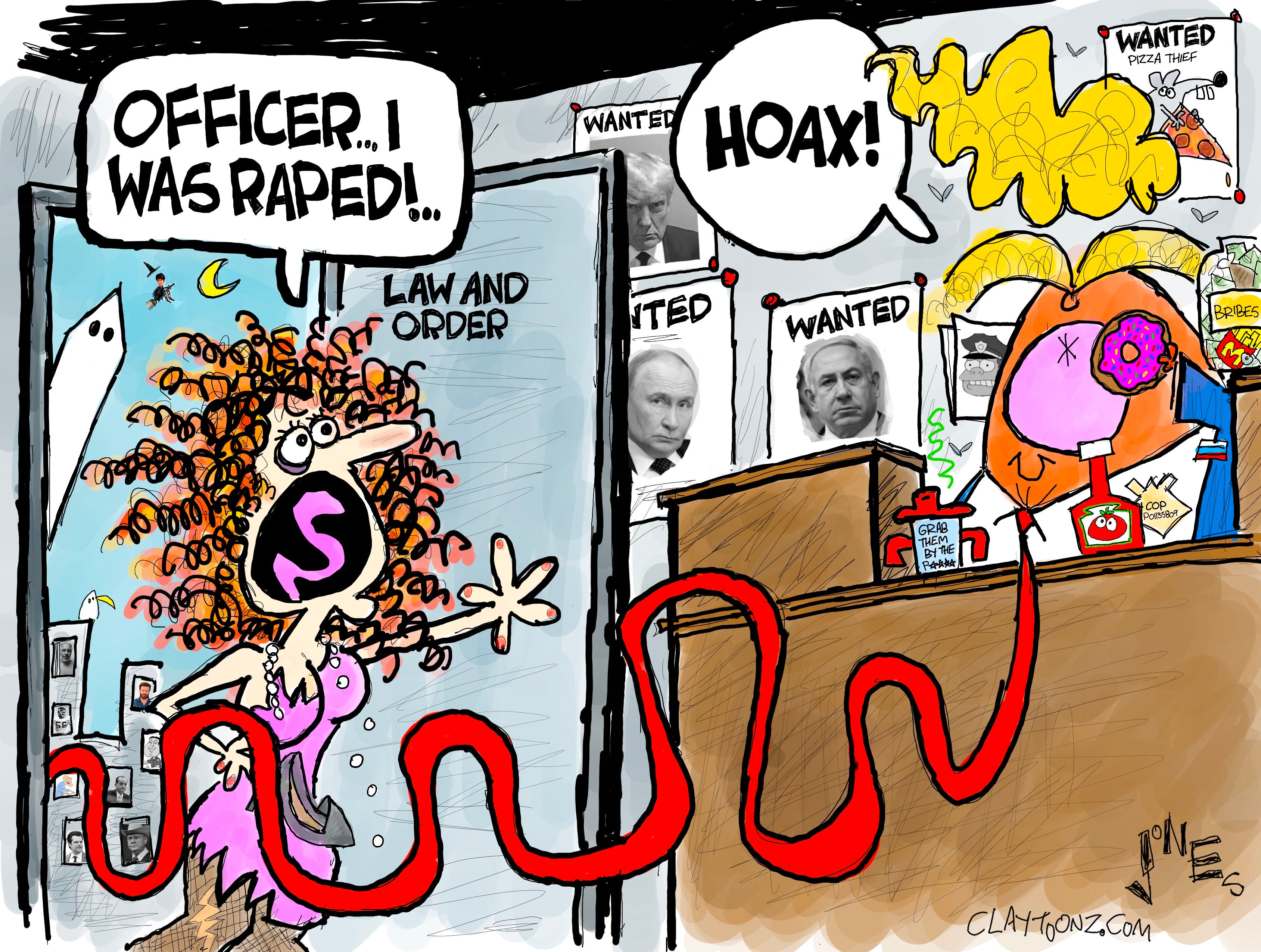
Hoax With Sprinkles by Clay Jones

Trump should shut his donut hole Read on Substack

A group of Epstein abuse survivors held a press conference on Capitol Hill yesterday, calling for the release of all the documents related to the investigation into Jeffrey Epstein. Donald Trump replied to this, calling it a “Democrat hoax,” which was weird since his name didn’t even come up, other than pleas to help release the files. So, what exactly is the “hoax” he’s speaking of?

This is like a case where someone ran a bus full of nuns off a cliff, and then a friend says to you, “Hey, did you hear about that bus full of…” And you interrupt, shouting, “I didn’t do it! Those nuns are lying!”

Has Donald Trump ever sexually assaulted a nun?

Bipartisan lawmakers and Survivors of Epstein’s abuse gathered on the steps of the Capitol to demand that Congress vote to release all the files related to the investigation. These are files that Speaker Mike Johnson, who told his colleagues to ignore the petition, does not want released. Today on GoComics, one of the trolls said that the Epstein Files won’t implicate Trump. If that’s the case, then Trump should release them.

This is weird because MAGAts are either demanding the release of the files or helping Trump with the cover-up. Is that what Watergate was like, with Republicans stating that nobody needs to hear the missing 18 minutes?

I’ve never said the Epstein Files would implicate Trump, but I’m all for pressuring the regime to release them. There’s a reason why the regime won’t release them. What is that reason? (snip-MORE, and it’s excellent)

Trump Revamps the Smithsonian Art Collection by Ann Telnaes Read on Substack

WASHINGTON—Denouncing the Smithsonian Institution’s art collection for being “toxically woke”, Donald J. Trump announced today that he is replacing it with newly commissioned works depicting himself and members of his inner circle: Melania Trump, Pam Bondi, Stephen Miller, JD Vance, and Kristi Noem.

Deep Dish Homicide by Clay Jones

I’ve been known to murder a few pizzas Read on Substack

Describing the city as the “murder capital of the world, Donald Trump said yesterday that he’s going to send the National Guard into Chicago, saying, “We’re going in.” Actually, Memphis is the “murder capital” of the United States, but it’s in Tennessee, which is a red state. These are all photo-ops, you know.

Trump reversed course today while entertaining Poland’s new president, who, like Putin, got a military flyover. A lot of DC residents didn’t appreciate the flyover, as those things tend to be loud, and they shake things off shelves, like cats do.

I can’t tell you how many times I’ve been to the District, and I’ve never gotten a military flyover.

Trump said that now he’d like for the military to be invited by governors before he sends the military into their cities for photo-ops, like he did with DC.

Trump said, “We are making a determination now. Do we go to Chicago? Or do we go to a place like New Orleans where we have a great governor, Jeff Landry, who wants us to come in and straighten out a very nice section of this country that has become quite – quite tough, quite bad?” Make up your mind, Trump. Is it nice or is it bad?

Someone must have told Trump that it’s illegal to send the military into cities without formal requests by governors. DC is a different situation as it is under the exclusive constitutional authority of Congress, which has the power to directly intervene in local governance. This arrangement is due to the city’s status as a federal district, not a state, and gives DC residents limited self-government and no voting representation in Congress. The citizens of Washington, DC have taxation without representation.

But other cities are different, and a judge just ruled that Trump broke the law when he sent Marines into Los Angeles to break up anti-ICE protests. Trump can probably expect the same verdict if he invades Chicago, which the city will reject. (snip-MORE)

Paul Robeson, Elizabeth Eckford, & More, in Peace & Justice History for 9/4

September 4, 1949
Paul Robeson, scholar, athlete, musician and leader, defying a racist and red-baiting mob, sang to 15,000 at a Labor Day gathering in Peekskill, New York.
 
Paul Robeson (at microphone) singing to the Labor Day gathering in Peekskill, New York
The story and photographs of what happened 
Film from that day narrated by Sidney Poitier 
September 4, 1954
The Peace Pledge Union (PPU) organized a demonstration against the H-Bomb in London’s Trafalgar Square.
The PPU dates back to October 1934.


Young Peace Pledge Union members today.
The PPU today
History of the Peace Pledge Union
__________________________________________________
September 4, 1957
Elizabeth Eckford and eight other young Negroes were blocked from becoming the first black student at Central High School in Little Rock, Arkansas.

Elizabeth Eckford
Governor Orval Faubus had called out the National Guard to prevent the court-ordered integration of the public schools in the state’s capital.
President Dwight Eisenhower eventually sent in federal troops to guarantee the law was enforced.


Elizabeth Eckford followed and taunted by mob, 1957.Read more
 Read More
A very interesting related story: 
____________________________________________________
September 4, 1970
Vietnam Veterans Against the War (VVAW) began Operation RAW (Rapid American Withdrawal). Over the following three days more than 200 veterans, assisted by the Philadelphia Guerilla Theater, staged a march from Morristown, New Jersey, to Valley Forge, Pennsylvania, reenacting the invasion of small rural hamlets along the way.


Operation Rapid American Withdrawal 1970-2005: Memories 
______________________________________________________________
September 4, 1978
Simultaneous demonstrations in Moscow’s Red Square and in front of the White House in Washington, D.C. were organized by the War Resisters League, calling for nuclear disarmament.

https://www.peacebuttons.info/E-News/peacehistoryseptember.htm#september4

Let’s talk about more Democratic generational shifts….