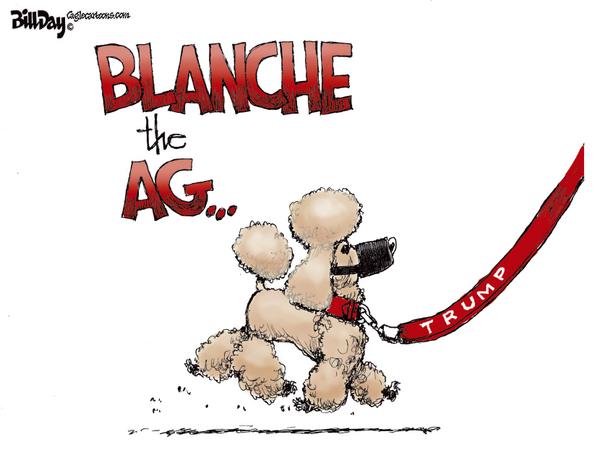
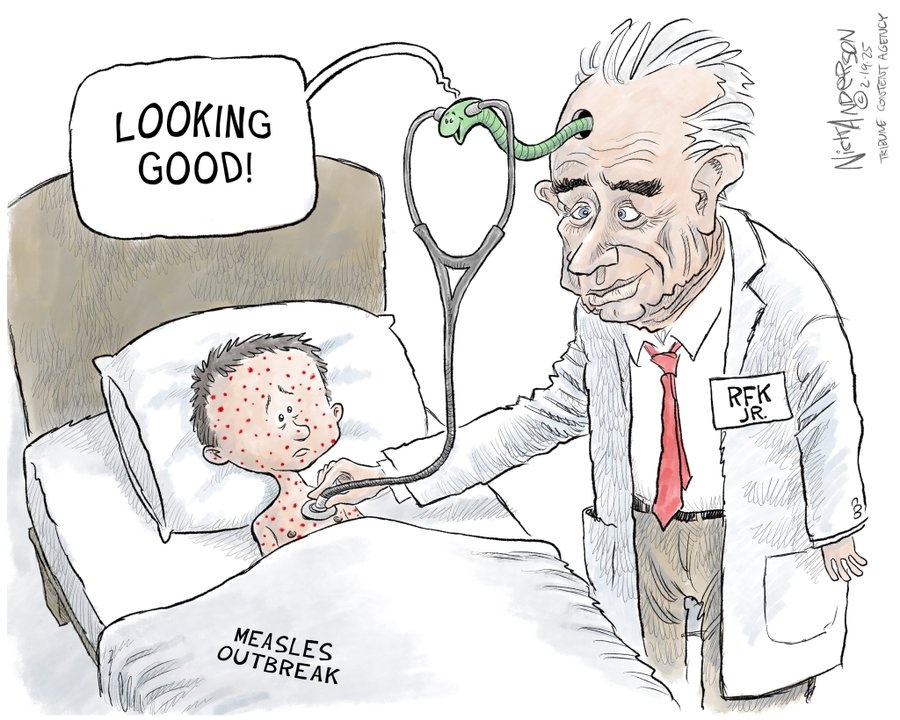
As you know, by now, Todd, Blanche, Donald Trump’s former personal lawyer and current acting Attorney General, is a political hack.
If you had read that someone was going to prison in another country for posting an image of seashells that spelled out 8647, you would think that it was from an authoritarian state. If this were North Korea, would James Comey be put to death by anti-aircraft fire?
Pam Bondi, Blanche’s predecessor, was fired for what many believe was for being too slow to prosecute Donald Trump’s enemies. She had already indicted James Comey once before, which was basically laughed out of court, and never had even the slightest possibility of ever going to trial.
Participation in the Supplemental Nutrition Assistance Program (SNAP) fell by more than 3 million people (8 percent) nationwide between July 2025 and January 2026. The drop followed the enactment of H.R.1, the Republican megabill that made unprecedented cuts to the program. SNAP typically expands to meet need and then shrinks when economic conditions improve. It took over three years for the caseload to drop by over 3 million people (or 7 percent) between its peak in December 2012 and February 2016, during the recovery following the Great Recession.
But economic conditions haven’t been improving as the number of people receiving SNAP has plummeted in recent months, representing the sharpest decline in decades. The last time there was such a steep decrease in participation in such a short period of time (other than temporary spikes following natural disasters) was nearly three decades ago, after Congress enacted very deep cuts to SNAP (then the Food Stamp Program) in 1996. SNAP participation dropped by 9.4 percent (2.2 million people) in the six months between March and September 1997.
SNAP participation has fallen in every state and in some, the drop is particularly alarming. (snip-MORE)
Enten: "These are the worst numbers I've ever seen for any president on inflation. Trump is 49 points underwater. Biden — inflation absolutely crushed his presidency — but at his worst he was only 43 points underwater. Trump is in a worse position on inflation than Jimmy Carter was!"
(Click the headline right up there for more info, or scroll down for yet more links and info)
The next National Day of Action is right around the corner, May Day, Friday, May 1st.
The national call is for no business as usual. This will look different in different places. In some locations, it will mean no work, no school, and no shopping. (snip)
This May Day, we’re flexing our economic power as workers, students, and everyday people to send a clear message to the Trump regime: we will not do business as usual while they trample our rights, terrorize our communities, and drag us into a senseless war in Iran.
Note: A core principle behind all May Day events is a commitment to nonviolent action. We expect all participants to seek to de-escalate any potential confrontation with those who disagree with our values and to act lawfully at these events. No weapons are permitted under any circumstances. (snip)
It’s time for the conditions and standard of living that the working class deserves. We’re beginning a year of action on May 1st with a series of protests, strikes, and other direct action opportunities.
MAY 1 NATIONAL DAY OF ACTIONS:
THRIVING WAGES The working class people have been taken advantage of for far too long! Join us as we mobilize to create worldwide plans of action for THRIVING WAGES. We are demanding at least $20/hr as well as better union laws, the ease of information for organizing co-ops, and better working conditions. But wait, there’s more! We are also demanding mandatory PTO, paternal leave, and good benefits.
Why do we want these demands? Inflation over the last year has risen over 7% and continues to climb. Rents and housing costs have skyrocketed. The costs of consumer goods as greatly increased. Yet corporations and billionaires have doubled their wealth in 2 years as the working class has struggled during a pandemic that has killed over 850,000 Americans and counting. (snip-MORE)
May 1, 1886 May Day was called Emancipation Day in 1886 when 340,000 went on strike (though it was Saturday it was a regular day of work) in Chicago for the 8-hour workday.
May 1, 1890 May Day labor demonstrations spread to thirteen other countries; 30,000 marched in Chicago as the newly prominent American Federation of Labor threw its weight behind the 8-hour day campaign.
May 1, 1933 Dorothy Day The Catholic Worker newspaper was founded by Dorothy Day and Peter Maurin. Dorothy Day said, “God meant things to be much easier than we have made them,” and Peter Maurin wanted to build a society “where it is easier for people to be good.” Peter Maurin
May 1, 1948 Senator Glen Hearst Taylor (D-Idaho) was arrested in Birmingham, Alabama, for trying to enter a meeting through a door marked for “Negroes” rather than using the “whites only” door, and convicted of disorderly conduct. Taylor was the Progressive Party candidate for Vice President, running mate of Henry Wallace. He was in Birmingham to address the Southern Negro Youth Congress.
May 1, 1965 Second Factory for Peace opened in Onllwyn, Dulais Valley, in south Wales, employing disabled miners. Tom McAlpine, active in the Committee for Nuclear Disarmament, and a supporter of cooperatives and industrial democracy, established Rowen Engineering in both Wales and Glasgow, Scotland.
May 1, 1967 Soviet youths openly defied police and danced the twist in Moscow’s Red Square during May Day celebrations. In the early ‘60s the Twist had been banned in Buffalo, New York, and Tampa, Florida. The religious right claimed the Twist was actually a pagan fertility dance. Are you old enough to remember Chubby Checker? — May 1, 1971 Five days of anti-war May Day protests began in Washington, D.C., resulting in over 14,000 arrests—the largest mass civil disobedience in U.S. history. — May 1, 1986
One million South Africans demonstrated their opposition to apartheid in a strike organized by the Congress of South African Trade Unions (COSATU)
So, some of us don’t get around much anymore. Some of us may be somehow constrained to go to work. Some of us have waited all week to buy a few needed groceries. Maybe we wanted to participate, but just forgot and now it’s tomorrow, and there doesn’t seem to be a way to do it. How can we participate? Well, click onto any or all of these links to find out. There is no fault or fail in not being able to do the primary actions, but there are other ways to participate, and even if we don’t find a way, we can certainly work toward being able to observe a personal May Day now and then on our own. We can simplify, and always work to keep our spending where it will be most useful to community. And maybe we can watch someone else’s kids or pets while they go and do.Benefitting our communities while not feeding the already-wealthy with our commerce, labor, and dollars will benefit people, and is the objective. Above this graf are resources. May Day is tomorrow. Let’s do all we can!
*** Personal note. Almost did not make the deadline on this one. I was running on fumes as I am finishing this. Then instead of eating supper I am going to bed. Thank you for reading / enjoying / or even if you wish commenting. On that note. Rather than getting to comments which I will do someday, I am focusing all my energy on doing these cartoons / memes / news posts. I hope to be able to do more soon. I love the comments and will some day when sitting in my desk chair is not so painful and there are not so many other things I need to get done, I will reply to them, even if they are far too old to matter to anyone. Hugs and loves. *** Scottie
———————————————————————————————————————————————-
Sharing the picture of a happy trans women gives you the vitamins and nutrients you need to fight back against bigotry all day long.
Russia has labeled its leading LGBTQ+ rights group, the Russian LGBT Network, as “extremist,” effectively banning the organization and exposing supporters to possible criminal prosecution.
The Russian Supreme Court banned the nonexistent “International LGBT Movement” in 2023. Now the courts are going after more and more real organizations, including the Russian LGBT Network and at least five other LGBTQ+ initiatives. meduza.io/en/news/2026…
Amazing how his ear has healed with no trace of a bullet wound. Remember how his cult wore fake bandages to show support for their dear leader.
🚨BREAKING: The Florida House has passed a new, aggressively gerrymandered congressional map that could net 4 GOP seats ahead of midterms.Revealingly, the vote came just an hour after SCOTUS gutted the Voting Rights Act, rolling back 50 years of protections against racial gerrymandering.
🚨 HOT MIC: Sen. Chuck Grassley (R-IA) was caught asking staff during questioning of Trump judicial nominees: “What would be wrong if they said Biden won?” Multiple people in the room heard it. GOP staffers were reportedly panicking, according to sources familiar.
On Monday, the Colorado Senate Judiciary Committee passed HB26-1322, a bill that creates a private civil right of action allowing survivors of conversion therapy to sue the practitioners who subjected them to it. The bill, which has no statute of limitations for such claims, would likely make the practice of conversion therapy financially prohibitive in the state. It comes in the aftermath of the Supreme Court’s 8-1 decision last month in Chiles v. Salazar, which found that Colorado’s 2019 ban on conversion therapy unconstitutional—effectively legalizing the discredited practice nationwide. The new bill has one final legislative hurdle to clear—the full Colorado Senate—before heading to Governor Jared Polis’s desk, though the governor has so far offered only lukewarm signals about whether he will sign it, saying he is “hopeful there is still time to construct a framework he could support.”
The bill targets what it calls “sexual orientation or gender identity change efforts”—defined as “any practice by a licensed mental health professional that seeks to direct a patient toward a predetermined sexual orientation or gender identity outcome, or to eliminate or reduce sexual or romantic attractions or feelings toward individuals of a particular sex or gender, regardless of the sexual orientation or gender identity the patient is directed toward.” The inclusion of “eliminate or reduce sexual or romantic attractions” is notable—conversion therapists have long used this framework to argue disingenuously that they are not trying to change a person’s sexual orientation, merely helping them manage unwanted feelings. The bill explicitly carves out any counseling or therapy that “provides acceptance, support, and understanding of a patient” or “facilitates a patient’s coping, social support, and identity exploration and development”—meaning therapists who support a patient’s own process of self-discovery, without steering them toward a predetermined outcome, would face no liability.
The bill uses a novel legal mechanism to target conversion therapy—a private right of action. Rather than the government banning conversion therapy outright, which is what the Supreme Court struck down in Chiles, the bill instead allows survivors to sue their practitioners directly, stating that “a person who suffered an injury as a result of sexual orientation or gender identity change efforts may bring a civil action for damages” against their conversion therapist. It also states that a lawsuit to recover damages can be commenced “at any time without limitation,” making its statute of limitations effectively endless. The mechanism may be insulated from the constitutional problem the Supreme Court identified in Chiles because the government is not restricting speech—instead, private citizens are seeking civil remedies for harm they suffered, the same way a patient can sue a doctor for malpractice. As Alejandra Caraballo, a clinical instructor at Harvard Law School, told Erin in the Morning after the Chiles ruling, “While the Supreme Court decision limits the abilities of states to regulate conversion therapy through professional standards, they did not limit the ability for states to protect LGBTQ youth from these abusive practices through tort or malpractice law.”
If the mechanism sounds familiar, it is because Republicans pioneered it to get around Supreme Court rulings they didn’t like—most famously in Texas’s SB 8, the 2021 abortion “bounty hunter” law. That law banned abortion after six weeks not through government enforcement but by allowing any private citizen to sue anyone who performed or aided an abortion for $10,000 in damages. The legal trick was simple: when abortion providers tried to challenge SB 8 in court, they couldn’t get an injunction because there was no government official to enjoin. Courts found that you can’t sue “the state” to block a law that only private citizens enforce. The Supreme Court effectively let SB 8 stand, and the strategy worked—abortion access in Texas collapsed virtually overnight even while Roe v. Wade was still the law of the land. Kansas used the same model in SB 244, which allows anyone to sue a transgender person for using a restroom that doesn’t match their assigned sex at birth. Now, Colorado Democrats are exploiting the same constitutional loophole in the opposite direction—using private civil enforcement to deter a harmful practice that the Supreme Court says the government cannot directly ban.
It is important to note that some have raised concerns the bill could be weaponized against gender-affirming therapists—with anti-trans groups arguing that helping a trans youth transition constitutes its own form of “conversion therapy.” But the bill contains multiple layers of protection against such misuse. Its carveouts explicitly shield counseling that provides “acceptance, support, and understanding of a patient.” The bill also has protections in its causation standard. To establish that conversion therapy caused harm, a court must weigh “the nature, duration, and intensity” of the efforts, “the age and vulnerability of the plaintiff at the time,” “the relationship between the plaintiff and the mental health professional,” and “expert testimony regarding the general psychological effects of sexual orientation or gender identity change efforts.” It is unlikely that judges will consider anti-trans activists to be considered medical “experts” on this topic.
LGBTQ+ organizations, activists, and Democratic lawmakers in the state have supported the bill’s passage. “This decision only reinforces the urgent need for state-level protections,” said One Colorado, the state’s largest LGBTQ+ advocacy organization. “[HB 1322] provides a pathway for accountability, allowing survivors to seek justice against those who administer this harmful practice. We remain committed to ensuring that those responsible for such profound damage are held accountable.” Rep. Karen McCormick, a Democrat from Longmont, was blunt about the bill’s intent: “The purpose of this bill is seriously to send a chilling effect to any licensed professional therapist who may think about bringing that practice back.”
Conversion therapy is a discredited practice broadly decried by every major American medical organization. The APA concluded in a 2009 systematic review that the practice is “unlikely to be successful and involves risk of harm, including depression, suicidality, and anxiety,” and called for its total elimination. The United Nations has deemed conversion therapy a form of torture. A 2020 study published in the American Journal of Public Health found that LGBTQ+ youth subjected to conversion therapy were more than twice as likely to report attempting suicide. For transgender people specifically, conversion therapy often takes the form of so-called “gender exploratory therapy,” a rebranded approach that seeks to convince trans youth they are not actually transgender, keeping transition just out of reach by tricking trans youth that it might be offered if they jump through endless hoops while intending to deny it the entire way.
The bill now heads to the full Colorado Senate for a floor vote, where Democrats hold a 23-12 majority and passage is expected. Coloradans who support the bill can contact their state senator through the Colorado General Assembly’s legislator lookup tool. If the Senate passes the bill, it will go to Governor Polis, whose signature remains the final and most uncertain step. Polis, the first openly gay governor elected in the United States, signed the original 2019 conversion therapy ban and has called the practice “a scam and a waste of people’s hard-earned money”—but his office has stopped short of committing to sign this bill, saying only that he is “hopeful there is still time to construct a framework he could support.” What changes, if any, the governor is seeking remain unclear. The bill includes a safety clause that would make it take effect on July 1, 2026, and would exempt it from voter referendum. If signed, Colorado would become the first state in the country to use a private right of action to combat conversion therapy in the wake of the Supreme Court’s ruling.
Political violence is on the rise — making the job more dangerous for state lawmakers and posing new challenges for state law enforcement officials.
Every high-profile act of violence sets off new waves of threats and fears of more — the assassination of conservative activist Charlie Kirk in September sent chills down the spines of elected officials throughout the country. But Utah, where he was killed, was already ahead of the curve on addressing threats to lawmakers and high-profile public officials.
Nine years earlier, it had set up a new unit to track and prevent violence against public officials.
The unit follows a four-step process, said Taylor Keys, a spokesperson for the state Department of Public Safety: It receives and identifies reports of threats and concerning behaviors, gathers the facts, assesses the individual’s risk of posing a real physical threat, and then manages the risk with intervention and case management.
But many states aren’t as proactive and prepared as Utah. Most state legislatures are in session only part-time, and many of the state enforcement agencies charged with protecting them are stretched thin and lack standardized procedures for reporting threats, collecting data and conducting regular training.
A spate of high-profile violent attacks over the past year threw this reality into stark relief.
And for some lawmakers, the environment is becoming untenable: Two recent reports show that harassment, abuse and violence are leading factors driving women and younger legislators, especially, to exit office.
State legislatures shape consequential policy and serve as a critical pipeline for higher office. But serving in office and entering the pipeline to power poses increasingly high risks to personal safety, especially for groups already underrepresented in the halls of power. While being a state lawmaker is a part-time job with a part-time salary in most states, lawmakers can’t opt out of being a full-time public figure.
“Elected and appointed officials live in a risk environment by nature of their job and their outward, public-facing positions,” said former Lt. Col. Tim Cameron of the Wyoming Highway Patrol, who spoke to The 19th in 2025 before he retired from the agency after more than 46 years in law enforcement. “Within the last year and a half to two years, that’s moved into a threat environment.”
The 19th spoke with experts and reached out to state-level law enforcement agencies in all 50 states to capture a comprehensive picture of the scope of political violence against state lawmakers and how law enforcement is responding. Officials in a dozen states told The 19th how they identify and respond to threats, what data they collect, and how they’re adapting their responses and procedures to an ever-evolving landscape.
As political violence is on the rise, many states are scrambling to keep pace. Political violence, Cameron said, was a major topic of discussion at the International Association of Chiefs of Police conference he attended in 2025.
“Anyone charged with executive protection is really looking closely at what they’re doing, how they’re doing it, and looking to utilize technology to leverage that in every way they can,” he said. “So it is going to be a challenge moving forward. And nobody has enough people.”
A February report from the nonprofit organization Future Caucus, based on interviews and surveys with 89 young lawmakers in 31 states, found that threats of violence “have become a serious deterrent to both candidate recruitment and retention,” especially for women, lawmakers of color and LGBTQ+ lawmakers.
“This is a four-alarm fire,” said Layla Zaidane, the president and CEO of Future Caucus, which supports young state lawmakers in bridging divides and working on policy across the political aisle.
“They can stomach the low pay. They can stomach no staff. They can handle even trying to figure out the toxic polarization and transcending that,” Zaidane said of young lawmakers. “But political violence was the thing that, when you add it all together, was the decider of: ‘I don’t know if I’m going to run again, I don’t know if this is worth it.’”
The rise in violent incidents is having an outsized impact on women, who make up half of the United States population but account for only a third of state lawmakers; even fewer women of color are represented in the political arena.
And when it comes to hyperpolarization and the increasingly toxic and hostile climate in state capitols, “women bear the brunt of this, multi-fold, compared to their male peers,” said Aparna Ghosh, the founder and executive director of the Ghosh Innovation Lab, a nonpartisan organization that conducts research and builds tools to support diverse and representative state legislatures.
A report the Ghosh Innovation Lab published last summer, based on 60 interviews and a nationally representative survey of over 300 women legislators, concluded that the assassination of Hortman “exposed a crisis that has been building for years.” Women lawmakers, the report found, “face systematic harassment, threats, and violence that compromise their safety, well-being, and democratic participation.”
The report found that 93 percent of women lawmakers said they experienced some form of harm or abuse in office, 59 percent said it disrupted their legislative duties and 32 percent said it impacted their desire to stay in office.
“It’s not just about an incident, but it’s about the everyday things that add up that push them out of office,” Ghosh said. “This is a huge problem for democracy, because this constant harm that women are facing is eroding the intent to run for office, so it’s eroding democracy in some way.”
(Emily Scherer for The 19th)
In the wake of Hortman’s assassination, several states have weighed legislation that would allow lawmakers to have their home addresses and other identifying information removed from public records. And as federal campaign spending on security expenses has continued to climb into the millions, 25 states now officially or informally authorize state candidates to use campaign funds for personal security, according to an analysis from the nonpartisan Vote Mama Foundation.
The role of law enforcement has also come under scrutiny, with the Ghosh Innovation Lab report concluding that state capitols and law enforcement “systematically fail to protect women legislators.”
The top safety shortcomings identified by women legislators surveyed for the report were a lack of training in handling threats (53 percent), the absence of a panic button for reporting incidents (46 percent) and unclear reporting procedures (42 percent). They also cited inadequate technological solutions, insufficient legal support, buildings feeling overly exposed, too few security officers and poor coordination with law enforcement.
“Whatever training they’re getting is their own responsibility, and that’s part of where the system breaks down,” said Ghosh. “It’s two things: One is that we’re not a proactive system, we react to incidents, that is one huge thing. And the second is it feels like safety and security is a legislator problem, not an institutional problem.”
At the federal level, the U.S. Capitol Police (USCP) protects members of Congress, often in coordination with local law enforcement, and issues regular public assessments indicating that threats against federal lawmakers are on the rise.
But far less is known about the risk environment and security landscape for state lawmakers.
States have widely varying levels of security for their state capitol complexes and different open carry rules. A 2024 review from the Wisconsin Legislative Audit Bureau found that 39 states use metal detectors in their capitol buildings, 31 use X-ray machines to scan packages and belongings and 10 require visitors to have photo identification.
Many states have dedicated capitol police forces, specialized units within state police or highway patrols responsible for protecting lawmakers and executive officials, or both. Local sheriff’s offices and police departments also respond to reports of threats from state lawmakers.
“The big problem is that there’s no standardization in the protocols and processes, and this is the gray zone where the system breaks down,” Ghosh said.
To get a clearer picture of the protection landscape, The 19th asked these questions to state agencies responsible for protecting state lawmakers in all 50 states:
What steps should a lawmaker take if they receive a threat?
What are the agency’s processes for identifying and responding to threats?
Does the agency collect data or produce threat assessments on threats to public officials, including state lawmakers? If not, are there plans to start collecting that data and/or to make it public, as the U.S. Capitol Police does?
Has the agency implemented or plans to implement any additional security measures, safety plans or training for state lawmakers/capitol protectees in the wake of the Hortman and Kirk shootings?
Representatives of law enforcement agencies in 27 states responded to The 19th’s inquiries. Representatives of agencies in four states declined to comment, and 19 did not respond to requests for comment. Of the agencies that responded, many declined to share specific security plans or details but said they were committed to ensuring the security of state elected officials and those working at and visiting state capitol complexes.
The basics are the same: All agencies said lawmakers should immediately report a threat to a state, capitol or local law enforcement agency. But where lawmakers report threats can vary depending on whether the legislature is in session and the nature of the threat: a lawmaker might report a threat to the state capitol police or the highway patrol if the legislature is in session, or to their local police or sheriff’s department if they’re in their home county.
All the law enforcement officials emphasized that keeping evidence of threats is important.
Chris Loftis, a spokesperson for the Washington State Patrol, also said lawmakers should preserve “all evidence, including emails, voicemails, and social media posts” and are “advised not to engage directly with the individual making the threat.”
States use different methods to identify and trace threats. Many said they work with other agencies to monitor, identify and respond to threats. New York State Police spokesman Beau Duffy said the agency has a team of social media analysts who identify threats. Sgt. Ricardo Breceda of the New Mexico State Police said they use a variety of sources, including law enforcement databases.
“Our response depends on the nature and severity of the threat and can range from routine follow-up investigations to the activation of specialized tactical teams if necessary,” Breceda said.
Some officials and courts have found that some harassing and abrasive rhetoric directed at public officials falls under the First Amendment’s free speech protections, a finding that has at times frustrated lawmakers. Zaidane pointed to a 2021 case in which a man charged with making a threat to a Michigan state legislator’s office was acquitted after his lawyer said he was “just blowing off steam.”
“I think, at a minimum, better enforcement of laws and coordination with law enforcement would make lawmakers feel like the system has their back,” Zaidane said. “Like there are still bright lines that we should not cross in America and that we are committed to upholding those.”
Another thing lawmakers want more of, Ghosh said, is data.
For over 20 years, the U.S. Capitol Police has published annual public threat assessments detailing the number of threats they investigate. In new data released in January, the USCP’s Threat Assessment Section reported investigating nearly 15,000 “concerning statements, behaviors, and communications” against lawmakers, their families, staff and the U.S. Capitol complex in 2025, marking the third consecutive year the USCP has investigated more threats.
But most state law enforcement and state capitol security agencies either don’t collect or don’t publish such statistics. Utah is one of just a few states in the country that collects statewide data on threats to state lawmakers and produces assessments. The lack of comprehensive data from official sources makes it difficult to know the scope and scale of political violence against state lawmakers.
“They want that kind of tracking and monitoring system,” Ghosh said of women lawmakers. “They want security briefings annually.”
Some state agencies told The 19th they don’t have a full picture of how threats are reported and investigated across their states because jurisdictions respond differently to threat reports. Several others said they do centrally collect that data but don’t release it for security reasons.
“We collect data, but sometimes we’re not aware of the other complaints that potentially could be made to the sheriff of whatever respective county,” said Cameron of the Wyoming Highway Patrol.
Some state agencies share data with other law enforcement authorities, including through fusion centers.
Ghosh said women lawmakers also want more official safety training from law enforcement — many told her that they spend thousands of dollars out of pocket for self-defense and security training.
“They want systems to back them up and say, ‘We’re going to prepare you for what’s coming,’ even if it doesn’t happen,” Ghosh said.
Many states are working to expand security as well as training for lawmakers in the wake of the Minnesota shooting, though most declined to share specifics.
Cameron said that in Wyoming, the conversation about improving protective operations “never stops.” The state Highway Patrol has a trooper focused on protective intelligence who attended a threat intelligence course at the U.S. Marshals Service headquarters in Crystal City, Virginia, and investigates threats against lawmakers, he said.
“We’re constantly training our people. We recently instituted a special response team, more or less a SWAT unit, but they’re cross-trained to do executive protection,” he added. “Sometimes we’ll activate some of those members, so our [executive protection division] has additional personnel, either for advanced work or on site work or escort work.”
He said he’d like to see more adoption of drones and drone technology, an area where law enforcement in the United States is “behind,” to protect the state capitol and lawmakers.
Ghosh said the women lawmakers she’s spoken to need three things to carry out their work: to feel prepared, protected and nurtured.
“It’s simple things, right?” she said. “Their safety needs to feel well supported and ready to do the work that they’re meant to do. They want these three things, and when it breaks down is when they’re unable to do this work.”