This person Same is interviewing is from the Cato Institute. Sam and David talk about the bigotry and attempt to purify the country of non-white people. tRump and his racist administration claim to want to remove 100 million from the US. There is no where near that number of undocumented people in the country. That number is almost 1/3 of the US population. Undocumented immigrants were estimated at 14 million in 2023 at the highest. So where are the rest of these people coming from? Legal documented immigrants and non-white citizens born in the US. That is why they are rounding up brown people who immigrated here legally and why they are trying so hard to end birth right citizenship. The goal has become clear and it is scary to me. To cement the white majority for as long as possible and stop the slow decline of the white majority / rize of minority demographics. Stephen Miller and the other racists in tRump administration want an apartheid state like the former South African one was. They want no rights for non-whites. They want no non-whites in positions of authority. The administration is going after businesses and higher education for not prioritizing whites over any other group. They feel no white male is less qualified than any non-white. If a non-white person scored 95 and the white person scored 75, these racists feel the white person is still more qualified because of their skin color. The racists feel the only DEI that should be allowed is the promotion of white males over everyone else. Hugs
ICE is a white supremacy white nationlist / Christian nationalist group that is driven to remove nonwhite people and non-Christian people from the country. They are driven by hate and malice. They are former / current gang thugs that live to terrorize those they disagree with or hate. In their minds might makes right and so they always go around in packs picking on easy prey. Hugs
U.S. Immigration and Customs Enforcement (ICE) is investigating allegations that agents left “racist death cards” in the vehicles of detained individuals.
“ICE is investigating this situation but unequivocally condemns this type of action and/or officer conduct. Once notified, ICE supervisors acted swiftly to address the issue,” a Department of Homeland Security (DHS) spokesperson wrote in a statement to Newsweek. “The ICE Office of Professional Responsibility will conduct a thorough investigation and will take appropriate and swift action.”
Why It Matters
ICE is facing growing scrutiny over its tactics amid President Donald Trump’s ramped up immigration enforcement. Support for the agency has dwindled in recent weeks—a recent YouGov poll found Americans are split about whether to abolish ICE. Forty-five percent each said they support and oppose the proposal. It surveyed 1,722 adults from January 16-19, 2026.
What to Know
In Colorado, an advocacy group named Voces Unidas said last week that ICE agents who detained nine Latino individuals left ace of spades cards inside the abandoned vehicles. The cards identify ICE’s field office in Denver and were later found by their family members, according to the organization’s statement.
Alex Sánchez, president and CEO of Voces Unidas, said in a statement the group was “disgusted” by their actions.
ICE agents approach a house before detaining two people on January 13, 2026, in Minneapolis, Minnesota. | Stephen Maturen/Getty Images
“Leaving a racist death card behind after targeting Latino workers is deliberate intimidation rooted in a long history of racial violence. This is an abuse of power, and it has no place in any society that claims to value human dignity,” Sánchez said.
During the Vietnam War, soldiers used the Ace of Spades card as an intimidation tactic against the Viet Cong, according to HistoryNet.com. Voces Unidas described their use in Colorado as “deliberate psychological harassment.”
The DHS spokesperson also told Newsweek that ICE is held “to the highest professional standard.”
“As our brave law enforcement arrests and removes dangerous criminal illegal aliens, including murderers, rapists, and gang members from our communities, America can be proud of the professionalism our officers bring to the job day-in and day-out,” the spokesperson said.
ICE has ramped up enforcement in states like Minneapolis and Maine over recent weeks. In Minneapolis, two individuals, Renee Nicole Good and Alex Pretti, both 37-year-old U.S. citizens, have been fatally shot by federal agents from ICE and U.S. Border Patrol, drawing increased scrutiny toward the administration’s hardline immigration approach. Some agents are expected to depart from Minneapolis as early as Tuesday.
What People Are Saying
Author Seth Abramson wrote to X: “ICE agents in Colorado have been leaving ace of spades cards behind when they detain someone, a psychological warfare technique the United States Armed Forces used against its mortal enemies during the Vietnam War. If you don’t think Trump is at war with his country, think again.”
The Colorado Democratic Party wrote to X: “This is disgusting on so many levels. Families of those arrested by ICE near Vail say agents left behind branded ‘death cards’ after arrests, a racist intimidation tactic, according to advocates and community leaders. Our communities deserve better, and we await the results of DHS’ investigation.”
What Happens Next
ICE operations continue across the country as Trump aims to carry out his campaign pledge of mass deportations. Criticism is also likely to continue, with a government shutdown possible over funding for ICE over the situation in Minnesota.
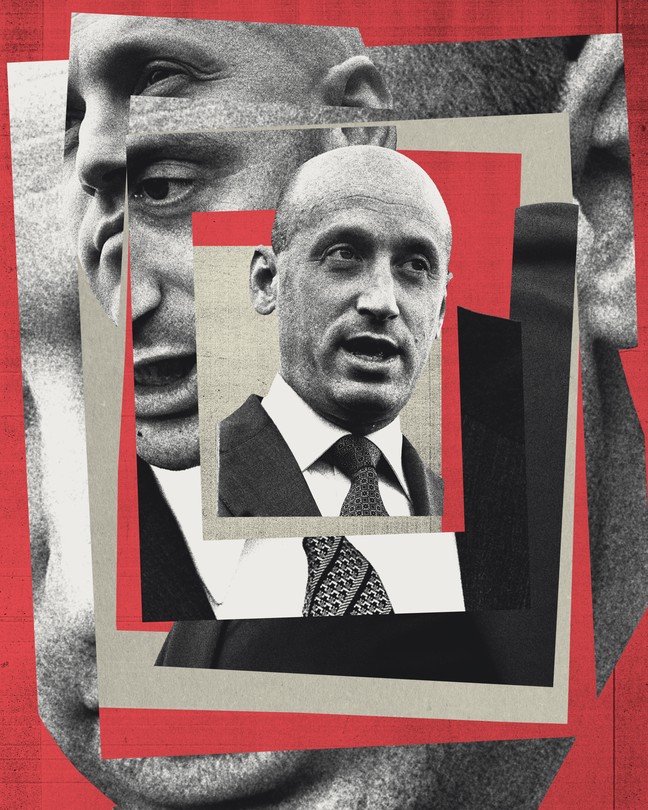
Illustration by Ben Kothe / The Atlantic. Sources: Demetrius Freeman / The Washington Post / Getty; Kayla Bartkowski / Getty; Samuel Corum / Sipa / Bloomberg / Getty.
January 7, 2026
Stephen Miller runs his daily 10 a.m. conference calls—yes, even on Saturdays—less like a government adviser and more like a wartime general. His is the dominant voice, as he plays the role of browbeater, inquisitor, and bully. He accepts no excuses, entertains no dissent.
Donald Trump’s deputy chief of staff for policy ruthlessly pursues the president’s vision, especially when it comes to pushing immigrants out of the country, and he runs a tight, efficient meeting. Consensus is not the goal.
Instead, Miller demands progress reports on his mass-deportation campaign and issues orders to the full alphabet soup of federal enforcement agencies, including the FBI, CBP, ICE, HHS, and the DOD. One senior official who has participated in the calls told us that the intensity and urgency often veer into hectoring. “He pushes everybody to the absolute limit because he knows that the clock is ticking,” this person said. “He gets on the phone and he yells at everybody. Nobody is spared from his wrath.”
In May, Miller told Immigration and Customs Enforcement officials that he wanted 3,000 immigration arrests a day, a nearly tenfold increase over the number they’d arrested on U.S. streets in 2024. He demands daily updates on the ICE hiring surge too; the administration had pledged to deploy 10,000 new deportation officers by this month—more than doubling the agency’s workforce. And Miller expects regular updates on detention capacity, deportation flights, and border crossings.
Miller publicly shames bureaucrats he feels are falling short or resisting orders. “If there’s a problem and you’re the owner, you have to fix it quickly,” another frequent conference-call participant told us. “It’s not a place where you can say, ‘I have to get back to you.’”
A third official told us that the calls are unlike any other government meetings they’ve attended. “If you say something stupid, he’ll tell you to your face. You are expected to perform at a certain level, and there’s no excuse for not meeting those expectations,” this person said.
In Trump’s inner circle—even with the president himself—Miller is known as a dogmatic force whose ideas are sometimes too extreme for public consumption. “I’d love to have him come up and explain his true feelings—maybe not his truest feelings,” the president joked at an Oval Office briefing in October. But in Trump’s second term, Miller finds himself at the height of his powers—the pulsing human id of a president who is already almost pure id.
Miller has tried to recast the nation’s partisan political disagreements as an existential conflict, a battle pitting “forces of wickedness and evil” against the nation’s noble, virtuous people—a mostly native-born crowd that traces its lineage and legacy “back to Athens, to Rome, to Philadelphia, to Monticello.” He accuses federal judges of “legal insurrection” for ruling against Trump’s policies, describes the Democratic Party as a “domestic extremist organization,” and dismisses the results of even legal immigration programs as “the Somalification of America.” And he has declared an end to the post–World War II order of “international niceties” in favor of a world that rebukes the weak, “that is governed by strength, that is governed by force, that is governed by power,” as he put it this week when discussing recent military action against Venezuela.
Along with Secretary of State Marco Rubio, Miller was the chief force behind Trump’s decision to capture the Venezuelan strongman Nicolás Maduro. “We are a superpower, and under President Trump, we are going to conduct ourselves as a superpower,” Miller told CNN’s Jake Tapper on Monday, articulating a worldview that started with the fear of immigration but has gradually expanded to a broader national-security and rule-of-law argument. (In this Darwinian vein, Miller also declared that the U.S. military could seize Greenland without a fight, echoing a social-media post that his wife, Katie Miller, had made two days earlier, showing an American flag superimposed on a map of the icy landmass alongside the word: SOON. NATO leaders have nervously affirmed Denmark’s claim to the territory.)
Miller’s official titles—he is also the director of the interagency Homeland Security Council—understate the full sweep of his purview. Steve Bannon, a former Trump adviser and a Miller ally, describes him as Trump’s “prime minister.” Miller has a role in nearly every area about which he cares deeply: immigration and border security, yes, but also national security, foreign policy, trade, military action, and policing. He may draft a flurry of executive orders one day, lead a meeting on lowering domestic beef prices the next, and travel to deliver a fiery speech of his own—think Trump at his angriest and most dystopian, without any of the president’s impish humor—the following week. (Miller declined to comment for this story.)
Early in Trump’s second term, he invoked the Alien Enemies Act of 1798 to treat migrants as part of a foreign invasion, directed Congress to pass $150 billion in new funding for homeland-security enforcement, and captained the administration’s assault on elite universities such as Harvard and Columbia. Late last year, he helped orchestrate Trump’s authorization of military strikes on suspected drug-smuggling boats in the Caribbean Sea and eastern Pacific Ocean, setting the stage for the military operation against Maduro.
The force behind Miller’s directives became clear during Signalgate—in which the Trump administration accidentally included The Atlantic’seditor in chief, Jeffrey Goldberg, on a private Signal chat about a bombing campaign in Yemen. It was Miller—not Trump’s national security adviser, Pentagon chief, or even vice president—who ended the debate and directed the group to move forward with the strikes. Trump has described Miller as sitting “at the top of the totem pole” inside the White House.
“He oversees every policy the administration touches,” White House Press Secretary Karoline Leavitt told us. “I can’t tell you the number of times a policy matter is discussed in the Oval and Trump will say, ‘Where’s Stephen? Tell him to get that done.’”
To critics, Miller is the smirking embodiment of everything they view as dangerous and authoritarian about the Trump administration. He has been called a Nazi, a neo-Nazi, a white supremacist, a kapo, and Lord Voldemort. Posters of Miller—pursed lips, furrowed brow—have been plastered around the nation’s capital, stamped with CREEP and FASCISM AIN’T PRETTY. His own uncle has denounced him, writing at one point that if Miller’s immigration policies had been implemented a century ago, their family—which fled anti-Jewish pogroms in Europe—“would have been wiped out.”
Yet if Miller has internalized any of the criticism, or acknowledged the parallels to his own lineage, he has not shown it, even among friends or colleagues. Miller is now acting as an accelerant for the president’s most incendiary impulses and shaping the lives of individual Americans in nearly every realm. He has demonstrated neither the interest nor the ability to moderate his views—even for tactical purposes. He is apt to overreach. And he has shown that he’s not afraid to use the power of the government to go after those who try to stand in his way—even his liberal neighbors, whom he has accused of threatening his family.
During Trump’s first term, Miller pushed the family-separation policy at the southern border, a measure long considered too extreme to implement. It triggered such a massive backlash that Trump’s wife and eldest daughter urged him to stop it. The separations became the defining immigration policy of Trump’s first term, undermining his ability to run on the issue in 2020. Now that he’s back in office, the latest polling shows eroding support for the president’s immigration crackdown, especially among the Latino voters who helped carry him to victory in 2024.
But Miller has continued to push not just for the deportation of people in the country illegally but also for narrowing or closing legal immigration pathways, especially for people from poor, not-majority-white, non-Christian nations. His actions have struck many Americans as racist and xenophobic. (In 2019, for instance, the Southern Poverty Law Center reported on leaked emails in which Miller urged the conservative Breitbart News to promote ideas from The Camp of the Saints, a 1973 French novel popular in white-nationalist and neo-Nazi circles.) Colleagues who have worked with him for years say they have never heard him utter a racist slur, even in private. His devotion is not to white supremacy per se, they insist, but to the political and intellectual thesis he has been pushing since before he arrived in Washington. He wants to halt and reverse America’s post-1960s immigration boom, and he pursues that goal with a fervor that has made him the public face of Trump’s restrictionist immigration policies.
During debate prep for the 2024 campaign, Miller found himself in a contentious back-and-forth over immigration with a more moderate Trump ally. Finally, a frustrated Trump interrupted the two men: Stephen,he said, if you had it your way, everyone would look exactly like you, someone familiar with the exchange told us.
“That’s correct,” Miller said, before turning back to continue sparring.
The nexus of Miller’s power is a vestige of President George W. Bush’s War on Terror. Weeks after the attacks of September 11, 2001, Bush established the Homeland Security Council to coordinate the government’s domestic response to the new threats from abroad. More than two and a half decades later, Miller has attached that rubric of national emergency to a new target, turning the council into a daily war room to track and fine-tune Trump’s campaign to deport 1 million people a year.
The September murder of the right-wing activist Charlie Kirk, who was close to many in the administration, including Miller, plunged Trump’s already single-minded martinet into a maximalist frenzy. A portrait of Ronald Reagan hangs prominently in the Oval Office—just over Trump’s left shoulder when he’s seated at the Resolute Desk—but Miller has made it abundantly clear that this is no longer Reagan’s Republican Party.
Former Senator Jeff Flake, the Arizona Republican who retired during Trump’s first term, told us that he has noticed a clear shift from one Trump administration to the next. “Before, it was more subtle, more nuanced, but now it’s pretty plain. He wants to see more immigration from the Nordic countries, and not so much from the Third World countries. It’s just a clear break from the huddled masses yearning to breathe free,” said Flake, who, as a senator, worked unsuccessfully to pass a bipartisan immigration overhaul. “It’s not the Reagan vision. It’s not the traditional Republican vision.”
Flake said that although the immigration system has serious problems, Trump and Miller’s goal seems to be “to change the nature of who we are as a country.”
Beyond immigration, Miller specializes in turning the president’s whims and rantings into government policy. As Trump griped about the homeless encampments near the State Department one day, Leavitt recalled that he turned to Miller and said: “Get it done.” “And within six hours,” she said, “I looked at Twitter, and there were cranes cleaning them up.”
“Stephen is the most effective political aide of this generation—and probably since James Baker,” the former Trump adviser Cliff Sims told us in a text. “No one is more deft at moving the levers of government to turn the President’s policies into action.”
May Mailman, who last year worked closely with Miller to punish elite universities that the administration claims are rife with anti-Semitism and “woke” ideology, explained to us how Miller approaches a problem. In March, for instance, upset with Columbia University for several reasons—including prominent pro-Palestinian protests on campus—Trump posted a message on social media that began, “All Federal Funding will STOP for any College, School, or University that allows illegal protests.” Miller told Mailman to come up with some options, but, with Trump’s buy-in, Miller was ultimately the one who approved pulling federal funding from the school.
Then he carefully watched for the reaction. “If taking money from Columbia was a bad idea and backfired in some way, then Stephen would be the one to demand a course correction,” said Mailman, who first worked with Miller during Trump’s first term. “But because that worked out pretty well, he then tries to figure out: How can we use that tool in other areas?”
Close observers of Miller say that his total command is a marked contrast to his role during the first Trump term, when, despite being a senior adviser, he was limited in his ability to direct others. David Lapan, a retired Marine Corps colonel and aide to former Homeland Security Secretary John Kelly, told us that he remembers attending a 2017 meeting at which Miller urged officials to send him examples of crimes committed by immigrants so he could publicize them. The difference then, Lapan said, is that Miller had an advisory role, and the other meeting attendees could disregard requests that they felt were too outlandish. “We came out of that meeting and said, Yeah, we’re not doing that,” Lapan recalled. “We knew that Kelly would cover for us.”
“Are there stories like that out there? Sure,” Lapan said. “But they’re the exception, not the rule. Cherry-picking a few bad cases to paint all immigrants in a negative light is not something that we were willing to do.”
Although Miller views himself as the president’s loyal servant, Trump’s stances appear to have shifted under Miller’s direction. The president used to speak favorably about certain immigrant groups he liked, such as DACA recipients and the employees at his golf resorts. But lately, his occasional pro-immigrant chatter has quieted. “‘America First’ is becoming ‘Americans Only,’” Lapan said.
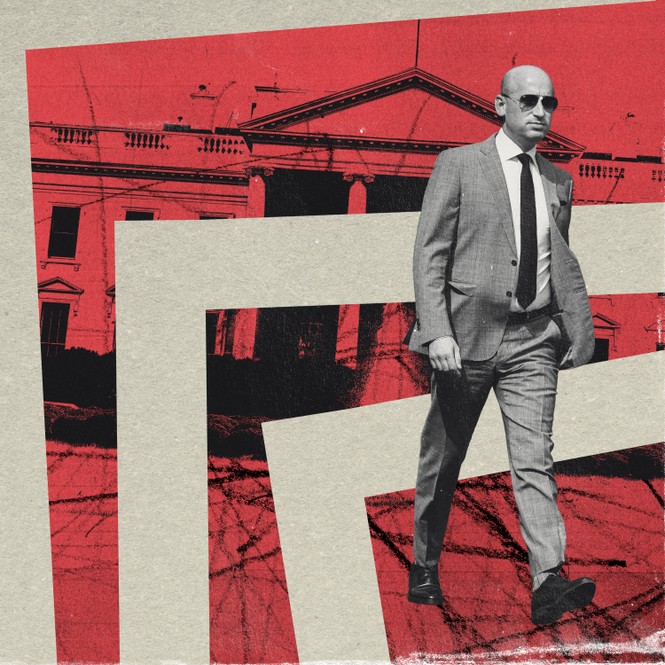
Illustration by Ben Kothe. Sources: Getty; Jim Watson / AFP / Getty.
Miller turned 40 in August and celebrated with a surprise party at the Ned, a chic members-only club blocks from the White House. The president did not show up, but just about everyone else did: White House Chief of Staff Susie Wiles, House Speaker Mike Johnson, conservative influencers, nearly every Cabinet secretary. Miller did not have a speech prepared but spoke self-deprecatingly, thanking Wiles for putting up with his ideas and suggestions. The turnout was a show of not just Miller’s immense power but also his popularity in an administration that has been rife with infighting and backstabbing, especially during Trump’s first term.
The gleeful brawler Miller plays on TV is no act, his colleagues told us, and he behaves similarly in private (although often with a dash of deadpan humor). Several people told us that they appreciate how dogmatic he is, for a possibly surprising reason: They always know where he stands on the issues, and where they stand with him. As Trump’s speechwriter during the first administration, he built goodwill with colleagues by warning them when the president was about to say something contrary to their plans, so they had time to try to convince him otherwise.
“The lazy and clearly false hit on him is to call him these disgusting names,” White House Communications Director Steven Cheung told us, about the accusations that Miller is a Nazi or a fascist. “If you dig deeper and aren’t suffering from Trump Derangement Syndrome, he’s not what the media portrays him as. He’s actually a very nice and cordial person who cares about this country and wants to do a good job. He’s very easy to work with. I’ve been in Trump world a long time, and he’s probably the easiest to work with.”
Several people described Miller as an exacting boss, even a micromanager, but one who looks out for his team—including younger aides. In Trump’s first term, he was not yet married, and he spent many of his nights out, grabbing drinks or dinner with everyone from Cabinet secretaries to more junior staff, who were eager to get time with him. When Trump’s first term wound down, Miller helped ensure that everyone on his staff (and even some not on his team) had a job lined up.
Friends and colleagues say he has rarely seemed hurt by the criticism and caricatures. But he can be vain about his appearance; in Trump’s first term, he once showed up to Face the Nation with what was roundly mocked as spray-on hair. (In Trump’s second term, the hair is gone.) And after a recent Vanity Fair photo shoot of senior West Wing staff, the photographer—whose close-up, often unflattering photos went viral—recounted to The Washington Postthat Miller “was perhaps the most concerned about the portrait session,” asking whether or not he should smile. Colleagues also describe a proud sartorialist who regularly debated fashion and traded menswear tips with another West Wing fashionista, Hogan Gidley, a deputy press secretary during Trump’s first term.
“We would talk about the difference in fabrics for seasons, and lapel size and width of ties and these types of things,” Gidley told us, before describing Miller’s style as “sophisticated and smart and chic but also daring at times.”
In a recently resurfaced 2003 video, a 17-year-old Miller—prominent sideburns and tightly coiled brown hair—sits in the back of a moving school bus, opining on the war in Iraq. In the video, Miller smirkily suggests that the “ideal solution” for “Saddam Hussein and his henchmen” would be “to cut off their fingers”; he argues that torture is the proper punishment in a nonbarbaric society. (In a barbaric society, he implies, death would be the appropriate punishment.) “Torture is a celebration of life and human dignity,” he continues, briefly unable to hide his delight as his latest outlandish proclamation illicits titters from his peers—his mouth widens into a toothy grin, and he emits an audible chuckle before taking a breath and continuing.
This is Miller the troll, who has confided in friends that he enjoys starting a fire, then dousing it with gasoline. But after more than two decades relishing his role as the gleeful contrarian, the persona has now become more true character than occasional outlandish caricature. “He has a flair for the dramatic, and you can tell that now with the way he comports himself on TV,” Bannon told us. “He plays the character well, knowing he always wants to have the libs’—the progressives’—heads blow up.”
After graduating from Duke in 2007—where he vigorously defended white lacrosse players who were falsely accused of rape by a Black stripper—Miller landed a job with newly elected Republican Representative Michele Bachmann of Minnesota. As young Capitol Hill aides, he and Sergio Gor—who recently became Trump’s ambassador to India—helped launch the supernova ambitions of Bachmann, a right-wing darling whose then-fringe ideology presaged the rise of MAGA. By the time Bachmann’s 2012 presidential bid flamed out, Miller was already firmly ensconced with then-Senator Jeff Sessions of Alabama, who shared his hard-line obsession with immigration, and Bannon, who provided a broader nationalist, populist scaffolding.
As Sessions’s aide-de-camp, Miller helped his boss sabotage the bipartisan “Gang of Eight” immigration bill, which passed the Senate by a wide margin in 2013. At the time, a post-2012 Republican autopsy was calling for a gentler, more inclusive GOP, and the proposed immigration overhaul had the support of business and tech leaders, interest groups, and wealthy donors. But Miller was undaunted, buttonholing reporters in the hallways of Congress to press his anti-immigrant case, and calling them later at home to talk—for hours, if they’d let him—about the bill’s minutiae and why it would harm American workers. The bill died in the House, where it never came up for a vote.
Miller pushed colleagues to keep the same round-the-clock hours as he did, including calling meetings on Friday afternoons, when most Hill staffers were eager to skip out early to happy hours. Instead, Republican staffers sullenly reported to messaging meetings to talk about immigration.
Working with Bannon, Miller made Breitbart News the communications arm of his effort. And, understanding that data and statistics, however dubious, could lend their cause the sheen of legitimacy, they elevated obscure anti-immigration groups—the Center for Immigration Studies, NumbersUSA—into prominent sources. “The more outrageous the headline, the better,” Bannon said.
By the time Miller joined Trump’s 2016 campaign—officially launched with claims that Mexico was sending “rapists” and criminals across the border—his immigration bona fides were well established, and he learned to channel Trump’s voice into policy prescriptions. The baby-faced Miller quickly moved from the back of Trump’s plane to the inner circle at the front.
By March 2016, Miller was Trump’s opening act, riling up crowds across the country with an anti-immigrant, anti-Washington populism that sometimes threatened to overshadow Trump himself. “I said, ‘Listen, the point of an introduction is that Trump doesn’t have to top it,’” Bannon said. “He was so insane over-the-top. But of course the MAGA base can’t get enough of him.”
In Trump’s first White House, Miller made quick use of the various levers available to him, no matter how buried in the bureaucratic bowels. He took a particular interest in the office of the staff secretary, a little-known but powerful team that vets any memo or speech or policy before it reaches the president. Not a lawyer himself, he nevertheless leaned on creative and expansive interpretations of statutes to push the president’s agenda. In the early days of COVID, for instance, he successfully urged the administration to invoke a 1944 emergency public-health law to shut down the border and rapidly expel migrants to Mexico or their home country. In a White House staffed partly by amateurs, he also benefited from his deep understanding of policy issues, which he’d been honing since high school. He coached Trump and others into even more extreme immigration positions, explaining why, for instance, he believed that giving merit-based green cards to promising foreign students was problematic.
Even his allies find Miller to be something of an “acquired taste,” as one put it. Another quipped that he has the bedside manner of Heinrich Himmler, one of Adolf Hitler’s earliest followers and a key architect of the Holocaust. But Mailman said that Miller could be strategic when making a policy pitch. On immigration, he instinctively understood if someone was a “type person” (who cared about the type of immigrant coming to the country) or a “numbers person” (who cared simply about the sheer number of immigrants) and often tailored his message accordingly. “He thinks about the rationale of how someone is approaching something,” she said.
Because Miller’s views—especially on immigration—were so well known, he earned Trump’s trust despite also, at times, vigorously disagreeing with him. “Miller is 100 percent firm in every conviction and feeling he has, and he just says it the way he believes it, and if it aligns with what the president wants to do, then great,” a first-term Trump aide told us. “And if it’s nuanced or different, then Miller stakes out his position—he doesn’t care if it’s different from what other people think or what the president wants—but then once the president makes his position clear, Miller executes on it, whether or not he agrees with it.”
Despite his years as Sessions’s protégé, Miller quickly distanced himself from his longtime mentor, several people told us, when Sessions, then Trump’s first attorney general, recused himself from the investigation into Russian interference in the 2016 election, angering the president. In fact, the rupture was more acute than was publicly known; Miller was enraged by what he viewed as Sessions’s unforgivable betrayal of Trump.
During the first term, Miller aligned himself with Ivanka Trump and her husband, Jared Kushner, once it became clear that they held tremendous sway with the president. The pairing was unusual, given that the president’s daughter and son-in-law were seen as misguided “globalists” by much of the far-right base. One person familiar with the dynamic described Miller spending hours with Ivanka Trump on her key initiatives—paid family leave and tax credits for parents. The charitable explanation, this person continued, is that Miller was being generous with his time and expertise; the more cynical one is that Miller understood that Ivanka Trump was less likely to complain to her father about Miller’s hard-line immigration policies if the two had a good relationship.
“He always understood where power lies,” Bannon said. “No matter what—he can be coaching a Little League team—Miller can very quickly analyze.”
Miller’s fealty to his boss was on display right up until the end of Trump’s first term. On January 6, 2021, Miller’s wife—who had worked as Vice President Mike Pence’s communications director—was on maternity leave but still employed by Pence. But when Trump called Miller that morning to discuss adding lines to his speech attacking Pence, Miller—ever the good soldier—did as he was told.
Later that day, angry Trump supporters marched to the Capitol, calling for the vice president to be hanged for treason.
The enemy arrived at the Millers’ doorstep on a warm September morning in the form of a retired gender and peace-studies professor in a loose striped dress. Barbara Wien, who had been protesting the family’s presence in Arlington, Virginia, pointed her index and middle fingers at her own eyes, then directed those fingers at Katie Miller, who was on the front porch.
Stephen Miller took the gesture at his wife, which was captured on video, as a call to violence—an offense that he uniquely had the power to punish.
The Millers had already felt under siege, facing threats and fearing that the entire family was being surveilled by sophisticated actors. A Rhode Island man had been indicted in August for publicly threatening to kill Miller and other officials. A law-enforcement official told us that Katie Miller had been surreptitiously photographed in her neighborhood—while going to the gym, and at least once while walking with her kids—and said that there was a “coordinated” and “malicious” effort to, at the very least, intimidate them. Someone had also posted flyers at neighborhood parks where their kids played, revealing their home address and calling him a Nazi. The Millers had stopped allowing their children to play in front of the house or in the backyard.
But they were not going to be intimidated by a 66-year-old activist.
“You want us to live in fear? We will not live in fear,” Miller said days later, in an appearance on Sean Hannity’s Fox News program. He had gone on the program to discuss the federal response to Kirk’s recent assassination, but although he was focused on “domestic terrorists,” he included doxxing on the list of related offenses. For those familiar with the Millers’ personal lives, it sounded less like he was talking about Kirk’s assassin than about Wien, who’d distributed flyers with his address.
“You will live in exile,” he continued, “because the power of law enforcement under President Trump’s leadership will be used to find you, will be used to take away your money, take away your power, and, if you have broken the law, to take away your freedom.”
Miller set about drafting a series of executive orders, later signed by Trump, that directed federal law enforcement to refocus counterterrorism efforts on people with “anti-fascist” ideas, such as “extremism on migration, race, and gender” and “hostility towards those who hold traditional American views on family, religion, and morality.”
This fall, Miller also began describing a central divide in the country, pitting “legitimate state power” against what he termed left-wing “street violence.” His definition of the latter was broad. He accused Democratic politicians who called him or Trump “authoritarian” of “inciting violence.” (Never mind that he had repeatedly called the Biden administration “fascist.”) He placed doxxing—what his family faced—on the continuum that leads to violence. (Also never mind that Vice President J. D. Vance encouraged calling out those who celebrated Kirk’s murder, including at their place of employment.)
As Miller announced federal policies aimed at combatting the threat, he was also fighting a private battle against the very enemy he described. In the weeks after Wien made her gesture in front of his wife, the Millers decided that they were no longer safe in their six-bedroom, roughly $3 million Northern Virginia home. They sought out military housing at a nearby base, arguing to friends and allies inside the administration that their safety depended on it.
But the legitimate powers of the state repeatedly declined to fully cooperate with the Millers’ attempt to turn their own situation into a catalyst for the sort of crackdown they claimed was necessary. The FBI was initially hesitant to take a major role in the investigation of Wien, prompting the Millers to demand its involvement, according to a person briefed on their efforts. A Democratic Virginia state prosecutor became concerned about the federal involvement in a search warrant on Wien, and sought to narrow its scope. A federal magistrate judge refused to approve federal search warrants, according to a report by Axios.
Katie Miller, who hosts her own podcast, recently appeared on Piers Morgan’s YouTube show and accused a progressive guest, Cenk Uyger, of attacking her Jewish children by merely having a difference of opinion with her. She then offered a veiled threat to have Uyger’s citizenship revoked. (Uyger is a naturalized citizen; in a text message, he described Katie Miller’s threat as “not an attack on me as much as it’s an attack on America.”) When the investigation against Wien appeared to stall, Miller’s longtime ally Jim Jordan, the House Judiciary Committee chair, announced that he had opened an inquiry into the Democratic prosecutor in Virginia who had sought to narrow the search warrant and raised concerns about federal involvement.
“This is so cool,” Katie Miller said on social media. “Thank you.”
Days later, the prosecutor said that she would not cooperate with Jordan’s inquiry, because the investigation was ongoing and Congress lacked the ability to intervene in a state law-enforcement matter. There were still some powers of the state that Miller did not control.
Ten Bears made a post that points out something I think we all should be aware of. I know a lot of the people who come here also go to his site also. But incase anyone missed it this short video is a powerful reminder of what we are fighting in the second tRump dictatorship. Hugs
A white Christian Karen uses her own mistake and inability to understand to pull a Riley Gaines to make a life out of fake outrage at something she did not understand. Hugs
Henry Stout runs the neo-Nazi Aryan Freedom Network with his partner. REUTERS/Jim Urquhart
HOCHATOWN, Oklahoma – Wearing cargo shorts, flip-flops and a baseball cap shading his eyes from the sun, Dalton Henry Stout blends in easily in rural America.
Except for the insignia on his hat. It bears the skull and crossbones of the infamous “Death’s Head” SS units that oversaw Nazi Germany’s concentration camps – and the initials “AFN,” short for Aryan Freedom Network, the neo-Nazi group Stout leads with his partner.
From a modest ranch house in Texas, the couple oversee a network they say has been turbocharged by President Donald Trump’s return to the White House. They point to Trump’s rhetoric – his attacks on diversity initiatives, his hardline stance on immigration and his invocation of “Western values” – as driving a surge in interest and recruitment.
Trump “awakened a lot of people to the issues we’ve been raising for years,” Stout told Reuters. “He’s the best thing that’s happened to us.”
While the Aryan Freedom Network and other neo-Nazi groups remain on the outermost edges of American politics, broadly regarded as toxic by conservatives and mainstream America, they are increasingly at the center of far-right public demonstrations and acts of violence, according to interviews with a dozen members of extremist groups, nine experts on political extremism and a review of data on far-right violence.
Several trends have converged since Trump’s re-election, Reuters found. Trump’s rhetoric has galvanized a new wave of far-right activists, fueling growth in white supremacist ranks. Trump’s pardons of January 6 rioters and a shift in federal law enforcement’s focus toward immigration have also led many on the far right to believe that federal investigations into white nationalists are no longer a priority.
[Trump] awakened a lot of people to the issues we’ve been raising for years. He’s the best thing that’s happened to us.
Henry Stout, a leader of the white nationalist group Aryan Freedom Network
And the boundaries of the far right itself are shifting. Ideas once confined to fringe groups like the Proud Boys – who helped lead the January 6 siege – are now more visible in Republican politics, from election denialism to rhetoric portraying immigrants as “invaders.” Trump’s public support and pardons for far-right figures helped normalize those views, the researchers said. As the Make America Great Again movement has come to define the party’s identity, the line separating the far right from mainstream conservatism has grown increasingly difficult to draw, they added.
What was once extreme now blends more easily into the broader far-right, not because those extreme groups have changed, but because the terrain around them has, said Heidi Beirich, co-founder of the Global Project Against Hate and Extremism, a nonprofit that tracks hate speech and extremism. “A Proud Boy doesn’t even seem that scary anymore because of the normalization process,” she said.
That shift has coincided with a surge in white nationalist activity. White extremists are committing a growing proportion of U.S. political violence, according to the Armed Conflict Location & Event Data project, a nonprofit research outfit that tracks global conflicts. In 2020, such groups were linked to 13% of all U.S. extremist-related demonstrations and acts of political violence, or 57 of the events ACLED tracked. By 2024, they accounted for nearly 80%, or 154 events.
Ideas once confined to fringe groups like the Proud Boys are now more visible in mainstream Republican politics. REUTERS/Jim Urquhart
Trump has denied that he supports white extremism, and the White House rejects the notion that his rhetoric promotes racism.
“President Trump is a president for all Americans and hate has no place in our country,” White House spokesperson Harrison Fields said in response to questions for this story. “President Trump is focused on uniting our country, improving our economy, securing our borders, and establishing peace across the globe.” Fields also pointed to a significant rise in support for Trump among Black voters. In last year’s election, his share of the Black vote nearly doubled from 2020 to about 15%.
Trump has batted away accusations of racism. At a campaign rally last year, he declared, “I’m not a Nazi. I’m the opposite of a Nazi.” A few months earlier, he told an interviewer that he can’t be racist because he has “so many Black friends.”
Even as he has made inroads with non-white voters, Trump has consistently drawn support from white nationalist and extremist groups while using racially divisive rhetoric. He promoted the false claim that Barack Obama, the nation’s first Black president, was not born in the U.S. In his 2024 campaign, he suggested immigrants commit violent crimes because “it’s in their genes,” a remark condemned by many as racist.
Stout said his group opposes violence. Yet the Aryan Freedom Network openly advocates preparing for a “Racial Holy War.” It promotes white superiority ideology, seeks to unify elements of the broader white nationalist movement and actively recruits former members of other extremist groups.
The Trump administration has scaled back efforts to counter domestic extremism, redirecting resources toward immigration enforcement and citing the southern border as the top security threat. The Federal Bureau of Investigation has reduced staffing in its Domestic Terrorism Operations Section. The Department of Homeland Security has cut personnel in its violence prevention office.
Some specialists in domestic terrorism say these moves could embolden extremists by weakening U.S. capacity to detect and disrupt threats. The DHS and FBI have defended the cuts, saying they remain committed to fighting domestic terrorism. The FBI said in a statement it allocates resources based on threat analysis and “the investigative needs of the Bureau,” and that it remains committed to investigating domestic terrorism.
“RACIST ROYALTY”
In his first interview with any news organization, Stout met Reuters journalists in April at a restaurant in Hochatown, Oklahoma, a quiet town known for its hiking and fishing about an hour’s drive north of their Texas home. He was joined by his partner, who goes by the name Daisy Barr.
Stout says AFN is focused on staying within the law. “We got to watch our Ps and Qs,” he said. Then his tone turned apocalyptic: “And when the day comes, that will be the day – that’s when violence will solve everything.” While he offered no timeline, researchers who study domestic extremism say the comment reflects a strategy among some far-right groups: operate within the law while openly predicting a moment of upheaval.
The Aryan Freedom Network first drew national attention in 2021 after organizing a “White Unity” conference in Longview, Texas. By the following year, it was distributing flyers in cities across the country. One in Texas featured racist caricatures of Black Americans – one swinging from a street lamp amid rubble and an overturned car – alongside the caption: “At the current rate of decline what will America’s major cities look like in ten years?”
An AFN flyer found in West Bend, Wisconsin, in a plastic bag. Photo via West Bend Police Department. Image was redacted by Reuters to remove group’s website address.
Another AFN flyer, targeting immigrants. The plastic bags were weighted with wood pellets to make them easier for canvassers to toss into people’s yards. Photo via West Bend Police Department.
AFN also began staging protests, often targeting drag events and LGBTQ+ gatherings. Stout says the demonstrations were designed to attract recruits. Its conferences and annual “Aryan Fests” have become networking hubs for the far right, drawing attendees from groups such as the Ku Klux Klan and other white nationalist organizations, according to two individuals affiliated with those movements. Reuters was unable to independently verify the claim.
The pseudoscientific notion of a superior white Aryan race – essentially Germanic – was a core tenet of Hitler’s Nazi regime. AFN gatherings brim with Nazi memes: Swastikas are ritually set ablaze and chants of “white power” echo through the woods. AFN’s website pays specific tribute to violent white supremacist groups of the past, including The Order, whose members killed a Jewish radio host in 1984. Two key members responsible for the killing were sentenced to lengthy prison terms and are now deceased.
Stout’s beliefs are rooted in the Christian Identity movement, which claims that white Europeans, not Jews, are the true Israelites of biblical scripture and therefore God’s chosen people. Stout and Barr also claim that Black Americans, under Jewish influence, are leading a Communist revolution – an ideology that fuses racial supremacy with far-right conspiracy theories.
Stout, 34, and Barr, 48, were born into self-avowed white supremacist families with deep ties to the Ku Klux Klan, infamous for its white robes, burning crosses and long history of racist violence, including decades of lynchings and terrorist campaigns against Black Americans.
As a child, Stout said he attended Klan ceremonies and white nationalist youth camps. He recalls reading translations of SS training manuals from Nazi-era Germany. And while other girls were playing video games, Barr said she was wrapping torches in burlap strips, for secret KKK cross-burning ceremonies.
Though they now identify as American Nazis, their ideology is anchored in the KKK and other white extremist groups. Their families are well known to historians of the movement. Stout’s father, George Stout, was a “grand dragon” in the White Knights of Texas, a KKK offshoot. He declined to comment for this story.
Barr’s late father was a KKK “grand wizard” from Indiana who was sentenced to seven years in prison for holding two journalists at gunpoint. AFN requires members to use aliases; she chose “Daisy Barr” after the name of a female Klan leader of the 1920s who sold Klan robes and died in a car crash.
AFN leaders have links to the Ku Klux Klan. Here, a KKK member attends a gathering marking the 160th anniversary of the of the Klan’s founding, outside Maysville, Kentucky, in May. REUTERS/Jim Urquhart
One person familiar with the couple described their 2020 marriage as a union of “racist royalty.”
They filed for divorce two years later, but Stout said the split was in name only – a legal move to shield their assets in case they faced civil rights lawsuits like those that once bankrupted the Klan and Aryan Nations, a neo-Nazi group held liable in a 1999 civil suit for inciting violence.
Stout and Barr declined to share membership numbers but said AFN now has nearly twice as many chapters as the 23 it claimed in early 2023.
The Terrorism Research and Analysis Consortium, a private research group that monitors extremist movements, estimates AFN’s members have grown to between 1,000 and 1,500. “We collect and record every event of theirs,” said TRAC researcher Muskan Sangwan. Some of the earliest chapters, including those in Texas, likely began with around 100 members each, Sangwan said, suggesting the group may have had roughly 200 members in its initial stages.
Chris Magyarics, a senior researcher at the Anti-Defamation League, a Jewish advocacy organization that monitors antisemitic harassment, said he was skeptical AFN was so big but said he had no independent data on its size. “The previous largest neo-Nazi group only had a couple of hundred,” he said, referring to the National Socialist Movement, which has been in steady decline.
Reuters was unable to independently establish the extent of AFN’s membership.
Despite the uncertainty over its numbers, AFN is on the radar screens of independent researchers. Jon Lewis, a research fellow specializing in domestic extremism at George Washington University’s Program on Extremism, said the group has been “really popular” among far-right “accelerationists,” a term used by white supremacists who advocate violence to hasten a race war.
Stout said his group has benefited from the decline of the Proud Boys following the Capitol attack. Once prominent for street clashes during the Trump administration, the Proud Boys have faced legal setbacks and public scrutiny since many of its members were convicted – and later pardoned by Trump – for their roles in the January 6 Capitol riots. The group describes its ideology as “Western chauvinism.” Critics say the group uses the term “Western” rather than “white” to veil its racism, a charge the Proud Boys’ defenders deny.
Stout described groups like the Proud Boys as “civic nationalists” – movements that draw in followers with patriotic rhetoric, then serve as stepping stones toward more overtly racist organizations like AFN or the Klan.
“A lot of newbies, new people to the movement, join that type of movement before they join us,” Stout said.
Reuters was unable to reach a Proud Boy representative for comment.
Members of the Ku Klux Klan take part in a cross-burning to mark the group’s 160th anniversary, outside Maysville, Kentucky, in May. REUTERS/Jim Urquhart
WEAPONS AND RACE WAR
Although Stout said the Aryan Freedom Network rejects violence, firearms and tactical training remain central to its identity and feature prominently in its gatherings and recruitment efforts, according to a review of federal court records.
One former member, Andrew Munsinger, built and traded semi-automatic AR-15 rifles and other weapons, using a machine shop to fabricate untraceable parts, according to an FBI affidavit filed in federal court. He boasted to other AFN members of stockpiling ammunition and constructing explosive devices, and claimed to have pointed a shotgun at a sleeping prosecutor, the affidavit said.
Munsinger, who went by the alias “Thor,” was arrested last year in Minneapolis on federal charges of illegally possessing firearms. As a convicted felon, he was barred under federal law from owning weapons. He attended at least five AFN events in one year, the FBI said. Agents described him as an adherent of accelerationism, which seeks to provoke a race war through violence.
An excerpt from the federal arrest affidavit for Andrew Munsinger.
AFN is “an umbrella organization for other white-supremacist organizations,” the affidavit said. Documents relating to Munsinger’s case, including testimony from an FBI informant who infiltrated the group, offer a glimpse inside its operations: firearms training across several states, encrypted communications focused on weapons, a recruitment event at a lakeside bar in Ohio, and new members building timber swastikas in a ritualistic initiation.
Stout said he disavowed Munsinger, who was convicted by a federal jury in April of illegally possessing firearms and ammunition, as well as trafficking marijuana. He is awaiting sentencing. Munsinger and his attorney did not respond to requests for comment.
Stout said his network has links to the Klan, which has splintered and shrunk dramatically since its peak a century ago.
In May, Reuters attended a modern-day Klan ceremony held in a clearing deep within the woods on private land in northeastern Kentucky. William Bader, leader of the Trinity Knights, a small Klan faction, donned a purple silk robe and conical hood as he presided over the swearing in of about half a dozen heavily tattooed new members.
Item 1 of 5 New initiates are blindfolded and walked along a trail as part of an induction ceremony during a gathering and cross-burning marking the Klan’s anniversary outside Maysville, Kentucky, in May. REUTERS/Jim Urquhart
[1/5]New initiates are blindfolded and walked along a trail as part of an induction ceremony during a gathering and cross-burning marking the Klan’s anniversary outside Maysville, Kentucky, in May. REUTERS/Jim Urquhart
In an interview, Bader said Trump has energized the white nationalist movement. “White people,” he said, “are finally seeing something going their way for once.” Bader said he had previously attended an AFN event without elaborating.
Steve Bowers, another Klan official at the ceremony, which didn’t involve AFN, said he isn’t a fan of Trump because of his administration’s close ties with Israel. But he said many white nationalists are fully behind the president. “People think he’s going to save the white race in America,” said Bowers, dressed in a white KKK robe and hood, decorated with two blood crosses on the chest.
The Klan once claimed as many as six million members in the 1920s. It had dwindled to an estimated 2,000 to 3,000 members across 72 chapters by 2015, according to the Southern Poverty Law Center, a nonprofit that tracks extremist groups. More recent figures are unavailable, a research analyst at the center said.
AFN has adopted certain tactics and rituals of the Klan, including widespread distribution of racist flyers.
AFN’s flyers have appeared in multiple cities and towns, from Florida to Washington state, according to police reports. Stout and Barr said they view them as a recruitment tool. Police in West Bend, Wisconsin, said hundreds of flyers targeting immigrants were distributed in May. One flyer found in the Wisconsin village of Mukwonago read, “Tired of being discriminated against because you’re white? Join.”
Stout said members are instructed to distribute flyers at night – what he calls “night rides,” echoing the Klan’s term for its historic terrorism campaigns against Black people.
In another echo of the Klan, its signature cross burnings, swastikas are set alight at AFN gatherings. In an AFN video posted online, Stout stands on the bed of a pickup truck, masked and flanked by armed guards, arm raised in a Nazi salute.
Still image from AFN video shows Stout on the bed of a pickup truck, arm raised in a Nazi salute. AFN website.
Still image from AFN video found on their website
“White power!” he shouts in a hoarse Texas drawl, wearing a chest rig for rifle magazines. His audience returns the Nazi salute. “White Power!” they call out.
At the restaurant in Oklahoma, asked why he believes his group is gaining momentum, Stout offered a simple explanation.
Education advocates are afraid that the administration’s getting hold of admissions racial data could make colleges a more hostile place for students of color.
“The student data could be used to challenge the admission of Black students in particular under assumptions that they are presumptively unqualified because of their race,” Janel George, a law professor at Georgetown University, told HuffPost.
“Woke is officially DEAD at Brown. Thank you for your attention to this matter!” Donald Trump declared in a Truth Social post last week.
He was celebrating the fact that the prestigious Providence, Rhode Island, university had just agreed to a settlement with him. In order to restore its federal funding, the school agreed to implement anti-transgender policies and hand over its race and admissions data.
It was similar to a deal the federal government had struck with Columbia University in New York after Trump relentlessly attacked the school in the wake of on-campus pro-Palestinian protests.
And then on Thursday, Trump went further: He signed an executive order demanding that every college in the country hand over its admissions data, citing a 2023 Supreme Court decision prohibiting the use of race as a factor in college admissions. “Greater transparency is essential to exposing unlawful practices and ultimately ridding society of shameful, dangerous racial hierarchies,” the order reads.
Already, there is growing fear from legal experts and higher education advocates that he could weaponize this data in order to get higher education institutions to fall in line with his administration’s goals.
“They can misuse the data, they can interpret it in any way they want,” said Mariam Rashid, the associate director for the Center for American Progress’ racial equity and justice program. “And they can misuse it in order to misinform the public, too.”
For example, the Trump administration could use the racial data to claim a university is discriminating against a certain race, or infer that not enough Trump supporters are being admitted because the freshman class doesn’t have a high enough percentage of students from red states.
Trump’s latest strike on American institutions connects his war on diversity and his administration’s assault on colleges across the country in a way that could turbocharge both. It’s not just that Trump will have an extraordinary amount of information about colleges; it’s how he’s likely to use it to further his false narrative about both race and higher education. And it’s students who will bear the brunt of the consequences.
“Given the administration’s flawed interpretation of our civil rights law, they might use this data to accuse schools of discrimination and threaten universities,” Donya Khadem, an attorney at the NAACP Legal Defense Fund, told HuffPost.
“It’s unprecedented scrutiny by the federal government.”
– Donya Khadem, attorney at the NAACP Legal Defense Fund
Some schools refused to play the game. In April, Harvard University wrote a letter to Trump saying that his demands flew in the face of free speech laws and would stifle the kind of learning and research that happens at a place of higher education. But other schools, like Columbia and Brown, bent the knee and gave Trump what he wanted.
“It’s very concerning because it’s unprecedented scrutiny by the federal government,” Khadem said.
This time, the administration is taking aim at an aspect of educational life that has long been a bugbear for conservatives. There is a widespread belief among conservatives that colleges and universities have given advantages to students of color at the expense of white students.
By allowing race to be a factor in admissions, the claim goes, schools are taking spots away from certain groups of students and instead admitting students they claim are less qualified, based solely on their race. (In reality, race has been one of many factors admissions officers consider when choosing between fully qualified applicants.)
“This is all motivated by a racist myth that Black people don’t deserve to be in these elite spaces,” Khadem said.
And now that Trump is back in office, getting his hands on this data is likely just the beginning of his attempt to turn back the clock on admitting students of color.
Asked for comment about how it intends to use the admissions data, the Department of Education directed HuffPost to a press release about the new executive order Trump signed on Thursday.
“We will not allow institutions to blight the dreams of students by presuming that their skin color matters more than their hard work and accomplishments,” Education Secretary Linda McMahon said.
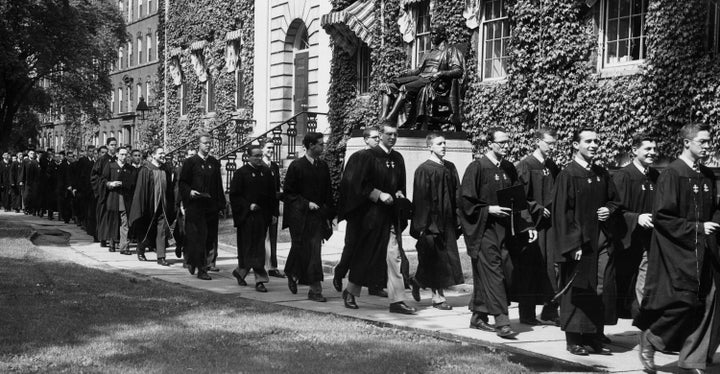
Students pass the statue of John Harvard in Harvard Yard on their way to baccalaureate services ahead of commencement at Harvard University on June 17, 1951.
Photo by Sam Hammat/The Boston Globe via Getty Images
Conservatives celebrated when the U.S. Supreme Court struck down race-conscious college admissions processes in Students For Fair Admissions v. Harvard in 2023, saying that schools can not use race as a factor in college admissions.
Harvard, together with fellow defendant the University of North Carolina at Chapel Hill, had argued that schools needed to be able to consider race as one factor among many to ensure the educational benefits of a diverse student body. The high court disagreed, saying the schools did not have a “compelling interest” in considering race as a factor and thus violated the 14th Amendment.
But education law experts say that the federal government is using that ruling and expanding it far beyond its original intent.
In the same ruling, the court expressly said that “nothing prohibits universities from considering an applicant’s discussion of how race affected the applicant’s life, so long as that discussion is concretely tied to a quality of character or unique ability that the particular applicant can contribute to the university.”
Now, Trump’s order undermines that.
“They’re using the Students For Fair Admissions [decision] in ways that are not what the justices meant when they wrote it,” Khadem said.
Education advocates are afraid that the administration’s getting hold of admissions racial data could make colleges a more hostile place for students of color.
“The student data could be used to challenge the admission of Black students in particular under assumptions that they are presumptively unqualified because of their race,” Janel George, a law professor at Georgetown University, told HuffPost.
“This is all motivated by a racist myth that Black people don’t deserve to be in these elite spaces.”
– Khadem
It could also turn off otherwise qualified students from attending some of these colleges. “I think it’s a big deterrent,” Khadem said. “Columbia’s campus has become and will continue to become less welcoming to Black students.”
Columbia and Brown did not immediately respond to HuffPost’s request for comment.
Systemic racism and inequality are already significant barriers to college attendance. Research shows that Black students and other people of color are more likely to be from low-income families and struggle to afford college. Then there’s the fact that standardized tests frequently used in college admissions are biased toward white students and those from wealthier families.
Studies have shown that race-neutral admissions processes lead to a drop in diversity. In 1996, after California voters approved a measure that would ban affirmative action at the state’s public universities, the state’s most prestigious schools saw a drastic drop in diversity. Indeed, one of the arguments made by Harvard during its legal fight was that no race-neutral admissions process offers the same diversity benefits.
The first college classes to be enrolled after the Students for Fair Admissions ruling varied in their diversity. Some schools, like the Massachusetts Institute of Technology, Tufts University and the University of North Carolina at Chapel Hill, saw a decrease in Black and Hispanic enrollment, while other schools’ racial compositions stayed roughly the same.
Not only could these changes further hinder access to higher education for nonwhite students, but there’s a question of how making this data public could harm students. If the Trump administration publicly calls out a school for having a certain number of nonwhite students, that could become a problem for people on campus.
“I do think it’s harmful,” Rashid said. “[The data] is not going to be attached to a name, but they can make up whatever narrative they want.”
Experts warn that it could create a hostile environment on campuses, where nonwhite students feel as if their peers believe that they’re unqualified to be there. “At schools with higher admissions of Black students or faculty, some people are going to feel a certain way about how they’re perceived at school,” Khadem said.
There is a direct line from Trump’s attacks on colleges to his administration’s larger anti-diversity campaign.
In an attempt to begin removing people of color from public life, Trump signed an executive order in January that sought to end diversity, equity and inclusion programs at different institutions, including nonprofit organizations receiving federal grants, law enforcement agencies and institutions of higher education. The penalty for not ending DEI, though vague, was the loss of crucial federal funding.
The Department of Education followed up with guidance for educational institutions, telling them they must end “racial preferences” and restore “merit.”
The Department of Justice joined the crusade too, launching investigations of colleges and universities it alleged were not complying with the Supreme Court’s ruling on using race in college admissions under the pretense of combating “illegal discrimination.”
“The [DOJ] will put an end to a shameful system in which someone’s race matters more than their ability,” acting Associate Attorney General Chad Mizelle said in a press release in March.
To the Trump administration, American society, and colleges in particular, have been beset by a racial regime that disfavors white conservatives — and this executive order was intended to combat that. Others, though, see a very different agenda.
“What they want to do is make everything race-neutral,” Rashid said. “In other words, make everything white.”









 Scottie's Playtime