May 11, 1973 Charges against former Pentagon analyst Daniel Ellsberg (including conspiracy, espionage and larceny) for his role in the release of The Pentagon Papers (a comprehensive classified study of the origins and conduct of the Vietnam War) were dismissed. Judge William M. Byrne cited government misconduct, including attempts to bribe him with an appointment as FBI Director, and previously undisclosed wiretaps of Ellsberg. His compatriot, Tony Russo, a former RAND Corporation analyst, was also released. Secrets: A Memoir of Vietnam and the Pentagon Papers a book review Daniel Ellsberg’s website
May 11, 1975 80,000 turned out in New York City’s Central Park to celebrate the end of the Vietnam War.
Since cis het men who are natural born US citizens commit the most crimes, I think they should have markers on their IDs, restricted state to state travel, higher insurance and tax rates, separate restrooms, and state sanctioned vasectomies at 14 because they cause 100% of unwanted pregnancies.
Sending love and support to our transgender service members. Thank you for your continued desire to serve and protect this country. I’m so sorry this pathetic draft dodger has any say in who can defend our country and the Constitution since he has no intention of doing either. 🤍🏳️⚧️
You know, many of the grievances against King George III that Thomas Jefferson and others listed in the Declaration of Independence seem to apply to Trump:
–>He has refused his Assent to Laws, the most wholesome and necessary for the public good. –>He has endeavoured to prevent the population of these States; for that purpose obstructing the Laws for Naturalization of Foreigners; refusing to pass others to encourage their migrations hither, and raising the conditions of new Appropriations of Lands. –>He has obstructed the Administration of Justice, by refusing his Assent to Laws for establishing Judiciary powers. –>He has made Judges dependent on his Will alone, for the tenure of their offices, and the amount and payment of their salaries. –>For cutting off our Trade with all parts of the world –>For imposing Taxes on us without our Consent –>For depriving us in many cases, of the benefits of Trial by Jury –>For transporting us beyond Seas to be tried for pretended offences –>For taking away our Charters, abolishing our most valuable Laws, and altering fundamentally the Forms of our Governments.
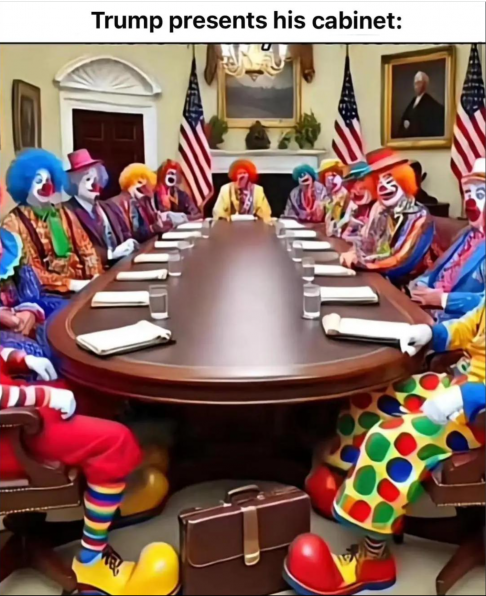
Art of the deal is raising the tariff to 145% then cutting it almost in half despite the fact that China has made no concessions and has completely ignored you. Xi just sits back at laughs at our orange clown.
You voted for a clown sleep farting through his court case. A convicted felon and lifelong rapist. The swamp incarnate. A narcissist and fraud willing to do anything to enrich himself.
Voting for Harris/Walz was clearly better considering your kids’ student debt and husband’s job situation.
Nancy Mace is such an imbicile. All gender is men and women. Any gender can use the bathroom. I have all gender bathrooms in my house. So does Nancy Mace.
Conservatives are unabashed losers.
Posting a POS by a bathroom door is very meta.
Nancy Mace is trying to make a career out of manipulated outrage and cringe morals.
Hello everyone. I have slowed down posting about Ron and myself other than the home repairs. Some because I have been so tired and worn out from trying to help Ron as he worked on the new bathrooms by doing as much housework as I could around the house. But I Ron realized I was trying so hard to pitch in to help as he did the remodeling that I was getting sick / ill. He has been insisting and pushing me to not help so much. But yesterday was grand.
We had a small supper of a few hotdogs with homemade chili. I ate one. Then we picked everything up and went to bed together. We had “quality time” if you can read between the lines. Then we cuddled back and forth and fell asleep in each other’s arms. Then at around 1:20 am we both woke up to urinate … it is an old man thing. But we started talking and I was hungry as I felt my blood sugar was dropping bad. He was also hungry. So I suggested that we get up and have waffles with him showing me how to use the waffle maker. So we got up in our birthday suit to come from the bedroom to the kitchen and learned that the stuff to make a good waffle meal we did not have. So I offered to make a scrambled egg, link sausage, ham steak, and toast meal. We had the stuff but it was more than we had planned for that time. I thought he would just want to go back to bed. But he agreed. He offered to do it, but I felt I wanted to.
I got 6 eggs out, and I use a sharp knife using the sharp edge to snap the eggshell to break open the eggshells with no fragments in the bowls. Then I add a small amount of water to add fluffy ness to them. We had 6 frozen sausage links which I fried and the ham steak. I fried the sausage and ham, then I did the eggs.
Everything came out perfect and Ron was so impressed that as he ate he told me it was the most wonderful midnight meal he had ever had. I admit I had only one sausage, a quarter of the ham steak, And only one of my two pieces of toast. Ron ate the rest including my sausage, rest of my ham steak, and my second piece of toast. I was so happy and full but so tired. I picked stuff up while Ron sat in his chair and then we decided to go back to bed. I was willing as I was very happy as my belly was full and everything seemed wonderful.
Then as we laid there cuddling talking about things … Ron made me very happy with a second quality time event. He asked me … how could I refuse. I was so spent and happy … that we slept in the next morning with him still in my arms.
Today I have had little time for the blog. I did get time to add more stuff to my cartoon / meme / news item post. But mostly while Ron rested and worked on the new bathroom I did the dishes, started / did laundry, and took care of the house stuff. But all day Ron has been so concerned for my health he has tried to keep me from doing stuff, wanting me to just take the entire day off and rest. I so love that man. For supper he made me a stir fry meal with both thick noodles and angel hair pasta. I love it. I do miss the Chinese take out we sometimes still order because I love the hot / sour soup.
I apologize for the lateness of today’s blog, but I had three deadlines today. I’ll explain further in a future blog.
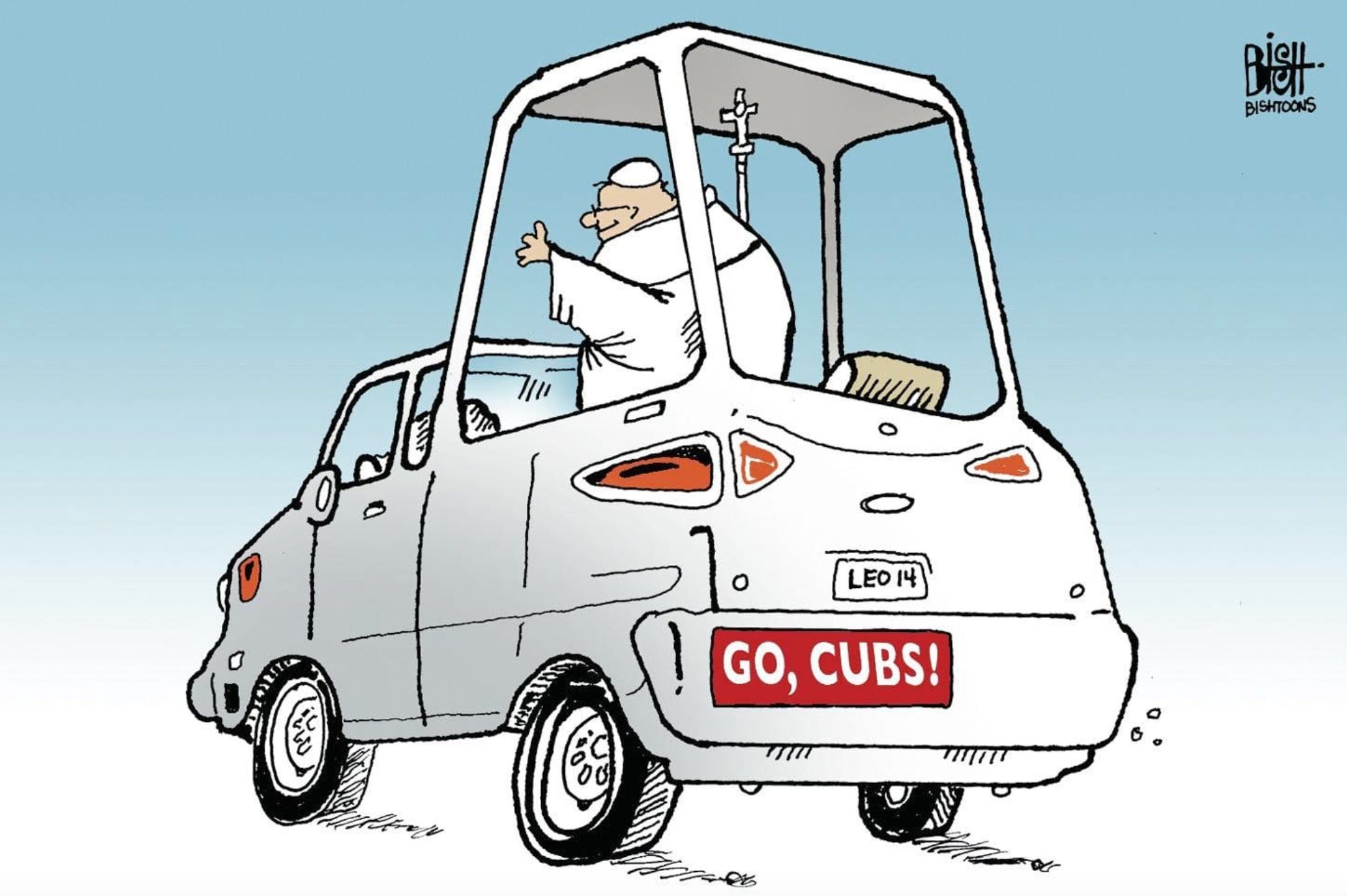
We have the first American pope, and to add to that, he’s from Chicago. How cool is that? I think Chicago all by itself spites Trump, but a pope who’s criticized the administration for its policies on immigration is a nice plus. Also, Pope Leo XIV is against the death penalty, racism (Trump is a racist), and understands that Climate Change is a real thing and not a “hoax” created by China.
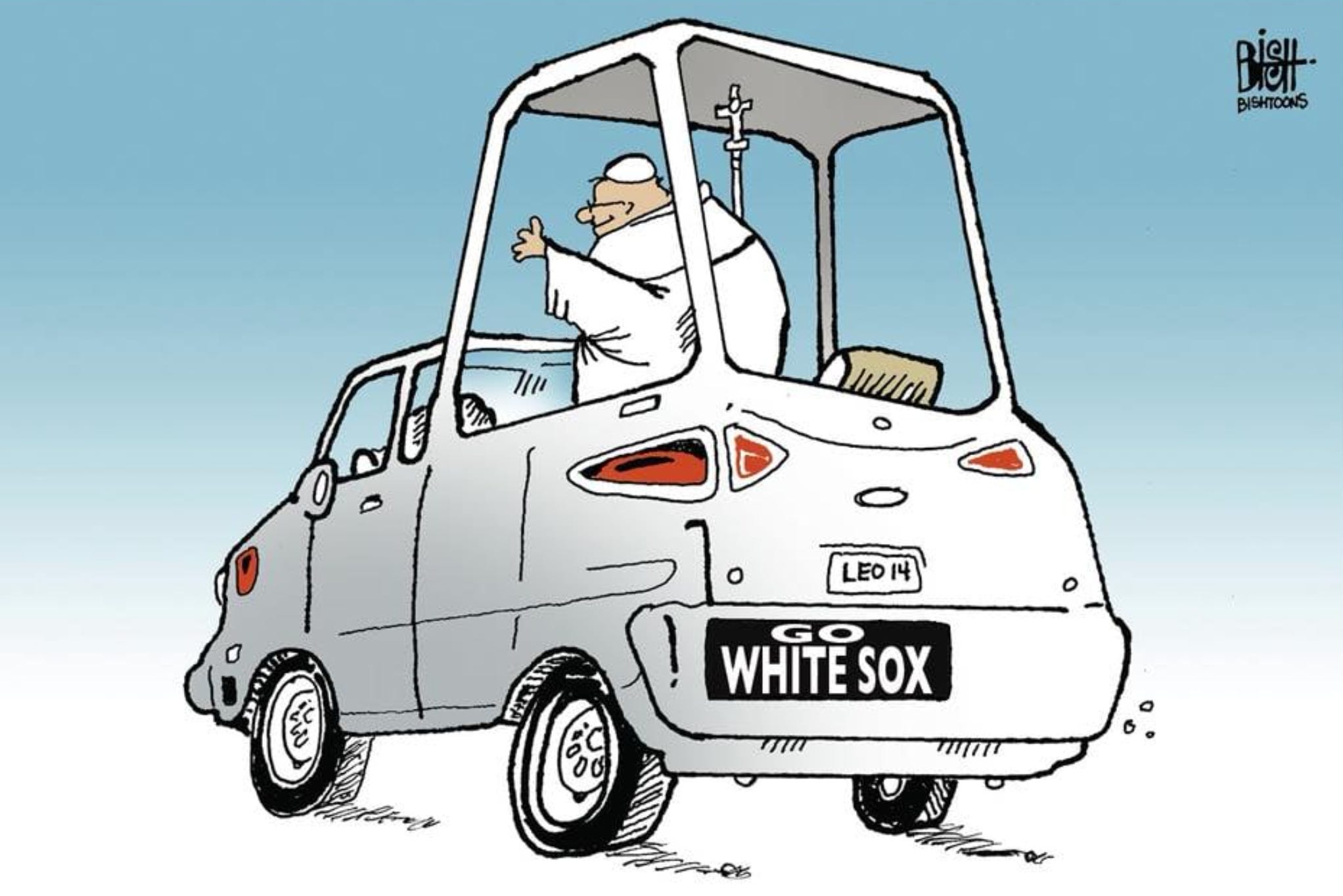
One of the first things I was curious about with our Chicago pope was if he is a Cubs fan. The Chicago Cubs posted on their famous marquee above Addison Street at Wrigley Field that Pope Leo is a Cubs fan. They got it wrong. So did some cartoonists.
Henry Payne is already an idiot. That’s not new news. Randy Bish rushed to judgment.
But it didn’t matter to him because he just made a simple swap when he found out he was wrong.
Sorry, Randy, but this is generic cartooning. Plus, nobody should listen to you about Chicago. You’re from Pittsburgh.
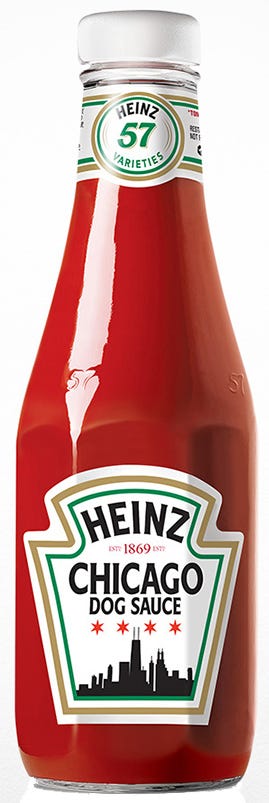
What else is from Pittsburgh is this shit.
What is it? It’s ketchup. There’s nothing special about this ketchup. It’s just regular shitty Heinz ketchup, but the company was trying to trick Chicagoans to fuck up their hot dogs with it. It didn’t work, and Eater.com let them know it.
I’m sure the Pope would agree that it’s sacrilege to put ketchup on a hot dog, but since he’s the Pope, he would probably forgive you, but I won’t. How dare you put ketchup on a hot dog? What are you? Five?
I used to have a theory that people who love ketchup had mothers who couldn’t cook. I developed this theory because my ex-wife LOVED ketchup, and her mother could not cook. I hope she doesn’t read this because she’s very nice and my son’s grandmother. My father-in-law, may he rest in peace, made the best fried pork chops I’ve ever had.
I think there are only four acceptable reasons for using ketchup, and they are, for crinkle-cut fries, very bad fries, meatloaf, and if you’re five. I kid, I kid. I know some of you love your ketchup, and none of us is perfect. For example, Donald Trump LOVES ketchup. Let that sink in.
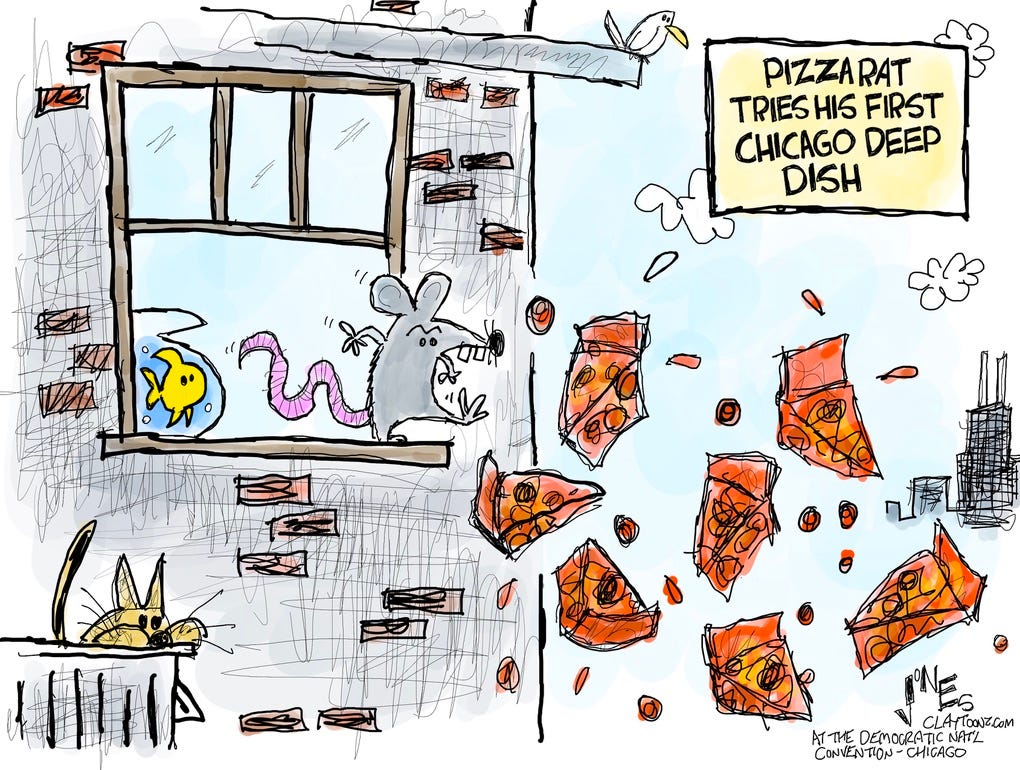
What I learned about Chicago pizza is that most Chicagoans eat more tavern-style than deep dish. Chicagoans like deep dish, but it’s more for special occasions and when they have visitors. Deep dish is more for tourists. I don’t really get deep dish, and I don’t even think it should be considered a pizza.
Do you remember Pizza Rat’s first trip to Chicago last year? He tried the deep dish.
Not a fan.
Today’s cartoon put me in the mood for tavern-style tonight, and Pizza Hut has it as a special. When I picked it up, the manager apologized because they had accidentally cut it into triangles instead of squares. A lot of Chicagoans would not stand for that, but I’m tolerant. I thought of Pope Leo, and I forgave them…this time.
Shout-out and dedication: I dedicate this cartoon to Greg Zaborniak, who introduced me to Old Style beer and tavern-style Chicago pizza last year during the Democratic convention. Thank you again, Greg.
Creative note: I didn’t know what I was going to draw today, and I also had a deadline for the Advance. And then, one of my clients contacted me wanting a cartoon on a local issue, and they wanted it today. So, I was facing three deadlines with zero ideas. But they came to me, one by one, and I knocked ‘em all down.
I deserved that pizza.
There’s a version of this cartoon without Pizza Rat. I didn’t include him because not everyone who will see this cartoon will be a regular reader of mine, and they might think the rat is an aspersion on Catholicism. So I sent it to my clients without Peezy. But then, a reader changed my mind because he thought it was a bigger sin to include a pizza without Pizza Rat. I figured I was going to hear more howls about missing Peezy than I’d hear from angry Catholics. The version at GoComics may not feature Peezy because sometimes a new file won’t override the existing file. I did resend the Peezy version to my clients, but they’ll use the one they want, and maybe not even care.
Pride events are very expensive to put on. Most of the cost is security and insurance. The more threats from haters, normally fundamentalist religious people, the more security needed and the more costly insurance is. It is another weapon the haters of the LGBTQ+ community have learned to use to shut down events for people they hate. So much for freedoms these people keep demanding for themselves but want to deny to others. Hugs
Kehlani ‘s planned concert in Central Park next month has been canceled after New York City’s mayor raised security concerns about the R&B star’s performance during Pride month, organizers announced Monday.
The “After Hours” singer had been set to headline a June 26 concert billed as “Pride with Kehlani” at the Manhattan park as part of SummerStage, an annual slate of free concerts at parks across the city.
But organizers, in their announcement, cited concerns from Mayor Eric Adams’ administration about the “controversy surrounding Cornell University’s decision to cancel Kehlani’s concert at the University, as well as security demands in Central Park and throughout the City for other Pride events during that same period.”
Following the April 10 announcement of Kehlani as the original Slope Day headliner, some students and parents criticized the artist’s anti-Israel rhetoric and social media presence. Cornellians for Israel also launched a petition against the selection of Kehlani as the Slope Day headliner that accumulated over 5,000 signatures.
Cornell revoked Kehlani’s invitation to headline Slope Day over what President Michael Kotlikoff labeled “antisemitic, anti-Israel sentiments.”
But the cancellation sparked criticism from student groups about freedom of speech and institutional neutrality. The Community Slope Day Instagram account urged students to “boycott Slope Day,” writing that Kehlani’s “opposition to the genocide in Palestine isn’t hateful” and that the decision was made “without representative input of the student body.”
It doesn’t appear that Kehlani has any affiliation with NYC Pride itself. The cult is celebrating the cancellation. The recent single below has 32 million views on YouTube.
Singer Kehlani was scheduled to perform at Cornell University, but their show was canceled because of their support for Palestine. The university framed their activism as antisemitic. This is their response: pic.twitter.com/K1iA207v89
Community Slope Day, organized in reaction to news of Kehlani’s cancelation, will feature local, underground and independent artists at Stone-Bend Farm, in an event that will run concurrent to the annual University music festival.https://t.co/olfbv9tyZF
Kehlani, a vocal critic of Israel, had been scheduled to perform in June as part of Pride festivities. Two weeks ago, Cornell dropped a plan to have her headline a concert. https://t.co/OCaNu9jtG4
— New York Times Music (@nytimesmusic) May 7, 2025
Oklahoma's Christian nationalist state Sen. Dusty Deevers is waging "spiritual warfare" to outlaw pornography because he says those who use/produce it are under a demonic "power that they aren't able to control." https://t.co/rNZ7PNnZXppic.twitter.com/eY1rJ1aEfm
We can't really come up with a better example of Christian nationalism than Oklahoma state Sen. Dusty Deevers explaining that he wants to change a law just so that its punishment aligns with various Bible verses. https://t.co/a00MHR3B1wpic.twitter.com/YYoznTrKQe
Dusty Deevers, a Christian nationalist pastor/Oklahoma state senator, says the 2015 Obergefell ruling will never be settled law because "no ruling that redefines a God-ordained institution is ever truly settled": "The rogue court will stand before God for their decision." pic.twitter.com/hfdydIzEz6
Dusty Deevers is a far-right pastor and member of the Oklahoma state senate who seems to love nothing more than using his political position to demand theocracy: "Nations will rise and fall on the basis of their submission to Christ!" https://t.co/nlpXbkVdTbpic.twitter.com/sWSch4hxXk
Exclusive: A series of internal government messages obtained by The Post reveal how U.S. embassies and the State Department have pushed nations to clear hurdles for U.S. satellite companies, often mentioning Starlink by name. https://t.co/wFWyt3RFQ6
— The Washington Post (@washingtonpost) May 7, 2025
Dr. Casey Means speaks for mothers all across America here.
“As someone who is a hopefully soon-to-be mother who’s gonna be making decisions about vaccines for my own children, the idea that the FDA that’s regulating vaccines is a revolving door with the companies who make them… pic.twitter.com/CAP27BjyVi
1/ The US government has ordered the Swedish city of Stockholm to end its diversity, inclusivity and equality (DEI) programmes within 10 days. The city authorities say the demand is "bizarre" and they won't be complying. ⬇️ pic.twitter.com/nwejOrkQgT
2/ The Swedish newspaper Dagens Nyheter reports that the Stockholm city planning office has received a letter from the US embassy explaining that every organisation doing business with the US government must sign a contract within a few days and agree to end their DEI programmes.
3/ Since February 2025, US embassies around the world have been sending letters to local contractors making similar demands. This seems to be the first time that it's been reported that a similar letter has been sent to a foreign government organisation.https://t.co/xqGDjBtsG1
May 10, 1857 The Sepoy Rebellion was triggered in Meerut, India, when native troops (known as Sepoys, which also designated a rank equivalent to private) turned on their British officers.It was the first instance of armed resistance against colonial rule. Indians constituted 96% of the 300,000-man British Army.Loading the Lee-Enfield Rifled Musket assigned to the Sepoys involved biting the end of a cartridge greased in a combination of pig fat and beef tallow. “Attack of the Mutineers,” a British illustration of the Sepoy Rebellion The former is haraam (forbidden) under Islamic law, the latter offensive to Hindus who consider the cow as aghanya (that which may not be slaughtered). When the Sepoys, including both Hindu and Muslim Indians, became aware of this, some refused to load their weapons. Mangal Pandey, a soldier in the Army shot his commander for forcing the Indian troops to use the controversial rifles. When others were charged with mutiny for refusing, Sepoys turned on their officers and released the imprisoned soldiers. The rebellion is now considered the first Indian war for independence. More on the rebellion
May 10, 1967 Army Captain Howard Levy, a physician, was imprisoned three years for refusing to train U.S. Special Forces soldiers for Vietnam. He refused an order to perform the training as he considered it a violation of his medical ethics. “The United States is wrong in being involved in the Viet Nam War. I would refuse to go to Viet Nam if ordered to do so. I don’t see why any colored soldier would go to Viet Nam: they should refuse to go to Viet Nam and if sent should refuse to fight because they are discriminated against and denied their freedom in the United States, and they are sacrificed and discriminated against in Viet Nam by being given all the hazardous duty and they are suffering the majority of casualties.” – From the Supreme Court case, Parker, Warden, et al. v. Levy.
May 10, 1968 Peace talks began in Paris between the U.S. and North Vietnam with businessman, former New York governor, ambassador and cabinet secretary W. Averell Harriman representing the United States. Former Foreign Minister Xuan Thuy, heading the North Vietnamese delegation, immediately demanded cessation of U.S. bombing.
May 10, 1972 Jane Briggs Hart, the wife of Senator Philip A. Hart (D-Michigan), informed the Internal Revenue Service that she wouldn’t pay some of her taxes; instead, she deposited her quarterly estimated tax of $6,200 in a special bank account. She wrote: “I cannot contribute one more dollar toward the purchase of more bombs and bullets.” Jane Briggs Hart More about Jane Briggs Hart
May 10, 1980 A federal judge in Salt Lake City, Utah, found the U.S. government negligent for its above-ground testing of nuclear weapons in Nevada from 1951 to 1962. The land of the Nevada Test Site is scarred with craters from nuclear testing.
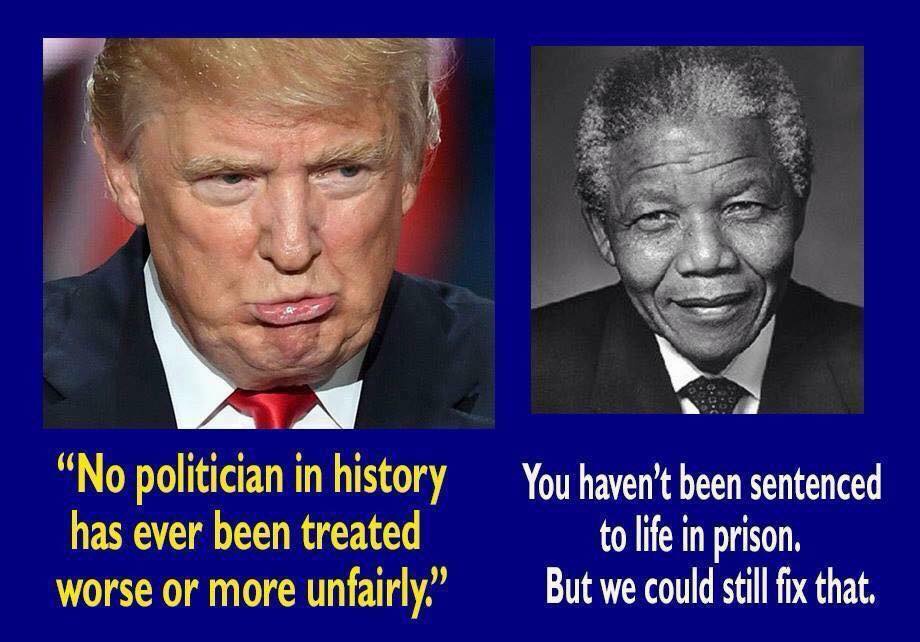
May 10, 1994 Nelson Mandela was inaugurated as South Africa’s first black president. He had won the country’s first election in which all South Africans could vote, regardless of race. Mandela had spent nearly three decades imprisoned for his part in the struggle to attain political and civil rights for black and colored citizens. This ended more than three centuries of white rule, beginning with the Dutch in 1652. Biography of Nelson Mandela South African chronology
As the House Ways and Means Committee prepares to mark up a major tax bill, it is important to step back and consider which priorities it will reflect — whether it will prioritize tax policies that help families meet basic needs, require corporations and the wealthy to pay a fairer share of tax, and strengthen the nation’s fiscal outlook to allow us to meet existing commitments and make high-value investments.
Numerous independent analyses have shown that the 2017 tax law, which the bill is expected to extend, was skewed to the rich, drove up deficits and debt, and failed to deliver on its economic promises.[1] It also has proved unpopular with the public.[2] The 2025 bill should be held to a much higher standard than the 2017 bill, given its poor record of achievement, the higher risks the country now faces due to higher levels of debt, and the more uncertain economic outlook.
President Trump’s extreme and chaotic tariff policies pose a major threat of recession and are already raising consumer prices.[3] The President’s attacks on the rule of law, scientific and medical research, top universities and law firms, and the functioning of the federal government — including its ability to collect revenue and deliver core services — pose large additional economic risks, over both the short and long term.
Any forthcoming Ways and Means bill should respond to the current economic moment and the growing risks that families face: rising costs, increasing risks of job loss, and high uncertainty about their future financial stability. The bill also must be examined in connection with the other central pieces of the Republican economic agenda: massive cuts in health coverage, food assistance, and other forms of help for families and communities to partially offset the cost of the bill’s tax cuts.[4]
The answers to the following ten questions will illuminate what House Republicans prioritized as they put together their signature tax bill.
Prioritizing Tax Policies That Help Families Meet Basic Needs
1. Do House Republicans block the President’s reckless global tariffs to protect their constituents and stop a potential recession?
The tariffs’ impact on consumers and the economy is already impossible to ignore. Importantly, the Ways and Means Committee has jurisdiction not only over tax policy but also over Congress’ constitutional trade policy authority.[5] Thus, the committee can and should respond to the President’s destructive tariff policy.
Unless they are stopped, tax increases due to the tariffs are likely to more than erase any forthcoming tax cuts for households in all income groups except the top 10 percent, whose incomes are above $317,000. (See Figure 1.) Moreover, while the 2017 tax cuts won’t expire until the end of this year, households and businesses are already feeling the impact of the tariffs on prices, supply chains, and business viability.[6]
Figure 1
Soon after President Trump imposed the highest tariffs since the Smoot-Hawley tariffs of the 1930s on more than 100 countries, a number of states and businesses filed lawsuits challenging his legal authority.[7] Yet House Republicans, despite their constitutional responsibility over tariff policy and the obvious risks the tariffs pose to their constituents, have failed to act. Meanwhile, the tariffs and the frequent shifts in the Administration’s tariff policies are paralyzing businesses, raising costs on consumers, and sharply increasing the risk of recession, which could lead to a rise in unemployment and the number of people who need help to afford the basics, just as those supports are slated for cuts.
A major question for the committee markup is whether House Republicans will, in parallel with the tax bill, assert their constitutional trade policy authority to stop these destructive policies and protect the country from a potential self-inflicted recession.
Furthermore, as Figure 1 shows, these historic tariffs represent major tax increases on households with low or moderate incomes.[8] Given that extending the 2017 tax law would give the biggest benefits to high-income households, it will be important to see if Republicans modify the upcoming bill to reflect the current economic situation, including through measures discussed below.
2. Do House Republicans extend enhanced premium tax credits for marketplace health coverage to protect millions of people, including many small business owners, from sharp premium increases?
While the Ways and Means bill is expected to extend many other expiring tax provisions, it may not extend the premium tax credit enhancements, which are critical to making health coverage in the Affordable Care Act (ACA) marketplace more affordable.
Failing to extend them would drive up health care premiums by an average of 79 percent for over 20 million people, including 3 million small business owners.[9] (Figure 2 shows the average premium increases nationally for a family of four at different income levels; in some states the increases would be far higher.)[10] Roughly 4 million people would then be expected to lose their health insurance as its cost rose to unaffordable levels.[11] As a result, they would be more likely to forgo necessary care or to incur medical debt.
Figure 2
3. Do House Republicans expand the Child Tax Credit for children in working families who get less than the full credit, whom 169 House Republicans voted to help last year?
Under the Child Tax Credit now in place, 17 million children receive less than the full credit, or none at all, because their families’ earnings are too low; the large majority of these children live in families with earnings.[12] Last year, Ways and Means Chair Jason Smith negotiated and championed legislation to expand the credit for the vast majority of these children. The bill, which passed the House, would have corrected many (but not all) key flaws in the credit’s design.[13]
First, the bill would have improved how the credit phases in with earnings. As it stands now, higher-income families get a $2,000 credit for each child, but because of the way the phase-in works for low-income families, many families with two or three children receive roughly the same total credit as a family with one child at the same earnings level. Not allowing lower-income families to claim the credit on a per-child basis harms the roughly three-quarters of children in lower-income families who live in a family with more than one child.
Second, the bill would have treated families with low or moderate incomes the same as higher-income families when it comes to the maximum credit they can receive. Currently, these families are restricted to a smaller maximum credit. The lower maximum credit for families who don’t owe income taxes means that when they are able to increase their earnings, they often receive no additional Child Tax Credit, as they remain stuck at the lower maximum credit. This is seemingly at odds with Republicans’ rhetorical focus on increasing returns to work.
If Republicans simply increase the $2,000 maximum credit, or index it for inflation, not one of the 17 million children or their families would benefit from the change. The children who wouldn’t benefit include an estimated 650,000 children in veterans’ families, as well as millions of children whose parents work important jobs for low pay, such as truck drivers, cooks and waiters, nursing assistants, home health aides, construction workers, cashiers, and others. These children should be the top priority, not the lowest.
Some prior Republican proposals to expand the Child Tax Credit would offset the cost by cutting the Earned Income Tax Credit (EITC) for families with children and eliminating the head-of-household filing status for single parents.[14] In effect, this would increase income support for single parents with one hand while taking away part or all of that added support with the other. The Ways and Means bill should boost the incomes of single parents, an economically precarious group — not take away support.
4. Do House Republicans prevent low-paid working adults not raising children in their homes from being taxed into poverty?
More than 6 million working adults aged 19 and older who aren’t raising children at home will be taxed into, or deeper into, poverty by federal income and payroll taxes in 2026 if House Republicans do not improve the very limited EITC for this group.[15]
Republicans should increase the paltry size of their EITC, expand the income range for people to qualify, and expand the age range (currently 25-64) to include anyone aged 19 or older. This would help young adults entering the workforce, who currently do not qualify for any EITC, and adults aged 65 and over, many of whom continue to work but aren’t eligible for any EITC. And it would provide a larger credit for currently eligible adults aged 25 to 64.
These changes would also be consistent with the President’s attention during the campaign to the economic circumstances of young men, especially those who don’t go to college.
5. Do House Republicans protect energy tax credits that help families lower their utility bills and create economic opportunities for struggling communities?
Tax credits for investments in clean, affordable energy have spurred tremendous growth in the solar, wind, and geothermal energy industries, and they are bringing new economic opportunities to areas of the country facing underinvestment and hardship, including many rural areas.[16] But House Republicans are reportedly considering large cuts to energy tax credits, which risks upending this progress.[17]
Repealing these credits would result in higher utility bills for households and businesses (increases of 7 percent and 10 percent, respectively)[18] at a time when consumers already face higher costs from the President’s tariffs. Repeal could also add up to $49 billion in annual health care costs and lost productivity.[19]
Requiring Corporations and Wealthy Households to Pay a Fairer Share of Tax
6. Do House Republicans end costly tax cuts targeted to high-income households?
Extending the expiring individual income and estate tax provisions of the 2017 law would benefit households with considerable wealth and high incomes far more than households with low or moderate incomes. Roughly half the cost of extending the expiring tax cuts would flow to households with incomes in the top 5 percent (those with incomes over around $320,000).[20]
This tilt to the top reflects several costly provisions that primarily benefit the most well-off:
Lower top rate. The 2017 law cut the top individual income tax rate, which now applies to taxable incomes over roughly $730,000 for married couples, from 39.6 percent to 37 percent. Some House Republicans have reportedly considered including a higher top rate in their bill — such as 40 percent for people with taxable incomes over $1 million — but President Trump and House Speaker Mike Johnson have both rejected the idea.[21]Allowing the top rate to revert to 39.6 percent while extending all of the 2017 law’s other expiring provisions would still give households in the top 1 percent a $40,000 average annual tax cut, according to the Tax Policy Center.[22] That’s because most high-income households receive large tax cuts from the law’s other provisions, like the pass-through deduction (see below), and also benefit from the law’s rate cuts that apply to the lower tax brackets. Still, even this modest change would be a welcome departure from the failed “trickle-down” approach to tax policy.
Pass-through deduction. The 2017 law adopted a special 20 percent deduction for certain income that owners of pass-through businesses (partnerships, S corporations, and sole proprietorships) report on their individual tax returns. Over half of the benefits go to 200,000 business owners with incomes over $1 million, who now face a lower top rate (29.6 percent) than their employees (37 percent).[23] Research finds the deduction had no trickle-down benefits for workers’ wages or business investment.[24]At a minimum, Republicans can follow through on their rhetorical support for small business owners by letting the deduction expire for millionaires, which would reduce the deduction’s cost by over $350 billion from 2025-2034, and instead extending enhanced premium tax credits that help 3 million business owners (see above) for a somewhat lower cost.[25]
Tax break for large estates. The 2017 law doubled the estate tax exemption to $22 million per couple and indexed it for inflation going forward; today a couple can pass on an estate worth up to $28 million tax free. Extending this generous exemption amounts to a $5.7 million tax cut for the wealthiest 1 in 1,000 estates, whose value consists largely of unrealized capital gains income that has never been taxed.House Republicans may double down on this costly estate tax break, with some even calling for permanently repealing the estate tax altogether.[26] Providing tax breaks to multi-million-dollar estates would be especially egregious given that Republicans also appear poised to steeply cut vital health care and food assistance, while the President’s sweeping tariffs will cost families with low or moderate incomes hundreds if not thousands of dollars a year and drive up the likelihood of a recession.
7. Do House Republicans revisit the 2017 law’s permanent and steep cut in the corporate tax rate?
The centerpiece of the 2017 law was a deep, permanent cut in the corporate tax rate — from 35 percent to 21 percent — that cost $1.3 trillion from 2018-2027 and is tilted even more heavily toward wealthy people than the expiring individual tax cuts.[27] (See Figure 3.) Rigorous research shows that the corporate rate cut did not produce the promised economic benefits: a study by economists from the Joint Committee on Taxation and the Federal Reserve Board found that workers in the bottom 90th percentile of their firm’s income scale saw no change in earnings from the rate cut.[28]
Rather than revisit this costly, skewed rate cut, which was even deeper than corporate lobbyists had expected to achieve in the 2017 law,[29] House Republicans are likely to go in the opposite direction: reverse scheduled business tax increases that Congress added to the 2017 law to partially offset the cost of the corporate rate cut. Reversing these increases without a corresponding increase in the corporate rate would amount to hundreds of billions in additional tax cuts for corporations.[30]
figure 3
8. Do House Republicans reject additional unwise tax cuts?
The House-passed budget resolution calls for $4.5 trillion of tax cuts over fiscal years 2025-2034, which leaves room for $1.2 trillion in additional tax cuts on top of extending the 2017 individual and estate tax cuts. In addition to the likely business tax cuts discussed above, House Republicans may include some costly new tax cuts that disproportionately benefit high-income households.
Notably, Republicans appear poised to weaken the2017 law’s $10,000 cap on deductions for state and local taxes (SALT). The SALT cap has received outsized public attention, potentially creating the mistaken impression that the affected filers fared relatively poorly under the 2017 law. Even with the SALT cap, the 2017 law delivered the biggest average tax cut, measured as a share of pre-tax income, to households with incomes in the 95-99th percentiles, a group making roughly between $400,000 and $1 million.
These households would also be the biggest winners from most proposals to expand the SALT cap. For example, increasing the cap to $25,000 for married couples would mean an additional $5,550 to high-income couples, or 12 times as much as households with incomes in the bottom 60 percent would receive from extending the entire 2017 law.
The Ways and Means bill also will likely include other tax cuts President Trump proposed during the campaign, such as exempting Social Security income and tips from income taxes. But these policies would do little for households with low incomes and would add significantly to the cost.
For example, repealing the taxation of Social Security benefits would weaken the financing of Social Security and Medicare and make the Social Security system less progressive.[31] About half of Social Security beneficiaries already pay no tax on their benefits, primarily because their incomes fall below the specified thresholds. Similar proposals, like retaining the tax on benefits but fully offsetting it with an equal income tax credit, would still dig a large and growing hole in the federal budget (costing well over $1 trillion over ten years) without benefiting low-income seniors.[32]
The President’s proposal to eliminate taxes on tips would help only a small minority of low-paid workers and barely add to the tax cuts going to families with low and moderate incomes.[33] It also could open up significant tax gaming opportunities as people with high incomes seek to reclassify their income as tips to avoid tax.
Strengthening the Fiscal Outlook to Meet Existing Commitments and Make High-Value Investments
9. Do House Republicans offset the cost of their tax cuts with sound revenue proposals?
Despite rising needs due to the aging of the baby boom generation and underinvestment in public services and the economy, policymakers have enacted tax cuts in the past two decades that have eroded the revenue base.[34] This has undermined investments and driven up deficits and debt, increasing future risks to the economy.
Instead of raising revenues, many congressional Republicans have used the increase in debt to push for deep cuts in Medicaid and SNAP even as they seek to extend costly tax cuts and add a trillion dollars or more in new cuts on top.
Republicans could cut the cost of extending the 2017 law by more than half, from $4.2 trillion to $1.8 trillion over 2026-2035, by reversing the tax cuts for anyone with income above $400,000.[35] Moreover, sound tax policies are readily available for Republicans to pay for the tax cuts they want to extend.[36]
10. Do House Republicans avoid gimmicks and timing shifts that prior tax bills (such as the 2017 law) have used to hide their true cost?
The 2017 law relied on budget tricks such as making many tax cuts temporary or having tax increases phase in later to make its tax cuts appear less costly, which allowed Republican lawmakers to squeeze in a larger corporate rate cut. They may do so again this year, despite authorizing an even more costly bill than the original 2017 law.
For example, House Republicans are reportedly considering limiting any new tax cuts — that is, those other than extensions of the 2017 law, such as eliminating tax on tips — to just four years.[37] This would lower the bill’s official cost relative to permanent new tax cuts but would mask the true cost of those provisions, because lawmakers could be expected to push for their extension later, likely without offsetting the cost. An even more egregious gimmick would be for House Republicans to copy Senate Republicans in adopting a “current policy” baseline, where the expiring tax cuts are simply assumed to continue after 2025 and thus that they would have zero cost.[38]
[5] The House Ways and Means Committee has jurisdiction over “Revenue measures generally,” including tariffs. See Clause 1(t)(3) of House Rule X. Other committees, including the House Foreign Affairs Committee, have jurisdiction over export controls.
[35] Treasury, “The Cost and Distribution of Extending Expiring Provisions.” Treasury’s analysis reflects the Biden Administration’s pledge not to raise taxes for people making up to $400,000 a year. Its estimates of reversing the tax cuts for people with incomes above $400,000 include certain tax changes that would modestly increase tax rates for households in the top 1 percent (those with incomes over $743,247) relative to allowing all the tax cuts to fully expire. For example, the 2017 tax law’s revenue-raising provisions are assumed to be extended for all income levels rather than being allowed to expire.




























 Scottie's Playtime