I know in the last few days I have posted a lot of what I think is important stuff. But if you have ever wanted to hear a grand response to a hate preacher calling for the death of gay people then you need to watch this video. The reverend is as upset and agitated as I have ever seen him. He not only debunks the hate preachers arguments but uses the verses before and after to show how wrong people that use that to hate on gays are. Hugs.
Cuban reggaeton artist Leamsy La Figura, arrested last week in Miami-Dade on assault charges, was transferred to South Florida’s new immigration detention facility known as Alligator Alcatraz in the Everglades, the singer confirmed in a phone call.
He and other detainees claim they are enduring inhumane conditions at the site, including lack of access to water, inadequate food and denial of religious rights.
Alligator Alcatraz was built in a matter of days on a rarely used municipal airport located about 50 miles west of the City of Miami. The first group of detainees arrived at the center on July 3, according to state Attorney General James Uthmeier.
La Figura, whose real name is Leamsy Isquierdo, was charged with aggravated assault with a deadly weapon and battery. He was initially held at the Turner Guilford Knight Correctional Center (TGK) before being transferred to Alligator Alcatraz.
“There’s no water to take a bath”
In a phone call from inside the facility, La Figura described what he called horrific conditions.
“I am Leamsy La Figura. We’ve been here at Alcatraz since Friday. There’s over 400 people here. There’s no water to take a bath, it’s been four days since I’ve taken a bath,” he said.
He claimed the food at the immigration facility is scarce and unsanitary.
“They only brought a meal once a day and it had maggots. They never take off the lights for 24 hours. The mosquitoes are as big as elephants,” La Figura said.
Detainees say rights are being violated
Other detainees echoed La Figura’s concerns, alleging violations of their basic rights.
“They’re not respecting our human rights,” one man said during the same call. “We’re human beings; we’re not dogs. We’re like rats in an experiment.”
“I don’t know their motive for doing this, if it’s a form of torture. A lot of us have our residency documents and we don’t understand why we’re here,” he added.
A third detainee, who said he is Colombian, described deteriorating mental health and lack of access to necessary medical care.
“I’m on the edge of losing my mind. I’ve gone three days without taking my medicine,” he said. “It’s impossible to sleep with this white light that’s on all day.”
He also claimed his Bible was confiscated.
“They took the Bible I had and they said here there is no right to religion. And my Bible is the one thing that keeps my faith, and now I’m losing my faith,” he said.
La Figura’s girlfriend said the couple shares a 4-year-old daughter.
Florida officials respond to inhumane conditions allegations
On Tuesday, state officials responded to the allegations made by detainees at the facility, saying they are “completely false.”
“The reporting on the conditions in the facility is completely false. The facility meets all required standards and is in good working order,” said Stephanie Hartman, director of communications for the Florida Division of Emergency Management.
FDEM was the engine behind Alligator Alcatraz, using the state’s emergency management tools and funding to build, staff and operate the detention facility.
With little discussion, Pittsburgh City Council on Tuesday unanimously passed three bills intended to provide further safeguards to LGBTQ Pittsburghers.
Councilor Barb Warwick introduced the bills at the end of June to extend more protections to the local queer community.
Two of the bills were designed to de-emphasize enforcement of any future law restricting the LGBTQ community from participating in otherwise legal activities and create avenues for reporting medical discrimination.
The first bill prohibits the withholding or denial of “elective medical care which would normally be provided to a person, but for that person’s real or perceived gender identity or expression.”
For example, if a medical provider denied breast augmentation surgery to a trans patient on the basis of their gender identity, residents could report the provider to the city’s Commission on Human Relations.
The second bill aims to pre-emptively shield the LGBTQ community against being barred from society by future federal legislation by directing the city to de-prioritize enforcement of such a ban or restriction.
A third bill lessens the legal penalty for engaging in sex work from a misdemeanor to a summary offense. Warwick and other advocates say LGBTQ individuals have been disproportionately affected by such arrests. They say this measure will help the queer community and other vulnerable workers to not be targeted, and come forward to law enforcement if they need help without fear of persecution.
“Whether it’s proactively making sure that we are not criminalizing being trans, or making sure trans people have access to the health care that they need or not being discriminated against by our largest medical providers, and also making sure that folks who are doing survival sex work on the street are not being persecuted and thrown in jail, but they’re actually being cared for and getting the services that they need — these are all good things, right?” Warwick said.
“These are things that make Pittsburgh safer and really help protect our most vulnerable.”
Julia Maruca reports on Pittsburgh city government, programs and policy. She previously covered the Westmoreland County regions of Hempfield and Greensburg along with health care news for the Tribune-Review.
Ohio Republicans split the Ohio Equal Rights Amendment into two separate ballot issues.
One issue addresses overturning Ohio’s same-sex marriage ban, while the other expands anti-discrimination protections for LGBTQ+ individuals.
This move requires proponents to collect double the signatures or sue the Ohio Ballot Board.
Ohio Republicans added another hurdle for proponents of a measure to overturn Ohio’s dormant ban on same-sex marriage and expand anti-discrimination protections for LGBTQ residents.
In a party-line vote, Ohio Ballot Board divided the Ohio Equal Rights Amendment into two issues: one to overturn a 2004 vote that defined marriage as between one man and one woman and another that would prohibit state and local government from discriminating against more than a dozen protected groups, including transgender Ohioans.
To make the ballot, proponents will either have to collect double the number of signatures to get both proposals approved or sue the Ohio Ballot Board to overturn its decision. Backers are eyeing the 2026 ballot at the earliest, said Lis Regula, a member of Ohio Equal Rights’ leadership committee.
During the July 9 meeting, the ballot campaign’s attorney Corey Colombo argued that the proposed constitutional amendment was one issue because it encompassed equal rights for all Ohioans.
But Republicans contended that transgender issues and marriage equality are two different things with two different levels of support from voters.
While Ohioans might support marriage between any two people in the Ohio Constitution, “they may not want to support creating 12 new protected classes under a bunch of different circumstances,” said Ohio Secretary of State Frank LaRose, a Republican who leads the Ohio Ballot Board.
Rep. Terrence Upchurch, D-Cleveland, said Republicans divided the measure because of politics. “It’s one issue. It’s cut and dry.”
“There’s definitely political will for using trans people to divide Ohioans,” Regula said. “The hopeful side of me appreciates that they are recognizing the support for same-sex marriage. That’s great. We’ve made progress. We still have progress to make.”
What is the Ohio Equal Rights Amendment?
If approved by voters, the Ohio Equal Rights Amendment would prohibit state and local government from discriminating based on: “race, color, creed or religion, sex, sexual orientation, gender identity or expression regardless of sex assigned at birth, pregnancy status, genetic information, disease status, age, disability, recovery status, familial status, ancestry, national origin or military and veteran status.”
The sweeping measure would expand the list of protected individuals far beyond the national Equal Rights Amendment, which aims to prohibit discrimination based on sex. Ohio ratified that amendment in 1974, but it has not been recognized as part of the U.S. Constitution because of missed deadlines and other disputes.
The proposal would also overturn a 2004 vote that defined marriage as between one man and one woman.
This language has been dormant since a 2015 U.S. Supreme Court decision led by Ohioan Jim Obergefell legalized gay marriage in America. As of 2023, Ohio had 22,400 same-sex married couples, according to the most recent federal census data.
“Marriage equality has been going strong now for 10 years, and the sky hasn’t fallen. Society hasn’t collapsed,” said Senate Minority Leader Nickie Antonio, D-Lakewood. “What happened is you have families who have standing, whose children can feel good and talk about their families just like every other kid at school, no matter what the configuration of their family is.”
But proponents of marriage equality worry that the Obergefell decision could be overturned by an unfriendly U.S. Supreme Court. “I think it is reasonable to believe that it is under threat,” said Regula, citing the language used in the decision overturning Roe v. Wade.
What are the arguments for and against this measure?
“Those discriminatory laws make Ohio less of a welcoming place and make it a place where fewer people are interested in coming,” Regula said.
Opponents say these are losing issues at the ballot box.
“To bring such an unpopular constitutional amendment like this forward is one, shockingly appalling, but also really dumb after Sherrod Brown just lost his Senate seat over these issues,” said Aaron Baer, president of the Center for Christian Virtues.
Republicans crafted attack ads against Brown for voting against amendments that would have stripped funding from schools and colleges that allowed transgender girls to play in women’s sports.
“I have a hard time seeing them get a lot of traction with this,” Baer said. CCV was a driving force behind the 2004 constitutional amendment to ban same sex marriage in Ohio.
What happens next?
The group looking to put the Ohio ERA before voters faces a tall task. If they want voters to approve both measures, they must collect an additional 1,000 valid signatures for each proposal, go before Ohio Attorney General Dave Yost for initial approval and return to the ballot board.
Then, proponents would have to collect at least 413,487 valid signatures, or 10% of votes cast in the most recent governor’s race, for each measure or 826,974 in total. Those signatures must meet a minimum threshold in half of Ohio’s 88 counties.
“While I applaud the spirit of the work that they are trying to do, I just think it’s a real uphill battle that they’re going to be faced with,” said Antonio, the state’s first and currently only openly gay lawmaker.
For more than a decade, Antonio has repeatedly introduced the Ohio Fairness Act to prohibit discrimination based on sexual orientation or gender identity. The GOP-controlled Legislature has not moved forward on the fairness act.
Antonio said a legislative fix is still the right path for protections against LGBTQ discrimination.
“I struggle with asking the majority of people, the majority of the population, to grant equality by a vote to a marginalized group,” Antonio said. “I will continue to fight for the Ohio Fairness Act, because I think it’s the right thing to do.”
Reporter Laura A. Bischoff contributed to this article.
State government reporter Jessie Balmert can be reached at jbalmert@gannett.com or @jbalmert on X.
It isn’t timidity. It’s a complete reconstruction of what is acceptable rhetoric, and it makes gentler more collegial conversation and work impossible.
Whether it’s bloodshed at Glastonbury or starving people on benefits, their ‘irony poisoning’ seeps obscene ideas into the range of the possible
Illustration: Nate Kitch/The Guardian
Imagine the furore if a Guardian columnist suggested bombing, say, the Conservative party conference and the Tory stronghold of Arundel in Sussex. It would dominate public discussion for weeks. Despite protesting they were “only joking”, that person would never work in journalism again. Their editor would certainly be sacked. The police would probably come knocking. But when the Spectator columnist Rod Liddle speculates about bombing Glastonbury festival and Brighton, complaints are met with, “Calm down dear, can’t you take a joke?” The journalist keeps his job, as does his editor, the former justice secretary Michael Gove. There’s one rule for the left and another for the right.
The same applies to the recent comments on GB News by its regular guest Lewis Schaffer. He proposed that, to reduce the number of disabled people claiming benefits, he would “just starve them. I mean, that’s what people have to do, that’s what you’ve got to do to people, you just can’t give people money … What else can you do? Shoot them? I mean, I suggest that, but I think that’s maybe a bit strong.” The presenter, Patrick Christys replied, “Yeah, it’s just not allowed these days.”
You could call these jokes, if you think killing people is funny. Or you could call them thought experiments. Liddle suggested as much in his column: “I am merely hypothesising, in a slightly wistful kinda way.” This “humour” permits obscene ideas to seep into the range of the possible.
Academic researchers see the use of jokes to break taboos and reduce the thresholds of hate speech as a form of “strategic mainstreaming”. Far-right influencers use humour, irony and memes to inject ideas into public life that would otherwise be unacceptable. In doing so, they desensitise their audience and normalise extremism. A study of German Telegram channels found that far-right content presented seriously achieved limited reach, as did non-political humour. But when far-right extremism was presented humorously, it took off. (snip-MORE)
Sheldon Whitehouse of Rhode Island gives 300th climate speech on the US Senate floor
Sheldon Whitehouse at a Senate confirmation hearing on 6 February 2025. Photograph: Tom Williams/CQ-Roll Call via Getty Images
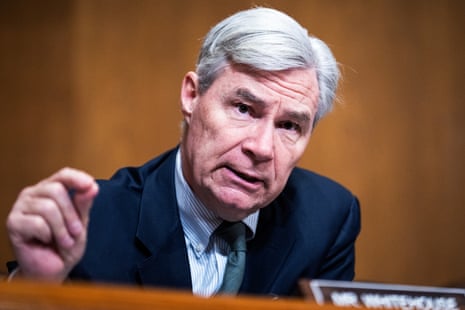
The Democratic party and the climate movement have been “too cautious and polite” and should instead be denouncing the fossil fuel industry’s “huge denial operation”, the US senator Sheldon Whitehouse said.
“The fossil fuel industry has run the biggest and most malevolent propaganda operation the country has ever seen,” the Rhode Island Democrat said in an interview Monday with the global media collaboration Covering Climate Now. “It is defending a $700-plus billion [annual] subsidy” of not being charged for the health and environmental damages caused by burning fossil fuels. “I think the more people understand that, the more they’ll be irate [that] they’ve been lied to.” But, he added, “Democrats have not done a good job of calling that out.”
Whitehouse is among the most outspoken climate champions on Capitol Hill, and on Wednesday evening, he delivered his 300th Time to Wake Up climate speech on the floor of the Senate.
He began giving these speeches in 2012, when Barack Obama was in his first term, and has consistently criticized both political parties for their lackluster response to the climate emergency. The Obama White House, he complained, for years would not even “use the word ‘climate’ and ‘change’ in the same paragraph”.
While Whitehouse slams his fellow Democrats for timidity, he blasts Republicans for being in the pocket of the fossil fuel industry, an entity whose behavior “has been downright evil”, he said. “To deliberately ignore [the laws of physics] for short-term profits that set up people for huge, really bad impacts – if that’s not a good definition of evil, I don’t know what is.” (snip-MORE)
Landmark ruling finds Russia shot down MH17 with 298 people on board
Europe’s top human rights court finds Boeing 777 flying from Amsterdam to Kuala Lumpur was shot down by Russia in July 2014
Internal DOJ messages bolster claim that Trump judicial nominee spoke of defying court orders
Emil Bove, a top DOJ official who has been nominated to be an appellate judge, is the subject of whistleblower allegations.
Faith and fear: Haitian immigrants in Springfield stand firm as Trump threatens deportation
Accompanied by their newborn son, Michelet and his wife arrived at the St. Vincent de Paul Community Center in Springfield, Ohio, last week looking for help from the non-profit’s volunteers. They wanted to apply for a valuable document for the infant that for now seems out of reach for them as Haitian immigrants: a U.S. passport.
Russian drones swarm Kyiv from all sides in apparent shift of tactics
Hundreds of Russian drones flying from all directions attacked Kyiv overnight into Thursday in an apparent new Russian tactic, marking a second consecutive night of ferocious attacks on Ukraine.



 Jessie Balmert


 Scottie's Playtime