Justice Department official posts social media photo revealing investigation into Ohio State
The head of the department’s Civil Rights Division, Harmeet Dhillon, appears to have inadvertently revealed the probe into admissions policies at Ohio State’s medical school.
Just a question to those who support this regime: Just what the hell is it going to take before reality makes it through whatever brainwashing happened to you?
Well, I’m dying soon. I’ve got a cough, runny nose, bit of a head-ache. It’s over for me.
I’m devastated, destroyed! I can’t do housework like this, I might sneeze! You women won’t understand.
In all seriousness, perhaps men do complain about not feeling well far more than women do. But, see – it’s how we look at the world. For a man, not feeling well is a direct evidence of something being broken, something we have no way to fix and can hope only that someone else can fix the problem – or at best suffer until we are back under warranty. Women, on the other hand, do look upon illness as a direct evidence of something broken, and they very much do complain about it – do not let the meme lie to you. But the real difference is that women are very familiar with dealing with broken things, things that shouldn’t be, and they just go on with their day mainly because the man in her life hasn’t fixed that thing that’s broken yet.
Hugs Everyone! – I mean, you know, from across the room. You don’t want this cold….
and, I hope, NOT misogynist. The other Dem candidate still has some answering to do in regard to that. That being said, he’d still be better than Susan Collins.Emphasis below is mine.
On Monday, days after Republican Sen. Susan Collins voted in favor of an amendment to Trump’s SAVE Act that would ban transgender students from girls’ sports nationwide, Maine Gov. Janet Mills—who is running in a Democratic primary to unseat her—came out with a forceful statement in favor of transgender youth in sports. Mills was asked about her position on a new ballot referendum that will likely go before voters this November—which would ban transgender girls from sports, bar transgender students from bathrooms in schools across the state, and carve transgender students out of the Maine Human Rights Act in certain cases. It is Mills’ first time directly opposing the referendum, and a significant case of a Democratic candidate running for a swing seat standing up for transgender people.
“I would not support a ballot measure that demonizes children and demonizes and uses as a political ploy, as the Republicans have done, the right-wing Republicans have done, with this kind of initiative. It targets some of the most vulnerable people in our society,” Mills said at a press conference. “I brought up five daughters in Maine. They all played sports. They should all have an opportunity to play sports. My husband was a coach, a high school coach, and I saw, I always saw in the eyes of those kids, new energy, new feeling about life, a new way to engage in teamwork, to make new friends, and that’s what sports does—gives you a different perspective on life, makes you a better human being.”
Her statement was in response to a referendum from “Protect Girls Sports in Maine,” an anti-transgender organization funded by far-right Republican megadonor and billionaire Richard Uihlein, of Uline office supplies, who donated $800,000 to bankroll the signature drive. The referendum successfully collected enough signatures to appear on the ballot this November. It would define sex for school purposes as “a person’s biological status as male or female recorded at birth on the person’s original birth certificate”—a definition that would bar transgender students’ legal recognition. It would require schools to “maintain separate restrooms, locker rooms, shower rooms, and other private spaces for each sex,” going beyond sports, and would create a transgender sports ban across the state. It would also create a private right of action allowing individuals who encounter transgender students in bathrooms to sue the school that permitted their access—while carving all of these provisions out of the Maine Human Rights Act.
This is not Mills’ first foray into the fight over transgender athletes. In February 2025, Trump singled out Maine at a meeting with Republican governors, threatening to pull federal funding unless the state banned transgender girls from girls’ sports. The next day, Mills confronted Trump at the White House, telling him, “See you in court.” What followed was an unprecedented federal pressure campaign: six federal agencies launched investigations targeting the state—all over a handful of transgender athletes out of roughly 53,000 high school sports participants statewide. When Maine refused to comply, the Department of Justice sued the state in April 2025—that lawsuit is still ongoing.
Mills’ stance in support of transgender athletes is a notable position for a Democratic governor running for a purple Senate seat in an era where well-funded political pundits and organizations have aimed to push Democrats to the right on transgender issues. Her approach stands in stark contrast to that of fellow Democratic Governor California Gov. Gavin Newsom, a likely 2028 presidential contender, who has repeatedly thrown transgender people under the bus. In March 2025, Newsom told conservative activist Charlie Kirk on the debut of his podcast that trans participation in girls’ sports was “deeply unfair.” And just weeks ago, in an interview with Katie Couric, he said he could not see a way for trans women to fairly compete on women’s sports teams—while insisting he was not throwing the community under the bus. Mills, by contrast, is running toward the issue rather than away from it, and doing so in a competitive seat.
Mills, who is term-limited and cannot run for a third consecutive term as governor in 2026, is running against fellow Democrat Graham Platner for the chance to unseat Collins. Platner, for his part, has also been ardently pro-transgender rights. He opposed the referendum as early as November 2025, telling NOTUS that it “targets transgender kids and takes Maine backwards.” After Collins voted for the Tuberville amendment this weekend, Platner criticized her on social media, writing, “At a time when Mainers are dealing with rising gas prices and airport chaos, this is what she’s focused on—attacking kids and taking away your right to vote.” Of the referendum itself, Platner has said, “I think banning people from playing in sports in the gender that they see themselves as and identify as, doing that in a wholesale way, is going to be restrictive of people’s rights. So, I do not think that banning is the answer.”
The Maine Democratic primary is June 9, with the winner facing Collins in the November general election—the same ballot where voters will likely decide the fate of the anti-trans referendum. That means the fight over transgender rights in Maine will play out simultaneously on two tracks: the Senate race, where both Democratic candidates have now staked out firm positions in defense of transgender youth, and the referendum. How both play out could reshape the political calculus around transgender issues for Democrats nationwide.
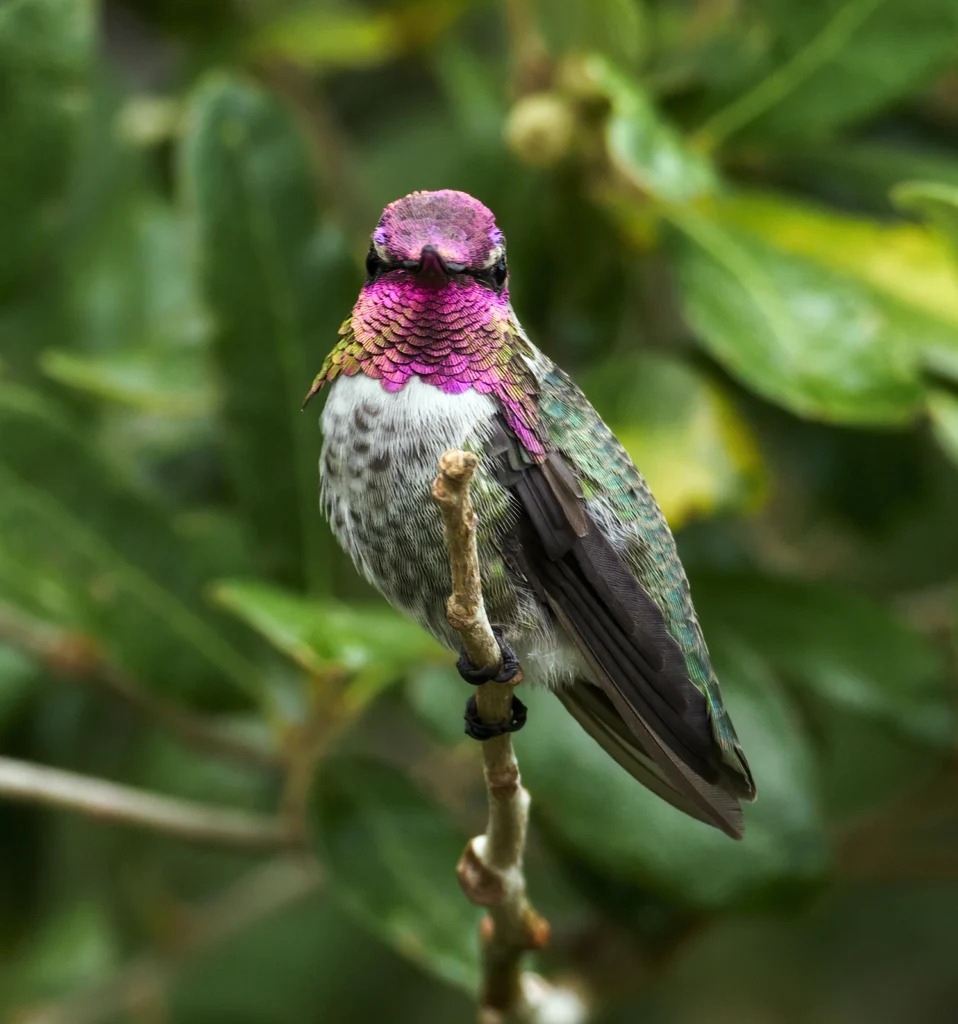
The Anna’s Hummingbird is a characteristic and charismatic species of coastal Central, Southern, and Baja California, although this species has expanded its range northward along the Pacific Coast and eastward into the Desert Southwest. Like the Rufous Hummingbird, Anna’s is well known for its aggressive territorial behavior. Males fiercely defend feeding areas, where they chase away other male hummingbirds and even large insects such as bumblebees and hawk moths that try to feed there.
Although the Anna’s Hummingbird readily feeds from non-native plants, wild plants are still crucial to these birds — and the birds are just as critical to these native plants. Anna’s Hummingbirds are important pollinators of the chaparral flora of coastal California. Many of these plants flower in the winter months, coinciding with California’s wet season. To take advantage of this boon of nectar, Anna’s Hummingbirds in coastal California breed in what is the nonbreeding season for most North American species, nesting as early as mid-December. After the rains end, many hummingbirds will move up into the mountains to take advantage of blooms at higher elevations.
The Anna’s Hummingbird is a highly vocal species, especially for a hummingbird. Males sing a complex, scratchy-sounding song while perched and during their high-flying courtship spectacles. The male performs this diving display by first ascending to 100 feet or higher, then swooping toward the ground. At the bottom of his dive, he will be moving at about 60 miles per hour, just overhead of a female (or intruding male). At the last minute, he banks upward and flares his tail, causing his modified tail feathers to produce an explosive, high-pitched chirp. The gravitational force (“G-force”) caused by this maneuver would cause a human pilot to lose consciousness, but these little hummingbirds do it again and again, up to about 40 times back to back, when trying to impress a female. He also orients his dives to maximize the reflectance of his beautiful gorget — the gem-like patch of tiny iridescent purple-pink feathers on his throat. According to researchers Christopher Clark and Stephen Russell, from the perspective of a female, he looks like a “tiny, glowing magenta comet” plummeting towards her. (Snip-More on the page. Actually hear a hummingbird!)
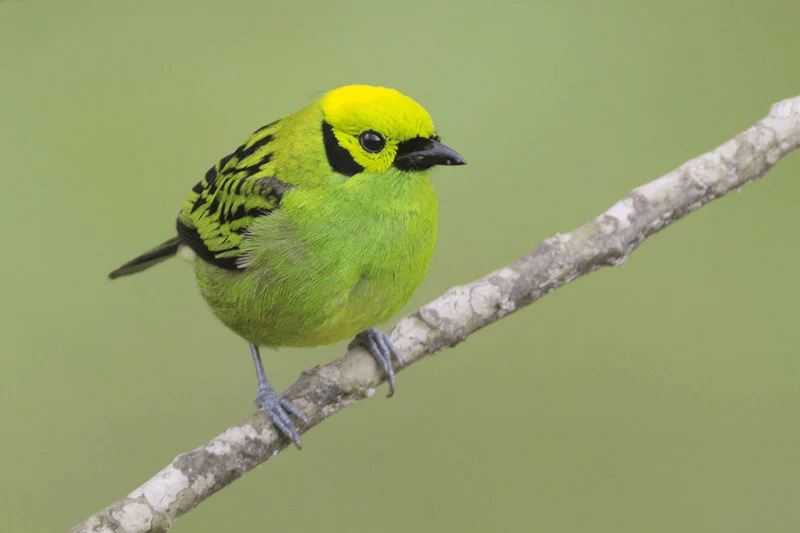
The Emerald Tanager is truly a gem of the forest, roaming through the canopy in search of fruiting trees in the humid montane forests of Central and northern South America. Although primarily a fruit-eater, this species is also adept at hunting insects and other invertebrates on tree branches, deftly manipulating mosses with its bill in search of prey. This behavior sets it apart from other tanager species it often flocks with, but outside of the Emerald Tanager’s range, other specialized tanager species may fill this niche.
The Emerald Tanager’s relationship with moss extends beyond its foraging habits. Though their breeding biology is largely undescribed in peer-reviewed literature, the nests that have been observed have either been made of moss entirely or thoroughly covered in it. This, of course, provides good camouflage on the mossy branches where these tanagers build their nests. (Snip; MORE, and hear the Emerald Tanager)
It has been a joy to deconstruct my religious trauma alongside 32-year-old comedian Taylor Tomlinson. Four years ago, as I was coming out as queer to my family, I found her Netflix special Taylor Tomlinson: Look at You to be a warm welcome into the community of formerly Christian queer kids and purity culture survivors. Dark humor gave all of us a silly sort of grace, a space where we could grieve and grow.
Tomlinson, who was raised in a conservative Christian household in Temecula, Calif., got her start in stand-up through the church comedy circuit. But as she grew up, she began deconstructing how her conservative Christian upbringing was hurting her mental health and sexual development, deciding instead to be a “secular” comic.
Her new Netflix special Prodigal Daughter was filmed inside Fountain Street Church in Grand Rapids, Mich., which welcomed her not despite but rather because of her comedy. On her aptly named “Save Me” tour, Tomlinson builds on a foundation of jokes about toxic Christian culture to call out not just people who weaponize religion as a tool for bigotry but also the people who make fun of those who still believe in God.
“Because if God does exist, he does not exist to make you feel better than other people. He exists to make you better for other people,” she said. “We judge each other’s coping mechanisms. Like, ‘You’re a quitter if you get on antidepressants. You’re stupid if you believe in God. B—-, I’m on mood stabilizers, you’re on Jesus. We’re all trying to get to ‘dead with Daddy.’”
In fact, Tomlinson recognizes the people in her life—her grandparents, aunt, and uncle, himself a pastor—“who are using religion correctly.”
“There are a lot of people who are using religion as a tool for community and connection and compassion and comfort,” she says, “and when I was writing this hour, I was thinking about those people.”
Cheekily, Tomlinson compares her own stand-up specials to her uncle’s Christian services. “We’re both out here on the weekends, changing lives.”
But the comedian is not here to absolve all the sins of Christianity or its effects on her.
“When you grow up in a religious environment, you spend a lot of your young adulthood untangling who you are from who they wanted you to be,” she says. For Tomlinson, this is best represented by her “late” coming out at age 30.
Tomlinson explains that she has so many queer friends who are open and free about their sexualities—the “Samanthas” of the group—but she didn’t see anyone else who, like her, was nervous entering the queer dating scene. “We need more gay prude representation,” she chuckles, making those of us coming out at an older age and experiencing a real queer second adolescence feel less alone.
A second adolescence refers to how many LGBTQ+ people didn’t have the chance to experience the joys of teenage years. Because of rampant queerphobia inside and outside religious communities, we didn’t have access to the romantic and sexual “firsts”—first crush, first kiss, first sexual encounter—that many heterosexual people did because we were told repeatedly that our love and our bodies were shameful and had to be hidden.
While she doesn’t explicitly name “second adolescence,” the significance of coming-of-age as a queer person runs throughout her special.
According to Adam James Cohen, a therapist specializing in helping LGBTQ+ patients, adolescence is critical to developing and cementing a person’s identity and sense of self. For those who missed out on that true identity formation earlier in life, second adolescence offers a mental and physical stage of healing and liberation, often involving people deconstructing their internalized anti-queerness and religious trauma. Sometimes this liberation happens through comedy, sometimes through therapy, or as Tomlinson discusses in her special, sometimes both. During this formational time, adults reckon with the grief of missing adolescence, and make up for lost time.
Second adolescence isn’t just a uniquely queer experience. Many people raised in far-right Chrisitan environments experience a new phase of psychosocial development after they leave their conservative Christian homes. For people raised in purity culture, their second adolescence can be a time of sexual exploration, experimentation, and liberation during and after deconstructing harmful theologies of the body.
For the queer Christian kids like Tomlinson, we were robbed of moments of bodily and social experimentation and generation, so experiencing our second adolescence is like coming home to our bodies, an emotional rebirth or reversion, to put it in Christian terms, of learning and loving to be a queer child and queer teenager again. For trans and nonbinary people undergoing gender affirming medical care, second adolescence can be even more physical, as hormone therapy brings about a second puberty.
And for many of us, this second adolescence is characterized by an eagerness—and joy—to accept and share the possibilities that many never questioned. As Tomlinson joked, “When I started dating women, it was the closest I’d come to feeling religious in a long time because my friend would complain about their boyfriends and husbands and I was like, ‘Have you heard the good news? You don’t have to live like this. There’s a better way.’”
Second adolescence is especially common among people who have a later-in-life realization or acceptance of their LGBTQ+ identity, often called a “queer awakening” or “second coming out,” just like Tomlinson. There is no time limit on coming out or discovering and affirming gender or sexuality, but as Tomlinson jokes in her special, “coming out as bisexual at 30 feels like saying to a waiter, ‘By the way, it’s my birthday.’ They’re like, ‘Cool, sing to yourself. You’re a grown woman.’”
Tomlinson’s special portrays this second adolescence with a humor, grace, and visibility I hadn’t encountered before but am deeply indebted to. Prodigal Daughter, and her comedy as a whole, carries special poignancy for the formerly queer Christian kids coming of age through humor and deconstruction.
As Belle says tRump started a war and is blocking the funding for the very department in charged with securing the country against foreign threats until the all important trans people playing sports are banned. tRump is putting paid unmasked ICE agents in airports so why can’t they go unmasked on the streets of our towns and cities to stand around watching TSA agents work for free all because his feelings are hurt by trans people. She said something similar about FEMA but it all comes down to tRump using the scape goat of trans people and the Christian nationalists need to have a white male straight cis nation to live in even though those people are not representative of most of the nation nor of all Christians. But to not fund FEMA during horrific flooding and wildfires, to not fund DHS and TSA for security, to not fund the coast guard for our protection and assistance in local waters, and more just because he has a hard time understanding the truth that trans people exist and are normal members of society that deserve full unconditional civil rights and equality. Hugs
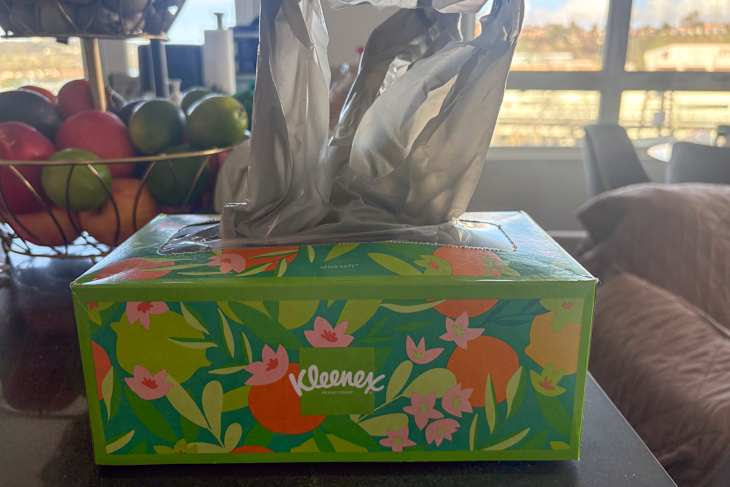
Here’s how I repurposed my empty tissue box as a plastic grocery bag dispenser in a few easy steps:
Take a plastic shopping bag and stuff it horizontally into the tissue box with the handles sticking out of the slit on top.
Grab another plastic bag and weave it through the handles of the bag sticking out of the box, then stop once it’s about three-quarters the way through.
Stuff both bags into the box, with the handles of the second bag sticking out again like you had before.
Repeat the process until all of the plastic bags are in the box (I was able to fit about 12 bags in mine!)
Gently pull a bag out of the box when you want to use it, just like a regular Kleenex box! Follow steps 1 through 4 to refill when you have more bags to store.
I understand about the pastry boxes; they are pretty stupid. Lewis Black expresses someone’s feelings as Lewis Black does.
Have a fun dog video!
Oh, yeah! Another email buried but that I wanted to post here last week. My accomplished niece is a writer, and this is her webpage for her fiction books, Swaimwrites.com . She’s got one about to be released called “Reven,” which is, as her site says, “A steampunk retelling of Peter Pan about the lengths we’ll go to escape the past.” I’m excited to read it, not only because I’m her auntie, but because it looks like it’ll be perfect for these times!📖📚
















 Scottie's Playtime