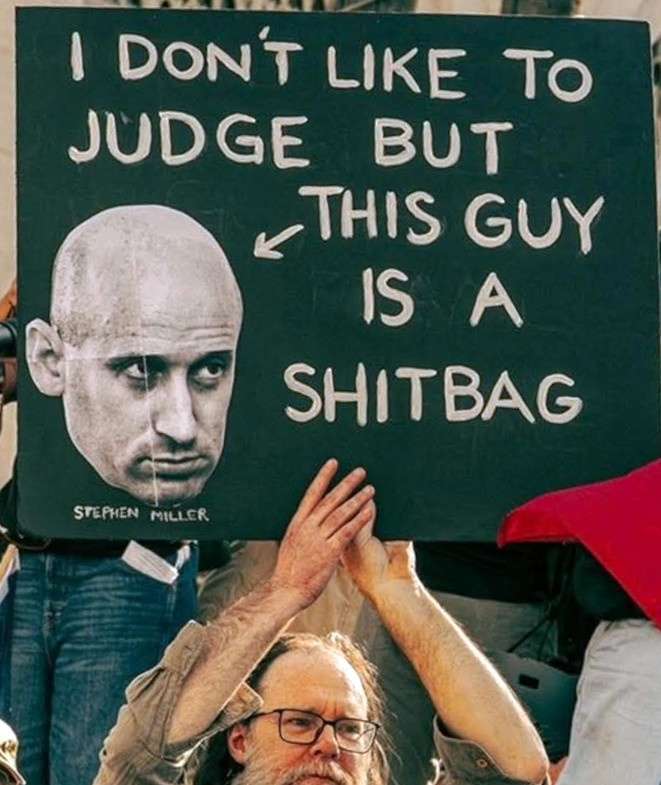
Trump’s DOJ Has An Anti-Hate Group In Its Sights — With Deeply Chilling Consequences
Indicting the SPLC will tie the nonprofit up in litigation, drain it of resources, and serve as a shot across the bow to others, experts say.
This is a very well researched and scholarly man. He knows far more than the dogma of the bible he knows how to read the Hebrew and the nuances of the time. Hugs
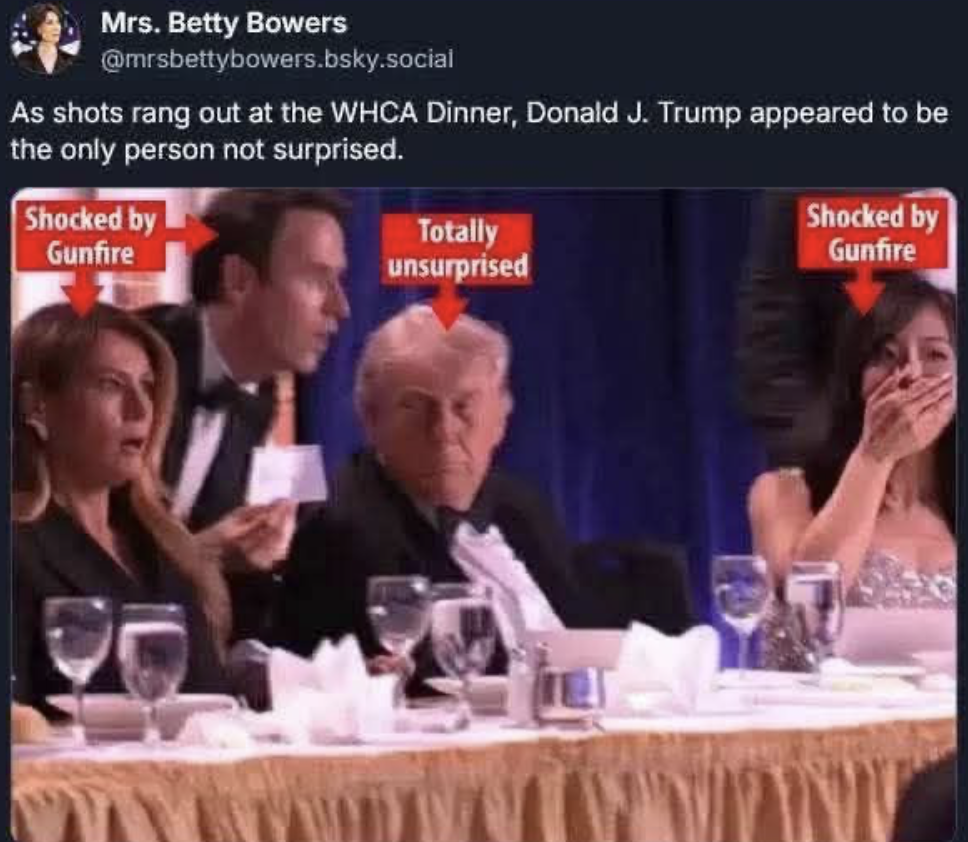
Donald and Melania Trump were evacuated from the White House correspondents’ dinner on Saturday evening after the event was interrupted by loud gunshots.
A suspect was in custody, the FBI said, after the annual black tie dinner honoring the White House press corps was suddenly interrupted by confusion and chaos. Journalists ducked under tables as authorities rushed the president and members of his cabinet out of the room.
There were reports that the US Secret Service had guns drawn as White House pool reporters were rushed out of the room and Secret Service agents yelled “shots fired”.
In a post on Truth Social, Trump praised the Secret Service and law enforcement and said the shooter had been apprehended.
The FBI confirmed later on Saturday that a suspect was apprehended.
The Secret Service said in a statement that the shooting incident occurred near the main magnetometer screening area at the hotel.
Weijia Jang, president of the White House correspondents’ dinner, told the room that the president is planning a press conference from the White House later Saturday and that he wants to reschedule the dinner in the next 30 days.
“Thank God everyone is safe, and thank you for coming together tonight,” she said. “We will do this again.”
Guardian reporters in the room said there were initially mixed messages about whether press and guests should stay in the room. Many people who stayed in the ballroom said the program was scheduled to resume, although the presidential seal was removed from the podium.
CNN’s Wolf Blitzer reported that he saw someone with a gun at the event.
“I did see the gunman on the ground after he started shooting,” he said. “Police officers threw him to the ground.”
Guests had just started eating dinner when the commotion began. The atmosphere in the room was tense as journalists waited to hear what happened and what to do next.
Jamie Raskin, a Democratic congressman from Maryland, who was attending the dinner said he never saw a shooter, but “I think a Secret Service agent threw me to the ground and on top of some other people and people were screaming and yelling”.
“I heard some loud noises but I don’t know if that was people reacting or if that was something outside, it was hard to know, but people very quickly were saying that was a shot, that was the gunshot,” he added. “People were terrified; people seem to be relieved now.”
Outside the hotel, helicopters circled overhead.
This year’s dinner was already tense given the presence of Trump and top members of his cabinet, including Pete Hegseth, the secretary of defense, and Marco Rubio, the secretary of state. Trump agreed to attend this year’s dinner after refusing to attend last year and during his first term. The correspondents’ dinner tradition began in 1921, though the tradition of a presidential guest started in 1924, when Calvin Coolidge attended.
There is frank recital of the grooming and threats that happened to these women, in case you might need to skip reading this one. If you or someone you know needs help, please call the Human Trafficking Hotline at 888-373-7888, or text INFO to 233733. See the website at https://humantraffickinghotline.org/en
Saturday will mark one year since the death of Virginia Giuffre, one of the first women to surrender her anonymity, detail her experiences and publicly call for criminal charges against convicted child sex offender Jeffrey Epstein. For other Epstein survivors such as Liz Stein and Jess Michaels, Giuffre’s public reckoning made it possible to finally name what had happened to them.
“I saw myself in Virginia, in [Epstein survivor] Maria Farmer, in all of them,” said Danielle Bensky, who was pulled into Epstein’s orbit when she was 17. “And I thought: if they can be victimized, anyone can be. I was not alone. I finally understood that we were not going to be silent any more.
More than a dozen Epstein survivors will gather in Washington DC this weekend for a memorial vigil in Giuffre’s honor. But they will also be marking something larger: the emergence of a survivors’ movement Giuffre helped make possible – and that is only gaining momentum.
Epstein survivors have held press conferences and met with congressional lawmakers; in November, the Epstein Files Transparency Act passed, and the release of more than 3.5m pages of documents followed. However, in the more than two months since the justice department released its latest batch of files – more than 2m documents have yet to be released – prosecutors have not brought any new charges, despite federal lawmakers on both sides of the aisle continuing to demand accountability.
As for Ghislaine Maxwell – the only person convicted in connection with Epstein’s network – she was sentenced to 20 years in prison in 2022 and has exhausted her appeals. Rather than facing harsher scrutiny, however, Maxwell was controversially transferred from a low-security prison in Florida to a minimum-security federal camp in Texas in August.
While the lack of action has left survivors with little faith that the full scope of Epstein’s network will ever face justice, they don’t intend to back down.
Stein, Bensky, Lisa Phillips and Michaels discuss, in their own words, what made them come forward, the power of survivors banding together and where they want the movement to go.
‘If I could go back, I would tell someone’
Liz Stein, human trafficking specialist and survivor advocate
When I met Epstein and Maxwell, I was a senior in college. I had aspirations of going to law school. People had a lot of expectations for what my life would look like. But my life turned out the exact opposite. For decades, I buried what happened to me. I thought these were friends I had met in New York – that is how they made the relationship feel. So the narrative in my mind was that I had these unspeakable, horrific experiences with people I thought cared about me. I never wanted to think about it. I never wanted to talk about it. I just lived with it.I wasn’t ready for his face to appear on television the day he was arrested. And what followed confused me further, because the coverage focused on the girls in Florida – and I had these preconceived notions about what trafficking was and who it happened to. I wasn’t underage. I never went to the island. So I thought: that’s different, that’s separate. But I educated myself. I immersed myself in the national anti-trafficking movement, consuming every webinar and publication I could find. And when I did that, I thought: this is exactly what happened to me. And I was just enraged and saddened to know it wasn’t just me – that it was potentially hundreds of other young women.When I delivered my victim impact statement after Maxwell’s sentencing [for sex trafficking], I nearly shouted. I talked about my emotional health, my physical health, how this derailed my life. I wanted to project my voice so that no one in that courtroom could ignore what I was saying. And it was important to me to look at her directly while I spoke. I didn’t want her to see me cry. I didn’t want to give her that satisfaction.That moment changed something. I couldn’t imagine having this visibility and not fighting for justice. If I could go back, I would tell someone. And if they didn’t listen, I would tell someone else, and I would just keep telling until someone listened.What I want people to understand is that speaking out publicly is not a requirement. For those who aren’t ready, know that there are women standing in their truth on your behalf. And for those who are afraid, if you tell someone and they don’t listen, tell someone else. Just keep telling until someone listens. Even if it falls on deaf ears, you will still be proud of yourself for being willing to stand in your uncomfortable truth.
‘What changed everything was meeting other survivors’
Danielle Bensky, choreographer, performer and survivor advocate
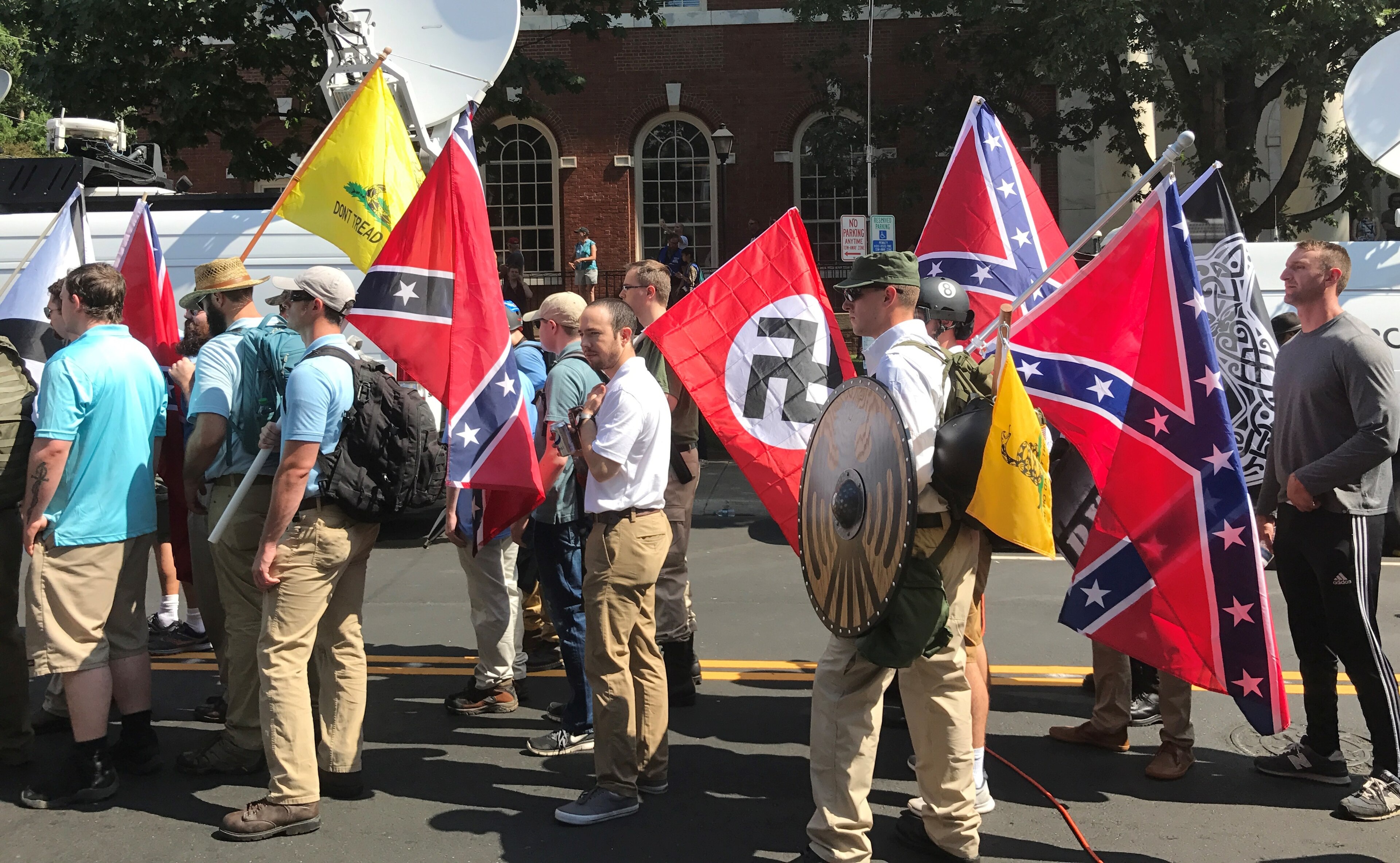
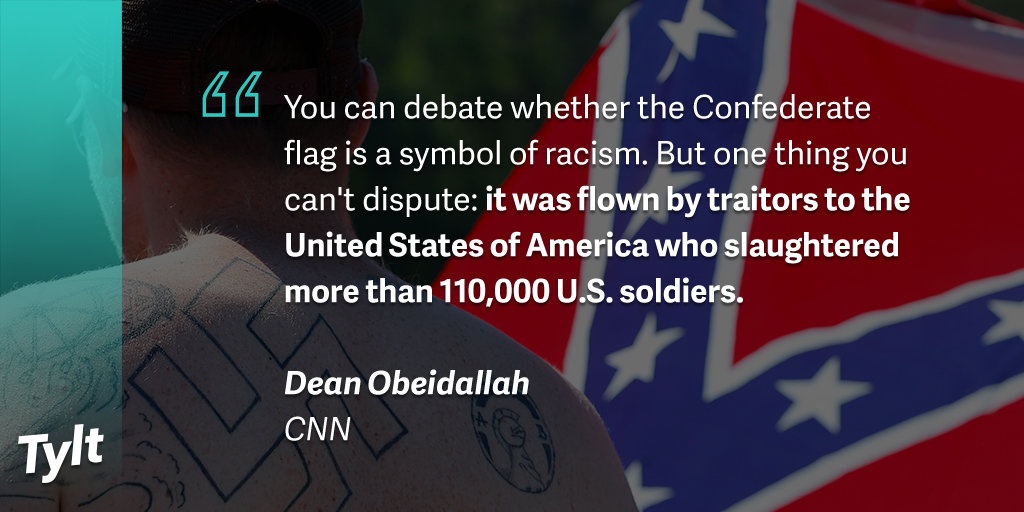
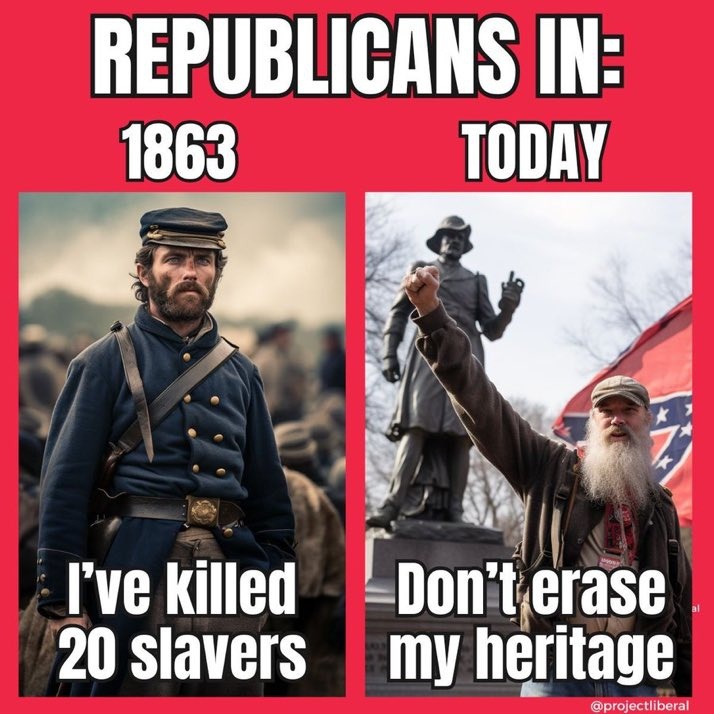
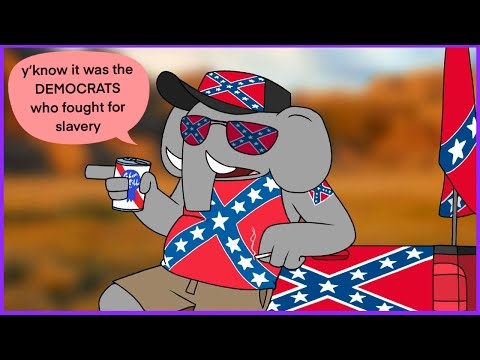
I don’t know if all republicans are racist bigots but they certainly do tolerate them in their midst. Pride month, pride flags, and black history month, MLK, and other non-white persons of note are too political, divisive, and too morally offensive to be displayed or talked about. No month to celebrate the oppressed minorities yet one to celebrate the oppressors? No pride flags on government buildings or school classrooms but confederate battle flags are OK to be displayed everywhere. Some how the people calling for the end of DEI as racist along with those saying the pride symbols and history months are divisive and too political, think displays of people wanting to own / deny rights to a group based on skin color are not divisive or political. Hugs
Two Confederate flag bearers walk across the lawn of the Mississippi State Capitol in Jackson, Miss., on Monday, July 6, 2015. A group of about 50 people participated in the rally sponsored by the Magnolia State Heritage Campaign as they opposed efforts to remove Mississippi’s 1894 Confederate-themed state flag. Five years later, in 2020, Gov. Tate Reeves would sign a bill retiring the old state flag, even as he continued declaring Confederate Heritage Month annually. AP Photo/Rogelio V. Solis
Nearly six years after signing the bill that removed the Confederate symbol from Mississippi’s state flag, Gov. Tate Reeves declared April 2026 as Confederate Heritage Month, continuing a tradition that began 33 years ago.
Though the governor does not publish the Confederate Heritage Month proclamations on any official government websites, the Mississippi Division of the Sons of Confederate Veterans posted a copy of the latest proclamation on its Facebook page. The proclamation shows that the governor signed it on April 17.
Tap or click the preview image to read Mississippi Gov. Tate Reeves’ April 17, 2026, Confederate Heritage Month proclamation. Courtesy Mississippi Division Sons of Confederate Veterans
As in past years, Reeves’ proclamation does not mention the central role of slavery and white supremacy in the Confederacy’s birth, instead speaking only vaguely about how April “is the month when, in 1861, the American Civil War began between the Confederate and Union armies, reportedly the deadliest war ever fought on American soil.”
“WHEREAS, as we honor all who lost their lives in this war, it is important for all Americans to reflect upon our nation’s past, to gain insight from our mistakes and successes, and to come to a full understanding that the lessons learned yesterday and today will carry us through tomorrow if we carefully and earnestly strive to understand and appreciate our heritage and our opportunities which lie before us,” says the governor’s proclamation. “NOW, THEREFORE, I, Tate Reeves, as Governor of the State of Mississippi, do hereby proclaim the month of April 2026 as CONFEDERATE HERITAGE MONTH in the State of Mississippi.”
Kevin M. Levin, a Boston-based historian whose work has focused heavily on the Civil War-era, wrote on his Substack, Civil War Memory, on April 18 that Reeves issued the document “with the quiet, almost regularity of a bureaucratic obligation.”
“There is no mention of what the Confederacy stood for, no celebration of Southern martial valor, no invocation of states’ rights, and—most conspicuously—no mention of slavery, even though it was the explicit cause Mississippi named when it seceded from the Union in 1861,” Levin wrote. “What the proclamation most resembles is a permission slip signed reluctantly, just legible enough to satisfy the requester and vague enough to require no defense.”
Slavery Defined the Confederacy
The Sons of Confederate Veterans is a neo-Confederate organization that espouses “Lost Cause” ideology, which promotes a revisionist version of the Civil War that whitewashes the Confederacy’s white supremacist history and downplays the role of slavery in the Civil War. SCV owns and operates Beauvoir, the museum and historic home of Confederate President Jefferson Davis, located in Biloxi, Mississippi; the organization annually receives $100,000 from the State of Mississippi for development and maintenance.
The Mississippi Division of the Sons of Confederate Veterans issued this Confederate History and Heritage Month proclamation on April 1, 2026. Courtesy Mississippi Division of Sons of Confederate Veterans
The Mississippi Division of the Sons of Confederate Veterans issued its own 2026 “Confederate History and Heritage Month” proclamation on April 1, saying that “states of the South, including Mississippi, did legally declare their independence from the United States in 1861, and … these states did form a Confederation to protect and defend themselves from an invading army.”
What the SCV proclamation left out was the defining issue that led Mississippi and other Southern states to secede from the Union—the “cause” the Confederacy fought for.
“Our position is thoroughly identified with the institution of slavery—the greatest material interest of the world,” Mississippi’s 1861 Declaration of Secession declared. “Its labor supplies the product which constitutes by far the largest and most important portions of commerce of the earth.”
The 2026 SCV proclamation, signed by Mississippi Division Commander Forrest S. Daws, says that the people of the Confederacy spent “four long years fighting and sacrificing for their independence” as part of “their commitment to defend the rights secured under the United States Constitution.”
But the historical record shows that that, too, is a revisionist view of history.
Confederate Vice President Alexander Hamilton Stephens said in a speech on March 21, 1861, that slavery “was the immediate cause of the late rupture” that led to the American Civil War and that the Confederate Constitution enshrined the idea that the enslavement of Africans to white men was “natural and normal.” Photo Public Domain / Wikimedia Commons Credit: NARA
In his 1861 Cornerstone Speech announcing the Confederate Constitution, Confederate Vice President Alexander Hamilton Stephens said that it made “great improvements upon the old constitution.”
“The new constitution has put at rest, forever, all the agitating questions relating to our peculiar institution African slavery as it exists amongst us the proper status of the negro in our form of civilization. This was the immediate cause of the late rupture and present revolution,” Stephens said. “(Thomas) Jefferson in his forecast, had anticipated this, as the ‘rock upon which the old Union would split.’ He was right. What was conjecture with him, is now a realized fact. But whether he fully comprehended the great truth upon which that rock stood and stands, may be doubted.
“The prevailing ideas entertained by him and most of the leading statesmen at the time of the formation of the old constitution, were that the enslavement of the African was in violation of the laws of nature; that it was wrong in principle, socially, morally, and politically. It was an evil they knew not well how to deal with, but the general opinion of the men of that day was that, somehow or other in the order of Providence, the institution would be evanescent and pass away.”
“This idea, though not incorporated in the constitution, was the prevailing idea at that time. … Those ideas, however, were fundamentally wrong,” Stephens continued. “They rested upon the assumption of the equality of races. This was an error. It was a sandy foundation, and the government built upon it fell when the ‘storm came and the wind blew.’ Our new government is founded upon exactly the opposite idea; its foundations are laid, its cornerstone rests, upon the great truth that the negro is not equal to the white man; that slavery subordination to the superior race is his natural and normal condition. This, our new government, is the first, in the history of the world, based upon this great physical, philosophical, and moral truth.”
The bust of Mississippi State University’s first president, Confederate Lt. Gen. Stephen D. Lee, has long been an iconic center of the Mississippi State campus from its perch on the Drill Field in front of the building bearing Lee’s name. He led efforts long after the Civil War to successfully rewrite history about the Confederacy and its documented motives out of school textbooks and classrooms, furthering the Lost Cause. Photo by Donna Ladd
In the decades after the Civil War ended, Confederate veterans, such as Mississippi State University’s inaugural president, Stephen D. Lee, and groups like SCV and the United Daughters of the Confederacy began the work of remaking history in a way that shone a more favorable light on the South—muddying the waters over the cause of the war and falsely describing it as a “war of northern aggression.”
White-supremacist leaders in Mississippi renewed efforts to enshrine Confederate heritage in the 1950s and 1960s in reaction to the rise of the Civil Rights Movement.
Young white Mississippians wave Confederate flags at civil rights marchers near Highway 7 on the outskirts of Greenwood, Miss., on June 17, 1966, weeks after James Meredith, who integrated the University of Mississippi, was shot while leading the group of marchers. AP Photo
Despite his campaign pledge to supporters of the old Confederate-themed flag not to use his power to change the flag, Gov. Reeves signed the bill retiring it, calling it “a law to turn a page in Mississippi today.”
“It is fashionable in some quarters to say our ancestors were all evil. I reject that notion. I also reject the elitist worldview that these United States are anything but the greatest nation in the history of mankind. I reject the mobs tearing down statues of our history—north and south, Union and Confederate, founding fathers and veterans,” the governor said in 2020, criticizing Black Lives Matter protesters from across the country even as he signed the bill with several Mississippi civil rights icons behind him. “I reject the chaos and lawlessness, and I am proud it has not happened in our state.”
‘An Ideology Reduced to a Form Letter’
The Mississippi Division of the Sons of Confederate Veterans’ 2026 Confederate Heritage proclamation notes that “in 1993 Mississippi Governor Kirk Fordice, understanding the importance of remembering and preserving all history, did declare the first Confederate History Month.”
Mississippi Gov. Kirk Fordice issued the first Confederate Heritage Month proclamation in 1993. During his time as governor, he courted support from white supremacist groups, including the Council of Conservative Citizens. He is seen here on Aug. 22, 1996, with (from left) Donald Wildmon of the Tupelo-based American Family Association; then-Mississippi House Rep. Phil Bryant; and Mississippi Family Council’s Forest Thigpen. Photo/Rogelio V. Solis, File Credit: AP
Since then, one Democratic governor and three Republican governors have followed Fordice’s lead.
Starting in 2016, Donna Ladd, then the editor of the Jackson Free Press and now the executive editor of the Mississippi Free Press, first reported on then-Mississippi Gov. Phil Bryant’s Confederate Heritage Month proclamations. Despite issuing Confederate Heritage Month proclamations annually for his first seven years in office between 2011 and 2018, former Gov. Phil Bryant did not issue one in 2019, his last year in office; he opted instead for a “Month of Unity” proclamation on behalf of a Christian religious organization.
The Mississippi Free Press has since reported on each of Reeves’ annual proclamations, including in 2020, 2021, 2022, 2023, 2024 and 2025.
Reeves’ ties to the Sons of Confederate Veterans stretch back long before his time as governor. In 2013, he spoke to the SCV’s national gathering in Vicksburg, Mississippi, in front of a massive Confederate battle flag and in a room decorated with smaller Confederate flags and cotton plants. After then-Lt. Gov. Reeves congratulated the organization for “keeping history for our youth,” speakers defended the Confederate “cause” and compared “Yankees” to German “Nazis” in World War II.
Then-Lt. Gov. Tate Reeves appeared at this July 2013 Sons of Confederate Veterans event in Vicksburg with a massive Confederate flag behind him. Photo via R.E. Lee Camp 239 SCV Facebook group
Long before entering politics, Reeves was part of a Millsaps College fraternity known for lionizing Confederate General Robert E. Lee and for Confederate-themed parties where members wore blackface. When it became an issue in his 2019 campaign for governor, though, he said he never participated in blackface during his time in the fraternity.
Reeves’ Democratic opponent at the time, then-Attorney General Jim Hood, was also in a fraternity at the University of Mississippi, where members wore blackface; he similarly denied ever participating.
Reeves defended issuing the proclamations in 2021.
“For the last 30 years, five Mississippi governors—Republicans and Democrats alike—have signed a proclamation recognizing the statutory state holiday and identifying April as Confederate Heritage Month,” the governor’s office said in a statement to WAPT at the time. “Gov. Reeves also signed the proclamation because he believes we can all learn from our history.”
The governor’s annual proclamation routinely notes that state law designates the last Monday in April as Confederate Memorial Day. However, state law does not require governors to issue Confederate Heritage Month proclamations.
Mississippi Gov. Tate Reeves, seen here speaking at a press conference in Ridgeland, Miss., on Thursday, April 9, 2026, has signed Confederate Heritage Month proclamations each year as governor from 2020 to 2026. MFP Photo by Rogelio V. Solis
The language in Reeves’ Confederate Heritage Month proclamations uses much of the same language as the one that former Democratic Gov. Ronnie Musgrove, who served from 2000 to 2004, issued in April 2000.
In 2023, Musgrove told the Mississippi Free Press that Confederate Heritage Month is “something that should not continue in today’s world.”
“I cannot say why the practice started, but it was one that should never have been started,” the former governor said. “It was one that I should not have signed, and it should have ended a long time ago.”
Former Republican Gov. Haley Barbour also signed Confederate Heritage Month proclamations every year between 2004 and 2016.
In his Substack post, Kevin M. Levin wrote that the earlier proclamations that began with Fordice “were issued with more ideological confidence” and as “instruments of the Lost Cause.” Now, instead, the historian wrote, they appear on Sons of Confederate Veterans Facebook groups—a sign of the Lost Cause’s “crumbling infrastructure” and that it is now “an ideology reduced to a form letter.”
“A celebration conducted in secret, or at least in silence, is not really a celebration. It is a favor done for a diminishing constituency that the issuer would prefer the broader public not notice,” he wrote.
Members of the Mississippi Poor People’s Campaign burn a Confederate battle flag at the Governor’s Mansion in Jackson, Miss., Monday, June 18, 2018. AP Photo/Rogelio V. Solis
Levin called it “the political logic of a cause in retreat.”
“The Lost Cause did not die in a single moment, not with the removal of Confederate statues after Charleston in 2015, not with Mississippi’s replacement of its Confederate-emblem state flag in 2020, and not with any particular court ruling or protest march. It has died the slower death of a story that fewer and fewer people believe, or are willing to say publicly that they believe,” the Boston historian continued. “What remains is a three-paragraph proclamation, quietly signed, quietly announced in a Facebook group, saying as little as possible about a cause its issuer is no longer willing to name.”